Seeking Justice: the Civil Rights Movement,
Black Nationalism and Jews at Brandeis University
K
ITAMiyuki
THEUNIVERSITYOFKITAKYUSHU
Introduction
Ihave a dream that one day even the state of Mississippi, a state sweltering with the heat of injustice, sweltering with the heat of oppression, will be transformed into an oasis of freedom and justice. . . .1
In his historic speech “I have a dream,” delivered on the steps of the Lincoln Memorial during the March on Washington for Jobs and Freedom on August 28, 1963, Martin Luther King, Jr. used the word “justice” eight times. He held up this word along with “freedom” as a slogan through his life as a leader of the civil rights movement. The word “justice” appeared in his address to the first Montgomery Improvement Association (MIA) at the mass meeting at Holt Street Baptist Church as early as December 5, 1955, through a speech entitled “Where Do We Go From Here?” delivered to the Tenth Anniversary Convention of the Southern Christian Leadership Conference (SCLC) in Atlanta on August 16, 1967.2
In this sense, the civil rights movement was not merely a movement to desegregate public facilities or to secure the voting rights of African-Americans; it was a movement of Americans to realize social justice. Consequently, thinking about the civil rights movement should include consideration of social justice.
Previous studies by the author of this paper, Kita Miyuki, have included some of the American Jewish organizations’ fights against anti-Jewish quotas at colleges and universities in the late 1940s. Jewish organizations, especially the American Jewish Congress, lent active support to the passage of the fair educational practices laws, which forbade higher educational institutions to limit or bar enrollment of students because of race, religion or national origin. In 1948, New York, where about half of the population of Jews in the United States resided, became the first state to enact that law. Jewish organizations also advocated the elimination of questions on applications that enabled universities to discriminate against certain minority groups. Subsequently, they sought to combat the quota system by promoting racially and religiously neutral admission procedures within the broad context of the expansion of opportunity in higher education after World War II, instead of attacking anti-Semitism at colleges
directly.
The Jewish ideal of color-blindness, as realized in antidiscrimination laws and application blanks without questions on race and religion indeed helped not only Jews but also other minorities. Their tendency to act for the equality of all minorities was observed in other situations at that time. Jews have been involved in litigation to desegregate schools in the South. Jewish organizations filed briefs and supported black plaintiffs in Brown vs. Board of Education, which had been launched by the National Association for the Advancement of Colored People (NAACP) and which finally ruled segregation at public schools unconstitutional in 1954. They also gave financial support to the “doll test,” a social psychological test developed by Kenneth B. and Mamie Clark, and showed the Supreme Court concrete data related to how segregated education damaged the cognitive development of black children.3
Simultaneously, Jews have sought other ways to resolve difficulties in gaining admission to colleges. One was the foundation of their own university. In 1948, Brandeis University, the first Jewish-sponsored secular university in America, was established in Waltham, Massachusetts. Brandeis provided a chance for higher education for Jewish students who had been rejected by other universities because of the anti-Jewish quotas. It also became the model of a nondiscriminatory university by adopting a non-quota admission policy, i.e., by never asking its applicants about their race or religion.
This paper specifically describes the activism of Jews in the civil rights movement in the 1960s by taking the case of Brandeis University. According to results of earlier studies, about half to two-thirds of the white volunteers in the civil rights movement were Jewish. Considering the fact that the proportion of Jews among total population is about 3-4 percent, this figure underscores how enthusiastically Jews have participated in civil rights causes. Stanley Levison, Martin Luther King, Jr.’s most trusted friend, was a Jewish lawyer.4
In 1964, two Jewish activists, Michael Schwerner and Andrew Goodman, along with a black volunteer, James Chaney, struck out together to investigate the burning of a black church in Mississippi, went missing and were later found to have been killed by racists. The news of their missing and murder not only aroused public interest of the whole United States, it also created a sensational response internationally.5
Consequently, judging from these examples of Jewish dedication to the civil rights movement, we might expect that Brandeis students made a great contribution to it. That inference, however, is not simply based on the fact that about 85 percent of Brandeis students were Jews during that period. Rather, considering their policy of color-blindness shown in the fight against discrimination and segregation in education, we might infer that the basis of Jewish activity during the civil rights movement had already been established by the late 1940s.
The following chapters first present the thought related to liberalism, nondiscrimination, and social justice at Brandeis University through the story of
its founding. Subsequently, Idescribe an examination of the activism of Brandeis students on civil rights issues. Finally, black nationalism at Brandeis, especially the request for the establishment of Afro-American studies department is considered. By a curious coincidence, the name of the Brandeis student newspaper used as a primary source for this paper is The Justice.
I. Brandeis University: Its Founding and the Spiritual Legacy
In the pictorial history published to commemorate its fortieth anniversary, professors and alumni described Brandeis as a university founded on a long tradition of social justice. The university had been named for Louis D. Brandeis, the first Jew who became justice of the United States Supreme Court and whose work in the public interest earned his reputation as “the people’s attorney.”6
This chapter presents an examination of how this Jewish-sponsored secular university was established and on what ideas it was based. A consistent posture of nondiscrimination of Brandeis and its precursor, Middlesex, tells us how earnestly they sought social justice.
Founded in 1948, Brandeis is the realization of a dream, long-held but long deferred: the gift of American Jewry to higher education. In fact, beginning in the mid-nineteenth century, Jewish leaders had put forward various proposals for the establishment of Jewish institutions of higher learning. Some had already been realized by 1948: the founding of Maimonides College in Philadelphia in 1867, which ceased to exist in 1873; the Hebrew Union College in Cincinnati in 1875; and the Jewish Theological Seminary of America in New York in 1886. These institutions, however, were small rabbinical schools at which Jewish studies predominated. None had been intended or planned as a secular institution. In 1923, in a monograph entitled A Jewish University in America, Rabbi Louis I. Newman presented his concept and proposals for a secular Jewish institution of higher learning.7
His proposal, however, was not welcomed and did not come close to fruition. A serious concern about the establishment of a Jewish university was that of discrimination by gentiles. In June, 1922, President Abbott Lawrence Lowell of Harvard University announced a plan to restrict Jewish students because they constituted a disproportionately large percentage of the student body. Furthermore, universities such as Columbia and New York secretly began restricting Jewish students’ admissions in the late 1910s. The news of Harvard’s plan attracted attention; in fact, Newman’s proposal corresponded to it. Yet, confronted with the growth and spread of anti-Semitism, Jewish leaders thought that the establishment of one or even several institutions would only slightly solve the problem to accommodate Jewish youths who aspired to higher education. Rather, they argued, it would be a compromise of their Americanism and would create ghettos in the world of learning.8
Then the end of World War II provided new momentum for the founding of the university. Veterans returning from wartime service placed an unprecedented
demand on America’s educational resources. A generation of young men and women looked to a promising future in a nation at peace. The enactment of the G. I. Bill of Rights ensured educational opportunities for all. In fact, the number of college students in the U.S. increased rapidly: from 1,155,000 in 1944, to 1,677,000 in 1946, and 2,616,000 in 1947. Veterans who had become students increased to more than 1,000,000 in 1947, coming to constitute almost half of all college students in the U.S.
During 1945, a group of communal leaders, hoping to revive the dream, began to explore the feasibility of establishing a new university under Jewish auspices. Most dedicated to the idea was Rabbi Israel Goldstein, who was a spiritual head of B’nai Jeshrun Congregation in New York and who later became president of the American Jewish Congress.9
As president of the Zionist Organization of America and the Synagogue Council of America, he had extensive organizational experience and important contacts in national communal circles.
The real story of the founding of Brandeis University started with a letter written by C. Ruggles Smith, the General Counsel of Middlesex University, a medical and veterinary school, on January 7, 1946. He wrote Goldstein of the problems threatening the future of the university and proposed that in an attempt to save their school, he and his colleagues were offering the Middlesex charter and campus to an appropriate group pledged to maintain the school’s nondiscriminatory admission policy and its imperiled medical college. Middlesex University, which had been founded in 1849 as the Worchester Medical Institution, operated on the principles of freedom and equality, maintaining a racially, religiously, and ethnically diverse student body.
The reasons why Middlesex had to suspend its teaching activities appear to be complex. Certainly it lacked adequate funds and facilities to be accredited by the American Medical Association (AMA). Therefore, its graduates, including a considerable number of Jews, had not been permitted to take examinations for licenses in any state except Massachusetts. In 1944, the Massachusetts legislature had taken a similar negative action. On the other hand, Smith contended that the rejections of accreditation by the AMA and the Medical Society of Massachusetts were engendered by those bodies’ racial and religious biases.10
In fact, 85 percent of Middlesex’s 300 students were Jews in 1944. It had become a haven for those excluded from other institutions by religious and ethnic quotas.
On January 15, 1946, only one week after the receipt of Smith’s letter, Goldstein visited the Middlesex campus. He was profoundly impressed by its commanding view of the city of Waltham and the Charles River as well as a building that had been destroyed by a fire, interiors badly in need of repair, and the grounds overgrown with grass and weeds. Notwithstanding, he later recalled, “Iwas sure that this campus was intrinsically worthy of becoming the site of a great Jewish-sponsored university.”11
In February, Goldstein and his friends formed the Albert Einstein Foundation for Higher Education as the fund-raising
and public relations vehicle for the new university. Einstein not only agreed to lend his name to the foundation, but also offered help and wrote to Goldstein, “I would do anything in my power to help in the creation and guidance of such an institute. It would always be near my heart.”12
Yet the negative opinion against the establishment of a Jewish university prevailed. Those who opposed it feared that it worsened the restrictions against Jews in other colleges and universities by giving them an excuse: Jews could go to their own school. It was also true that establishing a Jewish university would invariably intensify the conception of Jews as a group and make them stand out. In fact, it goes against not only their assimilationist view hoping to melt into the mainstream society but also their strategy of combating discrimination, which demanded that universities delete questions related to race and religion from applications.
How did Goldstein solve this problem? How did he persuade the Jews who opposed the idea of Jewish university as it became an “academic ghetto” and then gain support and funding for Brandeis? At a panel discussion at the National Community Relations Advisory Council (NCRAC) held in Chicago in June 1946, he addressed the delegates of major Jewish organizations as follows.
Every effort should be made to combat it [=quota system], whether by exposing to public criticism those institutions who practice it or by urging withdrawal of their tax exemption, although it seems unlikely that the Courts will sustain the contention, or by agitating for the establishment of more State Universities. As Americans, we have the right and duty to try to expurgate un-American policies from the sphere of higher education. Yet one cannot be at all sure how successful the effort is likely to be and how long it will take. . . . The proponents of a Jewish-sponsored university. . . do not propose to limit the student body or the faculty to Jews. What is being proposed is a non-quota university where the sole criterion for admission to the student body and for faculty should be merit.13
The next day, the Plenary Session of the NCRAC resolved that it approved the “recent developments looking toward the establishment and the expansion in the United States of Jewish universities and colleges, and of institutions of higher learning under Jewish auspices, open to all persons, regardless of race, color or creed.”14
Consequently, Goldstein settled the dilemma of how Jewish a Jewish university should be by developing the argument that he and his fellows were not going to establish a university of Jews by Jews for Jews; they were going to found a Jewish-sponsored non-quota university in America.
In May 1948, Abram Sachar, an organizer of the B’nai B’rith Hillel Foundation, became the first president. In October, classes began with 107 students and 13 faculty members. From the beginning of the activity of the Einstein Foundation until the opening of the university, standards of nonsectarianism and nondiscrimination had not changed. Although it has no school record of students’ race and religion, Brandeis has accepted black students
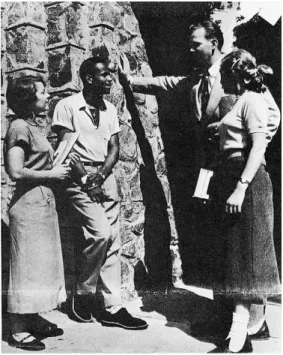
since it was founded. In 1952, at least 8 black students were enrolled among the nearly 400 students; it had 1 black professor (see Figure 1).15
As for nonsectarianism at Brandeis, it had three houses of worship on campus by 1955: Jewish, Protestant and Catholic.16
Guided by these founding precepts, Brandeis fostered an environment that was open to intellectual inquiry and debate. From the beginning, to ensure students access to ideas beyond those offered by a small faculty and limited resources, guest lecture series and visiting professorships were organized. Since 1956, the Helmsley series, which was organized “to reduce the barriers that separate races, creeds, and nationalists,” has invited speakers from various fields. Speakers have included black public figures and civil rights leaders such as Roy Wilkins, Ralph Abernathy, Andrew Young, and Kenneth B. Clark.17
Martin Luther King, Jr. visited the Brandeis campus in 1957 and again in 1963, addressing the themes of interracial justice and nonviolence.18
II. From Massachusetts to Mississippi: the Civil Rights Movement at Brandeis
Encouraged by the University’s uncompromising manner of nondiscrimination, Brandeis students have been involved in political and social activism. Chapters of some civil rights groups, such as the NAACP, were established on campus in the early 1950s. In the 1960s, Brandeis students, faculty, and alumni worked everywhere: on campus, in Boston, and in the South.
Figure 1: A Black student at Brandeis Source: Ebony, February 1952, p. 59.
A. Student Sit-in and Picket at Woolworth Stores in Boston
The month of February 1960 witnessed the beginning of what became a nationwide fight for the right of African-Americans to eat at lunch counters on a desegregated basis. The movement, which was started in Greensboro, North Carolina, by students at the Agricultural and Technical College, spread rapidly, not only to numerous other black colleges throughout the South, but to such northern schools as Brandeis, Harvard, Boston, Wisconsin, and Yale.
In Boston, on February 23, 1960 at the NAACP Meeting Hall in downtown Boston, representatives from five groups met to form a basic organization to plan support for the black students’ “sit-in” movement in the South. These groups were the NAACP, the Congress of Racial Equality (CORE), Brandeis, Harvard, and Quaker Friends; they all expressed a desire to support the student movement in the South. Within five days, three meetings were held to lay the organizational groundwork. The organization was named the Emergency Public Integration Committee (EPIC). Participants to the meeting voted to accept CORE as the sponsoring coordinator, thereby promising to follow the rules and precedents of CORE’s nonviolent protest.19
A sit-in at lunch counters began at a Woolworth store in Greensboro, so EPIC decided to picket those stores in the Boston area. From Brandeis, about 75 students joined the picket at Woolworth stores on February 27 for the first time. The group was divided into four teams, one for each of the Brookline-Newton Woolworth stores. At 1 p.m., the teams departed Brandeis campus for their various destinations, and picketed from 2:00 to 4 or 4:30 p.m., depending on the locale. Picketers distributed copies of a leaflet in front of Woolworth stores to protest Woolworth’s national policy of tolerating segregation and Jim Crow facilities at lunch counters in its stores in the South.20
Students held further organizational meetings and continued pickets on every Saturday. On one occasion, they dared to picket in spite of blizzard, which had paralyzed many sections of Boston and which had made driving conditions hazardous throughout the city. In March, students picketed even during midterm exams. Meanwhile, the Boston area EPIC grew week by week; in addition to college groups from Brandeis, Harvard, M.I.T., and Boston University, members of labor unions, church groups, and veteran’s associations joined the movement, swelling the total membership to more than 400.21
The EPIC picketers continued their demonstration in front of Boston Woolworth stores right through the spring of 1960. Over one hundred Brandeis students and faculty members participated in protests against discriminatory policies in chain stores throughout the South. In April, picketing spread to stores in Belmont, Lexington, Wellesley, and Newtonville, bringing the number of stores being picketed in the Boston area to 16. The EPIC spokesman observed that, at many stores, they had observed a slow but steady decline in business. The managers were beginning to take them seriously, which was their goal. In fact, it was hoped by EPIC that the managers of the branches of Woolworth’s in the
North would write to the central office urging a change in the chain’s policy in the South by which blacks were refused service at lunch counters.22
President Sachar made a statement in the March 22 issue of The Justice and supported the students’ activism. He said, “The issue of integration very properly dominates the contemporary American scene. . . . As an educator. . . Ifind it gratifying that students should give time and energy, and expose themselves to possible abuse, in the interest of an important social issue.”23
The activity of EPIC did not end at picketing Woolworth stores. On May 17, EPIC held a rally in support of the student sit-in movement on the Boston Common. That day was chosen for a nationwide student demonstration for civil rights because it was the anniversary of Brown. The Boston demonstration took the form of a protest march, followed by a rally. Participants assembled at 6:45 p.m. at Carter Field, at the intersection of Camden Street and Columbus Avenue. From there, the one and one-half mile walk commenced. Speakers at the rally included one SCLC leader. Bands from Harvard and several high schools also marched.24
Consequently, Brandeis EPIC picketed 13 Woolworth stores in the Boston area from February to the closing of school. Although the number of participants was cut by the dispersal of students during the summer, remaining members continued picketing during the months of June and July. By August, 69 Woolworth stores in the South had been integrated and Woolworth’s central office outlined a plan for slow integration of the remaining segregated stores. Because Woolworth’s management had pledged to integrate all of its chain stores, EPIC finally voted to discontinue picketing in September 1960.25
B. Freedom Fast
Student movements did not stop at picketing Woolworth stores in the Boston area. Brandeis students and faculty supported the Freedom Riders’ fight to win racial equality in the South, for instance. On June 1, 1961, approximately 150 rallied on the campus quadrangle. Students sent a letter to every faculty member asking for donations to enable the Freedom Riders to continue, and arranged a book sale at the Student Union.26
Although the demonstration at Woolworth stores was a part of national movement, with participation of students from California to Massachusetts picketing and calling for boycotts in their own communities,27
another project began at Brandeis and became a nationwide movement: Freedom Fast.
Freedom Fast was a by-product of the 10,000 March, which was held in sympathy with integration demonstrations led by Martin Luther King, Jr. in Birmingham and on Boston Common in early May 1963. Students from Brandeis attended the March and learned that Mississippi had been the scene of violent conflict over voter-registration drives in the prior few weeks. In fact, food provided by the Federal Food Surplus Program, distributed by state authorities, had proved insufficient to meet basic subsistence needs.28
The Freedom Fast day was set for the evening of May 23, 1963. William Caspe of the class of 1965 organized the project at Brandeis: the Brandeis Northern Student Movement (NSM). Caspe and his friends circulated petitions in an effort to win the cooperation of the students in the one-meal fast, abstaining from food and drink.
Providing food to the South was arranged. Students indicated in advance that they would not eat a meal for which they had already paid. The college cafeteria then diverted the money that would have been used for cafeteria food to the Brandeis University “Fast for Freedom” Fund. The Brandeis organization then, assisted by professional buyers, purchased flour, grain and other needed staples. Then the International Brotherhood of Teamsters Union shipped the food free of charge to the Student Nonviolent Coordinating Committee (SNCC) and CORE distribution centers in Greenwood and Canton, Mississippi, and in Selma, Alabama. There it was distributed to black people who faced starvation.
More than 600 people abstained from one dinner meal; in fact it was over 80 percent of the Brandeis student body. The money that was saved was used to send 4,500 pounds of food to the Mississippi Delta area.29
Consequently, Freedom Fast made a great success from the outset at Brandeis. In fact, the fast had started at several schools for the first year, but was not well coordinated. By the time the second Freedom Fast was scheduled, the project was coordinated on a national basis by Brandeis students. Over 280 colleges were contacted and were asked to participate in the program. The Brandeis group also worked in conjunction with several national civil rights organizations. The program was endorsed by President Sachar, the National Student Association, the NAACP, SNCC, CORE, the National Student Christian Association, and the B’nai B’rith Hillel Foundation.30
The second fast occurred on February 26, 1964. This time, Bruce Fleegler of the class of 1965 joined Caspe to head the drive. At Brandeis, more than 900 students fasted. Colleges throughout the country, such as the University of Chicago, Columbia, Howard, Northwestern, Oberlin, Simmons, and Swarthmore participated in a national effort to supply needed food to black people in the South. In all, $10,250 was collected from more than 6,000 students of 42 colleges. This money bought 80,000 pounds of food, which was sufficient to feed 600 families for two weeks.31
According to the articles from The Justice, Freedom Fast was organized three times before Caspe and Fleeger graduated from Brandeis. The third fast was on December 3, 1964. More than triple the number of participants fasted at about 150 campuses across the country. By then, Freedom Fast had become well known and had been endorsed by President Lyndon B. Johnson, Martin Luther King, Jr., and Ralph Bunche. Other national civil-rights organizations lent their support.32
Consequently, Brandeis students not only participated in civil rights activities with other college students and organizations, but also initiated a nationwide
movement by themselves. Furthermore, Brandeis faculty did not merely endorse the movement. William Goldsmith, Assistant Professor of Political Science, and some other faculty members held a faculty show to raise money on May 8, 1962, when CORE confronted a serious plight because it had spent over $350,000 during the year including $116,000 on bail for arrested Freedom Riders.33
The Brandeis Chapter of NSM, the organization Caspe and Fleeger belonged to, had shifted its focus to de facto segregation in Boston public schools since around 1964. Members worked as managers of a day camp, playground directors, and tutors of children in Roxbury, which had become the center of the African-American community in Boston since the 1940s.34
C. Students and Alumni Field Workers
Some Brandeisians even left Waltham not just for Boston but for destinations as distant as the Southern states. In the 1960s, they sat in for Selma and marched in Montgomery. Although we cannot grasp the exact number by reading through the articles of The Justice, individual students, faculty and alumni worked to register black voters and to demonstrate against segregation as SNCC and other organizations’ workers. The case of the summer of 1965 is particularly illustrative. More than 30 students took part in grassroots civil rights actions during the summer.35
One group that sent students to the South was Summer Community Organization and Political Education (SCOPE), run under the auspices of SCLC. This was similar to the SNCC program of 1964 in Mississippi. Participants in the project were selected from colleges and universities and work was done in more than eighty blackbelt counties in such states as Florida, Alabama, Georgia, South Carolina, and Virginia. Original plans called for 500 undergraduates, graduate students, and professors to work in the ten-week project, but the initial response from colleges was favorable. Eventually, the SCOPE project involved thousands in all. The work was voter registration and political education, including efforts to increase literacy.
At Brandeis, the SCOPE branch was formed on campus soon after the project was announced. It maintained a close contact with SCLC offices in Atlanta. It hoped to establish the basis for a continuing development in its county organization and especially with local black colleges. During the spring semester, the volunteers held several meetings on campus. Before traveling south, they studied the local power structure, past issues of local newspapers, and the history of race relations and conflicts within the community to determine with whom they should deal and how to work most effectively and most safely.36
As SCOPE volunteers, about 15 Brandeis students spent the summer working in three South Carolina counties: Calhoun, Kershaw, and Richland. While some volunteers did not go and instead just helped with publicizing, raising funds, or in other ways, field workers accomplished many tasks. Among the concrete accomplishments of the Brandeis SCOPE project were the registration of some
3,000 voters, the integration of two laundromats and a theater, the formation of a boy’s club, and the organization of a group of local people to continue voter registration work. According to Bill Kornrich of the class of 1967, a SCOPE leader, some members were planning to return to South Carolina during winter and the next summer to continue work.37
Consequently, in almost every aspect of the civil rights movement, Brandeis played a key role. Jean Soso, a student representative at the Student Leadership Conference on Religion and Race, held in Washington, D.C. from November 17 to 21, 1963, reported the following impression of the conference: “The overall impression Ireceived was that Brandeis is a unique campus in having an active civil rights organization and in having none of the forms of discrimination existing in so many other schools. For this reason we were mainly on the giving side and not the receiving side when problems of discrimination on the campus were discussed. . . .”38
III. Black Nationalism at Brandeis:
the Creation of Afro-American Studies Department A. Changing Climate in Race Relations after King’s Assassination
A riot in Watts, Los Angeles, and Stokely Carmichael’s statement of “Black Power,” symbolized the transformation of race relations in the 1960s. African-Americans began to seek new ways to live; they were not satisfied with the enactment of the Civil Rights Act of 1964 and the Voting Rights Act of 1965. They hoped to establish their own identity as blacks rather than merely to integrate themselves with whites. Therefore, African-Americans at the civil rights groups sometimes excluded white members from their organizations. This trend was observed among Brandeis students, too. It was written in an article in The Justice in 1967 that “Civil Rights is no longer a topic of discussion at Brandeis, or at least with Jewish Brandeis whites. We have focused our attention on drugs, war and rock.”39
The assassination of Martin Luther King, Jr. on April 4, 1968 spurred widely various distinct reactions from the black and white communities at Brandeis. These included separate memorial services, a call for a two-day suspension of classes, and an additional day of classroom discussion on racism. At a memorial demonstration held at the Boston State House, which many Brandeis students attended, blacks and whites peacefully separated and marched in different directions, apparently without specific instructions to do so. At Brandeis, the Afro-American Club sponsored an hour-long meditation at Harlan Chapel for black students only. At that time they also decided as a group not to attend the Brandeis-sponsored memorial convocation, although some did attend individually. A member of the Afro Club explained the group’s decision, “any gesture made by whites had to be hypocritical.”40
Following King’s death, Brandeis, like the nation itself, was called on to address racism in all forms and to search for new ways to incorporate minority
interests more effectively. Proposals made to the administration included measures such as formation of an African and Afro-American Studies concentration, increased recruitment of minority faculty, students, and staff, designation of scholarships in honor of King and his work, and the establishment of new programs to facilitate access to college by disadvantaged young men and women.
These demands from African-American students had been partly fulfilled immediately through efforts by the faculty and administration. In 1968, the Transitional Year Program (TYP) was introduced. This is a one-year program of classroom instruction designed to prepare educationally disadvantaged students for college. Those who were successful in this program were encouraged and helped in their application for admission to Brandeis or to any other college or university of their choice. Nearly half of the students who completed TYP matriculated at Brandeis. Faculty members donated their own funds to establish the TYP and a director was appointed for the program. In fact, although exact data remain unavailable, Frederick Luddy, Director of Admissions, described that a “very significant increase” had taken place in the number of black students attending Brandeis in 1968.41
Meanwhile, the discussion on other proposals from black students had not progressed, although an Advisory Committee on Afro-Americans Student Affairs was set up in April 1968 to conduct preliminary discussions related to the proposals. As for the idea for an Afro-American Studies Department, it was handed over to the Educational Policies Committee (EPC).42
No faculty body, however, discussed the issue until September. For that reason, students were skeptical about the future of proposals.43
B. Ford Occupation and its Aftermath
A tumultuous event occurred on the Brandeis campus in 1969. At 2 p.m. on Wednesday, January 8, about 15 members of the Brandeis Afro-American Society entered the switchboard room of Ford Hall, a campus building, and took over the communication nerve center and computer facilities of the University, refusing to vacate the building until they were satisfied that the University would comply with their 10 demands that had been presented in the prior April.44
The demands, which black students insisted, were “nonnegotiable” and included the creation of an autonomous Afro-American studies department, in which members would have control over the hiring and firing of faculty, with the appointment of a chairman selected by a committee of students. By 9:00 p.m. of that day, about 65 black students were in the building (see The Ten Demands).45
The Ford Hall takeover did not end quickly. In fact, it lasted 11 days and shook the entire Brandeis world. It coincided with similar revolts by black students at several colleges, including San Francisco State College and Queens College of the City University of New York, but it was not previously announced at all. The Brandeis community, students, faculty, and administration reacted
with a stunning array of attitudes: sympathy, fear, hostility, recalcitrance, speculation, and above all, confusion.46
The editorial board of The Justice put out an extra on January 10 and the subsequent issue of January 14 reported the Ford occupation in great detail; it extended to over 11 pages (see Figure 2).
The campus was deeply divided on this issue. Responding to demands from Afro-American Society, at 7:45 p.m. on January 8, President Morris Abram announced that the faculty had approved, by a vote of 153 to 18, a resolution condemning the black students’ actions, and called for the students to leave the building and enter into negotiations.47
On January 11, President Abram issued a formal statement to explain the University’s position that “we cannot establish academic policy by intimidation of any kind” and sent it to alumni and other related people.48
Yet, although the administration and some faculty members denounced the takeover strategy as antithetical to the practice of open discourse that must characterize a university, as well as a clear threat to faculty control over
The Ten Demands
1. An African Studies Department with the power to hire and fire. This means that the committee must have an independent budget of its own. 2. Year-round recruitment of black students by black students and headed by a black director. The number of students in the TYP Program should be doubled next year and the administration should support and actively campaign for necessary funds.
3. There must be black directors for the Upward Bound and TYP Program.
4. Immediate action on the part of the administration to have black professors added to the various departments.
5. The establishment of an Afro-American center designed by black students.
6. Written clarification of the position of TYP students within the University structure encompassing the areas of financial aid, admission to Brandeis, criteria for satisfactory work.
7. Expulsion of a white student who shot a black student before the Christmas Holiday.
8. The brochure (for black student recruitment) must be accepted in its present form or only with changes accepted by black students. The brochure must be published immediately.
9. Intensify the recruitment of African students in the Wien program. 10. Ten Martin Luther King automatic full scholarships for on and off
campus black students. This should include transportation from the TYP Program on up to graduation from the University.
academic affairs, many faculty members supported the students’ demands. The most noticeable reaction was that of white students; they supported the demands of the black students. In response to the seizure of Ford Hall, in the evening, 500 students held a mass meeting at the Spingold Theater and voted to demand amnesty for barricaders. They again congregated in Gryzmish Courtyard the next morning. They sent a delegation to the administration to request amnesty for the black students and to ask assurance that the police would not be called to the campus. It was reported that 890 students signed that resolution.49
In fact, 200-300 students even sat in at the Bernstein-Marcus administration building asserting that a major underlying cause of the unrest was “racism” in university policy. Furthermore, students began a class strike on January 14, the seventh day of the takeover, in support of the demands of the black students who remained barricaded in Ford Hall. About 300 white students held a meeting in the Bernstein-Marcus building on the night before and voted overwhelmingly in favor of the strike as they learned that negotiation over creation of the African and Afro-American Studies Department came to a deadlock.50
Other attempts were made to gain widespread student support for black students. On January 14, approximately 250 strikers started picketing at various locations on campus. Some strikers even disrupted a class. When Professor I. Milton Sacks attempted to begin his class of political science, students began to
Figure 2: The Justice reporting the seizure of Ford Hall Source: The Justice, January 14, 1969, p. 1.
heckle him and to play rock music from the projection balcony. Others began a hunger strike sitting outside of President Abram’s office. More than 25 students participated and vowed to “continue to fast until the 10 demands are met to the satisfaction of the black students.” Students also began circulating a contingency petition that would initiate a strike of final examinations which had been scheduled to commence on January 21. By the morning of January 18, about 500 students had signed it.51
Finally, failing to achieve any agreement except amnesty for the occupation and sit-in, the Ford Hall occupation ended after 11 days. About 75 black Brandeis students left the building through a second story rear fire escape. In statements issued after the building had emptied, around 5 p.m. of January 18, neither President Abram, speaking for the university, nor Randy Bailey of the class of 1969, representing the black students, stated or indicated what had brought about the resolution of the problem of Ford Hall. Both clarified that only the occupation was over and that no substantial solution had been reached. The only actions that resulted from the end of the occupation were the establishment of a university-wide body to work on means of preventing further disruptions, plus the creation of a one-week intersession including the five school days following the last final exam on January 31. Classes were set to resume on February 10.52
According to President Abram, demands presented by black students were not new, with the exception of demand No. 7 dealing with the shooting of a black student. He indicated that actions had been undertaken by the university. In addition, on January 13, during the Ford crisis, the faculty resolved that they would approve the creation of the department as soon as the students left Ford Hall, although they did not act on the demand that the department chairman be selected by black students.53
Consequently, during subsequent negotiations involving faculty, students, and administrators, the university acknowledged the “deeply felt and unfulfilled needs” of many black students.
Again, Brandeis was thrust into turmoil. On the morning of February 14 in front of Ford Hall, Brandeis’ Afro-American Organization announced its intentions related to their demands. Addressing a group of about 50 students, reporters and photographers, Alex Aikens of the class of 1971 stated that the Organization was going to nominate its own candidate for the position of chairman of the African and Afro-American Studies Department and resolved to boycott all white-taught courses on black subjects.54
Again white students took sides with black students. At noon on March 5, a group of students began a 24-hour vigil outside President Abram’s office. Their purpose was to refocus the attention of the university on the 10 demands of the black students so that all would be fully implemented. In all, 76 students participated and lined both sides of the hall outside Abram’s office. At noon of the next day, a meeting for all students was called by the Afro-American Organization coinciding with the end of the sit-in. Approximately 250 students
attended and decided to conduct the second vigil that night. Bill Callahan, active in the vigil, saw it as an attempt by the white students “to manifest our concern for the conditions of the blacks in the University. . . and ultimately for the condition of blacks in this country.”55
These students held a meeting on March 8 and voted another sit-in to be held on March 11 at the Bernstein-Marcus building, in which approximately 90 students participated.56
These tumults eventually engendered the establishment of the Department of African and Afro-American Studies. The faculty officially approved it at a meeting on April 24, 1969.57
Ronald W. Walters, then an assistant professor at Syracuse University, was appointed as chairman, and two black professors in the Departments of English and American civilization assembled over the summer. The university also hired a black assistant director of admissions for the newly established department. The total enrollment for the 1969 fall semester was 70, with 6 concentrators, and the average class comprised 7-8 students. Of all enrolled, 30 percent were white.58
Regarding the other demands, they had been almost all been met in a year after the Ford occupation.59
The Martin Luther King scholarships were created originally for disadvantaged black students, but were later made available to all students who demonstrate financial need, academic achievement, and a record of community service. President Abram regarded the outcome as a triumph for the university in that the dispute had been resolved without relinquishing faculty control over academic affairs or establishing an exclusionary precedent.
In this manner, the black nationalism movement at Brandeis took place; it clearly gained support from white students. Because of the limitation of documentary sources, it remains unclear how racial relations at Brandeis changed after the Ford occupation and white students’ sit-in. In fact, during the occupation, black students declared that they had established Malcolm X University in Ford Hall.60
From this fact, it can be inferred that they had not expected support from whites at least when they had entered Ford Hall and started the occupation. Moreover, it is interesting that up to 30 percent of the freshmen studying in the Afro-American department in 1969 were white. These facts suggest interesting topics for future studies.
Conclusion
In this paper, I have examined the founding spirit and story of Brandeis University and the subsequent involvement of its students in the civil rights movement and black nationalism. Rabbi Israel Goldstein and his fellow founders of the University declared a policy of nondiscrimination from its outset. The earliest Brandeis documents stated that faculty were chosen based on capacity and creativity and its students according to the criteria of academic merit and promise.61
Although Jews had suffered discrimination because of anti-Jewish quotas that had been widespread in academia, Brandeis never showed preference
for Jewish applicants in admission, as many Catholic schools showed for Catholic students. In addition, it asked neither applicants’ race nor religion on its applications nor collected data about them. By adopting a non-quota policy, Brandeis refuted universities which discriminated against Jews, and instead embraced American ideals of equal opportunity and religious freedom. Demonstrably, it lofted high a sturdy faith in Americanism while securing social justice for American Jews.
Nurtured in these circumstances, students of Brandeis were conscious of black causes because they were interested in the equal opportunity of all minorities in the whole United States. They, along with the faculty, picketed Woolworth stores in Boston when the black students’ sit-in began in North Carolina; they even picketed in a severe snowstorm. They began “Freedom Fast” to buy food and send it to needy black people in the South. This movement did not remain confined to the circle of Brandeis. Ultimately, more than 100 colleges and universities joined it. Some students and alumni even went to the South and spent the summer there as volunteers supporting voter registration. Consequently, Brandeis became a leading university proponent of the civil rights movement. As the trend of black nationalism reached Brandeis, separatism of blacks and whites grew there, too. When a group of black students took over a campus building and demanded the creation of an Afro-American studies department, however, white students immediately began a sit-in at the administration building to ask for the amnesty for the black students. They conducted an additional sit-in to compel the university administration to implement demands of the Afro-American Club.
Actually, attention to the feature of the students’ activity at Brandeis reveals that it was far from Judaism in its religious meaning. For example, picketing at Woolworth stores in the Boston area was done on every Saturday, which is the Judaic Sabbath day. No ordinary work nor act of labor would have been performed if the students had been devout Jews. Furthermore, SCOPE, which Brandeis students joined as field workers during the summer of 1965, was an affiliated organization of the Southern “Christian” Leadership Conference.
Judging from the students’ behaviors, there can be no doubt that they were liberal and had aspired to equality of opportunity irrespective of race or religion.62
In this sense, they were faithful to the ideas which bind Americans, such as freedom and equality. It is also noteworthy that about four-fifths of the Brandeis students were Jewish. They were the children of immigrants who had suffered historically from discrimination and prejudice at the hands of gentiles in Europe and in America, “the promised land.” That might have been the very reason that they so ardently sought and supported the American ideal of liberty and justice for all. It is not an overstatement to say that they were not so much believers of Judaism as believers of Americanism.
Notes
1. Clayborne Carson and Kris Shepard, A Call to Conscience: The Landmark Speeches of Dr. Martin Luther King, Jr., New York: IPM (Intellectual Properties Management), in association with Warner Books, 2001, p. 85.
2. Ibid., pp. 7-12, 171-199.
3. Kita Miyuki, “A Journey to Brown: American Jewish Organizations’ Fight Against Segregated Education,” Bulletin: Faculty of Foreign Studies, The University of Kitakyushu, no. 117, October 2006, pp. 31-61.
4. Hedda Garza, African Americans and Jewish Americans: A History of Struggle, New York: Franklin Watts, 1995, p. 149; Rabbi Marc Schneier, Shared Dreams: Martin Luther King, Jr. and the Jewish Community, Woodstock, VT: Jewish Lights Publishing, 1999, pp. 44, 49-56.
5. Jonathan Kaufman, Broken Alliance: The Turbulent Times Between Blacks and Jews in America, New York: Simon & Schuster, 1995, pp. 15-17.
6. From the Beginning: A Picture History of the First Four Decades of Brandeis University, Waltham, MA: Brandeis University Press, 1988, p. 133.
7. Louis I. Newman, A Jewish University in America?: With a Symposium of Opinions by Educators, Editors and Publishers, and a Bibliography on the Jewish Question in American Colleges, New York: Bloch Publishing Company, 1923.
8. Editorial, “Is a Jewish University Desirable?” Jewish Tribune, October 27, 1922, quoted in Newman, A Jewish University in America? p. 22.
9. Rabbi Goldstein belonged to Conservative Judaism.
10. Israel Goldstein, Brandeis University: Chapter of Its Founding, New York: Bloch Publishing Company, 1951, p. 17.
11. Ibid., p. 20. 12. Ibid., pp. 28-29.
13. Address delivered by Dr. Israel Goldstein before National Community Relations Advisory Council Chicago, June 16, 1946, quoted in Goldstein, Brandeis University, pp. 127-128. 14. Goldstein, Brandeis University, p. 58.
15. “Brandeis University: New Jewish-Founded School in Massachusetts Preaches and Practices Full Democracy,” Ebony, February 1952, p. 59.
16. The New York Times, September 10, 1955, p. 19; Albert Guerard, “The Three Chapels at Brandeis University,” The Standard, March-April 1956, pp. 53-54.
17. From the Beginning, pp. 133-134.
18. “Martin Luther King Discusses Role of Non-Violent Resistance,” The Justice, April 9, 1957, p. 4.
19. “‘CORE’ Principles for Action in Non-Violent Demonstrations,”The Justice, March 1, 1960, p. 1.
20. “75 From Brandeis Join in Picketing,” The Justice, March 1, 1960, p. 1; “CORE Leaflet Sees Boycott as Possibility,” The Justice, March 1, 1960, p. 1.
21. “EPIC Pickets: Interest Grows,” The Justice, March 22, 1960, p. 1.
22. “EPIC Policy Continues; Belafonte Concert Slated,” The Justice, April 5, 1960, p. 4. 23. “From the President,” The Justice, March 22, 1960, p. 1.
25. “EPIC Plans, Past Actions,” The Justice, September 27, 1960, p. 1.
26. “Students, Professors Hold ‘Freedom Riders’ Meeting,” The Justice, June 9, 1961, p. 1. 27. The New York Times, March 20, 1960, pp. 1, 2.
28. “Campus Pledge One-Meal Fast; Food to Aid Mississippi Negroes,” The Justice, May 14, 1963, p. 3.
29. Ibid.
30. “‘Freedom Fast’ to Feed Negroes in the South,” The Justice, February 11, 1964, p. 1. 31. “Student ‘Fast for Freedom’ Sends Food to Mississippi,” The Justice, June 7, 1964, p. 1. 32. “Freedom Fast to Aid Civil Rights Work,” The Justice, November 24, 1964, pp. 1, 6. 33. “Faculty to Benefit CORE With Parody,” The Justice, May 8, 1962, pp. 1, 6.
34. “Civil Rights and Welfare Groups Prepare for Summer Field Work,” The Justice, April 13, 1965, p. 1.
35. “SCOPE Registers Successes in South; Civil Rights Group Campaigns in Boston,” The Justice, October 5, 1965, p. 3.
36. “SCLC Voter Project Asks Campus Aid,” The Justice, March 9, 1965, p. 1; “Civil Rights and Welfare Groups Prepare for Summer Field Work,” The Justice, April 13, 1965, p. 1. 37. “SCOPE Registers Successes in South; Civil Rights Group Campaigns in Boston,” The
Justice, October 5, 1965, p. 3.
38. “Report from Washington: ‘IHave a Dream. . .’,” The Justice, December 10, 1963, p. 3. 39. “What’s Happening: Brandeis Black and White,” The Justice, April 4, 1967, p. 3. 40. “Memorial, Seminars and Shock Fill Time After King Assassination,” The Justice, April
9, 1968, p. 1.
41. “New Programs Add More Black Students,” The Justice, October 8, 1968, p. 1. 42. “Sachar Forms Group on Racism Proposal,” The Justice, May 1, 1968, p. 1; “Blacks’
Demands: Progress on TYP,” The Justice, March 4, 1969, p. 3. 43. “A History of Black Studies,” The Justice, January 14, 1969, p. 1.
44. Ford Hall was named after Joseph F. Ford, one of the seven original members of the Brandeis University Board of Trustees. He was president of Ford Manufacturing, Inc., a clothing manufacturer.
45. The New York Times reported the number of black students at Brandeis as 80; The Chicago Tribune reported 110. Whichever is true, a considerable percentage of the black students at Brandeis participated in the Ford Hall takeover. (The New York Times, January 9, 1969, p. 17; The Chicago Tribune, January 10, 1969, pp. 1, 2.)
46. “Ford Occupied; Talks Progress,” The Justice, January 10, 1969, p. 1.
47. “Ford Occupied; Talk Progress: More Meetings Slated for Tonight,” The Justice, January 10, 1969, p. 1.
48. Brandeis University, Office of the President, January 13, 1969. Available at the American Jewish Archives, Cincinnati, OH.
49. The New York Times, January 11, 1969, p. 17. At that time, total number of Brandeis students was about 2,600.
50. The New York Times, January 10, 1969, p. 33; “White Sit-ins Back Black’s Ten Demands,” January 14, 1969, p. 1; “Student Strike on to Support Blacks,” The Justice, January 14, 1969, p. 1.
51. “Black Students Leave Ford Hall,” The Justice, January 21, 1969, p. 4.
52. “Ford Occupation Ends Without Settlement of 10 Demands; Group Planned to Prevent Recurrence; Term Extended,” The Justice, January 21, 1969, p. 1.
54. “Black Students Leave Committee: Plan to Name Chairman Candidate,” The Justice, February 19, 1969, p. 1.
55. “Students Plan Sit-in Tonight on Demands,” The Justice, March 11, 1969, p. 1; “Over 200 Students Lose ID Cards in Sit-ins,” The Justice, March 11, 1969, p. 6.
56. Ibid.
57. “Faculty Approves Afro Department,” The Justice, April 29, 1969, p. 1. 58. “AAS Progressing: Response Favorable,” The Justice, October 28, 1969, p. 1.
59. “The Ten Demands: What Has Been Done After a Year,” The Justice, January 13, 1970, p. 3.
60. “Ford Occupation Ends Without Settlement of 10 Demands; Group Planned to Prevent Recurrence; Term Extended,” The Justice, January 21, 1969, p. 1.
61. “Brandeis University, the Challenge, the Assurance, the Pledge”. Text of the Address at the Dinner and Reception in Honor of Dr. Abram Leon Sachar, First President of Brandeis University, June 14, 1948, Hotel Statler, Boston, as Broadcast over the ABC Network. Available at the American Jewish Committee Blaustein Library, New York, NY. 62. Even though Jews have ranked as the most liberal white ethnic group in American politics,
according to Marc Dollinger, when faced with a conflict between liberal politics and their own acculturation, Jews almost always chose the latter. For example, regarding the internment of Japanese Americans, Jewish leaders either supported the government’s decision or remained silent. (Marc Dollinger, Quest for Inclusion: Jews and Liberalism in Modern America, Princeton, NJ: Princeton University Press, 2000, pp. 86-91.)