西 南 交 通 大 学 学 报
第 55 卷 第 5 期
2020 年 10 月
JOURNAL OF SOUTHWEST JIAOTONG UNIVERSITY
Vol. 55 No. 5
Oct. 2020
ISSN: 0258-2724 DOI:10.35741/issn.0258-2724.55.5.18
Research Articles Economics
M
ODEL OF
D
EVELOPMENT AND
S
USTAINABILITY OF
C
OMMUNITY
E
MPOWERMENT
T
RUST
F
UND
M
ANAGEMENT
–
B
ASED ON
I
NSTITUTIONAL
E
CONOMY
基於製度經濟的社區所有權信託基金管理髮展與可持續性模型
Etty Indriania, Agus Utomoa, Hartawana, Asri Wulandaria
Magister ManagementPostgraduate Program, STIE Adi UnggulBhirawa Surakarta, Indonesia, [email protected]; [email protected]
Received: June 22, 2020 ▪ Review: September 17, 2020 ▪ Accepted: October 8, 2020
This article is an open-access article distributed under the terms and conditions of the Creative Commons Attribution License (http://creativecommons.org/licenses/by/4.0)
Abstract
This article describes a new idea to build a model for the development and sustainability of a community empowerment trust fund activity management unit to become a microfinance institution based on the institutional economy. The model is built based on gaps in empirical research on the factors that influence the development and sustainability of community empowerment trust fund management and places the factors that characterize the institution to fill these gaps. The method used to test the model statistically is path analysis regression. The results obtained are that social capital built from community empowerment is proven to mediate the factors that determine the development of community empowerment trust fund management. This study's results can be used as a model for the development and sustainability of community empowerment trust fund management by building social capital based on community empowerment.
Keywords: Social Capital, Community Empowerment, Microfinance, Institutional Economy.
摘要 本文介紹了一種新思想,即為社區授權信託基金活動管理部門的發展和可持續性建立模型, 使其成為基於製度經濟的小額信貸機構。 該模型基於對影響社區授權信託基金管理的發展和可持 續性的因素進行實證研究的空白,並放置了表徵該機構的因素來填補這些空白。 用於統計檢驗模 型的方法是路徑分析回歸。 獲得的結果是,事實證明,從社區授權中建立的社會資本可以介導決 定社區授權信託基金管理髮展的因素。 通過基於社區賦權建立社會資本,本研究的結果可以用作 社區賦權信託基金管理的發展和可持續性的模型。 关键词: 社會資本,社區賦權,小額信貸,制度經濟
E. Indriani et al. / Journal of Southwest Jiaotong University/ Vol.55 No.5 Oct. 2020 2
I. I
NTRODUCTIONThe national program for community empowerment – independent rural is the Indonesian government's national program to reduce poverty and empower rural communities in an integrated and sustainable manner. This National Program builds inter-village cooperation institutions and work units that support program activities in each district in Indonesia. The work units that support the rural community empowerment program's activities - independent rural areas, include the activity management unit, the verification team, and the supervisory agency. These work units are revolving fund management institutions with the function of empowering the productive and marginalized poor by providing loans for community business capital that are deemed not bankable and visible from the perspective of formal financial institutions or banks. The Community Empowerment Trust Fund activity management unit institutionalizes microfinance management in providing services to poor households.
The phenomenon that occurs is that the National Program for Community Empowerment – independent rural has ended in 2014, but revolving fund management continues to exist and develop until now. The development of community empowerment trust fund institutions from 2014-2019 has increased by an average of 260 per cent from the Revolving Fund's initial capital. Based on the excellent performance of the Community Empowerment Trust Fund management institution and having an extensive network of community groups utilizing funds, it is the motivation for community empowerment trust fund management to develop and sustainably become a healthy microfinance institution based on community empowerment.
The development and sustainability of the community empowerment trust funds management, becoming healthy microfinance institutions face many internal and external problems. External factors include aspects of governance, aspects of regulation, and aspects of infrastructure, while internal factors include aspects of management, aspects of human resources, aspects of capital, aspects of market reach, and aspects of product innovation [1].
Empirical research on the factors that influence the development and sustainability of Microfinance Institutions suggests gaps in research results. Empirical research on governance on the performance of microfinance institutions shows gaps in research results. According to the research results [1], governance has a positive and significant effect on Shariah
microfinance institutions' sustainability in regulation and supervision. Governance plays a vital role in microfinance institutions' performance. Board independence and clear separation of CEO and board chairman positions positively correlate with microfinance institutions' performance measures [2]. According to the research results [3], microfinance institutions' sustainability depends on the supervisory board's size and the proportion of directors. Meanwhile, research [4] underlines the need for industry-specific governance for microfinance institutions. On the other hand, the findings [5] show that microfinance institutions have supervisory boards, although ineffective, no board committee is fully formed, shareholder rights are sometimes not respected, and accountability failures are frequent. In other words, governance has no significant effect on the performance of microfinance institutions. Article [6] finds that regulatory involvement does not directly affect performance either in operational self-sustainability or outreach.
The market is a factor that determines the sustainability of microfinance institutions. Empirical research on market reach on the performance of microfinance institutions has gaps in research results. Research [28] examined bank financial institutions and non-bank institutions in Bandung, Madiun, Pontianak, Samarinda, Manado, and Jayapura. The focus of the study includes evaluating the capabilities of microfinance institutions in several regions in Indonesia. The capabilities referred to in this study include efficiency, sustainability, and ability, especially the ability to develop service networks and microfinance institutions' ability to develop a vast institutional network. On the other hand, according to research [1], market coverage has no significant effect on microfinance institutions' sustainability.
Promotion of Small Financial Institution [27] revealed that the current microfinance system in Indonesia has problems, including: (a) outreach; (b) legal framework; there are only two types of microfinance institutions, namely BPRs and cooperatives that are legally recognized; (c) regulation and supervision: the absence of regulation and supervision for microfinance institutions that are not BPRs or cooperatives; (d) support structure: the absence of a sufficiently legal framework results in no party feeling responsible in terms of regulation, supervision, and support of microfinance institutions other than BPRs and Cooperatives.
The sustainability of microfinance institutions depends on the quality of management and
human resources. Operations management is measured by an indicator of the application of standard operating procedures and management operational standards. With the application of standard operating procedures and management operational standards, the institution's operationalization will be based on a standard system, so transparency and accountability are guaranteed in its management. This is consistent with the research [7] on the Savings and Loans Cooperative industry, which found that the better the implementation of standard operational procedures and management operational standards, the higher the cooperative rating. The study [1] suggests that human resources and capital have a positive effect on Shariah microfinance institutions' sustainability. On the other hand, [8] analyzed the management of microfinance institutions and their relationship with aid subsidies. The results show that the level of subsidies given per year is related to the quality of management. Microfinance institutions with good management qualities are the larger and more regulated organizations. However, a microfinance institution's organizational structure or experience does not play a role in determining its financial effectiveness.
Several empirical studies on the operational or technical effects of microfinance on microfinance institutions' performance have gaps in research results. A useful application of information technology will: (a) facilitate the implementation of the Operations Strategy; (b) can improve Institutional Performance. The implementation of the appropriate operational strategy will improve the performance of the institution [9]. The research [10] suggests that the Indian banking structure's innovation forms a new small financial bank (SFB) banking institution. These banks are expected to enter into financial inclusion by providing basic banking and credit services with different banking models for the broader population. In this context, the new SFB has many challenges in generating new, different business models. Challenges include building a low-cost liability portfolio, technology management, and balancing regulatory compliance. On the other hand, [11] provides evidence about the trade-off between efficiency and outreach of microfinance institutions. The empirical research gaps on the factors that influence microfinance institutions' development and sustainability can be summarized in Table 1 below.
Table 1.
Research gap in empirical research
Variable relationship Significant effect Not significant effect Corporate governance and development and sustainability MFI [1]; [2]; [3]; [4] [5]; [6] Market and sustainability MFI [28] [1]; [13]
Structural & legal and sustainability MFI [27] [1] Management and sustainability MFI [1]; [7] [8] Operational/technical and sustainability MFI [10]; [14]; [13]; [1]; [9] [11]
Based on the phenomenon and research gap on the determinants of performance and sustainability of microfinance institutions, the research problem is how to develop a Community Empowerment Trust Fund Management Institution to become a sustainable Micro Finance Institution. The community empowerment trust fund management institution has a distinctive characteristic of lending funds to community groups, giving the group confidence and freedom of space to develop independently. Empowerment of community business groups causes these business groups to run with enthusiasm, loyalty, and partnership with the institution. This is social capital in the institutional economy. Putnam in [12] defines social capital as a description of social organization, such as a network of norms and social trust that facilitate the coordination of mutually beneficial cooperation. Social Capital is expected to become a mediator in the model of determining factors for the development and sustainability of community empowerment trust fund management institutions and is expected to fill the research gap.
II. L
ITERATURER
EVIEW A. Institution EconomicsInstitutional Economics is a new paradigm in economics that views institutions as having a central role in shaping an efficient economy. In its development, institutional economics is divided into old institutional economics (OIE) and new institutional economics (NIE).
The theory of OlE is a branch of economics that has no basis in orthodox economics, classical economics, or neoclassical economics. They oppose neoclassical thinking because they are considered not to include humanistic aspects in
E.Indriani et al. / Journal of Southwest Jiaotong University/ Vol.55 No.5 Oct. 2020 4
their approach. They say that the OIE theory is not a physical institution but an economic behavior driven by considerations and feelings that generally apply in certain circumstances and times [15].
The NIE theory describes the imperfection of information and the existence of transaction costs. Every economic actor cannot freely enter the market because not all actors have the same information. This dissimilar information results in transaction costs. The more imperfect the information, the higher the transaction costs incurred [15].
The key to the difference between OIE and NIE is that the first approach focuses heavily on its study of "habits." For OIE experts, habit is considered a crucial factor that will determine institutional formation and sustenance. On the other hand, at the opposite end of the spectrum, NIE pays more attention to the constraints that hinder the process. Ultimately, NIE (and transaction cost economics) builds on the idea that institutions and organizations strive to achieve efficiency, minimize overall costs (not just creation / institutional conditioning costs), and primarily focus on the importance of institutions as a framework for interaction between individuals. NIE experts' characteristic is that they always try to explain the importance of institutions, such as companies or countries, as a reference model for rational individual behavior and prevent unwanted human interaction possibilities. The explanatory factor is from individuals in the rules of the game (from individuals of institutions), by considering the individual as what they are (given). This approach was later described as methodological individualism.
NIE operates at two levels: the institutional environment at the macro level and the institutional arrangement at the micro-level. Williamson describes this institutional environment as a set of political, social, and legal regulatory structures that establish production, exchange, and distribution activities. Rules regarding election procedures, property rights, and contractual rights are some examples of economic policy. In contrast, the micro-level analysis deals with institutional governance issues. An institutional arrangement is an agreement between economic units to manage and find a way for the relationship between them to occur, either through cooperation or competition. An ownership agreement is an institutional arrangement because it allocates ownership rights to individuals, groups, or the government. Thus, according to Williamson, the
institutional agreement refers to managing transactions through markets, quasi-markets, or hierarchical contract models.
B. Determinants of Development and Sustainability of Institutional Economy-Based Community Empowerment Trust Funds
By referring to the theories in Institutional Economics, the theory of the sustainability of Microfinance Institutions, and previous research, it suggests that the factors that determine the development or sustainability of an MFI are internal factors and external factors. The following is a mapping table from empirical research in determining the aspects that determine the development and sustainability of Microfinance Institutions (Table 2).
Based on these references, the aspects used as criteria for determining the development and sustainability of an MFI are external factors and internal factors. The factors indicated to influence the sustainability of the MFI include three external aspects, namely aspects of governance, market aspects, social capital aspects, and internal factors including aspects of management quality, technical or operational aspects, and legal and structural aspects.
1. Governance. Corporate governance is an
essential element in microfinance institutions, given the increasing risks and challenges faced. The development and sustainability of an institution require a foundation of good governance. The application of GCG as the main framework for company growth must be applied consistently and continuously based on transparency, accountability, responsibility, professionalism, and fairness. Microfinance institutions need good governance [19]. Based on theoretical studies and previous research, a hypothesis can be developed:
H1: Good governance affects the development and sustainability of the community empowerment Trust Fund management.
2. Quality management. Management involves
planning, organizing, implementing, monitoring, evaluating, and controlling activities to empower all organizational resources, both human, capital, material, and technology resources optimally to achieve organizational goals. The quality of good management starting from planning, organizing, staffing, motivating, directing, and controlling, the sustainability of an organization will be guaranteed. Referring to the assessment of the health level of the MFI, it can be seen that the
main elements of sustainability are good governance and the quality of management and operations. Research [1] one of the factors for the sustainability of Islamic Microfinance Institutions is management quality. Based on theoretical studies and previous research, the following hypothesis can be developed:
H2: The quality of management affects the development and sustainability of the Community Empowerment Trust Fund.
3. Legal and structural. The vital role of
institutions in the economy is to reduce uncertainty or turn it into risk. The decrease in uncertainty makes transaction costs lower, so market or trade transactions will increase [22]. The Promotion of Small Financial Institution [27] reveals that the current microfinance system in Indonesia has problems, including: 1) outreach; 2) legal framework; there are only two types of MFIs, namely BPRs and cooperatives that are legally recognized; 3) regulation and supervision: the absence of regulation and supervision for MFIs that are not BPRs or cooperatives; 4) support structure: the absence of a sufficiently legal framework results in no party feeling responsible in terms of regulation, supervision, and support for MFIs other than BPRs and cooperatives. Formal legal microfinance institutions will be more comfortable conducting supervision and developing the sustainability of microfinance institutions [17]. The hypothesis can be formulated as follows:
H3: Formal legal status has a positive effect on the development and sustainability of the Community Empowerment Trust Fund.
4. Operational and technical. The sustainability
theory developed so far states that MFI sustainability is the MFI's ability to run a system that has been built so that it can operate sustainably. MFI's sustainability is the MFI's ability to survive, continuously covering operational costs using business income generated from business activities [23]. According to [4], stating the definition of microfinance in general, there are three essential elements. First, providing various types of financial services. Microfinance, in the experience of traditional Indonesian society, provides various financial services such as savings, loans, payments, deposits, and insurance. Second, serving the poor. In the beginning, microfinance was alive and well to serve people who were marginalized by the existing formal financial system so that it had distinctive constituent characteristics. Third, use procedures and mechanisms that are contextual and flexible. According to [20], the internal problem faced by microfinance institutions is the weak performance of financial institutions, which can be seen from three aspects, including: (a) low levels of credit repayment; (b) low morality of the implementing apparatus; and c) low level of mobilization of public funds. This weakness has a consequence on the performance of financial institutions that are not sustainable. Thus, with good operational and technical management, it will be able to overcome the financial institution's weaknesses so that it will support the sustainability of the financial institution. Based on theory and empirical research, the following hypotheses can be developed:
H4: Operational and technical influence the development and sustainability of the Community Empowerment Trust Fund.
Table 2.
Mapping goal and aspects of achievement
No Reference Goal Aspect/Criteria
1 [16] Models of Sharia
Microfinance
1. HRM 2. Financial 3. Management
4. Sharia compliance marketing
2 [17] Development problems of
Baitul Maal Wat-Tamwill (BMT) in Indonesia
1. HRM 2. Technical, 3. Legal/Structural 4. Market/Communal
3 [18] Sharia Micro finance
strengthening strategy 1. HRM 2. Infrastructure 3. Market 4. Management 4 [1] Sustainability factors of Sharia microfinance External factors: 1. Regulation 2. Monitoring 3. Infrastucture Internal factors: 1. HRM 2. Management 3. Capital 4. Outreach market 5. Product Innovation
E. Indriani et al. / Journal of Southwest Jiaotong University/ Vol.55 No.5 Oct. 2020 6
5. Market reach. One of the main activities of a
Micro Finance Institution is providing good financing services. The greater the ability to reach customers, the greater the economies of scale so that operational costs can be more efficient. The wider it reaches the market, the greater the number of customers or members that can be served, which impacts the greater the number of loans that can be granted. The market reach factor in theoretical and practical terms is the main requirement in forming a sustainable MFI. Descriptively, the market reach factor confirms the quality of MFI services formed from the microfinance market's reach, referring to several small-scale financial services, especially financing and savings [21]. The study [20] explained that among the factors that affect the performance and sustainability of rural financial institutions is the market reach factor. The hypothesis can be formulated as follows:
H5: Market reach has a positive effect on the development and sustainability of the Community Empowerment Trust Fund.
6. Social capital. The management of the
Community Empowerment Trust Fund has distinctiveness in its services that tend to be personal. Social capital will influence the interaction between the user and the financial institution manager in the financing and savings contract. The World Bank [26] defines social capital as something that refers to the institutional dimension, the created relationships, and the norms that shape the quality and quantity of social relations in society. According to [25], social capital is not just a row of the number of institutions or groups that support (underpinning) social life, but with a broader reach, namely, as an adhesive (social glue) that keeps group members together. The main elements of social capital are divided into six categories, including: a) participation in a network; b) reciprocity and trust; c) social norms; d) values; and e) proactive action. Empirical research [25] examines the role of governance and social capital in the financing process. The results showed that Shariah microfinance's social capital was the existence of trust formed due to good relations with the community, such as cooperation in several community activities. The approach to channeling funds to business groups with the mentoring model that has been carried out by the Community Empowerment Trust Fund creates trust for the beneficiaries of the funds. Thus, the following hypothesis can be developed:
H6: Social capital affects the development and sustainability of the Community Empowerment Trust Fund.
III. R
ESEARCHM
ETHODSThe object of this research is the activity management unit - community empowerment trust funds. The activity management unit population - community empowerment trust funds are spread across all districts in Indonesia. This study used a sample of the activity management unit - community empowerment trust funds located in the province of Central Java, Indonesia, with 36 respondents. The sampling technique used was random. Data collection using questionnaires and forum group discussions. The independent variables are Governance, Management Quality, Legal and Structural, Operational and Technical, and Market Reach. The dependent variable is the Development and Sustainability of Community Empowerment Trust FundManagement. Meanwhile, Social Capital is an intervening variable. The analysis technique uses path analysis regression with the sub-structure equation model as follows:
(1)
(2) Where SC is social capital; Gov is Governance; MR a is a market reach; LS is legal and structural; OT is operational and technical, and DSCETF is the development and sustainability of the community empowerment trust fund.
IV. R
ESULTS ANDD
ISCUSSIONThe path analysis results for equations of substructure 1 and 2 can be shown in Table 3.
Table 3.
Result of path analysis regression
Independent Var. Dependent Var. SC DSCETF Gov QM LS OT MR SC 3.902 (0.000)** 2.179 (0.037)* 2.174 (0.038)* 0.917 (0.367) 2.268 (0.031)* - -1.026 (0.313) 0.868 (0.393) -1.964 (0.059) 0.263 (0.795) 2.231 (0.034)** 2.555 (0.016)* *:Significant at 0.05 **:Significant at 0.01
The statistical results of the substructure Equation 1 show that governance, management
quality, legal and structural factors, and market reach have a significant effect on social capital in a positive direction. These results indicate that good governance, quality management, institutional legality, and development of market reach will build public trust as social capital.
In the context of the new institutional economics, the legal and structural aspects and aspects of market reach are the institutional environment, which is a set of political, social, and legal regulatory structures that establish production, exchange, and distribution activities. Community empowerment trust fund management institutions do not yet have a legal form as a microfinance institution under applicable regulations. A legal microfinance institution will increase public trust as social capital.
Meanwhile, governance and management quality in transaction management is an institutional arrangement in new institutional economics, which is an agreement between economic units to manage and find a way so that the relationship between these units can run well. Thus the management of the trust fund for community empowerment will be better and healthier to increase people's trust as social capital.
The statistical results of the substructure equation 2 prove that the market reach factor and social capital have a positive effect on the development and sustainability of community empowerment trust fund management. These two aspects constitute an institutional environment as a determining factor for community empowerment trust fund management's development and sustainability.
Based on the results of the statistical tests, the empirical research model results from path analysis can be described in Figure 1.
Figure 1. Empirical research model based on the results of path analysis
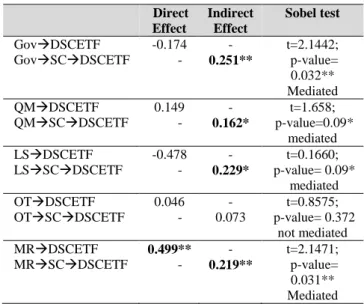
Path analysis presents an alternative path choice, whether effective with direct or indirect effects. The comparison of the coefficient of direct and indirect effect is presented in Table 4.
Table 4.
The direct and indirect effect
Direct Effect Indirect Effect Sobel test GovDSCETF GovSCDSCETF -0.174 - - 0.251** t=2.1442; p-value= 0.032** Mediated QMDSCETF QMSCDSCETF 0.149 - - 0.162* t=1.658; p-value=0.09* mediated LSDSCETF LSSCDSCETF -0.478 - - 0.229* t=0.1660; p-value= 0.09* mediated OTDSCETF OTSCDSCETF 0.046 - - 0.073 t=0.8575; p-value= 0.372 not mediated MRDSCETF MRSCDSCETF 0.499** - - 0.219** t=2.1471; p-value= 0.031** Mediated **: Significance at 5% *: Significance at 10%
The comparison between the direct and indirect effect coefficients shows that the indirect effect of governance, management quality, and legal structure on the development and sustainability of community empowerment trust fund management through social capital is greater than the direct effect. The Sobel test supports the results, confirming that governance and market reach variables have a p-value of less than 0.05. The Sobel test results for management quality and legal and structural variables yielded a significant p-value of 0.09 at 10%.
This study's findings are that social capital is proven to mediate the factors of good governance and quality management, legal and structural and market reach to the development and sustainability of community empowerment trust fund management. The study results support the research [25] that social capital is a factor that triggers the development and sustainability of community empowerment trust fund management institutions. These results also support research [9] that microfinance institutions need good governance. Good governance will increase public trust. The results of this study support the theory of social capital in institutional economics, where institutional development is related to good governance, which can reduce transaction costs through strengthening mutual trust, work networks, and norms as determinants of social capital. Social capital owned by community empowerment trust fund
E.Indriani et al. / Journal of Southwest Jiaotong University/ Vol.55 No.5 Oct. 2020 8
management institutions is the existence of trust formed due to good relationships with the community, such as mentoring business groups, cooperation in several community activities, and corporate social responsibility to the poor.
The next finding is that market reach is a dominant factor in addition to social capital for the development and sustainability of community empowerment trust fund management institutions. Outreach is a critical component of microcredit institutions' success because it is based on the vision that the focus of activities of microcredit institutions is to offer financial services to some of the poor on the one hand and to achieve economies of scale on the other. Performance indicators for the outreach category generally include the number of active customers, the percentage of customers under poverty, and the average loan size.
V. C
ONCLUSIONManagement of revolving funds for the poor by the Ex-National Program for Community Empowerment-Independent Rural Activities Management Unit provides positive benefits for improving and developing the MSME-based economy in Indonesia. In its development, the Community Empowerment Trust Fund activity management unit has provided good financial performance. It has a group of mentors or assisting groups of SMEs and large enough beneficiaries. The existence of this institution requires a development and sustainability model for community empowerment trust fund management institutions. The model is built on the problems that determine the development and sustainability of community empowerment trust fund management institutions: governance, quality of management, legal and structural, operational and technical, market reach, and social capital.
Social capital in the form of trust, norms, and networks formed from mentoring community groups using loans for small businesses is the principal capital in the development and sustainability of institutional economy-based community empowerment trust fund management. Social capital mediates the influence of governance, management quality, legal and structural and market reach on the development and sustainability of community empowerment trust fund management to become a model for the development and sustainability of community empowerment trust fund management based on the institutional economy. The intensity of mentoring community groups that use loans for small businesses within reach
of the market is a dominant factor in building social capital and community empowerment trust fund management institutions' development and sustainability.
A
CKNOWLEDGMENTSThanks to the Indonesian Ministry of Education and Culture, which is managed by the Directorate of Research and Community Service (DRPM), Directorate General of Research and Development Strengthening for funding the Master Thesis Grant.
R
EFERENCES[1] ZUBAIR, M. K. (2016).
Analisfaktor-faktorsustainabilitas
Lembaga
Keuangan
Mikro Syariah [Sustainability factors of
Islamic
Microfinance
Institutions].
Iqtishadia, 9(2), pp.201-226.
[2] KYEREBOAH-COLEMAN, A. and
OSEI, K.A. (2008) Outreach and profitability
of microfinance institutions: the role of
governance. Journal of Economic Studies,
35(3), pp. 236-248.
[3] SOLTANE, B. B. (2009). Governance
and performance of microfinance institutions
in Mediterranean Contries. Journal of
Business Economic and Management, 10(1),
pp. 31-43.
[4] MERSLAND, R. and
YSTEIN, S. R.
(2009). Performance and governance in
microfinance institutions. Journal of Banking
and Finance, 33(4), pp. 662-669.
[5] SSEKIZIYIVU, B. R., JUMA, M.,
ZAINAB,
B.
M.
(2018).
Corporate
governance
practices
in
microfinance
institutions: Evidence from Uganda.
Cogent-Business and Management, 5, pp.1-19.
[6] HARTARSKA, V. and NADOLNYAK,
D. (2007) Do regulated microfinance
institutions achieve better sustainability and
outreach? Cross-country evidence. Applied
Economics, 39, pp.1207-1222.
[7] SALAM, A. (2008) Sustainabilitas
Lembaga Keuangan Mikro Koperasi Simpan
Pinjam [Sustainability of Microfinance
Institutions,
Savings
and
Loans
Cooperatives]
Yogyakarta:
Sekolah
Pascasarjana UGM.
[8] HUDON, M. (2010) Management of
microfinance institutions: Do subsidies
matter? International Development, 22(7),
pp. 833-1053.
[9] ZULFIKARIJAH, F. (2010) Pengaruh
Teknologi
Informasi,
Supply
Chain
Management dan Strategi Operasi terhadap
Kinerja Lembaga Keuangan Mikro Syariah
di Jawa Timur. [The influence of information
technology, supply chain management and
operational strategies on the performance of
Islamic microfinance institutions in East
Java] Ph.D Thesis. Universitas Brawijaya,
Malang.
[10] AYADEV, M., SINGH, H., KUMAR,
P. (2017) Small finance banks: Challenges. II
MB. Management Review, 29, pp.311-325
[11] BEREKET, Z. and LALITHA, R.
(2012)
Technical
efficiency
and
its
determinant of microfinance institutions in
Ethiopia: A stochastic frontier approach.
African Journal of Accounting, Economics,
Finance and Banking Research, 8(8),
pp.1-18.
[12] YUSTIKA, E.A. (2006) Ekonomi
kelembagaan, definisi, teori dan strategi.
[Institutional economics, definitions, theory
and strategy] Malang: Bayu Media.
[13] FIYANTO, B. A., HAYU, A. F., and
NISFUL, M. L. (2019) Determining factors
of non-performing financing in Islamic
microfinance institutions. Heliyon, 5(8),
e02301. doi: 10.1016/j.heliyon.2019.e02301
[14] SAAB, G. (2015) Micro financing and
their “Mission drift” orientation the MENA
region case. Procedia - Economics and
Finance,
30,
pp.790-796.
doi:
10.1016/S2212-5671(15)01328-3
[15] FURUBOTN, E. G. and RICHTER R.
(2000). Institution and economic theory. the
contribution
of
the
new
institutional
economics. Ann Arbor: The University of
Michigan Press.
[16] EUIS, A. and MAHMUDAH, A. (2015).
Evaluating
the
models
of
Sharia
Microfinance in Indonesia: An analytical
network process approach. Al-Iqtishad:
Journal of Islamic Economics. 7(1),
pp.13-30. doi: 10.15408/ijies.v7i1.1355.
[17] FIRMANSYAH, I. and RUSYDIANA,
A. (2013). Pengaruh profitabilitas terhadap
pengeluaran zakat pada bank umum syariah
di indonesia dengan ukuran perusahaan
sebagai variabel moderasi [The effect of
profitability on zakat expenditure on Islamic
commercial
banks
in
Indonesia
with
company size as a moderating variable].
Jurnal Liquidity, 2, pp.110-116.
[18] DARWANTO, D. (2014) Strategi
Penguatan Microfinance Syariah Berbasis
Ekonomi
Kelembagaan
[Strategy
for
strengthening Islamic microfinance based on
institutional economics] Inferensi, 8(2),
pp.501-522.
[19] TRIMULATO, T. (2017). Manajemen
Risiko Berbasis Syariah. [Sharia Based Risk
Management] Al-Urban: Jurnal Ekonomi
Syariah dan Filantropi Islam, 1(2), pp. 90–
104. doi:
10.22236/alurban_vol1/is1pp90-104.
[20] MARTOWIJOYO, S. (2001). Dampak
Pemberlakuan Sistem Bank Perkreditan
Rakyat
Terhadap
Kinerja
Lembaga
Keuangan
Pedesaan.
[Impact
of
the
Implementation of the Rural Bank System on
the
Performance
of
Rural
Financial
Institutions].
Ph.D
Thesis.
Universitas
Gadjah Mada, Yogyakarta.
[21]
ROBINSON,
M.
(2002)
The
microfinance
revolution:
Lesson
from
Indonesia. Jakarta: PT Salemba Emban
Patria.
[22]
THE
WORLD
BANK
(2008)
Conditional Cash Transfers in Indonesia:
Baseline Survey Report. Program Keluarga
Harapan and PNPM-Generasi. Jakarta: The
World Bank.
[23] BRAU, J. C., and WOLLER, G. M.
(2004) Microfinance: A comprehensive
review of the existing literature. The Journal
of Entrepreneurial Finance, 9, pp.1-7.
[24]
KRISHNAMURTI,
B.
(2003)
Pengembangan
Keuangan
Mikro
dan
Penanggulangan Kemiskinan [Development
of Microfinance and Poverty Reduction.
Journal of People's Economics] Jurnal
Ekonomi Rakyat, II(2), pp.65-78
[25] AFIF, S. and DARWANTO, D. (2017)
Tata kelola baitul maal wa tamwil (BMT)
berbasis prinsip 6c dan modal sosial: Studi
pada bmt mekar da’wah [Governance of
baitul maal wa tamwil (BMT) based on 6c
principles and social capital: Studies on BMT
bloom da'wah]. Al-Uqud: Journal of Islamic
Economics, 1, pp.121-138. doi:
10.26740/al-uqud.v1n2.p121-138.
E.Indriani et al. / Journal of Southwest Jiaotong University/ Vol.55 No.5 Oct. 2020 10