and Attitude: Designing, Implementing and
Evaluating English Classes at Universities
著者
FUJISAKI Sanae
journal or
publication title
Annual Report Graduate School of Education,
Tohoku University
volume
68
number
2
page range
25-46
year
2020-06-30
URL
http://hdl.handle.net/10097/00128379
This study is aimed at nurturing learners’ critical reading awareness and attitude by designing, implementing and evaluating English classes at Japanese universities. By providing the task-based activities pre, during, and post reading, the research attempts to offer a clear link between being trained to understand the background knowledge, and acquiring critical reading awareness and attitude. In 2018, the author introduced the development and implementation of critical reading strategies by acquiring background knowledge of English context in content-centered newspaper articles (2018a). It analyzed and compared the critical reading awareness and attitude questionnaire research data results of two sample groups at two private Japanese universities’ general English classes. However, in that research, the questionnaire survey results were merely calculated by each question’s means―its factor analysis was not conducted. For that reason, a factor analysis was done in this research by adding 13 questions (to the original 26 questions in the survey of 2017) that ask about learners’ reading strategies and knowledge of both sentence and paragraph structures. The analysis indicates that there is a four-factor structure, thus a t-test was conducted to find out the means’ shift each factor. The t-test shows that the trained group’s critical reading awareness and attitude significantly shifted mainly on their attention to reliability of theses’ conclusions, facts in books, the real meaning of “comprehending English texts”, and facts on the internet.
Key words:Critical Reading, Critical Thinking, English Reading, Media literacy, TEFL
1.
Introduction
In the general English classes at Japanese universities, it has been required to offer classes which enable students to acquire integrated skills within a limited time. Among the integrated skills, the ability to read passages critically is one of the most important. Because of the enormous changes in the light of information, both in terms of the amount and quality, including fake newsNurturing Learners’ Critical Reading Awareness and Attitude:
Designing, Implementing and Evaluating English Classes at Universities
Sanae FUJISAKI
**Graduate Student, Graduate School of Education, Tohoku University
and post truth, Critical thinking’s (CT) role has become even more significant than ever. There have been a number of research and implementations done on CT in psychology and education through the first language, however, when it comes to English as a foreign language education, the discussions on the importance of CT have not seemed to be highly animated yet. Therefore, this study is aimed at designing, implementing and evaluating reading comprehension strategies to help students acquire critical reading awareness and attitude.
In 2018, the author introduced the development and implementation of critical reading strategies by acquiring background knowledge of English context in content-centered newspaper articles during the limited general English class time (2018a). It analyzed and compared the critical reading awareness and attitude questionnaire research data results of two sample groups at two private Japanese universities’ general English classes. Throughout pre, during, and post reading activities, the research showed how the students learned to pay attention to the reading process by acquiring the background knowledge. However, in that research, the questionnaire survey results were merely calculated by each question’s means―its factor analysis was not conducted. For that reason, a factor analysis was done in this research by adding 13 questions (to the original 26 questions in the survey of 2017) that ask about learners’ reading strategies and knowledge of both sentence and paragraph structures. The analysis indicates that there is a four-factor structure, thus a t-test was conducted to find out the means’ shift each factor. In this paper, it first describes the definition of CT skills and the relation to this research. Second, it explains the rationale of developing English CR strategies for Japanese universities. Third, it introduces previous research done on CT. Fourth, it analyzes and compares the critical awareness questionnaire research data results from two sample groups at two private Japanese universities’ English classes. Finally, this research concludes that learners’ critical awareness and attitude have significantly shifted among the training group, particularly on the reliability of theses’ conclusions, facts in books, and the real meaning of “comprehending English texts”.
2. Definition of Critical Thinking
Ennis (1987) defines CT as a logical and reflective way of decision-making process focusing on what to believe and what to do. He determines that the ultimate goal of CT is to make decisions or solve problems in different situations with the appropriate CT skills. Afterwards, Ennis (1989) divides CT into four categories; general, infusion, immersion and mixed approaches. General approach is specifically and separately offering universal knowledge to improve academic skills such as writing, reading, and presentation (context-free). Infusion approach is expressing an
introductory purpose within the existing subject (context-based). Immersion approach is non-explicitly offering CT knowledge in the current subject (context-based). Mixed approach is a combination of the general approach with the infusion or the immersion approaches. Zohar (1994) claims that the infusion approach is necessary for transferring CT skills across domains. This study could belong to the infusion approach, because within the existing course which is general English for mainly first and second year students, critical reading classes have been offered to improve students’ critical reading skills. These are provided so that learners will be able to use the acquired CT attitude and knowledge in four skills of English learning, as well as reading and media literacy in their first language.
3. Rationale of Developing English Critical Reading Strategies for Japanese
Universities
3.1 Rationale of Teaching CT in EFL classes
There is a growing awareness towards the importance of CT in higher education—especially in Asia—due to the recognition of English as a universal language in a global economy. English literacy has become a synonym of competitive advantage in the workplace (Nunan, 2003). As stated above, Japanese students should be taught English as a tool to read to learn, not to learn to read English. This study is designed to train learners to acquire the mechanism of English structure, using the context of content-centered articles. As for the rationale of conducting CT classes in Japan, there are a number of evidences we have seen. Shiotani (2006) states that in order to understand logical composition, inference and flow of information, learners need to strengthen text construction function by receiving training that includes CT. In a way, English might be more suitable to acquire CT than the Japanese language due to its directness and the way paragraphs are written with main sentences and supporting sentences. When finding out the main idea which describes the writer’s claims, one might say reading English is much more straightforward than reading in Japanese. This aspect of English language helps to utilize English reading classes as a very useful tool to gain CT skills. Other evidences demonstrate reasons to implement CT classes for the Japanese students. Griffin, P et al. (2014) include CT in their 21st Century skills, which is known as ATC21S, as one of ten academic ability elements required for the globalized age. ATC21S has been influential for PISA’s scores’ evaluation criteria, although Fujisaki (2015) argues that ATC21S seems to focus on ability in elements, not for integrated and contextualized ability, which is difficult to show using numerical data. In 2017, the Ministry of Education, Culture, Sports, Science and Technology in Japan (MEXT) released “the New Curriculum Guidelines”, and their goals shifted to problem solving ability with various mixed contexts, and to collaborating with others to live toward unexpected changes. It also emphasized the importance of forming learners’ own opinions. In
order to achieve the MEXT’s guidelines, it is crucial for learners to acquire CT skills.
Michita (2013) reviews current research on CT education by focusing on theoretical research and practical research. He found that there have mainly been the general approach and immersion approach done based on Ennis’ categories above. However, he claims that those researches have mainly been journal papers and presentations at academic conferences; therefore, we will need to see more deepened research from now on. Halpern (2007) states that the concepts of CT and intelligence seem similar and are strongly related, but CT is more accepted as teachable and improvable with suitable instruction. He elaborates that thinking skills are a consequence of education, whereas intelligence seems more to be the raw power of an individual’s mental equipment. However, as Durkin (2008) describes, Asian students are less overt or less expressive in class, and often the reason is interpreted as lack of CT, particularly in the situations where argument and debate are involved.
3.2 Risks of Not Teaching CT in Japan
Dunn (2015) argues that the Japanese higher education curriculum lacks development of CT skills, which leads to Japanese university students being unable to think for themselves. For that reason, he insists the importance of utilizing CT skills in all classes, not only in the EFL context. Hence, we need to tackle how to implement CT-geared classes through the second language so that the educational effect of thinking for themselves will be developed. While discussing ways to develop Japan-China “public sphere” (open discussion space to discuss public issues), Ako (2014) claims that the environment for nurturing CT is absolutely essential, as well as guaranteed freedom of speech. The restrain of freedom of speech and human rights seems to be increasing in China; however, Ako warns us that there is a concern about an undeveloped “public sphere” in Japan, just as in China. The influence of populism based on democracy and commercialized media has become stronger in Japan. When some extreme opinions gain popularity, so-called silent majority and minority opinions may not be represented, and as a result, we may see runaway power. Fahim et al. (2010) claims that CT is an ability crucial for successful performance not only at the academic level but also in both professional and social context. When looking back at the date of March 11th, 2011, the date most Japanese people will never forget, the day the Great East
Japan Earthquake caused the Fukushima Daiichi Nuclear Disaster, Kurokawa (2012), the chairman of The Fukushima Nuclear Accident Independent Investigation Commission, wrote: “What must be admitted-very painfully-is that this was a disaster ‘Made in Japan’. Its fundamental causes are to be found in the ingrained conversations of Japanese culture: our reflexive obedience; our reluctance to question authority; our devotion to ‘sticking with the program’; our
groupism; and our insularity.
Had other Japanese been in the shoes of those who bear responsibility for this accident, the result may well have been the same.”
If many Japanese people agree with his analysis of the nuclear disaster’s causes, CT skills must be taught in Japanese education system. For the people in power in any country, it would be much easier if whatever policies and laws they made were never doubted or challenged by the media or the general public, or even interpreted how they like. Rear (2012) argues that if we see CT skills as a way of “freeing themselves from the self-serving manipulations of their own leaders” (Paul, 1993:359), then Japan, a country known as having a conformist society, will have a dilemma between traditional ways of behaving and encouraging non-conformism as part of the educational process. Rear continues to state that encouraging non-conformism has caused fears, especially among the conservative elites in Japan, because it makes the strong norm of Japanese society disappear. However, enhancing CT skills among employees and the young generation will enable them to produce the autonomous and creative workers that are crucial for increasing value to the nation’s economy. Media bias should not be forgotten when we discuss teaching CT. Matsunaga (2008) claims that we always need to bear in mind the danger of media bias. Information we receive from many kinds of media is not “absolutely correct”, rather it is often inadequate and reflects the mindset of the reporters and producers. We must stop blindly believing the information from mass media and celebrities’ claims. Our primary attitude must be to doubt the information. It is crucial for us to learn to gather various information from different sources of administration, scientists, citizen groups, and companies. Then how to analyze and judge the information by ourselves also needs to be taught. As mentioned above, CT skills are teachable and CT is an ability crucial for successful performance not only at the academic level but also in both professional and social context.
4. Previous Research in EFL
The need for CT is explicitly described in many books; furthermore, educational organizations around the world emphasize it—including Japan. However, it seems it is rarely implemented inside the classroom. So far, there has been some research done on CT in both reading and writing, but only a few studies were solely done on critical reading.
Fahim et al.(2010) conducted a survey with 83 advanced EFL learners in a private institute in Iran to find if there is any relationship between test takers’ CT ability and their scores of the reading section of TOEFL. The results indicated that there was a statistically significant correlation for those with greater CT skills as demonstrated on the Watson-Glaser Critical
Thinking Appraisal (1980) and the scores on the reading section of Paper-Based TOEFL (PBT). Therefore, they suggest that CR strategy training be incorporated in PBT reading preparatory programs and other EFL reading courses, particularly those related to main ideas. Yang et al. (2014) used CT-infused language activities based on social constructivist principles to implement CT skills-oriented reading and writing classes in a semester for 83 undergraduate students in Taiwan. They divided the students into three groups by online pre-test English Literacy TOEIC scores, delivered specifically designed adaptive learning materials for each group, and then collected students’ individual feedback. The themes they chose were travel and business life, in both reading and writing exercises. They concluded that empirical results show that CT-enhanced adaptive English literacy instruction improved both students’ acquisition of CTS and English literacy.
Mbato (2019) investigated 55 Indonesian undergraduate EFL learners’ critical thinking awareness in reading by using a Likert-scale questionnaire and students’ reflections in 2014. The students were enrolled in two classes of Critical Reading and Writing. He used a two-grouped set of twenty-three statements asking students about a) planning, monitoring, and evaluation strategies of CT in reading, and b) planning, monitoring and evaluation of feeling in CR. He concluded that most of the students had sufficient declarative knowledge of CT strategies in reading. However, their knowledge of how to use the CT skills, as well as when and why to use certain strategies in reading were insufficient. Therefore, he claims that it is important to have a learning environment where the students’ declarative, procedural and conditional knowledge of CT skills while reading is nurtured regularly and intensively. 5. Method In the first semester of 2018, a questionnaire research project was conducted with groups of students at two private universities in Sendai. The purpose of the project was to compare the questionnaire results about CR awareness between two sample groups using two exercises: one using fact and opinion worksheets, and the other reading English newspaper articles. The questionnaire, which asked the same 39 questions, was conducted twice, once in April and again in July 2018. Training (CR) Group was taught by the author, and Non-Training (NCR) Group was taught by four other English instructors. NCR groups used various published EFL textbooks exclusively. First, CR Group students learned how to find evidence through a facts and opinion worksheet (see appendix). Afterwards, they read three English newspaper articles written by three different newspaper companies about the same topic. For the articles, CR Group students were given a specially designed worksheet, which focuses on key words in their titles, the writers’ main
intensions and purposes, the tone of the articles, and the media’s ideological background which are the important elements of background knowledge to comprehend the text. After learning the differences between facts and opinions with BBC worksheets, and reading the three articles with a set of goals, how the means of the questionnaire in both CR and NCR Groups changed was investigated. Throughout pre, during, and post reading activities, the research showed how the students learned to pay attention to the reading process by acquiring the background knowledge. 5.1. Participants There are 395 sample students who go to two private universities in Sendai. 139 students are in the training group (CR Group) taught by the author, and 256 students are in the non-training group (NCR Group) taught by four other instructors. For reference, University A’s entrance test deviation measurement figure is between 45 and 59 (mixed departments) and that of University B is between 50 and 54.
5.2. The English Newspaper Article Materials
This research has purposely chosen English newspaper articles, due to their concise size and clear context structure to understand the mechanism of English articles. Each article’s political intension was clear, and therefore, the writers’ intensions and their political positions would have significant influence on improving students’ critical reading ability. The three English articles were written by three different newspaper media who have different political ideologies: The Asahi Shimbun, BBC News, and The Japan News. The theme was “#Me, too in Japan”, written on Mar. 1st, April 25th, and June 13th, 2018 respectively.
5.3. Procedures
5.3.1 The Newspaper Article Reading Lesson Plans
Table 2 describes the lesson plans for CR purpose classes during the 15 lessons. The courses at the two universities are general English classes, so the time the author could use for CR purpose was limited. Therefore, only the 7th, 8th, 9th and 10th classes were for CR classes. The 7th
and 8th classes were for finding evidence in order to differentiate facts from opinions, using
worksheets intended for American junior high school students (appendix 1). The 9th and 10th
Table 1. The Sample Students
University # classes # students University # classes # students
CR Group A 4 79 B 2 60
classes were for reading three articles with pre, during, and post reading activities.
5.3.2 Needs of Strategic Instructions
Pritchard (2004) claims that readers need to receive strategic instruction in authentic, meaning-centered contents to implement instructional strategies. Language and literature development challenges not the students, but teachers, by assessing their applicability of instructional strategies. They should be determined in context and be adjusted to the particular needs of students. In order to pay attention towards the texts critically, the students in each class were divided into groups of five or six. Each group was assigned to be in charge of one article out of the three. In a typical class with thirty students, for example, there were six groups of five, and two groups read the same article. The students were not English majors, and some of them expressed their overwhelmed feeling about reading an authentic English newspaper alone. Therefore, working as a group made those weak students feel more comfortable and less pressured to read and answer the questions on the worksheet. 5.3.3. Pre-reading Activity As the first step, in order to see the students’ background knowledge of #Me, too and sexual harassment incidents , the whole class was asked what they know about the topic for about five minutes. Then each group read the title of the article to find the key word. This took about ten
Table 2. Critical Reading Lesson Plans
Class/15 Activity Purpose Time used
in 90 minutes 7th Identifying Facts/ Opinions Worksheet 1 1. Finding evidence. What is the difference between facts and opinions?
2. How can we validate the facts? 90 8th Identifying Facts/ Opinions Worksheet 2 Exercises to differentiate facts and opinions. 90
Homework Finish reading at home
9th
Newspaper articles
① Pre-reading Activity 1.Paying attention to the titles 20 Newspaper articles
②During-the-reading Activity 2.Group discussion about the main ideas, their supporting parts, and the tone of the articles. 70
Homework Read the article again 10th Newspaper articles ③During-the-reading Activity Group Presentation of above. Class discussion 80 Newspaper articles ④ Post-reading Activity Media’s political ideology 10
minutes. As mentioned earlier, the three newspapers have different political positions. Therefore, often a title would explicitly reveal each newspaper company’s stance on it. The actual titles are as follows.
First, “The Asahi Shimbun” used “In patriarchal Japan, saying ‘Me Too’ can be risky for women” as their title. The key words that the students paid attention to were patriarchal and
risky for women. By this, it was clear that The Asahi Shimbun possessed a sympathetic attitude
toward the women in patriarchal Japan who are involved in the #Me, too movement.
Second, “BBC News” chose “#Me Too Japan: What happened when women broke their
silence”. From this particular title, it was not clear what BBC News’ stance was toward #Me, too in Japan. As such, the students were asked to shift their attention toward the subtiltes, and they found that suffering and Taught not to say no are the key words. Thus, the students understood that BBC News expresses their critical stance toward Japanese society. Third, “The Japan News” used “Officials to get training on harassment prevention”, and the key words are officials and harassment prevention. “The Japan News” particular chose the word harassment prevention instead of sexual harassment. By this, the students could comprehend that “The Japan News” wanted to emphasize to the readers that the general harassment training would be implemented, and that the name of the training has no implication toward the sexual harassment scandal committed by the top bureaucrat in Japan’s finance ministry. Also, the students were asked to search the Japan News’ web-site and find any other articles related to sexual harassment in Japan—the result was none.
Therefore, the students focused on each title’s valuable key words, and after that the students were asked to focus on what each article adopted as evidence. By doing so, they were certainly able to find out each article’s press comments. In other words, CR Group students acquired the writers’ claims and their positions as “background knowledge” by focusing on the titles.
Table 3. Pre-Reading Activity-the Titles of Three Articles
The Asahi Shimbun
(The Associated Press) BBC News The Japan News (Jiji Press)
Titles In patriarchal Japan, saying ‘Me Too’ can be risky for women
#Me Too Japan: What happened when women broke their silence Subtitle: Suffering in silence, The photographer and a muse, ‘Taught not to say no’
Officials to get training on harassment prevention
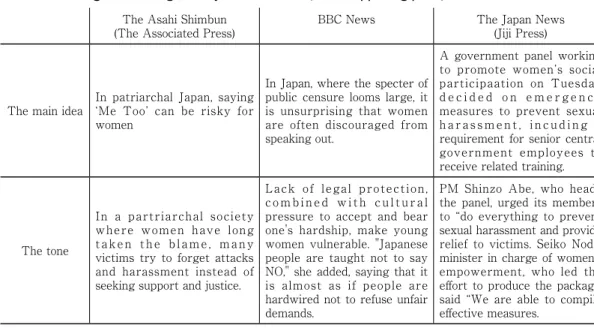
5.3.4. During-the reading Activity After learning about key words in titles’ that have the role of the evidence to support the tone of the articles by the Pre-reading Activity above, CR Group moved on to the During-the-reading Activity. Before starting to read the body parts of the articles, the author asked each team to choose a team leader. Then, the leader allocated each member the paragraphs they were in charge of. During the lesson, each student tried to find the main sentence and the supporting sentences of the paragraphs they were responsible for comprehending. Some teams almost finished that activity within the class time, while other teams needed more time to discuss the details, so those teams read more as their homework. In the final class, each group continued to discuss the main idea, its supporting parts, and then the tone of each article. After the discussion, group presentations took place. In most classes, one article was read by two groups, so after the two presentations, there was a whole class discussion on the differences between the two teams’ results. The details of the main ideas, it supporting parts, and the tone of the articles were written in Fujisaki (2018b); therefore, given the limited space in this paper, Table 4 shows the summary of the believed main ideas and tone. Through the During-the reading Activity, CR Group students learned a pattern where in most English articles, the writer’s claim is written in the first paragraph or the second paragraph, then supporting sentences follow after that. The tone of the articles is usually written clearly in the final paragraph, however, with the limited space of the article, it is not always so, and sometimes it is spread around the whole article. In other words, CR Group acquired “background knowledge” of sentence construction and mechanism of English articles by focusing on the writers’ claims, the supporting sentences, the tone of the articles and their political positions according to the titles.
5.3.5. Post-reading Activity – Media’s Ideological Background
As a final activity, the Post-reading Activity was conducted as a group activity to let the students find out each of the three newspaper companies’ ideological background. This was also important, because when asked if they knew the difference between right wing and left wing, or liberal position among various media companies or organizations, almost all the students answered “No.” Therefore, they were asked to use the Internet to learn about each medium’s ideological stance to find out why there are differences in the three tone of the articles. The following is the outcome of the activity.
By learning about the three media’s background, it became clear to the students why the three articles’ writers’ claims and the tone of the articles had their own claims and why they were very different from the other two. The “background knowledge” CR Group acquired deepened the students’ understanding about the articles by focusing on the media’s ideological Table 4. During -the reading Activity-the Main ideas, their supporting parts, and the tone of the Articles
The Asahi Shimbun
(The Associated Press) BBC News The Japan News(Jiji Press)
The main idea In patriarchal Japan, saying ‘Me Too’ can be risky for women
In Japan, where the specter of public censure looms large, it is unsurprising that women are often discouraged from speaking out.
A government panel working to promote women’s social participaation on Tuesday d e c i d e d o n e m e r g e n c y measures to prevent sexual h a r a s s m e n t , i n c u d i n g a requirement for senior central government employees to receive related training.
The tone
In a partriarchal society where women have long t a k e n t h e b l a m e , m a n y victims try to forget attacks and harassment instead of seeking support and justice.
Lack of legal protection, c o m b i n e d w i t h c u l t u r a l pressure to accept and bear one's hardship, make young women vulnerable. "Japanese people are taught not to say NO," she added, saying that it is almost as if people are hardwired not to refuse unfair demands.
PM Shinzo Abe, who heads the panel, urged its members to “do everything to prevent sexual harassment and provide relief to victims. Seiko Noda, minister in charge of women’s empowerment, who led the effort to produce the package, said “We are able to compile effective measures.
Table 5. Post-Reading Activity- The Three Newspaper Companies’ Ideological Background
The Asahi Shimbun BBC News The Japan News
Media’s background English version of The Asahi Shimbun C r i t i c a l t o w a r d t h e government Left ideology No particular ideology was found.
Perhaps neutral political stance
English version of The Yomiuri Shimbun
background. The group work and collaborative learning took place to promote discussions in order to stimulate problem-solving ability and interpreting ability. Throughout pre, during, and post reading activities, this whole process led learners to focus on specific content structures, and therefore, by taking account of background knowledge, the students’ CT awareness and attitude shifted towards reading more critically. 6. The Questionnaire In this research the author chose thirty-nine questions to examine the students’ attitude and their CR awareness when they read English. The questionnaire with self-rated scales was first conducted in April, and the second time was done with the same questions in July, 2018. The students were asked to circle to which degree they agreed with each question. In truth, the actual number of questions was thirty-eight, because the first question, “Do you like to read English?” was included to make it easier for the students to set about answering the questions; therefore, this question was not included to calculate its mean. Out of thirty-nine questions, twenty-six questions were asked to find out mainly whether the students understood the importance of finding the writer’s intentions, how to identify facts that have enough evidence to support the opinions, and how to distinguish differences in the writers’ / media’s claims on the same topic. In addition to those twenty-six questions used in 2017 (Fujisaki), thirteen questions about students’ reading strategies and knowledge of both sentence and paragraph structures were added, based on Ushiro’s (2011) reading comprehension skills. Those questions are No. 6, 9, 11, 13, 15, 17, 19, 21, 23, 28, 30, 32, 39. Questions No. 2, 10, 22, 30, and 34 are written with the intention of having a viewpoint in contrast to that of the author.
7. Factor Analysis of the Two-Time Questionnaire
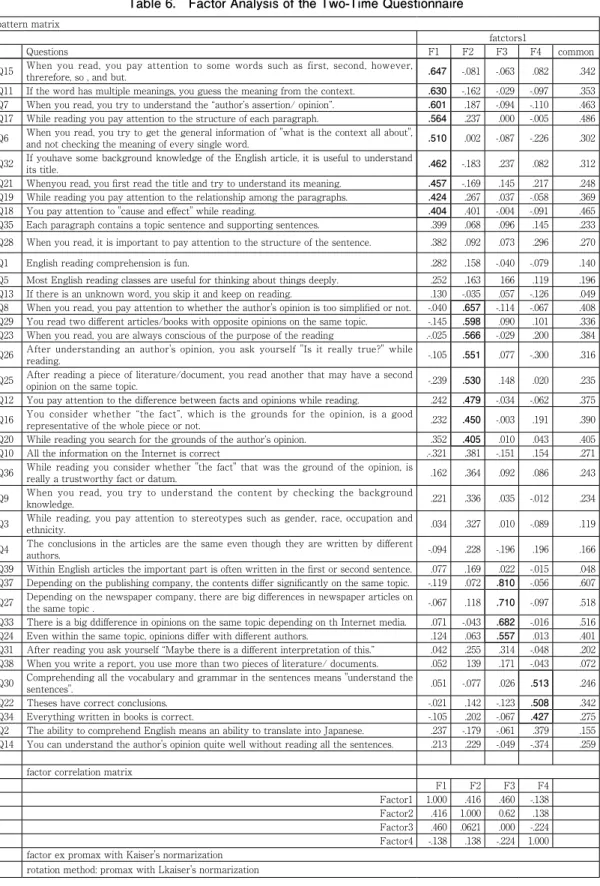
After conducting the survey two times, scale scores and factor scores were analyzed. Table 6, Factor Analysis of the Two- Time Questionnaire shows the results. The first factor is interpreted as attention to structures due to the focus on the questions is mainly about the structures of words and sentences, and the relationship between the paragraphs, structure of paragraphs, and cause and effect. The second factor is named skeptical attitude because of having mostly skeptical minded questions towards authors’ opinions. The third factor is interpreted as attention to the media, because the questions are largely asking the differences among publishing companies, and newspaper companies. The fourth factor is attention to reliability, because the questions are about the reliability of definition of comprehension, theses and books.
Table 6. Factor Analysis of the Two-Time Questionnaire
pattern matrix
fatctors1
Questions F1 F2 F3 F4 common Q15 When you read, you pay attention to some words such as first, second, however, threrefore, so , and but. .647 -.081 -.063 .082 .342 Q11 If the word has multiple meanings, you guess the meaning from the context. .630 -.162 -.029 -.097 .353 Q7 When you read, you try to understand the “author’s assertion/ opinion”. .601 .187 -.094 -.110 .463 Q17 While reading you pay attention to the structure of each paragraph. .564 .237 .000 -.005 .486 Q6 When you read, you try to get the general information of "what is the context all about", and not checking the meaning of every single word. .510 .002 -.087 -.226 .302 Q32 If youhave some background knowledge of the English article, it is useful to understand its title. .462 -.183 .237 .082 .312 Q21 Whenyou read, you first read the title and try to understand its meaning. .457 -.169 .145 .217 .248 Q19 While reading you pay attention to the relationship among the paragraphs. .424 .267 .037 -.058 .369 Q18 You pay attention to "cause and effect" while reading. .404 .401 -.004 -.091 .465 Q35 Each paragraph contains a topic sentence and supporting sentences. .399 .068 .096 .145 .233 Q28 When you read, it is important to pay attention to the structure of the sentence. .382 .092 .073 .296 .270 Q1 English reading comprehension is fun. .282 .158 -.040 -.079 .140 Q5 Most English reading classes are useful for thinking about things deeply. .252 .163 166 .119 .196 Q13 If there is an unknown word, you skip it and keep on reading. .130 -.035 .057 -.126 .049 Q8 When you read, you pay attention to whether the author's opinion is too simplified or not. -.040 .657 -.114 -.067 .408 Q29 You read two different articles/books with opposite opinions on the same topic. -.145 .598 .090 .101 .336 Q23 When you read, you are always conscious of the purpose of the reading .-.025 .566 -.029 .200 .384 Q26 After understanding an author's opinion, you ask yourself "Is it really true?" while reading. -.105 .551 .077 -.300 .316 Q25 After reading a piece of literature/document, you read another that may have a second opinion on the same topic. -.239 .530 .148 .020 .235 Q12 You pay attention to the difference between facts and opinions while reading. .242 .479 -.034 -.062 .375 Q16 You consider whether “the fact”, which is the grounds for the opinion, is a good representative of the whole piece or not. .232 .450 -.003 .191 .390 Q20 While reading you search for the grounds of the author’s opinion. .352 .405 .010 .043 .405 Q10 All the information on the Internet is correct .-.321 .381 -.151 .154 .271 Q36 While reading you consider whether "the fact" that was the ground of the opinion, is really a trustworthy fact or datum. .162 .364 .092 .086 .243 Q9 When you read, you try to understand the content by checking the background knowledge. .221 .336 .035 -.012 .234 Q3 While reading, you pay attention to stereotypes such as gender, race, occupation and ethnicity. .034 .327 .010 -.089 .119 Q4 The conclusions in the articles are the same even though they are written by different authors. -.094 .228 -.196 .196 .166 Q39 Within English articles the important part is often written in the first or second sentence. .077 .169 .022 -.015 .048 Q37 Depending on the publishing company, the contents differ significantly on the same topic. -.119 .072 .810 -.056 .607 Q27 Depending on the newspaper company, there are big differences in newspaper articles on the same topic . -.067 .118 .710 -.097 .518 Q33 There is a big ddifference in opinions on the same topic depending on th Internet media. .071 -.043 .682 -.016 .516 Q24 Even within the same topic, opinions differ with different authors. .124 .063 .557 .013 .401 Q31 After reading you ask yourself “Maybe there is a different interpretation of this.” .042 .255 .314 -.048 .202 Q38 When you write a report, you use more than two pieces of literature/ documents. .052 139 .171 -.043 .072 Q30 Comprehending all the vocabulary and grammar in the sentences means "understand the sentences". .051 -.077 .026 .513 .246 Q22 Theses have correct conclusions. -.021 .142 -.123 .508 .342 Q34 Everything written in books is correct. -.105 .202 -.067 .427 .275 Q2 The ability to comprehend English means an ability to translate into Japanese. .237 -.179 -.061 .379 .155 Q14 You can understand the author's opinion quite well without reading all the sentences. .213 .229 -.049 -.374 .259 factor correlation matrix F1 F2 F3 F4 Factor1 1.000 .416 .460 -.138 Factor2 .416 1.000 0.62 .138 Factor3 .460 .0621 .000 -.224 Factor4 -.138 .138 -.224 1.000 factor ex promax with Kaiser's normarization rotation method: promax with Lkaiser's normarization
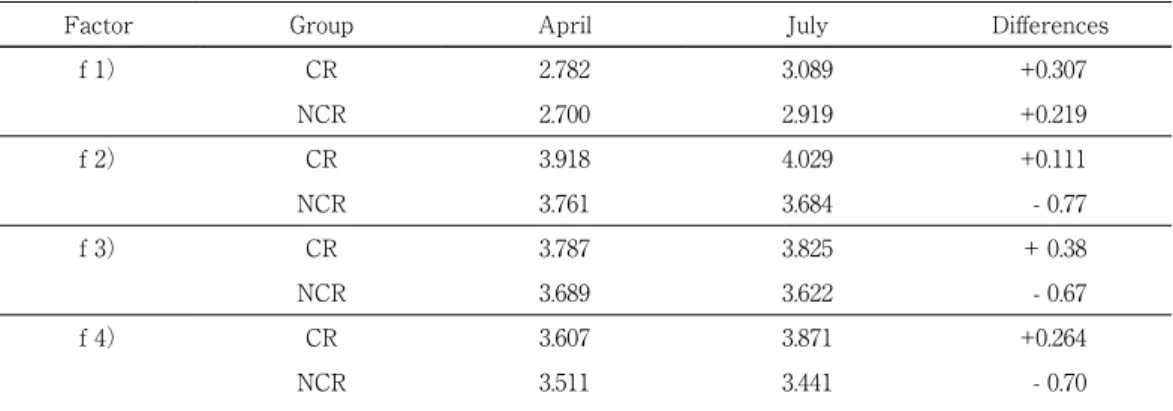
8. Discussion After the factor analysis, the difference values of four main factors were calculated by t-test. Table 7 shows the t-test results and the differences of the means for the two groups between April and July. The first survey result in April shows the total means of CR group was already higher than NCR group: 3.523 and 3.415, respectively (see graph 1). Therefore, this survey’s result cannot conclude that CR group’s total CR awareness has nurtured significantly compared to NCR group. This was caused by including some second-year students’ data who had already taken the author’ s classes in the previous year. Nevertheless, the following points can be discussed. The means of factor 1 interpreted as attention to structures in both CR and NCR increased: .307 and .219 respectively. (see graph 2) However, for Total 2 in July, the means of the CR group (3.703) was higher than April (3.523),
Table 7. T-test Results and the Differences of the Means for the Two Groups Between April and July
Factor Group April July Differences
f 1) CR 2.782 3.089 +0.307 NCR 2.700 2.919 +0.219 f 2) CR 3.918 4.029 +0.111 NCR 3.761 3.684 - 0.77 f 3) CR 3.787 3.825 + 0.38 NCR 3.689 3.622 - 0.67 f 4) CR 3.607 3.871 +0.264 NCR 3.511 3.441 - 0.70
while those of the NCR group (3.415 in April and 3.416 in July) were about the same. Therefore, we could say that to a certain extent CR group’s CR awareness increased significantly whereas NCR group’s CR awareness did not change. Since the questions mainly focus on words and sentences, the structure of paragraphs, relationship between the paragraphs, and cause and effect, it could be said that even without CR-oriented reading exercises, the elements of factor 1 can be improved. But because of the slightly larger increase in CR group, CR-related lessons could have a stronger impact on the students’ ability to focus on the structures.
Moreover, CR group’s means of factor 2, 3 and 4 all increased, whereas those of NCR group all decreased. For factor 2, named skeptical attitude due to being questions mainly asking about the skeptical attitude towards authors’ opinions, the increase (.111) in CR mean can demonstrate that CR students have learnt to doubt whether authors’ opinions are worthy of belief (see graph 3).
Graph 2. Factor 1 - Attention to Structures’ Means
With factor 3, interpreted as attention to the media for questions asking primarily on the differences among publishing companies and newspaper companies, the CR’s mean only increased by .38, which was a little disappointing for the author (see graph 4). In factor 4, attention to reliability, CR’s mean increased quite well (.264), proving CR students learnt to pay attention to the reliability of theses’ conclusions, facts in books, and the real meaning of “comprehending English texts”. From the differences in the means below, we can see that the CR Group students have significantly shifted their CR awareness and attitude, especially in terms of factor 4, attention to reliability (see graph 5).
The reason for the decrease in NCR means in factors 2, 3, and 4 is unknown. NCR mean of factor 1, attention to structures (.219) is still lower (by .088) than that of CR group (.307). NCR classes were conducted by other instructors; therefore, perhaps NCR students might have felt it a bit troublesome to answer the same questions for the second time in July. So, it might be fair to say that NCR group students have learnt to pay more attention to the English structures in their
Graph 4. Factor 3 - Attention to the Media’s Means
classes. However, the elements of skeptical attitude, attention to reliability, and attention to the media (factors 2, 3, and 4) were still foreign to them, and as such, they opted to circle slightly lower scales in July than April’s survey. The two-time questionnaire research demonstrated that CR Group’s means increased in almost all the questions. However, in the next survey, the means in the first questionnaire for CR and NCR should be almost the same. Nonetheless, with the results, we can say that under the various mixed context, learners should be trained to pay attention to the context structure by focusing on key words in the titles, writers’ claims, their supporting sentences, and the tone of the articles. Thus, finding out the information according to the purpose and a set of goals, as well as making independent decisions and solving problems with others, are effective strategies in critical reading exercises. 9. Conclusion Over the past several decades, we have seen a paradigm shift from the view of language as a rule-governed system towards the view of language as full of meaning and communicative competence. However, instead of comprehending the context to learn something, by considering various elements of multicultural differences such as gender, age, and media, the students in Japan are still translating sentences the old-fashioned way by simply connecting their grammatical and lexical knowledge. Hence, this study focuses on how to utilize critical reading classes in Japan to shift from learning to read to that of reading to learn the various diversities in complex contexts. CT skills are teachable; as such, it is crucial to offer CT/ CR-oriented classes before the students leave university, start to work, and immediately face situations of selecting what they can believe and what they cannot. So that Japanese students will be able to read English critically, this study has been aimed to design, implement, and evaluate practical classes to build critical reading skills to understand the mechanism of specific text structure. The training Group learned how to find evidence when facts differentiate from opinions, and they read three articles written by three different newspaper companies with different political ideologies and stances, all while paying attention to the context structures, in order to gain the critical reading strategies on finding particular information under a set of goals. This study has also explored the two-time questionnaire research in April and July 2018 to find out if the gained particular background knowledge within an environment where various contexts are mixed will be able to function as a tool to help shift learners’ awareness and attitude to read more critically from various angles. The results show that learners’ critical awareness and attitude have shifted among the training
group, particularly in regards to factor 4, attention to reliability (paying attention to reliability of theses’ conclusions, facts in books, and the real meaning of “comprehending English texts”). However, this research’s sample included some students who had taken the author’s class previously; consequently, the first questionnaire survey’s means of the CR group were already higher than those of the NCR groups. Hence, in the next research to be conducted, it is definitely essential to make sure to exclude any students who have done a similar exercise with the author. It will also be important to conduct a post-activity test to evaluate how well each student can answer CR questions such as finding the main idea, the evidence for the main idea, the tone of the article, and the reason/purpose of the article. Acknowledgements I would like to express my gratitude to Associate Professor Yuji Wada of the Graduate School of Information Science, Tohoku University for his helpful advice on the data analysis. References 1. Ako, T. (2014). China and Japan: A View of Developing Public Sphere Beyond Indifferent to Borders. The 73rd Annual Conference of Japanese Educational Research Association. Public Symposium I Seeking Educational Possibilities to Connect East Asia-Beyond Poverty, Disparity and Nationalism- pp. 234, 235.
2. Dunn, J. D. (2015). Critical Thinking in Japanese Secondary Education: Student and Teacher Perspectives. Critical Thinking in Language learning. The Journal of the JALT Critical Thinking SIG Volume II, Issue I, pp.28-38. 3. Durkin, K. (2008). The Adaptation of East Asian Masters Students to Western Norms of Critical Thinking and
Argumentation in the UK. Intercultural Education, 19 (1), pp.15-17. 4. Education.com (2017). identifying fact and opinion.pdf, retrieved from https://www.education.com/worksheet/article/identifying-fact-and-opinion/
5. Ennis, R. H. (1987). A Taxonomy of Critical Thinking Dispositions and Abilities. In J.B. Baron & R. J. Sternberg (EDS.), Teaching Thinking Skills: Theory and Practice. New York: W.H. Freeman and Company. pp.9-26. 6. Ennis, R. H. (1989). Critical Thinking and Subject Specificity: Clarification and Needed Research. Educational
Researcher. 18, pp.4-10.
7. Fahim, M et al.(2010). The Relationship between Test Takers’ Critical Thinking Ability and their Performance on the Reading Section of TOEFL. ISSN 1798-4769. Journal of Language Teaching and Research. Vol. 1, No. 6, pp.830-837, November.
8. Fujisaki, S. (2015). Required Ability for the Globalized Age: Through Critical Analysis of ATC21S. Global Education. Vol. 17, pp.79-89.
9. Fujisaki, S. (2018a). Developing English Reading Comprehension Strategies for Japanese Universities: Shifting from Learning to Read to Reading to Learn. Annual Report Graduate School of Education, Tohoku University. Vol. 66, No.2, pp.113-128.
10. Fujisaki, S. (2018b). Developing, Implementing and Evaluating for Improving Critical Reading Strategies for University Students. Annual Report Graduate School of Education, Tohoku University. Vol. 67, No.1, pp.31-52. 11. Griffin, P et al. (2014). Assessment and Teaching of 21st Century Skills. Melbourne Graduate School of Education.
University of Melbourne, VIC, Australia.
12. Halpern, D.F. (2007). The Nature and Nurture of Critical Thinking. In R. J. Sternberg, H.L.I. Roediger, & D.F. Halpern (Eds.). Critical Thinking in Psychology (pp.1-14). New York: Cambridge University Press.
13. Kurokawa, K. (2012). The Official Report of The Fukushima Nuclear Accident Independent Investigation Commission Executive Summary. The National Diet of Japan. p9.
14. Matsunaga, W. (2008) Media Bias: Suspicious Information on Health and Fake Science Koubunsha.
15. Mbato, C, L. (2019). Indonesian EFL Learners’ Critical Thinking in Reading: Bridging the Gap Between Declarative, Procedural and Conditional Knowledge. HUMANIORA Vol.41, No.1 (February) 92-101.
16. MEXT. (2017). The New Guidelines: From Discussion to Revision and Enforcement.
Central Council for Education, retrieved from http://www.mext.go.jp/a_menu/shotou/new-cs/__icsFiles/ afieldfile/2017/09/28/1396716_1.pdf September 28th, p9.
17. Michita, Y. (2013). A Review of Critical Thinking Education. The Annual Report of Educational Psychology in Japan. Vol.52, 128-139.
18. Nunan, D. (2003). The Impact of English as a Global Language on Educational Policies and Practices in the Asia-Pacific Region. TESOL Quarterly, 37, 4, 589-613.
19. Paul, R. (1993). Critical Thinking: What Every Person Needs to Survive in a Rapidly Changing World. California: Foundation for Critical Thinking.
20. Rear, D. (2012). The Dilemma of Critical Thinking: Conformism and Non-Conformism in Japanese Education Policy. In T. Isles and P. Matanle (eds.): Researching Twenty-First Century Japan: New Perspectives for the Electronic Age, pp. 119-137. Lexington Books: Maryland.
21. Shiotani, E. (2006). Sematic Theory・Cognitive Linguistics and Language Education. Teikyo University Literature American British Linguistic Culture, pp.37-85.
22. Pritchard, R. (2004). Strategic Reading for English Learners: Principles and Practices. The CATESOL Journal, 16.1, 29-42. 23. Ushiro, Y. ed. (2011). Lessons for Reading English in English. Kenkyuusha. 24. Yang, Y. C. et al. (2013). An Online Adaptive Learning Environment for Critical Thinking-Infused English Literacy Instruction. British Journal of Educational Technology, 45(4), 727-747. DOI:10.1111/bjet.12080 25. Zohar, A. (1994). Teaching a Thinking Strategy: Transfer Across Domains and Self-Learning Versus Class-Like Setting. Applied Cognitive Psychology, 8, 6, 549-563. 26. “In Patriarchal Japan, Saying ‘Me Too’ Can Be Risky For Women”, retrieved from http://www.asahi.com/ajw/ articles/AJ201803010026.html 27. “#Me Too Japan: What Happened When Women Broke Their Silence”, retrieved from https://www.bbc.co.uk/ news/world-asia-43721227
28. “Officials to Get Training on Harassment Prevention”, retrieved from http://the-japan-news.com/ article/0004507331
APPENDIX
Appendix 2: Questions of the Questionnaire Q1 English reading comprehension is fun. Q2 The ability to comprehend English means an ability to translate into Japanese. Q3 While reading, you pay attention to stereotypes such as gender, race, occupation and ethnicity. Q4 The conclusions in the articles are the same even though they are written by different authors. Q5 Most English reading classes are useful for thinking about things deeply. Q6 When you read, you try to get the general information of "what is the context all about", and not checking the meaning of every single word. Q7 When you read, you try to understand the “author’s assertion/ opinion”. Q8 When you read, you pay attention to whether the author's opinion is too simplified or not. Q9 When you read, you try to understand the content by checking the background knowledge. Q10 All the information on the Internet is correct. Q11 If the word has multiple meanings, you guess the meaning from the context. Q12 You pay attention to the difference between facts and opinions while reading. Q13 If there is an unknown word, you skip it and keep on reading. Q14 You can understand the author's opinion quite well without reading all the sentences. Q15 When you read, you pay attention to some words such as first, second, however, threrefore, so , and but. Q16 You consider whether “the fact”, which is the grounds for the opinion, is a good representative of the whole piece or not. Q17 While reading you pay attention to the structure of each paragraph. Q18 You pay attention to "cause and effect" while reading. Q19 While reading you pay attention to the relationship among the paragraphs. Q20 While reading you search for the grounds of the author’s opinion. Q21 Whenyou read, you first read the title and try to understand its meaning. Q22 Theses have correct conclusions. Q23 When you read, you are always conscious of the purpose of the reading. Q24 Even within the same topic, opinions differ with different authors. Q25 After reading a piece of literature/document, you read another that may have a second opinion on the same topic. Q26 After understanding an author's opinion, you ask yourself "Is it really true?" while reading. Q27 Depending on the newspaper company, there are big differences in newspaper articles on the same topic . Q28 When you read, it is important to pay attention to the structure of the sentence. Q29 You read two different articles/books with opposite opinions on the same topic. Q30 Comprehending all the vocabulary and grammar in the sentences means "understand the sentences". Q31 After reading you ask yourself “Maybe there is a different interpretation of this.” Q32 If you have some background knowledge of the English article, it is useful to understand its title. Q33 There is a big deffence in opinions on the same topic depending on the net media. Q34 Everything written in books is correct. Q35 Each paragraph contains a topic sentence and supporting sentences. Q36 While reading you consider whether "the fact" that was the ground of the opinion, is really a trustworthy fact or datum. Q37 Depending on the publishing company, the contents differ significantly on the same topic. Q38 When you write a report, you use more than two pieces of literature/ documents. Q39 Within English articles the important part is often written in the first or second sentence.
本研究は,大学の一般英語の授業内で,学生のクリティカルリーディング(CR)を育成するため の指導を実践し,事前事後の二度のアンケート調査を行ない,その指導の効果を確かめたものであ る。二つの私立大学の1・2年生を対象とした CR クラスと NCR クラスを用意した。藤崎(2018)では, 「質問項目ごと」の得点変化によって指導効果を確かめたが,CR の態度が指導前後で上昇したこと を「尺度」得点の変化を用いたうえでも,指導の効果が確かめられるかどうかについては不明であ るという限界があった。本研究では,藤崎(2018)で用いた質問項目を,CR 尺度の項目を再検討し その尺度の改良を試みた。質問項目の得点の結果を因子分析(最尤法・プロマックス回転)し, t-test を行なって平均値の推移を比較し,その結果4因子構造が確認された。CR クラスでは主に論 文の結論と本の信憑性,英文読解の定義の点で,CR の態度が指導後上昇した。 キーワード: クリティカルリーディング,クリティカルシンキング,英語読解,メディアリタラシィ, 英語教授法