Models
in
Microbial
Ecology and Related Problems
in Ordinary
and Partial
Differential
Equations
Sze-Bi
Hsu
Institute of Applied Mathematics, National Tsing-Hua University,
Hsin-chu, Taiwan
Abstract. In this article, we survey the mathematical models of severval microorganisms
compet-ing for a scompet-ingle-limited nutrient. Several mathematical models in the form of system ofordinary
differential equations or partial differential equations arepresented to explain the competitive
ex-clusion and the coexistence of the species.
1
Introduction
Human being cannot survive without microorganisms. It is important to understand the
ecological behavior of microorganisms in their communities, for example, the competition,
predation, mutualism, inhibition effects [FS]. In thispaper, we shall restrict our attentitions
to the mathematical models ofseveral microorganisms competing for a single-limited
nutri-ent. For the case of multiple nutrients, interested readers may consult [CHH], [WHH]. There
are several reasons to study these mathematical models. Firstly,we have different ecological
view points about the validity of the classical Lotka-Volterra two species competition model
$\neq=\gamma_{1}x_{1}(1-\neq)-\alpha_{1}x_{1}x_{2}dx_{t}x_{1}$
(1.1) $\neq_{t}^{dx}=\gamma_{2}x_{2}(1-\neq^{x_{2}})-\alpha_{2}x_{1}x_{2}$,
$x_{1}(0)>0$, $x_{2}(0)>0$
Gauss (1934) used bacteria to verify the validity of the model [H]. However the competition
coefficients $\alpha_{1},$ $\alpha_{2}$ are not “physical” parameters which cannot be measured in advance of
type interaction, coupled with the type2 functionalresponse, to construct our mathematical
models where the parameters can be measured in advanced of the experiments. Secondly,
the models are also relatedto theecology of lakes andstreams. Weshall present the
“chemo-stat” equation. Chemostat is an laboratory apparatus where both theory and experiments
are tractable and match. Thirdly in the application to Chemical engineering, the industrial
microorganisms are used to “eat” the industrial waste water [PC], [SFA]. Chemostat is also
used to culturethe usefulindustrial microorganisms. Andfinally, thereare interesting
math-ematical problems in these mathematical models, for example, global stability, uniqueness of limit cycle, periodic solutions, persistent theory in dynamical system, strongly monotone flows.
2
Simple Chemostat (Well-Stirred)
The chemostat is a piece of laboratory apparatus used for culturing microorganisms. It
has a constant nutrient source, containing all nutrients needed by the microorganisms in
aboundance except one. The nutrient is pumped at a constant rate into a culture vessel.
Constant
volume is maintained in the culture vessel by allowing an overflow or by pumpingthe contents of vessel out at the same rate that nutrient is pumped in. The output of the
culture vessel is collected in a receptacle. The culture vessel is charged with a quantity of
a given type of microorganism and the collection vessel then contains both organisms and
nutrient. This provides a continuous supply of microorganisms. For ecological purpose the
chemostat is the laboratory realization of a very simple lake; the importance of the
chemo-stat as an experimental vehicle is well documented [FS], [V], [P]. It is also of interesting in
chemicalengineering where it is a simplified model ofthewastewater treatment process [PC].
Based on the experimental evidence [Mo], we assumed
(i) The growth rate of a microorganism species obeys the Michaelis-Menten kinetics, i.e.
$\frac{1}{x}\frac{dx}{dt}=\frac{mS}{a+S}$
Where $S$ is the concentration of the nutrient, $m$ is the maximum growth rate and $a$ is
the half-saturation constant.
(ii) The growth can be expressed in terms of the nutrient consumed by
Where $y$ is a yield constant expressed as
$y= \frac{organismformed}{substrateused}$
For simplicity, we consider thecase of two species. Then chemostat equation takes theform
$\mathcal{T}tdS=(S^{(0)}-S)D_{1}-\frac{m}{y}1\frac{S}{a_{1}+S}x_{1_{2}^{-\frac{m}{y}4_{\frac{S}{a_{2}+}}}}F^{X_{2}}$ $\neq^{dx_{l}}=(\frac{m_{1}S}{a_{1}+S}-D)x_{1}$ (2.1) $\neq^{dx_{l}}=(\frac{m_{2}S}{a_{2}+S}-D)x_{2}$ $S(O)\geq 0$, $x_{1}(0)>0$, $x_{2}(0)>0$ where
$S(t)=the$ concentration of nutrient at time $t$
$x;(t)=the$ concentration of i-th micororganism at time $t$
$S^{\langle 0)}=input$ concentration ofthe nutrient
$q=flow$ rate
$V=volume$ of the vessel
$D=\theta=dilution$ rate
We note that the parameters $S^{(0)}$ and
$q$ are controlled by the experimenter.
For system (2.1) our basic assumption is
where
$\lambda_{i}=\frac{a_{t}D}{m_{i}-D}$ is the “break-even” concentration for i-th species
Theorem [HHWI], [Hsul]
Let (H) hold. Then the solution of (2.1) satisfy
$\lim_{tarrow\infty}S(t)=\lambda_{1},\lim_{tarrow\infty}x_{1}(t)=x_{1}^{*}>0,\lim_{tarrow\infty}x_{2}(t)=0$
Remark: Species with smallest $\lambda$ wins the competition. Smaller half-saturationor larger
maximum growth rate implies smaller A.
Sketch of the Proof:
Construct the following Liapunov function
$V(S, x_{1}, x_{2})= \int_{\lambda_{1}}^{s}\frac{\xi-\lambda_{1}}{\xi}d\xi+c_{1}\int_{xi}^{x_{1}}\frac{\xi-xi}{\xi}d\xi+c_{2}x_{2}$
for some $c_{1}>0_{\}}c_{2}>0$. Applying LaSalle’s invariance principle completes the proof.
Remark : Recently Wolkowicz&Lu [WL] construct a new Liapunov function for general
functional responses.
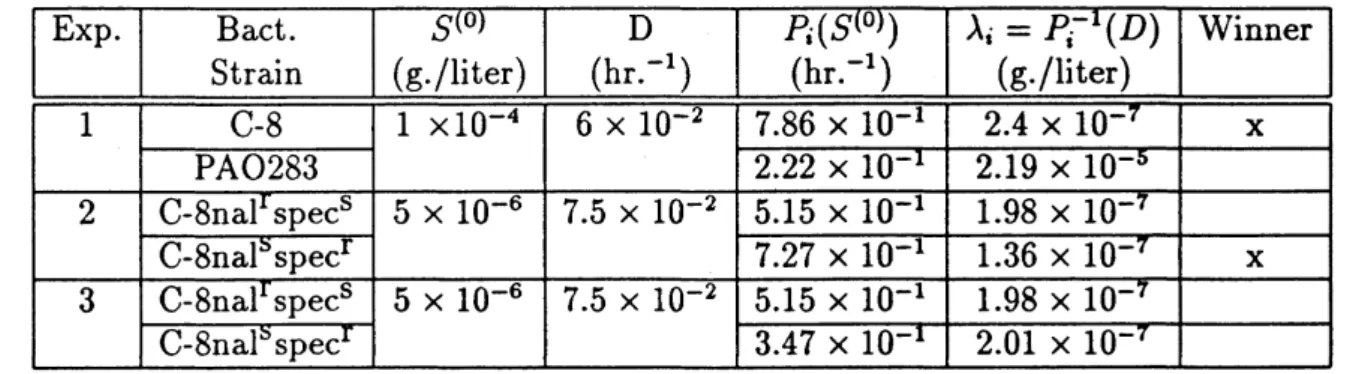
The best known series of laboratory experiments preformedfor thepurpose oftestingthe
validity of the chemostat equation werecarriedout by Hansen and Hubbell [HH].A summary
of their experiments is given in Table below. The parameters of the model were measured
by growing each of the competitors separately on the growth-limiting nutrient tryptophan
and assuming Michaelis-Menten functional responses. In Experiment 1,
C-8
is a particularstrain of Escherichia coli and
PAO283
isastrain of Psuedomonas aeruginosa. In Experiment2, the competition was between two variants of C-8, one which is resistant to the inhibitor
naladixic acid but susceptible to spectinomycin, and the other the reverse. In both of these
experiments, the species predicted to win by the model did indeed win even though it
was
originally inoculated into the growth vessel in a much smaller amount than the predictd
los-er. In the third experiment, the C-8 variants were used again, but naladixic acid was added
to the culture medium in the proper amount so that the parameters $\lambda_{i}=P_{1}^{-1}(D),$$i=1,2$
coexist in the growth vessel for as long as the experiment was run (120 hours).
Table 5.1 Summary ofHansen-Hubbell experiments
Inspired by the Hansen-Hubbell experiment, Lenski and Hattingh [LH] construct the
fol-lowing model describing the competition in a chemostat with external inhibitor. Let $P(t)$
be the concentration of external inhibitor, for example, pollutant or antibody. We
assume
the species 1 is susceptible to the inhibitor while the species 2 is resistant. Only species 2
consumes the inhibitor. Then the equations takes the form
$\mathcal{T}tdS=(S^{(0)}-S)D-\frac{m_{1}S}{a_{1}+b}x_{1}e^{-\lambda P}-\frac{m_{2}S}{a_{2}+b}x_{2}$
$\neq^{dx}t=(\frac{m_{1}S}{a_{1}+S}e^{-\lambda P}-D)x_{1}$
(2.2) $\neq^{dx}t=(\frac{m_{2}S}{a_{2}+S}-D)x_{2}$
$-\tau tdP\delta xP=(P^{\langle 0)}-P)D-\iota\neq+T$
$S(0)\geq 0,$ $x_{1}(0)>0$, $x_{2}(0)>0,$ $P(O)\geq 0$,
Where $P^{(0)}$ is the input concentration of the inhibitor.
In $[HsW1]$ the authors observed that the solution of (2.2) satisfies $S(t)+x_{1}(t)+x_{2}(t)=S^{(0)}+O(e^{-Dt})$ as $tarrow\infty$
$\neq_{t}^{dx}=(\frac{m_{1}(S^{(0)}-x_{1}-x_{2})}{a_{1}+(S^{(0)}-x_{1}-x_{2})}e^{-\lambda P}-D)x_{1}$
(2.3)
$\neq_{t}^{dx}=(\frac{m_{2}(S^{\{0)}-x_{1}-x_{2})}{a_{2}+(S^{(0)}-x_{1}-x_{2})}-D)x_{2}$
$\underline{d}P\delta x_{+}P\tau_{t}^{=(P^{(0)}-P)D-\infty}$
$0<x_{1}(0)+x_{2}(0)<S^{\langle 0)},$ $P(0)\geq 0$
.
Since (2.3) is a competitive system in $R^{3}$, from [Hir], [Sm3] we have Poincar\’e-Bendixson
Theorem. When the interior equilibrium $E_{c}=(xi,x_{2}, P)$ exists , we show that for large
$\lambda,$$\delta$ and small $K,$$E_{c}$ is unstable. Thus the coexistence occurs in the form of periodic
solutions
3
Coexistence
In this section we shall search for possible reasons for coexistence which is aften observed in
the nature.
I.
Assume $S$ is the prey which grows logistically. Consider the following “model” equationfirst studied by Koch [Ko] and then analyzed in [HHW3]
$7^{\frac{S}{t}}d=rS(1_{K}^{S}-)- \frac{m_{1}S}{a_{1}+S}x_{1}-\frac{m}{a_{2}}+Ls_{F^{X_{2}}}$
$\neq^{dx}t=(\frac{m_{1}S}{a_{1}+S}-D_{1})x_{1}$
(3.1)
$\neq^{dx}t=(\frac{m_{2}S}{a_{2}+S}-D_{2})x_{2}$
$S(O)>0,$ $x_{1}(0)>0,$ $x_{2}(0)>0$
(H1) $0<\lambda_{1}<K$, $\lambda;=\frac{a_{i}D_{:}}{m_{1}-D:}$, $i=1,2$
Theorem
3.1
: (Extinction) Let (H1) hold and $b_{i}= \frac{m:}{D_{:}}$,
$i=1,2$.
If(3.2) $a_{1}<a_{2}$, $b_{1}>b_{2}$ or
(3.3) $a_{1}<a_{2}$
,
$b_{1}<b_{2},$ $K< \frac{b_{1}a_{2}-b_{2}a_{1}}{b_{2}-b_{1}}$then $\lim_{tarrow\infty}x_{2}(t)=0$
To understand the dynamics of (3.1), we need to study the two-dimensional Predator-Prey
system.
$7^{\frac{S}{t}=\gamma S(1-}K^{)-\frac{mS}{a+}}F^{x}dS$
(3.4) $Tt+T^{-D)x}d_{X_{-=(\frac{m}{a}}}S$
$S(O)>0,$ $x(O)>0$
Theorem 3.2 : Let $0<\lambda<K,$ $\lambda=\frac{aD}{m-D}$
.
(i) If$\frac{K-a}{2}\leq\lambda$ then the solution $S(t),$ $x(t)$ of (3.4) satisfy
$\lim_{tarrow\infty}S(t)=\lambda$, $\lim_{tarrow\infty}x(t)=x^{*}>0$
(ii) If$\frac{K-a}{2}>\lambda$, then there exists a unique limit cycle.
Insterested readermayfind the proof of(i) in [HHW3] and that of(ii) in [Ch].
Condiser
ourone prey-two predators system (3.1), we have the following
extinction
results.Theorem 3.2: Let (H1) holdand either(3.2) or (3.3) hold. Then the solution $\{S(t),x_{1}(t),x_{2}(t))$
of (3.1) satisfies.
$\lim_{\ellarrow\infty}S(t)=\lambda_{1}$
$\lim_{\ellarrow\infty}x_{1}(t)=x_{1}^{*}>0$
$\lim_{tarrow\infty}x_{2}(t)=0$
(ii) If$\frac{K-a_{1}}{2}>\lambda_{1}$ then the trajectory $(S(t)\cdot x_{1}(t), x_{2}(t))$ approach the unique limit
cycle $\Gamma_{1}$ in $S-x_{1}$ plane except the one dimensional stable manifold of $(\lambda_{1}, x_{1}^{*},0)$
In [HHW2], the numerical studies shows that under the assumption $0<\lambda_{1}<\lambda_{2}<K,$ $a_{1}<$
$a_{2},$ $b_{1}<b_{2},$ $K>rightarrow^{ba_{2}-b_{1}ab-b}$, varying $K$ from $\infty ba_{2}-b_{1}ab-b$ to infinity produces a family of
positive periodic solutions emerging from $\Gamma_{1}$ and decending to $\Gamma_{2}$
.
Recently [MR] Muratorassume the parameter $\gamma$ is large and apply the singular pertubation technique to justify
the phenomena. Butler and Waltman [BW] apply the result in [Ch] to show that when $\Gamma_{1}$
becomes unstable, there is a familyof positive periodic solutions bifurcating from $\Gamma_{1}$
.
Smith[Sm2] also shows the existence of positive solution by Hopf bufurcation. Next we consider
one nutrient-one prey-twopredatorsin the chemostat. The equations take thefollowing form.
$dSTt=(S^{(0)}-S)D- \frac{m_{1}S}{a_{1}+S}x$
$- \tau tdx=(\frac{m_{1}S}{a_{1}+S}-D-\frac{m_{2}y}{a_{2}+x}-\frac{m_{3}z}{a_{3}+x})x$
(3.5) $\neq_{t}^{d}=(\frac{m_{2}x}{a_{2}+x}-D)y$
$7^{\frac{z}{t}}d=( \frac{m_{3}x}{a_{3}+x}-D)z$
$S(O)\geq 0,$ $x(O)>0,$ $y(O)>0,$ $z(O)>0$
The behavior of solutions of (3.5) is similar to that of (3.1). Interested reader may consult
[BHWI]
$\Pi$
.
Periodic input and periodic washout rate when the imput concentration is a periodic$dSTt=( \varphi(t)-S)-\frac{m_{1}S}{a_{1}+S}x_{1}-\frac{m_{2}S}{a_{2}+S}x_{2}$
$\neq^{dx}t=(\frac{m_{1}S}{a_{1}+S}-D)x_{1}$
(3.6)
$\neq^{dx}t=(\frac{m_{2}S}{a_{2}+S}-D)x_{2}$
$S(O)>0,$ $x_{1}(0)>0,$ $x_{2}(0)>0$
In [Hsu2], we study the extinction, persistence of the solutions of (3.6) for the special case
$\varphi(t)=S^{(0)}+b\sin\omega t$
.
A numerical study shows thecoexistence ispossible in the b-wparam-eter region. Smith [Sml] shows the existence of $\frac{2\pi}{w}$periodic solutions by Hopf bifurcation
Hale and Somolinas $[HaS]$ observe the relationship $S(t)+x_{1}(t)+x_{2}(t)=\Phi(t)+o(e^{-\alpha\ell}),$ $\alpha>$
$0,$ $\Phi(t+w)=\Phi(t)$ and reduce the dynamics of (3.6) to a competitive, periodic two
dimen-sional system
$\neq^{dx_{l}}=(\frac{m_{1}(\Phi(t)-x_{1}-x_{2})}{a_{1}+(\Phi(t)-x_{1}-x_{2})}-D)x_{1}$
(3.7)
$\neq^{dx}t=(\frac{m_{2}(\Phi(t)-x_{1}-x_{2})}{a_{2}+(\Phi(t)-x_{1}-x_{2})}-D)x_{2}$
and apply the results obtained by de Mottoni and Schiaffino [MS] which states any solution
of two-dimensional, periodic, competitive system approaches to a periodic solution. For the
appliction to industrial waste water in Chemical Engineering, the dilution rate is periodic.
$- \tau tdS=(S^{\langle 0)}-S)D(t)-\frac{m_{1}S}{a_{1}+b}x_{1}-\frac{m_{2}S}{a_{2}+S}x_{2}$
$\neq^{dx}t=(\frac{m_{1}S}{a_{1}+b}-D(t))x_{1}$
(3.8)
$\neq^{dx_{l}}=(\frac{m_{2}S}{a_{2}+S}-D(t))x_{2}$
$S(O)\geq 0,$ $x_{1}(0)>0,$ $x_{2}(0)>0$
Where $D(t)=q(t)/V,$ $q(t)$ is the periodic flow rate with periodic $w$
.
Use the relationship$S(t)+x_{1}(t)+x_{2}(t)=S^{\langle 0)}+O(e^{-dt}),$ $\alpha>0$
.
We reduce the dynamics of (3.8) to(3.9)
$\neq^{dx_{l}}=(\frac{m_{2}(S^{(0)}-x_{1}-x_{2})}{a_{2}+(S^{(0)}-x_{1}-x_{2})}-D(t))x_{2}$
$x_{1}(0)>0,$ $x_{2}(0)>0,$ $x_{1}(0)+x_{2}(0)<S^{\langle 0)}$
As in (3.7), (3.9) is also a two dimensional, periodic, competitive system. The solution of
(3.9) approaches a periodic solution. In the following,
we
state the results of coexistence in[BHW2].
Theorem
3.4
: Let $m_{2}$ be a bifurcation parameter. Thereexistsa continuous one-parameterfamily of positive w-periodic solutions connecting $E_{1},$$E_{2}$ where $E$; is the unique positive
w-periodic solution on $x$;-axis.
III.
Gradostat and unstirred chemostatGradostat is a concatenation of chemostats, designed by Lovitt and Wimpenny [LW] to
Fig. 1
$R=Reservoir$
$C=$ Collecting Vessel
The mathematical analysis for the growth of a population in a gradostat was given by Tang
[T]. Competition oftwo population in the two vessels case wasstudied by Jagerat al [JTSW]
and acomplete classification of limiting behavior was givenincluding the caseofcoexistence.
The equationsoftwo species competition in alinear-chained n-vessel gradostat take the form:
$\frac{dS_{i}}{dt}=(S_{1-1}-2S;+S_{i+1})D-U;f_{u}(S_{i})-V_{j}f_{v}(S_{i})$
$\frac{dU:}{dt}=(U_{i-1}-2U;+U_{i+1})D+U;f_{u}(S_{i})$
$7tdV_{i}=(V_{j-1}-2V_{i}+V_{j+1})D+V_{i}f_{v}(S_{i})$
(3.10)
$S_{i}(0)\geq 0$, $U_{i}(0)>0$, $V_{1}(0)>0,$ $i=1,$$\ldots n$
$S_{0}=S^{(0)}$, $U_{0}=V_{0}=0$, $S_{n+1}=U_{\mathfrak{n}+1}=V_{n+1}=0$
$f_{u}(S)= \frac{m}{a_{u}}\lrcorner+^{L}TS$ $f_{v}(S)= \frac{m_{v}S}{a_{v}+S}$
Where $S_{i}(t),$ $U_{i}(t),$ $V_{i}(t)$ are the concentration ofnutrient, u-species, v-speciesat i-th vessel
at time $t$ respectively.
including (3.10) as a special case. They classify all possible cases by the sets of equilibria.
Sufficient conditions for two species to coexist in the gradostat are derived using the theory
of monotone dynamical systems and global bifurcation theory. Numerical computations
re-quired to verify the hypotheses of the coexistence results suggested the coexistence is more
likely as the number of vessels increases.
When $n$ becomes larger, it is harder to analyze (3.10). In $[HsW2]$ we remove the
“well-stirred” hypothesis in chemostat and construct the model for two species competition in
unstirred chemostat.
$Tt \partial S=d_{x}^{2}\frac{\partial}{\partial}\nabla s_{-\frac{m_{1}S}{a_{1}+b}U-\frac{m_{2}S}{a_{2}+S}V}$
$\mathcal{T}t\partial U=d\frac{\partial^{2}U}{\partial x^{2}}-\frac{m_{1}S}{a_{1}+S}U$ $0<x<1,$ $t>0$
$\mathcal{T}t\partial V=d\frac{\partial^{2}V}{\partial x^{2}}-\frac{m_{1}S}{a_{1}+S}V$
(3.11)
$Tx\partial S_{(t,0)=-S^{\langle 0)}}$ , $\partial^{\frac{S}{x}(t,1)+\gamma S(t,1)=0}\partial$
$\tau_{x}^{(t,0)}\partial U=0$ , $\tau_{x}^{(t,1)}\partial U+\gamma U(t, 1)=0$
$\tau_{x}^{(t,0)}\partial V=0$ , $\tau_{x}^{(t,1)}\partial V+\gamma V(t, 1)=0$
$S(O, x)=S_{0}(x)\geq 0$, $U(0, x)=U_{0}(x)\geq 0,$ $V(O,x)=V_{0}(x)\geq 0$
.
Here we assumethe equal diffusions for nutrient and speciesfor mathematical reasons. With
the equal diffusions, we have
$S(t, \cdot)+U(t, \cdot)+V(t, \cdot)=\varphi(\cdot)+O(e^{-\alpha t})$
as $tarrow\infty$ for some $\alpha>0$,where
$\varphi(x)=S^{(0)}=(\frac{\gamma+1}{\gamma}-x),$ $0<x<1$
$Tt \partial U=d\frac{\partial^{2}U}{\partial x^{2}}+\frac{m_{1}(\varphi(x)-U-V)}{a_{1}(\varphi(x)-U-V)}U$
$\frac{\partial V}{\theta t}=d\frac{\partial^{2}V}{\partial x^{2}}+\frac{m_{2}(\varphi(x)-U-V)}{a_{2}(\varphi(x)-U-V)}V$
(3.12) $\partial^{\frac{U}{x}(t,0)=0}\partial$ , $Tx\partial U_{-(t,1)+\gamma U(t,1)=0}$
$\frac{\partial V}{\partial x}(t, 0)=0$
,
$\frac{\partial V}{dx}(t, 1)+\gamma V(t, 1)=0$$U(O, x)=U_{0}(x)\geq 0$, $V(O,x)=V_{0}(x)\geq 0$
$U_{O}(x)+V_{0}(x)\leq\varphi(x)$
for
$0<x<1$
The system (3.12) generates a monotone flow. We apply the persistent theory in infinite
References
[BHWI] G. J. Butler, S. B. Hsu, and P. Waltman, Coexistence
of
$\omega m\mu ting$ predators in achemostat, J. Math. Biol., 17(1983), pp. 133-152.
[BHW2] G. J. Butler, S. B. Hsu, and P. Waltman, A mathematical model
of
chemostat with periodic washout rate, SIAM J. Appl. Math. Vol45, No. 3(1985) 435-449.[BW] G. J. Butler, and P. Waltma,
Bifurcation froma
hmit cycle inatwopoey onepoedator ecosystem modeled on a chemostat, J. Math. Biol., 12 (1981), pp. 295-310.[Ch] K. S. Cheng, Uniqueness
of
a limit cyclefor
a predator-prey system, SIAM J. Math.Anal., 12 (1981), pp. 541-548.
[CHH] K. S. Cheng, S. B. Hsu and S. P. Hubbell, Exploitative competition
of
two micro-organismfor
two complementary nutrients in continuous culture, SIAM J. Appl. Math.(1981) 422-444.
[FS] A. G. Fredrickson and G. Stephanopoulos, Microbial competition, Science, 213
(1981),pp. 972-979.
[Hir] M. Hirsch, System
of differential
equations which are competitive or cooperative I.. Limitsets, SIAM J. Appl. Math. 13 (1982) p. 167-179.
[H] G. E. Hutchinson, An Introduction toPopulation Ecology,YaleUniv.Press, New Haven,
CT, 1978.
[HaS] J. K. Hale and A. S. Somolinos, Competition
for
fluctuating nutrient, J. Math. Biol.18 (1983)p. 255-280.
[HaW] J. K. Hale and P. Waltman, Prersistence in
infinite-dimensional
systemSIAM J.Math. Analysis 20 (1989) 388-395.[HH] S. R. Hansen and S. P. Hubbell, Single nutnent microbial competition; agreement between experimental and theoretical
forecast
outcomes, Science, 20 (1980),pp. 1491-1493.[Hsul] S. B. Hsu, Limitingbehavior
for
competingspecies, SIAM J. Appl. Math.,34 (1978),pp. 760-763.[Hsu2] –, A competition model
for
a seasonally fluctuating nutnent, J. Math. Biol., 9 (1980),pp. 115-132.
[HHWI] S. B. Hsu, S. P. Hubbell and P. Waltman, A mathematical theory
for
single nutrientcompetition in continuous cultures
of
microorganisms, SIAM J. Appl. Math., 32 (1977),pp. 366-383.
[HHW2] –, A contribution to the theory
of
competing predators, Ecol. Monogr., 48 (1978), pp.337-349.
[HsWl] S. B. Hsu and P. Waltman: Analysis
of
a modelof
two competitors in a chemostat with an extemal inhibitor, SIAM J. Appl. Math. Vol52 No. 2 p. 528-540 (1992).[HsW2] –, On a system
of
reaction-diffusion
equations arisingfrom
competition in an unstirred chemostat, SIAM J. Appl. Math. (to appear)[JTSW] W. Jager, J. So, B. Tang and P. Waltman, Competition in the gradostat, J. Math. Biol. 25 (1987) p. 23-42.
[Ko] A. L. Koch, Competitve coexistence
of
two predators utilizing the same prey under $con-$stant environmental conditions, J. Theoret. Biol., 44(1974), pp. 378-386.
[LH] R. E. Lenski and S. Hattingh, Coexistence
of
two competitors on one resource andone inhibitor; A chemostat model based on bactena and antibiotics, J. Theoret. Bio. 122
(1986) p. 83-93.
[LW] R. W. Lovitt and J. W. T. Wimpenny, The gradostat: a bidirectional compound chemostat and its application in microbiological research, Gen. Microbiol. 127 (1981) p.
261-268.
[Mo] Monod, Recherehes sur la croissance des cultures bactertennes, Hermann, Paris, 1942.
[MR] S. Murator and S. Rinaldi, Remarks on competitive coexistence, SIAM J. Appl. Math.
(1989) Vol. 49, No. 5, p. 1462-1472.
[MS] Mottoni P. de and Schiaffino A., Competition systems with periodic coefficients, $A$
geometric approach, J. Math. Biol. 11, 319-335 (1981).
[P] E. O. Powell, Critena
for
thegrowthof
contaminants and mutants in continuous culture,J. Genet. Microbiol., 18 (1958), pp. 259-268.
[PC] E. B. Pike and C. R. Cuids, The microbial ecology
of
activated sludge process, inMicrobial Aspects of Pollution, G. Sykes and F. A. Skinner, eds., Academic Press, New
York, 1971.
[Sml] H. L. Smith, Competitive coexistence in an oscillating chemostat, SIAM J. Appl. Math.,
40 (1981), pp. 498-522.
[Sm2] –, The interaction
of
steady state and Hopfbifurcation
in a two-predator-one-prey competition model, SIAM J. appl. Math., 42 (1982), pp. 27-43.[Sm3] –, Periodic orbits
of
competitive and cooperative systems, J. Differential Equations 65(1986), p. 362-373.
[SFA] G. Stephanopoulos, A. G. Fredrickson and A. Aris, the growth
of
competing $mi-$crobial populations in a CSTR with periodically varying inputs, AIChE J., 25 (1979), pp.
863-872.
[STW] H. L. Smit h, B. Tang and P. Waltman, Competition in an n-vessel gradostat, SIAM
[T] B. Tang, Mathematical investigation
of
growthof
microorganisms in the gradostat, J. Math. Biol. 23 (1986) p. 319-339.[V] H. Veldcamp, Ecologicalstudies with the chemostat, Adv. Microbial Ecol., 1 (1977),pp. 59-95.
[WHH] P. Waltman, S. P. Hubbell and S. B. Hsu, Theoretical and experimental investigations
of
microbial competition in continuous culture, in Modeling and Differential Equations in Biology, T. Burton,ed., Marcel Dekker, New York, 1980.[WL] G. Wolkowicz and Z. Lu, Global dynamics