BILINGUAL十EDUCATION
IN犬THE
UNITED
STATES
AND
EUROPE
:
ダ THE CULTURAL
CONTRAST …
… : ‥ ‥‥‥‥
Patrick Blanche 十 ∧
Faculty of Huma戒ties and Ec卵り前心, Departm回しof InterculturaトC回卵田両肘i皿
Abstract : This i〕aper〉is I summary presentation of the different contexts inトwhich thirty-two European nations are pursuing the goals of bilingual crosscultural education. The
very diversity of Europe underscores the geopolitical dimension of such goals in a continent that comprises both immigration and emigration countries : this component is described first. Then the author brief!y examines t恥public policy component at the level of the European Communities (the EU 芦nd the Council (jf Europe), as well as the sociolinguistic aspects of :bilingual education in the corresponding・ geographical ・areas.
しBilinguaトEduca-tion guidelines : for Europe tend to ・be predicated on the Interculturat HylHithesis,a comprehensive sociological option linked to the concepts of sociocu!tura!・ insertion and
positive discrimination. Intercultural education is viewed by Europeans as a dynamic process involving a world-oriented approach to teaching conceived as an apprenticeship in \ mutual understanding and:crossfertilization. This approach may be unique・ in some ways, and may also have a number of implications for America. \ \ j ‥
上 INTRODU・CTK
“Ifyou want to get ahead, get a theory"1 i'sa common piece of advice・thφse days. Yet in the
field of bilingual crosscultural educationトthe recommendation seems to have beenヶlargely ignored⊃in
the United States. As Banks notes, “Concepts such犬as multicultural education, multiculturalism,
multi-ethnic ed・ucation, ethnic education, ethnic studiesにcultural pluralism, and ethnic pluralis・mare
often used interchangeably or to convey different but high:1yambig面面meaningが.2 Thus, '‘Some of
the problems in multiethnic education Γむsuitfrom conceptual and ideological confusion… These
questions must be better clarified and resolved before we can design and implement more effective
and justifiableprograms ・related to ethnic diversity in Americaリ ・Likewise, Appleton writes,“The
United States appears to be on the verge of embracing cultural: pluralism as a social ideal...
Unfortunately, at present the ideal 0f cultural pluralism…is plagued withトambiguity, generality and
confusion,・pa此icularly in educational circles".4 < \ ・. .・十 上
/ ltトmay be that bilingual educators and researchers in the United States have developed a
limited view of their work from a failure to interact with and learn from colleagues in other parts of
the world. The aim of this paper is to afford a contrastive overview of the international・,political,
卸d socio・linguisticcontexts in which thirty-two European nations・^ are pursuing the goals of
bilingual crosscultural education. Indeed the geopolitical dimension of these goals is underscored
52 Res. Rep. ・Kochi Univ. Vol.42 (1993) Hum
their com皿unities,the representatives of the Council of Europe have developed a/ theory of their
own, the Intercultural Hypothesis. Some of its implications will be briefly discussed insofar as it
paral!els the cultural pluralist ideology that has been evolving in 八merica。
The above considerations might Soリnd too philosophical and remote to be of practical value.
This writer does realize that the American bilingual education movement would very much want to
have more information about such questions as how program しexit/entryare determined, how literacy
in the firstand second language is introduced, and what training requirements there are for teachers
in Europe. Regrettably, this type of information cannot possibly be presented in summary form. In
addition, the author feels that, as Baptiste and Baptiste put it,“Multicultural education must ・be
regarded as・a philosophy, as a ぱocess which guides the total education enterpriseソノTheしEuropean
perspective is probably worth a few words of explanationトalong these linesよ
THE DEMOGRAPHIC AND GEOPOLITICAL DIMENSIONS
The problem of educating the“childreり of migrants"7 has long been a dif恥ult one and one ・of
worldwideトimportance in four aspects 一political, social, economic, and educational. This is
especially true of Europe, which comprises both immigration and emigration countries and which, for
well-known historical reasons, has not experienced the “melting pot"phenomenon that is part of
America's makeup. ノ フレ ト
Todayトmillionsof European children are involved in this situation,and the schools concerned
are confronted with a massive difficulty. A recent survey among London children, for eχample,
identified 131 home languages ; 14% of all pupils, in fact, were bilingual.ト
I Recent (im)migration trends in the EU are shown in Table 1.\ つ
The total“foreign" population of the EU countries had exceeded 10 million by the 197O's.
This figure does not include recently naturalized citizens in the respective “host states".9
In 1980, the total population of the United States was estimated at 226,547,000 by the U. S.
Census Bureau
"that of the EU was nearly 255 million. There were slightly more than 14 million
foreign-born residents incl 「細g naturalized citizens (6.15% of the population), but ・slightlyless thar!
7 million reが仙?red aliens (3.08% of the population) in America. The corresponding number of
registered aliensトwas in excess of 11 million (morethan 4.4% of the population) in the EU.
十In 1979, however, 7% of the population of France was made up of resident aliens. Belgium
had 9.4%, and Luχemburg over 20%. Moreover, the immigrant population of each European country
was extremely varied. In France it included large numbers of Portuguese, Algerians, and
MoroccansへGermany had many Turks and Yugoslavs. The United Kingdom had Indians,
Pakistanis√andぺiVest Indians. 尚
The considerable increase in unemployment in all the industrial nations after 1973 has not
made things easier for Europe, because it has reduced employmentトopportunities in the immigration
countries without increasing 哨emin the emigration countriesレ Even the aim of founding a new
world order gives little hope for significant changes in the near future. Several countries have
greatly reduced or even 斗opped the entry of foreign workers, yet the number of immigrant children
. ︵ 十 ∼ 9 f f : n a ︶ s u a i p p a J S l s i S s j ︵ % 8 0 ' £ ) 0 1 6 ' 9 ^ 1 ” ° 1 ” 1 ' s u a z i ^ p p a z i [ \ 3 j i n i 3 u g u i p n p m s ^ u a p i s a j u j o q -u S r a j o j t e i ' g ) 0 8 0 ' t T W ' * ' ( £ 8 Z ' g S Z : 0 3 ︶ L K ' 9 Z Z S E M 0 8 6 1 ° ! s a j E l s p s i r a f l ^ i R -" O J ^ J f ^ i f u o 晋 一 n d o d i E } 0 } a m ' n E a j n g s n s u a g ・ § ・ n a m o i S u i p j o o o v : a j o / V s j o m n y ■ s i U E u S r a s u g s a p a u u a a d o j n g a o p B i D O s s y : a o u u j j ' s i j b j ・ ( 2 ^ -6 9 . 巨 ︶ s } U D X s i u i s x n a m v i i V A j d v s : i 6 ∼ ? s a p u o i : } V S i A V i O 3 S v j . ︵ 回 ∼ ︶ 1 ' 3 3 Z J \ 3 M : a i A t W g 0 9 9 ' I Z-996 £ ' Z Z 四 Q q − − ︱ ︱ ︱ ︱ − − ︱ ︱ ︱ 1 1 1 1 1 1 1 − − − − − − − ︱ − ︱ − ︱ − ︱ ︱ ︱ ︱ ︱ ︱ ! 0 6 V r t ⋮ 呂 ︷ − ︱ ︱ − 9 祠 誘 C Y つ ⊂ ) r − i 回 9 宅 ︱ ︱ − ︱ ・ い ぷ S 8 u ︸ u n o ' ) J 3 U 1 0 − − ︱ − − − ︱ − − ︱ ︱ − ︱ ︱ i ︱ 1 1 1 1 1 − − ︱ ︱ − 1 − ︲ − ︱ − ︱ − 1 − 1 1 1 B i s i u n T ︱ 1 1 1 1 a o 9 9 J 3 − − − − ︱ − ︱ − − − − − − 0 3 3 0 J 0 W つ → 8 ' O T 1 − ︱ ︱ − − ︱ − − − ︱ ’ 9 鴎 1 1 1 1 1 1 1 1 1 1 1 斜 ︱ ︱︱ ︱1 11 11 9 四 − − − − r s 9﹃ ︱ 11 11 11 11 OJ 四 s ' l e i − ︱ ︱ ︱ − I f t L − − − ︲ − − t − − ︱ ︱ ︱ ︱ f T 8 I 9 ' t 8 I − ︱ − ︱ − − − − ぱ あ I ︱ − ︱ ︱ ︲ − 1 穴 ? 函 ︷ − ︱ ︱ ︱ − 穴 ∼ − − − − − ∼ 品 1 11 11 11 11 9 ' I ︱ I 1 − I 1 − ︱ ︱ f Z 5 S C ` 1 あ 9 ︷ 1 1 1 − 1 ∼ 器 − ︱ ︱ I I ∼ 凪 1 ・ | . ・ | 1 1 1 i−︱−−︱− − − − ︱ ︱ − − ︱ ︱ − ︱ 1 1 1 1 1 1 1 1 1 E i A B i s o a n x J 8 U U 0 j ︲ ︱ ︲ ︱ ︱ − − − − − − − − ︱ − ︱ ︱ − ︱ − r e 3 n } j o j ︱−︱−−−−−−︱︱︱︱︱︱︱︱111111111111 Aajjanx 1 1 1 − I t − 1 1 1 − 1 1 1 1 1 胞 C り → C N J 吋 i Q こ 〉 吋 ` ︱ − − − − − ︱ ︱ − 9 胆 寸 1 1 − j − ! 呂 い つ ← C ね C り C O つ ミ ← C < 1 Q つ 1 こ ) つ ぷ ﹃ ︱ ︱ − − 9 f ・ − − − − 9 鵬 あ︷ ︱ 詰 − ∼呂十 苫︷ Z'SI 咀ぶ tS'Z ∼つ︷十 芯.﹃ い 函 ・ ︱ ︱ ︱ − ︱ g ' 9 S − l O t ' l − z n − % 8 -C り 苫 ← 9胞 11111111 ﹃︵︶6S 819'I Z'SSt %ZII Z'IZO'Z L O 5 1 つ e n C < 1 9 認 I 品 g T u i s a u j u n o Q n a " ' ^ ° N m o -i j s a s X o i d u i g u a i i v 回 I 0 8 6 1 ^ ! S 3 u ; n n o 3 Q g J S ^ O i i o -i j S 3 3 A o ] d u i g n s i j y % I S 十 S Z 6 T J O ' Z Z 6 T ' T Z 6 I ^ ^ ” i s 3 s b 3 j d 3 ( j j o 8 S E 8 j o u i -Olt t − ZO9'I − ∼5Z.? に︵︶J − ︵蔚に︶ ∼ ︷ 一 S 9 9 ' I ︱ ∼ 9 ' Z ︵︷曽ど︸ ∼四 會﹁邑 ∃y 十︵略︶ぷ︶ 十言り︷︷︸ ssz'ssz つ → Ξ目蓉 ͡.͡ 恰゜`1尚 % r v 7 . 7 。 1 O Q L ' Z i ∼ f g e s f -1 1 9 ' £ l 0081 − r?.?. 1 °m十 ﹃IS − ∼riR 函お L r ) お に 卜 L r ) C Y つ ︱ ∼認︱ 召に i 6 0 9 5 9
回曽諮
に認 CNl ZLZI 諮 ( 刀 C ) ← つ ← ∃ Ξ g 卜 ( コ I L r つ ば つ ミ ぴ う 7 1 C り c r > ミ つ U つ ∼ 0 0 0 1 9 W ' 1 8 8 9 ' 6 − % 9 ' 9 Z 9 6 ' £ 詞 覗 ︵ ︶ f ︶ L'?.?. l rn − %zz十 浮 ∼いぷ 為 況s − s?︷ C・つQ 呂バ` L口 9 ' Z £ S − % 8 ' t l ^ 9 Z O S l ' l 首 ( 刀 回寮 ”. a> A U E U U a n p u E i s j T 3 0 U B J J 1 0 D n q n d a j r s j E u i u a n u i n i g p a r e j a p a j 品 g T u i s a s X o i d u i a u s n v p a j a j s i S a j i r e ^ O T J O 3 3 e ; u 3 3 J 3 J ︱ S U 9 1 1 V I f i Z f i l ° ' f l J a p u r i S U 0 S J 3 J S u n o i j o j a q m n N I B J O T 1 0 3 3 E J U 3 D J 3 J ︱ u o i j E j n d o j U 8 1 1 Y I 6 Z 6 I ” ! u o n e i n d o j i e ^ o x ・ s a j n S n a j q E j r e A E u n j o a j q i S i i S s u j o j p u B j s ︵ ⋮ ︶ j o ︷ I ■ s a } E r a q s 8 m o i j o i d u b j s ︵ + ︶ u 8 i s s n i d E A q p a A i o n o i s r e i o x . A v o i j < i 3 M } E i 3 j S I u o n B i n d o d n a i j E a s o i i A i ' j t r e n J O j s a j n S n a p n i a u i j o u o p s a s a q j n a J E d u i s j e ^ o x 。 ︷ 品 6 1 ■ i 3 ≪ ' 3 n a 。 D } P 9 U I 0 二 B S n v o d p n i 2 u i E d c ' 9 3 3 9 占 ︶ 品 6 1 P t i E 6 Z 6 I D ! n a ^ m ^ n o i i S n o j q T ( s u o s j a j j o s p u E s n o q x 岨 t T J a p u n S U 0 S J 9 J u a i i V S u n o j ^ p u E s j 3 3 [ j O j \ ^ u a i j y j o u o i ^ n q u j s i Q p n s s u o p B j n d o j n 3 i ] y : i a j q E X54 犬Res. Rep. Kochi Univ. Vol.42バ1993) Hum.
Workers who had already settled in the receiving country before the laws limiting
immigration were introduced were often there without their families; they are still
entitled t0 have their spouses and children j・ointhem. ニ
The birthrate of immigrant populations is much
higher than that of the receiving
countries. \.
Political events and humanitarian considerationsトhave led to further unforeseen
admissions of mostly Latin American and Asian refugees, as well as asylum seekers
from the emerging nations of Africaト ト \ 尚 上
The plight of Asian and East Eリropean refugees, in particular, shows that (im)migration as
seen from the poinレof view of its present rむgionaland international consequences in Europe and
America is ・actually a global problem largely depending on economic and political factors, which〉is
encountered in various forms in all continents and whose impact is intercontinental. ニ
THE PUBLIC POLI(
トIn November 1970, the Committee of Ministers of the Council of Europe issued a non-binding
resolution stating that :“Children of migrant workers should not lose their cultural and linguistic
heritage and should also benefit from the culture of the receiving country". Following up on the
work done in 1973 and 1974 for the ad hocConference on the Education of Migrants (Strasbourg,
1974), and on the basis of its recommをndation adopted ・by the standing Conference of European
Ministers of Education at Stockho!m in 1975, the Parliamentary Assembly of the Council 0fEurope
adopted Recommendation 841, after debate, in September 1978. In this document, one can read:
1。“...The socio-cultural development of migrants' children is closely linked with that
of the migrant familyよas a whole." \
2バ... Any policy on migrant workers and their families must be based on an adequate
knowledge of the phenomenon of migrationプ’十
6パ…States should promote the traini!Igof teachers wit!Ispecial responsibilities for
the education of migrant children and young personsグ 十 :
∇ On Julyダ・15,1977,1o the Council\^ of the European Communities adopted Directive ・77/486/ EEC, which is reproduced in Appendix A( This time, member states were instructed to support, in coordination withnormaledwcatiow,the teaching of the 常況船y£ongue and culture of the country of
origin for all thecHildrenfor whom school attendance was compulsory under the laws 0f the host stateトPrior to that, there was no landmark court decision related to civil rights or bilingual educatior!(such as the U. S. Supreme Court decisions in the召忽作叩.lobeliaBoardofEducatiぴmcase in 1954 and the Lauvs. Ntch-olse・asein 1974), there were no outbreaks of urban violence (such as the
riots which left Watts and other American "ghetto" areas in shambles in the 196O's), nor was there
any urge to implement important civilrights legis!ation(SuCh・as the passing by the U.SよCongress of
the Civil Rights Act of 1964). ト ニ \ = \
In this writer's opinion, the fa・ctthat Directive 7・7/486/EEC・ was quietly issued by the
executive branch of the European Union, and the fact that this was not done in response to the kind
of pressures that were prevailing in America・at that particular time, are highly significant.
THE SOCIOLINGUISTK
Linguistic phenomena are no longer regarded by European experts as having priority・
European schools by the year 2000 Wilトprobably have well-developむd programs for minority
languages, but only as one aspect of immigrant culture enhancement. Nevertheless, socio!inguistics
represents an instructional domain whose importance should continue to grow. Communication is
increasingly being viewed by Europeans as a social practice which includes language, itse!f a social
practice. \ 〈〉 ∧
One of tりe purposes of minority language programs・in Europe is to 齢ve students an
opportunity to becomefunctionaUybilingual―i.e。to help them to develop an active biling回廊m that
will make them feel at home in at least two cultures so t!latthey will be able, willing, and unafraid
to use theirトhome language(s)・in various situations. Yet the most essential aim of such instruction
should be to build up what linguists call“communication ability,”because anyone who is unable to
communicate adequately is going to be penalized by society. In terms of teacher training and
curriculum p・lanning,ダthisimplies further eχploration of the relationships between (1)language,
culture, and social structure, (2) language awareness 飢dl use, (3) identity formation, and, in the
partic叫ar case of tt!e bilingual child, (4トlinguisticレand coneやptual deVeIopment,‥‥‥‥ ‥‥
In addition, Europeans tend t0100kupon language as a plural, evolving phenomenon. It can
change from the place where it is spoken 一whether it be the language of the country of origin or the
host country. For instance, a large number of people who have moved from southern to northern
Europe come from the rural or semi-rural areas of their countries. They are, 0nthe whole, rooted
in thタir aboriginal culture. Thus in a Galician or Catalonian family the current means of
communication is usually not Spanish. The Finnish dialects spoken in Sweden afford a different
example. Whereas Finnish as spoken in Finland and in some parts of Sweden has undergone an
intense process of evolution, the dialect used by the population of Tornedalen in the Swedish county
of Norrbotten has retained 卸 archaic structure (m!ich like some of the Spanish dialects spoken in
the southwest of the United States), and has gradually absorbed many Swedish words denoting new
phenomena and concepts. ‥Fuけhermore, there is an important Lapp community in Tornedalen, so
the implications of special status 毎r①theTorneda・1-Finnish vernacular cannot be explored without
reference一to, amongダother things, the teaching ofしappish as a native minorityトlanguageレ∧
THE INTERCULTURAL HYPOTHESIS
Linguistic diversity is a fact of life "within the European UnionレIt is also one of the
56 Res. Rep. Kochi Univ. Vol.42 (1993) Hum.
education is concernec!, the model's underlying assumption derives from a pragma-linguistic and
communicative approach to the teaching and methodology of the host country's languageへWhat
such an approach signifies to immigrant children is that when they become adults they should be
able to decide freely to what extent they wish to integrate into the host country's culture and/or to
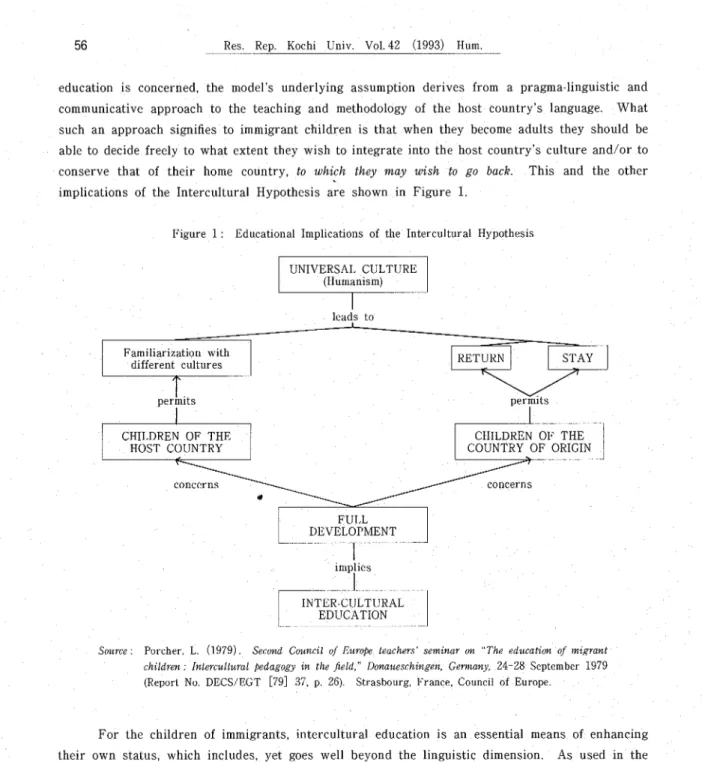
conserve that of their home country, 如圃Wch thりmaymsH togoback,犬Thisand the other
implications of the Intercultural Hy面thesis are shown in Figure 1.
Figure l : Educational Implications of the Interculturai Hypothesis
UNIVERSAL CULTURE
(Humanism)づ
Source : Porcher, L. (1979)。&c。d Council of EuTote. teachers'se。緬a7㎝“The education ofmigrant
children :みぬ回甫:ural peda即tgy in the field,"Donauesch治即n, Germany, 24-28 September 1979
(ReporトNo.DECS/EGT.(791.。37, p. 26). Strasbourg, France, Coun・ciトof Europe.上・ \
For the children of immigrants, intercultural education is an essential means of enhancing
their own status, which includes, yet goes well beyond the linguistic dimensionレAs used in the
Council 0fEurope, the term “multicultural" serves to describe phenomena (e.g・,European societies
are at present de facto multicultural), whereas“intercultural"implies an approach ,to action.
Interculturalism asserts the need for interaction betweer! the various CO皿ponents that make up
European societies and constitutes not only a point of reference, but also a method and a perspective.
It is a comprehensive sociological option. Therefore, it should be construed less as a・relationship
between cultures in the abstract sense than as a series of dynamic exchanges between individuals,
groups, and sub-groups of people and institutions negotiating a reallocation of resources within a
BILINGUAL EDUCATION IN THE UNITED STATES AND EUROPE: THEトCULTURAL CONTRAST (Blanche) 57
t
S
I
咀回当
回天
白
J
Q
ぴつ ぴ) Q μ4 切 O Q a 匹ぢ 自 l S Ξ ロ ・a ・四 回 回 .9 ち 4-J ・F4刎 .ヨ 川州 ヨ §? y M-i S 回 届 届 o 回 ●- zゴ j 4 眉 忿 .t=I Q J 』 1 ・W 1 1 Cη C] ぴつ ○川川州 o − j2 ●一 ぴつ ・ヨ 弓 a老 グ j ,
W l
j
咄 咄 Q 口 ]∩ U fF4 召 戻 Q CI ぶづ ご§右万万 ○ ・- i.4 4・ 白tILドド に .ョ a レ ぃ ∩ 4.祠 ●.祠 ・肖 ●肖 t じ コ O Q じ に O O Q O O .。 ぴI U Q ぴ7 ぴl.ぎ o
w sl s § ち・っ
ミF I 」に 1 レ回 且且
こ 2 さ t ぎ1 ぎF E? s
言 ∩ ∩∩ ∩ IL
j o m n v : a o u E j j ' S j n o q s E f l Q 。 ︵ 呂 . Q ︶ d 4 o j . n ^ m s d i u d -q o s u o v i v o n p a w A n : f i n o A 。 a : } u i u o u o x : } v u u o ︷ u % f a m -m p % t d 4 v A 。 0 ' ^ T S f i T 。 ︵ も 巴 . a a o j n g j o i p u n o f ) : d O A ^ n o ^ S T S 8 q : │ 0 Q A j j i E j n } j n 3 j 3 } u i a q ; j o s ^ u a u o d u i o ' ︶ ︰ J Q 当 切 に58 Res. Kochi・ Univ. Vol. 42 1・(1993)・Hum.
The scope of interculturalism is at once internationa卜and local. Moreover, it encompasses both the present and the future. Consequently, the field of reference and a雨間of interc!lltural education makes the bridging of generation gaps just as desirable as the removal 0f institutional, social・, and geographical barriers. For example, schools will in t・he future be increasingly attended byむhildren who belong to the second or the third generations of immigrants. Even though their school and out-of-school problems will take on a different form, they wi1[be influenced by today's attitudes.十 二 ト > ニ
Finally, the European model emphasizes the fact tねatダimmigration concerns not only immigrants themselves, but the whole community in botkthehostCOWTlt阿吽dtVie countりof origin 一therefore, the school experience of the Pakistani children in Britain, the Moroccans in France, and 幽e Turks in Germany should not be divorced from the economic reality of their parents' lives. In such a meeting between cultures, each culture is admittedly challenged, but is also enriched by the values of the other 一provided that it is receptive to other forms of cultural expression. The two bilingual education projects summarized in Appendix B would illustrate this view.
THE EUROPEAN PATH ;POSITIVE DISCRIMINATION AND SOCIOCULTURALINSERTION
The idea of intercultural education that the Council of Europe is proposing entails a
world-oriented approach to teaching conceived as an apprenticeship in mutual understanding and
crossfertilization. In prescribing such a formula as a dynamic process and as an objective of
international coUaboraion, the Council of Europe wishes to recog 「ze that all integration or
assimilation into the structures of the host country coリcぱns immigrants・on a personal level and
should reflect their own choices. Therefore, they should be enab!ed either to stay away from, 0rto
go back to their countries of origin under the best possible conditions. In this regard, the terms
“assimilation”or “integration” are ambiguous. Onlyイinsertion” ―in the sense of a balanced entry
into new structures― seems to be fully compatible with the interculturalist philosophy。
According to this philosophy, the bene丘ts of integration are inをvitablyoffset・by a loss of
certain categories of original values. But while it is vital to maintain aboriginal cultures by
associating the phenomenon of immigration with specific peoples, lands, and histories, the cultural
complexity of immigration can hardly be reduced to such maintenance alone. For instance, the
presentation of a changing society in the emigration coリntrymust be all the more updated as there
will be a natural temptation to cling to past images. Equality of:treatment is likewise not enough.
To treat equally a child who, by birth and fa皿ily environment is not the same as his native
schoolmates, would ultimately become a cause of further inequality between immigrant children and
those from the host country. That is why the governments of some European nations, notably the
Dutch government, have opted for the principle of "positive discrimination.”
In the Netherlands, the assimilation theory has even beenダconscioリsly rejected. Using the
words of the former Minister of Education and Science, Mr. Van Kamenade, “The Dutch Government
is trying everything possible to satisfy the legitimate claim of migrant parents to りave access to a
bicultural educationグ And it was soon agreed that in order to attain the desired level of bicultural
59
The problem certainly appears rather complex when one realizes that there were 48 dif恥re皿
nationalities represented in the schools 0f・Rotterdam in 1979. Furthermore, cultural diversity is not
confined・ to the hostダstate.・ Itis also necessary to take トinto account the ・coexistence 。0f different
cultura! expressions 飢d ・the presence ,0fin- and ouしmigration in several countries"of origin.・
Increasing mobility between European nations, the return of /alarge number 6f immigrants to their
homelands, and the interactions due to the contacts which many immigrants stillhave with their
original communities further complicate the issue. 犬 ‥ 十 ト ト
By choosing a卜elativelyリnknown path, in opposition to the "widely▽established ideal of
assimilation that was adopted in other parts of the world, European nations areトshowingthat they do
not fear difficulties. Their apparen:t∧resolve to abolish scholastic discrimination, coupled with the
叩quirement that original cultures be officiallyrecognized, often leads to delicately shaded and at the
same time highly complex differences of outlook. Rights and treat皿e皿Smust∧be equaトbut not the
same. In this respect, the centralized states areしhavingthe most problems in coordinating two
simulta・neous and often conflicting needs・Where curricula are ic!enticalfor all children throughout
the country, it is not easy to ensure both・that special characteristics are preserved and that・でourses
and examinations remain uniform. ト 1 1
IMI?'LICAT IONS FOj?AMEl?7C4
So what does all this have to do with bilingua卜education in the USA? It seems to this writer that a broader: understanding of multicultural education〉as the necessary background for bilingual programs could be achieved by considering theしdifferences, and also the similarities, between Europe and America. Five important differences Wilトbe reviewed first.
1.The larger Eur・opean community represented by the Council of Europe:compr1SeS‥‥‥‥ both emigration and immigration countries,ニmany of which are former∧colonial ニ powers. As a result, its immigrant population is relatively larger and may be even more heterogeneous and mobile than that of the United States. In addition, more \ European immigrants are able to manage close relationships withパ relatives and l friends±1 their countries of origin. 0n the other hand, Table 1 shows that ト immigration to Europe as a whole slowed dramatically in the mid 197O's, which = probably was not the case for immigration to America. Persistently high unemploy- 十ment rates in most European countr・ies are partly responsible for this situation. 2. Bilingual education in the United States is to a considerable extent an obligation: トderiving from a legal (i.e・,a iwdicial)lhandate13ニt㈲t came in respoリse to し
プ ‥‥‥‥‥extraordinary<Iocal pressures. By contrast, bilingual education :guidelines for Europe are the productトof a world vision. They were Sdしby the highest \ representatives of theexecutivebranches of the governments concerned, and this was ダ done in a rather spontaneous ・and orderly fashion. ..!n additioB, official collaboration between European nations leads todecisions with, internationalforcederiving from the governments' general foreign policy and not merelyしfrom their respective educational policies.一It is this type of cooperation that has brought・about the generalized use of
60 Res.
Kochi Univ. Vol. 42ト(1993)・Hum.
classrooms throughout Europe 一where some secondary schools have even recruited
十foreign≒counselors. プ∧ ・...
3. Europea:n interculturalism implies that immigrants should be able eithぴto stay in
thehost state 。rto go back to their homelands under the beかpossibleじonditions. To 上
theauthor's knowledge, such a sociocultural insertion mode卜hasnot been promoted
十inAmerica, not even along the Mexican :border. 上 十 ノ 犬
4. The一scope of European interculturalism is international, while the advocates of
"cultural・pluralism" in the United States have pretty・ m・uch restricted their ideology
tothe same country. According to Baptiste and Baptiste, “Cultural p!uralism
involvesthe natural eχchange ofコculture〉with叫ムastate of equal (joレexistence in a・
mutually supportive system within the framework of one nation of diverse groups of
peoplewith significantly different patterns of belief,lifestyle,color, and languageソ4 \
Appleton even writes,“Thus we do not think of the Common Market in Europe as
cultural pluralism becぽuSe上each member is considered to be∧a separate and \
犬 independent entity"15 (but then Appleton almost contradicts himself by stating that 十
“If the spirit of pluralism is to be followed, we ShoリId expect to develop not one
nationalmodel, but a number of regional and local models that皿eet the needs of ・
variousgroups"16)● し ・●
5.A somewhat different view is expressed by Banks, who feels that cultural pluralists 犬
have been exaggerating the differences between and∧among ethnic groups in
j America. Banks cites Gordon, who wrote that“Structural pluralism …is theヶmajor
key to understanding the ethnic makeup of American society, while cultural
pluralismis the minor oneプ17 This is interesting because the opposite o=fGordon's
belief would probably be true in :Europe√ although“cultural pluralism"and
“interculturalism" are not synonymoリSi\ \ ト
` Consequently,the general “cultura! pluralist" theory evolved in the United States would not
be out of place in Europe -but the particular“multiethnic ideology" that Banks proposes〉would seem
to better suit America. As it turns out, several similarities between the European and U!eAmerican
situations would highlight the features which the multiethnic and cultural pluralist theories have in
common. Three of these similarities are outlined below. 犬
し1.The most challenging implication of interculturlism for Europeans is likely to be the
enhancement of a value climate more accepting of diversity. In eduむation,this
means making all children more aware of the ethnic variety of〉Europe, more
appreciativeof the intrinsic worth of al1・cultures, and moreトinformed about the
diverseorigins of European society itselfレ18 Interculturalism Cal卜for the
develop- ment of less ethnocentric school curricula, textbooks, and other resources.
‘ニTherefore, educators will increasingly need to study the various political and social
interpretationsO卜“culturalpluralism" and related fields such as politicaland social
anthr・opology,sociology, and economics ―and this is something which the American つ
上proponentsof both the multiethnic ideology and cultural pluralism would agree with. 十
Accordingto Banks,“Multiethnic education is designed for all students, of all races,
BILINGUAL EDUCATION IN THE UNITED STATES AND EUROPE :T!{ECリLTURAL CONTRAST。(Blanche) 61
トethnically・ mixed populations"19 It iS・ needed as m・uch if not moreしby the
Anglo- American, middle-class, suburban child as it is by the MexicanこAmerican who !ives
in the barrio. It is a very broad concept that entails total school reform.・Likewise,
・ Baptiste and Baptiste claim that “Anything less than a process ・conceptualization of
multicultural education as an instruction・al delivery system designed to affect the
total・educative process,・is prone to limited utility and rapid obsolescenceソ9
2. Thus, both in the United ・States and in Europe,∧bilingua!十education is〉a
comprehensive course of action going beyond (the fairly rare and often selective)
spontaneous manifestations of openness towards other people, transcending the
purely folklore level of pizzas and paellas and taking account of what actually gives
differ・ent cultures their structures. This entire process must inevitably be〉guided
by the basic principle of strict equality, regardless of actu・al relative positions of
strength, between all cultures. Accordingly, its primary goal will be to preserve
一〇r,to be more accurate, to create一 unity of educational objectives and equality of
opportunity for native and・ immigrant childrenトWhereニthe objectives of bilingual
crosscultural education are concered, it follows that the specific content of one
culture must not be evaluated with the criteria and values of the other, for this
would be to regard the former as a lifeless object. And asよcrossculturaleducation
cannot be limited to the teaching and processing factual knowledge, the preferred
form of instruction should be the project.
3. Moreover, the principle ofコpositivediscrimination adopted by the Dutch government
has also been advocated in America. For instance, GoUnick and Chinn write,“It
will no longer be possible to teach a11 students in the classroo皿equa・ily because they
プare not the same. Thむy have different needs and skills that must be recognized in
developing educational programs. Each student is different because of physical and
mental abilities,sex, ethnicity or national origin,・religion, socioeconomic level, and
age",21 ニ \
CONCLUSIOl\戸
Thesimilarities and differences between the United States and the European Union can both
be expressed more easily on a conceptual level. In practical terms, similarities are likely to
outweigh differences. For example, the situation of Asian refugees in Europe may be a10tcloser to
theしAmerican situation than Europeans imagine. On balance, however, one gets the impression that
Europeans have displayed more political will,set clearむrgoals for bilingual education, and thatトu. s.
educators may have failed to capitalize on the vision of their European colleagues, even after
Cummins and others revealed the importance of the work being done in Swedenよー \ \
Afew words of caution are in order at this point American readers should not come away
with the mistaken notion that Europe as a whole is well on its way towards being a culture that is
not only multiethnic in Gomposition but egalitarian in practice as well. Within the European Union,
the Netherlands (like Sweden, which is not yet a member of the EU) may stillbe the exception rather
62 Res. Rep. KochトUniv. Vol.42 (1993) Hum.
expressed in the Intercultural Hypothesis and the school day reality of minority children in Europe・ A gap remains to be bridged (to varying degrees), and a 10t of work is yet to be done in each of the 32 nations represented in IStrasbourg. While a number of countries did start several large-scale projects designed to facilitate multicultural education, others ha・ve been slow in implementing the policies needed to respond to the special needs of immigrant children. ノ ・。 I ・ ゝ ●
So far as the EU is concerned, the official responses of皿ember states to the directives issued by the Council 0f Ministers have\no卜always∧been well-received. For example, Britain's initial reaction to the EU guidelines on bilingual・ education was widely labeled racist and assimil・ationist... in Britain itselfよThis illustrates the extent to which local interpretations of international directives
can affect t・heir outcomeよSuch directives are all too often difficult to・enforce, and if it turned out that a significant number of children Werかdenied the services guaranteed by theトexecutive arm of the EU, the U. S. right to:Sue・for enforcement of上the Bilingual Education Act would take on a different dimension. 犬 十 し
・One the other hand,・ the legislative・ decisions .reached in u. S. courts have frequently been time-consuming and costly. They can alsoしbe circumvented, or amended and partly reversed, especially if they do not appear to geじfulland constant support from the White House. Under these circumstances, bilingual educators in the U. S. would be well advised t0100kmore often beyond their
own borders. ∧ \ ト \‥
トNot all American educators are homebound. For instance, Banks writes, "The white race is a world minority…The school should present students… with cultural and ethnic alternatives,・and teach them to live in a world society that is ethnically and racially diverse…"23十And yet, to this writer (who has lived and worked in seven different countries), staterae皿S such as this one sound a bit too much like cries in the wilderness when they are made by residents of t!le United States.
・.・・・.. Appendi耳A ..
DIRECTIVE
77Λ486
/ EEC
Article 1. The Directive shall apply to cりildrenfor whom Sとhoolattendance is compulsory under the
laws of the host State, who are depend・ents of any worker who is a national 0fanother Member
十 State,where such children are resident in the territory of the Member State in which that
national carries十〇n・・orhaS・carriedぴn an activity as an employed ・person.
Article 2. Member States shall,inしaccordance with their national circumstances and legal systems,
take appropriate measures to ensure that free tuition to facilitateinitial reception is offered in
theirterritory to the children referred to in Article 1,including, in particular, the teaching
―adapted to the specific needs of such children― of the officialトlanguageor one of the official
尚languages of ・the host State. ご ∧ .・.
Member States shall take上the measures necessary for the training and further training of the
teachers who are to provide this tuitionレ \ コ
Articl召3. Member States shall,in accordance with their national circumstances and legal systems,
and in cooperation with States or origin, take appropriate measures to promote, in・coordination
with normal education, the teaching of the mot!ler tongue and culture of the country・ of origin for
Article 4. The member States shall take the necessary measures to comply with this Directive within four ・years of its notification and shall forthwith inform t.h(CommiSSion1よ1thereofL‥‥ ‥ ト The Member States shall also inform the Commission of a11 laws, regulations and
・ administrative and・ other provisions which they adopt in the∧field governed lby this Directive. Article 5. The Member States shalトforward to the Commission within five years of the notification of this Dirむctive, and subsequently at regular interva・1S at the request of the Commission, all relevant information to enable the Commission to report上to the Council" on上曲e application of this Directive. 十 尚 し し ‥ j
Article6. This Directive is addressed to the Member States. / し ト ニ Done at Brussels↓ 25 July, 197724 〉 十 ト : \ j
Appendiχ B へ
TWO ILLUSTRATIONSOF THE INTERCULTURALISTAPPROACH
1. Mother tongue teaching in classes comprising two nationalities. An expむriment in
cooperation between Finnish and Swedish pupils in the town ofトGust衣berg,25Sweden.
\ In 1974, the idea was put forward that Finnish and Swedish pupils attending the Gustavberg primary school should bし・put ・together in上one class to一万achieve4 double goal :∧The Finn・ish pupils should」・eceive most of their instruction in their motherコtongue and, at the same time, the school should create the opportunity to increase understanding betweenしthe pupils from the twOトlanguage groups. Half of the p叩ils in the class would be Finnish-speaking, the other half Swedish-speaking. This class would have two full-time teachers who would be with the・pupils during their目前st six years in (primary and middle)SChool.The official aim for mother-tongue teaching in Gustavberg already was that the pupils should be helped to attain an active bilingualismト プ ノ \ The two一teacher svstem \ \ / ..・・・・. ・・・.・ ・. .・ .. ・. Since then it has become possib!e to form such a composite classトOne of the teachers is
bilingual (and Finnish), the other only speaks Swedish. \ ∧ ノ ノ 土 十 Thet>rogTcssvDemcreaseof Sxuedish 十 ∧ 十 ‥ \ ノ I
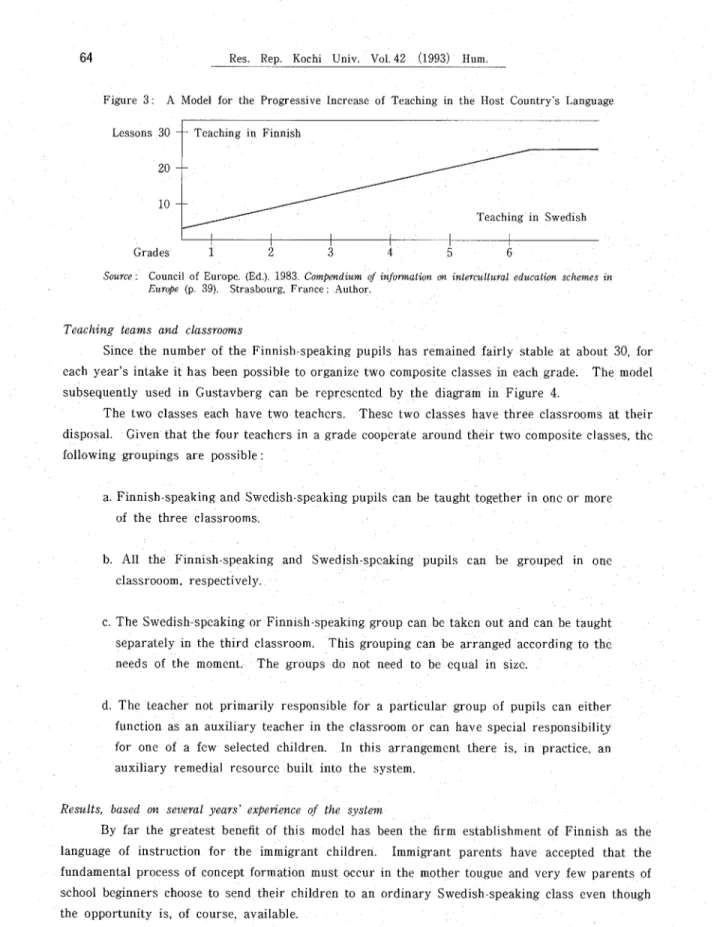
The teaching is conducted so that the Finnish pupils,・during their first schoo!year, receive most of their instruction in Finnish and the teaching of, and in, Swedish is introduced and successively increasむd during the six years in primary and middle school. This means that, at first. the Finnish-speaking teacher is the e!ass teacher for。the Finnish pupils in almost all・ subjects. Swedish, however, is taught by the Swedish class teacher beC:ause the children should recognize the separate language identity of these two persons. Little by little,ダaSトthe teaching in Swedish increases, the bilingual Finnish teacher may take on the responsibility for certain lessons with the Swedish pupils. This:should occur in lessons which are not primarily based on oral presentation and in which the pupils' own work is the dominating feature・..・.・ .. ・.・ .. ・・.. The model can,トinしsimplified form, be illustrated by Figure 3よ ・.・・.・ ・. ..・ 1 When the teaching in Swedish i!icreases for the Finnish pupils it:becomes possible to teach
the Swedish and Finnish pupils in a heterogeneous・groupンレThe combined group teaching can be carried out by both (jf the teachers together・ or by either one of them. ト 十..
64 Res. Rep. Kochi Univ. Vol.42 (1993) Hum.
Figure 3 : A Model for the Progressive Increase of Teaching in the Host Country's Language
Lessons 30 0 0 C S l r -( Grades
Sanrcp.i Council of Europe. (Ed.). 1983. Com,加・ndium of in/on.・ation on intercultural education schemes in
Europe (p. 39). Strasbourg. France : Author.
Teaching teams and classroび批s ト レ \ ヶ ,
ト Since the number of the Finnish・speaking pupils has remained fairly stable at about 3Q, for
each year's intake it has been possible t(jorganize two composite classes in each grade. The model
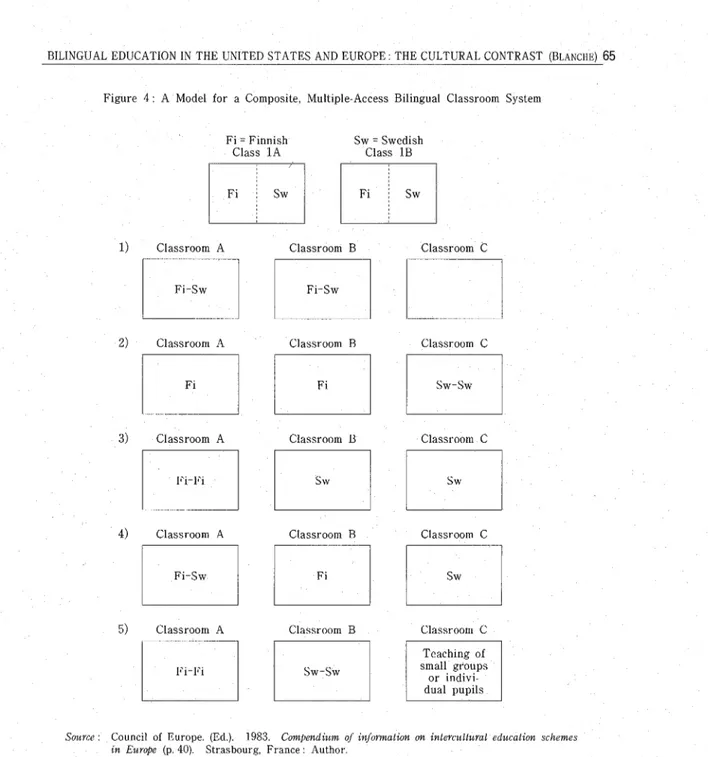
subsequently used in Gustavberg can be represented by the diagram in Figure 4に
The two classes each have two teachers. These two classes have three classrooms at their
disposal. Given that the four teachers in a grade cooperate around their two composite classes, the
following ・groupings are possible: レ ト
△ \ ・ ■
a. Finnish-speaking∧and Swedish-speaking pupils can be taught together in one or more
of the threeダclassrooms. 一 し \ ニ 〉
b. All the Finnish-speaking and Swedish-speakingプpupils can be grouped in one classrooom, respectively.∧ ..・・.・・ .・・ ・. ・・ .・
c. The Swedish-speaking or Finnish-speaking group can be taken o緋 and can be taught
separately in the third classroom. This grouping can be arranged according to the
needs of the moment. The groupsトdo not need to be equal in sizeに <
d. The teacher not primarily responsible for・a particular group of pupils can either
function as an auxiliary teacher in・ the・d卵sroom or can have special・responsibility
forone of a few selected children. In this arrangement there is, in practice, an
auxiliaryremedial resource built into the system. \
Results.∧basedon severalyears'experience of tjie・system \ 二
By far the greatest benefit of this mode卜has been the firm establishment of Finnish as the language of instruction for the immigrant children. Immigrant parents have accepted that the fundamental process of concept formation must occur in the mother tougue and very few parents of school beginners choose to sendしtheir children to an ordinary Swedish-speaking class even though the・ opportunity is, 0f.・course, available.し.犬. \ 〉 上 上 I・ \
BILINGUAL EDUCATION IN THE UNITED STATES AND EUROPE: THE CULTURAL CONTRAST
Figure 4: A Model for a Composite, Multiple-Access Bilingual Classroom System
1 ) 2 ) 3 ) 4 ) 5 ) ① ■・・ ■■ ■
Classroom A
□
Classroom
A
レロ
ClassroomA
Classroom AClassroom A
□
□ ■■ ・・ ・ ■■■ Classroom B Classroom B Classroom B Classroom BClassroom B
O\)
Classroom C
□
Classroom
C
O]
ClassroomC
Classroom C Classroom C. 匯]S仇irce・.\Council of Europe. (Ed.). 1983. Com,夕飢dium of informa励・皿i耐a;1・Ituml education schemes in Enrobe(p.40). Strasbourg, France : Author.
2. A se耳linar for Turkish immigrant children's host country teachers in Ankara, Turkey
One of the major concerns of the Turkish government i11 recent years has been the education
of Turkish emigrant workers' children, especially those in Europe. This concern is sharedトby the
governments of European countries where such children reside. \
In 1977, Turkey joined the Teacher Biirsaries Scheme of the Coun ・ for CulturaトCooperation
and Culture of the Counc・il of Europe (CDCC)26which has been set ・叩to foster closer relations
66 Res. Hum
concerned with the education of Turkish migrant workers' childrer! were invited by Turkey, through
the Council of Europe, to attend a seven-day seminar in Ankara devotedto・astudy of the Turkish
education system, together with an introduction to its socioeco・nomic and cultural background.
Theseminar provided : 十 /
a. An introduction to the Turkish education 。system (kindergarter!, primary and
secondary schools, general and vocational high schools, etc.) by officialsfrom :th尽
Ministry of Education, supported by documentation and followed by discussions.
b. A series of visits to a kindergarten, primary school, vocational school, town school,
villageschool, scientificsecondary Scho01,・teacher training college,・and schools for・
handicapped ・children. 上 ・.
c. Invitations to several cultural events.
d. A usefリl eχchange of views among the participants.
Theschool visits were particularly・instr!ictive, not only because of the opportunities for
discussions with head teachers and staff members, but also because of the resulting direct contact
with the students. The participants' first-hand experience 6f the social and educational milieu of
students sharing a background very similar to the background of some of the children living in their
countries made a significantand lasting impression. In a number of schools this was heightened by
contact with repatriate children, thanks to whom they were able to identify and リnderstand both the
problems associated with the adaptation of the educational, social, and cultural values of the host
country and the problems resulting from reintegration into the Turkish education system and
Turkish society. し \
NOTES
Bilingual education can be broadly defined as an educational system in which two languages are alternately used as the medium of instruction for children or adolescents. It 1S probably the only way to produce balanced bilinguals on a 。large scale. The 即alof a majority ofレbilingua! education programs is to quickly
assimilate students from various origins to the mainstream culture in a monolingual society. This type of program is still prevalent in the United States. By contrast, other programs seek to promote true
multiculturalism, and that is the direction in which Europe has been going・
In this article, the term “America” does not mean that other countries have been lumped together with the United States.“America” is always used in lieu of “the United States”(of America) in order to avoid cumbersome repetitions. Likewise, the term “Europeans” is often used only to name the representatives of the Council 0f Europe or the Eリropean Union. Some Europeans。then, may welトhave opinions that differ considerably from those expressed by their representatives in Strasbourg or Brussels.
1. A. Karmiloff-Smith and B.Inhelder,“If You Want to Get Ahead, Get a Theory,”a屈指m 3, 1974 / 75,pp. 195¬212. 犬 し ト
2. J. A. Ba:nks,“Pluralism and Educational Concepts : A Clariflcation,"PeabodyJournal=が四ducation,January 1977, p. 73. \ \ y ヶ ,
3: J. A. Banks, Multiethnic Educati。; Theoりand Practic。1981, p. 61. ‥
4L N. Appleton, C 「tural Pluralism仙石'ducation: Theore良心Foundations, 1983, pp. 1-2.
5. The countrie・Siねvolved arをthe32 d・emocracies of the larger European Co!nmunity剛〕resented by the Council of Europe (GE countries). They include “the Twelve" member states of the European Union (the・EU, formerly known as the European Community or EC, 呼d before that a乱he European Economic Community -the EEC, or “Common Market:" Belgium, Denmark, Germany, France, Greece, IrelandにItaly, Luxemburg, the Netherlands, Portugal, Spain, and the United Kingdom),in additiont(jAustria, Bulgaria, Cy・prus, the Czech Republic, Estonia, Finland√Hungary, Iceland, Liechenstein, Lithuania, Malta, Norway, Poland, Romania, San Marino, Slovakia, Slovenia, Sweden, Switzerland, and Turkey (total population: approximately 500 million ・persons). [As of October 1993】 丿 十 \
The EU member states, whose combined population is about 350 million, are not to be confused with other CE countries. The EU is a more tightly knit community. It has an embryo nic government with both an executive branch (the Commission of the European Communities, headquartered in Brussels, Belgium) and a legislative branch (the European Parliament, which 1S part of the huge administrブativecomplex originally built for the Council 0f Europe in Strasbou贈, France). Its econo面cダand social commitments were already
strong before 1993. They were further strengthened after the economic integration of all member states was officially completed, 0n December 31, 1992. 〉
6. H. P. Baptiste, Jr. and M. L. Baptiste,DeveloiJitig the MttlticultuTatニProcessm ClassroomInstruction:I
ComtJeten£"i≪sfm Teachers(volume l : Cognitive Competencies), 1979, p. 15. 工大
7. "The children for whom school∧attendance is compulsory under the laws of the host State, who are dependents of any worker who is a national of another Member State, where such childrenへare resident in the territory of the Member state in which that national carries on or has carried on an activity as an employed person,” as stated in Article l of the EEC Council Directive 77/486 which is reproduced in Appendiχ A.つ し
In Europe, the term “migrant” usually applies to immigrant workers who m友y at any time decide to return to their country of origin, although they may have settled down where they currently live and may not actually move about from place to place. I 〉 j
8. It would be possible to argue that such a phenomenon “only occurred on stage and in the mind" (Baptiste and Baptiste, op. cit, p. 11). However,ダ“the American melting t)Oトdid achieve reality in SO皿einstances ―initially for the white Western European immigrant and later for his East European counterpart" (J. A. Banks and W. W. Joyce, eds., Teaching Social Studies fc・Culturally Diかg紺でhildren. 1971, p. 352). More recently, a Washington Post columnist put it as follows.“The truth iSレthat…a principal theme in the history of the United States is the gradual blurring of ethnic, racial・,and cultural distinctions into a natior!al character that may be predominantly Western b叫 is most accurately called American. We may retain some of those distinctions as we enter the American mix, but it is the mix that matters most -and it is that those who insist on ‘centris 「 of any kind seek to repudiate"(J. Yardley,“Making U. S. Education a Mix of Voices, not Biases,トT船丿apan Times, April 22,1989, p. 18)ト
9. L. Porcher, The Educationがthe Children of Migrant Worke・7s仇Europe:Intercultuねlism and几・%cher Tra細細兪, 1981. ▽ し ノ ト
68 Res. Rep. Kochi Univ. Vo 42 (1993)・Hum.
10. At about the same time as the j?仙sis;・励ad・U. S. District Court decision was rendered :“It is not enough simply to provide a program for disadvantaged children 9reven to staff the program with bilingual teachers ふAn inadequate program is as harmful to a child who does not speak English as no program at a11”(H, Teitelbaum and R. J. Hiller,“BilingualダEducation : The Legal Mandate,”∬α抑αれ1£d加計ional I?'eview,47, p. 150). ダ \
11. The EU (formerly EC) C・ommission makes proposals. The Council (of Ministers) takes decisions.
12. Porcher, op. cit. ・.・.・. .・ ・.・ .・ ・. .・. ・・
13. H. Teitelbaum and R. J. Hiller,“Bilingリa1 Education: The Legal Mandate,”Harvard Educati・ 「j?eview, 47, pp● 138-170, \ 犬 < 十. ∧ \ 一白
14.・Baptiste ・and Baptiste, ・op. cit, p. 9・
15. Appleton, op. cit, pp. 21-22.
16. Ibid, p. 153. ‥ プ ●●●●●● ●● = This opinion is in keeping with “No One Model American,”the statむment on multicultural education issued in November 1972 by the American Association of Colleges for Teacher Education in the aftermath of the
Kent State University and the Jackson State University ・ tragedies in which severaトstudents were killed.
17. Banks, 1981, op. cit.,p. 67. 犬 ・. ’・
18, M, Rey-von Allman, Colloquy on“皿芦皿口CultureinαG−が昭:Society: MulticulturalEurope by the Year
2000,”Strasbourg, France, 18-20 January 1983 (Report No. DECS ノ EGT 183] 10), 1983.ト ‥
19. Banks, 1981, op. cit, p. 30. し 上 一一
20. Baptiste and Baptiste, op. cit.,p. 27
21. D. M. Gollnick and P. C. Chinn, Multi。μuralEducation in a F〕luralisticSociety,1983, p, 28。
22. J. Cummins, "The Construct of Language Proficiencyin Bilingual Education,”paper presented at the
Georgetown I?心 「は随?㎝£anguages and Linguistics,1980ト
23. J. A. Banks, 7切ching S加tegies fo「£加庇Studies,」979, p. 25
24. One could contrast Directive 77 / 486 / EEC and the Bilingual Education Act(jf 1974 in which the United States Congress (only) described bilingual education几programs as those in which
……there is instruction given in, and study of, English∧and to the extent necessary to allow a child to progress effectively through the educational system, the native language of the children of limited English- speaking ability, and such instruction is given with ap・preciation for the cultural heritage of such children, and, with respect to elementary school instruction, such instruction shall,to the extent necessary, be in a11 courses or subjects of study which will allow a child to progress effectively through the educational system.” し
25. Gustavberg is the urban center for the municipal area of Varmdo (17。500 inhabitants), 15 miles east of Stockholm, in the archipelago. ・。
26. CDCC actually stands for "Conseil de Cooperation Culturelle." し ∧
BIBLIOGRAPHY \ \
Appleton, Nバ1983). Cultural Pluralism in Education:T船り'Tetical Fou加功ions. New York: Longman.
Banks, J. A. (1981), M 「tiethnic Education: The。りand Practice. Boston: AUyn and Bacon.
Banks√J. A. (1979).TcachmgStrateがes.for Ethmic Studies,・Boston : AUyn and Bacon.。 ■
Banks, J. Aバ1977). Pluralism and educational concepts: a clarification.Peabody Journal of education.:January issue.
Banks, J. A。and W. W. Joyce (Eds.)。1971. Teaching S。&z! Studies tc・=Citltumlり・・Different・ChildTm.Reading, Massachusetts : Addison-Wesley Publishing Company. \ 十 犬
Baptiste, Jr., H. P., and M. L. Baptisteバ1979). Developing the Multicultural Process in Classroom Instru出叩?
尚 Comtiete-nciesfor TcacHers(Volume l : Cognitive Competencies). Washington, DトC.レUniversity Press of
America. ,
Commission 6f the European Communities. (1984)。尺ゆぽ£丿'rom 哨gC。m。^issi㎝1・the Council・n the 加
Bel1がum: Author. ∧ づ
Commission on Migrants' Languages and Culture in School and Adult Education in Sweden (Swedish Ministry of Education)バ1984). Enがish Summμザ血市債e Main R砂州“£)i加柳排○冗が回一PaTtacTskiti mSroeden, 励麗肘i四知r Linguistic and Cultural Diversity" (SOU 1983:57), Stockholm, Sweden : Author.
Council of Europe. (1983). Compend仙sが皿/1・rmation on Interciぷ'uml Education Sc秘奥es in Europe. Strasbourg、 France : Author. 尚 犬 : ∧ 、 し
Council of Euだope.(Ed.).(1979). Dossiersがりhe Intercultural Train仙g of Teachers. Strasbourg, France : Author
Council of Europe. (Ed.). (1979).Socio一CulturalSituationがMigrants and Their Families. Strasbourg, France: Author. し
Cummins、J. (1980). The construct of language proficiency in bilingual education. Paper 、presented at the
Georgetoiλm Roundtable onLaれeuages aれdLinguistics、Georgetown University・ \
GoUnick, D. M。and P.C. Chinn・(1983). Multicultural Education仙a Plura心配&φり・. St. Louis, Missouri : The C. V. Mosby Company. 1 \
Hohmann, M. (1981). Cmmcil of Etのipe Teachers' Seminar on "The Education of M'植忽功Children," Donauesch面g- en, Ge四回丿', 22-27 September 1980 (Report No. DECS/EGT [801 81). Strasbourg, FranceトCouncil of Europe. ●. ・・ \ ∧一一
Jupp, T. C. (1982). The几aching of the Ni朗叩α1£飢即αμが1佃裁ボG・untry tりAdult加作migrants (Report NO・ CDCC尚[81│ 38). Strasbourg, France : Council of Europe. レ ニ ∧ ・..・..・・ ・・ .・.
70 Res. Rep. Kochi Univ. Vol.42 (1993) Hum.
Karmiloff-Smith, A。and B. Inhelderバ1974/75). If you want to get ahead, get a theory.(洵囲加s 3・: 195-212.
Liegeois, J. P. (1983). T回顧eth Council of Europe Tea油卵' Seminar on“The Education of GypりChildren," J回四回chingen√叫四回'.y. 20-25 June 1983 (Report No. DECS/EGT [83│ 63). Strasboリrg, France:Council 0f Europe.,丿 ノ ノ .・ ダ
Nemetz Robinson, G. L. (1985).Crassむultural Uれ山erstanding:PTocessesattd Abbroachesfor Foreign Language,
English as a Second£α侭gMαμα刀d召丿ingual Educatoリ. New York: Pergamon press.
Nielsen, J. S. (1981)レフhirteent瓦a回dがEurope Teα池gが&屈nar on‘The TrainingがTeachers of the Children トげ仙が皿乙皿■>rkers: Cultural Values and Education inαMulticultural Society,'リ)映αueschingen, Germany, 19-24 October 1981 (Report NO∠DECS/EGT [81] 4). Strasbourg, France:Council of Europe. ∧
Porcher, L. (1981). The Education of the C回心sがMなm耐丿Workers in五町砂g: 万両rcuUuralism and Teache『 乃
Porcher, L. (1979). Second Csタicil of Europe TeacheがSeminat・on "The EducationがM毎砲緋C回力四;
ItitercultumlPedaffogy in, the Field," Donmteschingm,Germaり', 24-28 September 1979 (Report No.
DECS/EGT 1791 37). Strasbourg, France: Council of Europe. :
Rev-von Allman, M. (1983a). Col切砂回“M毎忽耐Culture仇a Changing Society:Multicultural Europe by the Year 2000,”Strasbourg, France, 18-20 January 1983 (Report No. DECS/EGT │83│ 10】.Strasbourg, France: Council of Europe. 犬 ●・
Reyニvon AI屈曲, M. (1983b). Symposiu加皿"The Intercultuml Tra仙ing of 7切碗・s,"L'Aquila,丿ialy, 10-14 May 1982 (Report No. DECS/EGT [831 61). Strasbourg, France:Council of Europe・ \
Rey-von AUman, M. (1979). L'education des enfants (de) migrants dans le canton de Geneve : Vers une education interculturelle [The education of migrantls']children in the county of Geneva:Toward an intercultural education).・ in Payot (Ed.)。/1四朗決加I'instructionか副ique: Etu加s /? 汾ュ昭毎麗s(P!jblic Education Directory : Pedagogical Studies). Lausanne, Switzerland : Author.
Rey-von Allman√M. (Ed.). (1978). La scolarisation des enfants migrants: l'ecoleトetla coeducation d'enfants de differentes cultures (Theschooling of migrant children : The coeducation of children from different cultures and the school), B 「研細心G眉
Teitelbaum, H・, and R. J. HiUer. (1977). Bilingual education ; The legal mandate. Han・ard Educational j? 「∼,47 138-70. ノ
U. S. Bureau of the Census. (1984)。SocioeconomicCharacteristiりげひS.几吻即一加加励加lation Detailedin
Gsお瓦肖。T面心雨9パPublication No. CB 84^179). Washington, D. C.: U. S. Department of Commerce.
Warzee, L√(1983). Lαscolarisation des enfants de travailleurs migrants (The Schooling of Migrant Workers' Children). Paris, Francを:Association Europeenne des Enseignants (European Teachers' Association).
Yardley, J. (1989). Making U. S. education a mix of voices, not biases. 7加丿砂an Times, April 22 issue.
Manuscript received:しSeptember 16, 1993