AUTOMATION-IT'S
CHALLENGE
TO
EDUCATION
An Analysis of the Problems Posed
by Automation
by
TABLE
OF CONTENTS
Page LIST OF TABLES vi PREFACE vii I. AUTOMATION 1 A. Definitions 1B. Reasons for Introduction 4
C. Snowball Effect 4
D. The Displaced Worker • 5
1. Blue collar workers 5
2. Service Industries 6
E. A Study—The Effect of Automation on Clerical
Personal 6
F. Psychological Effects 12
G. The Impossibility of Arresting its Development 13
H. Its Implications for the Dropout 13
II. THE IMPLICATION OF CHOSEN AND UNCHOSEN
ACTS FOR THE DROPOUT AND THE DISPLACED
WORKER 17
III. RETAINING OF THE DISPLACED
PHYSIOLGICAL, PSYCHOLOGICAL AND PRACTICAL
DIFFICULTIES 20 A. Biological Development 20 B. Chronological Age 21 C. Neurophysical Differences 21 D. Need for Continual Exercise of the Intellect 22 IV. AN ANALYSIS OF THE NUMBERS,
CHARACTERISTICS, CAUSES AND IMPLICATIONS
OF SCHOOL DROPOUTS 24
A. Statistics 24
B. Mental Potential—the Loss to the Individual
and Society. 25
Page
C. Socio-economic Environment 32
D. Reasons for leaving School 33
E. Some Differences between High and Low Achievers 34
1. Innate Differences 34 2. The Family— a) Parental example 34 b) Parental recognition 35 c) Parental attitude toward and interest
in the child's school work 35
d) Cultural-and educational background
of the family 36
e) Minimum physical standards 36
f) Attitudes toward work 36
3. Emotion and Achievement Motivation 36
4. Peer Group Influence 38
5. The School and Motivation 38
a) The school experience 38
b) Motivation and student expectations 39
c) Area of challenge 39
6. Culture and Motivation 40
V. MOTIVATION
A. The Meaning of Motivation ... ... 42
B. Motivated Behavior—the developmental approach ..., 43
C. Motivations Relevant to Education 44
I. Distant goals 44
2. Exploration 45
3. The Development of Intrinsic Interest 45
D. The Syndromes of the Fearful and the Angry 46
E. The Uninterested Syndrome 47
F. Methods to build up Motivation to Achieve and Learn 47
1. The Need to Change the Self-Concept 49
2. "n-achivement" 49
3. Slack's Method 50
VI. A NEW APPROACH TO EDUCATION 52
-LIST OF TABLES
Table Page
I . Educational level of employees in affected units
and in electronic data processing 14
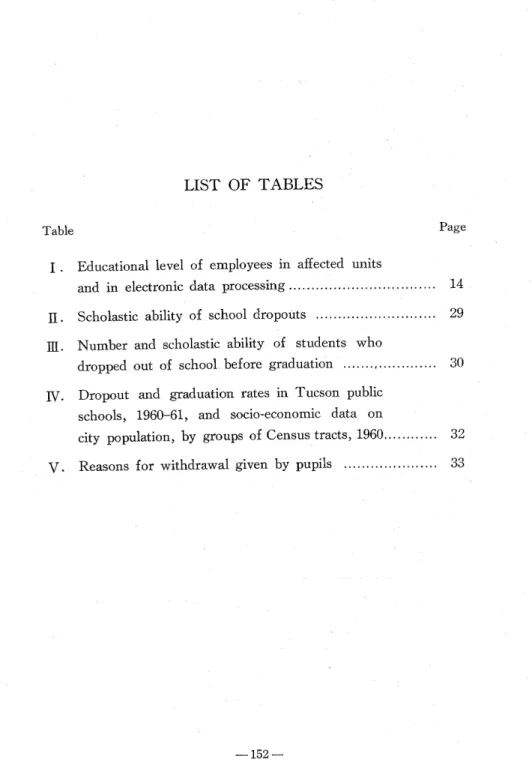
II. Scholastic ability of school dropouts 29 III. Number and scholastic ability of students who
dropped out of school before graduation 30 1V. Dropout and graduation rates in Tucson public
schools, 1960-61, and socio-economic data on
city population, by groups of Census tracts, 1960 32 V. Reasons for withdrawal given by pupils 33
PREFACE
This paper is concerned with the effects and demands of
automa-tion upon educaautoma-tion systems.
Before we can determine the effects it is necessary to define
auto-mation. Having done this we can then determine some of its effects.
One of its most noticeable effects is its influence on the labor market.
Automation affects the labor market by displacing non-skilled workers
or those having low level skills. This results in unemployment and
the need to retrain displaced workers.
Retraining is by no means a simple operation since it requires
adaption to various aspect of the psychology of adult learning. Added
to the problem of unemployed adult workers we find that the schools
"
produce" a large number of dropouts and reluctant learners which
tends to swell the number of unemployed.
In order to discover how the schools can reduce the number of
dropouts and reluctant learners we must analyze their psychological
and environmental causes and search for deficiencies in the educational
system.
Looking at another aspect of the problem we conclude that :
" ...continued desire to learn and achieve is a prerequisite to efficient
adaptation in a society based on automation." This requires that we
examine learning motivation and methods to increase it
Having passed through the above stages we are in a position to
make constructive criticisms of the education system as it is at present
constituted and set forth proposals for its revision to meet the
chal-lenge of automation.
I. Automation A. Definitions..
What does the word "automation" mean ? The vice-president of Ford Motor Company, D.S. Harder, was the first to define it in 1947. He defined it thus : "Automation is a philosophy of manufacturing
where machines are hitched together so that they feed each other
without human intervention and produce either a completed product
or a major component of a final product."
John Diebold elaborated on this definition by stating that "...the distinctive feature of automation is the application of feed back through which machines control their own operations, i.e. there is a
self-correcting mechanism by which computers feed new information to
the machines they control so that these machines continuously turn out the specified product.'")
The above definitions do give us some idea of the economy of labor involved in the process but do not give any indication as to its effect
on our standard of living and its impact on employment. The full
impact of automation, with all its ramifications, in the realms of em-ployment, education and leisure patterns has not yet been fully studied or evaluated. At this moment studies are in progress to meet the
challenge which automation presents to our whole way of life. In
order to meet this challenge of change we must be educated to deal with it in an intelligent way.
We must, if we are to have a clear idea of the problems involved, know something of the nature and use of automation and computers. There are two main categories of devices. The first is the one usual-ly referred to when one talks of "automation." It is made up of 1) Buckingham, Walter, Automation : Its Impact on Business and People N.
Y., 1961, p. 5.
2) Diebold, John, Automation : Its Impact on Business and Labor, Planning Pamphlet No. 106, Washington D.C. May, 1959, p. 3.
AUTOMATION—IT'S CHALLENGE TO EDUCATION
devices that automatically perform motor and .sensing tasks, replacing or improving on human capacities in performance. The second cate-gory is made up of devices that carry out, at high speed, routine or complex logical and decision-making tasks, usually much more rapidly and efficiently than humans. These are commonly called "computers." There is a certain amount of overlap between the two categories in
that we have mixed systems whereby computers control and correct
for error complicated processes.
There are automated systems in operation at this moment which
are built to detect errors in their own performance and indicate these
to men, make judgements based on programmed instructions,
"re-member" and search their "memories" for appropriate data, either programmed into them or acquired in the process of manipulating new data Thus they can learn on the basis of past experience with
their environment. Michael writes of a machine, designed by Dr.
Frank Rosenblatt, whose behaviour is not completely controllable or
predictable." It can learn to recognize what it has seen before and to teach itself generalizations about what it recognizes. It also can learn to discriminate, and identify shapes similar to those it has seen before. Most important of all it is not possible to predict the degree and quality of recognition that it will display as it is learning. Dr. Rosenblatt designed it to learn and discriminate in the same way that it is believed man does ; it has its own pace and style of learning, of refining its discriminations, and of making mistakes in the process.
Thus we can no longer be smug in our assertion that since man has constructed the machine he will always be more capable or smarter
than his creation. Norbert Wiener backs up this condemnation of
smugness : "It may be seen that the result of a programing technique
of (automation) is to remove from the mind of the designer and
operator an effective understanding of many of the stages by which
1) Michael, Donald, N., —Cybernation : The Silent Conquest, A Report to the Center for the Study of Democratic Institutions", 1962, p. 8.
--the machine comes to its conclusions and of what --the real tactical
intentions of many of its operations may be.""
We have already
entered an age in which machines can do more work, more rapidly
and more efficiently than most men if not all men. It is an age of
great moment and great promise. In 1957 it was expressed by the
National Association of Manufacturers thus :
For the expending, dynamic economy of America, the sky is
indeed the limit. Now more than ever we must have confidence in
America's capacity to grow.
Guided by electronics, powered by
atomic energy, the magic carpet of our free economy heads for
distant and undreamed horizons. Just going along for the ride will
be the biggest thrill on earth !2)
When this was written not much thought had been expended on
the possibility of negative side effects that might accompany the positive
aspects of automation. It is mainly with the former that we shall
deal in this paper.
B. Reasons for Introduction.
Among the most common reasons for the introduction of automation
to various fields are : to increase productions ; to reduce costs ; to
in-crease efficiency
; to make jobs easier ; to perform jobs that could not
be done otherwise. "As automation is applied, man's job shifts to
that of the planner, monitor and maintainer—the machine does the
work. "3?
C. Snowball Effect.
There is a noted tendency that when automation is introduced in
one area (for example the production side in a factory) the tempo is
1) Wiener, Norbert, "Some Moral and Technical Consequences of
tion" Science, Vol., 131, No. 3410, May 6, 1960, p. 1356.
2) Calling All Jobs, National Association of Manufacturers, N.Y., October,
1957, p. 21.
3) "Automation", Encyclopaedia
Britannica, William Benton (Publisher) N.Y.
1961, Vol. 2, p. 783.
AUTOMATION—IT'S CHALLENGE TO EDUCATION
increased in such a way as to make it necessary to introduce it into other areas (e.g. the paperwork and, sales sections of the same company.)
Thus, we see that automation has a snowballing effect. We note
that rather than those displaced in one area being transfered and re-trained to help in another area now under pressure, there is a tendency to introduce automation to that area too, thereby creating further displacement of human labor.
Automation systems tend to become faster, larger and more complex and their applications place emphasis on systems design, on the use of theory and analysis and on the use of electronics, especially in
computing and information-processing machines.
"Automation means the ultimate divorcement of man from the
machine as an integral part of its operation"') This means that there has to be a drastic increase in the ratio of technical personnel to the total of skilled, semi-skilled, and unskilled labor if we are to keep up
with advances in automation. Are we producing enough technical
personnel in our schools ? Is our education system geared to meet the future ? How many dropouts are there and why do they drop out ? What happens to these dropouts now and what will be their place in society in 10 to 20 years time ? These are but a few of the questions which the challenge of automation requires us to answer. D. The Displaced Worker.
A brief summary of how automation has affected the blue-collar
worker should be sufficient here, and later we shall see its effect on the clerical worker.
1) Blue Collar Works.
"Because of technological changes
, about 200,000 production jobs have been eliminated in recent years in the aircraft industry alone even though the industry's total business has continued to increase".2) In 1) "Automation" Encyclopedia Americana, Vol. 2. N.Y. 1964, p. 643. 2) Kilpatrick, Franklin, P., Automation and the Challenge to Education,
N.E.A., Washington, D.C., 1962. p. 164.
other fields, too, large numbers of workers were displaced. In the
highly automated chemical industry, the number of production jobs
has fallen 3% since 1956 while output has soared 27%. Though steel
capacity has increased 20% since 1955, the number of men needed to
operate the industry's plants-even at full capacity—has dropped 17,000.
"Auto employment slid from a peak of 746,000 in 1955 to 614,000 in
November (1961)...Bakery jobs have been on a steady decline from
174,000 in 1954 to 163,000 last year (1961). On the farm one man
can grow enough to feed 24 people ; back in 1949 he could feed only
15,,.1)
2) Service Industries.
It has been assumed by many that the Service Industries would be
able to absorb the displaced blue-collar workers but this is not possible
since the Service Industries have also taken to automation. Thus we
find that the U.S. Census Bureau used a mere 50 statisticians in 1960
to do the tabulations which required 4,100 in 1950. The introduction
of vending machines, self-service stores, automated banking systems
and business machines has eliminated a vast number of jobs.
Since
the need for more workers due to expanded output and foreign trade
has absorbed many workers we tend to ignore the problem.
We are at present training students in our high-schools for
occupa-tions which are rapidly becoming automized and teaching them skills
which are rapidly becoming obsolescent. Schools must be guided by
estimates of what will be required of a worker not just next year but
in 10 to 15 years.
E. A Study The Effects of Automation on Clerical Personnel.
At this point let us glance briefly at the summary and conclusions
of a study,2) made by the Bureau of Labor Statistics, of twenty large
1) "The Automation
Jobless...Not Fired, Just Not Hired" Time, Vol. 77, No.
9, Feb. 24, 1961, p. 69.
2) Adustments to the Introduction of office Automation, U.S. Department of
Labor, Bulletin No. 1276, May, 1960, p. 3ff.
AUTOMATION—IT'S CHALLENGE TO EDUCATION
offices which have installed large-scale electronic data-processing equip-ment. It is necessary to quote this study at length since it gives us quite a clear picture of certain aspects of automation to be dealt with more fully later in this paper. It is useful for our purpose since it gives both the positive and negative sides of the question. It must be remembered that the offices in this study were large, therefore there was a possibility of transfering workers to other sections not at that time being automated. This may not be possible in smaller companies.
Management Objectives
The introduction of a large-scale electronic computer increased data-processing capacity and provided a means of achieving significant
operating savings on a variety of large-scale routine activities such as payroll preparation and billing. There, saving generally resulted not only in a larger clerical output with the same or fewer employees— a major objective—but also economies in processing time, space, and equipment, and greater accuracy. Moreover, some offices were able to process data for management decision making that were previously uneconomical to collect. This new information increased the clerical
workload. But, by extending management's control over inventory,
other operations and conditions, the acquisition of such data also opened up the possibility of achieving savings in nonclerical ac-tivities.1)
The last point is of especial interest, "...has opened up the pos-sibility of achieving savings in nonclerical activities.", in connection with the "snowballing effect" mentioned earlier in this paper.
Personnel Planning for Transition.
The installation of a new computer involved a sequence of ad-ministrative, technical, and personnel changes that, on the average, spanned nearly 3 years. This long preparatory period was particul-arly useful in avoiding extensive dislocation of employees. During 1) Ibid., p. 3.
this preliminary period, most of the offices studied informed employees about prospective changes, assured those affected of job security, and curtailed hiring to fill vacancies. In the seven offices where employees were organized, existing contracts provided machinery for employee notification and the application of seniority rules in dis-placement and transfer. A few of the contracts contained provisions regarding consultation, training, and severance benefits."
Where planning is carried out hurriedly and without due consider-ation to the employees there is likely to be confusion and
unemploy-ment. This is especially so when a company needs to automatize
rapidly to stay in business and when labor is abundant so that the company does not have to automatize circumspectly. It is worthy of note that many Unions are now demanding provisions under "Auto-mation" in their labor contracts to protect the rights of labor. The problem will come to a head when the labor market is flooded with
workers. When this happens the Unions may lose some of their
bargaining power.
Extent of Displacement and Reassignment.
Within one year after the installation of the computer, about one-third of the approximately 2,800 employees in units whose work was directly affected had been reassigned to other positions, either within the same unit or elsewhere in the office. A majority remained in the same position. Close to one-sixth had quit, retired, died, or
had taken leave of absence. Only 9 persons had been laid off.
Altogether, employment in the affected unit had been reduced by
about 25 percent at the end of the year.
A little over 80 percent of the employees affected by the change were in jobs involving posting, checking and maintaining records,
filing, computing, or tabulating, keypunch, and related machine
operations. Most of the remainder were in administrative,
visory, and accounting work. Only a little over 4 percent were
1) Ibid., p. 3.
AUTOMATION—IT'S CHALLENGE TO EDUCATION
engaged in the less routine clerical jobs such as correspondence,
stenographic, and secretarial work.
About two-thirds of those workers still employed in the offices
one year after the installation continued to do the same type of work .
Only about 16 percent of this group were shifted to a different
type of work, e.g., from posting and checking to computing. A
little under 2 percent ... were transferred from the affected group to
electronic data processing jobs.
Close to one-third of the employees in the affected group had
been promoted to a higher grade. A negligible number had been
downgraded. Most of the upgrading involved employees under age
45 and to some extent reflected promotions which would have taken
place regardless of the advent of the new equipment.
The relatively favorable experience of these offices reflected the
widespread adoption of policies to provide job security, the continued
growth of the clerical workload, and the high rate of labor turnover
during a period of prosperity. Since these were large offices,
ployees could be transferred to jobs without retraining (with the
exception of those assigned to electronic data processing.)')
The point to reflect on here is whether a small company could bring
about transfers and increase its clerical work load in such a smooth
manner. Also in the next section we note that the 15% rise reported
for clerical and kindred workers in the Nation as a whole would
certainly have an effect on the number of jobs opening up in a large
company and it may well be that instead of hiring the usual number
of new employees in other sections, the displaced workers were used
instead.
Effect of Growth of Office Employment.
In the offices studied, the groups directly affected by the
introduc-tion of electronic data processing represented, on the average, only
1) Ibid., pp. 3 and 4.
about 5 percent of total office employment. Since the companies
planned to apply the computers to other activities a larger
propor-tion of office employees will obviously be affected.
Despite the reduction in labor requirements for the tasks
perform-ed by the computers, total employment of the offices as a whole
rose. Over the 4 years from December 1953 to December 1957,
total office employment at 17 of the offices studied increased an
average of 7 percent. This increase, however, was less than the
15 percent rise reported for clerical and kindred workers in the
Nation as a whole. In 6 of the 17 offices, the increase was greater
than 15 percent ; in 7, less ; and in 4 there was a decrease. Although
the immediate effect of electronic data processing suggests some
re-tardation in the growth of office employment, particularly part-time
work, the experience of some offices suggests the possibility of
ex-panding employment in new areas of office activity to handle
in-formation which had previously been uneconomical to acquire."
Creation of New Jobs.
A small number of new positions were created to operate,
pro-gram, and manage electronic data-porcessing activities. An average
of 29 persons was employed in these units at the time of the study.
Close to 7 out of 10 persons in electronic data-processing work were
in programming and planning positions, about a quarter were engaged
in operating the equipment, and 8 percent of the group were in
administratrative and supervisory positions.
Wage and Salary rates were generally fixed through existing job
evaluation and personnel classification systems and where the
em-ployees were organized with the participation of the unions. The
offices generally rated these new positions at somewhat higher grades
than jobs in other data processing, placing them at the top of the
office pay structure.2)
1) Ibid., pp. 4 and 5.
2) Ibid., p. 5.
AUTOMATION—IT'S CHALLENGE TO EDUCATION
It is interesting to note the nucleus of a new class. These people need special skills and this points to a need in educational programm-ing which is just openprogramm-ing up and is beprogramm-ing recognized in some school systems.
Change in Grade Structure.
The introduction of electronic data processing raised the average grade or skill of office occupations, but only to a slight extent.
Routine low paid jobs becoming vacant during the transition period
were eliminated, which resulted in the higher paid group making
up a larger proportion of the total in the affected group. The
classification of electronic data-processing positions at the top of the
office pay structure also tended to upgrade the pattern. Since the
newly created positions constituted a small proportion of total office
employment, however, the net effects on the structure of an entire
office was small.1)
Here we, should note that jobs becoming vacant were eliminated.
Selecting and Training Employees.
More than 80 percent of all employees in the new positions were selected from within the offices. Those hired from the outside were primarily trainees. Of the 915 employees in these new positions, only, 52, or close to 6 percent, were selected from among employees whose work had been directly affected. Most offices used standard tests of learning ability and numerical aptitude to screen applicants for these positions but based their selection on individual interviews
and appraisal.
Typically, the persons selected for programming and planning
work, which accounted for the largest group of new positions, were men between the ages of 25 and 34, who had some college educa-tion, and who had been engaged in accounting, procedure analysis , or related work. Few women or older workers were chosen for the 1) Ibid., p. 5.
newly created positions. Four out of five employees assigned to
these positions were upgraded. All offices provided at least 4 or 5
weeks of formal classroom instruction for programmers and and
on-the job training for operators of on-the equipment.'
The glib answer that the displaced worker can be trained to work
the computers does not seem to be justified in practice since only 6%
were selected. It is of interest to see what type of men was selected—
those from the lower age group having some college education.
Some Problems of the Change over, and the Implications for Older
Workers.
Although layoffs were averted for all those whose jobs were
eliminated, reassingning employees and staffing the new positions
sometimes involved complex personnel problems... Finding suitable
positions for long-service employees, especially supervisors, without
disturbing promotion opportunities of other employees, presented
difficulties. Partly because of the newness of the field, establishing
salary levels for the new jobs and interpreting tests for selecting
staff caused some uncertainly. In unionized offices, there were
some-times prolonged negotiations over which, if any, of the new
posi-tions would be within the collective bargaining unit.
Older employees were affected by changes in job status to a lesser
extent than younger workers. They benefited from general policies
assuring job security, seniority provisions in union agreements and
similar protective provisions in agreements.
However, they were
not promoted to the newly created electronic positions to the same
extent as were younger workers, nor were they hired as trainees.
Their educational qualifications, employer's opinions, and pre-existing
hiring practices, as well as their own lack of confidence in their
learning capacity, were said to be among the factors retarding their
advancement.
In the few cases in which they were assigned to
1) Ibid., p. 5.
AUTOMATION—IT'S CHALLENGE TO EDUCATION
computer work a sense of responsibility and their maturity and
experience were considered important factors in favor of older
employees.
In those instances where employers had formed opinions about the inflexibility or lack of adaptability of older workers , the
tion of electronic data processing may have intensified reluctance to
hire or promote them. The examples of the successful performance
of older employees in these new positions reinforce the findings of research workers on the variability in learning capacity at all ages ..."
This study has enabled us to some extent to grasp some of the implications of automation for our way of life and our education system . We shall deal at length later with adult retaining and the psychology
of adult learning but let us consider here the effects of automation on the psychology of the individual.
F. Phychological Effects.
Automation and technology are creating a situation of unpredictability and great complexity which tend to produce feelings of confusion and inadequacy among many people. If these feelings are not countered
, they could lead to withdrawal, denial, regression and a general state of apathy.
In order to prevent this people must be helped to gain some per-spective by finding a means of standing apart from their immediate situation and evaluating things in their larger context . One of man's basic needs is a concept of self-identity. This is impossible to gain unless there is a certain continuity between past, present, and future . Education must plan in order to establish bridges for the individual . In other words, educators must do their best (with the aid of experts from the other sciences) to anticipate events and plan for them ac-cordingly, setting in motion programs for retraining and re-education far enough in advance to provide the individual with the continuity 1) Ibid., pp. 5 and 6.
he needs to function effectively and to retain his concept of
self-indentity.
G. The Impossibility of Arresting Its Development.
Some critics of automation, seeing the possibility of mass
unemploy-ment, delinquency, too much leisure and the problem of who is to
buy the products- of automation if there is large scale unemployment,
have suggested that automation be banned before it is is too late. Can
we stop it and yet maintain the position of a modern nation ? Can
we stop it by making it illegal or unprofitable to develop automated
techniques ? The answer is "No" unless we virtually stop the
develop-ment of almost all new technology and a good part of the general
development of scientific knowledge. In order to accumulate knowledge
in many areas of science we must depend on computers. Now, to
refine computers and make them more versatile requires research in
almost every scientific area, It also requires the development of a
new technology, usually automated, to produce the parts needed to
build new computers. So long as we choose to compete with other
parts of the world, we must develop new products and new means
for producing them more efficiently. We can only do this in a significant
way by using automation. If we choose to live in a world guided by
science and its technology we have no other choice but to encourage
the development of automation.
Thus it seems that a ban on the
development of automation is not feasible. We must find some other
answer to its challenge.
H. Its Implication for the Dropout.
As we stated earlier, automation tends to upgrade the level of skill
required of the worker. This upgrading of skills in turn requires a
higher level of education and a flexibility to learn new skills as needed.
For work connected with the operation of computers, for example,
selection of personnel largely reflects the level of education the selected
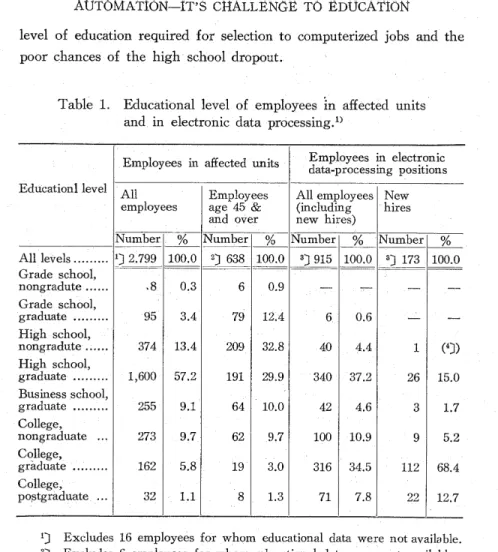
person has attained. The following table gives some indication of the
AUTOMATION-IT'S CHALLENGE TO EDUCATION
level of education required for selection to computerized jobs and the poor chances of the high school dropout.
Table 1. Educational level of employees in affected units and in electronic data processing.')
Education) level All levels Grade school, nongradute Grade school, graduate High school, nongradute High school, graduate Business school, graduate College, nongraduate College, graduate College, postgraduate
Employees in affected units All employees Number 'D 2 .799 .8 95 374 1,600 255 273 162 32 100.0 0.3 3.4 13.4 57.2 9.1 9.7 5.8 1.1 Employees age 45 & and over Number 2) 638 6 79 209 191 64 62 19 8 100.0 0.9 12.4 32.8 29.9 10.0 9.7 3.0 1.3 Employees in electronic data-processing positions All employees (including new hires) Number 8j 915 6 40 340 42 100 316 71 100.0 0.6 4.4 37.2 4.6 10.9 34.5 7.8 New hires Number 173 1 26 3 9 112 22 100.0 (4)) 15.0 1.7 5.2 68.4 12.7 1) Excludes 16 employees for whom educational data were not available .
Excludes 6 employees for whom educational data were not available.
3) Excludes 1 person for whom educational data were not available . 4j Number is too small to calculate percent .
It should be noted that out of a total of 583 high school dropouts, of whom 209 were over 45 years old and therefore presumably efficient in the use of figures, only 40 were chosen for the new work 1) Adjustments to the Introduction of Office Automation, oy., cit., p. 53.
-and only one was hired. The majority had continued their education beyond high school. It is already difficult for the dropout to obtain work and this tendency will increase. Taking the age group 17 to 21 who are out of school and have no jobs we find that, "There are
reported to be more than 50,000... in New York City alone. Many
of them have school diplomas, but they have not acquired what is required to enable them to find their place in the world of work.' What strikes one as even more amazing it the following quotation
which gives us some idea of the magnitude and urgency of the
problem : "New York City's yearly expenses on welfare and correction for those under 21 total 465 million dollars, or more than half as much as the metropolis spends on its schools. "2) This was in 1964 and the trend is toward an increase rather than a decrease in unemployment
among the young. Employed dropouts are the first to be laid off and are the first to be displaced by automation since their skills are usually rudimentary. We must, therefore, devote some of our time to analyz-ing what are the chief causes of droppanalyz-ing out of school and what
preventative measures must be taken; From the foregoing pages we
have learned : what automation is ; that its development can not be halted without disastrous consequences ; that it requires an upgrading of education and skills ; its grave implications for the old, the dropout, and for the education system as a whole from the angle of maintain-ing the individual's psychological equilibrium, flexibility and ability to learn new skills as required.
Before we enter into a discussion on the psychological aspects of retraining and the dropout we must first consider a closely related problem. This is the problem of choice. It is a very important problem since all too often when a man fails to undergo retraining or to get another type of job when he has been displaced, we tend to accuse him of choosing against a course of action which we consider 1) Arnstein, G.E. "The Problem : An Introduction", No Room at the
tom, N.E.A., Washington, 1962, P. 2.
2) Velie, Lester, "Automation", Reader's Digest, May, 1964 pp. 145/6. — 168 —
AUTOMATION—IT'S CHALLENGE TO EDUCATION would be beneficial to him. We tend to do the same with the drop-out. In the next section we must consider if "choice", as it is usually defined, is always operative in such cases.
II. The Implication of Chosen and Unchosen Acts for
the Dropout and the Displaced Worker.
Two of the <problems which in part are the result of automation and in part due to the failure of the school and society are those who dropout of school and can not obtain work and those displaced workers who do not undergo retraining when it is available.
This section deals with an aspect of the above problems which must be faced by the educator if the trend toward largescale unemployment of those having no skills (the dropout) and those having no skills or obsolescent skills (the displaced worker) is to be contained.
It is usually thought that the dropout "chooses" to leave school and that the displaced worker "chooses" to remain idle rather than under-take retraining. What exactly do we mean by a chosen act ? The meaning implies that : If an individual is going to make a choice from among the alternatives available, not only must there be an out-come that he prefers above others, but also he must have an expecta-tion that choosing the act will lead to the preferred outcome."')
Before entering into an analysis of choice I wish to illustrate the non-technical way in which Irwin puts his point across ; this point being that the fact that a person performs as action does not prove
that he has chosen to do it The following quotation should be
sufficient ;
1) Irwin, F.R. "Unchosen Acts", No Room at the Bottom, op. cit. p. 49. Note : I am much indebted to Professor Irwin for his insights into the chosen
and unchosen act and I think them of such importance for their
plications for education that I have gone into the problem at some length.
My walking into my office five days a week at a regular time does not demonstrate that I am choosing to continue to be a psychologist. Nobody has offered me an alternative to this ; the alternatives that do exist are not obvious ; my life would be much harder if I had to make such a decision every day. It is the same for everyone. You do not choose your career every day ; you do not decide your whole life every day. No one could live under these conditions. The mere fact that you are doing things does not mean that you have chosen to do them. Last Sunday, I did not go to my office. This did not mean that I chose not to go, for I rarely go to my office on Sunday. However, when I do go, that is something out of my routine and can probably be regarded as the result of choice.') Thus, it is possible for the dropout to leave school without ever having decided to leave school. Irwin points out that "He may have decided no more about it than I did in deciding to go to college. The step was simply taken for granted ;..."2) Or as in my own case, in Scotland, as to whether or not to go on to college no decision was made ; it was taken for granted by myself and my friends and family that I would not go to college. There was no social expectation that we should go to college : therefore no choice was presented. Only some years later did I find that there was a possibility for choice. In a similar way, the socio-economic and familial circumstances may be such that the child is expected to drop out of school in the tenth or eleventh grade. Hence, no choice at all may have been involved.
With regard to retraining or the adoption of a Sunday routine for every day, while it may be based on a real choice among the expected outcomes which have been evaluated, it may exclude retraining without, retraining being a viable alternative in the choice situation.
Since it seems highly doubtful if we can consider a man responsible for all the consequencies that did not occur because he did not elect 1) Ibid., p. 50.
2) Ibid., p. 50.
AUTOMATION—IT'S CHALLENGE TO EDUCATION
some alternative, it would seem that if a certain decision is made that
excludes a particular course of action (e.g. retraining), this need not
necessarily mean that the choice has been against the excluded course
of action.
Looking at the problem in this light leads us to the realization that
a particular consequence (e.g. leaving school) may play no part in the
decision, or it might play a heavy or a light part. To take a simple
example, a boy may want a new car to keep up with his friends or to
impress his girl friend and decides that in order to do so he needs a
job which at the same time gives him a feeling of independence and
status. In his decision to take a job which is offered the consequences
of leaving school may or may not have played part in his "choice".
It would be a difficult problem of psychological diagnosis to determine
what had been chosen for and what had been chosen against in this
case.
What has been stated above is a rather over-simplified account of
the process of choice. Let us now consider a little more deeply what
is meant when we say that the student chose not to attend school any
more or the worker chose not to be retrained.
There are two types of acts in decision making :
a). those that form alternatives in decision processes and are chosen
for or against and ;
b). those that occur or fail to occur without having been the object
of choice.
From this we come to see what is essential if an act is to be
regard-ed as chosen. There must be a preference for one consequence over
another consequence and there must be an expectation that this
parti-cular act rather than an alternative act will lead to the desired
con-sequence. The important point to note is that a choice is always both
a choice of one act over an alternative and one consequence over
another. Whenever an act does not meet these criteria, it is not a
chosen act. From what has been said it will be seen that we often
misclassify acts and call them chosen when in fact they were, from
the psychological point of view, the irrelevant consequences of a choice
in which they took no part.
What is the significance for the dropout and the displaced worker ?
Well, if the educator wishes to increase the probability that a certain,
act be chosen, such as continuing in school or engaging in retraining ,
then it is necessary to arrange that : a) this act rather than an
alter-native be expected to lead to a particular consequence and b) that this
consequence be preferred over alternative consequences. In the past,
while (b) has often been emphasized, (a) has often been almost
dis-regarded.
Irwin deals with what he terms "routines" and suggests
that the working man develops a set of routines which he follows
every work-day (e.g. getting up at a certain time, having breakfast and
leaving the house for work at a certain time) and another set of
routines for use on Saturdays and Sundays. When he is displaced by
automation and becomes unemployed, if the unemployment continues,
he will soon use the Saturday/Sunday routine every day. There is, of
course, no choice in the routine—he does not decide to go to work
and not to go to work on Saturday and Sunday.
When, for the displaced worker, this change-over of routines occurs
it would be incorrect to think of him as making a conscious choice
each day not to look for or not to engage in retraining.
It is not enough to just make retraining available and interesting—
it is necessary to make retraining a true alternative for choice. Thus,
the school must identify potential dropouts as early as possible and the
continuation of education must be made a true alternative for choice
and that this act rather than alternatives be expected to lead to a
particular consequence (e.g. a good job or high status) and that this
consequence be preferred over alternative consequences. This is, of
course, based on the assumption that the school is in fact the best
place for him to be and can provide the necessary experiences to
materialize the particular consequence which is being aimed at.
The
same goes for retraining.
AUTOMATION—IT'S CHALLENGE TO EDUCATION
III. Retraining of the Displaced Worker—Physiological ,
Psychological and Practical Difficulties.
As has been previously pointed out automation decreases the number of unskilled jobs and increases the number of highly skilled . The number of dropouts is expected to be in the region of 71- million in this decade which will provide a super-abundance of unskilled labor
for a rapidly decreasing number of unskilled jobs .
Firstly, I wish to approach the problem from the point of view of the psychology of adult learning in so far as it will effect retraining programs in order to analyze what can be done for those who will need retraining in the near future and to ascertain in what way our education system must be adapted if we are to provide a smooth transi-tion from one job to another in the future .
Secondly, I will make some mention of what is being achieved at present in the field of retraining and give some indications as to why present methods are unsatisfactory.
Starting with the assumption that the worker of the future will need to undergo retraining or at least the updating of his skill quite frequently, it is necessary to analyze the special features encountered in adult learning. For example we must analyze what are the limita-tions and potentialities of man during middle and later adult years. Also to what extent does the aging process impair the capacity to learn, remember and to adjust
A. Biological Depelopment.
Though not a great deal is known of the biological effects of aging on learning, some factors have been well documented. Muscle strength tends to decrease after reaching its peak in early adulthood. This may be a limiting factor insofar as it is necessary for learning new skills . Neurophysiological aspects will be dealt with later,
B. Chronological Age.
It would seem that social concepts largely determine the limits on
learning where chronological age is concerned. While social patterns
in every type of society and every age determine to some extent
be-havior appropriate to each chronological age level, as such adeges as
"An old dog cannot learn new tricks" reveal
, it can be shown that if
appropriate training is given and if the motivational level is sufficiently
high then we should revise the adage thus : "An old dog cannot
learn new tricks unless he wants to". If we are to meet the challenge
of automation we must change the negative conviction into the positive
conviction that—"One is never too old to learn".
Where experience is controlled in mental tasks it has usually been
found that the old learn more slowly than the young. In other tests
of intellectual capacity verbal performance tends to hold up, while
non-verbal tasks where speed is involved tend to deteriorate. But Donahue
points out that, "...decline... (is) less marked in persons with higher
intelligence and/or more education.' "-" This is a very important point
and has great significance in any plan for the reorganization of the
edcational system.
C. Neurophysical Differences.
From the neurophysical aspect we note that an overt change in
be-havior response requires a change in established neural patterns of
response.
Also to be noted is the fact that there are limits to the
speed which the neural mechanisms can handle and switch incoming
impulses to alternative channels. What does this mean in terms of
adult learning ? It means that since the adult has more established
neural patterns than the young it may require more time for "new"
incoming material to be accommodated : therefore learning in which
speed counts is bound to be slower. But we should not confuse speed
of absorption with capacity for learning. This is an all too common
1) Donahue, Wilma, T., "Adult Learning
: Limits and Potentialities."
mation and the Challenge to Education, N.E.A., 1962, p. 22.
AUTOMATION—IT'S
CHALLENGE TO EDUCATION
mistake. Other factors which must be considered in test results which
compare the old with the young are as follows
a). Mental tests in which marginal snap judgements and
taking attitudes predominate favor the young since the old tend
to be more on the conservative side.
b). The problem of motivation comes into the test situation since
the older person will not really try very hard if he "doesn't see
any point in it."
c). Familiarity and practice with test materials usually favor the
young.
d). The older person tends to seek a meaning in the questions
ther than just doing the problem.
e). The greater caution and higher accuracy attributed to the older
worker in the working situation is seldom evident in test
situations.'
Also they tend to persist in their errors—this may
be due to old responses, inappropriate to the new situation,
which hamper the new learning situation.
D. Need for Continual Exercise of the Intellect.
Let me attempt to summarize the important aspects of adult
learn-ing significant for retrainlearn-ing. Many years ago (1928) E.L. Thorndike
expressed the opinion, in his account of adult learning, that the ap
parent loss in the ability of adults to learn is the result of disuse or
lack of practice. This opinion has had ample backing from later
re-searchers such as Sorenson, Kanin and Anderson. If the older learner
is given time he has just as great a capacity to learn as the younger
person. More repetition of the material is often needed for the adult
learner since extinction of conditioned responses must take place
othe-wise there is a tendency for the more practiced phase sequences to be
triggered by the presenting stimuli and consequently it is more difficult
1) Welford, A.T., "Psychomotor Performance", Aging and Human Skill,
London, Oxford University Press. 1958, p. 294.
—175—
to set up a new response. There is also a tendency, noted by Welford,1) for responses that are too well established to "work loose" and appear in contexts where they are not appropriate. It may well be that with certain adults the possession of a well established set of responses may in fact prove a handicap to learning since the neurological traces can prove to be inhibitors to new learning patterns.
Since good learning takes place when the learner is highly motivated, it is imperative to interest the learner and most important to challenge him since, if he regards the learning problem as trivial or too unrelated to life and meaningful experience or beyond expectation of success,
the adult learner may refuse to attempt the task.
Since industry does not employ a young man so much for what he knows as for his proven capacity to learn, the educator must make it his business to produce men with a capacity to learn, and by motivat-ing them to desire to continue learning after leaving school they will still have the ability to learn when it is required of them.
There must be a greater dissemination of knowledge regarding the continuation of the ability of adults to learn and the means of maintain-ing efficiency through continued use of the intellect. Combined with this, there must be a re-examination of the use of leisure time and efforts must be made to introduce changes in our use of it in such a way as to exercise the intellect in order to stop it becoming "rusty" through lack of use.
From the foregoing it can be seen that among the important factors influencing adult learning are : what is learned, the circumstances under which learning takes place, and its value to the society. These factors will become more and more significant in a world rapidly be-coming automated where relearning is no longer a simple change from one task to another but is radical. The psychological effects of these radical changes can be minimized where learning builds on skills already acquired or when linked to definite employment : therefore retraining 1) Welford, A.T., op. cit., p. 321.
AUTOMATION—IT'S CHALLENGE TO EDUCATION
should, where possible, begin before the individual loses his present job to avoid the psychological state of insecurity and to prevent a tendency toward reversion to a Saturda.y/Sanday routine.
N. An Analysis of the Numbers, Characteristics, Causes
and Implications of School Dropouts.
A. Statistics.
We shall now examine some of the statistics of the dropout problem based on data gathered from widely diverse areas in order to elucidate some of the causative factors underlying this problem . What, it may well be asked, is the relationship between the dropout and the challenge of automation ? It is simply this ; it was previously pointed out that automation displaces those workers with low levels of skills and non-skilled workers. These displaced workers must either be retrained or compete for the 5% of the country's jobs which do not require special skill. The experts predict that this percentage will decrease the more such jobs can be done by automated means. Added to the unemployed resulting from the above we can expect, over this decade , some 26 million new young workers to join the labor force, of which 71- million will not have completed high school and 21- million will not even have finished elementary school." This means that there will be a demand for new jobs at the rate of 4 million a year for the next decade and many of these job hunters will be unqualified for the new jobs and skills which automation will create.
According to Buckingham in 1962 there were about 900,000 young people between the ages of 16-17 years not enrolled in any school of 1) The figures quoted here and based on U.S. Department of Labor
tics estimated from the number of children in school now and upon
rent trends in, the dropout rate as quoted by Buckingham, Walter,
mation and the Challenge to Education, N.E. A., 1962, p. 1965.
—177--any kind.1)
Hence, we see the urgency of facing the dropout problem and its implications for the future. There is often a tendency to overlook the effects either unintentionally or because we would rather not know. It seems that the minority groups are the first to be hit by automation. Conant highlights this in one of his researches.2) He found that in one of the largest American cities, in an almost exclusively Negro slum of 125,000, 70% of the boys and girls between 16 and 21 were out of school and unemployed. In another city, in an almost exclu-sively Negro slum, in the same age groups, 48% of the high school dropouts were unemployed.
B. Intellectual Potential-the Loss to the Individual and Society. It has long been a popular misconception that the dropout must be
of inferior mental capacity. The study made by 0. Ray Warners)
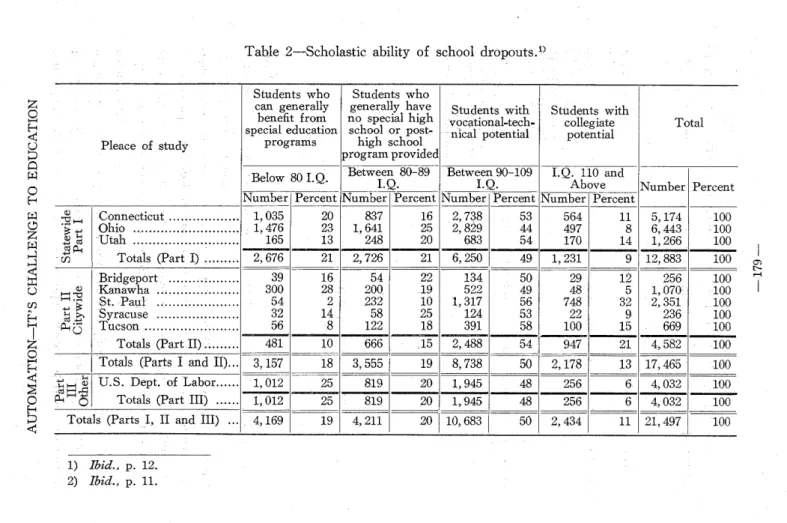
explodes this misconception. Besides investigating the I.Q,'s of drop-outs he has drawn attention to the resulting loss of potential which the nation must sustain. Let us now turn our attention to Table 2. Warner has drawn his data from a number of sources listed at the side of the table.
It is important to note that he classifies those with I.Q.'s of between 80-89 as having no special high school or post-high-school vocational-technical schools. The latter are reluctant to accept students who have I.Q. scores of less than 90. There is a very real need for something to be done for these people. We tend to expect them to complete the "normal" course and we would rather ignore the fact that they have not the intellectual capacity to succeed in the "normal" course or if they do it is only due to an abnormal amount of effort which may 1) Ibid., p. 165.
2) Conant, James, B., "Social Dynamite in Our Large Cities," Vital Speeches, No. 18, July, 1961, p. 554ff.
3) Warner, 0. Ray, "The Scholastic Ability of School Dropouts," Selected Reports and Statistics on School Dropouts, U.S. Office of Education, 1964,
p. 11ff.
z O 0 H (.7 z 4.1 cn H z O 0 rH ti
Table 2—Scholastic ability of school dropouts.e
Pleace of study Students who can generally benefit from special education programs Students who generally have no special high school or post-high school program provided Students with vocational-tech-nical potential Students with collegiate potential Total
Below 80 I.Q. Between 80-89I.Q. Between 90-109 I.Q.
I.Q. 110 and
Above Number Percent
Number Percent Number Percent Number Percent Number Percent
a
54.1
Connecticut 1, 035 1,476 165 2, 676 20 23 13 21 837 1, 641 248 16 25 20 21 2,738 2,829 683 6,250 53 44 54 564 497 170 11 8 14 9 5,174 6,443 1,266 100 100 100 Ohio Utah Totals (Part I) 2, 726 49 1, 231 12,883 100 _ — 39 300 54 32 56 481 16 28 2 14 8 10 54 200 232 58 122 666 22 19 10 25 18 15 134 522 1, 317 124 391 2, 488 50 49 56 53 58 54 29 48 748 22 100 947 12 5 32 9 15 21 256 1, 070 2,351 236 669 4, 582 100 100 100 100 100 100 Bridgeport .... nvrrl,..a Kanawha St. Paul Syracuse TucsonTotals (Part II)
Totals (Parts I and II)... 3,157 18 3, 555 19 8, 738 50 2, 178 13 17, 465 100
I—I
U.S. Dept. of Labor Totals (Part III)
1,012 25 819 819 20 20 1, 945 48 48 256 256 6 6 4, 032 4, 032 100 100 1,012 25 1, 945
Totals (Parts I, II and III) ... 4, 169 19 4, 211 20 10, 683 50 2, 434 11 21,497 100
1) Ibid., p. 12. 2) Ibid., p. 11.
force them to pay the cost in some other aspect of their personality . From this table it is possible to see the loss of potential but we cannot tell to what extent society must pay for maladjustments and unemploy-ment resulting from these students leaving school.
It must be remembered that the mere physical presence of the student in the classroom is by no means enough. We have at present many students who are dropouts but have not in fact left the school . The school can, in this case, do something constructive if the student is identified soon enough.
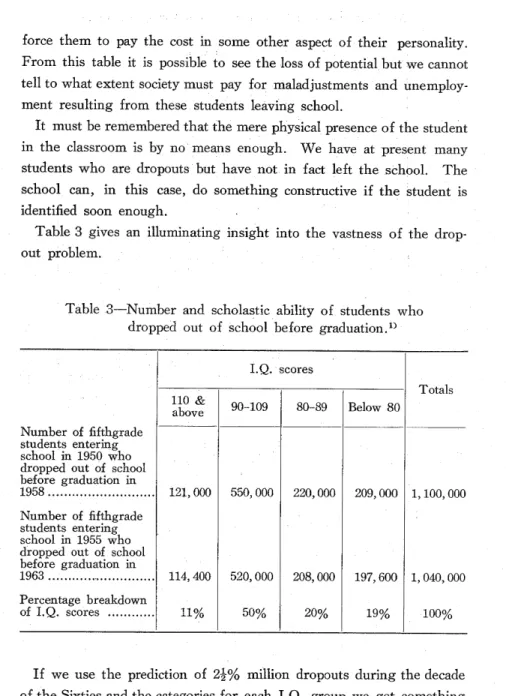
Table 3 gives an illuminating insight into the vastness of the drop-out problem.
Table 3—Number and scholastic ability of students who dropped out of school before graduation.')
Number of fifthgrade students entering school in 1950 who dropped out of school before graduation in 1958
Number of fifthgrade students entering school in 1955 who dropped out of school before graduation in 1963 Percentage breakdown of I.Q. scores I.Q. scores 110 & above 121, 000 114, 400 11% 90-109 550, 000 520, 000 50% 80-89 220, 000 208, 000 20% Below 80 209, 000 197, 600 19% Totals 1, 100, 000 1, 040, 000 100%
If we use, the prediction of 21% million dropouts of the Sixties and the categories for each I.Q. group
during the decade we get something 1) Ibid., p. 13.
AUTOMATION—IT'S CHALLENGE TO EDUCATION like this
Of the
825,000 have the scholastic potential to complete a college program , or 82,500 per year.
3,750,000 are potentially able to comple post-high-school vocational technical programs, or 375,000 per year
1,500,000 (I. Q. 80-89) will have little or no vocational preparation and with few educational programs available to them , or
000 per year.
1,425,000 (I.Q. below 80) will have few limited training programs open to them and consequently will be added to the swelling
number of unemployed, juvenile delinquents , and welfare
cases at an average rate of 142,500 per year .
From the above statistics we can see that the numbers are vast and the problem requires that something be done , and done soon. It is true that certain projects have been launched to try to deal with the situation but what has been done so far is a mere drop in the ocean and too many of the projects start when it is almost too late for
anything to be done. More research is needed into the causes of
dropping out and more intense efforts must be made by agencies out-side the school to combat the social and psychological environments in which the potential dropout learns to dropout.
C. Socio-economic Environment.
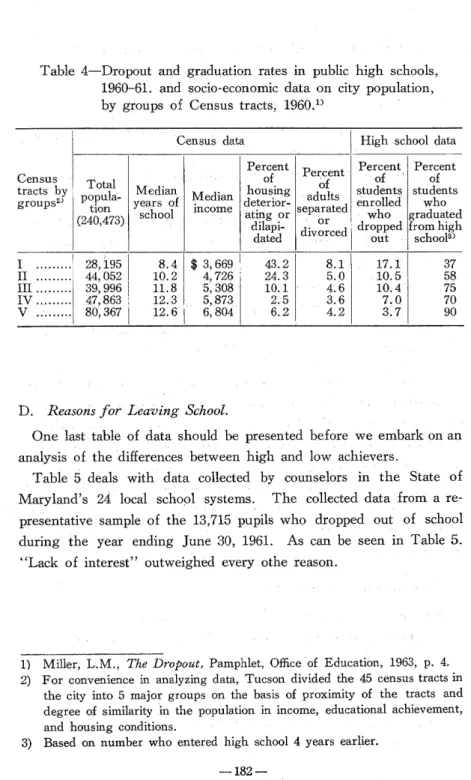
Let us now turn to Table 4 which gives us an example of how the socio-economic environment comes into the picture . This table also indicates the, number of years of schooling which the parents had and separation and divorce rates.
This table reveals a significant relationship between the dropout and his community ; between the dropout and the education , income, and marital status of the people around him.