Title
Studies on Endocrine Disruptors Contained in Diesel Exhaust
Particles( 本文(Fulltext) )
Author(s)
李, 春梅
Report No.(Doctoral
Degree)
博士(獣医学) 甲第214号
Issue Date
2007-03-13
Type
博士論文
Version
publisher
URL
http://hdl.handle.net/20.500.12099/21397
※この資料の著作権は、各資料の著者・学協会・出版社等に帰属します。
Studies
onEndocrine
Disruptors
Contained
in
Diesel
Exhaust
Particles
(ディーゼル排気微粒子中に含まれる内分泌撹乱化学物質に関する研究)
2006
The
United
Graduate
School
of Veterinary
Sciences,
Gifu
University
(Tokyo
University
of Agriculture
and
Technology)
Chapter l・ Introduction ・・・・・・…………・・…・・・・・…・・・・・・・・・・……・・・・・・・・・・・・・・・・・・・・-・・・・・・--・・・--・・-・・・・・・・-・ 1
1-1. Air pollution and diesel exhaust
112. Isolation and identification of nitrophenols from diesel exhaust particles
(DEP)
2I-3. HypothalamicIPituitary-Gonadal axis
(HPG)
1-4. Japanese quail
(CoturnLx:japonica)
115.
Objectives
of the present studyChapter 2・ General Materials and Methods ・-・・・・・・・・・-・・・・・-・・・・・・・・--・・・・・・・・・・・-・・・-・-・-・・・- 12
2-1. Animals 2-2. Histology
213. Immunohistochemistry
214. Radioimmunoassay
(RIA)
of hormones2-5. General statistics 12 12 12 13 15
Chapter 3. Impairment of Testicular Function in Adult Male Japanese
Quail (CoturnLx:
japonica)
After aSingle
Administration of PNMC ・・・・・・・・・・・・・・・・・・・・・・・・・・・・・・・・・・・・・・・・・・243-1. Background
312. Material and Methods
3-2-1. Chemicals 3-2-2. Animals
3-2-3. Administration of PNMC
3-214・ Regrouplng ● according to testicular atrophy
3-2-5. Histopathology
312-6. Effects of PNMC on hypothalamusIPituitary function
3-2-7. Interstitial cell preparation
24 25 25 25 25 26 26 26 27
3-2-8. I)etermination of concentrations of luteinizing hormone
(LH)
andtestosterone 3-2-9. Statistics 3-3. Results 3-3-1. Acute effect of PNMC 3-3-2. Testicular atrophy 27 28 28 28 28
3_3_4. Plasma concentrations of LH and testosterone
3-3-5. Cloacal gland area
3_3_6. Acute effects ofPNMC on secretion ofLH
3-3-7. Dose and time dependent effects of PNMC on testosterone secretion of
interstitial cells 3-4. Discussion
chapter 4・ Effects of PNMC on the Regulation of Reproductive Function in Mature and
lmmature Female Japanese
Quail
(CoturnLrjaponica)
・・・・・・・・・・・・・・・・・・・・・・・・・・・・・・・・・・・42 4-1・ Backgrollnd
4_2.Materials and methods
4-2-1. Chemicals 4-2-2. Animals
4_2_3. Administration of PNMC in mature female birds
4_2_4. Administration of PNMC in immature female birds
42 43 43 43 43 44
4-215. Determination of plasma concentrations of LH,
estradiol-17P,
and ・・・・・・・・・・・・44progesterone
4_2_6. Immunohistochemical localization of inhibin α-subunit and
叩-hydroxysteroid
debydrogenase(叩ⅢSD)
in ovares of immature birds - 454-2-7. Statistics 4-3. Results
413-1. Effects ofPNMC on organs and body
weights
of mature female birds・・・・・・・45
4-3-2. Effects of PNMC on egg laying and hatchability of mature female birds・・・・45
4-3-3. Effects of PNMC on plasma concentrations of LH,
estradiol117P,
andprogesterone in mature female birds
4-314. Effects of PNMC on organs and body
weights
in immature female birds ・・・464-315. Effects of PNMC on plasma concentrations of LH,
estradiol117P,
andprogesterone in immature female birds
4_3_6. Immunohistochemical localization of inhibin α,subunit and
3βHSD
inovaries of immature birds
5-1. Background
5-2. Materials and methods 5-2-1. Chemicals
5-2-2. Animals
5-2-3. Anti-androgenic activity of PNMC
5-2-4 Effects of PNMC on reproductive function
5-2-5. Radioimmunoassay
(RIA)
5-2-6. Statistics 5-3. Results
513-1. Anti-androgenic recombinant yeast screen assay
5-3-2. Hershberger assay
5-313. Effects ofPNMC on organ and body
weights
5-3-4. Effects of PNMC on plasma and testicular hormones
58 59 59 59 60 61 63 63 64 64 64 65 65
5-3-5. Effect of in vitro exposure of anterior pituitary cells to PNMC on LH and
FSH release
51316. Effect of in vitro exposure of interstitial Leydig cells to PNMC on
testosterone release
5-4. Discussion
chapter 6・ Effects of PNMC on the Suppression ofAdrenocortical Function in Immature
Male Rats...…...……....…..….…...…...…...…...…...-.-....-..-...-81
611. Background
6-2. Materials and methods 6-211. Chemicals
6-2-2. Animals
61213. Administration of PNMC
6-2-4・ Preparation of anterior pituitary cells and cell cultures 6-2-5. Isolation and culture of prlmary● adrenal cells
61216. Radioimmunoassay
(RIA)
613-1. Effects of PNMC on
adrenalglands
weights
613-2. Effects of PNMC on plasma ACTH! corticosterone and progesterone ・・・・・・・・ 85
6-3-3. Effects of PNMC on plasma free triiodothyronin
(FT3)
and freeL-thyrocine
(FT4)
6-3-4. Effect of in vitro exposure of anterior pituitary cells to PNMC on ACTH
production
6-3-5. Effect of in vitro exposure of adrenal cells to PNMC on corticosterone and
progesterone production 6-4. Discussion
chapter 7・ Estrogenic and Anti-Androgenic Activities of PNP
・・・・・・・・・・・・・・・・・・・・・・・・・・・・・・・・・・・・・・・・・・95 711. Background
7-2. Materials and methods 7-211. Chemicals 7-2-2. Animals 712-3. Uterotrophic assay 7-2-4. Hershberger assay 71215. Radioimmunoassay
(RIA)
7-216. Statistics 7-3. Results713-1. Immature rat uterotrophic assay
7-312. Hershberger assay
713-3. Plasma concentrations of FSH and LH
7-4. Discussion 95 96 96 96 96 97 97 98 98 98 98 99 99
chapter 8・ General discussion and summary ・・・・・・・・・・・・・・・・・・・・・・・・・・・・・・・・・・・・・・・・・・・・・・・・・・・・・・・・・・・・・・・・・・・・ 109
8-1. General discussion 812. Summary
Acknowledgement・・・-・・・・-・-・・---・・-・・・-・-・・・・-・-・・・・--・・・・-・・・・-・・・・・・・・-・・-・・・・-・・・- 121
Chapter
l・ Introduction111・ Air pollution and diesel exhaust
pollution is becomlng an important public health problem and a political issue,
due to the rapid growth in world population and the increaslng world-wide mlgration
fromrural to urban areas. Recent United Nations estimates have indicated that 47%
of the global population is living ln urban areas・ This urbanization has brought about
an increasing need for transportation and hence an increase in motor vehicle generated
air pollutants・ There is growlng lntemational concem regarding the adverse health
effects of air pollution・ In Japan, more than seventy two million vehicles are
officially registered
(excluding motorcycles)・
In addition, the motor vehiclegenerated air pollutants, diesel exhaust particles
(DEP)
account for a highly significantpercentage of the particles emitted in many towns and cities・ Furthermore, the
atmosphere in urban areas contains a large amount of vapor and solid phase pollutants・
The
majority
of the solid phase pollutants are suspended particulate matter(SPM),
which may have adverse effects on human health・ Recently, the health significance of
fine particles in SPM, such as particles smaller than 2・5 um in aerodynamic diameter
(pM2.5)
and nanoparticles have been receiving increased attention・ Most of the flneparticles in urban areas are DEP
(the
majority
ofDEP are in the range ofO・02-0・5um)・
Many countries exhaust vast amounts of DEP into the atmosphere・ For example, in
Japan 58902 tons
(39),
in the United States of America 111530 tons(111),
in England(uK)
37000 tons(3),
and in EURO, the highest of240000 tons(81)
are emitted eachyear and this isan amount that can not be ignored・
DEP contain a vast number of organic constituents and is considered as
containing Slgnificant environment compounds including polyaromatic hydrocarbons,
nitro aromatic hydrocarbons, heterocycles, qulnOneS, aldebydes, and aliphatic
including lung cancer
(37, 58),
allergic rhinitis(64, 98),
and bronchial asthma-likedisease
(61, 91).
Moreover, DEP has endocrine-disrupting properties and potentialadverse effects on both male and female reproductivefunctions・ Diesel exhaust
suppresses spermatogenesis in adult mice
(122)
and rats(109, 117)・
Furthermore,pregnant c57BL mice
Injected
with DEP extracts showed signiflCant increase inabortion rate and uterine weight
(110).
These in vivo findings show that DEP containcompounds that have modulated estrogenic and anti-androgenic activities・ In vitro
studies similarly have shown that DEP possess estrogenic, anti-estrogenic, and
anti-androgenic activities
(45,
59, 75,99)・
1-2. Isolation and identification of nitrophenols from diesel exhaust particles
(DEP)
Although DEP contain carbon nuclei which absorb numerous and diverse
chemicals, the specific
compound(s)
responsible for phenomena such as suppressedspermatogenesis and increased abortion rate and uterine weight remain unclear・ To
address this question, Dr・ Akira K Suzuki and his coworkers recently lSOlated fわur
nitropbenol derivatives 丘・om DEP, namely 4-nitrophenol
(PNP),
21methy14nitrophenol, 3-methyl-4-nitrophenol
(PNMC),
and 41nitro13 1Phenylphenolfrom DEP and showed that they had vasodilatation, estrogenic and anti-androgenic
activity
(Fig. 1-1).
The 1 kgDEP contains 28 mg PNMC and 15 mg PNP(62, 100)・
In addition to its presence in DEP, PNMC is a degradation product of the insecticide
fenitrothion
(34) (Fig. 1-2),
which is widely used in many countries・ Also, PNP is adegradation product of the insecticides parathion and methylparathion
(43) (Fig・ 1-3),
which are not currently in use in Japan but are still used worldwide in countries such as
china, asfumigants, acaricides, and pre-harvest soil and foliage treatments for a wide
variety of crops, both outdoors and in gree血ouses・ The accumulation of PNMC and
wildlife and human health through disturbance of endocrine and reproductive systems・ Therefore, 1tis an important aim of the current study to clarify the effects of PNMC
and PNP isolated from DEP on wildlife and human health.
1-3. HypothalamicIPituitary-Gonadal axis
(HPG)
(Fig・ 114)
The physiology of reproduction centers on the HPG axis・ The HPG axis is
composed or the hypothalamus and its neural connections with the rest of the brain, the
pituitary, and the testis
(male)
or ovary(female)・
The classic view of this axis is thatthe anterior hypothalamus and preoptlC area represent the reglOnS that are responsible
for the synthesis of the peptide gonadotropin-releasing hormone
(GnRH),
which is theprlmary regulator of the pltuitary gonadotrophs・ Axons anslng from these
hypothalamic nuclei
project
toward the medial basal hypothalamus and into the outerzone of the median eminence
(ME).
From the ME, GnRH reaches the anteriorpituitary via hypothalamo-hypophyseal portal system and stimulates gonadotropIC Cells
to release luteinizing hormone
(LH)
and follicle stimulating hormone(FSH)
into thegeneral circulation・ LH and FSH bind to specific receptors in the ovary and testis and
regulate gonadalfunction by stimulating gametogenesis and production of steroid
homones. In the male, L= binds to speci丘c membrane receptors on Leydig cells of
the testis, which leads to generation of CAMP and other messengers that ultimately
cause the secretion of androgens
(testosterone).
LH in combination with FSH isrequired fわr maturation of spematozoa・ FSH stimulates testicular growth and
increases production of androgen-binding protein by Sertoli cells・ Androgen-binding
protein concentrates testosterone near the sperm, enabling normal spermatogenesis・
Inhibin is a glycoprotein hormone secreted from Sertoli cells and is nowknown to be
one of the important gonadal hormones which regulate the secretion of FSH
(14)・
within the testis, inhibin production is stimulated by FSH and acts by negative feedback
secretion particularly of the FSH of the anterior pltuitary and even LH・ LH stimulates
ovarian production of estrogen and progesterone・ LH surges midway ln the estrous
cycle are responsible fわrovum maturation and ovulation, and sustained LH secretion
stimulates the corpus luteum to produce progesterone・ FSH exerts pnmary control
over development of the ovarian follicle, and both FSH and LH are responsible for
follicular secretion of estrogen・ This axis normallyfunctions in a tightly regulated
manner to produce at optlmal circulating steroids fわr development of secondary sexual
characters, spermatogenesis and maintenance of fertility・
114. Japanese quail
(CoturnLrjaponica)
The Japanese quail
(Coturnix japonica)
was originally domesticated in Japanaround the llth century as a pet song bird
(118).
Nowadays, this poultry lScommercially raised f♭r egg production in East Asian countries including Japan, and
for meat production in WesternEuropean countries such as Spain and France・ The
Japanese quail as a laboratory animal began in the late 1950s, because of its
adaptability to battery breeding cages, small body size, early sexual maturation, short
generation inteⅣal
(16-1 7days),
regular egg laying and high egg production(200-300
eggs a
year)
(118),
it has been used extensively in research・Tbe Japanese quail can be sexed as early as three weeks of age, based on the
feather color the females which can be easily identified by the slightly whiter plumage
under the throat and upper breast, different from the characteristically black stlPPled
feathers of the male
(Fig. 1-5).
The plumage color on the throat and breast iscinnamon orrusty brown・ Males generally live longer than females・When matured,
the weight ofmales is in the range of 100-140 grams, and they reach sexual matunty at
5 to 6 weeks ofage・ When males are sexually matured, a large glandular or bulbous
structure appears above the cloacal openlng・ The cloacal gland, which is situated at
rudimentary in females. This gland is an androgen-dependent structure
(90)
andproduces foam that is transferred to the female at copulation, which is hypothesized to
help maintain spermin the cloaca of the female and in this way Improve egg
fertilization. Growth of the cloacal gland can be induced in females by treatment
with testosterone but they never reach the same size as in males
(2)・
The cloacalgland becomes demasculinized by embryonic estrogen exposure
(1)
and the gland of inovo estrogen treated males does not respond to androgens to the same extent as the
gland of normal males・ Male quail testes are located in the abdominal cavity behind
the kidney・ Fur也emore, quail testes show a seasonal increase in size, which is
mainly due to an increase in the size of the seminiferous tubules associated with sperm
production, as well as increase in the number of interstitial cells, which are responsible
for the production of testicular hormones・ These changes are tnggered by increasing
day length under the influence of gonadotropins・ The adult female Japanese quail is
generally larger than the male, weighing about 1201160 grams, and they start laying
eggs as early as 6 weeks ofage・ In the quail, as in most avian species, only the left
gonad develops into the ovary・ The left ovary lS attached by the mesovarian ligament
at the cephalic end of the left kidney・ A unlque feature of the avian reproduction
system is the unilateral development of the ovary and oviduct in the female embryo・
The right ovary grows slowly ln the 8- to 10-day-old embryo, becomlng a tlny
mdiment in the 15 day-old embryo
(12).
Tbe Japanese quail as a laboratory animal has been extensively used in
reproductive toxicity testing.
Quail
are considered to be representative of terrestrialbirds and accepted models for assesslng both the acute and chronic effects of pesticides
and other chemicals in wild birds
(19, 71),
because spermatogenesis is well1-5.
Objectives
of the present studyThe present study focuses on clarifying the adverse effects induced by
3-methy14nitrophenol
(PNMC)
and 4-nitrophenol(PNP)
isolated from DEP on thereproductive function in male and female avian
(quail)
and mammalian(rat)
animalA スcK=
㌫cK=
4-nitropheno1 3-methyト4-nitropheno1 2-methyl-4-nitrophenol
(PNP) (PNMC)
4-nitro-3
-phenylphenol
H耳(二'-() ()- 〔,H5
\
/sly
pi
DeLJradatioll
-i_ ('H弓Fe11i廿othi()ll
3
-MeThvトヰー11itropllellOl
(PhTM(I
-1iFig. 1-2 Chemical structure of 3-methy-4-nitrophenol
(4-nitro-∽-cresol,PNMC),
aCH3CH2ho -CⅢ3CH2 0 P S
.ク
I礼
Parathi on //scH3ーoブ-c恥o晶
M ethylpar athion\ヰ/
申
4-Ⅳitrop henol
(P付P)
Fig. 113 Chemical structure of 4-nitrophenol
@-nitrophenol,
PNP),
a component of///
CloacalglaJld
CloacaIgland
「→A,J .pr .\l )A ㌔叫声・シ 4.T1.t〉′}、 , ;・Iこ 、 -、 、-/i I イ:与・・:.ベ」少■J
・ ;:⊥・,こ・-17 ・ :J-■ ヽ一 ⊥.∴ニ
藍垂…
ヴ_上■■h .斗■:1 ・斗■三_二y:{=-
・■苧津:f.i吉、:.-y;i..
・, ∴.i*・:.∴,:すtナ,1,戎f三
■・-イ -ノ ・■・ ■i ・'3 [1,-二.; ≡ ,1..-3 LL.,.:I 】L) _I.亡J 'iF .tt こ:. +J .. T丘:,?息L:.I-・::.:-て二∴ミ.
■lL:T/:■3 `J. ・r:L/I-こナ・_㌔-I:宗J・ こ∴ノ了・・."ナii::,・_:f
声、
・ ヽl ∴/ .∵ Female ;.!:、キ、∫車
・I・∴享■?㌔`車
rネ:A-.'ylq 二一 考,,:■.言-l・....I. ・・ I--` :-+)・▼こ■Fig. l15 Japanese quail
(Coturnixjaponica)
1 ・・
二:・ rヒ
Chapter 2・ General Materials and Methods 2-1. Animals
All experimental procedures were carried out in accordance with the Guiding
principles in the Use ofAnimals in Toxicology, and were approved by the Animal Care
and Use Committee of the Japanese National lnstitute fわr Environmental Studies・
The experimental animal of the present study were healthy Japanese quail
(Coturnix
japonica)
and rats(Wistar-Imamichi)
raised under controlled environment(lights
ono500 to 1900 h, temperature 23土2 oC, humidity 50土10%, and air exchanged 20
times
hourly)
in Japanese National lnstitute f♭r Environmental Studies・2-2. Histology
Tissue samples were immediately 丘Ⅹed in 4% parafbrmaldebyde
(Sigma
chemical Co., St. Louis, MO,
USA)
in 0.05 M phosphate buffered saline(PBS),
pH7・4, and embedded in paraffin・ The paraffin-embedded tissue blocks were serially
sectioned at 6 〟m thickness and placed on poly-L-1ysine
(Sigma
Aldricb Co・, St・ Louis,MO,
USA)
coated slide glasses(Dako Japan
Co・, Kyoto,Japan)・
The preparation oftissues for histology lS Shown in Fig. 2-1 ・
2-3. Immunohistochemistry
A氏er tissue sections were deparaffinized with xylene, they were
subjected
toantigen retrieval by autoclaving in 0.01M sodium citrate buffer
(pH 6・0)
at 121 oC for15 min. The sections were then incubated in 0.3% H202 in methanol at room
temperature for 1 h, followed by incubating with block solution of O・5% casein-Tris
saline
(CTS)
(0.05
M Tris-HCI with 0.15 M NaCl, pH 7・6;CTS)
at 37 oC fわr 1 h toquench nonspeci丘c stainlng・ Followlng this, the tissue sections were incubated fわr 16
h at 37 oC with rabbit polyclonal丘rst antibodies in CTS・ The sections were then
叩-hydroxysteroid
dehydrogenase(3βHSD)
(16)
andanti-(Tyr30)-porcine
inhibinα-chain
(1-30)-NH2
(inhibin α)
conjugated
to rabbit serum albumin for 16 h at roomtemperature. The antibody of
3βHSD
was kindly supplied by Dr・ J・ Ⅰ・ Mason(Edinburgh
University, Edinburgh EH3 9YW,U・K・)・
The antibody against inhibin αsubunit was
anti-[Tyr30]
inhibin- α-chain(1-30)-NH2
conjugated
to rabbit serumalbumin. The
[Tyr30]-inhibin-
α-chain(1-30)-NH2
Was kindly provided by Dr・ N・ Ling,(Neuroendocrine
lnc., Sam Dieg,USA).
Then the sections were treated with O・25%(Ⅴ/v)
biotinylated second antibodies(Elite
ABC kit; Vector Lab・ Burlingame, CA,USA)
in CTS fわr 1 也 at 37 oC, and were subsequently incubated with 2%(v/v)
avidin-biotin complex
(Elite
ABCkit)
in CTS fわr 30 min at room temperature・ Thereactions were visualized by treatlng With O・025% 3,3 ラ-diaminobenzidine tetrachloride
(DAB,
Sigma ChemicalCo.)
in 10 rnM Tris-bufffered saline containing O・01 % H202for 1-30 min・ Specificity of the antibodies was examined using normal rabbit lgG
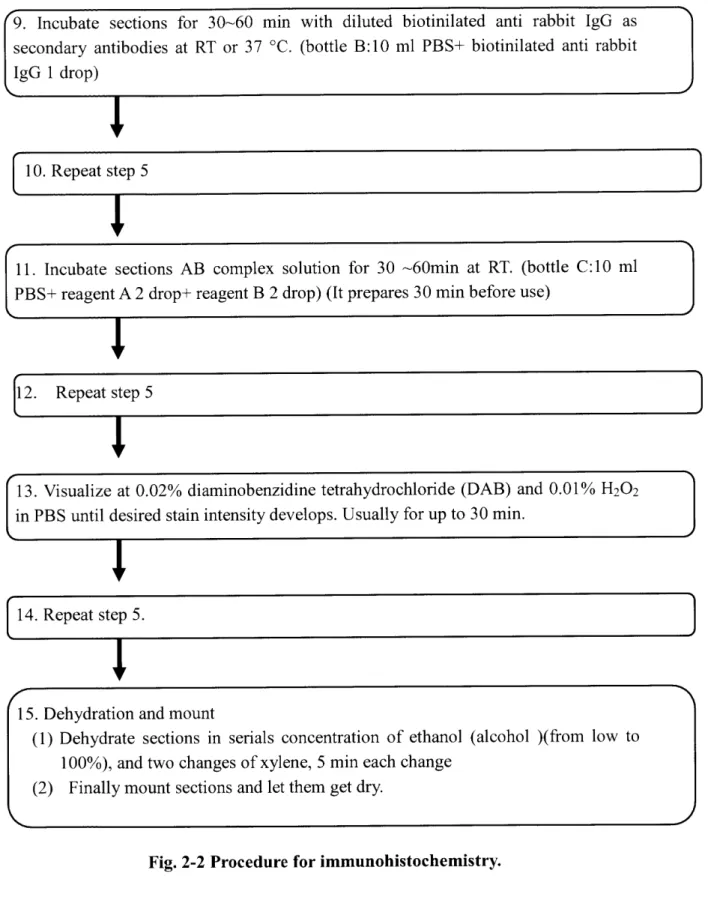
instead of丘rst antibody・ The procedures fわr immunohistochemistry are shown in Fig・
2-2.
2-4. Radioimmunoassay
(RIA)
of hormonesplasma and conditioned media concentrations of LH and FSH were measured by
using National lnstitute of Diabetes and Digestive and Kidney Disease
(NIDDK)
ratradioimmunoassay
(RIA)
kits(Bethesda,
MD,USA)
for rat LH and FSH・ Theantisemm used was anti-rat LH-S-ll and anti-rat FSH-S-ll. The intra- and
inter-assay coefficients of variation were 5・4% and 6・9% for LH, 4・3% and lO・3% for
FSH, respectively・ The protocol fわr RIA ofFSH and LH is shown in Fig・ 2-3・
Quails
plasma concentrations of LH were measured with a USDAIARSradioimmunoassay
(RIA)
kit(Beltsville,
MD,USA)
for chicken LH・ The antiserumused was anti-avian LH
(HAC-CH27-01RBP75).
Ho-one fわr iodination wasThe intra- and inter-assay coefflCients of variation were 5・2% and 1 1
・2%, respectively・
USDA-CLH-Ⅰ-3 and USDA-CLH-K-3 were kindly provided by Dr. John A・ Proudman,
Biotecbnology and Gemplasm Laboratory, Animal and Natural Resources Institute,
Beltsville, Maryland, USA
(48)・
The antisemm against avian LH was kindlyprovided by the Bioslgnal Research Center, Institute f♭r Molecular and Cellular
Regulation, Gunma, Japan
(32).
The protocol for RIA of quail LH is shown in Fig・2-4.
plasma and conditioned media concentrations of ACTH were measured by
double-antibody RIAs using 125I-labeled radioligands as described previously
(108).
Synthetic rat ACTH 1-39
(Sigma
Chemical Co・, St Louis, MO,USA)
was used as thereference standard. The intra- and inter-assay coefficients of variation were 1 l・3 and
ll・9%, respectively The protocol fわrRIAofACTH is shown in Fig・ 2-3・
plasma and testicular concentrations of ir-inhibin were measured as described
previously
(31).
The iodinated preparation was 32-kDa bovine i血ibin, and theantiserum used was rabbit antisemm against bovine inhibin
(TNDH-1)・
Results wereexpressed in terms of 32 kDa bovine inhibin・ The intra- and inter-assay coefficients
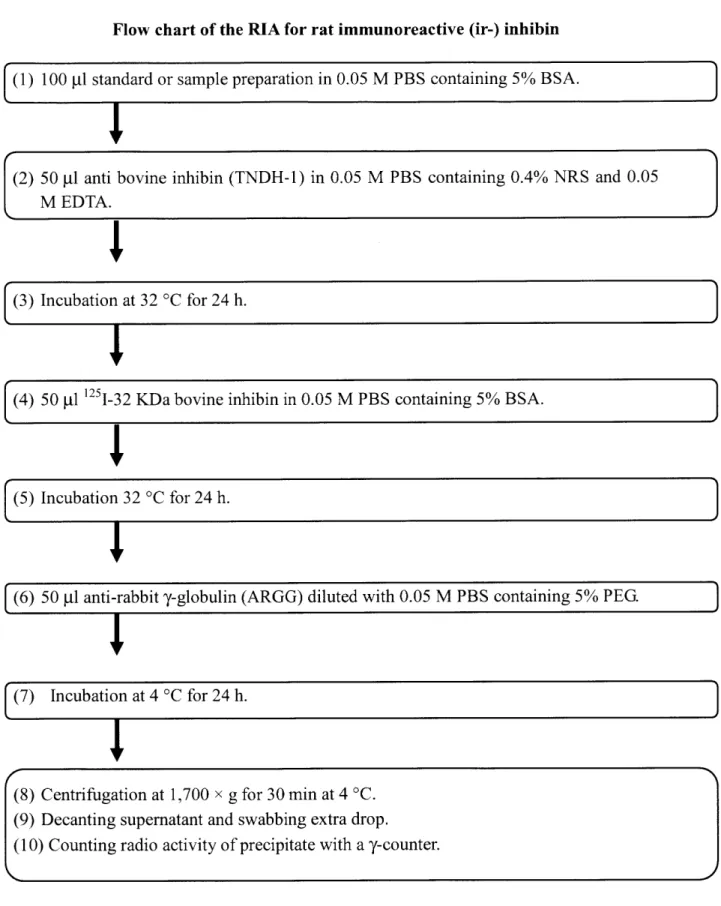
of variation were 8.8 and 14.4%, respectively. The detailed procedures are shown in
Fig.2-5.
Plasma, testicular, and conditioned media concentrations of testosterone
(102)
,plasma and conditioned media concentrations of
progesterone(1 02)
and corticosterone(42)
were detemined by double-antibody RIA system with 125Ⅰ-labeled radioligands asdescribed previously. The antiserum against testosterone
(GDN
250)
(29)
andprogesterone
(GDN
337)
were kindly provided by Dr・ G D・ Niswender, Colorado StateUniversity
(Fort
Collins, CO,USA).
The antiserum corticosterone was purchasedfrom UCB-Bioproducts, Belgium・ The intra- and inter-assay coefficients of variation
were 6.3 and 7.2% for testosterone, 9.5 and 16.4% for corticosterone, and 6.9 and
1 1
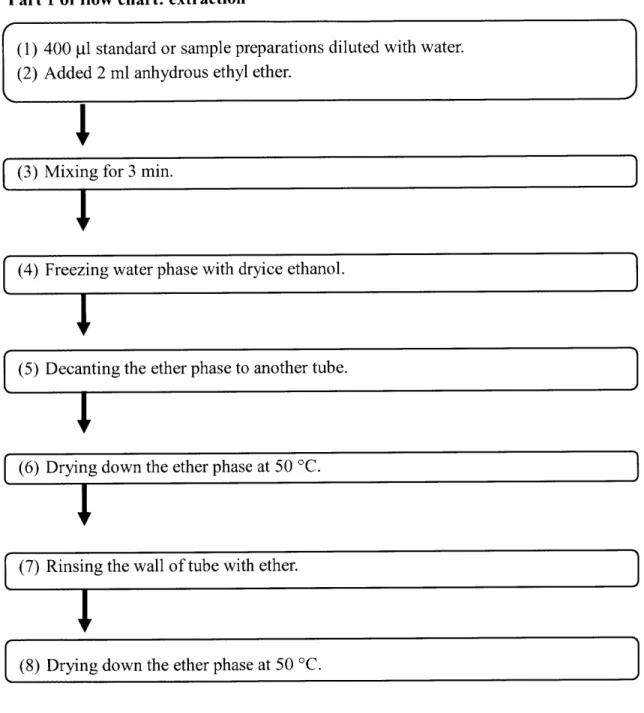
・2% for progesterone, respectively・ The detailed procedures
and Fig. 2-7.
plasma concentrations of free triiodothyronin
(FT3)
and free L-thyrocine(FT4)
were measured by using AMERLEX-MAB FT3 and FT4 kits
(Trinity
Biotech, Bray,co. wicklow,
Ireland).
The intra- and inter-assay coefflCients of variation were 7・0%and 8.5% for FT3, and 6.5% and 7・5% for FT4, respectively・
2-5. General statistics
All data are expressed as mean土SEM
(standard
error of themean)・
Statisticalanalysis was performed using one-way or two-way analysis of variance
(ANOVA)
followed by Fisher's protected least significant difference test
(Fisher's PLSD)
orDunnett-s test. Statistical analysts Was perfbⅢned uslng the so氏ware program
statview 5.0
(SAS
Institute Inc., Cary, NC,USA)・
A probability value ofP < 0・05 wasFlow chart of the tissues preparation for histology
8・ Drying at 37oC over night to be ready fわrhistology or immunohistocbemistry
Flow chart of immunohistochemistry
1 5. Dehydration and mount
(1)
Dehydrate sections in serials concentration of ethanol(alcohol )(from
low tolOO%),
and two changes ofxylene, 5 min each change(2)
Finally mount sections and let them get dry・Flow chart of the RIA for rat gonadotrophins
(LH, FSH)
and ACTHFlow chart of the RIA for quail LH
(4)
50 ul 125I-chicken LH(USDA-CLH-I-3)
in O・05 M PBS containing l% BSA・(8)
Centrifugation at 1,700 xg for 30min at 4 oC・
(9)
Decanting supematant and swabbing extra drop・(1 0)
Counting radio activity of precipitate with a γcounter・Flow chart of the RIA for rat immunoreactive
(ir-)
inhibin(2)
50い′1 anti bovine inhibin(TNDH-1)
in 0.05 M PBS containing O・4% NRS and O・05MEDTA.
(4)
50 pl 125I-32 KDabovine inhibin in 0.05 M PBS containing 5% BSA.(8)
Centrifugation at 1,700 ×g for 30min at4 oC・
(9)
Decanting supernatant and swabbing extra drop・(10)
Counting radio activity of precipitate with a γcounter・Flow chart of the RIA for steroid hormones-1
Part 1 offlow chart: extraction
(1)
400 pl standard or sample preparations diluted with water・(2)
Added 2 ml anhydrous ethyl etber・(8)
Drying down the ether phase at 50 oC・Part 2 offlow chart: assay after extraction
(15)
Centrifugation at 1,700 x g for 30 min at 4 oC・(1
6)
Decanting supernatant and swabbing extra drop・(1
7)
Counting radio activity of precipitate with a γcounter・Chapter 3. Impairment of Testicular Function in Adult Male Japanese
Quail
(CoturnLrjaponica)
After aSingle
Administration of PNMC3-1. Background
Diesel air pollution is a slgniflCant environmental problem and has broad effects
on human health, including lung cancer
(37, 58),
allergic rhinitis(64, 98),
andbronchial asthmallike disease
(61, 91).
DEP, the soluble organic fraction ofparticulate matter from diesel exhaust, are also toxic to the male and female
reproductive systems
(109,
110, 117,122)・
However, the speci丘c compoundsresponsible fわr this toxiclty are Still unclear・
Four nitrophenols, 4-nitrophenol, 2-methyト4-nitrophenol,
31methyl-4-nitrophenol
(PNMC),
and 4-nitro13-phenylphenol were isolatedfrom DEPand showed that they had vasodilatory activity
(62, 100),
estrogenic activity(25,
26,101),
and anti-androgenic activity(101).
In addition to its presence in DEP, PNMC isa degradation product of the insecticide fenitrothion, a widely used pesticide with high
potential fわr human, livestock, and poultry exposure in both mral and residential
environments. The accumulation ofPNMCfrom these sources could have slgnificant
effects on wildlife and human health via disruptions of endocrine and reproductive
systems・
Desplte the potentially slgnificant effects, the possible biologlCal impact and
basic data on the toxiclty Of PNMC are still unknown・ To dete-in° the basic
potential endocrine and reproductive toxicities of PNMC, I used the adult male
terrestrial Japanese quail
(Coturnix japonica)・
The Japanese quail as a laboratoryanimal has been extensively used in reproductive toxiclty teStlng・
Quail
areconsidered to be representative of te汀eStrial birds and accepted models fわr assesslng
both the acute and chronic effects of pesticides and other chemicals in wild birds
(19,
marker of gonadal development
(76)・
In the present study, I used this animal modelto examine the in vivo effects of a slngle dose of PNMC and in vitro effects on the
testicularfunction of adult male quail.
312. Material and Methods
3-211. Chemicals
3-Methyl14-nitrophenol
(4-nitro-m-cresol, PNMC)
was purchased from TokyoKasei Kogyo Co. Ltd.
(Tokyo, Japan)・
Collagenase(type V),
soybean trypsininhibitor, Medium 199
(M199)from
Sigma(Sigma
Chemical Co・, ST・ Louis, MO,USA).
3-2-2. Animals
Japanese quail
(Coturnixjaponica)
came from L selected lines, in which chicksbatch a洗er 17 days of incubation and the birds reach sexual maturity at 6 weeks・
Birds were provided with food
(Kanematsu
quail diet, Kanematsu Agri-tech Co・ Ltd・,Ibaraki,
Japan)
and water ad libitum. Six- to nine-week old male birds were housedin metal cages in a controlled environment
(lights
on 0500 to 1900 也, temperature 23土2 oC, humidity 50士10%, and air exchanged 20 times
hourly)・
3-2-3. Administration of PNMC
Mature male Japanese quail were treated with a single intramuscular
(im)
injection
ofPNMC(78,
103 or 135 mg/kg bodyweight)・
The doses were decided bythe preliminary experiments of LD50 0fPNMC in the adult male quail・ The LD50 0f
PNMC in the adult male quail was 135 mg/kg, so the 3 lower doses including 135
mg/kg were adopted in this study. Controls were
injected
with vehicle alone(PBS
euthanized by decapltation at 1, 2 and 4 weeks after the
lnjection・
Followlngdecapltation, blood samples were collected in heparinized plastic tubes and centr血ged
at 1700 ×
g fわr 15 min at 4 oC・ Plasma was separated and stored at
-20 oC until
assayed fわrtestosterone and luteinizing hormone
(LH)・
The testes were collected andweighed, and the cloacal gland area
(longest
length xgreatest
width)
was measured・3-2-4・ Regrouplng according to testicular atrophy
●
Birds with testicular atrophy were fわund in all PNMC-treated groups, but none
was fわund in the control group・ Birds were separated into three atrophy groups
(severe,
intemediate, andmild)
on the basis oftesticular weigbt・ The severe atrophygroup included birds in which the weight of both testes was at least 50%
(1・33土0・064
蛋)
lighter than the mean of the control group(2・66
± 0・128蛋)・
The intemediate groupincluded birds with one testis weighing less than 50% of the control weight・ The
criterion fわr the mild atrophy group was one testis weight of 50% to 70% oftbe control
weight.
3-2-5. Histopathology
Procedures of histopatbology were described in general materials and methods of
chapter2.
31216. Effects of PNMC on hypothalamus-pituitary function
To observe the direct effects ofPNMC on the secretion of LH, birds were treated
with a single im
injection
of small amount of PNMC(25 mg/kg)
to avoid an acutetoxic effect that was observed at the highest dose setting
(See results)・
Control birdswere treated with vehicle alone
(PBS
containing 0.05% Tween80)・
Eight birds were1 and 3 h after the
Injection.
Six hours afterInjection,
birds were killed bydecapitation and blood was collected・ All blood samples were centr血ged at 1700 ×
蛋 fわr 15 min at 4 oC, and plasma was separated and stored at -20oC until it was
assayed fわr LH・
3-2-7. Interstitial cell preparation
lnterstitial cell preparations containlng Leydig cells were prepared from the testes
of adult quail as previously described with minor modifications
(46)・
The testeswere immediately removed from adult quail after death by cervical dislocation and
testicular cells were dispersed by treatlng the decapsulated testis in M 199 medium with
O・71 mg/ml sodium bicarbonate and 2・21 mg/ml HEPES containing collagenase
(o.25mg/ml)
and soybean trypsin i血ibitor(0・025mg/ml)
at 37oC fわr 30 min in ashaking water batb・ A鮎r incubation, the supematant, containlng Leydig cells, was
decanted through nylon mesh to remove debris・ The cells were washed by
centrifugation and resuspended in 10 ml of M199 with l% fetal bovine serum・ The
viability of the cells was evaluated by means of the trypan blue exclusion test and fわund
to be 92%. Cells
(105 cells/well/10叫1)
were cultured in 96- well culture plates at 37oCunder a 95% air-5% CO2 atmOSphere・ Followlng a 20 min equilibration period, cells
were exposed for 3, 8, or 24 hr to 10-6, 10-5, o, 10-4 M PNMC
(100 pl)
dissolved inM199. The viability of treated cells was dete-ined by Lactate dehydrogenase
(LDH)
Cytotoxicity Detection Kit
(Takara,
Code No・ MK401, Otsu, Shiga,Japan)・
NoslgniflCant differences in LDH release activlty Were Observed at treated PNMC cells
compared with control cells
(data
notshown)・
Conditioned media were assayed fortestosterone.
3-218. Determination of concentrations of luteinizing hormone
(LH)
andThe detailed R士A procedures fわr dete-ination of LH and testosterone in plasma
and conditioned media were described in general materials and methods of chapter 2・
3-2-9. Statistics
The statistical methods are shown in chapter 2・ The acute effects ofPNMC on
the secretion of LH were analyzed uslng two-Way ANOVA丘)1lowed by Dunnett-s test・
3-3. Results
313-1. Acute effect of PNMC
of28 birds treated with the highest dose ofPNMC
(135
mg/kg),
6 died within 10min of treatment
(Table 3-1).
Of26 birds in the 103 mg/kg treatment group, one birddied. The birds showed behavior such as dyspnea, openlng the beak and tremor pnor
to death. None died in the 78 mg/kg or control groups・ The suⅣiving birds in all
treatment groups grew normally, with no differences in body weights
(data
notshown)・
3-3-2. Testicular atrophy
Results concern1ng With testicular atrophy are shown in Tables 1 and 2・
Morphology and histology of atrophic testes are also shown in Fig・ 3-1・ PNMC
treatment induced testicular atrophy as early as one week after treatment, but neither
the severity nor the incidence of atrophy showed a dose-dependent relationship
(Table
3-1).
The highest rate oftesticular atrophy was obseⅣed 2 weeks a鮎r treatment withPNMC in all groups・ In birds receiving 78 mg/kg and lO3mg/kg PNMC, 70% and
67% birds showed testicular atrophy
(Table 3-1).
Some birds showed signiflCantweight decreases in both testes, but others showed an asymmetrical decrease
(Table
3-2).
In most cases, the right testis was signi丘cantly decreased in size, whereas the3-313. Morphology and histology of the testes and
cloacalglands
Overall testicular morphology was normal in the control group
(Fig・ 311A),
whereas PNMC treatment induced severe atrophy, either bilaterally or on the right side
only
(Figs.
3-1B,C).
Control sections showed compartmentalization of gem cells inthe seminiferous tubules, with spermatozoa visible in normal-sized lumen
(Fig・ 311D)I
In birds with testicular atrophy on one side, seminiferous tubules contained only a thin
layer of spe皿atOgenic lineage cells, and spe-atids and spe-atozoa were absent
(Fig・
311E).
In contrast, paired atrophic testes showed no compartmentalization of germcells or spermatozoa, and had highly atrophic seminiferous tubules that were devoid of
all cells except spermatogonia and Sertoli cells
(Fig・ 311F)・
Control cloacal glandshad nomal morphology and produced cloacal gland fわam
(Fig・ 3-1G),
whereasPNMC-treated birds with testicular atrophy had smaller cloacal glands and did not
produce cloacal fわam
(Figs・
3-1H,Ⅰ)・
313-4. Plasma concentrations of LH and testosterone
plasma concentrations of LH and testosterone in PNMC treated birds are shown
in Fig・ 3-2 and Fig・ 3-3・ There were no treatmenトinduced changes in basa1 levels of
plasma LH at any time point with relatively large individual variation
(Fig・ 3-2)・
plasma concentrations of testosterone were slgni丘cantly lower in both the 78 and 103
mg/kg-treated groups at 1, 2, and 4 weeks a鮎r PNMC treatment
(Fig・
3-3A,B),
whereas the high-dose group showed a slgnificant decrease only at 4 weeks after
treatment
(Fig. 3-3C).
plasma concentrations of LH and testosterone in grouped birds by atrophy level
are shown in Table 3-2. There are two types of circulating levels of LH in PNMC
treated birds having various grades of atrophy testes・ The丘rst type of birds revealed
(1.34±0.45
ng/ml)
as compared with controls(4・66±0・61
ng/ml) (Table 3-2)・
plasma concentrations of LH in this type of birds decreased with increaslng Seventy Of
testicular atrophy, and the level paralleled with testis weight・ In this type of birds,
plasma concentrations of testosterone were significantly lower in severe, Intermediate
and mild atrophy groups as compared with controls・ It is also paralleled with testis
weight
(Table 3-2).
On the other hand, the second type of birds showed that plasmaconcentrations of L= were higher as compared with controls though they have atropbic
testes and low levels oftestosterone・ This type of birds was obseⅣed 1 out of6, 2 out
of 6 and 4 out of 16 in the severe, intemediate and mild atrophy group, respectively・
Data were shown in parentheses in each group
(Table 3-2)・
3-3-5. Cloacal gland area
cloacal gland area was slgni丘cantly decreased in all atrophy groups, with the
lowest value obseⅣed in the severe atrophy group・ Changes in cloacal gland area
were similar with plasma levels of testosterone
(Table 3-2)・
3_3_6. Acute effects of PNMC on secretion of LH
Tbere was a clear time-dependent decline in plasma LH concentrations in the
group treated with PNMC
(Fig. 3-4)・
PNMC treatment(25
mg/kg)
signiflCantlyreduced plasma LH concentrations
(P
<0・05)from
1 hour afterinjection・
313-7. Dose and time dependent effects of PNMC on testosterone secretion of
interstitial cells
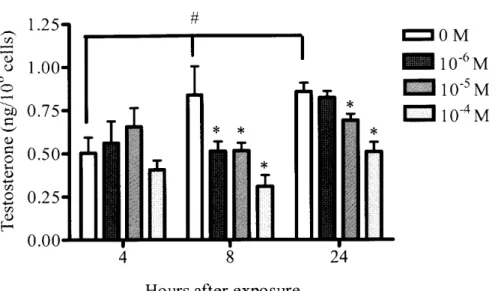
Dose and time dependent effects of PNMC on testosterone secretion into
interstitial cell cultured medium were examined
(Fig. 3-5).
In the cells exposed toPNMC fわr 4 h, the amount of testosterone secretion was almost same as in the control
treated with 10-6, 10-5 or 10-4 M PNMC at 8 h and 10-band 10-5 = PNMC at24 h・
3-4. Discussion
The present study clearly demonstrated that a specific component Of DEP induced
testicular impalment in an avian model・ A single administration of PNMC in adult
male Japanese quail induced acute toxicologlCal responses as well as slgnificant
testicular atrophy and decreases in plasma concentrations of LH and testosterone・
The acute toxicologlCal responses were obseⅣed in the birds treated with the high
dose
(135mg/kg),
and the conditions encountered were dyspnea and tremor prior todeath. From these conditions it can be speculated that PNMC causes acute toxiclty
and death, possibly by a blood pressure drop fわllowed by an iscbemic shock, as it has
been reported that PNMC has a potent vasodilating activity
(62, 100)・
Tbe present study clearly demonstrated that there are two types of responses in
secretion of LH and testosterone in PNMC treated birds. The丘rst type of PNMC
treated birds showed low plasma levels of both LH and testosterone・ On the other
hand, the second type of birds treated with PNMC showed high levels of LH but low
levels of testosterone. These results clearly indicate that the site of action ofPNMC is
in male quail・ The flrSt type Of response suggests the direct effect of PNMC on the
hypothalamus and pituitary axis to reduce secretion ofLH・ In this case, therefわre, it is
suggested that PNMC丘rstly act on the hypotbalamus to reduce pulsatile secretion of
gonadotrophin-releasing hormone
(GnRH)from
the hypothalamus, and then reducepulsatile secretion of LHfrom anterior pituitary glands, followed by a reduction of
testosterone secretion from the testis. In addition, the present study demonstrated that
plasma concentrations of LH, slgni丘cantly decreased丘・om 1 hour a鮎r a slngle
Injection
ofPNMC. These results strongly support that PNMC may act directly on thehypothalamus-pltuitary axis fわr reduclng GnRH release丘om the hypothalamus, and
the second type of response suggests the direct effect of PNMC on the testis to reduce
secretion of testosterone. In this case, it is suggested that PNMC firstly act directly on
testes fわr reduction of testosterone secretions. This reduction of testosterone induces
hypersecretion of GnRHfrom hypothalamus and subsequently increases in secretion of
L=丘om anterior pltuitary glands・ It is well known that Leydig cells play a crucial
role in synthesizing testosterone and regulating the process of spematogenesis
(94)・
Alteration of Leydig cellfunction can lead to adverse effects on testicularfunctions
(94)・
The present study clearly demonstrated that PNMC reduce testosterone production in
cultured testicular interstitial cells. This observation is in agreement with in vivo study
of the second type that showed higher LH levels and lower testosterone levels, which
the testosterone levels were suppressed pnor to the toxic effects on the pituitary that
would reduce the LH levels. The present results, tberefbre, strongly suggest that
PNMC has a direct effect on the testis in addition to the effects on the hypothalamus and
the pltuitary, whereas an exact reason responsible for these two different types of
response are not clear atthe present time・
Testicular atrophy o鮎n showed an asymmetric response, with atrophy most
frequently observed in theright testes・ A characteristic feature of sexual development
in both female and male birds is gonadal asymmetry: theright ovary does not develop,
and the right testis is o鮎n slightly smaller than the
le氏(54)・
Treatment of avianembryos with an estrogenic chemical, diethylstilboestrol, induces a similar
asymmetrical pattern, with greater atrophy in theright testis
(80, 87)・
In birds, the le氏embryonic gonad has ambisexual potential, whereas the right gonad is exclusively
masculine
(80).
The mechanism underlying this phenomenon requires further study・Tbe atrophic paired testes showed no compartmentalization of ge- cells and
spermatozoa, and seminiferous tubules were atrophic and almost devoid of cells except
for the spermatogonia and Sertoli cells・ These results suggest that circulating gonadal
PNMC to the seminiferous tubules. The direct effect ofPNMC on testes results in the
decrease in spe-atogenesis, leading to the reduction in the spe- production of the
treated birds. In avian testes, interstitial cells
(Leydig cells),
as well as testiculargerm cells and Sertoli cells, contain steroidogenic enzymes, which produce
progesterone, androgen and estrogen
(50,
83,89)・
Thus, steroidogenic activities weredestroyed in the treated group testes because the seminiferous epithelium was thinner
and thus decreased the speⅢ1 pOpulation・
The present study showed that the cloacal gland area in birds with testicular
atrophy was slgnificantly smaller than in normal birds・ The androgen-dependent
cloacal gland, posterior to the cloaca, 1S a Secondary sex characteristic unlque tO the
genus
coturnixjaponica.
The cloacal gland contains androgen receptors and growsin response to circulating androgen
(6,
40, 76,77),
so it is a widely used indicator ofandrogen status in the male during sexual maturation・ The decrease in cloacal gland
area in the treated groups may be attributed to the reduced testosterone level recorded
in the present study.
previous papers reported that PNMC, a nitrophenol derivative compound isolated
from DEP has been shown to posses estrogenic activity in vivo and in vitro
(25,
26,101).
A previous paper reported that an estrogenic chemical bisphenol-A reduced theweight of the combs and testes in the male chicken
(27)・
It is well known that thegrowth of the comb and testes are highly promoted by testosterone and inhibited by
estrogen
(6).
In addition, PNMC also has anti-androgenic activity invitro(101)・
previous reports showed thatflutamide, a potent androgen antagonist, decreased
accessory sex organ weight in rats in vivo
(4,
119)・
It is suggested that estrogenic andanti-androgenic potency of PNMC may be involved in suppression of testicular
function in the PNMC treated quail in the present study・ In the present study, effect
of PNMC on secretion of testosterone is not dose dependent manner・ However, the
PNMC may be involved in this phenomenon・
The present study is also important to the environmental perspective・
Remarkable amount of DEP are exhausted into the air of many countries・ In Japan
58,902 tons
(39)
are emitted each year and this is an amount that can not be ignored・The amount ofPNMC which is included in 1 kg ofDEP is 28 mg
(62, 100)・
Theenvironmental concentrations of PNMC are not well known since the research of the
isolation oftbe compounds fわund in DEP has
just
been begun・ In addition, PNMC isa known degradation product of the insecticide fenitrothion
(11),
which is used widelyin many countries and is being accumulated in the air, soils and water
(67, 69)・
According to the data submitted by the pollutant release and transfer registers
(PRTR),
the amount of fenitrothion emitted into the environment in 2002 in Japan was
approximately 1,300 tons, and roughly half of this is degraded into PNMC
(34)・
Itwasalso reported that the amount of PNMC contained in the rain water in Roskilde,
Denmark was as high as 2483 ng/1
(5).
These丘ndings clearly indicate that PNMCexists in large amounts in the environment from diesel exhaust, fenitrothion used on
farms, and in rainwater・ It is difficult to directly interpret the present results of the
effects of PNMC to the wildlife since the doses do not relate to the environmental
concentration. However, as demonstrated in the results from this research, it is
certain that PNMC has toxic effects on the reproductive system, and therefore the
possibility of the large amounts ofPNMC in the environment havlng Serious effects on
wildlife and human beings can not be ignored・
In conclusion, the present study clearly shows that PNMC impalrS reproductive
function in male Japanese quail through toxic effects on the hypothalamus, pituitary,
Table 3-1 Testicular atrophy in adult male quail treated with PNMC in 1 week, 2 weeks and 4weeks
Number Number Grade oratrophy Rate of
Compound Group Dose of of
Severe lntemediate Mild atrophy
(mg/kg)
birds deaths(%)
0 1 78 week 1 03 135 7 0 0 8 0 0 8 0 0 9 3 0 0 0 0 1 1 25 0 2 25 0 1 17 O PNMC 2 78 weeks 1 03 135 8 0 0 10 0 3 10 1 2 10 1 1 0 0 0 2 2 70 1 3 67 0 2 33 0 4 78 weeks 103 135 7 0 0 8 0 0 8 0 0 9 2 0 35 0 0 0 1 2 38 1 2 38 0 1 14Table 3-2 Testis weight, cloacal gland area, testosterone and LH concentrations by atrophy group after treatment with
PNMC
Tre atm ent Grade N umb er Ri g♭t
of- of testes
atrophy animals
(g)
Left C ombined Cloacal Testosterone LH
testes testes gland area concentration concentration
(g)
(g)
(cm2)
(ng/ml)
(ng/ml)
Control NoⅡnal Severe atrop hy PN MC Intemediate atrop hy Mild atrop hy 22 1.11±0.07 5 0.31±0.06***(1)
(0.01)
4 0.47±0.05***(2)
(0.32,0・33)
12 0.85±0.07***(4)
(0.96±0.12)
1.45±0.09 2.56±0.14 1.62±0.07 2.12±0.29 4.66±0.61 0.35±0.07***(0.01)
1.27±0.15(2.24,2.ll)
1.27±0.ll(1.37±0.21)
0.66±0.12***(0.26)
1.74±0.17*(2.56,2.44)
2.12±0.12*(2.32±0.13)
0.74±0.13***(0.26)
l.55±0.10*(1.81, 1.49)
1.18±0.07***(1.53±0.23)
0.15±0.07***(0.10)
0.46±0.12*(0.74,0.20)
0.48±0. 14***(1.61±0.51)
1.34±0.45*(14.02)
2.33±0.89(10.46, 12.85)
3.03±0.67(16.18±1.83)
The values are expressed as mean ±SEM・***p < o.oo1, *P < 0.05 compared
with value of control quail
(ANOVA
and DunnettTstest)
B =・
i6
■ヽ一′ EZ] 4 A 王 0 10 8 ′■. ==! .g 6書
EZ] 4 A 2 8 hJrT.卓
6E
E] 4 A 王 0 0 78 10:事 135Do5e OfPⅣMC ()TIgJ一等)
Fig. 312 Plasma concentrations ofLH in adult male quail treated with PNMC
(78,
103,and 135
mg/kg)
after 1 week(A),
2 weeks(B),
or 4 weeks(C)・
Each bar represents4 ・^ ■・・・・・・・・一
息3
;コ \ヽ_/ O宕
2 5 ・l■■■■J ∽ ○ち1
ト育
ー盲b ‡= 、■■′ O ;] 0 5 ◆■■ ∽ ○ ・■・■ ZZ O ≡ ′■\ . :i3
⊂ \_一/ qJg
2 i{ qJ -∽ C)葛1
ト 0 0 78 103 135 Dose of PNMC (mg/kg)Fig・ 3-3 Plasma concentrations of testosterone in adult male quail treated with PNMC
(78,
103, or 135mg/kg)
after 1 week(A),
2 weeks(B),
or 4 weeks(C)・
Each barrepresents mean土SEM of6 to 9 quail per group・ ***P < 0・001, **P < 0・01
compared with control quail
(Dunnett's test).
5 ′■■l■■ヽ ■■l■■■一■ ′■一 ■■一 ・■・-■
碧4
・■-I ⊂:'亡■=+ヨ
3 I ■■■ 1 1 3Ho1汀S a負er uljeetion
Fig・ 3-4 Changes in plasma concentrations of LH in adult male quail treated with
vehicle
(control; ○)
or PNMC(25
mg/kg;●).
Each bar represents mean士SEM of8quail per group・ *P < 0・05 compared with control when analyzed uslng tWOIWay
/■\ ∽ r A ■ 」 O O \○ ⊂) ▼lllllll】l-i⊆!! 5J) 1= 、-■′ q) ;コ ○ l} q) 巴≡】 〔′) (〇 ■■・■ ∽ O ト 1.25 1.00 0.75 0.50 0.25 8 Hours after exposure
24
⊂=:コO M
四10-6M
国1015M
l::∃lo-4M
Fig・ 315 Dose and time dependent effect of PNMC on secretion of testosterone in quail
testicular interstitial cell culture. The cells were incubated fわr 4, 8 or 24 h in M199
containing different doses ofPNMC
(10-6,
10-5 or 10-4M)・
Each bar represents mean士SEM
(n-6).
*P < 0.05compared with same time control, "p< 0.05 compared with 4
Chapter 4・ Effects of PNMC on the Regulation of Reproductive Function in Mature
and Immature Female Japanese
Quail (CoturnLrjaponica)
4-1. Background
Mortality and reproductive abno-alities of wild birds caused by environmental
pollutants and pesticides have been reported in endocrine disruptlng Chemicals・
Indeed, many contaminants possess reproductive toxiclty tO aVian species as a result of
endocrine disrupting effects and adverse effects on the reproductive system such as
abnormality of the reproductive organs and impairment of egg laying
(23)・
PNMCisolated from DEP showed that they had vasodilatory
(62, 100),
estrogenic(25,
26,101),
and anti-androgenic activities(101).
In addition, PNMC is a degradationproduct of the insecticide fenitrothion
(1 1),
a widely used pesticide withhighpotential
for human beings, animal, and poultry exposure in bothrural and residential
environments. The accumulation ofPNMCfrom these sources might have slgnificant
effects on wildlife and human health via disruptions of endocrine and reproductive
systems・
Japanese quail as a laboratory animal has been extensively used in reproductive
toxicity testing.
Quail
are considered to be representative of terrestrial birds andaccepted models for assesslng both the acute and chronic effects of pesticides and other
chemicals in wild birds
(19, 71).
Results in the chapter 3 of the present study showedthat a slngle administration of PNMC in adult male Japanese quail induced a marked
testicular atrophy and clearly shows that PNMC impalrS rePrOductivefunction in male
Japanese quail through its toxic effects on hypothalamus, pltuitary, and testis・
Moreover, weight of the ovaries and oviducts of immature female quail are very low
(less
than 5% of those in maturequail)
and develop rapidly upon stimulation by longphotoperiods and the concomitant increases in the secretion of gonadotroplnS and