Study on Data Warehouse System for Supporting Decision Making in the Higher Education
Institution (HEI) in Indonesia
著者 アルディアン アグン ユリアント
著者別表示 ARDHIAN AGUNG YULIANTO journal or
publication title
博士論文要旨Abstract 学位授与番号 13301甲第1921号
学位名 博士(工学)
学位授与年月日 2020‑09‑28
URL http://hdl.handle.net/2297/00061340
doi: https://doi.org/10.14569/IJACSA.2020.0110666
Creative Commons : 表示 ‑ 非営利 ‑ 改変禁止 http://creativecommons.org/licenses/by‑nc‑nd/3.0/deed.ja
インドネシアの高等教育機関における意思決定支援用 データウェアハウスシステムの研究
Study on Data Warehouse System for Supporting Decision Making in the Higher Education Institution (HEI) in Indonesia
Graduate School of Natural Science & Technology Division of Electrical Engineering and Computer Science
Kanazawa University
Ardhian Agung Yulianto
ii Abstract
In this study, we developed a data warehouse (DW) system to provide sufficient information to the higher education institutions’s (HEI’s) administrators in Indonesia for decision making in the admission processes. The system was managed the tuition fees level of applicants and education cost analysis between collected tuition fees by level and the standard education cost. The system was developed by integrating multisource data become a single repository following the annual regulation issued by the government. A simple but sufficient method was introduced using the open-source following the business requirements of HEI’s administrator. As a business intelligence (BI) approach, four procedures are applied e.g., preparation, integration, analysis, and visualization to construct a tuition fee level management system and educational cost performance indicator. Analysis results were presented in various charts, graphic, and dashboard of tuition fee level, which has many functions to provide insight relative to the business performance. The DW system described in this study can be used as a guideline for HEIs in Indonesia for tuition-fee-level management and educational cost analysis from tuition fee.
Keywords- data warehouse; higher education institution; multidimensional analysis; Indonesia;
tuition-fee-level management; education cost analysis.
1
1. Introduction
Classified as tertiary education, higher education (HE) has been an important role in “The 2030 Agenda for Sustainable Development Goals (SDGs)”. The establishment of the HEIs and all aspects of their quality must be continue supported for the future of one nation. The Organization for Economic Co-operation and Development (OECD) 2019 Indicators reported the wide disparity among countries in the average tuition fees charged by public institutions for national students in undergraduate programs. Range from no tuition fee charged for the national student in many Nordic countries until the highest at USD 11,866 a year in the United Kingdom. Korea, Japan, Chile, the United States included in the six top expensive tuition fee in the world.
Tuition fees have been taking an important role in HEIs establishment. In the United Kingdom (UK) during 2016/2017 tuition fees represented 52.2% of total income. In the United States (US), thirty-two states are above national average student share of 46.4%, while other twenty-seven states are above a 50% student share means that public institutions are more dependent on tuition revenue than educational appropriations in over half of all states. In Japan, in 2018, two national universities receive the income from tuition fee around 9-11 % from total budget and a public university in Indonesia in 2016 around 20% of educational cost taken from tuition fee.
The leaders of HEI face many challenges in transforming their institution from traditional shared governance toward twenty-first-century values of transparency on financial and decision making.
In Indonesia, the implementation of the Integrated Academic Fee (IAF) policy should be more complicated. They need supporting tools in managing disparity of tuition fees and its recapitulation. Another problem arises from the fact that the functions of many information systems in HEI work independently. The need for providing historical and analytics data in an integration data without interrupting existing operational system is increased by HEI administrator. Time consuming to generate reports manually. It has happened many times, the different reports are submitted by university and faculty staff regarding data, i.e., the number of applicants and tuition fee collected at each tuition fee level.
2
The IAF (or Uang Kuliah Tunggal) is the current admission policy for undergraduate students in public HEIs in Indonesia. Here, integrated means the students pay a fixed amount for education expenses each semester rather than several unit costs, e.g., development cost, number of credit units, and laboratory costs. This policy implemented variable tuition fees for undergraduate students based on the financial ability of their parents or guardians.
This study focuses on multidimensional analytics of the HEI tuition fee level in Indonesia under the IAF policy. Multidimensionally modeled data were designed to facilitate complex analysis and effortless visualization. The purpose of this study to provide information to the leader in many insights and analytics and to develop a DW system for supporting decision support in HEI in Indonesia. This study developed two DW system are DW for tuition-fee-level management and DW for admission.
2. Methodology
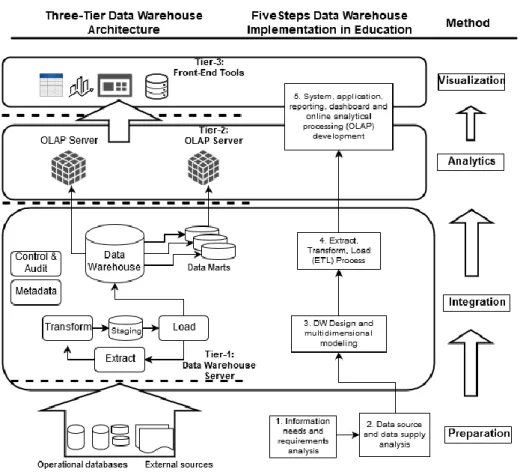
In this study, we then associated the three-tier approach to the practical method of DW implementation in education. As a simplification of these methods, we formulated four procedures, i.e., preparation, integration, analytics, and visualization. Figure 1 shows our method used and how it correlates with three-tier DW architecture and five-step DW implementation in education.
3
Figure 1: Proposed method
3. Data warehouse System for multidimensional analysis of tuition fee level in a public HEI in Indonesia
HEIs face problems in managing the financial data after each applicant got their tuition fee level.
It is difficult for university staff to distribute students equitably among faculties and study programs when the data are inconsistent. Another problem arises from the fact that the tuition- fee-level decision system functions independently of other information systems, e.g., student registration, payment, and teaching systems.
To address these issues, the authors have investigated using open-source software to construct a data warehouse (DW) system which is considered the backbone tool of a decision support system (DSS). The proposed DW system was developed using the open-source Pentaho BI software suite to reduce the development cost.
4
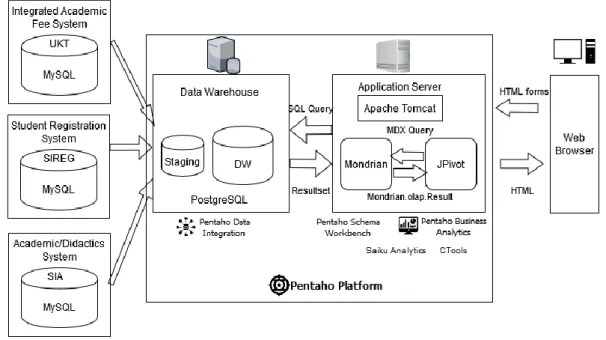
In the stakeholder analysis, we defined three groups engaged in tuition-fee-level management, i.e., HEI administrators, IT staff, and financial staff. We identified the source databases are UKT (Uang Kuliah Tunggal – IAF), SIREG (Student Registration), and SIA (Academic/Didactics System). The system configuration is shown in Figure 3-3. The Pentaho Data Integration tool is used to build Extract Transform Load (ETL) function from all MySQL-based data sources to a PostgreSQL-based DW.
Figure 2: System Configuration Diagram
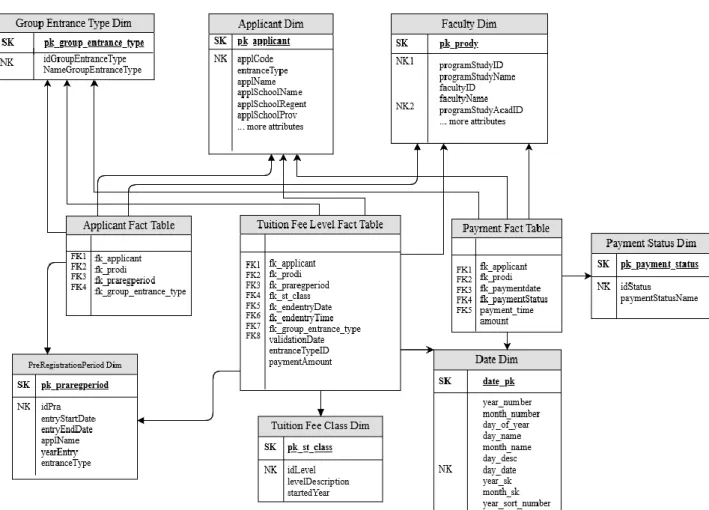
In DW schema, we define four basic dimensions used in the tuition fee level DW system:
Faculty, PreRegistrationPeriod, GroupEntranceType, and TuitionFeeClass with another three supporting dimensions were designed, i.e., Applicant, Date, and PaymentStatus dimensions.
Here, three fact data include Applicant data, Tuition-fee-level data, and Payment data.
5
Figure 3: Denormalized multidimensional facts constellation schema
Regarding the data analysis techniques refer to OLAP. In tuition fee level analysis, as a measurement, the number of applicants in the particular year is displayed and surrounded by a set of dimensions, i.e., the Faculty, PreRegistrationPeriod, GroupEntranceType, and Tuition- FeeClass dimensions. This multidimensional structure stores and distinct intersection values for the tuition fee level. OLAP operations can be applied to view data from different perspectives.
The visualization procedure is available in a web-based client application. The result of tuition- fee-level analysis is illustrated using many different types of charts. These charts are immediately loaded by querying the script that was deployed from many functionalities of the OLAP cubes. The dashboard operates as a graphic container that displays analysis data in a single view.
6
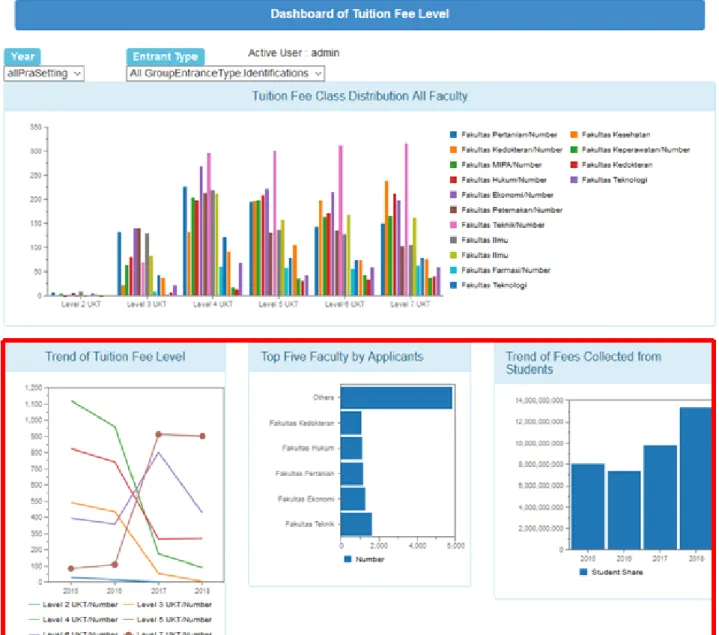
Figure 4: Dashboard for tuition fee level management
As results at Figure 4, we got tuition fee level trends 2015 to 2018 that Level 7 increased significantly in the last two years. We also showed the top five faculty by applicants that the Engineering Faculty (Fakultas Teknik) attracted the greatest number of applicants over the last five years. Another charts are fees collected from the students trends that over 2015-2018, the lowest amount was collected in 2016.
7
4. Multidimensional analysis of a public HEI admission in Indonesia
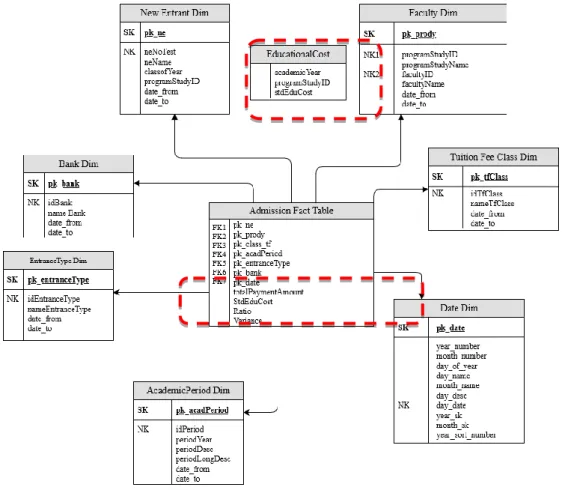
In this chapter we describe the financial analysis for admission in a public HEI in Indonesia. IAF policy issued another important regulation for public HEIs in generating another tuition fee by independent entrant type. At the same time, the IAF policy announced the standard education cost for each study program in each HEI. This cost become attribution of financial achievement in student-based income and update it annually.
Purpose of this study is to develop data warehouse on keeping a key performance indicator (KPI) for educational cost in HEI. The measurement in the DW is the total of tuition fee by new entrant in all entrant type including independent type that have more than one fee component. The reference cost is the standard education cost, then we can get the ratio and variance between them.
Figure 5: DW Schema on analysis of admission
8
We got the first result on new entrant analysis by entrant type by selecting the appropriate measurement data (i.e., number of new entrant), associated to entrant type and tuition fee level dimensions. We can easily obtain data filtered by year or by study program. Second result is analysis of student-based income. The measures can be represented by the value of total amount of tuition fee by new entrant, number of new entrants, standard educational cost, ratio and variance between total amount tuition fee and standard education cost. From the data, the highest ratio between total of tuition fee collected and standard education cost is 89.09% and the lowest is 21.93%.
Analysis fee collected by all new entrant shows that HEIs have a challenge to make a balance on their educational cost after implementation such kind of subsidize policy for low income family.
This data also become an exact data to propose another supporting budget to government. In other side, the leader of HEIs need to find another legal funding to fulfill education cost.
5. Concluding Remarks
In the present work, we have studied data warehouse system for supporting decision making in the public higher education institution (HEI) in Indonesia. Based on this research, we developed two data warehouse systems, first is data warehouse for tuition-fee-level management, and the second is data warehouse for admission related with the student-based income and education cost. The system was developed following the integrated academic fee (IAF) policy for undergraduate program and look forward to fit potential changing in the annual issue.
We found that the research in this study is a part of Institutional Research (IR) development in the area business reporting and enrollment management. IR itself defined by as Saupe (1990) as the research conducted within an institution of higher education to provide information which supports institutional planning, policy formation and decision making. The Four Faces of Institutional Research in academic affairs support, business/finance support reporting, enrolment management, and student affairs support. For the future research, we expected to dig in this area.