5
Copyright@SPSD Press from 2010, SPSD Press, Kanazawa
The Use of Vertical Greening in Urban Rehabilitation to Improve Sustainability of the Environment in
Taiwan
Kuang-Hui Peng1*, Yao-Chi Kuo2 and Hsin-Yi Lin3
1 Graduate Institute of Architecture and Urban Design, National Taipei University of Technology
2 Department of Architecture, National Taipei University of Technology 3 Department of Architecture, National Taipei University of Technology
* Corresponding Author, Email: [email protected] Received 12 January, 2014; Accepted 4 June, 2014
Key words: Urban Heat Island, Vertical Greening, Green Building, Urban Rehabilitation, Sustainable Environment
Abstract: Urban heat island effect has caused countries around the world to set a low- carbon and sustainable environment as their goal. It suggests that communities can achieve the goal by planting trees and vegetation which can cool down the temperature and reduce the effect on the environment. The paper aims at exploring how to promote the application of vertical greening that increases green quantity as well as how to regulate maintenance of it in urban rehabilitation. Through the literature review and foresighted design point of view, implications suggest a way of arranging plants in groups, natural irrigation, rainwater recycling systems, encouraging vertical greening, and the need of standards to provide and manage vertical greening. A case of a fiber reinforced plastic vertical greening system has introduced a further understanding of it.
1. INTRODUCTION
The formation of urban heat island effects in recent years has caused countries around the world to set a low-carbon and sustainable environment as their goal. According to the US Environmental Protection Agency (2008), the heat island effect affects micro-scale temperature differences between urban and rural areas: the built-up urban areas are warmer than their surrounding rural areas. The annual mean air temperature of a city can be 1–
3°C hotter in urban areas. The difference can be as high as 12°C in the evening. The problems caused by the heat island effect in urban built-areas can be categorized as increasing energy demand, air conditioning costs, air pollution, greenhouse gas emissions, heat-related illness and mortality, and water quality. It suggests that communities can achieve their goals by planting trees and vegetation so shade provided by trees and smaller plants such as shrubs, vines, grasses, and ground cover can help cool and reduce the effect on the environment.
In Taiwan, 97% of the buildings are considered as being part of the built- up environment, and their existence usually does not meet ecological needs.
This indicates that urban rehabilitation and environmental planning should
put an emphasis on being ‘green’, ecological city development and placing people at the core of the design process (Architecture and Building Research Institute, 2012). In 2008, Taiwan launched “The Eco-city and Green Building Promotion Program”. Eco-city and green building assessments are included in “The Implementation Regulation of Periodical Overall Review of Urban Planning”. This regulation was amended in 2011 and stated that the process of conducting the overall review of urban planning needed to develop a system of water and green network principles. The Taiwan government has learned that green buildings and networks are important to achieve an ecological city. However, the existing cities are crowded by buildings and artificial facilities. The motivation of this paper is to explore how trees and vegetation can help cool urban climates through shading and evapotranspiration, then focuses on applying vertical greening technology to rehabilitate built-up urban areas for creating a sustainable environment. It aims at exploring how to promote the application of vertical greening that increases green volume and regulates maintenance of it in urban renovation.
Through the literature review and foresighted design point of view, this paper first introduces the relationship and development between vertical greening and green building, followed by the vertical green technology which increases green space and creates an urban green network. Analysing and applying urban rehabilitation requires technology and innovation of vertical greening. An example of fiber reinforced plastic (FRP), a vertical greening system produced by the National Taipei University of Technology (NTUT), has introduced a further understanding of it.
2. BENEFITS AND ISSUES OF VERTICAL GREENING
Walls that are covered with vegetation that self-clings or grows on supporting structures are known as vertical greening. Vertical greening, also known as façade greening, green wall, planting wall, vertical garden, living wall, or ecological wall, is essentially a living and self-regenerating cladding system for buildings (Dunnett and Kingsbury, 2008). Self-clinging plants are used without supporting structure since they attach themselves directly to the building surface. On the other hand, a supporting structure greening wall uses wires or trellis which allows plants to “climb”.
Vertical façade engineers need to consider the essential elements - sun shine, water, soil, et cetera - of greening growth conditions in both cases. It turns out to be that by using natural or pipeline watering to sustain plants’
lives, shallow-rooted plants are able to grow in walls of different angles, and stems and leaves of plants will grow whether they are directly or indirectly attached to the building surface. Plants which grow on the surface of a building wall can be artistic, as well as improve the urban landscape, increase green coverage rate, reduce indoor temperature, improve efficacy regarding biodiversity and ecosystems, and improve urban greening.
Due to intensive urban construction and artificial facilities, extensive use of things which absorb or reflect solar radiation, such as dark roofs, walls, floors, uneven buildings, or impermeable pavement, are needed. On the other hand, reducing the use of air-conditioning, heat emissions from automobiles and motorcycles, air pollution, and other human waste heat is another important issue that causes urban heat island effects. In Taiwan, after successive decades of rapid economic development and a high degree of industrialization, energy use increased by approximately 20 times, and the energy consumption rate per unit area is probably one of the highest amongst
the countries that have populations exceeding ten million. Heat island effect may be one of the most significant urban environmental issues in the world.
The global area that is affected by the heat island effect has been consistently increasing. This may also be leading to regional climate change and should be considered an urgent environmental problem (Liu et al, 2003).
Based on the fact that tree-crowns can absorb or reflect approximately 80%
to 90% of long-wave radiation heat, and transpiration of blades can consume some heat, if the vertical green capacity of cities can be moderately increased, the rehabilitation area will have an effectively reduced urban heat island effect.
Lin (2010) pointed out that green walls are capable of reducing wall surface temperature effectively by 10 to 14°C and indoor temperature by 2.0 to 2.4°C. This leads to reduced use of air-conditioners and improvements in energy saving. If a ton of air-conditioning is operated without being turned off for 24 hours, the power cost is about NT$60. If a room’s temperature is increased by 1°C and then air-conditioned, electricity bills can be reduced by about 6%. In terms of office buildings, the electricity saving will be considerable. The Japanese Urban Greening Technology Development Institution’s experiments show that the implementation of green walls eases acid rain and UV damage to buildings and waterproof layers and improves the durability of buildings.
The indicators of green buildings are closely related to plant greening;
increasing greening volume and biodiversity, and site water indicators are directly correlated with them. In the past, applied green design, was rarely regarded as an architectural element, and the effect of vertical greening from an overall view of the urban landscape was hardly considered. Through the literature review and analysis, the paper sums up the following benefits for urban rehabilitation:
1. Dust-proof, lower temperature, noise-proof, and energy-saving: vertical greening can decorate rooms, improve the indoor microclimate, lower indoor temperature, increase humidity around 20~30%, isolate noise, absorb dust and reduce pollution.
2. Aesthetic and a better three-dimensional vision: green vegetation vertically set in the wall can shape the overall environment artistically, improve creative space effect, and provide social education function. It also gives three-dimensional stereoscopic visual effects from outdoor views by its uniqueness, distinctive kindness and use of advertisement.
3. Positive impact on human mentality: green walls via advanced greening technology may have plants with various colors, forms, and textures. The natural beauty of it positively enhances landscape, improves residents’
psychological feelings, and relieves pressure of modern life.
4. Increase green coverage and economize land: vertical greening can create an advantage of creating three-dimensional space of green network and lead to an increase of green coverage.
5. Create environmental bio-diversity: vertical greening supports the growth of dozens of beetles and spiders. In the food chain, beetles and spiders are the best food for birds, and it leads to a positive impact on urban ecological environment.
6. Added value to the real estate market: although cost of vertical greening buildings is slightly higher than cost of normal buildings in general, the added value of the real estate market increases since it raises positive benefits such as saving energy spending and a better long-term quality of living environment.
7. Modifying measures and legal system: through continuous research and practical operation, the benefits from greening are the best references for promoting green building and legalization in vertical green measures and norms.
In order to ensure the integrity of the benefits of green building beyond the current assessment indicators and strengthen the effectiveness of social, humanistic art, and community empowerment, issues related to technical research and innovation or relevant norms for promoting green building reference are summarized:
1. Safety concerns of supporting structure: although vertical greening in existing walls is able to improve the urban landscape and building energy efficiency, is there any issue regarding compatibility or safety caused by traditional urban planning and architectural design regulations? In Taiwan, we are confronted by the typhoon season during summer; thus, there is a need concerning structural safety and having further norms for legalization.
2. Simple calculation of green building rating: a proposal of a grading system which calculates the relationship between effect of carbon reduction and assessment of green building can facilitate vertical greening promotion.
3. Innovative materials and developing different types of units of green modules: the necessary measures to promote vertical greening is directly associated with reducing the costs of development and maintenance. Thus, we need to develop a high strength, durable, weather-proof, and biocompatible green wall system.
4. Community’s expectancy and way of localizing vertical greening: in order to strengthen the positive physical and psychological impact given by the green wall on residents, it is necessary to explore how residents are affected by the green wall practically and psychologically. Also, what are their feelings toward the process of plant growth?
5. Reuse of construction fences: how to effectively promote the application of vertical greening to safety fences in construction sites. How to retain fences and make them reusable rather than being dismantled and wasted.
6. Water supply and drainage system: in order to maintain plant health, water supply, drainage system, and stability should be carefully designed, constructed, managed, and maintained. For instance, how to link feed- water systems with storm-water retention systems? How do drainage systems avoid being polluted?
7. Subsequent maintenance: effective management including watering, pest management, plant domestication, changing plants and so on, are closely related to the sustainability of vertical greening. It is not a good idea to rely completely on costly professional factories. Therefore, how to educate people continuously? How to mould maintenance and warranty measures into management?
Aforementioned issues, derivatives of professional responsibility, acceptable quality standards and risk of long-term maintenance commitment issues need to be well catered for by legal systems. Interdisciplinary integration from co-operators and practitioners including from the civil and material science engineering, architecture design, urban design, and law disciplines, is needed so that our legal system to creates and supports better norms to solve these problems.
3. VERTICAL GREENING TECHNOLOGY
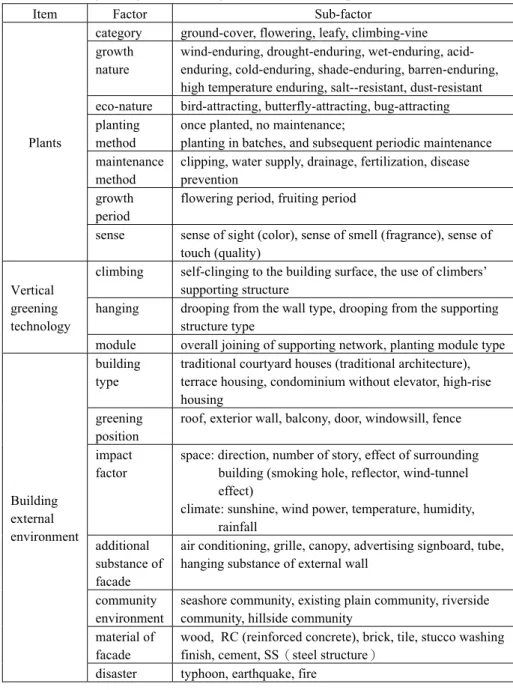
Regarding the application of vertical greening technology, the environmental characteristics of green walls and plant selection must be considered. Through literature review and field research, the paper has summarized the items including plants, vertical greening technology systems, and building external environment that are directly related to vertical greening technology in the following table, Table 1.
Table 1. Vertical greening of the building: related items with impact factor
The influencing factors mentioned above, especially the wall microclimate in windy environments, need to be carefully handled. It is necessary to find suitable treatments for rising wind, descending wind, whirlpool effects, and prevent vegetation from being stripped by the wind.
Additionally, illumination from sunshine is going to be influenced by differing wall directions, the surrounding environment and colours of the wall; therefore, we must choose plants carefully. It is also necessary to pay attention to temperature changes and avoid using materials such as metal, concrete, stone, tile, and other materials that absorb heat or have good conductivity. Regarding plant selection, native plants should be treated as priority, attention should be paid to their firmness, barren-endurance, drought-resistance, and moisture-resistance., they must be able to be properly affixed to walls, the thickness of which has to be applicable, maintainable and plants must be easily replaceable, durability must be maintained, and pests and diseases well managable.
Item Factor Sub-factor
Plants
category ground-cover, flowering, leafy, climbing-vine growth
nature
wind-enduring, drought-enduring, wet-enduring, acid- enduring, cold-enduring, shade-enduring, barren-enduring, high temperature enduring, salt--resistant, dust-resistant eco-nature bird-attracting, butterfly-attracting, bug-attracting planting
method
once planted, no maintenance;
planting in batches, and subsequent periodic maintenance maintenance
method
clipping, water supply, drainage, fertilization, disease prevention
growth period
flowering period, fruiting period
sense sense of sight (color), sense of smell (fragrance), sense of touch (quality)
Vertical greening technology
climbing self-clinging to the building surface, the use of climbers’
supporting structure
hanging drooping from the wall type, drooping from the supporting structure type
module overall joining of supporting network, planting module type
Building external environment
building type
traditional courtyard houses (traditional architecture), terrace housing, condominium without elevator, high-rise housing
greening position
roof, exterior wall, balcony, door, windowsill, fence impact
factor
space: direction, number of story, effect of surrounding building (smoking hole, reflector, wind-tunnel effect)
climate: sunshine, wind power, temperature, humidity, rainfall
additional substance of facade
air conditioning, grille, canopy, advertising signboard, tube, hanging substance of external wall
community environment
seashore community, existing plain community, riverside community, hillside community
material of facade
wood, RC (reinforced concrete), brick, tile, stucco washing finish, cement, SS(steel structure)
disaster typhoon, earthquake, fire
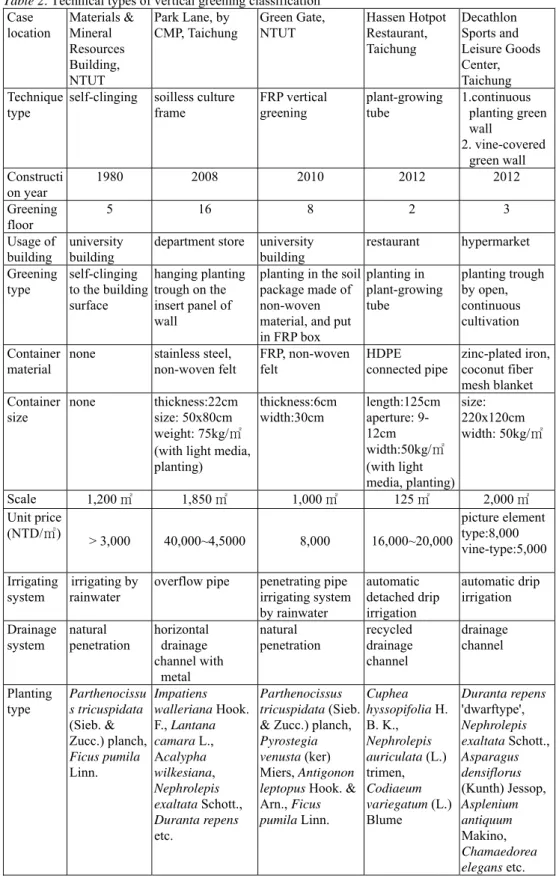
In response to the above, many vertical greening technologies have been developed recently. This paper summarizes them into six types of technologies in accordance with methods and characteristics of vertical greening in the following table, Table 2.
Table 2. Technical types of vertical greening classification Case
location
Materials &
Mineral Resources Building, NTUT
Park Lane, by CMP, Taichung
Green Gate, NTUT
Hassen Hotpot Restaurant, Taichung
Decathlon Sports and Leisure Goods Center, Taichung Technique
type
self-clinging soilless culture frame
FRP vertical greening
plant-growing tube
1.continuous planting green wall
2. vine-covered green wall Constructi
on year
1980 2008 2010 2012 2012
Greening floor
5 16 8 2 3
Usage of building
university building
department store university building
restaurant hypermarket Greening
type
self-clinging to the building surface
hanging planting trough on the insert panel of wall
planting in the soil package made of non-woven material, and put in FRP box
planting in plant-growing tube
planting trough by open, continuous cultivation Container
material
none stainless steel, non-woven felt
FRP, non-woven felt
HDPE connected pipe
zinc-plated iron, coconut fiber mesh blanket Container
size
none thickness:22cm size: 50x80cm weight: 75kg/㎡
(with light media, planting)
thickness:6cm width:30cm
length:125cm aperture: 9- 12cm width:50kg/㎡
(with light media, planting)
size:
220x120cm width: 50kg/㎡
Scale 1,200㎡ 1,850㎡ 1,000㎡ 125㎡ 2,000㎡
Unit price
(NTD/㎡) > 3,000 40,000~4,5000 8,000 16,000~20,000
picture element type:8,000 vine-type:5,000 Irrigating
system
irrigating by rainwater
overflow pipe penetrating pipe irrigating system by rainwater
automatic detached drip irrigation
automatic drip irrigation Drainage
system natural
penetration horizontal drainage channel with
metal
natural
penetration recycled drainage channel
drainage channel
Planting type
Parthenocissu s tricuspidata (Sieb. &
Zucc.) planch, Ficus pumila Linn.
Impatiens walleriana Hook.
F., Lantana camara L., Acalypha wilkesiana, Nephrolepis exaltata Schott., Duranta repens etc.
Parthenocissus tricuspidata (Sieb.
& Zucc.) planch, Pyrostegia venusta (ker) Miers, Antigonon leptopus Hook. &
Arn., Ficus pumila Linn.
Cuphea hyssopifolia H.
B. K., Nephrolepis auriculata (L.) trimen, Codiaeum variegatum (L.) Blume
Duranta repens 'dwarftype', Nephrolepis exaltata Schott., Asparagus densiflorus (Kunth) Jessop, Asplenium antiquum Makino, Chamaedorea elegans etc.
Picture
As introduced above, the natural type of self-clinging to the building surface is planting by traditional creepers which are attached, adhere to, and climb the walls by themselves. They hardly climb once they hit smooth or high temperature wall. Moreover, this heavily relies on natural growth conditions such as the soil layer and are reliant on air moisture created by rainwater; therefore, they grows slowly, approximately one to two meters per year.
Considering the type that uses climber support structures, seedlings can be fixed by humans, like planting droopy ivy so that it climbs through supporting frames. A better heat insulation effect is achieved since air layers form between the supporting frames and wall.
Another type of technology is planting troughs directly on the wall.
Whenever troughs and panels are planted completely, greening is completed.
If the wall structure is strong enough, we can apply this on higher floors.
Although plant selection is less restrictive in this case, it costs more, and facilities for its completion, maintenance, and replacement must be considered.
As for the type of soilless cultivation, in order to provide water and minerals required by plants, non-woven fabric can be used so that plants can meet their needs and grow directly on the fabric. In this case, Plants which can survive without a soil a substrate must be selected. This greening technique suits regions with stable climates.
4. APPLICATION OF PLANTING IN DIFFERENT REGIONS OF TAIWAN
The installation of plants on green walls must take local characteristics into account including rainy, dry, and typhoon seasons. After considering whether planting is applicable in Taiwan’s northern, central, southern, and eastern regions of the urban climate, this paper tries to establish the appropriate planting varieties in a database as shown in Table 3 and Table 4 below.
Table 3. Environmental characteristics of the northern, central, southern, and eastern regions of Taiwan
Region
Attributes
Environmental Characteristics Sunshine
hours
Temper
-ature Rainfall Humidity
Northern 1,587hr 22.8℃ 3,036mm 77%
Less sunshine hours, low temperature, rainy, high humidity. Applicable for humidity and shade-enduring plants
Central 2,063hr 23.2℃ 2,046mm 77%
More sunlight, moderate rainfall.
Applicable for warm and moist plants
Southern 2,156hr 24.6℃ 2,264mm 76% Much sunlight, high temperature, moderate rainfall. Applicable for
moist and drought-enduring plants
Eastern 1,670hr 24.2℃ 1,939mm 76%
More sunlight, high temperature, less rainfall, close to seashore, high humidity, windy. Applicable for barren-enduring, salt-resistant and wind-resistant plants Note: Average annual climate analysis in Taiwan during 1998-2008.
Source: Statistics Department of the Ministry of Communication and Transportation (2009) Table 4.Attribute of building facade and applicable planting
Height of building
facade
Attributes Environmental
Characteristics Sunshine Tempera-
ture Wind Humidity
Eastern
High
Direct sunshine in the morning, applicable for full-day sunshine, draught-enduring, poor temperature- enduring, light and good clinging plants
Middle Direct sunshine in the morning,
applicable for full and half day sunshine, wind-resistant plants
Low Direct sunshine in the morning,
applicable for half-day sunshine, shade-enduring, ornamental plants
Northern
High
Applicable for half-day sunshine, poor temperature-enduring, light and good clinging, wind-resistant, barren-enduring plants
Middle Non-sunshine, applicable for shade-
enduring, wet-enduring, cold- enduring and barren-enduring plants Low
Non-sunshine, applicable for shade- enduring, wet-enduring, cold- enduring, barren-enduring, and ornamental plants
Western
High
Direct sunshine in afternoon, applicable for full-day sunshine, draught-enduring, light and good clinging, wind-resistant, heat- absorbing plants
Middle
Direct sunshine in afternoon, applicable for full-day sunshine, draught-enduring, heat-absorbing plants
Low
Direct sunshine at afternoon, applicable for full and half day sunshine, heat-absorbing and ornamental plants
Southern
High
Sunshine all year, applicable for full-day sunshine, poor temperature- enduring, draught-enduring, wind- resistant, light and good clinging plants
Middle Sunshine all year, applicable for
full-day sunshine, draught-enduring plants
Low Applicable for full and half day
sunshine, ornamental plants
Note:
1: Referring to building technology regulations, the height of the building is roughly divided into: low: h<15m; middle-low: 15m<h<30m; middle- high: 30m<h<50m; high: 50m <h <75m; super-high: h>75m. The height of buildings for further analysis should be in accordance with the actual situation and the assessment of the regional environment.
Urban environment affects the growth of vegetation on the green wall.
The relevant factors are as follows:
1. Near main traffic arteries will be vulnerable because of vehicle emissions and thermal effects, applicable for anti-pollution, anti-dust, and wet- enduring plants.
2. Shadows arising from the buildings. It is suitable for shade-enduring plants.
3. Nearby surroundings, such as whether other light sources affect the light cycle, thereby affecting plant growth and shape of flowers.
4. Close to coastal areas, applicable for wind-resistant and salt-enduring plants.
5. Close to industrial areas, applicable for anti-acid and anti-pollution plants.
6. Conditions of nearby areas such as air conditioners, cooling water towers, and smoking machines which produce heat emissions and are harmful to plants.
The following example of Green Gate uses a fiber reinforced plastic (FRP) vertical greening system in the National Taipei University of Technology (NTUT), which is introduced for a further understanding of how it formed and what it looks like. It aims at exploring how to promote the application of vertical greening to increase green quantity and environmental landscaping.
5. AN EXAMPLE OF GREEN GATE IN NTUT
National Taipei University of Technology is located in the center of Taipei; it is a typical metropolitan campus. Following the opening of the MRT Zhongxiao Xinsheng Station, the entrance between the Design Building and Materials and Mineral Resources Building became a popular accessway to the MRT, and the nearby areas became places for the local public and tourists. In order to reduce the negative impact of crowds and harmonize the urban campus by a friendly, ecological, and green living environment, the university extended the wall from the Materials and Mineral Resources Building to the Design Building and turned the new wall into a green wall which is the so-called Green Gate as shown in Figure 1 and Figure 2.
High humidity:
70% or above Moderate humidity:
30~70%
High temp: 30℃ or above Moderate temp: 0~30℃
Low temp: 20℃ or lower Full-day sunshine:
60~100%
Half-day sunshine:
40~60%
Shaded: 0~40%
Strong wind: level 6 Moderate wind: level 4~5 Light wind: level 1~3
The Green Gate was quickly completed after approval by the University.
The case adopted FRP as the wall greening system (Figure 3). The system of the FRP box and built-in soil package were wrapped by non-woven cloth (Figure 4) which had the ability of resisting the acid etching ingredients released by plant roots and organic compounds. The FRP system is benefited by its light weight, structural strength, and excellent durability; it takes advantage of the amount of body light and strong material combination of the steel structure that links the FRP box (Figure 5) so that plants are solidly located on the building outer wall surface. It performs like an envelope that isolates buildings from sunshine and enriches the urban landscape (Figure 6).
This technology has been patented and applied to the FRP greening wall system of the National Taipei University of Technology as the paper’s foresighted concept design case shows. This innovative system can reduce costs, shorten the construction period, and is easily maintained. The FRP wall greening system has great facilities in fiber composites, reducing the
Figure 4. A diagram of FPR box and built-in soil package wrapped by non- woven cloth
Figure 3. A diagram of FRP wall greening system
Figure 6. A completed work of the Green Gate Figure 5. FRP greening wall
Figure 1. A proposal to build a new green wall from the existing wall of the Materials and Mineral Resources Building to the Design Building
Figure 2. A linkage proposal of vertical greening between buildings
structural weight and the seismic force, corrosion resistance, structural strength, and durability. Furthermore, the FRP wall greening system enhances the landscape environmentally, has economic efficiency, and the ability to achieve a sustainable environment. Regarding the maintenance plan, since plant roots can grow on the ground, and the internal pipeline automatically stores moisture, plants will be able to grow naturally without manual maintenance so that near-zero maintenance and management is able to be achieved.
6. CONCLUSION
Scarce green space and highly dense urban areas have caused serious urban heat island effects. Vertical greening can increase greening amount, reduce urban heat island effects, improve the quality of outdoor and indoor air, beautify urban landscapes, lower indoor temperatures, increase energy efficiency, protect building structures, and reduce noise. In conclusion, this paper suggests the following points:
1. Different vertical greening systems should exploit advantage from each system, such as doing an experiment of planting troughs into different segments and recording the improvements of natural growth rates.
2. The priority consideration is that the green is naturally watered with a rainwater recycling system which reduces maintenance and management costs.
3. In order to achieve better performance through renovation, the effectiveness of heat insulation and moisture-regulating effects should be reviewed and the best suited should be selected according to the particular environment.
4. Expanding the use of vertical greening is a good way to rehabilitate high- rise congregated house building façades and sustain the green wall system.
5. Encouraging local governments to green construction site fences and strengthen inspection works for periodic maintenance. Aims should be to prevent plants from wilting, which would result in a significant loss of greenery and of the facility to reduce carbon.
7. The competent authority should ascertain amendments through a Green Building Standards Special Chapter or set vertical greening and maintenance regulations so that it can encourage the promotion of vertical greening technology in applied rehabilitation of existing buildings and community, prevent secondary refurbishment of exterior walls and prevent owners from wasting space.
ACKNOWLEDGEMENTS
The authors are grateful for the funding of this research project from the National Science Council of Taiwan (NSC 101-2627-E-027-002-MY3)
REFERENCES
Architecture and Building Research Institute. (2012). 2012 Building Energy Efficiency and Improving Green Office Building Grant Program- Information for Applicants. Taipei.
Architecture and Building Research Institute. (2012). Retrieved from http://www.abri.gov.tw
Blanc, P. (2008). The Vertical Garden: From Nature to the City. New York: Norton.
Construction and Planning Agency, Urban and Rural Development Branch. (2012).
http://www.tcd.gov.tw
Construction and Planning Agency. (2012). Retrieved from http://recity.cpami.gov.tw Construction and Planning Agency. (2012). Retrieved from http://www.cpami.gov.tw Huang, S.M. (2008). Vertical Greening of the Building and Localized Customary-façade.
Kaohsiung: Graduate Institute of Urban Development and Architecture, Kaohsiung University.
Kingsbury N. & Dunnett, N. (2008). Planting Green Roofs and Living Walls. Portland:
Timber Press.
Lin, H.T. (2010). Green Roof and Green Walls. Retrieved from http://www.risecare.com//
Liu, S.C., Liu, Z.R., Lin, C.Y., Xu, G.Z. and Lin, W.Z. (2003). Taiwan's Western Plains Heat Island Effect. Watch Taiwan, Winter, Taipei.
MFO-Park. (2012). retrieved from Wikipedia, the free encyclopedia, http://en.wikipedia.org/wiki/MFO-Park
Peng, K.H. (2010). A Study on Green Wall Panel Technology to Promote Urban Rehabilitation and Maintenance. Taipei: National Science Council.(NSC 98-2218-E- 027 -012 -)
Peng, K.H. (2012). Vertical Greening of Green Building and Urban Rehabilitation. Taiwan Environmental and Land Law Journal, 1(4), Taipei.
Peng, K.H. and Ding, Y.C. (2009). A Study on Rehabilitation Plan of Public Facilities and Utilities of the Existing Housing Community. Taipei: Council for Economic Planning and Development.
United States Environmental Protection Agency. (2008). Reducing Urban Heat Islands:
Compendium of Strategies. United States Environmental Protection Agency.
Yin, D.C. and Tsai, J.H. (2009). Preliminary Study of Existing Buildings Wall Greening System. Proceedings of the 2nd of 21st Conference of the Architectural Institute of Taiwan, Taipei.
Zhou, Z.C., Tsai, Z.X. and Kuo, Z.C. (2009). “Explore the Vertical Green Wall from a Green Building Perspective”. Proceedings of the 6th Taiwan Architecture Forum: Review and Prospective of the 10th Anniversary of the 921 Earthquake, Taipei.