条件推論における結論の導出と評価に 必要性・十分性の関係が及ぼす影響の検討
The effect of necessity-sufficiency relations on drawing and evaluating the conclusion in conditional inference
中村 紘子 *, 川口 潤 **
Hiroko NAKAMURA, Jun KAWAGUCHI
<キーワード>
conditional inference, mental model, necessity and sufficiency, automatic and deliberative inference processes
<要 約>
This study investigated the effect of necessity and sufficiency on automatic inference processes by using an online priming paradigm. Participants read short stories that contained a conditional statement in which necessity-sufficiency relations were manipulated, with a minor premise of MP or AC inference, and they then completed a lexical decision task and a validity judgment task. In the lexical decision task, target words were the focal concept of the inferences. The results indicated that necessity-sufficiency relations affect both lexical decision tasks and validity judgment tasks.
Latencies in the lexical decision task were facilitated in low-necessity-sufficiency relations, and rates of ‘valid’ responses in the validity judgment task were increased in high-necessity-sufficiency relations. These findings imply that the content of conditional statements affect both automatic and deliberative inference processes.
*
大妻女子大学 人間関係学部 人間関係学科 社会・臨床心理学専攻**
名古屋大学大学院 環境学研究科 社会環境学専攻 心理学講座Conditional inference is a deduction that derives conclusions from a combination of a conditional statement: if p then q, and one of the four possible minor premises that either affirms or negates antecedent p or consequent q.
There are four forms of conditional inferences in accordance with the combination between antecedent and consequent:
Modus ponens (MP): If p then q, p; therefore q.
Modus tollens (MT): If p then q, not-q; therefore not-p.
Affirmation of the consequent (AC): If p then q, q; therefore p.
Denial of the antecedent (DA): If p then q, not-p; therefore not-q.
MP and AC are logically valid inference forms, as they both lead to a single, logically correct conclusion. AC and DA are logically invalid inference forms. Neither of these forms leads to a single, logically correct conclusion, and the correct response would be to deny the conclusion in both cases. In formal logic, validity of inference is determined by its inference forms. However, many studies have shown that even adult participants made logically invalid inferences and that performance of conditional inference was affected by nonlogical factors such as content of the conditional statement, pragmatic modulation, and background knowledge (1-3).
The mental model theory of reasoning (2, 4) suggested that reasoners construct and manipulate mental representations called mental models, to make inferences. According to the mental model theory, reasoners construct mental models from the meaning of premises and general knowledge to represent the possibilities under consideration, and they draw conclusions that contain these possibilities. The conclusion is rejected when reasoners find a counterexample, which is a possibility in which the premises are true but the conclusion is false. There are two processes underlying the model-based inference; one is an automatic process, and the other is a deliberative process. Given the conditional premise if it is cold outside then it is night, a reasoner spontaneously constructs a single mental model of the conditional cold night, which represents the possibilities that are compatible with the incoming premise and that are explicitly mentioned in it. Both MP (e.g. it is cold outside; therefore it is night) and AC (e.g. it is night; therefore it is cold outside) inference can be drawn from this initial model of the conditional, because they are represented as true possibilities in this single mental model. While an inference based on a single mental model can be easily and automatically drawn, an inference based on multiple models requires deliberative process and working memory. When one makes a negative MT (e.g. it is not-night; therefore it is not-cold outside) or DA (e.g. it is not-cold outside; therefore it is not-night) inference, he or she needs to construct a not-cold not- night model. Furthermore, to evaluate the validity of the AC and DA inference, one needs to represent a not-cold night model, since this model is a counterexample of these invalid inferences.
Several studies demonstrated that participants automatically made conditional inferences during text comprehension(5, 6). Rader & Sloutsky (2002) (6) applied an online priming paradigm that presented short stories containing conditional statements and minor premises of MP or AC inferences, and then required participants to respond with the word that was the focal concept of inferences. Note that their experiment did not instruct participants to make inferences. Thus, if participants automatically made an inference during text comprehension, the inferred conclusion may have primed their response to the words. Results showed that reaction time for words corresponding to the conclusion of MP and AC inferences were equally primed and that participants misjudged that they read the conclusion of MP and AC inferences. The results indicated that both logically valid MP and invalid AC inferences automatically occurred during text comprehension. The data of Rader & Sloutsky (2002) (6) is compatible with the mental model theory of reasoning (2, 4). According to the mental model theory, an initial model of the conditional is spontaneously constructed, and both MP and AC inferences can be automatically drawn from an initial
model of conditional statements. The theory also predicts that evaluating the validity of the conclusion is a deliberative process that requires one to construct multiple mental models. Therefore, the validity of the inference form does not affect spontaneous and automatic inference processes.
The aim of this study was to investigate the effect of readers’ world knowledge on the automatic process of conditional inference. Mental model theory (2, 4) explains that some nonlogical factors such as the content of conditional statements, contexts, and participants’ general knowledge can lead individuals to represent mental models, or that they can block the construction of models. Consequently, these nonlogical factors affect the performance of logical reasoning. Many studies have shown that the content of the premise and reasoners’ available background knowledge about the premise affect the inferences people are willing to draw (7-10). More specifically, research on conditional inferences revealed that the perceived necessity and sufficiency between antecedent and consequent of the conditional induce substantial and consistent effects on conditional inference performance (7, 10, 11-16). In the study of conditional inference, perceived sufficiency is defined as the degree to which the occurrence of antecedent p guaranteed the occurrence of consequent q, and perceived necessity is defined as the degree to which the absence of p guarantees the absence of q. Perceived sufficiency is undermined when a disabling condition, (a condition that prevents the antecedent from bringing the consequent) is available. Similarly, perceived necessity is undermined when an alternative cause, which is a cause aside from the antecedent, can bring about the consequent.
For example, take a conditional statement if the ignition key is turned, then the car starts. Sufficiency of the conditional (e.g. when the ignition key is turned, the car always starts) is undermined by the available disabling conditions (e.g.
car has a dead battery), and necessity of the conditional (e.g. when the ignition key isn’t turned, the car doesn’t start) is undermined by the alternative cause (e.g. hot wiring the car). Previous studies revealed that the perceived necessity affects AC and DA inferences, and that perceived sufficiency affects MP and MT inferences (7, 10, 12). Disabling conditions are worked as counterexamples of the MP and MT inferences; therefore, acceptance rates of logically valid MP and MT inference is suppressed when presenting reasoners with disabling conditions, or presenting conditionals that had many disabling conditions. Similarly, alternative causes are worked as counterexamples of the AC and DA inferences, with the result that acceptance rates of invalid AC and DA inferences are decreased when disabling conditions or conditionals with many disabling conditions were presented (8).
According to the mental model theory (2, 4), evaluating a conclusion of inference is a deliberative process that requires one to represent counterexamples of the conclusion. World knowledge, such as perceived necessity and sufficiency of the conditional, may facilitate or suppress a representing model of a counterexample. Many studies of conditional inference supported this account by using reasoning tasks that contained a variety of conditional statements and asked participants to evaluate the validity or acceptability of conclusions (7, 10,). Meanwhile, few studies have investigated the automatic conditional inference during text processing (5, 6, 12), and the effect of world knowledge on this automatic inference process is still unclear.
This study used an online priming paradigm to investigate whether the perceived necessity and sufficiency of the conditional affect automatic inference processes, such as representing an initial model and drawing a conclusion.
Studies of text comprehension have argued that the automatic activation of world knowledge associated with the meaning of the words in the text is an essential component of text comprehension, and that readers construct the representation of the text while reading (17, 18). Disabling conditions and alternative causes contradict conditional statements, and they may prevent readers from constructing coherent representations of the texts. Suppose disabling conditions or alternative causes are automatically activated when the conditional statement is read. This activation may inhibit automatic inference processes, such as constructing an initial model of the conditional or drawing an MP
or AC inference from it.
In this experiment, participants read short stories that contained a premise of either MP or AC inference, which was presented under a high-necessity-sufficiency condition or a low-necessity-sufficiency condition, and they then had to answer the lexical decision task immediately after each story. In the critical stories, words presented in the lexical decision task were focal concepts of the inferences. If participants’ world knowledge was activated during the reading, they would respond faster in a high-necessity-sufficiency condition, which contained few alternative causes and disabling conditions, than a low-necessity-sufficiency condition, which contained many alternative causes and disabling conditions. In addition, the experiment examined the effect of necessity-sufficiency relationships on validity judgment and the relationship between automatic process and deliberative process.
Method
Participants. The participants in the experiment were 19 undergraduate students of Nagoya University. They participated in return for partial course credits. None of them had received formal logic training, and they were all native Japanese speakers.
Design. The experimental design was a 2 (inference form: MP, AC) by 2 (necessity-sufficiency relationship: high- necessity-sufficiency, low-necessity-sufficiency) design. Both factors varied in the participants.
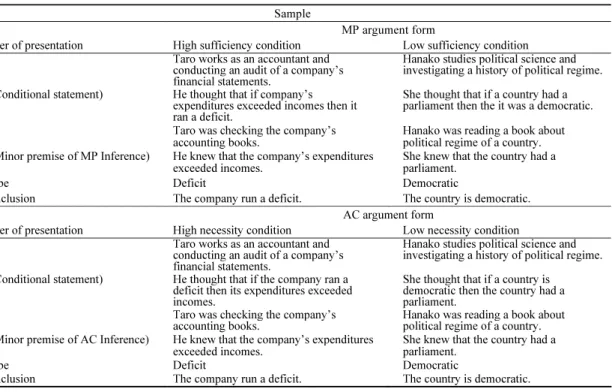
Materials. We composed 24 critical stories that fit the MP or AC inference form. Each critical story was four sentences long, contained a conditional statement in its second sentence, and had a minor premise of the MP or AC inference in its fourth sentence. Table 1 shows examples of the critical stories.
Table 1 Sample Modus Ponens (MP) and Affirming the Consequent (AC) stories of Highe-necessity- sufficiency condition and Low-necessity-sufficiency condition
Sample
MP argument form
Order of presentation High sufficiency condition Low sufficiency condition
1 Taro works as an accountant and
conducting an audit of a company’s financial statements.
Hanako studies political science and investigating a history of political regime.
2 (Conditional statement) He thought that if company’s expenditures exceeded incomes then it ran a deficit.
She thought that if a country had a parliament then the it was a democratic.
3 Taro was checking the company’s
accounting books.
Hanako was reading a book about political regime of a country.
4 (Minor premise of MP Inference) He knew that the company’s expenditures exceeded incomes.
She knew that the country had a parliament.
Probe Deficit Democratic
Conclusion The company run a deficit. The country is democratic.
AC argument form
Order of presentation High necessity condition Low necessity condition
1 Taro works as an accountant and
conducting an audit of a company’s financial statements.
Hanako studies political science and investigating a history of political regime.
2 (Conditional statement) He thought that if the company ran a deficit then its expenditures exceeded incomes.
She thought that if a country is democratic then the country had a parliament.
3 Taro was checking the company’s
accounting books. Hanako was reading a book about
political regime of a country.
4 (Minor premise of AC Inference) He knew that the company’s expenditures exceeded incomes.
She knew that the country had a parliament.
Probe Deficit Democratic
Conclusion The company run a deficit. The country is democratic.
Each conditional statement was formed from a noun-attribute pair. Half of the conditional statements were high- necessity-sufficiency conditionals and the remaining 12 were low-necessity-sufficiency conditionals. These 24 conditional statements were selected from a preliminary survey. In the preliminary survey, 12 participants read 40 conditional statements and evaluated the sufficiency relationship between antecedent p and consequent q on a 5- point scale, where 1 indicated the p is never sufficient for the q, and 5 indicated the p is always sufficient for the q.
We selected 12 high sufficiency conditionals (M = 4.06, SD = 0.23) and 12 low sufficiency conditionals (M = 2.80, SD = 0.64). In formal logic, p is sufficient for q is logically equivalent in meaning to q is necessary for p. Therefore, we used a reversed form of the high sufficiency conditionals as high necessary conditionals, and a reversed form of low sufficiency conditionals as low necessary conditionals. For example, in the conditional statement if the company’s expenditures exceeded income, then it ran a deficit, antecedent company’s expenditures exceeded income is sufficient for the consequent it ran a deficit. While in the reversed form of the conditional if the company ran a deficit then its expenditures exceeded income, antecedent the company ran a deficit is a necessary condition for its expenditures exceeded income.
Each story was constructed so that the noun would denote the focal concept in either an MP or AC inference. We wrote each critical story in two inference forms: MP inference and AC inference. MP inference forms contained second and fourth sentences that combined to fit the form if attribute then noun, attribute, whereas the AC inference forms contained second and fourth sentences that combined to fit the form if noun then attribute, attribute. Hence each high-necessity-sufficiency story and each low-necessity-sufficiency story appeared in each of the two inference conditions: MP or AC inference.
The probe word of the lexical decision task was a focal concept of the MP or AC inference, all of which were expected to yield ‘yes’ responses. The target of the validity judgment task was conclusion of an MP or AC inference.
Each probe word and conclusion was the same in both MP and AC inference form.
The 12 high-necessity-sufficiency stories were randomly split into two groups of six MP stories and six AC stories. The 12 low-necessity-sufficiency stories were also split into two groups of six MP and AC stories each.
Story groups and participants groups were counterbalanced. All participants responded to six high-necessity- sufficiency MP inference stories, six high-necessity-sufficiency AC inference stories, six low-necessity-sufficiency MP inference stories and six low-necessity-sufficiency AC inference stories.
Along with the 24 critical stories, there were 36 filler stories: 24 filler stories were similar to the critical stories, having a conditional statement and a minor premise of the MP or AC inference, whereas the probe word of these filler stories were pseudo words, therefore participants were required to answer ‘no’ in these filler stories. The remaining 12 fillers also consisted of four sentences, but they presented logical connectives other than the conditional statement (e.g. A or else B, A). Half of these filler stories had actual words and the remaining half had pseudo words as the probe word for the lexical decision task. In the validity judgment task, half of these filler stories presented a logically valid conclusion, and the remaining half presented a logically invalid conclusion. In addition to these 60 stories, we composed 10 practice stories.
Procedure. A Macintosh Power Book G3 and PsyScope 1.2.5 program were used for stimulus presentation and data collection. The participants were tested individually. Each participant received all the 70 stories. The sentences and probe words were displayed at the centre of the 14.1 inch computer screen in 14- and 28-point fonts, respectively. Presentation of the stories occurred sentence-by-sentence, self-paced by the participants. When a participant finished reading a sentence and pressed the space key, the following sentence appeared on the screen.
Pressing the space key after reading the final sentence of a story elicited the presentation of the probe word of the
lexical decision task. The lexical decision task required participants to decide whether a probe was an actual word or a pseudo-word, as quickly and as accurately as possible. After the end of each lexical decision task, the target statement of the validity judgment task was presented on the screen. In the validity judgment task, participants judged the validity of the statement with reference to the story. We assigned ‘a’ and ‘]’ keys to respond to the lexical decision task and validity judgment task. One key corresponded to word/valid response and the other was pseudo- word/invalid response. The key assignment was counterbalanced between participants. The participants were encouraged to read the story carefully for comprehension, and they took approximately 45 minutes to complete the entire task.
Results
In reported analyses, F1 analyses collapsed across items and used error terms based on participant variability, and F2 analyses collapsed across participants and obtained F-values with items as the random factors.
Reaction time data (RTs) for each participant was logarithmically transformed prior to statistical analysis. For each participant, incorrect answers and RTs that were more than 2.5 standard deviations above the participant’s grand mean were discarded, resulting in a loss of less than 6.3% of all RTs responses. In addition, data from three participants whose error rates on the lexical decision task were more than 30% were removed from further analysis.
Lexical decision task: Participants’ mean RTs along with error rates appear in Table 2. Both RTs and accuracy of lexical decision task were analyzed in repeated measures analysis of variance (ANOVAs) with the factors of necessity-sufficiency relations (high, low) and inference forms (MP, AC). In the RTs, a main effect of necessity- sufficiency relations was significant by participants (F1 (1, 16) = 9.16, p < .01), and marginally significant by items (F2 (1, 22) = 3.20, p < .10), with RTs of low-necessity-sufficiency conditions faster than that of high-necessity- sufficiency conditions. The main effect of inference forms and interaction between the two factors were not significant. ANOVA on error rates shows a main effect of necessity-sufficiency relations (F1 (1, 16) = 41.22, p
< .001; F2 (1, 22) = 17.26, p < .001) with low-necessity-sufficiency conditions more accurate than high-necessity- sufficiency conditions. Neither the main effect of inference forms nor the interaction was significant in this analysis.
In the lexical decision task, participants responded faster and more accurately in low-necessity-sufficiency conditions than in high-necessity-sufficiency conditions. These results indicated that the speed–accuracy tradeoffs were not present in this experiment.
Table 2 Mean Reaction Times (in ms) and Mean Proportions of Error by Necessity- Sufficiency Relations and Inference Forms in Lexical Decision Task
Necessity and Sufficiency Relations
High-Necessity-Sufficiency Low-Necessity-Sufficiency
Inference Form RT Error rate RT Error rate
MP 1008 (109) .07 944 (96) .00
AC 1080 (123) .07 931 (91) .04
Note. Standard errors are in parentheses. MP = modus ponens; AC = affirming the consequent.
Validity judgment task: Table 3 shows mean rates of ‘valid’ responses in the validity judgment task. The rates of
‘valid’ responses were analyzed in 2 (necessity-sufficiency relations) by 2 (inference forms) ANOVAs. Participants responded ‘valid’ more often in high-necessity-sufficiency conditionals than low-necessity-sufficiency conditionals (F1 (1, 16) = 41.22, p < .001; F2 (1, 22) = 17.25, p < .001) and in MP inference than AC inference (F1 (1, 16) = 7.56, p < .05; F2 (1, 22) = 4.48, p < .05). The interaction between two factors was not significant.
For analyzing the relationship between lexical decision and validity judgment, we calculated the correlation between RTs or accuracy of lexical decision task and rates of ‘valid’ responses in validity judgment task. The results showed no significant correlations between lexical decision and validity judgment.
Discussion
This study examined whether the contents of a conditional affect automatic inference processes as well as deliberative inference processes. The results showed a significant effect of perceived necessity-sufficiency on both the lexical decision task and the validity judgment task. In the lexical decision task, RTs were faster in low- necessity-sufficiency conditions than in high-necessity-sufficiency conditions, and the effect of inference form was not significant. The probe word of the lexical decision task was the focal concept of MP or AC inferences, and this task reflected an automatic inference process during text comprehension (6). Therefore, results of the lexical decision task implied that the automatic inference process is affected by contents of the premise. In the validity judgment task, the percentage of ‘valid’ responses was higher in the MP inference condition than in the AC inference condition;
further, this was so in the high-necessity-sufficiency condition than in the low-necessity-sufficiency condition. The results imply that both inference forms and contents of the premise affected deliberative inference processes.
The mental model theory (2, 4) posited two inference processes, one is an automatic inference process, which spontaneously constructs an initial model of premises and draws a conclusion from it; the other is a deliberative process, which evaluates the conclusion of inference by constructing counterexample models of the inference.
Contents of conditional and background knowledge may prompt or suppress the model construction, and many conditional inference studies have shown that evaluation of the inference varied according to content of the conditionals (7, 10). The results of our validity judgment task showed that the high necessity-sufficiency condition, which had few counter examples, was evaluated as ‘valid’ more often than the low necessity-sufficiency condition, which had many counter examples. This result can be explained by the mental model theory, which suggested that contents of the premise affect the construction of mental models and that reasoners refuse the conclusion when they construct counterexample of the conclusion.
Although previous studies revealed that the content of premises affect deliberative inference processes such as Table 3 Mean Proportions of ‘Valid’ Responses by Necessity-Sufficiency
Relations and Inference Forms in Validity Judgment Task
Necessity and Sufficiency Relations
Inference Form High-Necessity-Sufficiency Low-Necessity-Sufficiency
MP .93 (.03) .61 (.06)
AC .84 (.05) .54 (.07)
Note. Standard errors are in parentheses. MP = modus ponens; AC = affirming the consequent.
searching the counterexample, the effect of contents on the automatic inference process was unclear. The new finding in this experiment shows the effect of contents on the inference during text comprehension. RTs and accuracy of the lexical decision task were dependent not on its inference forms but on necessity-sufficiency relationships of the conditional. Studies of text processing showed automatic activation of knowledge during text comprehension, and this activated knowledge affected readers’ representation about the texts (17, 18). The results implied that reasoners’ background knowledge related to the conditional premises was automatically activated and affected the automatic inference process. Unlike the results of the validity judgment task, RTs and accuracy of lexical decision task were facilitated in the low necessity-sufficiency condition. Information about counterexamples, which contradicted the inferences, might not prevent readers from constructing a mental representation about the text or drawing a conclusion from it. In addition, the correlation between lexical decision and validity judgment was not observed. Deliberative inference process involoves searching for a counterexample to the conclusion; therefore, participants were sensitive to information about counterexamples. On the other hand, comprehension is a spontaneous and automatic process to represent a coherent representation of a text. Participants might adopt different inference strategies in a lexical decision task and a validity judgment task. Thus, the effect of contents, especially the availability of counter examples, would be different between automatic and deliberative inference processes.
This study revealed an effect of contents in automatic inference processes, however, the relationship between the automatic and deliberative process, and how contents affect the constructing of an initial mental representation and drawing a conclusion, are still unclear. Subsequent studies could further elucidate the effect of contents on automatic inference processes and the relationship between two processes in order to examine the nature of the representation underlying the reasoning, comprehension, and overlap between the two.
References
(1) Griggs, R. A., & Cox, J. R. (1983). The effects of problem content and negation on Wason’s selection task. The Quarterly Journal of Experimental Psychology, 35, 519-533.
(2) Johnson-Laird, P. N., & Byrne, R. M. J. (2002). Conditionals: A theory of meaning, pragmatics, and inference.
Psychological Review, 109, 646-678.
(3) Wason, P. C. (1966) Reasoning. In B. M. Foss (Ed). New horizons in psychology, Harmondsworth, U.K.:
Penguin, pp.135-151.
(4) Byrne, R. M. J., & Johnson-Laird, P. N. (2009). ‘If’ and the problem of conditional reasoning. Trends in Cognitive Sciences, 13, 282-287.
(5) Lea, R. B. (1995). On-line evidence for elaborative deductive inferences in text. Journal of Experimental Psychology: Learning, Memory, and Cognition, 21, 1469-1482.
(6) Rader, A. W., & Sloutsky, V. M. (2002). Processing of logically valid and logically invalid conditional inferences in discourse comprehension. Journal of Experimental Psychology: Learning, Memory, and Cognition, 28, 59-68.
(7) Cummins, D. D. (1995). Naïve theories and causal deduction. Memory and Cognition, 23, 646-658.
(8) De Neys, W., Schaeken, W., & d’Ydewalle, G. (2002). Causal conditional reasoning and semantic memory retrieval: A test of the semantic memory framework. Memory and Cognition, 30, 908-920.
(9) Grosset, N., Barrouillet, P., & Markovits, H. (2005). Chronometric evidence for memory retrieval in causal
conditional reasoning: The case of the association strength effect. Memory and Cognition, 33, 734-741.
(10) Thompson, V. A. (2000). The task-specific nature of domain-general reasoning. Cognition, 76, 209-268.
(11) Ahn, W., & Graham, L. M. (1999). The impact of necessity and sufficiency in the Wason four-card selection task. Psychological Science, 10, 237-242.
(12) Campion, N. (2006). Hypothetical and certain inferences from conditional arguments read in texts. Journal of Experimental Psychology: Learning, Memory, and Cognition, 32, 547-558.
(13) Fairley, N., Manktelow, K., & Over, D. (1999). Necessity, sufficiency, and perspective effects in causal conditional reasoning. The Quarterly Journal of Experimental Psychology A, 52, 771-790.
(14) Nakamura, H., & Kawaguchi, J. (2006). Role of the necessity and sufficiency in the thematic material effect and perspective effect of the Wason selection task. Journal of Human Environmental Studies, 4, 23-28.
(15) Thompson, V. A. (1995). Interpretational factors in conditional reasoning. Memory and Cognition, 22, 742-758.
(16) Verschueren, N., Schaeken, W., & Shroyens, W. (2006). Necessity and sufficiency in abstract conditional reasoning. European Journal of Cognitive Psychology, 18, 255-276.
(17) Kintsch, W. (1988). Comprehension: A paradigm for cognition. Cambridge, England: Cambridge University Press.
(18) McKoon, G., & Ratacliff, R. (1992). Inference during reading. Psychological Review, 99, 440-466.