• 検索結果がありません。

Wiener-Hopf Analysis of the Diffraction by a Circular Waveguide Cavity

N/A
N/A
Protected

Academic year: 2021

シェア "Wiener-Hopf Analysis of the Diffraction by a Circular Waveguide Cavity"

Copied!
7
0
0

読み込み中.... (全文を見る)

全文

(1)

Wiener-Hopf Analysis of the Diffraction by a Circular Waveguide Cavity

Dozyslav B. Kuryliak , Kazuya Kobayashi , Shoichi Koshikawa , and Zinoviy T. Nazarchuk

1 Introduction

The analysis of the scatteringand diffraction by open-ended metallic waveguide cavities has been of great interest recently in connection with the prediction and reduction of the radar cross section (RCS) of a target. This problem serves as a simple model of duct structures such as jet engine intakes of aircrafts and cracks occurringon surfaces of general complicated bodies. Therefore the investigation of a scattering mechanism in case of the existence of open cavities is an important subject in the field of the RCS prediction and reduction. Some of the cavity diffraction problems have been analyzed thus far usinga variety of different analytical and numerical methods. If the cavity dimensions are small in comparison to the incident wavelength, numerical techniques such as the method of moments and the finite element method can be applied efficiently. For large cavities with uniform cross sections, the results based on the waveguide modal approach by the use of the reciprocity relationship and the Kirchhoff approximation have been reported. In order to describe systematically the scattering mechanism as related to a fairly general class of large cavities with reasonable accuracy, the three ray-based approaches, namely, the method of shootingand bouncing rays, the Gaussian beam method, and the generalized ray expansion method have been developed.

Furthermore, hybrid techniques such as the asymptotic/modal approach and the boundary inte- gral/modal approach have also been established. These hybrid approaches take advantage of the efficiency of the modal analysis as well as the flexibility of asymptotic or numerical techniques. Most of these analysis methods incorporate the scatteringfrom the interior of the cavity includingthe rim diffraction at the open end, but they do not rigorously take into account the scattering effect arising from the entire exterior surface of the cavity. Therefore, final solutions due to these approaches are valid only for the restricted range of incidence and observation angles. In addition, these solutions may not be uniformly valid for arbitrary dimensions of the cavity.

The Wiener-Hopf technique is known as a powerful tool for analyzingelectromagnetic wave prob- lems associated with canonical geometries, which is mathematically rigorous in the sense that the edge condition is explicitly incorporated into the analysis. We have considered a finite parallel-plate waveguide with a planar termination at the open end as an example of simple two-dimensional (2-D) cavity structures, and solved the plane wave diffraction problem rigorously using the Wiener-Hopf technique. As a result, an efficient approximate solution has been obtained, which is valid for the cavity depth greater than the incident wavelength. We have further considered 2-D material-loaded cavities formed by finite and semi-infinite parallel-plate waveguides, and carried out a rigorous RCS

Karpenko Physico-Mechanical Institute, National Academy of Sciences of Ukraine Lviv, Ukraine

Department of Electrical, Electronic, and Communication Engineering, Chuo University Tokyo, Japan

Research & Development Division, Yokowo Co., Ltd., Tokyo, Japan

(2)

analysis by means of the Wiener-Hopf technique. It has been shown by numerical computation that the results are valid over a broad frequency range and can be used as a reference solution for validatingmore general-purpose computer codes based on approximate methods.

This paper gives a summary of our further research related to cavity diffraction problems, which contains new Wiener-Hopf solutions to more complicated cavities composed of a circular waveguide.

Some of the results presented in this paper have already been reported in journals and conference proceedings.

2 Wiener-Hopf Solution to the Diffraction by a Circular Waveguide Cavity 2.1 Vector diffraction problem

We shall generalize the technique, previously developed for a rigorous analysis of the 2-D diffraction by parallel-plate waveguide cavities, to the analysis of the three-dimensional (3-D) vector diffraction by open-ended cavity structures. Let us consider a semi-infinite circular waveguide with an interior planar termination as shown in Fig. 1 [1-3], where (ρ, ϕ, z) are cylindrical coordinates. It is assumed that the circular cavity is excited by non-symmetric electromagnetic waves of a hypothetical generator with voltage of unit amplitude across an infinitesimally small gap at the interior cylindrical face.

The mixed boundary value problem mentioned above for the wave diffraction by a cylindrical waveguide cavity involves the unknown TM and TE scalar potentials and the problem is stated as follows:

∆ + k 2 0 0 ∆ + k 2

u 1 (ρ, z) u 2 (ρ, z)

=

0 0

, (1)

Fig. 1 Semi-infinite cylinder with an interior planar termination

The boundary condition at the cylindrical surface:

z (−∞, L) with ρ = b + 0 and z (−L, L) with ρ = b 0

ϑ[∂ 2 /∂z 2 + k 2 ] 0 ϑmρ 1 ∂/∂z ∂/∂ρ

u t 1 u t 2

=

0 0

,

The boundary condition at the plate termination: ρ (0, b), z = −L

ϑmρ 1 ∂/∂z ∂/∂ρ ϑm∂ 2 /∂ρ∂z m/ρ

u t 1 u t 2

=

0 0

, (2) Here ϑ = i(ωε) 1 and m is the number of the azimuth mode.

Takingthe Fourier transform of (1) appropriately, we derive the transformed wave equations with unknown inhomogeneous terms comprising the field potentials and their normal derivatives on the surface of the interior planar termination, with the result that

T ˆ 0 0 T ˆ

U 1 (ρ, α) U 2 (ρ, α)

=

0 0

in ρ > b for | τ | < k 2 , (3)

(3)

T ˆ 0 0 T ˆ

Φ 1 (ρ, α) + e iαL Ψ + 1 (ρ, α) Φ 2 (ρ, α) + e iαL Ψ + 2 (ρ, α)

= e iαL

˜

g 1 (ρ) f ˜ 1 (ρ)

˜

g 2 (ρ) f ˜ 2 (ρ)

in 0 < ρ < b for τ > −k 2 , (4)

where α = Reα + iImα(≡ σ + iτ) with l = 1, 2, ˆ T =

d 2 /dρ 2 + ρ 1 d/dρ

γ 2 + m 2 2 , γ = (α 2 k 2 ) 1/2 with Reγ > 0, and ˜ f l (ρ), ˜ g l (ρ) are the unknown inhomogeneous terms defined by

f ˜ l (ρ) = (2π) 1/2 u t l (ρ, −L), g ˜ l (ρ) = (2π) 1/2 ∂u t l (ρ, z)/∂z| z= L . (5) The terms on the left-hand sides of (3) and (4) are the Fourier transforms of the unknown functions in (1) and (2), beingdefined by

U l (ρ, α) = (2π) 1/2 +

−∞ u l (ρ, z)e iαz dz, for ρ > b, (6a) U l (ρ, α) = (2π) 1/2

+

−∞

u l (ρ, z)e iαz dz, for 0 < ρ < b, (6b)

U l + (ρ, α) = 1

2π +

+L

u l (ρ, z)e iα(z L) dz, Φ l (ρ, α) = 1

2π +L

L

u t l (ρ, z)e iαz dz. (6c) It is found that U l + (ρ, α) are regular in the half-plane τ > −k 2 and Φ l (ρ, α) with l = 1, 2 are entire functions. Usingthe notation as given by (6), we may express U l (ρ, α) as

U l (ρ, α) = Φ l (ρ, α) + e iαL Ψ + l (ρ, α) U l i (ρ, α) (7) for 0 < ρ < b, where

Ψ (+) l (ρ, α) = U l + (ρ, α) + Q + l (ρ, α), (8) Q + 1 (ρ, α) = ωε

(2π) 3/2

+ +iε

+

−∞ +iε

+

I mβ ρ)e iβ(d L) γ β 2 I mβ b)

α β , (9)

U 1 i (ρ, α) = ωεe iαL (2π) 3/2

+ +iε

+

−∞ +iε

+

I mβ ρ)e iβ(d+L) γ β 2 I mβ b)

α β , (10)

In (9) and (10) the constant ε + is taken such that −k 2 < ε + < τ .

The main idea is to derive the expressions of the functions in (5) in terms of the Fourier-Bessel

and Dini series as well as the static terms with common unknown coefficients due to the correct

separation of the variables for (1) and (2) and then to account for the interaction of TM and TE

waves. This allows findingthe field image in Fourier transform domain. Since the scattered field

for the region ρ > b must vanish as ρ → ∞ accordingto the radiation condition, we find by taking

into account the boundary conditions at the termination the solutions of (3) and (4). This leads

to a scattered field representation in the Fourier transform domain. Usingthe boundary conditions

for the field components e z (ρ, z), e ϕ (ρ, z) at the cylindrical surfers with ρ = b and the conditions

of continuity for the field components h z (ρ, z), h ϕ (ρ, z) with ρ = b and L < z < in the Fourier

transform domain, we derive the Wiener-Hopf equation as well as the set of linear algebraic equations

of the second kind after the factorization and decomposition procedure, which leads to a rigorous

solution for arbitrary physical parameters. An approximate solution is further derived for the case

where the dominant propagating TE and TM modes consecutively appear in the circular cavity of

large depth.

(4)

2.2 Axially symmetric case (Scalar wave diffraction problem)

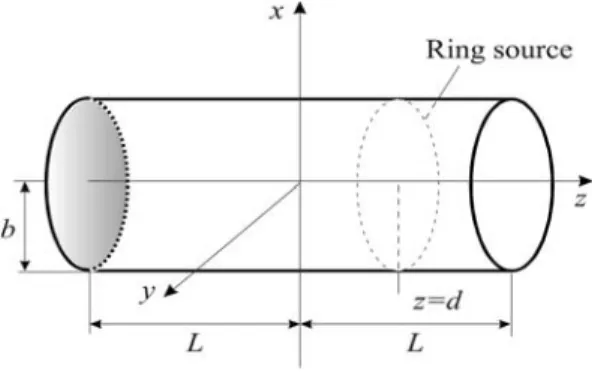
The scalar-type transition under co-phasal distribution of the electric voltage in the generator as well as a generalization of the approach to a more realistic model involving an open-ended finite circular waveguide cavity as shown in Fig. 2 are also investigated [4-6]. The axially symmetric mixed boundary value problem for the above-mentioned problem of wave diffraction by a cylindrical waveguide cavity now involves the unknown TM scalar potential and is stated as follows:

∆φ + k 2 φ = 0. (11)

The boundary condition at the cylindrical surface

z (−L, L) with ρ = b ± 0 : [∂ 2 /∂z 2 + k 2t = 0.

The boundary condition at the plate termination

ρ (0, b) with z = −L ± 0 : 2 /∂ρ∂z[φ t ] = 0.

(12) Takingthe Fourier transform of (11), we derive the transformed wave equations with unknown inhomogeneous terms which comprise the field potential on the opposite surfaces of the planar ter- mination. Expandingthese terms into the convergent Fourier-Bessel series and applyingthe above- mentioned technique, we obtain the correct field image in the Fourier transform domain. This allows to formulate the problem in terms of the Wiener-Hopf equation, which is solved via the factorization and decomposition procedure. Finally we obtain the exact solution with the result that

E (b, α) + M (α)

J E (1) (α) + n=1

M + (iγ n )E (b, −iγ n ) n n )

= M (α)R (α), (13)

E + (b, α) M + (α)

J E (2) (α) + n=1

e

n

L M + (iγ n )E + (b, iγ n ) n (α + n )

= M + (α)R + (α), (14)

where

J E (1,2) (α) = 1 2

± i ∞± k

± k

e ± 2iνL M ± (ν )E ± (b, ν) γ ν 2 K 0 (γ ν b)[K 0 (γ ν b) iπI 0 (γ ν b)]

ν α . (15)

Here E ± (b, α) are the unknown functions in the transform domain for e z (b, z); R ± (α) and M ± (α) are known functions which are regular in the half-planes τ < > k 2 . In (15), I 0 (·) and K 0 (·) are the modified Bessel functions of the first and second kinds, respectively.

The solution is exact but formal, since singular infinite branch-cut integrals (15) with unknown in- tegrands are involved. Then taking into account the exponentially decaying behavior of the integrand (15), we can express J E (1,2) (α) for large |k|L by keepingonly the leadingterm for the asymptotic expansion with the result that

J E (1) (α) 1

2 e 2ikL b 2 χ(α)M + (k)E + (b, k), J E (2) (α) 1

2 e 2ikL b 2 χ(−α)M + (k)E (b, −k), (16) where

χ(α) =

0

e 2tL

[t i(k α)]R 0 (t) dt (17)

with

R 0 (t) = 2itkb 2 K 0

i 1/2

2ktb 2 K 0

i 1/2

2ktb 2

iπI 0

i 1/2

2ktb 2

, (18)

(5)

Fig. 2 Geometry of the problem.

| α k | > 0 and π/2 < arg(α k) < 3π/2. (19) The integral (17) is uniformly convergent because of the integrable singularity R 0 (t) = O(t(ln t) 2 ) for t 0 and the conditions (19).

Next we derive the approximate expressions of E (α) and E + (α) which lead to the two sets of 2N + 2 equations, where N is a large positive integer. These equations can be solved numerically with high accuracy. In numerical computation, the truncation number N has been chosen so that it is greater than the number of propagating modes inside the waveguide. By careful numerical experimentation, it has been clarified that the choice of N = 10 gives sufficient accuracy in numerical results presented in this paper.

Approximation procedures based on a rigorous asymptotics are presented and an approximate solution of the Wiener-Hopf equation is derived. The scattered field inside and outside the cav- ity is evaluated by takingthe inverse Fourier transform and applyingthe saddle point method of integration.

3 Numerical results and discussion

Based on the mentioned above results, we have carried out numerical computations and give repre- sentative numerical examples of the radiation patterns for the amplitude of the electric components for various physical parameters. We have computed electric field components |e z | = |e z (ρ, z)R|

and |e ρ | = |e ρ (ρ, z)R| as R → ∞, where (R, θ) are cylindrical coordinates defined by z = R cos θ, ρ = R sin θ for 0 < θ < π. Figure 3 shows the far field amplitude of e z and e ρ as a function of observation angle. It is seen from the figure that the radiated field oscillates rapidly with an increase of the cavity dimension. This sharp oscillation for larger cavities is due to the effect of the multiple diffraction between the aperture and the back corner. Next we evaluate the power of TM waves radiated from the cavity through the elementary surface dS = sin θdθdϕ. The radiated power P is found to be

P (θ) 0.5(ε/µ) 1/2 | e z (ρ, z)/ sin θ | 2 R 2 .

We investigate the power radiated from the cavities as a function of the observation angle and cavity

parameters. Figure 4 shows that, with an increase of the cross section of the cavity, dominant peaks

(6)

(a) Farfield amplitude | e

z

| . (b) Farfield amplitude | e

ρ

| . Fig.3 Radiation pattern of electric field components e

z

and e

ρ

for d/L = 0.

Line 1: 2b = 10λ, L/b = 1. Line 2: 2b = 2λ, L/b = 5.

(a) 1 2b = 2λ, L/b = 10; 2 2b = 4λ, L/b = 5;

(a) 3 2b = 10λ, L/b = 2

(b) 2b = 10λ; 1 L/b = 0.1; 2 L/b = 0.5;

(b) 3 L/b = 1 Fig.4 Power of the radiation energy for d/L = 0.0

of oscillations of the radiated power are formed in the region 75 < θ < 105 . The focusingeffect of the radiated power is found in the direction θ = 90 for short cavities.

4 Conclusions

We have analyzed the vector diffraction problem for a circular waveguide cavity rigorously using the Wiener-Hopf technique. The method of solution is a generalization of the approach we have established previously for the analysis of the parallel-plate waveguide with a planar termination and it uses the infinite Fourier-Bessel and Dini series in the formulation, and rigorously involves the interaction between TM and TE types of waves. The key equations for investigation of the electromagnetic fields scattered by the cylindrical waveguide cavity in the vector case are derived.

For investigating the axial symmetric electromagnetic fields scattered by the cylindrical waveguide

cavity numerically, approximate procedures and an approximate solution of the Wiener-Hopf equa-

tion are derived. Based on these results, we have carried out numerical computations and showed

representative numerical examples of the radiation patterns for amplitude of the electric components

(7)

and the power radiated from the cavities for various physical parameters. Some comparisons with exact solution for infinite and semi infinite cylinders have also been made.

Acknowledgment

This work is supported in part by the Institute of Science and Engineering, Chuo University.

References

[1] Kuryliak, D. B., S. Koshikawa, K. Kobayashi, and Z. T. Nazarchuk, “Rigorous analysis of the vector diffraction problem for a cylindrical waveguide cavity,” Reports of National Academy of Sciences of Ukraine - 2001. - no.3, pp. 85–94.

[2] Kuryliak D. B., S. Koshikawa, K. Kobayashi, and Z. T. Nazarchuk, “Wiener-Hopf technique for the diffraction by circular waveguide cavity,” Proc. Progress in Electromagnetic Research Symposium (PIERS 2001), July 18–22, 2001, Osaka, Japan.

[3] Kuryliak D. B., S. Koshikawa, K. Kobayashi, and Z. T. Nazarchuk, “Wiener-Hopf technique for the vector diffraction by circular waveguide cavity,” Proc. Asia-Pacific Radio Science Conference (AP-RASC’01), August 1–4, 2001, Tokyo, Japan.

[4] Kuryliak D. B., K. Kobayashi, S. Koshikawa, and Z. T. Nazarchuk, “Wiener-Hopf analysis of the axial symmetric wave diffraction problem for a circular waveguide cavity,” Proc. International Workshop on Advanced Electromagnetics (IWAE’01), July 30–31, 2001, Tokyo, Japan.

[5] Kuryliak D. B., K. Kobayashi, S. Koshikawa, and Z. T. Nazarchuk, “Axial symmetric wave diffraction by a circular waveguide cavity,” Proc. 2002 International Conference on Mathematical Methods in Electromagnetic Theory (MMET*02), September 10–13, 2002, Kiev, Ukraine.

[6] Kuryliak D. B., K. Kobayashi, S. Koshikawa, Z. T. Nazarchuk, “Axial symmetric wave diffraction

by a circular waveguide cavity,” Proc. 2002 Asia-Pacific Microwave Conference (APMC 2002),

November 19–22, 2002, Kyoto, Japan.

Fig. 1 Semi-infinite cylinder with an interior planar termination
Fig. 2 Geometry of the problem.

参照

関連したドキュメント

pole placement, condition number, perturbation theory, Jordan form, explicit formulas, Cauchy matrix, Vandermonde matrix, stabilization, feedback gain, distance to

We show that a discrete fixed point theorem of Eilenberg is equivalent to the restriction of the contraction principle to the class of non-Archimedean bounded metric spaces.. We

Solutions of integral equa- tions are expressed by the inverse operators of auxiliary exterior and interior boundary value problems, i.e., theorems on the solvability of

In this paper, we extend this method to the homogenization in domains with holes, introducing the unfolding operator for functions defined on periodically perforated do- mains as

From the local results and by Theorem 4.3 the phase portrait is symmetric, we obtain three possible global phase portraits, the ones given of Figure 11.. Subcase 1 Subcase 2

It turns out that the symbol which is defined in a probabilistic way coincides with the analytic (in the sense of pseudo-differential operators) symbol for the class of Feller

We give a Dehn–Nielsen type theorem for the homology cobordism group of homol- ogy cylinders by considering its action on the acyclic closure, which was defined by Levine in [12]

Applying the conditions to the general differential solutions for the flow fields, we perform many tedious and long calculations in order to evaluate the unknown constant coefficients