林和靖・太公望図 : 修復報告書 : 在外日本古美術 品保存修復協力事業 : No.2017‑2
著者 文化遺産国際協力センター
出版年月日 2021‑03‑26
URL http://id.nii.ac.jp/1440/00009003/
在外日本古美術品保存修復協力事業
The Cooperative Program for the Conservation of
Japanese Art Objects Overseas
林和靖・太公望図 Lin Bu, Lu Shang
インディアナポリス美術館(アメリカ合衆国)
紙本墨画 掛軸装
2
幅The Indianapolis Museum of Art, USA Ink on paper, hanging scrolls, two scrolls
No.2017-2
平成29年度修復事業 The 2017 Japanese Fiscal Year
目 次
1
修復報告...1
1.1
名称等...1
1.2
工期及び施工者等...1
1.3
修復前の状態...1
1.4
修復方針...1
1.5
修復工程...2
2
作品解説...24
付録 付録
1
記録...29
付録
2
繊維組成分析...35
Table of Contents
1 Restoration Report...4
1.1 Information of the Artworks...4
1.2 Information of the Restoration Project ...4
1.3 Condition before Restoration...4
1.4 Restoration Policy...4
1.5 Restoration Process...5
2 Description about the Artwork...26
Appendices Appendix 1 Documentation...29
Appendix 2 Analyzing Paper...35
1.1 名称等
名称 『『林和靖図・太公望図』
制作者 曾我蕭白(
1730
~1781
) 制作年代19
世紀半ば所蔵館 インディアナポリス美術館(アメリカ合衆国)
所蔵番号
2000.54
(太公望図)、2000.55
(林和靖図)品質・形状 紙本墨画 掛軸装(三段表具)
2
幅本紙繊維 竹
1.2 工期及び施工者等
1.3 修復前の状態
・本紙に折れ、亀裂や欠失、捲れ、縦皺があった(
Fig. 1.7(a)
、Fig. 1.9(a)
、Fig. 1.11(a)
)。・過去の修復により施された折れ伏せや補修紙によって本紙表面に凹凸や細かい皺があった(
Fig. 1.8(a)
)。・補修部分に糊による染みがあった(
Fig. 1.10(a)
)。・『太公望図』に関しては欠失周囲の描線がずれていた(
Fig. 1.13(a)
)。・欠損部に本紙の一部と思われる補修紙が使用されていた。
・本紙に欠損や虫嘗めがあった。
・本紙に付着物や経年の汚れがあった(
Fig. 1.12(a)
)。・過去の切り継ぎ跡に糊による染みがあった。
・柱の切り継ぎ部分の本紙が切れていた。
・掛軸全体が内側に湾曲していた。
・総裏紙が部分的に浮いていた。
1.4 修復方針
・原状保存、現状維持を基本方針とした修復を行う。
・使用する材料、技術および修復環境は国指定品の修復と同等とする。
・修復前と同様の表装形式に仕立てる。
・表装裂、軸首、発装、軸棒、金具、啄木紐および保存箱などの保存用具を新調する。
・全ての付属物、付帯物を所蔵館に返還する。
修復報告
半田昌規、土屋三恵、山田知水、山本一来、佐々木立美 株式会社 半田九清堂
工期 平成
29
年9
月25
日~令和元年5
月30
日施工場所 株式会社 半田九清堂 東京国立博物館内修理室 施工者 株式会社 半田九清堂
1.5 修復工程
修復材料は
Table 1.3
を参照。(1)
記録(Fig. 1.14.1
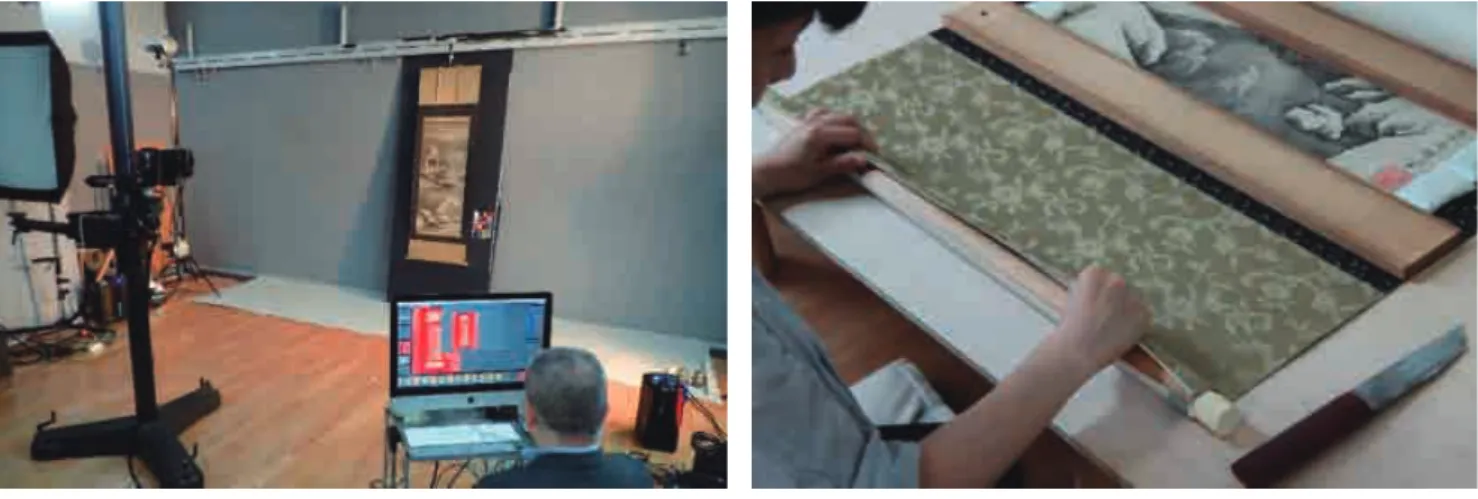
)・寸法や損傷状態などの修復前状況を記録した。本体の状態について
4
×5
リバーサルフィルム、デ ジタルカメラ、赤外線撮影により、細かな撮影記録を行った(付録1
)。・墨の定着具合や汚れの移り具合を調べるために、水を少量含ませた筆で軽くなぞるパッチテストを 行い、修理の作業順序や方法を検討した。
(2)
解体(Fig. 1.14.2
)表装から軸棒、発装を取り外し、本紙を表装裂地から取り外して、掛軸装を解体した。
(3)
繊維組成分析本紙裏面より微量の本紙繊維を採取し、
C
染色液を用いて繊維の分析を行った(付録2
)。(4)
剥落止め(Fig. 1.14.3
)朱や墨の必要箇所に牛膠水溶液(
0.5 wt-%
)を筆で塗布し、十分に乾燥した。(5)
総裏紙および折れ伏せの除去(Fig. 1.14.4
)本紙裏面を必要最低限の量のろ過水で加湿し、総裏紙および折れ伏せを除去した。
(6)
埃の除去(Fig. 1.14.5
)本紙表面の汚れや埃を、柔らかい毛の刷毛で除去した。
(7)
水による洗浄水溶性の汚れを除去するために必要最低限のろ過水を本紙表面に噴霧し、本紙の下に敷いた吸い取り 紙に汚れを吸収させた。
(8)
増裏紙の除去(Fig. 1.14.6
)必要最低限のろ過水を塗布して本紙裏面を加湿し、増裏紙および折れ伏せを除去した(
Fig. A.1.4
、Fig.
A.1.5
)。(9)
肌裏紙の除去(Fig. 1.14.7
)本紙裏面の全面を加湿せずに筆で部分的に水分を与えながら、徐々に折れ伏せと肌裏紙を除去した
(
Fig. A.1.6
、Fig. A.1.7
)。(10)
補修紙の除去と新規補修(Figs. 1.14.8
~11
)補修紙は全て除去し、本紙と同質の竹紙を欠損の形通りに喰い裂いて補填した。「太公望図」の本紙亀 裂部分における描写のズレは、描写を確認しながらズレ等を修正し、裏面より帯状の極薄美濃紙にて 補強した。切り継ぎ部分で本紙が切れた箇所には、裏面より帯状の極薄美濃紙にて補強した。これら の作業は全てフノリを混ぜた新糊を用いて行った(
Fig. A.1.8
、Fig. A.1.9
)。(11)
肌裏打ち(Fig. 1.14.12
)塡料入りの楮紙を、新糊を用いて新規肌裏打ちをした。
(12)
増裏打ち(Fig. 1.14.13
)古糊を用い、美栖紙を増裏打ちした。
(13)
表装裂地調整所蔵館および関係者と協議の上、表装裂を選択した。表装裂は、新糊を用いて美濃紙を肌裏打ちし、
さらに古糊を用いて美栖紙を増裏打ちした。
(14)
切り継ぎ(Fig. 1.14.14
)本紙と表装裂地を裁ち合わせ、新糊を用いて切り継いだ。
本紙裏面より新糊を用い、細く帯状に裁断した薄美濃紙を、折れが生じている箇所に貼り当て、今後 の折れを予防した。
(16)
中裏打ち(Fig. 1.14.16
)古糊を用い、美栖紙を中裏打ちした。
(17)
総裏打ち(Fig. 1.14.17
)宇陀紙と上巻絹を、古糊を用いて総裏打ちした。宇陀紙は天然染料(トマト茎・根)を煮出した抽出 液と楮の繊維を一緒に漉いたものを使用した。
(18)
仮張り(Fig. 1.14.18
)本紙画面の裏側を露出して仮張り板に本紙を一定期間張り込み、その後本紙を剥がし、次に表側を露 出して仮張り板に張り込みなおし、一定期間静置して乾燥した。
(19)
補彩(Fig. 1.14.19
)補修した箇所に、膠で溶いた顔料を用いて本紙基調色の補彩を施した。
(20)
仕上げ(Fig. 1.14.20
)軸棒、発装、軸首、金具、紐を新調し掛軸装に仕立てた。
(21)
保存(Fig. 1.14.21
、Fig. 1.14.22
)太巻芯、桐材印籠箱、包裂、蓋覆を新調し、作品を収納した。また修復前に使用されていた表装材料 である表装裂(上下、中廻し、一文字、風帯)、金具、紐、発装、軸棒、軸首、折れ伏せ、補修紙、裏 打ち紙(肌裏紙、増裏紙、総裏紙)、太巻芯、包裂および保存箱は別置保存とした。
(22)
記録修復後の作品の写真撮影を行い、本修復に関する記録を集約した。
1.1 Information of the Artworks
Titles Lin Bu, Lu Shang
『林和靖図・太公望図』Artist SOGA Shohaku (
曾我蕭白, 1730-1781)
Period Middle of the 19
thcentury
Owner The Indianapolis Museum of Art, United States of America Accession no. 2000.54 (Lu Shang), 2000.55 (Lin Bu)
Media and format (style) Ink on paper, hanging scroll (three-tier style), two scrolls Paper for artwork Bamboo fiber
1.2 Information of the Restoration Project
1.3 Condition before Restoration
・
There were creases in the artworks, rifts, losses, lifts and vertical wrinkles. (Fig. 1.7(a)
、Fig. 1.9(a)
、Fig. 1.11(a)).
・
There were unevenness and fine wrinkles caused by reinforcement paper strips and infill paper on the surface of the artworks (Fig. 1.8(a)).
・
There were stains by paste used for the infillings on the artworks (Fig. 1.10(a)).
・
There were shears of drawing lines on Lu Shang (Fig. 1.13(a)).
・
Infill paper, assumed to be a part of the artworks, had been applied to missing parts.
・
The surface of the artworks had suffered insect damage.
・
There were accretions and stains.(
・
There were stains caused by paste while assembling in the past.
・
The artworks were cut at places where assembling of the vertical strips was done.
・
The artworks were bent inside.
・
The final lining was partly lifting off.
1.4 Restoration Policy
・
Restoration of the artworks to their status quo ante and the maintenance of the present condition would be the fundamental policy to be followed in restoring the artworks.
・
Materials, techniques and restoration environment equivalent for the restoration of designated cultural properties would be used.
・
The mounting format would be the same style as that before restoration.
・
The mounting fabrics, roller knobs, hanging rods, roller rods, washers, eye-pins, cords, and storage boxes would be
1. Restoration Report
HANDA Masaki, TSUCHIYA Mie, YAMADA Tomomi, YAMAMOTO Itsuki, SASAKI Tatsumi Handa Kyuseido Co., Ltd.
Duration 25 September 2017 - 30 May 2019
Place The studio in the Tokyo National Museum, Handa Kyuseido Co., Ltd.
Restorers Handa Kyuseido Co., Ltd.
Fig. 1.12(a))
・
All the previous mounting materials and storage equipment would be returned to the museum.
・
All the processes of the restoration would be recorded including photographs.
・
Varieties of investigation towards the artworks during restoration would be carried out under the guidance of the person in charge of the Tokyo National Research Institute for Cultural Properties.
1.5 Restoration Process
Regarding restoration materials, see Table 1.3.
(1) Documenting (Fig. 1.14.1)
・
The condition of the artworks including the dimensions and damages were recorded. Photos were taken using 4×5 reversal film camera, digital camera and infrared photography (Appendix 1).
・
To examine the stability of the sumi (Chinese ink) and the possibility of stain migration, a patch test, providing water by brush, was done.
(2) Disassembling (Fig. 1.14.2)
Hanging rods, roller rods and the artworks were detaching from the mounting. And mounting fabrics were taken apart to pieces.
(3) Analyzing paper
A very small amount of fiber sampling from the back side of the artworks were dyed by C stain and observed with a microscope (Appendix 2).
(4) Consolidating (Fig. 1.14.3)
A cow skin glue solution (0.5wt-%) was applied to red colored shu (red ink) and dark colored sumi (Chinese ink) areas using a brush; consolidated paint layers were dried completely.
(5) Removing the final lining paper and reinforcement paper strips (Fig. 1.14.4)
The final lining paper and reinforcement paper strips were removed by applying minimum required filtered water to the back of the artworks.
(6) Removing dust (Fig. 1.14.5)
A soft brush was used to remove dirt and dust from the surface of the artworks.
(7) Washing
To remove water-soluble dirt, minimum required filtered water was sprayed onto the front side of the artworks and absorbed by blotting paper placed under the artworks.
(8) Removing the second lining paper (Fig. 1.14.6)
The second lining paper and reinforcement paper strips were removed by applying moisture of minimum required filtered water from the back side of the artworks (Fig. A.1.4, Fig. A.1.5).
(9) Removing the first lining paper (Fig. 1.14.7)
The first lining and reinforcement paper strips were removed slowly by applying moisture using a brush partially without applying water widely to the back side of the artworks (Fig. A.1.6, Fig. A.1.7).
(10) Removing the infill paper and infilling (Figs. 1.14.8-11)
All the infill paper was removed from the artworks; new infill paper prepared by shaping the loss areas was
applied. New infill paper was made of bamboo, the same material as the artworks. The shears of drawing lines
mixed with seaweed paste was used.
(11) Applying first lining (Fig. 1.14.12)
Kozo paper containing rice powder as filler was applied with new wheat starch paste.
(12) Applying second lining (Fig. 1.14.13)
Misu paper was applied with aged wheat starch paste.
(13) Preparing the mounting fabrics
Through consultation with the owner and the project manager, mounting fabrics that were suitable for the artworks were selected and prepared. To the newly prepared mounting fabrics, the first lining made of mino paper was attached using wheat starch paste. The second lining made of misu paper was attached using aged wheat starch paste.
(14) Assembling (Fig. 1.14.14)
The artworks and the mounting fabrics were cut together and assembled by using new wheat starch paste.
(15) Applying reinforcement paper strips (Fig. 1.14.15)
Using new wheat starch paste, reinforcement paper strips made of thin mino paper were applied to creases on the artworks from the back side as well as to places where creases may occur in the future.
(16) Applying third lining (Fig. 1.14.16)
Misu paper was applied with aged wheat starch paste.
(17) Applying final lining (Fig. 1.14.17)
Uda paper and cover silk fabrics were applied with aged wheat starch paste. This uda paper was made by mixing kozo fiber with extraction liquid boiled from natural dyes (stems and roots of tomato).
(18) Karibari (drying and conditioning) (Fig. 1.14.18)
The artworks with mounting (the object) were attached to the karibari panel face down for a while. After the object was removed from the panel, it was attached and dried again to the karibari panel face up for a certain period.
(19) Inpainting (Fig. 1.14.19)
Inpainting was applied to parts that had been infilled, by using pigment dissolved in liquid glue to match the color of the infilled parts with that of the artworks.
(20) Finishing (Fig. 1.14.20)
The roller rods, hanging rods, roller knobs, washers, eye-pins, and cords were newly made, and the artworks were finished as a hanging scroll.
(21) Preparing for storage (Fig. 1.14.21, Fig. 1.14.22)
Roller clamps, Paulownia inro-style storage boxes, wrapping cloths, and fabric covering the lid of the storage boxes were made a new to store the artworks. The mounting materials and storage equipment which had been used on the object before restoration—mounting fabrics (of outer border fabrics, center border fabrics, inner border fabrics, decorative fabric strips), washers and eye-pins, cords, hanging rods, roller rods, roller knobs, reinforcement paper strips, infill paper, lining paper (of first, second and final), roller clamps, wrapping cloths and storage boxes—were stored separately from the restored artworks.
(22) Documenting
Photographs were taken after restoration and reports were prepared.
Translated by SHIMIZU Ayako, KATO Masato
(a) (b)
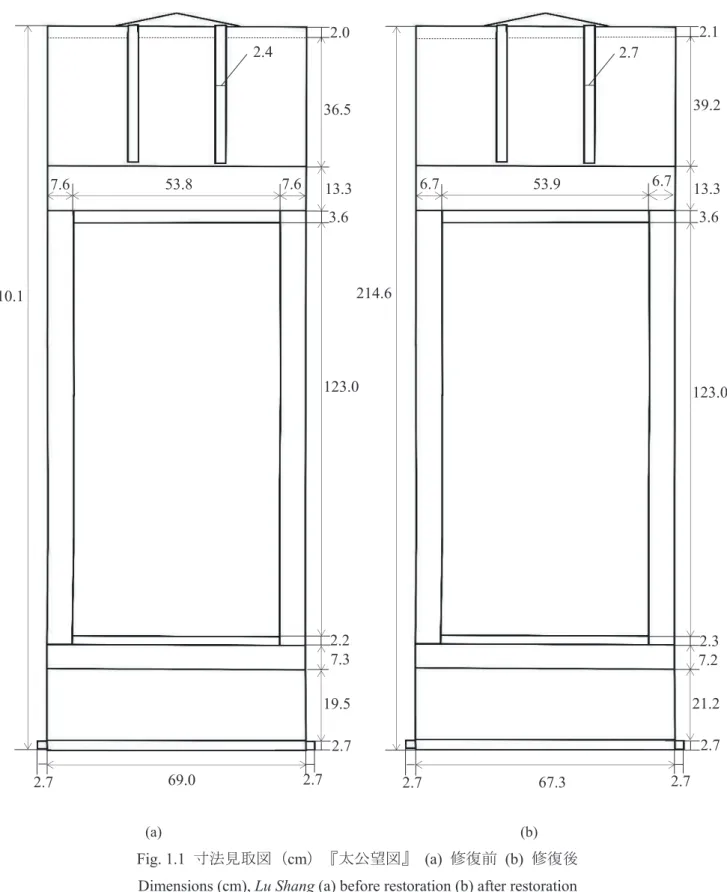
Fig. 1.1
寸法見取図(cm
)『太公望図』(a)
修復前(b)
修復後Dimensions (cm), Lu Shang (a) before restoration (b) after restoration
7.6
2.4 2.0
2.7 7.3 2.2 3.6 36.5
13.3
123.0 210.1
19.5
2.7 69.0
53.8 6.7
2.1 2.7
2.7 7.2 2.3 3.6 39.2
13.3
123.0 214.6
21.2
67.3 2.7
7.6 6.7 53.9
2.7 2.7
210.4
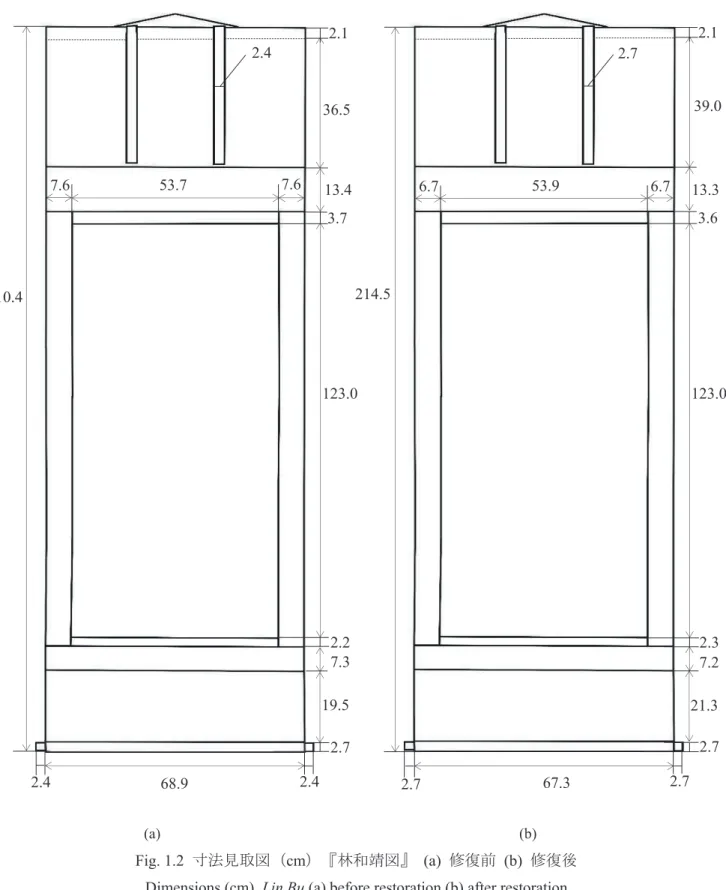
(a) (b)
Fig. 1.2
寸法見取図(cm
)『林和靖図』(a)
修復前(b)
修復後Dimensions (cm), Lin Bu (a) before restoration (b) after restoration
7.6
2.4 2.1
2.7 7.3 2.2 3.7 36.5
13.4
123.0
19.5
68.9 2.4
53.7 6.7
2.1 2.7
2.7 7.2 2.3 3.6 39.0
13.3
123.0
21.3
67.3 2.7 53.9
7.6 6.7
2.4 2.7
214.5
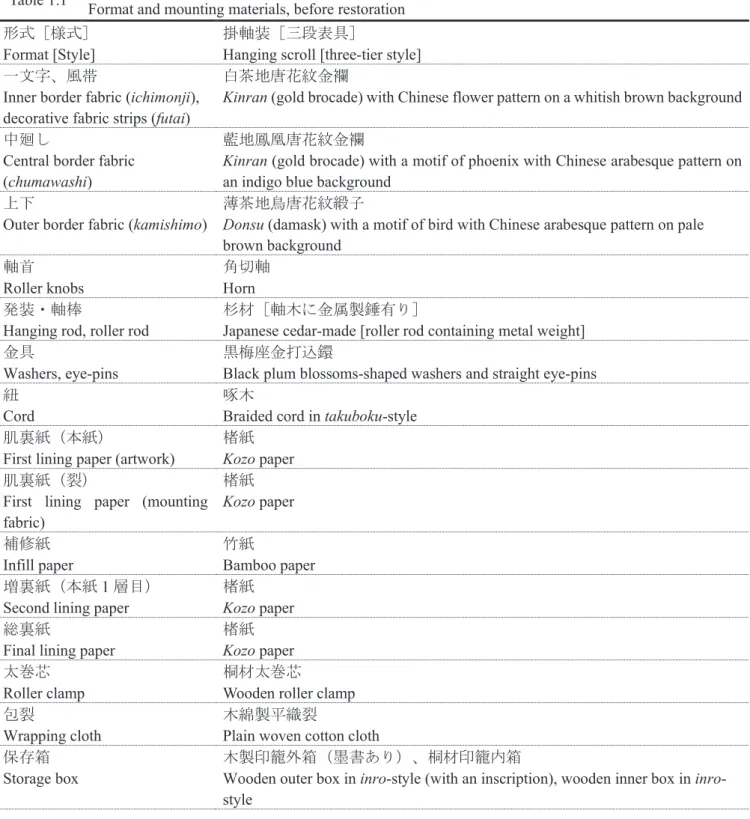
Table 1.1
形式・仕様等 修復前Format and mounting materials, before restoration
形式[様式]Format [Style]
掛軸装[三段表具]
Hanging scroll [three-tier style]
一文字、風帯
Inner border fabric (ichimonji), decorative fabric strips (futai)
白茶地唐花紋金襴
Kinran (gold brocade) with Chinese flower pattern on a whitish brown background
中廻しCentral border fabric (chumawashi)
藍地鳳凰唐花紋金襴
Kinran (gold brocade) with a motif of phoenix with Chinese arabesque pattern on an indigo blue background
上下
Outer border fabric (kamishimo)
薄茶地鳥唐花紋緞子
Donsu (damask) with a motif of bird with Chinese arabesque pattern on pale brown background
軸首
Roller knobs
角切軸
Horn
発装・軸棒Hanging rod, roller rod
杉材[軸木に金属製錘有り]
Japanese cedar-made [roller rod containing metal weight]
金具
Washers, eye-pins
黒梅座金打込鐶
Black plum blossoms-shaped washers and straight eye-pins
紐Cord
啄木
Braided cord in takuboku-style
肌裏紙(本紙)First lining paper (artwork)
楮紙
Kozo paper
肌裏紙(裂)First lining paper (mounting fabric)
楮紙
Kozo paper
補修紙
Infill paper
竹紙
Bamboo paper
増裏紙(本紙1
層目)Second lining paper
楮紙
Kozo paper
総裏紙Final lining paper
楮紙
Kozo paper
太巻芯Roller clamp
桐材太巻芯
Wooden roller clamp
包裂Wrapping cloth
木綿製平織裂
Plain woven cotton cloth
保存箱Storage box
木製印籠外箱(墨書あり)、桐材印籠内箱
Wooden outer box in inro-style (with an inscription), wooden inner box in inro-
style
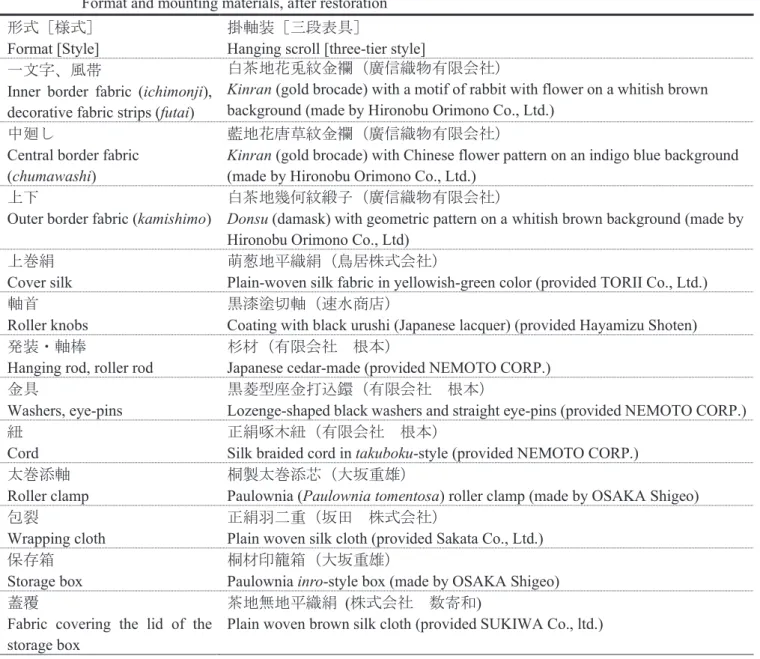
Table 1.2
形式・仕様等 修復後Format and mounting materials, after restoration
形式[様式]Format [Style]
掛軸装[三段表具]
Hanging scroll [three-tier style]
一文字、風帯
Inner border fabric (ichimonji), decorative fabric strips (futai)
白茶地花兎紋金襴(廣信織物有限会社)
Kinran (gold brocade) with a motif of rabbit with flower on a whitish brown background (made by Hironobu Orimono Co., Ltd.)
中廻し
Central border fabric (chumawashi)
藍地花唐草紋金襴(廣信織物有限会社)
Kinran (gold brocade) with Chinese flower pattern on an indigo blue background (made by Hironobu Orimono Co., Ltd.)
上下
Outer border fabric (kamishimo)
白茶地幾何紋緞子(廣信織物有限会社)
Donsu (damask) with geometric pattern on a whitish brown background (made by Hironobu Orimono Co., Ltd)
上巻絹
Cover silk
萌葱地平織絹(鳥居株式会社)
Plain-woven silk fabric in yellowish-green color (provided TORII Co., Ltd.)
軸首Roller knobs
黒漆塗切軸(速水商店)
Coating with black urushi (Japanese lacquer) (provided Hayamizu Shoten)
発装・軸棒Hanging rod, roller rod
杉材(有限会社 根本)
Japanese cedar-made (provided NEMOTO CORP.)
金具Washers, eye-pins
黒菱型座金打込鐶(有限会社 根本)
Lozenge-shaped black washers and straight eye-pins (provided NEMOTO CORP.)
紐Cord
正絹啄木紐(有限会社 根本)
Silk braided cord in takuboku-style (provided NEMOTO CORP.)
太巻添軸Roller clamp
桐製太巻添芯(大坂重雄)
Paulownia (Paulownia tomentosa) roller clamp (made by OSAKA Shigeo)
包裂Wrapping cloth
正絹羽二重(坂田 株式会社)
Plain woven silk cloth (provided Sakata Co., Ltd.)
保存箱Storage box
桐材印籠箱(大坂重雄)
Paulownia inro-style box (made by OSAKA Shigeo)
蓋覆Fabric covering the lid of the storage box
茶地無地平織絹
(
株式会社 数寄和)
Plain woven brown silk cloth (provided SUKIWA Co., ltd.)
Table 1.3
修復材料Restoration materials
水Water
ろ過水[糸巻きタイプフィルター、粒状活性炭カートリッジフィルターを 使用(
3M Purification
社)]Filtered water [ using a0.5μ diameter pore filter and granular activated carbon cartridge filter] (made by 3M Purification Inc.)
糊
Paste
新糊/小麦デンプン(籠島澱粉株式会社)
Wheat starch (manufactured by Kagoshima Denpun Co., Ltd.)
古糊(株式会社 半田九清堂)Aged wheat starch paste (made by Handa Kyuseido Co., Ltd.)
膠Animal glue
牛膠(株式会社かみ屋)
Cow glue (provided Kami Ya Co., Ltd.)
フノリSeaweed paste
マフノリ、フクロフノリ、ハナフノリ(有限会社金開堂)
Mafunori (Gloiopeltis tenax), Fukurofunori (Gloiopeltis furcata), Hanafunori (Gloiopeltis complanata) (provided Kinkaido Co.)
肌裏紙(本紙)
First lining paper (to the artwork)
楮紙[塡料:米粉](井上稔夫)
Kozo paper [containing rice powder as filler] (made by INOUE Toshio)
肌裏紙(裂)
First lining paper (to the mounting)
楮紙[美濃紙](長谷川聡)
Kozo paper [mino paper] (made by HASEGAWA Satoshi)
増裏紙
Second lining paper
楮紙[美栖紙](上窪良二)
Kozo paper [misu paper] (made by UEKUBO Ryoji)
中裏紙Third lining paper
楮紙[美栖紙](上窪良二)
Kozo paper [misu paper] (made by UEKUBO Ryoji)
総裏紙Final lining paper
楮紙[宇陀紙、天然染料(トマトの茎・根)の抽出液を楮繊維と一緒に漉 き込んだもの](福西正行)
Kozo paper [uda paper, made from mixing kozo fiber with the extraction liquid boiled from natural dyes (stem and root of tomato)]
(made by FUKUNISHI Masayuki)
折れ伏せReinforcement paper strips
楮紙[美濃紙](長谷川聡)
Kozo paper [mino paper] (made by HASEGAWA Satoshi)
補修紙Infill paper
本紙欠失部分/竹紙(中国製、株式会社かみ屋)
For lost area: bamboo paper (made in China, provided Kami Ya Co., Ltd.,)
本紙亀裂部分/楮紙[極薄美濃紙](澤木健司)For rift area: Kozo paper [extra-thin nimo paper] (made by SAWAKI Kenji)
補彩絵具Paints for adjusting color of infills
専門家用顔料(ホルベイン画材株式会社)
・ピオニーレッド
[C.I.No.PR185]
/ベンズイミダゾロンカーミンHF4C
・オリエンタルブルー
[C.I.No.PB15]
/フタロシアニンブルー・パーマネントイエローライト
[C.I.No.PY55]
/ベンジジンイエローARTISTS’ PIGMENT (provided Holbein Art Materials Inc.)
・
PEONY RED[C.I.No.PR185]/ Benzimidazolone Carmine HF4C
・
ORIENTAL BLUE:C.I.No.PB15/ Phthalocyanine Blue
・
PERMANENT YELLOW:C.I.No.PY55]/Benzidine Yellow
(a) (b)
(a) (b)
Fig. 1.4
యࠗᯘ㟹ᅗ࠘(a)
ಟ๓(b)
ಟᚋArtwork with mounting, Lin Bu (a) before restoration (b) after restoration
(a) (b)
(a) (b)
Fig. 1.6
本紙『林和靖図』(a)
修復前(b)
修復後Artwork, Lin Bu (a) before restoration (b) after restoration
(a) (b)
Fig. 1.7 (a) (b)
Creases, Lu Shang (a) before restoration (b) after restoration
(a) (b)
(c) Fig. 1.8
(a) (b) (c)
(a) (b) Fig. 1.9 本紙の
皺『太公望図』(a)
修復前(b)
修復後Wrinkles, Lu Shang (a) before restoration (b) after restoration
(a) (b)
Fig. 1.10 本紙の
皺および染み『太公望図』(a)
修復前(b)
修復後Wrinkles and stain, Lu Shang (a) before restoration (b) after restoration
(a) (b)
Fig. 1.11 本紙の亀裂および折れ
『太公望図』(a)
修復前(b)
修復後Rifts and Tears, Lu Shang (a) before restoration (b) after restoration
(a) (b) Fig. 1.12
付着物『太公望図』(a)
修復前(b)
修復後Accretions, Lu Shang (a) before restoration (b) after restoration
(a) (b)
(c) (d)
Fig. 1.13
欠失周囲の曲線のずれ『太公望図』Shears of drawing lines in the artwork, Lu Shang
Fig. 1.14.1
記録(作品撮影)Documenting (photographing)
Fig. 1.14.2
解体Disassembling
Fig. 1.14.3
剥落止めConsolidating
Fig. 1.14.4
総裏紙の除去Removing the final lining paper
Fig. 1.14.5
埃の除去Removing dust
Fig. 1.14.6
増裏紙の除去Removing the second lining paper
Fig. 1.14.7
肌裏紙の除去Removing the first lining paper
Fig. 1.14.8
旧補修紙の除去Removing infill paper
Fig. 1.14.9
本紙の調整Repositioning the artwork
Fig. 1.14.10
補修Infilling
Fig. 1.14.11
切れた本紙の補強Applying reinforcement paper strips to tears
Fig. 1.14.12
肌裏打ちApplying first lining
Fig. 1.14.13
増裏打ちApplying second lining
Fig. 1.14.14
切り継ぎAssembling
Fig. 1.14.15
折れ伏せ入れApplying reinforcement paper strips
Fig. 1.14.16
中裏打ちApplying third lining
Fig. 1.14.17
総裏打ちApplying final lining
Fig. 1.14.18
仮張りKaribari (drying and conditioning)
Fig. 1.14.19
補彩Inpainting
Fig. 1.14.20
仕上げFinishing
Fig. 1.14.21
保存箱(外箱、内箱)および太巻添軸、包裂(旧蔵)
Storage boxes (outer and inner), roller clamps and wrapping cloths (previously used)
Fig. 1.14.22
保存箱および太巻添軸、包裂(新調)
Storage boxes, roller clamps and wrapping cloths
(newly made)
画面向かって右の掛軸(右幅)には、中国の北宋時代の詩人で梅や鶴を愛したことでも知られる林和靖
(林逋、
967
~1028
)を描き、一方、左の掛軸(左幅)には、古代中国の周時代(紀元前11
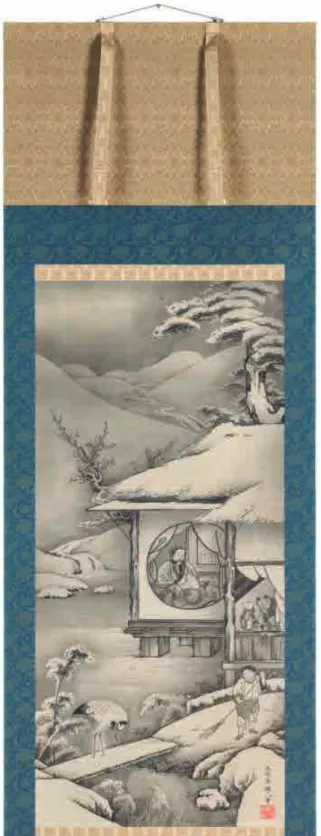
世紀ごろ)の軍 師で釣り好きの代名詞ともなった太公望(呂尚)を描いた対幅の作品。右幅では、画面のほぼ中央の円窓のある家屋の中に林和靖が座り、その隣の部屋で童子が涼炉の炭を吹い て、酒か茶を温めているようだ。家屋の外は一面雪景色で、家屋の前では箒を持った童子が雪を掃き、石橋 の上には一羽の鶴がたたずんでいる。林和靖のいる家屋は、池のような水の上に建てられており、どうやら その水は画面上部の遠景の山間から流れてきているらしい。家屋の奥には、花をつけた梅の木や、大きな 松、竹などが見え、木々の枝葉にはいずれも雪が積もっている。
対する左幅は、画面左上部の岩の上に太公望が寝そべり、網代で編んだテント状の屋根の下にもぐりこん で、水辺で釣り糸を垂らしている場面。右下には、荷物をくくりつけた棒を肩に担いで運ぶ童子の姿があ り、これから手前の橋を渡るようだ。橋の両脇や太公望のいる奥の水辺には蘆が茂り、空には飛び立つ雁の 群れと満月が見える。季節は秋である。
両幅とも、モチーフはいずれも墨のみで描かれ、彩色は施されていないが、右幅の各所に積もった雪や、
左幅の月など、白い部分を全て紙を塗り残して描いているのは、水墨画ならではの技巧的な表現として興味 深い。とりわけ、右幅では、上部の松葉や、鶴の隣の竹、画面下の蓮葉の周辺に、小さな塗り残しで雪片を 散らしているほか、鶴の脚が雪に埋もれている部分や、箒を持つ童子の下駄状の履なども、細かい描写力を 見せる。
右幅の右下には「鬼神斎輝一筆」の署名と「蛇足軒蕭白」(白文方印)が、左幅の左下には「曾我蕭白筆」
の署名と「輝一」(白文団扇形印)が捺され、曾我蕭白(
1730
~81
)の作であることを示している(Fig.2.1
)。蕭白は、江戸時代中期に活躍した画家で、京都の商家「丹波屋」に生まれた。家業は紺屋との説もあるが 未詳である。本姓は三浦を称したようで、兄と妹がいたが、
11
歳で兄を、14
歳で父(吉右衛門)を、17
歳 で母(ヨツ)を相次いで亡くし、丹波屋も潰れてしまったらしい。絵の師承関係などは不明な点が多いが、近江国出身の京狩野系の画家である高田敬輔(
1674
~1755
)の画風とは共通性があり、何らかの関わりがあ ったと想定されている。また、蕭白自身は室町時代の画家である曾我蛇足(生没年未詳)の画系に連なるこ とをしばしば落款に記しており、当時、蛇足の画系は途絶えていたものの、濃墨による激しい筆触などに は、蛇足や雲谷派といった室町時代から桃山時代の画家たちの影響もうかがえる。主な画歴としては、29
歳 前後に伊勢、33
歳に播磨、35
歳前後には再び伊勢、38
歳には再び播磨と、伊勢と播磨を交互に往来し、両 地で襖や屛風などの大作を数多く制作しているが、43
歳以降は京都に定住し、52
歳のとき京都で亡くなっ た。蕭白の画風は、緻密な描写と大胆なデフォルメとの拮抗が大きな見どころで、墨色の繊細なコントロー ルと、鮮烈な色彩表現との対比も印象的である。さらに、中国の故事人物など伝統的な主題を描きつつも、そこに多様な表情やモチーフを重ね合わせることで、意外性の強い描写や、主題の多義性を生み出し、破格 で独特の表現方法を獲得した。
こうした蕭白画の特徴を念頭に、改めて本図の主題についても確認しておくと、林和靖は、西湖の弧山に 隠棲し、世俗と交わらず、梅を愛し、鶴を飼って、風流な生活を送ったとの伝承から、しばしば梅や鶴とと もに絵画に描かれた。同様に、呂尚は釣りをしていた際に周の文王に見いだされ、文王より「太公(文王の
2
作品解説東京文化財研究所 安永 拓世
をする場面を絵画化したものが多い。本図の場合も、右幅には梅と鶴が描かれることから中央の高士を林和 靖とみなし、左幅の老人は釣りをする姿によって太公望に比定されている。たしかに、両者を対で描いた先 行作例は少ないものの、狩野元信(
1477
?~1559
)筆「旧大仙院方丈障壁画」(東京国立博物館蔵)の「故 事人物図」のうち「太公望・文王図」が一つの参考となろう。というのも、この元信の絵は、かつて「太公 望・林和靖図」とみなされており、また、古くは京都の大徳寺の大仙院の障壁画であったことから、蕭白が 知っていた可能性も高い。右に林和靖、左に太公望を配する構図にも、元信画と本図との関連性が想定され る。(a) (b)
Fig. 2.1
落款・印章(a)
『太公望図』(b)
『林和靖図』ただ、本図の林和靖をよく見ると、頭には渦巻きが特徴的な綸巾をかぶり、手には七星と「師」の文字
(軍師の意味であろうか)があらわされた羽扇を持つなど、一般的な林和靖の姿ではない。むしろ、こう した綸巾や羽扇を身につける人物としては、中国の三国時代の著名な軍師である諸葛孔明(諸葛亮、
181
~
234
)が想起され、門前で雪を掃く童子の姿も、「草廬三顧図」など諸葛孔明とゆかりの主題でしばしば 描かれた。左幅に登場する太公望も軍師として知られたことを考えると、諸葛孔明と太公望も、対になる 主題としてふさわしく、事実、両者を対幅にした絵画作例も確認される。故事人物や山水の主題に、多様 な意味やモチーフを重ね合わせることに意欲的であった蕭白ならば、林和靖と諸葛孔明をダブルイメージ のようにオーバラップさせているとも解釈できようか。ちなみに、左幅に登場する琴などのモチーフも太 公望の持物としては珍しく、あるいは何らかの別の意味や主題が、さらに隠されているのかもしれない。そうした点において、本図は、蕭白作品における主題の多義性を物語る、興味深い事例としても位置づけ られるといえよう。
These are a pair of hanging scrolls. The painting on the right scroll depicts Lin Hejing (Lin Bu, 967–1028), a poet of the Northern Song Dynasty, who is well known for his fondness for plum blossoms and cranes. The painting on the left illustrates Taigong Wang (Lu Shang), a military strategist of the Zhou Dynasty in ancient China (ca. 11th century BC), whose name became a synonym for a person who loves fishing .
On the right scroll, Lin Hejing sitting in a house with a round window is drawn almost in the center. His attendant boy in the next room seems to be blowing lit charcoals to warm up tea or alcoholic beverage on a tea stove (ryoro).
Everything is blanketed in snow outside. In front of the house, another attendant boy is sweeping the snow with a broom.
A crane is standing on a stone bridge. The house, which Lin Hejing is in, is built on water, perhaps a pond, and its water appears to be flowing down between the mountains in the distance illustrated in the upper part of the painting. There are plum blossoms in bloom, large pine trees and bamboos behind the house. All branches and leaves are covered in snow.
On the left scroll, Taigong Wang on the rocky crag is depicted in the upper-left of the painting. He is lying down under a wickerwork shelter built like a tent while dropping his fishing line on the waterside. In the lower right of the painting, a boy is carrying on his shoulder a rod to which his luggage is tied and appears about to cross a bridge in the foreground. Common reeds grow luxuriantly along both sides of the bridge and on the waterside in the distance—far behind the area where Taigong Wang is. In the sky, a flock of geese is flying away and the moon shows its full face. It is an autumn scene.
Both paintings are executed with Chinese ink (sumi) only, so no colors are applied. Part that should be in white, such as the snow of the right scroll and the moon of the left scroll, are expressed by being left unpainted— using the white of paper. This technical expression unique to ink painting is attractive. In particular, the scroll on the right demonstrates a representation skill of details. For example, the snowflakes being scattered around the pine-needles depicted in the upper part, and the bamboo next to the crane and the lotus leaves in the lower part of the painting are expressed by leaving miniscule spots unpainted. The legs of the crane partly buried under the snow and the clog-like footwear of the boy holding the broom are also exquisitely painted.
The painting on the right scroll has a signature reading
“painted by Kishinsai Kiichi (
鬼神斎輝一筆)
”and a square intaglio seal of
“Jasokuken Shohaku (
蛇足軒蕭白)
”at the bottom right corner. The painting on the left has a signature of
“曾我蕭白筆”which can be translated as
“painted by Soga Shohaku
”and an intaglio seal inscribed
“Kiichi (
輝 一)
”in the intermediate shape between circle and square at the bottom left corner. These indicate that both paintings were produced by SOGA Shohaku (1730–1781) (Fig.2.1).
Shohaku is a painter who was active in the middle of the Edo period. He was born into a merchant family named
“
Tambaya (
丹波屋)
”in Kyoto. It is said that his family business was fabric dyeing, but fact remains unclear. His surname might have been MIURA (
三浦). He had an older brother and a younger sister. However, the deaths of his family members came in succession; his older brother died when he was 11, his father Kichiemon when he was 14, and his mother Yotsu when he was 17. Apparently, Tambaya was going out of business as a consequence. Although there are still many unknown matters regarding his apprenticeship as a painter, it is presumed that he might have had relations
2 Description about the Artworks
YASUNAGA Takuyo Tokyo National Research Institute for Cultural Properties
because their painting styles share some common features. In addition, Shohaku often noted in his signature that he was descended from the school of SOGA Jasoku (year of birth and death unknown), a painter in the Muromachi period.
Shohaku’s vigorous brushworks with thick ink, for example, show the influence of the painters from the Muromachi to the Momoyama period such as Jasoku or the Unkoku school although the lineage of Jasoku’s painting style had come to an end at that time. In his career as a painter, he moved between Ise and Harima (current Mie and Hyogo prefectures) alternately; he stayed in Ise around the age of 29, went to Harima when he was 33, came back to Ise when he was about 35 years old and went to Harima again at the age of 38.He produced many large pieces of work such as those for sliding doors (fusuma) and folding screens (byobu) in both places. After the age of 43, he lived in Kyoto and died in Kyoto at 52. The significant point of Shohaku’s painting style is the balance between meticulous depiction and bold simplification and exaggeration. The contrast between the color of ink that are delicately controlled and the vivid expression of color is also impressive. Moreover, while he painted traditional subject matters such as Chinese fabled or historical people, he created highly unexpected images and ambiguity of subject matters by adding various expressions and motifs to them, and acquired outstanding, unique way of expression.
Keeping these characteristics of Shohaku’s paintings in mind, the subject matter of the paintings on these scrolls shall be reconfirmed. It is said that Lin Hejing spent his time in seclusion in Gushan of West Lake, leading an elegant life. He kept himself away from common people and society, loved plum blossoms and raised cranes. Because of this folklore, Lin Hejing is often drawn with plum blossoms and cranes. Similarly, the reason many paintings illustrate Lu Shang as an angler is in the legend that he was discovered by King Wen of the Zhou dynasty while he was fishing. The name “Taigong Wang” also originates from this legend. King Wen said “you are the wise man my grandfather (taigong) has been longing to meet,” and Lu Shang was convinced to assist the King. In the case of these paintings as well, the sage in the middle of the right scroll is assumed as Lin Hejing because the plum blossoms and the crane are depicted, and the old man on the left scroll is presumed as Taigong Wang as he is fishing. Although it is true that there are a few earlier examples in which Lin Hejing and Taigong Wang are painted as a set, Chinese Statesman Lu Shang and King Wen by KANO Motonobu (1477?–1559) would be one of the references. These are part of the set of paintings depicting Legendary Chinese Figures in the collection of Paintings for the Houjou (abbot's chamber) of the Former Daisen-in (Tokyo National Museum) and used to be believed as Taigong Wang (Lu Shang) and Lin Hejing. Moreover, since they
However, observing Lin Hejing painted by Shohaku carefully, he wears a hat of characteristic spiral design and
holds a feather fan on which seven stars and a letter
“師”(may possibly meaning “strategist”) are written. His
appearance is not Lin Hejing depicted generally. A person with such kind of appearance_the one with this distinctive
headwear and the feather fan–rather evokes Zhuge Kongming (Zhuge Liang, 181–234), a renowned military strategist
in the Three Kingdoms period of China. A boy sweeping snow in front of the house often appears in the paintings related
to Zhuge Kongming such as in the scene of
“three visits to the cottage.
”Taking into account the fact that Taigong
Wang on the left scroll is also a well-known military strategist, Zhuge Kongming would be a suitable subject matter
corresponding with Taigong Wang as well. Actually, there are some examples in which both are illustrated as a pair of
scrolls. Since Shohaku was enthusiastic about overlaying the main themes of fabled people and landscapes with various
were originally mounted on the sliding doors at Daisen-in, a sub-temple of Daitoku-ji in Kyoto, it is highly possible
that Shohaku had seen those paintings. The composition of placing Lin Hejing on the right side and Taigong Wang on
the left side would also indicate the relevance to Motonobu’s paintings.
these perspectives, the paintings on these two hanging scrolls would be interesting examples to describe the polysemy of subject matters in the works by Shohaku.
Translated by GOTO Rika
付録1 記録
Appendix 1 Documentation
■
亀裂・欠失Rift and Loss
■
折れCrease
■
皺Wrinkle
■
染みStain
■
付着物Accretion
■
本紙表面の擦れAbrasion
■
旧補彩Past inpainting
付録
Appendices
株式会社 半田九清堂 半田昌規、土屋三恵、山田知水、山本一来、佐々木立美 HANDA Masaki, TSUCHIYA Mie, YAMADA Tomomi, YAMAMOTO Itsuki, SASAKI Tatsumi Handa Kyuseido Co., Ltd.
■
亀裂・欠失Rift and Loss
■
折れCrease
■
皺Wrinkle
■
染みStain
■
付着物Accretion
■
本紙表面の擦れAbrasion
■
旧補彩Past inpainting
Fig. A.1.2
修復前損傷図面『林和靖図』Mapping of damages before restoration, Lin Bu
(a) (b)
Fig. A.1.
3 近赤外線写真(反射光)修復前(a)
『太公望図』(b)
『林和靖図』Near infrared photographs by reflected light, before restoration (a) Lu Shang (b) Lin Bu
イメージセンサーCCD
センサー フルフレーム 感度領域:800 ~ 1100
㎚画素数
4000
×2315
(ピクセル)画像フォーマット
Tiff
Image sensor CCD Sensor, Full-Frame, Sensitivity:800
-1100
㎚Fig. A.1.
4 増裏紙除去後(肌裏あり) 本紙裏面 部分写真(透過光)『太公望図』Back side of the artwork with first lining paper, after removal of the second lining paper (transmitted light), Lu Shang
Fig. A.1.
5 増裏紙除去後(肌裏あり) 本紙裏面 部分写真(透過光)『林和靖図』Fig. A.1.
6 肌裏紙除去後 本紙裏面 部分写真(透過光)『太公望図』Back side of the artwork, after removal of the first lining paper (transmitted light), Lu Shang
Fig. A.1.
8 補修後肌裏打ち前 本紙裏面 部分写真(透過光)『太公望図』Back side of the artwork, after infilling (transmitted light), Lu Shang
Fig. A.1.
9 補修後肌裏打ち前 本紙裏面 部分写真(透過光)『林和靖図』Back side of the artwork, after infilling (transmitted light), Lin Bu
付録2 繊維組成分析 Appendix 2 Analyzing Paper
試験方法;
JIS P8120
(ISO9184-4
)を参考に、本紙から採取した微量の繊維をC
染色液を用いて染色し、顕微鏡による観察を行った。その結果、本紙繊維は竹が用いられていることが分かった。
Analysis method
;According as Japanese Industrial Standard P8120 (cf. ISO9184-4), a very small amount of fibers sampling from the artworks were dyed by C stain and observed with a microscope. As a result, the paper was made of bamboo.
(a) (b)
Fig. A.2.1
本紙繊維の顕微写真(a)
『太公望図』(b)
『林和靖図』Micrographs of fiber from the artworks (a) Lu Shang (b) Lin Bu
使用機材 顕微鏡スギトウ(×
100
)、デジタルカメラリコーGR Ⅱ
画素数1936
×2912
(ピクセル)画像フォーマット
JPEG
Apparatus Microscope (SUGITOH (×100) equipped with a digital camera GR Ⅱ RICOH)
Image size 1936 × 2912 (pixel)
Image format JPEG
東京文化財研究所
平成29年度
在外日本古美術品保存修復協力事業 林和靖・太公望図
No.2017-2
発行日:令和3年3月26日 編集:文化遺産国際協力センター(監修:加藤雅人
編集・校閲:清水綾子、片渕奈美香)
Tokyo National Research Institute for Cultural Properties
2017JFY
The Cooperative Program for the Conservation of Japanese Art Objects Overseas Lin Bu, Lu Shang No.2017-2
Date of publication: 26 March 2021
![Table 1.3 修復材料 Restoration materials 水 Water ろ過水[糸巻きタイプフィルター、粒状活性炭カートリッジフィルターを使用(3M Purification社)]](https://thumb-ap.123doks.com/thumbv2/123deta/6809347.2230745/15.892.54.830.138.1017/Table修復材料水ろ過水タイプフィルターカートリッジフィルター.webp)