理報告
著者 山口 聰太郎, 江村 知子
図書名 在外日本古美術品保存修復協力事業 : 修理報告書
: 絵画/工芸品[平成18年度実施事業] : The Cooperative Program for the Conservation of Japanese Art Objects Overseas
開始ページ 81
終了ページ 113
出版年月日 2008‑03‑31
URL http://id.nii.ac.jp/1440/00005508/
Creative Commons : 表示 ‑ 非営利 ‑ 改変禁止 http://creativecommons.org/licenses/by‑nc‑nd/3.0/deed.ja
211
.
>
I. i 各 111; 各タト1·又 1/J(J直l /I 各 JljlJj1f (I / [ \'ル ・ オ ン タ IJ 1)し術館)
/'iC'll'.1 u/f.:̲1キu/u 1111<I Its /;'11l'inm1キ< 13 じ 1·or1.:Trt.:almt.:111 (Royal 0111;1rio Must.:um、Tom1110)
5 ‑2
(
‑ i ‑2
26
7. 修J叫111i k 隻第 5·6J雌
Be「oreTreatment: The entire images of fi 「lhand sixth panels of left sereen
8 修理後 After treatment
28
ffl' "~ 聖レ葺瀾凰『V · '~: ! ~,;-J : . ~ ,,;I,
9. ハ:1l1li:ihi j&̲; 他)\'.:(こよ ;:iplq f匁
Imageヽundertrnnsrnittcd light: 1:ilしhpanel o "llei、Iscreen
10. j,iJ Iキ イI多J―lj! 1i1」
Be「oreTreatment
Images under trailヽ111ittcdilght : Si ヽthpanel o 「 II:、nヽcrcc11
1:2. l,,J I fl''J1111、1 り lkliirc Trca1111c11l
I
洛中洛外図屏風
平成18 年1文修似事業
i'1111 名: 洛I
I
I洛外図肝風所蔵:ロイャル ・ オンタ リ オ必術館
汁和l1i各タ1-1:Xl/f(:J孤
修理報 告
I . 文化財の名称等
J 名称、具数 t各II It各夕中1叉IJ井)弧 6 I !iil J,又 2 所イi者
II. 工期及びエ抒 I . J!~J 2 場所
皿文化財の構造 j . 本紙、l怯 別衣参照 2. 衣装
修 flj!_jjlj
ロイャル ・ オンタ リ オ)~1,1サ節
' :I'成 し 8介:_投
胄fl'Itri] リ,し炒もi~I『ii J・牙ぐJI 「J5
r
11 ...,‑株式会ネI: 墨イ .哨.:
形式肝風 6l i!l1 双
衣装裂地
縁:鼠地小花又緞 f・ 小緑. 納) i菱地柚l文金柑11] 製本:、·'且漆旅 fり緑
) ti'風裏: 削焚雀劉 飾金具散らし鋲あり 修哩後
a. 形式加':風 6 1111 l双 b. 表装裂·地
N. 修理前の状況
縁 :納戸地角龍文金襴 (新拙J) 小縁 :白茶地小牡)·J-J,杯J'i'改〈金櫛j (新,)}i';j) 製木: 蝋色黒漆塾山丸縁(新調)
加':風裏 : 雀製唐紙 (鼠具,JIきに鼠雲·I:):押 〈新間〉)
飾金具散らし鋲 :クリ ーニングし元使い
仰.]..\ィ ·_,:;:.:
1111 il[!~I.)ヽ:且IS
第 1 2扇の画面中央に非常に大きな破れが見られた。 ほぽ訓而の 2 分の 1 利度の縦の破れは、 過去 の応急処協によ って、 亀裂の小口が止められていた。 大きな亀裂であることから、亀裂の 1叶iに引っ 張られて歪み、 画面の表面は波打っていた。
奥)毛背部分に沿って、 虫損や破れが見られた。
付萎の劣化や欠失が著しかった。 これは下に描かれている緑青の酸性化によって、紙が劣化し、破
,
イl多Jll\喉Ix~';- 83
れや部分欠失につながったものと息われる。
過去の補修紙には金色で袖彩している箇所が多く 見られに。 それらは令1り「:地 i'dSでも、絵共による着 色箇所でも詞 じように令で肌められているにめ、 辿和感があった。
本紙の継ぎ手に、 柑lの劣化による峨lj翡If: が見ら1 した。
蝶番のゆとりが肌1;いため、)叶風 1凡JI~'」の際に奥)じ抒に)」が掛かって起きにと息わ i しる、強い緻や絵 j し の剥落が見られた。
蝶番部分で絵のつながりにずれがあった。 縁裂にも虫祖や欠失、 iり糸れが多かった。 縁は乳I]れや凹み似が多かっに。
飾り金 j しは、 煤けて汚れていた。
V. 修理概要
1. 修輝方針
〈絵具の剥落止め〉
修訓前は、 絵具の発色が非常に災しかった。 しかし、所々で剥落が兄られ、 絵具./•~•',: と)晶底),;,·,:と の固〗りは不安定であった。そのにめ、 まず絵具の剥落止めをすることにしに。 (令イ本的な煤 1りオしや、 水によって大き く動いて染みを作るような 1りれは無いと 判断しににめ、 まず絵j しの剥落11·.めを
し、 修則前の絵具の状態を留めることに i:_眼を;;忙いた。)
剥落止めの湿りによって、 本紙が収縮して絵具)iりが小安定になるのを防ぐため、 'i;『に仮貼りを して固定し、仲縮を飯小限に~JIJえた状態を保って、 膠を硲布する作菜をおこなった。 ただし、 本紙が緊張しすぎないよう必ず具介を1i'.化かめながら調吼冬をした。
〈亀裂部分について〉
本紙中火の亀裂を直すことが今l1ill餃も人きな修州!のポイン ト であった。 人きな亀裂は判~ L 2 扇 のみであった。 そのため、第 I 2J』のみ、他裂を繋ぎ介わせる作業が加えられることになる 0 だが、 その際に、修輝 I牙閑II Iの水分械や収乞煤具合が他の扇と比べて汎なると、 jllljj(! jの風介い‘
絵具の発色に影脚を及ぼす恐れがあった。 よって、 第 l 2 J,1,iとその他のバランスを見ながら、 作業を進めることとした。
〈浮け紙、 111裂打紙の除よ〉
全体的なバランスを見ながら、‘常に仮貼りをしてli1,·1 定し、仲縮を蔽小限に抑えた状態で、スプレ一 にて浄水を本紙裏而よ り附籍蒻し、 庁け紙及び111裏打紙を除去した。
第 1 2扇は、 裏面から1且袖修の‘:けや袖強の紙が当てられていた。 よ って、 すべて除去 しに後 養生のための紙の帯をあてて仮固定しに。
〈旧補修紙について〉
旧補修紙には、 部分的に金色に袖彩してあるところや、 金地ではないi''dS 分にも 関わらず令色に 補彩してあるところなどがあった。 よって、 すべて除上し本米の地色に介わせに補修を新たに 行うこととした。 本紙の紙質検杏を行い、 その結呆に)よづいて袖修紙を選訳することとしに。
〈付箋について〉
下に描かれた緑青によ って、付箋の酸1咋劣化が進み、 剥落や破れが併しかった。 また絵具の I· に貼られた付萎は、外すときに絵具がそのまよ付箋如 (1jに付いてきてしまうため、 しつかりと 貼られている付萎については 1肌岬に剥がすことをやめ、付箋を合い剥ぎにして衣1(1jのみを収り 外し、欠担箇所を修皿して元のイ立ii11':に貼 り)べすことにしに。 l峻fl:. を111•1J.に移 11··する ように、 裏
l̲
打紙には炭酸カルシウム入りの紙を用いた。
〈絵の繋がりについて〉
絵の繋がり にずれが LI:. じていた。 各扇ごとに絵が繋がらない部分は、 !砧り込む際に』刈整 しなが 令休の絵が繋がるよ う貼り込むこととした。
〈蝶番について〉
修且l 11iiは蝶番が固いために、 奥)心背付近のJllljI (ijの破担の)瓜因になっていた。 全1本的に絵具層が 肘いため、 今1111は蝶番にゆとりを多く 小『たせ、 pl1j1(1iH I: で圧辿しあわないようにしたっ
〈 ド地について〉
111 ド地は本が釧< 、 ~~ みが11:_じており 、 それが11lij I川のしかみに繋がつていた。 よって ド地を新 叫',jすることとした。 炭尾背付近では、 どうしても)1:.J Jが仕じ、 Jill日 m表i(1 jに負JI1. が4卦かることか ヽ 、 卜地を修J1l1.11iiよ りも少し人きめに新』11i]し、 奥)釦吃',ds 分の絵が 卜軋L 灼にあたらないようにした。 ょに、 奥尾背i'ilS分の絵具が)
I :
辿し介わないように札I( の返りを多くと った。〈lli'J\令具、 散らし鋲について〉
-J-~--て」前いで残っていたため、 ク リ ーニングをして)じ使いすることにした。
2 . 修 JI!!・イ 1:1汲
剥落の危険‘件が(,'j,, ¥ヽ絵j し)\'•',:の•浮き Iーんがりや、 本紙)',·の介 Vヽ剥ぎが牛じてしヽるi'i:I) 分には、布洵.:
苔、 膠、 新沿'Jlなどを)llしヽて剥離.;·り:1)分に注人し峨lj落,1-.めを行う。
辿‘常の 'lj'. 真.撤彩のほかに、 絵j し粒 rの栂'i微鋭 'lj'. 真、 本紙透辿絣真、 1)ド外'lj'.真を伽彩する。
・ 絵具の発色が修Jlj!_jj1j後で変わることが無いよう 、 チ」_ ックするため、 分光枇lj色叶にて修J刑前の
色をI\°ト測する。 計汎lj結呆については担当府に報冑をする。
・ 採、j及び担1似奎かの成i崎を行い、 以状を出録する。
.謹糸Illな祖似地図を作成する。
• 修Jil\ I―A哨において使川する水に絵具)\'りがIf炉lえ得るか、少州の水で絵具の変化を事前に見る。
• 絵J~-,J;,,,: をii',Iliするため、兎膠水浴液にて剥落,,._めをhう。
・絵の繋がりを少しながら、 第 l 2 扇の大きな亀裂を繋ぎ刊1 ソ 0
· 111補修紙、袖節の除去については、担慟地図にて現状を確認の」 -.-e担''1監’腎竹と所布者との協 議の I·で決定する。
・ ド地 (杉白太期」卜総訥枯『造) 、 製木 (蝋色、黒漆崖I 1)し緑)を新澗する。
・ ド地には 6T程8陪 (骨縛り、)Jlnj 貼り、 哀掛け 〈3J,;,1〉 、 荻純 り、 下浮け、」^.浮け)の下貼り を行なう 。
・ 飾命具は修理して元使いする。
.緑裂、)叶風裂Jr仔紙を新調する。
・ 保存袋を新間する。 修理 I~科
l. J :1刀に搬入後、 修理前の与真撮影をした。 (普迎光、斜光、 赤外線照射)
2. 修則II Iに危険と息われる絵共や本紙片の部分的な剥翡jf=には、 出前に応急的に布海苔と膠、 小 麦粉澱粉糊などの況合液を粒して止めた。
製木を収り外した。 4.)毛11 『金を取り外した。
5. 1扇づつに解体した。
6. 本紙の損偽状況が一覧できる損傷地図を作成した。
7. 筆を使って、 本紙如(1jに付いている埃などを除よしに。 ( ドラ イクリーニング)
8. 分光測色計を)llいて、本紙の色を壮測 しに。 9. 顕微鏡写真撮影を行って絵具の状應を出録した。
1 0. 屏風を解体し、 本紙を収り外した。
1 1. 兎膠水浴液にて絵具の剥浴止めをした。 そのまま 1 O 11 IIUほど屹謀させた。
イI多JI!\ヤlx!'i-
1 2. 少-:化の水で湿しながら付箋を除よした。 その際、 1訓iJII!.に除よせず合い峨ljぎになるように除 去した。
1 3. 仮貼り州乞媒のための縁紙を取り付けた。
1 4. 衣に(,丈透しない{哨度の‘晶りによって本紙をイ!JIばし、 浮け紙を除よした。 除よ後はすぐに仮 貼乾媒した。 その後透過写真を撮彩した。
1 5. 第 1 2 J叫の亀裂部裏面に貼られてある袖強紙を除去した。 その後すぐに仮11·.めの紙ヽ間を '''1 てて止めた。
1 6. 本紙表而全体に、 スプレ一を川いて少 i化の水を唱栃し、)JJ しぬ紙と袖修紙を除よした。 1 7. 紙質検杏を行い、 その結呆に払づいて袖修紙を)ll忍した。
1 8. 小麦粉澱粉糊 (以下新甜j) と布i11J:苔の混介糾lを川いて、 本紙欠祖箇所に補修紙を添付した。 1 9. 本紙危裂部分には細く 切ったヽ;けを如 (1iから ''1てて袖強した。 叱.『に第l 2 J:i,iについては如 (1i
から絵の繋がり をイj'.(11認しながら、(波れ11がしっかりと合うようにした。 2 0. 本紙継ぎ下の浮いている 1\I) 分に梱l を入’・・・:した。
2 1. 美誤紙にて新甜jを仙川 し)J/L災打らをおこなった。
2 2 . JjJL裂打ち後すぐに仮貼り をしで如設させた。
2 3. 美磁紙にて妍糊を使川 し、 ti:炉必打らをおこない、 そのまますぐに仮貼り収乞虎染させに。 2 4. 黒漆塗製本、 ド地を新訛l しに。 ド地には 6 1: 程 8/1;,',1の ,,·wjりをおこなった。
2 5. 表而の金の補修紙を除よした。
2 6. 裂)1 l /~ り紙を新間し、 ド地の如 (1iに貼り込んだ。
2 7. 本紙を 1ヽ^地に!!内り込んだ。
2 8. 縁裂を新調し裏打ちをして、 ド地に貼り込んだ。
2 9. 付箋の欠担箇所を紙質検介の結呆に),しづいた袖修紙にて補修しに。 すぐに公打をして仮見 乾媒させた。
3 0. 付箋を元のイ釘性に貼り)及した。
3 1. 襲木を取り付けた。
3 2. 隅金具、 散らし鋲をク リ ーニングし、 製本に収り付けた。 3 3. 保存袋を新調し、 納人しに。
3 4. 修理後に旧状と比蚊できる''/真撮彩をおこなっに。
1. 各―I:程における材糾使用法
名称 材料 使 川 法
美濃紙 無染色
肌裏紙
新柿l
*
沿↑昧胡= 3 5 PH 6 へ~7災濃紙 熊染色
本紙 J-1竹公紙 新柿l 7J, 沿j·~札J= 3 5 PH 6 ‑7
間似合紙 矢l ド染、 媒染、水洗い した 袖修紙 介 n1屈苔、
新1湖j オじ rf,j: ギi J)j- 朴湖= 1 1 PII 6 ~ 7 '¥'Jキ 縛り
設掛け 梢紙 無染色
此糸導り
1‑
‑Hi'i )Jl1ij 貼り 間似合紙 側染色
し―
I·ir-• ナ イ 1 fl·I紙 側染色
ド浮しナ イ1・州紙 他染色
名称 材· 料 使)ll 法
緑災 糾地灼削文金櫛l
小緑災 白茶地小牡) ·JJ,'T り文金拙l
)釦呼 令筍'I':押、1:.Jの (紙
JJ ':j風災), If 紙 /rt; 翡1-!J,If
tt~
(ffし」l1JIきしこ鼠雲I:):れ II)保{{袋 絲}オIi 無 i票 (I· l胡抜き済み
使川材料
材・ 半I· 種 別 製造冗および販ヽノじ元 災濃紙 岐止県美裟
間似合紙
兵}車県名塩
(袖修)l1‑)
紙 間似合紙
高知し',+伊野
(下貼り )
柘紙 福岡県八女
石州紙 島根県
L
糊
補彩用絵具
染料 下地 穀木 屏風裏唐紙
VI. その他
小麦粉澱粉糾j
;{Jjy/1)・:苔
餅枠、ぶ('紅、 藤黄
!ll
7ヽ--~
—"'"-
矢車
1. 繊維分析結呆
〈本紙〉
長111船業株式会社製
韓1叶製
京都
奈良 京都
兄都黒田製 以 HIS !. 且111製
扇都 ), If長製
修月瑾Ix{ 『' 87
700 g の小友粉澱粉糊を 2Lの 水に溶かし、強火で20分間焚
く 。一晩冷ま してからする。
布rfu・:苔 7 g を水洗しヽしてJ-i11•;」』
し、 700cc の水を加えて、布 洵苔が浴けるまで約 15 分間) I IJ 熱する。 その後―^軍ガーゼで 曲過して、 冷却する。
総杉1'1)ヽ(I偶1I·総柄札'i 辿
蝋色、1_!_l, 漆冷山丸緑
4 、」• ノ雀邸), 1::甜 (J1 tiJ~. J1I きに鼠 雲I:): れjl)
水の吸水はゆっ くり 、 繊維の分牧は1朴難。 山の広い訓‘ドな雁波紙に、 糊化しに米澱粉を多凰に 途布した。
似11 t各"It各タト図 !HJ乱の杜妹ff;
l吋 g.I 17ibcr sample「romthe Rc1kuchu l~akugai-zu Byobu Fig. 2 I叶her samplじ fromthe Rakuchu Rakugai‑zu Byobu C‑sta1n
キolution
L
〈付萎〉
図 4 洛中洛外図付造の級維 c 染色液染め
l叶l!..J I叶1うじrSlllllplc; 「ro111the paper tags on Rakuchu Rakugai-l、u Fig. 4 Fiber sample 「ro111thじpaper tags on Rakuchu Rakugai‑zu Cュ キtain solution
'一< 洗i條された]他)文の紙にニカワが硲布されてい 'c..l。 繊維分析: う、:介ペーノ←ーラボ 穴介仇敏
新発見
肌公除よ後、 透過光をあてると 、 絵只]付の ,,・に本紙とは令<辿う絵が拙かれている乳:1s 分がある こ
とがわかった。
ー~
11l~ ·•·:.,··、·1>~..,,,.;.
;‑ . 、/-~ー・
~
,
̲
... ,. . -~
‑ . ~-~/. I , ‑.
.鼻.•, ‑キ
がウ電:_,
•一• ,...,,
. ,.~ .·, , . . ' '
I,:.'~, . A' ·•: ~- .
i'i~·:·、,..: y : i , : . , ,-.,~ . . . " . 委可噌~{,'./-●ヽ:
• ,,_:-•しゃ
I~I :~ 惰;.•'. • ; . 兄...キ ;
: . . ' ' , •\ ••. , 苫ぎ_)、,:、:,:念·. :·_~"~ -
疇:'}~ 論-·.,. ,
..;'·-~畔~.. . ,
,
¥
I
.
•』 . .、廿じ:?一曇四、ゲ
全 i·, 、
・←・
, . 1 ‑. . .キ j
i慶!,:~d:_ー_,
,¥;' ̲ キ ,
図 5 第 12! り)i 図 6 第11扇
Fi!!. 5 Twcl flh panel Fig. 6 Eleventh panel
新下地札','I: 辿
総杉白太 ド地を新閻した
オl:i'. の返りを大きくと って、下地の桟の彩評がでないようにした。
4. II」下地構造
隅が止め構造ではないため、 四隅のしかみの原因になっていた。 よ って、そのしかみを予防する
ために、四 /1/J~ を斜めに切って、 ゆとりを特たせるようにしていた。 本紙にも同様に斜めに切れ込
みが入っていた。
'
修 f'l!やIx:
キ
1;
5. 旧補修紙の状想
修理前は金色の補修紙が ,1,,たっていた。 しかし、 それらは過去の修JIilの際に)jJ し公紙を収り枠えず、 そのままその上に金色の袖修紙を‘りてに状態であった。 よ って、袖修1'11S 分と)点J1)1'1の本紙との1111凸 のバランスが叫< 11立っていた。 よ って、すI['l'j 者・所蔵竹と協議の [除よすることとした。
図 7 修JII嘩 Fig. 7 Be「oretreatment
両而に当てられに補強の令紙について
約 12扇l 廿央に大きな亀裂があり 、 その I·.には人きな令紙による補強がpl1j而の I·.から,,,てられてし
た。美観を担ねることから、除よすることとした。
図 9 修J叶嘩j Fig. 9枷 !'oretrl.!atml.!n
.ヽ
. ...
図 10 修 J り!後 ).!;O) 令(})補強紙を除去しに
17ig ・ IO /¥ Iler trじat111じnt Thじじold mending paper on the lhint was rじmoved
7. 他裂l i'ilS 分について
第 12 扇I11火·に人・きな(Q.災があっに。 加 (1jから ''1てられている補強紙を除よし、 表の絵の繋がりを 見ながら、 I り)虻(釦役を繋ぎなおしに。 (釦役部には細くり)っI..:)~誤紙の、間を—.爪に軍ねて補強とした。
|、:J.l l 1 修 J'll後 ltl 12 イI参J-11l1ill Fill.. 11 /¥ flじrlrCJlll1C11l Fig. 1213じ「oretrcal111CI1l
I'・に札『かれた緑平iによって、 付箋の峻性劣化が辿み、剥落や倣れが併しかった。 また絵具.の I に貼られた付姿は、 外すときに絵具がそのまま付妥c~~1(1jに付いてきてしま うにめ、 しっかり と見
、才している付姿については、)W)11lに剥がすことをやめ、付箋を合い剥ぎにして衣1川のみを収り外し、
欠担箇所を修則して元の位i11i:に貼り)べすことにした。
飾り令凡をク リーニングし}じ使いした。 尼背令紙は本紙の色味に合わせて新』1':Jした。
l O . )~-1噸虞)fり紙について
111/J‑f: 風公)1 り紙は破れや擦れが多かった。 色合いもI'I地に、県い文様で、 強い印象であっため、 今1111 は所介者と相談の」:柔らかい巳合いの鼠地に鼠溢I:):の文様とした。 新しい)1り紙は、桔紙に以色の 具.,JI きを し、 4 寸の雀型を鼠虞I:):で押した。 それらは 5 段の段貼り しこして貼 り込んだ。
111 ド地には、 下にも う ―罰)「り紙が貼ってあった。 辿上に、 上に貼 り 爪ねてるだuの罰場な修 JII!.ガ‘
1/われたことが判1リlした。
「修則 0り後色叶測結呆比蚊」 は省略した。
修則喉Ix:';· 91
図13 條 J'I\ 後 Fig. 13 A Iler trcatmじnt
r i l l
l'"J.I I 11 fl多Jljlliif ド ii.!.14 13 じlc1retreatment
Fig.15/\ll じl・trは1t111cn
図 16 修J哨前 1汁g. 1 6 13c 「01・じLrcatmcnt
L
図 17 修 JI![後
Fig. 17 /¥ Iler treatment Fig. 18 13clorc trcatm じ Ill
図 19 修理後 I叉120 イI参且l\T前
Fig. 19 After treatment Fig. 20 Before treatment
I
修則報 ;1;· 93
似I21 fl参J'll1炎 l'シI 22 fl参J'l!.li1/
Fig. 21 MtじrI I叫1111じnl Fill. 22 13\!lorじ11·じ;1[111(:11[
似I211 修 J-11[州j Fig. 24 13cl()rc trcaL111cnL
図 25 修J叶!後 図26 修J'lli11f
Fig. 25 /¥f1cr trcatmじnl fig. 26 13じ「orじtrcatm じ nl
図 27 修理後
Fig. 27 After treatment Fig. 28 Before treatment
修JII\喉1x:1;- g
図29 修 J刑後
Fig. 2り Altertrcatmじnt Fil.!.. 30 13c'forc treatment
~ <>ヽ. ~ .
.
/~,/'1'11:'. , .,̲,.
印
阪I31 イI多刊抒炎 図:32 修Jり嘩I
Fig. 31 A lier 1rca1111cn1 l汀l.!.32 lkl、()I'じtreatment
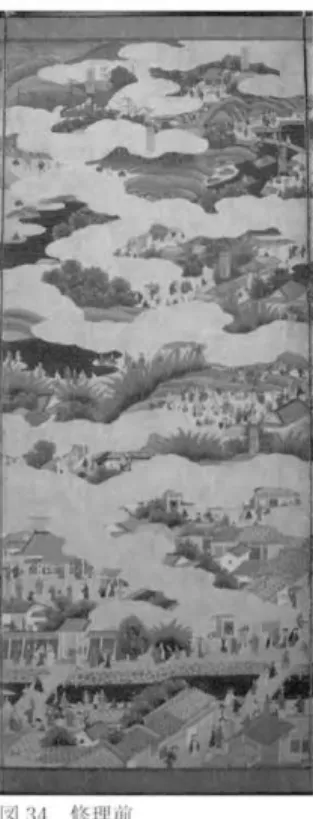
図 33 修理後
・1c..33 A fkr treatment Fiu. 34 Be 「oretreatment
図 35 修理後 図 36 修理前
Fig. 35 After treatment Fig. 36 Before treatment
修則報 ;1j- 97
洛中洛外図 寸法表 修理前 (cm)
4.7 57.5
4.711151.0
3.0 63. 〇 63.0 63. 〇 57.5
0.7
1 .7
修理後(cm)
6
5
-
—
57 63.6 63.6 63 3.6 57.6
0.7
5.111151.0 1.8
Vie1v.1キ 〇「 Kvowond Ifs Environs
T r e a t m e n t R e p o r t
I . Description and title of cultural property I
.
Tille, formal: Views q/Kyoto and Its Envi「ons; Parr 2. Collection: Royal Ontario Museum
I
l . Treatment period and location I. Treatment period: 2006
Sotaro Yamaguchi Bokunindo Co.,Ltd.
2. Location: Bokunindo Co., Ltd., 5‑8‑5 Sakae‑machi, Yaizu‑shi, Shizuoka Prefecture
皿 . Structure of the cultural property
I. Dimension e separate chart 2. Mounting
fore treatment
a. Format: pair of six‑paneled byobu b. Mounting fabric
uter border: Donsu (damask weave) silk with a sma llflower motif on a gray background Inner border: Gold brocade with a paulownia pattern on a peacock‑blue diamond background Frame: Black lacquered frame
Backside of the screens: Yellow‑green sparrow roundel patterned paper Decorated with metal ornaments and studs
After treatment
a. Format: Pair of six‑paneled byobu b. Mounting fabric
Outer border: New gold brocade with lcakuryii (square dragon) pattern on a peacock‑blue background Inner border: New gold brocade with a sma plleony and arabesque pattern on a pale brown background Frames: New rou—iro black lacquered frames with rounded edges
Backside of the screens: New karakami with a sparrow roundel pattern (pattern printed with mica mixed
I
onscrvaiton Trcalmcnl Report 99
with gray ink on a soft gray pigment background)
Metal ornaments and studs: Original pieces were cleaned and reused. N . Condition before treatment
An extremely large tear was 「ound at the center o「 the screen on the twel 「th pane .lThe tear, which run half of the length o「 the screen, had been mended in the past as an emergency measure. Because o「 th
large size of the tear, the left and right sides had contracted and became warped, causing cockling on th surface of the screen.
[nsect damage and tears were 「oundalong the inner portion of the paper hinge
The deterioration and loss of ji,sen, or paper tags (written labels that indicate di fferenl locations in th scene and are considered part of the artwork), were extensive. This is beileved to have been due Lo th oxidation of the malachite green pigment appiled underneath, which caused the paper to deteriorate and tear or partially disintegrate.
lnpainting of gold pigment was 「ound on many o「 the mending papers applied in the pas t.Because gold pigment was used regardless or whether the mending papers had a plain gold background or had been colored with paint, they were visually distractin
Some paper joints of the painting had separated due to the weakening of the adhes1v
There were severe creases and loss of pigments, presumably caused by the lack of room for movement around the hinges which placed a strain on the inner portion of the paper hinges when opening and closing the byobu.
The images were out of ailgnment at the hinge
There were many areas with insect damage, losses, and fraying on the border fabn Many cracks and dents were found on the outer frame
The metal ornamental fittings had become blackened with soot. V . Outline of treatment
1. Method of treatment Consolidation of paint layer
The colors of the pigments before treatment were very beau ti r u . IHowever, pigments had flaked off 111 some parts and the adhesion between the paint layer and the support was unstable. Therefore, the first
tep was to consolidate the paint layer. (Since it was determined that the migration of stains or creation f tidelincs with the addition of moisture was unlikely, the main focus was placed on stabilizing the preュ treatment state of the pigments by consolidating the paint laye.r)
To prevent destabi I ization of the pigment layer the paintings were fixed on a karibari throughout the nsolidation process to ensure that any stretching or shrinkage caused by the moisture in the animal skin luc consolidant would be kept to a minimum. The condition of the paintings and tension were constantly
、 hcckcdand adjusted to prevent overstrctching. Repair o「 thelarge tear
The largest issue in this treatment was lo repair the tear al the center o 「 thepainting. The large tear was contained within the twelfth panel onl
the treatment 「or this panel only. How
「 moisture and drying needed 「orthis panel
doing, there was 「ear that the di 「「erence in the amount mpared to しhe other panels would ar「ect the overa 1 l1ook r colors of the pigments. Therefore, treatment o 「 thispanel was carried out with constant vigliance of the alance between this panel and other panel
Removal o「 ukepaper and old I ining
While ensuring the overall balance was maintained by keeping the paintings attached to karibari to minimize expansion and contraction, purified water was sprayed onto the reverse sides of the paintings to remove the uke paper and old lining.
Id mendingsし rips and reinforcement papers were found attached to the reverse side of the twelfth panel.
「Lcrremoving a llof these, strips of paper were applied temporarliy for protection. Old mending paper
ome of the old mending papers were only partially colored with gold pigment. Some old mending papers appiled to non‑gold areas were also colored with gold pigments. Therefore, it was decided that all of the mending papers would be removed and replaced with those that match the background color. Fiber analysis of the paper used for the painting support was conducted, and mending papers were selected based on the resu It
Paper tag
The malachite green pigment appiled underneath was causing the paper tags to oxidize, leading to flaking and tearing. In addition, removing the paper tags pasted over the pigments would cause the pigments attached to the reverse side to be removed with them. Therefore, it was decided that the firmly fixed paper tags would not be forced off but be split into layers, and only the top layers would be removed. After repairing the missing parts, the paper tags would be pasted back in their original places. Paper containing
│]
onservarton Treatment Report IO I
calcium carbonate was used to neutralize the acidity of the oxidizing malachite pigment underneaしh.
Alignment of the image
The image was out of ailgnment in between panels. For areas where the image did not ailgn correclty l'rom panel to panel, positions or the paintings were adjusted when reattaching them to make sure し he cntir image was continuou
Hinges
The paper hinges found on the byobu before treatment were tight, causing damage on the screens near th inner portion o 「 the hinges. Since the paint layer is thick overall, the hinges prepared in this treatment wer attached in a manner to create some space to prevent the panels from pulling on each other
Wooden core structure
The wood o 「 the core structure was thin and warped, causing cockling in し he screens. There「OrC, It Wa decided that new wooden core structures would be prepared. Mindful of the inevitable pressure around
portion of the paper hinges from extending to the edges of the base sしruclure. More
were made silghtly thicker so that the pigments near the inner portion of the paper hinges would abrade each other
Metal corner fittings and metal studs
Since all of the metal pieces were still intact, they were to be cleaned and reused 2. Treatment specification
‑Consolidate the areas where the pigments have Ii 「led and are in danger o「 de「olialing or areas of th painting support that have split into layers by inserting adhesives such as seaweed glue, animal skin glu~, or wheat starch paste.
‑In addition to taking standard photographs, also take photo111icrographs o 「pigments, radiographs o「 th
paintings, and infrared photograph
‑To check that the colors of the pigments be 「ore and a「ter the し realmentremain the same, measure th reflectance of the pigments be「oretreatment using a spectroscopic colorimeter. Report the measurement results to the director
‑Take dimensions and examine the damaged areas o「 thescreens and record the find1111r
‑Create a detalied map of the damaged area
‑Examine changes in the quality of the pigments by testing with a sma llamount of water before treatment to determine whether the paint layer will be able to tolerate a wet treatment.
‑Treat and consolidate the paint layer with rabbit skin glue solution to prevent flaking.
‑Repair the large tear on the twelfth panel while ensuring the image is in alignment.
‑Determine whether or not to remove the old mending papers and inpainting by first checking the map of damaged areas and then consulting with the director and owner.
—\..,vnstruct new lattice cores (white cedar constructed with mitered corners and mortise and tenon joints) and outer frames (rou‑iro black lacquered frames with rounded edges).
‑/¥pply eight layers of paper to the wooden lattice cores (six processes: honeshibari, doubari, minokake (three layers), minoshibari, shilaulce and iし,waulce)
‑Repair and reuse the metal ornaments.
‑Prepare new karakami for the reverse side of the byobu panels.
‑Prepare a new storage bag. Treatment proce
I. The byobu was brought into the sludio and prc‑Lrcalmcnl pholographs were taken under natural ilght and rakina il!!ht. Infrared photographs were also taken.
2. Areas with naking pigments and lifting support material that were in danger o 「 detaching during
し rcatmcntwere temporarily fixed with mixed solution made of seaweed glue, animal skin glue and wheat tarch past
The outer frames were removed. 4. Metal hinges were removed.
5. The screen was separated into each individual panel
6. A diagram mapping the damaged areas was created so that the condition of the painting could be determined at a glance.
7. Dust was removed from the surface of the paintings with a brush (dry cleaning). The colors of the painting were measured using a spectroscopic colorimeter. 9. The condition of the pigments was recorded by taking photomicrograph..,.
I 0. Panels were disassembled and paintings were removed from the old wooden lattice cores.
11. Pigments were consolidated using rabbit glue solution. The paintings were allowed to dry for about I 0 day
12. Paper tags were removed while dampening them with small amounts of water. Jn doing so, the paper
nservation Treatment Report l03 tags were not forced off, bul were removed in layer
13. Mounting paper was attached to the paintings to temporarily dry them on a karibari).
14. The paintings were nattened using minimal moisture lo keep the waler 「ram soaking through lo th front, and uke paper was removed. A 「Lerwards,they were dried on lwrihari. Radiograph
15. Rein forcemcnt paper pasted on the reverse side or the large tear on the twel 「th panel was removed, after which a strip of paper was promptly placed as a temporary measure.
16. A small amount o 「 waterwas sprayed over the entire back surface of the paintings and the first I ininoュ and mending papers were removed.
17. Fiber analysis was conducted and based on the findings, mending paper was prepared.
18. Mending paper was applied lo lost parts of the painting with a mixture of wheal starch paste and seaweed paste.
19. A long, thin strip of reinforcement paper was applied to the torn areas of the paintings from the rever side. Particular care was taken in treating the large tear on the twel 「U, panel, during which the image wa checked from the front to make sure it was in ailgnment.
20. Paste was appiled Lo areas where the paper joints o「しhepaintings had Ii 「tcd.
21. A first lining made or Mino paper was appiled using wheat starch past
22. Immediately following the application of し he first lining, the paintings were dried on lwriban.
23. A final backing made o「 Minopaper was applied using wheal starch paste, and the paintings were dried immediately on karibari
24. New black lacquered outer frames and wooden lattice cores were prepared. Eight layers or paper wcr
25. Gold mending papc「son the front surface o「 thepaintings were removed.
26. New karakami d papered core
1de were prepared and appiled to the back sur 「ace 0 「 th
27. The paintings were attached lo the papered cor
28. A lining was appiled to the newly prepared border 「abrics,which were attached to the papered cor
29. Missing parts of paper tags were fixed using mending paper selected based on fiber analysis results. A lining was applied immediately following and the pieces were dried on karibari.
0. The paper tags were then attached to their original loca1ton I. The outer frames were attached
2. Corner metal ornament and studs were cleaned and allachcd Lo the outer frame The hyi. うbuwas stored in the newly prepared storage bag.
4. Photographs were taken to allow the treated screens to be compared with their pretreatment stale.
Pai nti 1112./M ou nt11117 tructur
Pa111t1110 First lining
Mcnd1n
ndcrlining of Lhc lattice 1/oneshiban core Mino/wk
Minoshibcm
Border 「abri utcr bordc1
Inner borde1
Hinge
Decoraitve back111g paper
loragc bag
Material
Mino paper Wheal starch past
kozo paper
Maniai paper
咄islwpaper
咄ishupaper
peony and arabesque pattern on a white‑brown background
Gilded lorinoko paper
キ5,pll6‑7 キ5, pl I 6‑7
awccd glue/wheal starch paste: I : I, pl I 6‑7
ndycd
Karakami with sparrow Pattern printed with mica mixed roundel pattern with gray ink on gray colored
urface
Cotton I Unbleached, starch removed
5. Materials and supplie Material
Paper
Paste
Pigment used for inpainting
Dye
Wooden lattice core
Outer frames
Karakami for the back side o「 thescreen
Mino paper Ma111w paper Moniai paper Kozo paper
kishu paper Wheat starch paste
Seaweed past
urnt inl Yaslw
onservarton Treatment Report I 0
Made in South Korea
Pre「ecLur
Kyoto Pref ccturc
Made bv Kuroda, Kyoto Prelccturc I White cedar constructed with mitered corners and
Made bv Kuroda, KyoLo Prclccturc
Koraka111i 「orthe back side or th crccn