非定常な波強制に対する中層大気2次元及び3次元循環の形成
林佑樹1、佐藤薫1
1東京大学大学院 理学系研究科
Formation of two dimensional and three dimensional circulation responding to unsteady wave forcing in the middle atmosphere
Yuki Hayashi1 and Kaoru Sato1
1The University of Tokyo, Tokyo, Japan
Lagrangian-mean meridional circulation in the middle atmosphere is important for the earth climate because it globally transports minor species such as ozone and changes the temperature structure through adiabatic heating/cooling associated with its vertical branches. This meridional circulation is mainly driven by remote redistribution of the momentum by atmospheric waves. In previous studies such as Haynes et al. (1991), a steady-state assumption is frequently used for the analysis of the wave-induced meridional circulation. In general, however, the wave forcing is not steady. Thus, dynamical understanding under the steady-state assumption is limited. When a stratospheric sudden warming occurs, for example, time scales of wave forcing is so short that behavior of the resultant circulation may differ from that expected under the steady-state assumption, which is confirmed by a numerical model (Matsuno 1971) and satellite observations (Labitzke 1972). So as to understand such a transient behavior and formation of the circulation, time evolutions of not only a slow variable describing balanced flows but also fast variables such as horizontal divergence and ageostrophic vorticity describing gravity waves and flows slaved to the balanced flow must be investigated. The purpose of this study is to theoretically examine the response of meridional circulation to unsteady wave forcing. In the first part of this study, a Boussinesq equation system is examined for zonal-mean flow response to a zonally-uniform unsteady forcing. In the second part, the three-dimensional response to a zonally-nonuniform and unsteady forcing is examined using a balance equation which is derived in this study.
As large-scale atmospheric response to the forcing can be described as a linear response, the method of Green’s function, which is a response to the delta function, is one of useful approaches for analysis of the linear response to forcing (e.g., Zhu and Holton, 1987). By using the Green's function method, the response to a wave forcing in the zonal momentum equation is mainly examined, but the responses to a diabatic heating in the thermodynamic equation and to a wave forcing in the meridional momentum equation are shortly discussed.
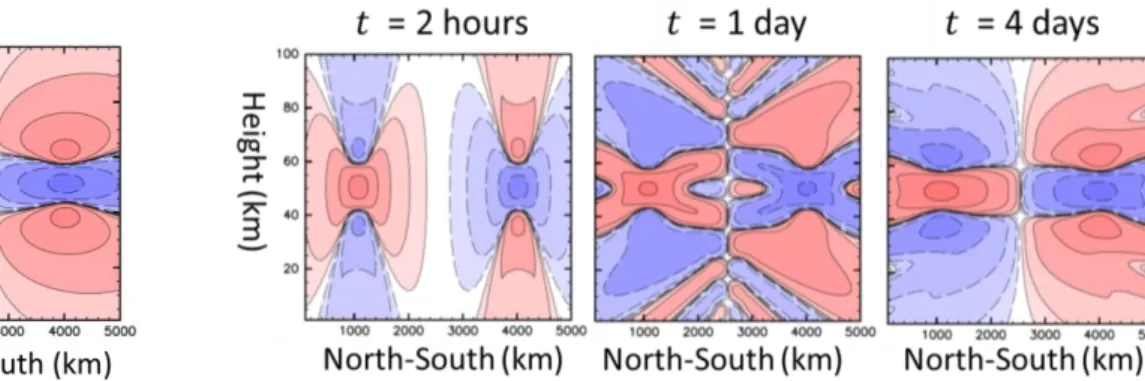
First, the response to a zonally-uniform forcing is examined. The steady solution of the meridional circulation responding to a constant forcing has structure with two cells aligned in the vertical (Figure 1). For a step-function shape forcing in time, large-scale gravity waves are radiated as a transient response, and a meridional circulation and an inertial oscillation finally remains (Figure 2). The quasi-steady meridional circulation accords well with the steady state solution for a constant forcing. The time needed for the formation of the meridional circulation depends on the aspect ratio (i.e., latitudinal to vertical lengths) of the wave forcing, as is consistent with a theoretical expectation. In addition, it is shown that the time scale of the circulation formation is determined by the time scale of the gravity wave energy propagation. The response for the forcing that increases gradually in time is also investigated. When the forcing change time-scale is longer than the inertial period, the meridional circulation always accords with that estimated using the steady-state assumption. The ratio of the magnitude of the zonal-wind acceleration and that of the Coriolis torque that are balanced with the wave forcing is also investigated. It is shown that this ratio depends on the aspect ratio of the forcing and can be explained by the dimensional analysis.
Second, the response to zonally-nonuniform forcing is examined. In this case, it is expected that Rossby waves are radiated as a transient response because of the beta effect. So as to focus only on the Rossby wave response, governing equations are derived following the method of balance equations used by Leith (1980). For the steady forcing case with the beta effect, the geostrophic flow becomes zonally asymmetric and has large magnitudes to the west of the forcing (Figure 3).
For the step-function forcing, Rossby waves are radiated as a transient response as expected. Rossby waves having smaller zonal wavenumbers radiated faster from the forcing region (Figure 4). Time period needed to reach the steady state strongly depends on the strength of the linear relaxation.
From these theoretical investigations, the following picture is obtained for the formation of the circulation by the unsteady forcing. For the wave forcing with time scales faster than the inertial period, the fast variable contains radiating gravity waves as an earlier transient response, and reaches the steady state with a two-celled structure in the vertical in a time
scale of the energy propagation of gravity waves. The conventionally-used steady state assumption is appropriate only when the forcing time scale is slower than the inertial period. On the other hand, the time scale of the slow variable is much longer than that of the fast variable and is determined by the strength of linear relaxation. As a transient response of the slow variable, Rossby waves are radiated from the zonally-nonuniform forcing and the circulation changes slowly depending on the linear relaxation. The meridional circulation calculated by the downward control principle (Haynes et al., 1991) differs from the vertically two-celled circulation obtained in the present study. The circulation shown by the DC theory can be understood as a final form of slowly changing the slow variable and the slaved component by the radiative relaxation.
Figure 1. Steady state of the horizontal divergence Figure 2. Time evolution of the horizontal divergence
Figure 3. Steady state of the pressure deviation Figure 4. Time evolution of the pressure deviation
References
Haynes, P., M. McIntyre, T. Shepherd, C. Marks, and K. P. Shine, 1991: On the“ downward control”of extratropical diabatic circulations by eddy-induced mean zonal forces. Journal of the Atmospheric Sciences, 48 (4), 651–678.
Labitzke, K., 1972: Temperature changes in the mesosphere and stratosphere connected with circulation changes in winter.
Journal of the Atmospheric Sciences, 29 (4), 756–
766.
Leith, C., 1980: Nonlinear normal mode initialization and quasi-geostrophic theory. Journal of the Atmospheric Sciences, 37 (5), 958–968.
Matsuno, T., 1971: A dynamical model of the stratospheric sudden warming. Journal of the Atmospheric Sciences, 28 (8), 1479–1494.
Zhu, X. and J. R. Holton, 1987: Mean fields induced by local gravity-wave forcing in the middle atmosphere. Journal of the atmospheric sciences, 44 (3), 620–630.