Effects of precipitation and ground covering by mosses on occurrence of tar-spot disease of polar willow
Motoaki Tojo1, Shota Masumoto2,4, Masaki Uchida2, Maria-Luz Herrero3, and Satoshi Imura2
1 Graduate School of Life and Environmental Sciences, Osaka Prefecture University, Japan
2 National Institute of Polar Research, Japan
3 NIBIO - Norwegian Institute of Bioeconomy Research, Division of Biotechnology and Plant Health, Norway
4 Present Address: Yokohama National University, Japan
Tar-spot caused by Rhytisma polare (Figure 1) is the most frequently found leaf disease on polar willow (Salix polaris) in the high arctic regions (Masumoto et al. 2014). However, epidemiological aspects of the pathogen have never been verified. This study demonstrated that occurrence of the pathogen was influenced by precipitation and ground covering by mosses under field conditions. Occurrences of the tar-spot disease were investigated on a colony of polar willow in Ny-Ålesund, Svalbard, Norway in mid-August in 2008, 2010, 2012 and 2013. Fourteen plots, each consisting of 15 x 15 cm square and containing 24- 223 shoots of the polar willow, were examined to determine the number of polar willow shoots infected with tar-spot disease.
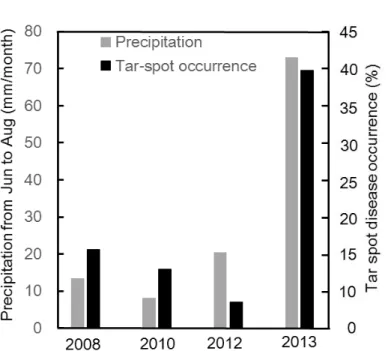
Monthly average precipitation from June to August at Ny-Ålesund were obtained from the Norwegian Meteorological Institute (http://www.eklima.no). Percentages of ground area covered by moss colonies, which consisted mainly of Sanionia uncinata and Orthothecium spp., were also investigated for each plot. Tar-spot disease occurrence was found to be 3.5 to 10.6% in 2008, 2010 and 2012 when the precipitation was less than 20.4 mm/month (Figure 2). Whereas, the disease occurrence increased to 34.8% in 2013 when the precipitation was 73.0 mm/month. The number of diseased plants increased with increasing of the moss-covering area through the four years. These results indicated that the tar-spot disease occurrence was related to precipitation and ground covering by mosses. Humid conditions are required for spore transmission of tar-spot disease (Minter 1997; Masumoto et al. 2014). The heavy precipitation (>70 mm/month) and the moss covering of the ground increase the moisture around polar willow leaves. These factors might enhance infection of tar-spot disease in the high arctic region.
References
Masumoto S, Tojo M, Uchida M, Imura S (2014) Rhytisma polaris: Morphological and molecular characterization of a new species from Spitsbergen Island, Norway. Mycological Progress, 13:181–188.
Minter DW(1997) Rhytisma salicinum. IMI Descr Fungi Bact, Set 134, No. 1339, CAB International, Wallingford, UK Figure 1. Occurrence of tar-spot disease of polar
willow grown on the ground covered by Sanionia moss in Ny-Ålesund, Svalbard, Norway.
Figure 2. Relationships between monthly average precipitation from June to August and occurrence of tar-spot disease of polar willow in Ny-Ålesund, Svalbard, Norway in 2008, 2010, 2012 and 2013.