AN EVALUATION OF STRENGTH AND CONDITIONING TRAINING PROGRAMS IN IPU MEN'S HANDBALL TEAM
I PU男 子 ハ ン ドボ ール 部 にお け るス トレン グ ス&コ ンデ ィ シ ョニ ン グ プ ログ ラ ム の評 価
体育学部体育学科 楠本 欣司 木野 実
KUSUMOTO, Kinji KINO, Minoru Department of Physical Education
Faculty of Physical Education Keywords : Handball, Strength and Conditioning Training Program, Questionnaire
要 旨:本 研 究 は 、IPU男 子 ハ ン ドボ ー ル 部 が6ヶ 月 間 実 施 して き た ス ト レ ン グ ス&コ ン デ ィ シ ョニ ン グ (S&C)ト レ ー ニ ン グ プ ロ グ ラ ム に 関 す る 意 識 調 査 を 目的 と し て 行 っ た 。部 員14名 を 対 象 と し て ア ン ケ ー ト調 査 を行 い 、結 果 は トレ ー ニ ン グ に よ る 身 体 能 力 の 向 上(81.8%)・ プ ログ ラ ム の 内 容 に 関 す る満 足 度(92.9%)・
専 門 イ ン ス トラ ク タ ー に 対 す る 現 場 指 導 力(100%)な ど の 項 目 に 対 し て ポ ジ デ ィ ブ な 回 答 を 得 た 。 ま た ト レ ー ニ ン グ を 通 じ て 関 連 す る 解 剖 生 理 学 ・ トレ ー ニ ン グ 理 論 ・栄 養 学 な ど に も興 味 を 持 っ て い る こ と を 把 握 す る こ と が で き た(75.1%)。 しか し 大 半 の も の は 来 年 度 の 後 輩 に 対 す る ト レ ー ニ ン グ指 導 に 関 し て あ る 程 度 の 自 信 し か な い(71.4%)と 回 答 し た た め に 、単 純 に ト レ ー ニ ン グ を 行 う だ け で な く 将 来 指 導 者 と し て
の 活 躍 が で き る た め の 教 育 の 必 要 性 も 感 じ た 。
キ ー ワ ー ド:ハ ン ドボ ー ル 、 ス トレ ン グ ス&コ ン デ ィ シ ョニ ン グ トレ ー ニ ン グ プ ロ グ ラ ム 、 ア ン ケ ー ト調 査
I . INTRODUCTION
International Pacific University ( IPU) has established in April 2007, and IPU men's handball team also has organized at the same time. Members on the team are obviously all freshmen. Amazingly, the team participated in a districted college handball championship game just after one month when the players met each other for the first time. Fortunately, the team won the third place ; however, the IPU men's handball head coach was never satisfied with the result even for their first games. He strongly considered that his players were supposed to
develop their competitive performance for next games . Thus , he visited at an IPU medical center and requested a team doctor to build up their physical abilities better.
An IPU strength and conditioning (S & C) instructor immediately designed an exercise program, and the coach agreed with the exercise description without any questions. The instructor has been training the athletes hard since the first games were done.
A total of three S & C training programs were design until now. Each training program shows in table 1 , table 2 , and table 3 . Basically, all of the training programs were planned to be performed within approximately two hours including warming-up and cooling-down . The training programs always included with two major purposes following by National Strength and Conditioning Association Guideline ; preventing athletic injuries and improving athletic performance
(Beachle and Earle. 2000) .
At the beginning of the first training section,
the instructor explained aims of each exercise,
benefits of the training, and methods of correct movement patterns very carefully and specifically.
Although the athletes struggled to understand the trainings in the early days, they gradually learned how they exercise with strong confidence, motivation, and ambition.
It has passed almost six months since they started the trainings. Therefore, the purpose of this study was to evaluate the strength and conditioning training programs in the IPU men's handball team. It might obtain helpful responses how the S&C training programs affected to the athletes and might also provide practical information to identify their current training status through the results.
II. PROCEDURES
SUBJECTS
There are fifteen players in the IPU men's handball team. A total of 14 athletes (average age : 18.7 ± 0.7 years ; height 172.0 ± 0.04cm ; mass : 67.9±7.4kg ; BMI : 23.0±2.4) participated and completed this research. One subject missed this study due to a personal reason. The subjects fully apprised of the nature of the research project and volunteer to participate by signed on informed consent form. This study was approved by the department of physical education for research reviews involving human subjects at IPU.
METHODS
It was one day survey conducted on the 1 st campus of IPU during the 2007 semester.
Before filling in a questionnaire, the subjects received a verbal explanation for this study , including a description of its purpose, risks, and benefits. The subjects then received an informed consent form and signed the form if they agreed to participate.
The questionnaire consisted of 10 multiple- choice questions, and the contents show in table4.
Table 4. Contents of the Questionnaire
Q1 : Have you ever been trained by any S&C instructors before entering IPU ?
Q2 : What are your own purposes of the S&C Training ? * Q3 : Do you feel anything has changed since you started
the S&C training ? *
Q4 : How long do you think the appropriate training time to spend per a section ?
Q5 : What lectures do you want to take if the S&C instructor offers ? *
Q6 : Do you have any dissatisfaction about the things related to the S&C training ? *
Q7 : What do you think about the training programs designed by the S&C instructor ?
Q8 : What do you think about the S&C instructor's practical guidance ?
Q9 : What do you request for the current S&C training programs ? *
Q10 : Do you think you will be able to train freshmen correctly in the next year ?
* Two or more answers possible
Those questions assessed the followings : (1) training guidance experience, (2) individuals' training purposes, (3) current conditions, (4 ) appropriate training time, (5) optional lectures, (6) environmental problems, (7) the exercise contents evaluation , (8) the S & C instructor evaluation, (9) requests for the trainings, and
( 10) leadership . Some questions allowed choosing two or more answers if they wanted to. There was no time limit to answer, and the subjects' confidentialities were insured by an investigator.
As soon as the subjects filled in the questionnaire, the investigator collected the forms and then averaged the data. In this study, a statistical analysis was not performed.
Bl. RESULTS
For the question number one, 21.4% of the
subjects had been trained by S&C instructors
before they entered IPU . The range of their
guidance periods were from one day to six
months during their high school ages. Conversely,
78.6% of the subjects had no S&C training
guidance experiences. (Table 5 )
Table 5. Training Guidance Experience
Q1 : Have you ever been trained by any S&C instructors before entering IPU?
Yes No
21.4% (n=3) 78.6% (n=11)
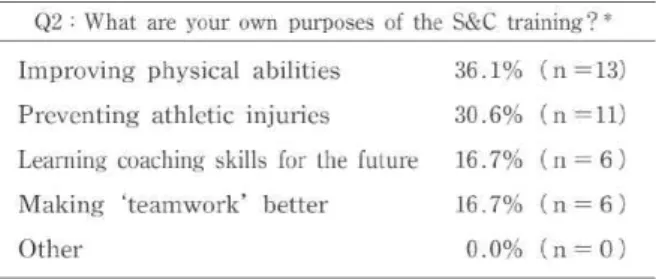
For the question number two, 36.1% of the subjects trained toward improving their physical abilities as their own purpose ; 30.6% of the subjects trained toward preventing athletic injuries ; and 16.7% of the subjects trained toward learning coaching skills for the future
and making `teamwork' better. (Table 6 ) Table 6. Individuals' Training Purposes
Q2 : What are your own purposes of the S&C training?*
Improving physical abilities Preventing athletic injuries Learning coaching skills for the future Making `teamwork' better Other
36.1% (n =13) 30.6% (n =11) 16.7% (n=6) 16.7% (n=6) 0.0% (n=0)
* Two or more answers possible
For the question number three, 33.3% of the subjects felt their body sizes has developed since the training started ; 30.3% of the subjects felt their muscular strength has increased ; 18.2%
of the subjects felt less fatigue during they exercise ; 15.2% of the subjects felt mental toughness has developed ; and 3.0% of the
subjects answered feeling `the center of the body'during exercise. (Table 7 )
Table 7. Current Conditions
Q3 Do you feel anything has changed since you started the S&C training? * Developing body size (Hypertrophy)
Increasing muscular strength Less fatigue during exercise Developing mental toughness Other
30.3% (n =10) 33.3% (n=11) 18.2% (n=6) 15.2% (n=5) 3.0% (n=1)
* Two or more answers possible
For the question number four, 71.2% of the subjects thought two hours long is the appropriate training time to spend per a section ; 14.3% of the subjects thought one hour long ; and 7.1% of the subjects thought either 2 hours and 30 minutes or only 30 minutes long. (Table8)
Table 8. Appropriate Training Time
Q4 : How long do you think the appropriate training time to spend per a section?
Over 3 hours 2 hours 1 hours 30 minutes Other
0 72 14 7 7
0%
1%
3%
1%
1%
(n=0) (n=10) (n=2) (n= 1) (n= 1)
For the question number five, 30.6% of the subjects wanted to take `Training Methods and Theories' as an optional lecture if the S & C instructor would offer ; 27.8% of the subjects want to take `Sports Nutrition' ; 22.2% of the subjects want to take `Mental Training' ; 16.7%
of the subjects want to take `Human Anatomy &
Exercise Physiology' ; but 2.8% of the subjects answered `nothing' . (Table 9 )
Table 9. Optional Lectures
Q5 : What lectures do
you wantto take if the S&C instructor offers ? * Human Anatomy & Exercise Physiology
Sports Nutrition
Training Methods and theories Mental Training
Other
16 27 30 22 2
7%
8%
6%
2%
8%
(n=6) (n=10) (n=11) (n=8) (n=1)
* Two or more answers possible
For the question number six, 54.5% of the subjects dissatisfied with the small facility of the training center ; 31.8% of the subjects dissatisfied with less training equipments to use; 9.1% of the subjects dissatisfied with the training time to spend, the training frequency, and the location of the training center ; but only 4.5% of the subjects satisfied with the current environment. (Table 10)
Table 10. Environmental Problems
Q6 : Do you have any dissatisfaction about the things related to the S&C training? * Nothing
Small facility
Less training equipments The S & C instructor
Other
4 54 31 0 9
5%
5%
8%
0%
1%
(n= 1) (n=12) (n=7) (n=0) (n=2)
* Two or more answers
possible
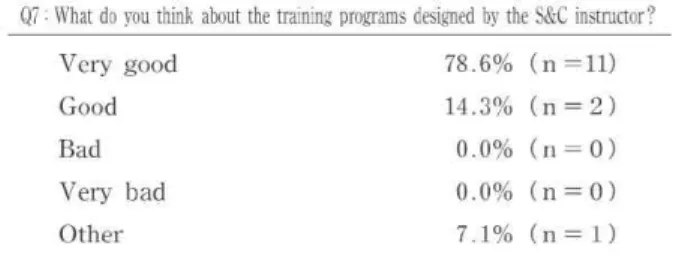
For the question number seven, 92.9% of the subjects satisfied with the S & C training contents ; however, 7.1% of the subjects were afraid of the qualities of the training from the next year. (Table 11)
Table 11. The Exercise Contents Evaluation
Q7 : What do you think about the training programs designed by the S&C instructor?
Very good Good Bad Very bad
Other
78.6% (n=11) 14.3% (n=2)
0.0% (n=0) 0.0% (n=0) 7.1% (n=1)
For the question number eight, the all subjects completely satisfied with the S & C instructor's practical guidance. (Table 12)
Table 12. The S&C Instructor Evaluation
Q8 What do you think about the S&C instructor's practical guidance?
Very good Good Bad Very bad
Other
92.9% (n=13) 7.1% (n=1) 0.0% (n=0) 0.0% (n=0) 0.0% (n=0)
For the question number nine, 37.5% of the subjects requested to have a personal S & C training program ; 18.8% of the subjects requested to have a program `for specific playing positions' and `for weak body parts', yet ; 31.3% of the subjects had no requests. (Table 13)
Table 13. Requests for the Trainings
Q9 : What do you request for the current S&C training programs ? *
Nothing31.3% (n= 5 )
Designing personal S&C training program 37.5% (n = 6 ) Introducing the latest and newest exercise program 12.5% (n = 2 ) I want to train by myself0.0% (n= 0)
Other18.8% (n=3)
* Two or more answers possible
For the question number ten , 71.4% of the subjects thought that they would be able to train freshmen correctly in some parts in the next year ; 21.4% of the subjects answered they would train new players completely ; but 7.1% of the subjects thought that they had less confidence to
teach freshmen trainings. (Table 14) Table 14. Leadership
Q10 Do you think you will be able to train freshmen correctly in the next year?
Yes, definitely Yes, some parts No, some parts No, definitely Other
21 71 0 7 0
4%
4%
0%
1%
0%
(n=3) (n=10) (n=0) (n= 1) (n=0)
IV. DISCUSSION
Handball is a sport combining aspects of basketball , soccer , and baseball . This sport requires physical strength and mental toughness similar to the other sports (Cardoso Marques. 2006) . It also includes many athletic abilities such as speed , power, agility, balance, flexibility , neuromuscular coordination, and cardiovascular endurance (Rogulj. 2005) . There are many athletic injuries happened because handball is a contact sport unlike basketball and volleyball (Olsen . 2006, Langevoort. 2007) . Thus, there is no doubt that the IPU men's handball players had to train in order to prevent injuries and to improve athletic abilities.
This study was a fundamental research that evaluated how the S & C training affected to the team. There was some useful information found through the results.
First of all , they enthusiastically work out with no complaints today even though the most of the athletes had never trained by any specific S & C instructors before entering IPU. Roughly 80% of the subjects have felt their physical changes such as developing body sizes, increasing muscular strength, and feeling less fatigues during exercise. Those are the nature of
the exercise (Gorostiaga et al. 2006, Izquierdo
et al. 2002) , yet their enhanced athletic abilities
actually caused their athletics' performance
positive in next games . Improving athletic
performance was one of the purposes of a
S & C training, and the players found out the
meaning of it all the way through such physical
training activities.
Secondly, they have interests in learning about things related to the S & C training. Through the
questions number 5 and 9 , they answered that they wanted to study `training methods and theories' and requested to have their own training
programs . They just used to exercise in the beginning ; however , they avariciously listen whatever the instructor teach and explain now.
It is a huge change of their attitudes compared to the first . They are always motivated to
practice , and they are recently seeking for something to improve their abilities. They might seem to enjoy learning new techniques and knowledge of exercise at this time.
Finally, the athletes were satisfied with the current training programs and the training time to spend. The training programs were originally
designed for the handball players, and the all programs were created progressively with specific
purposes by the instructor. For instance, the training program number one was mainly planned to learn correct exercise motions and patterns.
Because of their less training experience , the instructor had to demonstrate correct exercise forms and teach safe techniques . The training
program number two included with twisting motions and lateral movements. The instructor modified the second training program because the players require multi-dimensional motions in handball games . The second exercises with multi - planer movements obviously developed their physical abilities contrast to the first exercise program.
In addition , however , the coach and the instructor disappointed one thing of the results that the athletes would teach exercises to new freshmen with minimum confidence next year.
IPU has an educational policy `uniting sports and education' which means that IPU is the school for not only making top athletes but also promoting high-quality skilled coaches and teachers after graduation. Therefore, it must be necessary for the athletes to learn teaching and coaching skills as well as they actually perform exercise at present.
V. REFERENCES
1. BaechleTR, Training and IL. Human
Earle RW Essentials Conditioning. 2nd ed.
Kinetics. 2000.
of Strength Champaign,
2. Cardoso Marques MA, Gonzalez-Badillo JJ.
In-season resistance training and detraining in
professional team handball players. J Strength
Cond Res. 2006 Aug ; 20 (3) : 563-71.
3 . Gorostiaga EM , Granados C , Ibanez J , Gonzalez-Badillo JJ, Izquierdo M. Effects of
an entire season on physical fitness changes
in elite male handball players . Med Sci
Sports Exerc. 2006 Feb ; 38 (2) : 357-66.
4. Izquierdo M, Hakkinen K, Gonzalez-Badillo JJ , Ibanez J , Gorostiaga EM . Effects of
long-term training specificity on maximal
strength and power of the upper and lower
extremities in athletes from different sports.
Eur J Appl Physiol. 2002 Jul ; 87 (3) : 264-71.
Epub 2002 May 22.
5. Langevoort G, Myklebust G, Dvorak J, Junge A. Handball injuries during major international tournaments. Scand J Med Sci Sports. 2007
Aug ; 17 (4) : 400- 3 . Epub 2006 Oct 12. 2002
Jul ; 87 (3) : 264-71.
6 . Olsen OE , Myklebust G , Engebretsen L, Bahr R . Injury pattern in youth team
handball : a comparison of two prospective
registration methods.
Scand J Med Sci Sports. 2006. Dec ; 16 (6) : 426-32.
7. Rogulj N, Srhoj V, Nazor M, Srhoj L, Cavala M . Some anthropologic characteristics of
elite female handball players at different
playing positions. Coll Antropol. 2005 Dec ; 29 (2) : 705- 9 .
(平 成19年11月28日 受 理)