The Geographical Distribution of Sago‑Producing Palms
著者(英) Kenneth Ruddle
journal or
publication title
Bulletin of the National Museum of Ethnology
volume 3
number 3
page range 572‑594
year 1979‑01‑23
URL http://doi.org/10.15021/00004579
国立民族学博物館研究報告 3巻3号
The Geographical Distribution of Sago-Producing Palms
Kenneth RUDDLE*
INTRODUCTION
Palms are widespread over the surface of the earth, and man has shown remarkable ingenuity in exploiting the available local palm resource to produce an enormous range of useful goods. "Houses, baskets, mats, hammocks, cradles, quivers, packbaskets, bows, impromptu shelters, blowpipes, bows, starch, wine, protein from insect larvae, fruit, beverages, flour, oil, ornaments, loin cloths, cassava graters, magic, medicine, perfume—all are derived from palms" [MooRE 1973a: 64]. In the humid tropics, wild, protected and cultivated palms are often exploited for a combination of these uses.
Starch from the stems of palms is a product of local importance throughout the mainland and islands of Southeast Asia, in parts of Melanesia, certain islands of Micronesia, and various areas of tropical South America, where it is obtained from the stems of some, mostly native, palm species. Palm stem starch, or sago, although often of great local importance in barter and trade, is not a major item of commerce with areas outside the humid tropics. For this reason, palm sago is often overlooked outside the producing regions, although it probably represents one of the most important food products derived from palms.
The production of edible starch by the crushing, grinding, grating or macer- ating, and washing of plant parts in water, both to remove actively poisonous or acidic principles and to facilitate the sedimentation of starch, followed by fer- mentation and cooking of the product, is an ancient food-producing technology of world-wide distribution. Such processes are akin to those used in retting for fiber extraction, in the manufacture of bark cloth, and in the preparation of ingredients for beverage- and medicine-making. Although not limited to the tropical and subtropical realms, this method of starch production appears to have undergone its best development there, involving taxa of diverse plants such as palms, cycads, ferns, yams and aroids.
The difficulties of surveying palms of economic importance should be noted, for although considerable data exist on the 5 cultivated palms of prime importance to man—the coconut palm (Cocos nucifera), the date palm (Phoenix dactylifera), the African oil palm (Elaeis guineensis), the carnauba wax palm (Copernicia prunifera),
* Guest Researcher
, National Museum of Ethnology
RUDDLE The Geographical Distribution of Sago-Producing Palms
and the arecanut palm (Areca catechu)—botantical and utilization data for most other palms, including those discussed here, are fragmentary. Moreover, as observed by Corner [1966: 225], the physiology and ecology of palms have scarcely been examined. Moore [1973a: 63] notes also that, with scarcely an exception, the study of palm biology is in its infancy.
This article examines the geographical distribution of sago-producing palms, where the starch is recovered from the pulverized stem pith through water pro- cessing and sedimentation. Starch obtained from seeds, and the direct food use of both raw and cooked stem pith are excluded from consideration. It should also be noted that the term "sago," although originally applied only to starch derived from the stem of Metroxylon palms, is now used to describe starch from the stems of other palms, cycads and manioc root tubers.
PRINCIPAL GENERA EXPLOITED AND THEIR DISTRIBUTION
Palms of at least 14 species belonging to 8 genera are exploited for sago production (Table 1), but of these only Metroxylon and Arenga pinnata, in the Old World, and Mauritia in the New, are of major importance as palm starch sources.
(1) OLD WORLD GENERA
The distribution of the principal Old World sago-producing palm genera, Metroxylon, Arenga, Caryota, Corypha, and Eugeissona is depicted in Figure 1.
(a) Metroxylon: Although of relatively limited range, Metroxylon is by far the most important genus exploited for stem starch in either the Old or New World.
Palms of Metroxylon spp. are native to the area extending from Eastern Melanesia westward into Indonesia, Malaysia and Thailand, where domesticated are indistinguishable from wild species. At present, sago derived from palms of this genus is an important food source among some native peoples in Papua New Guinea, Indonesia and Malaysia, and cultivated Metroxylon is of importance in Malaysia and Indonesia. Metroxylon palms have large pinnate leaves and a stout, erect trunk which reaches a height of 10 m at maturity. Suckers grow from the base of the main stem and may be separated for propagation. In nature, the palms occur in clumps and in relatively pure stands, and occupy lowland, fresh- water swamps. Metroxylon spp. is monocarpic, and at about 15 years of age produces a large terminal inflorescence above the leaves. Flowering and fruiting may take up to 2 years before the plant finally dies. Starch content of the trunk is greatest just prior to the onset of flowering.
(b) Arenga pinnata: This palm, too, is one of the major reported sources of palm sago in Indonesia and India. It is cultivated in India. It is also of economic importance as a source of sap for toddy, sugar and vinegar, and in Indonesia the leaf sheaths yield a commercial fiber. The palm has a wide geographical range, which includes South and mainland Southeast Asia, from Formosa, through the Philippines, Indonesia, Papua New Guinea to India. Arenga pinnata is described
573
国 立民族学博物館研究報告 3巻3号 Table 1. Palm genera exploited for stem starch
Genus Species* Areas of Reported Use
1. OLD WORLD
Arenga pinnata (saccharifera) India
Peninsular Malaysia Philippines
Indonesia
Caryota aequatorialis Malaysia
mitis Peninsular Malaysia
rumphiana Kalimantan
urens India
Vietnam
Corypha umbraculifera Sri Lanka
Philippines
utan Malaysia
Madura Sulawesi
Eugeissona insignis Sarawak
utilis Kalimantan
Malaysia
Metroxylon spp. Papua New Guinea
Irian Jaya
sagu (rumphii) Kalimantan
India Peninsular Malaysia
Papua New Guinea
Irian Jaya
Philippines
2. NEW WORLD
Arecastrum romanzoffianum Paraguay
Southern Brazil
Copernicia alba Northeast Brazil
prunifera Northeast Brazil
Manicaria Saccifera Orinoco Delta
Mauritia flexuosa Amazon Basin
Orinoco Delta
Roystonea oleracea West Indies
* For some genera the identification and geographical distribution of individual species is not at all certain, and the literature remains confused. This list of species is not complete.
as more or less a forest tree, but not entirely restricted to the rainforest, growing
at elevations from sea level to about 1,200 m. The palm grows singly to a height
of 7-12 m and has large pinnate leaves. Like Metroxylon, Arenga is monoecious
and monocarpic. It begins to flower after 7-10 years, continuing for approxi-
Figure 1. Distribution of sago-yielding palms in the old world
国立民族学 博物館研 究報告 3巻3号
mately 2-5 years, after which it dies. A considerable amount of starch is stored in the trunk of the Arenga palm and converted into sugar when flowering begins.
The tree is popularly known as the "Sugar Palm" because the male inflorescences can be tapped and the sap consumed as toddy or reduced to sugar. Rather than fell the tree for sago extraction prior to the onset of flowering, users may tap the inflorescences and fell the tree afterwards for sago [MILLER 1964: 126]. That practice would, of course, reduce sago yield considerably.
(c) Caryota: The genus Caryota has a wide distribution quite similar to that of Arenga, except that Caryota extends as far south as northern Australia, but not as far north as Formosa. The chief sago-yielding species is Caryota urens, a large single-stemmed palm which often reaches a height of 20 m, and bears distinctive bipinnate leaves resembling fishtails, and which occurs naturally in moist tropical forests at elevations up to 1,500 m. Caryota urens is monoecious and monocarpic and its flowering habit is similar to those of Metroxylon spp. and Arenga pinnata.
Flowering begins when the palm is about 15 years old. Completion of flowering and fruiting signal the death of the trunk. The quantity of starch is greatest just prior to the onset of flowering, and palms exploited for starch would be felled at that time. Conversion of starch stored in the trunk to sugar during the terminal flowering permits the regular tapping of inflorescences for large quantities of sap
over as much as 2 years. The sap may be drunk as a toddy or made into sugar, as it is in India and Sri Lanka.
(d) Corypha: Palms of this genus have a range which closely overlaps that of Caryota. Corypha, however, extends somewhat further east of Papua New Guinea than either Caryota or Arenga. Corypha umbraculVera, the talipot plam, is the principal sago-yielding species, and is used in South and mainland Southeast Asia, the Philippines, Indonesia, Papua New Guinea and tropical Australia as a minor source of palm sago. C. umbraculifera is a massive, single-stemmed palm, the trunk of which may attain a diameter of 1 m, a height of 25 m, and which supports very large fan-shaped leaves. Because the talipot palm is unknown in the wild there is no information about its natural environment, although it is clearly native to the humid tropics. This palm, too, is monoecious, with herma- phroditic flowers, and monocarpic. It is distinguished by a terminal flowering
that does not occur until the palm is a least 30-40 years old, and by a huge, pyramidal inflorescence, said to be the largest in the plant kingdom, as a flower crown over the leaves. Flowering and fruiting require about one year, after which the tree dies. Like those of Arenga and Caryota, the inflorescences of the talipot palm can be tapped for sap.
(e) Eugeissona: These palms have the most limited distribution of any of the
principal genera under consideration, being found naturally only in Peninsular
Malaysia and Kalimantan. Eugeissona palms, which have an exceptionally
short stem and large, erect pinnate leaves, are common as understory plants in the
RUDDLE The Geographical Distribution of Sago-Producing Palms
tropical forests within its range. Apart from E. utilis, which attains a height of 8 m, limited stem development precludes the accumulation of large quantities of starch. As such, palms of this genus are regarded as only minor sources of sago.
Eugeissona palms are monocarpic and monoecious. They produce a terminal inflorescence after only 5-6 years of growth and, since there is relatively limited stem development, relatively small amounts of starch are produced.
(2) NEW WORLD GENERA
The geographical distribution of 3 New World sago-yielding palms, Mauritia
Figure 2. Distribution of sago-yielding palms in the new world
国立民族学博物 館研究 報告 3巻3号
flexuosa, Arecastrum romanzoffianum and Roystonea oleracea, is depicted in Figure 2.
(a) Mauritia flexuosa: This, the moriche or buriti palm, is the principal New World palm exploited for sago production. Extraction of its starch is at present of importance only among the Warao people of the Orinoco Delta of Venezuela.
Mauritia palms grow naturally throughout most of northern South America in the humid tropical forest, but especially along streams and in freshwater swamps, where it is often found in pure stands. These palms have a solitary trunk, up to 25 m in height, and large, rigid, pinnate leaves. The palm is dioecious, and once botanical maturity has been reached, flowering and fruiting occur annually. It should be noted that unlike the hapaxanthic sago-yielding palms of the Old World, which produce a terminal inflorescence, all of the New World genera used to make sago have an annual cycle of flowering and fruiting. In the Orinoco Delta, the flowering of Mauritia is in response to the rainfall regime [HEINEN and RUDDLE 1974: 121-123]. Compared with palms of the genus Mauritia, other New World sources of palm sago are of only minor importance.
(b) Arecastrum romanzoffianum: This, the queen palm, has a range limited to the southeastern part of South America, where it occurs in the tropical and subtropical forest. It reaches a height of 10-15 m, and has pinnate leaves, and forms the mainstay of the Guayaki Indian subsistence system. There remains a controversy about the validity of the genus Arecastrum, Moore [1973b: 110] considering it to be valid, whereas Glassman [1972: 12-13] treats it as a synonym of Syagrus.
(c) Roystonea oleracea: This palm, of the dry evergreen forests of the Caribbean and adoining regions of North, Central and South America, is also sometimes exploited for sago production. It is a solitary, tall, monoecious palm, which attains a height of 40-60 m. Palms of this genus are used mostly as ornamentals in the tropics, although their wood and leaves are utilized as building materials.
In some places the fruit is harvested and fed to pigs.
OTHER PALM GENERA EXPLOITED FOR SAGO PRODUCTION
It should be noted that Figures 1 and 2 map both reported and potential areas for exploitation of the palm genera included in Table 1, but that the presence of a palm in a particular area does not necessarily imply the presence of palm starch extraction. It is extremely difficult to map the distribution of other genera reportedly exploited for sago production. In most cases the report is for a very limited locality yet involves palms having a wide geographic range. Based on such limited evidence it would obviously be invalid to infer starch extraction else- where in the range.
In the Old World this involves palms of the genera Acrocomia, Borassus,
Phoenix, Pholidocarpus, and Raphia. The genus Phoenix, for example, extends in
a broad, continuous belt across the Old World from Formosa to the Canary
Islands. Within that range, however, the extraction of sago from P. farinifera is
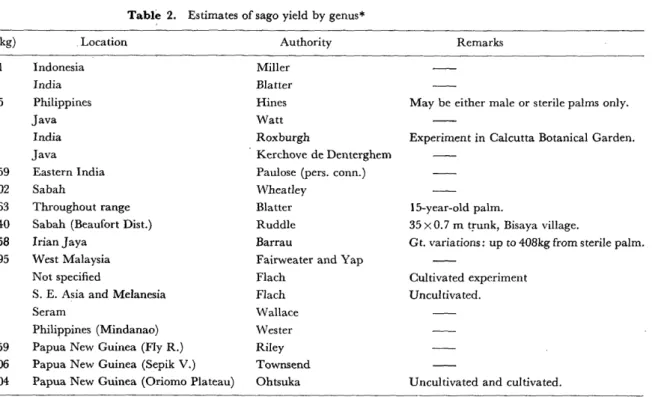
Table 2. Estimates of sago yield by genus*
Genus and Species Yield (kg)
Location Authority RemarksArenga pinnata 57-61 Indonesia Miller -
/i 68 India Blatter --
// 50-75 Philippines Hines May be either male or sterile palms only.
4 70 Java Watt ---
// 70 India Roxburgh Experiment in Calcutta Botanical Garden.
I/ 25 Java Kerchove de Denterghem -
Caryota wrens 102-159 Eastern India Paulose (pers. conn.) -
Metroxylon spp. 241-302 Sabah Wheatley ---
// 272-363 Throughout range Blatter 15-year-old palm.
ti 180-240 Sabah (Beaufort Dist.) Ruddle 35 x 0.7 m trunk, Bisaya village.
I/ 113-158 Irian Jaya Barrau Gt. variations: up to 408kg from sterile palm.
// 113-295 West Malaysia Fairweater and Yap --
4 167 Not specified Flach Cultivated experiment
// 159 S. E. Asia and Melanesia Flach Uncultivated.
// 272 Seram Wallace -
4 225 Philippines (Mindanao) Wester
// 79-159 Papua New Guinea (Fly R.) Riley
// 28-206 Papua New Guinea (Sepik V.) Townsend -
I/ 29-104 Papua New Guinea (Oriomo Plateau) Ohtsuka Uncultivated and cultivated.
Some yield data have been converted to kg and all figures have been rounded.
国立民族学博物館研究報告 3巻3号
reported only for the Coringa, Deccan and Travancore regions of the Indian subcontinent [DRURY 1858: 348; WATT 1883: 137] and in other unspecified parts of India and Sri Lanka [BLATTER 1926: 14-17]. Over most of its range, other products of this palm are used, and such a limited mention of starch ex- traction does not merit its inclusion in Figure 1. Further field and library research may justify the inclusion of Phoenix and other genera at a later date.
Similar problems occur with New World genera. Work in the Orinoco Delta [WILBERT 1976: 275-335] now suggests that Manicaria saccifera, the temiche palm, may historically have been another source of starch for the Warao Indians.
But this palm yields only small quantities of sago, and other than having been a source of emergency food or ritually important sago, is unlikely to have been widely exploited for starch throughout its range. The same kind of problem occurs with trying to extrapolate the extraction of sago throughout the discontinuous range of Copernicia prunifera and C. alba, in South America.
SAGO YIELDS
Little systematic measurement has been conducted on the sago yields of the different palm genera. Data are not available for many genera, and those published are generally unreliable and of little use for comparative purposes.
Nevertheless, it is evident that considerable variability exists in yields among the various taxa used (Table 2). Some are attributable to biophysical differences in the palms or to differences in soil conditions and management techniques. But efficiency with which starch is extracted may vary among societies as a result of differential skill and technology. Many discrepancies have surely arisen from inconsistencies in observation, measurement and reporting.
Estimates of the productivity of Metroxylon palms per hectare vary enormously.
Warberg [cited in SPRECHER VON BERNEGG 1929: 302] estimated that about 330 palms could be harvested per hectare per year. Barrau [1958: 39], utilizing data collected in Irian Jaya, claimed that a 1-hectare "normal swamp forest stand"
produced about 52 harvestable palms annually. Townsend [1969: 77], by contrast, estimated that in the Upper Sepik community where she worked, yields per hectare were considerably less, with only about 7 harvestable palms produced annually. In the Melanau area of Sarawak, Morris [1953: 158] estimated that the average yield per hectare was from 10-15 palms per year.
For Arenga pinnata, Jumelle [cited by WATT 1908: 92] noted that in Java 400 palms can be planted on about 0.4 ha, from which a total stand yield, based on an average yield of 70 kg per palm, would be 28,000 kg of sago. More important, Arenga palms, as Watt pointed out, thrive on poor soils where cereals cannot be successfully cultivated.
All such estimates must be regarded with a good deal of caution, as the
length of time to maturity and the harvest of palms at various stages of maturity
in any tract make estimation of productivity per hectare extremely difficult.
RUDDLE The Geographical Distribution of Sago-Producing Palms
However, sago productivity per unit of labor is more amenable to measurement.
Observations on the productivity of labor in the Sepik area of Papua New Guinea, where Metroxylon spp. palms are worked, are reasonably consistent. Townsend recorded yields of 2.2 kg per hour of labor, excluding travel time [TOWNSEND 1974: 227]. Abelam output per hour is almost the same [LEA 1964: 122], as is that of the Kwoma [WHITING and REED 1938: 179]. Data on labor input and sago yields from other areas is sketchy. Working Arenga, men in the Philippines produce 10-15 kg of sago per day [HINEs 1914: 228]. In eastern Seram, however, Wallace recorded an output of 40 kg of Metroxylon sago per day. Variation of such magnitude is not surprising given differences of work organization, division of labor, extractive technology, and the starch content and the difficulty of working different genera of palms.
But, when the scanty data available for sago production are compared with those for other types of subsistence economies, it is clear that sago provides a rela- tively efficient means of provisioning a community, with levels similar to that of shifting cultivation [RUDDLE et al. 1978: 65].
THE GEOGRAPHICAL DISTRIBUTION OF SAGO PRODUCTION
The techniques and implements used to extract sago are remarkably similar throughout the tropics, despite variations in detail and scale. In both the Old and the New World, palm sago is used as a subsistence, complementary and emergency food. But only in Southeast Asia does palm sago enter into both domestic and international commerce. This article does not, however, deal with that aspect.
(1) SAGO AS A SUBSISTENCE FOODSTUFF
The present use of cultivated, protected or wild sago palms for the production of sago as a staple subsistence item appears to be restricted to some ethnic and rural groups of the coastal mountains and swampy lowland areas of Papua New Guinea, Indonesia, the Philippines, Thailand and Malaysia in the Old World, and to the eastern Orinoco Delta in the New.
Metroxylon is undoubtedly the most important single source of palm stem starch. In Melanesia at least 300,000 people rely on it as their main energy food, and some one million consume it regularly in their diet [BROOKFIELD with HART 1971: 86].
Reports indicate that palms of the genus Metroxylon have been introduced to areas beyond their natural range. According to Barrau [1969: 59-60], Metroxylon has been in Samoa since pre-European times, and in Rotuma and Tonga, to which it may have been taken from the Fijian group, "since ancient days." More recently the palm was taken by Germans to Western Samoa, and by both Germans and Japanese to Palau. Metroxylon has diffused westwards through parts of Indonesia to West Malaysia, where it is cultivated for commercial purposes,
581
国立民族学博物館研究報告 3巻3号
although details of the westward diffusion remain to be clarified. Cultivation of this palm has recently spread to new areas within its natural range; the Mejbrat people of Irian Jaya, for example, took up Metroxylon cultivation fairly recently to provide an additional source of food [ELMBERG 1955: 58].
On the island of New Guinea, more than 100,000 Metroxylon sago-eaters annually produce an estimated 115,000 MT of sago [MCARTHUR 1972: 442] and live principally along the Sepik, Fly and Idenburg rivers, and in the deltaic parts of the lowlands such as those around Merauka and Waropen, and in the Purari Delta. The most extensive and continuous tracts of Metroxylon occur in the Sepik valley and along the Sepik Gulf of northwestern Papua New Guinea, and along the Gulf of Papua, from the Fly Delta in the west, embracing the lower courses of the Purari and Turama rivers, to the Inauafunga in the east. Elsewhere in Papua New Guinea the distribution of these palms is more fragmented : the lower courses of the south coastal rivers; the lower Opi and Mambare of the north coast, for example; and the coasts of the Admiralty Islands, northern New Britain and southwestern Bougainville [PAIJMANS 1975: 11-12, 17-18]. In
the Kerema-Vailala area of the Gulf District, where sago is a major component of the diet of the Elema people, palms grow or are grown in swampy depressions which separate individual beach ridges and swampy plains. In the mangrove-
nipa palm zone, which extends from Bell Point to the eastern edge of the Purari Delta, and where cultivable land is extremely limited, the population subsists mostly on a diet of sago and crabs. The inhabitants of scattered settlements in
alluvial swamps away from the beach ridges and beach plains subsist on sago and the products of gardens cultivated on narrow levees and terraces [RumANs 1972:
510]. Metroxylon sago was also an important foodstuff on the Vanikolo and Ndende islands of the Santa Cruz group, Eastern District, Solomon Islands [GRAEBNER 1909: 99; SPEISER 1916: 184], and in Fiji [Guppy 1906, vol. 2: 413].
Metroxylon palms are also cultivated on the slopes of the Southern Highlands, Papua New Guinea, at elevations of 800 m, by groups living around Lake Kutubu and at similar elevations by the inhabitants of the Torricelli Mountains in the West Sepik District [LEA 1972: 14]. Sago comprises a principal item of the diet in much of the Western and Southern Highlands districts [BLAKE 1972: 1191;
MCALPINE 1972: 1089]. In the New Ireland District it is a staple foodstuff on New Hanover Island, and an important subsidiary on Djaul, New Ireland, and
the islands off the east coast [REYNOLDS 1972b : 857].
In Indonesia sago has a very long historical record as a food. It was first
described by Marco Polo in the thirteenth century as one of the typical food items
of western Sumatra [Pow 1930: 279-280]. More than three centuries later it
was again mentioned along with millet and rice as a common food in Sumatra
[PuRcHAs 1617: 695], and a monumental description was made 300 years ago
by Rumphius in his 6 volume work, Herbarium Amboinense [MERRILL and ROBINSON
RUDDLE The Geographical Distribution of Sago-Producing Palms
1917]. Over much of Indonesia, in more recent times, the cultivation of rice, maize and cassava has gradually replaced sago. In western Java, for example, sago palms were reportedly cultivated at the beginning of this century, a trait which has now disappeared [ALKEMA and BEZEMER 1927: 362]. Nevertheless, sago remains important as a subsistence foodstuff in many parts of the country : on the Mentawai Islands off the west coast of Sumatra [NOOY-PALM 1968: 169], on the Bangka and Billiton islands in the Riau Archipelago and the Lingga Islands, which form part of Riau Province, in parts of eastern Sumatra, Bali and Lombok [REPUBLIC OF SINGAPORE n.d.], Kalimantan [REPUBLIC OF INDONESIA n.d.], Maluku [BURHAMZAH 1970: 34], Irian Jaya [MANNING and GARNAUT 1972: 38;
GARNAUT and MANNING 1973: 56], and in areas of northern Sulawesi [BoEproNo 1972: 68].
Within Indonesia, Maluku is the area most strongly associated with de- pendence on sago for subsistence, though even here it is not the staple on every island group. In the north, sago is the staple in much of Halamhera, Sulu, Buru, Seram and Ambon [NuTz 1959: 18; LEBAR 1972: 117, 120]. Even in areas where sago remains the carbohydrate staple, rice and cassava are of increasing importance, for example, the traditional agricultural village of Allang on Ambon Island [CooLEY 1962: 10, 1967: 138]. In southern Maluku, sago is the major staple in the low, swampy Aru Islands [LEBAR 1972: 115], it is important on Kisar, Roma, Babar, and Damar [LEBAR 1972: 110], and it supplements the tubers, maize and rice produced by shifting cultivation on the Kai Islands [NuTz 1959: 13; GEURTJENS 1921: 229-231] and on Wetar [JossELIN DE JONG 1947:
30].
In Malaysia sago is extracted for both subsistence and commercial purposes in Sarawak and Sabah, and small amounts are produced in Peninsular Malaysia.
In the mid-1930's, the total area in Peninsular Malaysia under Metroxylon palms was estimated at 1416 ha, of which some 88 were located in the State of Johore, and about 240 in Kedah [GRIsT 1936: 300]. According to the 1960 Census of Agriculture [FEDERATION OF MALAYA 1960: 79] the "compact area" under sago palms was put at some 1018 ha of which some 852 were in the State of Johore.
Metroxylon grows widely throughout Sarawak, but sago production is con- centrated in the Mukah, Oya, Dalat and Matu Districts of the Third Division, and in the Biladin, Saratok and Pusa Districts of the Second Division. Although widely planted on deep freshwater peat, the best sago gardens occupy river terrace loams. In Sarawak subsistence production of sago and most of the basic processing of the commercial product is mainly accomplished by various ethnic groups. Of these' the most renowned are the Melanau, who inhabit the valleys of the Igan, Oya, Mukah, Balingian, Tatau and Kemana rivers. The Bisaya, a small group located in the middle Limbang valley, plant sago, as well as wet rice and rubber. Small, nomadic, nonagricultural groups of Punan, who inhabit
583
国立民族学博物館研究報告 3巻3号
the forests of the upper Rejang and Baram valleys, subsist on wild sago, other items of the native vegetation, and wild game [JACKSON 1968: 52].
In many parts of Sabah, Metroxylon stem starch is used for both human and animal food, with the greatest concentrations occuring in the Interior and West Coast Residencies, particularly in Beaufort, Kuala Penyu, Papar, Penampang and Keningau. By contrast, in East Coast Residencies, Tawau and Sandakan, little sago production is recorded [STATE OF SABAH 1969: 8].
In Brunei Metroxylon is second to rice as a subsistence item among the ethnic population, with the main production areas located in the Kuala Belait and Tutong districts, and areas of lesser importance in the Temburong District [STATE OF BRUNEI 1969: 44]. Production is mostly to satisfy family subsistence needs, but surpluses are sold, particularly in the Kuala Belait market [Lim 1974:
145].
Sago produced from Metroxylon is locally important in southern Thailand, from Chumporn Province southward, as a subsistence foodstuff and as pig feed.
Before cassava was introduced, sago was more widely used as human food in Thailand (SANAVACHARIN Pers. Comm.).
Available data do not generally confirm the regular present-day use of genera other than Metroxylon for the production of sago as a staple foodstuff. The localized subsistence use of sago from other genera can be inferred from some older reports: Caryota in the Mishmi ranges of India [GRIFFITH 1850: 70]; and C. urens and C. umbraculifera from Sri Lanka, where sago was described as "...a valuable article of food" [TRIMEN 1898: 325] ; Raphia in the Malagasy Republic [PICKERING 1879; 630]; Arenga in India [Graham, cited by PICKERING 1879: 335];
and Corypha by the Bila-an people of southern Mindanao [COLE 1913: 83]. The same inferences can be made for the New World: Syagrus in Pernambuco, Brazil [KosTER 1817: 366]; Roystonea in the West Indies [SEEMANN 1856: 282]; Mauritia in the Amazon [SEEMANN 1856: 252-253] ; and Acrocomia—no location given—
[BuRKILL 1935: 39].
(2) SAGO AS A COMPLEMENTARY FOODSTUFF
Reports of palm sago as a complementary foodstuff are numerous, generally brief, and refer to palms of many different genera. Thus Corypha was described as being utilized by the Bila-an [COLE 1913: 85] ; Caryota in the Mishimi mountains of India [GRIFFITH 1859: 70]; Raphia spp. in Malagasy [PICKERING 1879: 630];
Syagrus coronata in Brazil [SEEMANN 1856: 157; SMITH 1876: 307]; Mauritia spp.
in the Amazon [SEEMANN 1856: 252-253]; Arenga spp. in India [PICKERING 1879:
355]; and Caryota urens (ko khuong), together with two other unidentified taxa (kó pang and ko pung), by the Montagnards of North Vietnam [RoBEQuAIN 1929:
187]. Sago is also produced in the Maldive Islands, presumably as a com- plementary foodstuff [PLANCHE 1837: 215, 217].
In China, Metroxylon sago has long been considered a nutritious and strength-
RUDDLE The Geographical Distribution of Sago-Producing Palms
ening food. It is included in The Great Herbal (Pen Ts'ao Kang Mu) of the Ming Dynasty, published in 1590, and the method of obtaining sago is given [SMITH 1911: 389-390]. The manufacture of sago from Caryota palms has also had a long history in southern China. Caryota is one of the plants mentioned by Ki Han, a minister of state under Hui ti of the Tsin dynasty (A.D. 290-307) in his Account of the Flora of the Southern Regions (Nan Fang Ts'ao Mu Chuang). Somewhat later, Kia Sz'niu, who lived sometime in the fifth century, mentioned the use of a sago-yielding palm (Caryota?) in his agricultural treatise, Important Rules for the People to Gain Their Living in Peace (Ts'i Min Yao Shu) [BRETSCHNEIDER 1881: 39, 79]. In the southern part of Hainan, the Hakka people produce sago from Arenga pinnata [GROSS, DING and GROFF 1929: 58].
Hong Kong Chinese use pearl sago as a medicine to aid the digestion of small children and to cure sore throat, as the principal ingredient of a custard- like dessert, and for making a vegetable soup. In Sarawak, the Chinese popu- lation uses sago medicinally as a cooling food to alleviate heat stroke, whereas the Melanau add pearl sago to either tea or boiling water to cure diarrhea.
In other areas, too, sago reportedly has special food uses. Reynders [1962:
59] notes the preparation of sago in the Muju district of Irian Jaya as food for in- fants not yet able to digest tubers, as did Firth [1950: 133] in Tikopia. A thin gruel made from sago is fed to the sick by some peoples in the Purari District of Papua New Guinea [NOLAN 1942: 11]. Owing to the scarcity of Metroxylon along the Maclay coast of Papau New Guinea, sago was regarded as a luxury food by some tribes, who reserved it for feasts [MIKLOUHO-MACLAY 1885: 349].
(3) SAGO AS AN EMERGENCY FOODSTUFF
Palm stem starch is important in some areas as an emergency food during times of famine and scarcity. Copernicia spp. have been described by Koster [1817: 366] and Seemann [1856: 173] as a famine food in northeastern Brazil.
Vellard [1939: 84] recalls that in 1870 Paraguayan campesinos used starch from Arecastrum romanzeianum, a staple of the Guarani Indians, to avoid starvation after the War of the Triple Alliance. In the Philippines and India Caryota spp.
are thus exploited in times of scarcity [BURKILL 1935: 233; SMITH 1876: 87], as is the Arenga by the Hanunoo tribe of Mindoro [CONKLIN 1957: 87], and the in- habitants of Cavite Province in the Philippines [HINES 1914: 227-228]. Geddes [1954: 58] notes that in December, Land Dyak "men whose households are running short of rice as a result of poor padi crops last year may now have to pound up Arenga palms for sago." Among the Dyak of the Karimata Islands of Indonesia, Arenga is also of emergency importance [Dewall 1862 cited by BARTLETT
1963: 208], as is Phoenix farinifera along the east coast of India [DRURY 1858: 348;
SEEMANN 1856: 314; WATT 1883: 6, 137]. Before the rice harvets, the Toradja of central Sulawesi forestall hunger by making sago from Metroxylon, Arenga saccarifera, and the take (unidentified) palms [ADRIAN' and KRUYT 1951:
585
国立民族学博物館研究報告 3巻3号
199, 204]. Areca sp. is used by the natives of Halmahera as an emergency source of sago [FORTGENS 1909: 104]. In southern Maluku the residents of the Tanimbar
Islands place a very low value on sago and eat it to spare their supplies of staple tubers, particularly yams, and their very limited supplies of highly prized rice
[DRABBE 1 940 : 55].
Although probably once a common staple throughout Melanesia, Metroxylon sago is now regarded as famine food in all parts of the region except Papua New Guinea [BROOKFIELD With HART 1971: 85; CODRINGTON 1891: 319-320; FIRTH
1930: 107; IvENs 1927: 36; GUIART 1958: 35-36]. In some parts of Papua New Guinea, however, such as the west coast of Huon Gulf, the Bougainville District, and sections of the east coast of New Ireland, sago is regarded as a standby for use only during prolonged emergencies [CHINNERY 1929: 29; HOGBIN 1951:
42; REYNOLDS 1972a: 109]. In the Lau District of Malaita and in Tikopia, whole sections of the unprocessed pith of palms of this genus were roasted and eaten during times of food shortage [FIRTH 1950: 131].
In the northwestern Solomon Islands, Blackwood [1935: 287-288] observed that although Metroxylon palms grew in considerable numbers the pith was not normally eaten, except in times of scarcity, when the taro crop failed. In a recent study of subsistence in the Solomons, Yen [1974: 256] found that sago is considered an emergency food on Santa Cruz, but that on nearby Tomotu Neo it is prized and still eaten as a change from the regular diet of root crops and breadfruit.
Perhaps the earliest record of sago as an emergency food in the Philippines comes from Dampier [1729, vol. 1: 310-311]. An account dated 1686 mentions emergency sago use by certain tribes on Mindanao for 3-4 months each year when other starch supplies were exhausted. The Subanu mountain people of Mindanao distinguish five taxa of sago-producing palms which are exploited only when the rice crop fails. The most often used are the bun (Corypha umbraculifera) and the lumbia (Metroxylon sp.). Also utilized are the bagsang (Metroxylon sp.), the canong or caaong (Caryota sp.), and the pagahan (probably Caryota sp.) [FINLEY and CHURCHILL 1913: 19]. A compendium of Philippine resources compiled by the Jesuits noted that sago from the burl. palm, "...tan celebre en todo el Archipielago,"
constituted an important emergency food on the islands of Masbate, Burias and Bohol at the end of the nineteenth century [MIsION DE LA COMPAIZTIA DE JESUS
1900: 600]. In the Cotobato and Agusan region of Mindanao, as in the moist sections of Visayas, where extensive sago swamps exist, stem starch from Metroxylon was, by 1924, already relegated to an emergency role [WESTER 1924: 174]. Hart
[1954: 529] noted that villagers in the Central Visayas used Corypha spp., saksak
(Metroxylon sp.), and ediok (Arenga pinnata) palm sago in emergencies, and that
the rural inhabitants of the northern Visayas used it frequently before the maize
harvest.
RUDDLE The Geographical Distribution of Sago-Producing Palms
THE FUTURE PROSPECTS FOR PALM SAGO PRODUCTION
Ethnobotanical data suggest that over most of the world there has been a gradual replacement of the technology by which palm stem starch was produced through crushing, grinding, grating or macerating or washing of stem pith, by higher levels of food production based on more developed agricultural systems.
In some tropical regions occupied by root cultivators, where attention has focused primarily on individual plants, rather than on monocultural fields in which plants have fairly uniform characteristics, the traditional starch-extraction technology has persisted to the present. Among seed cultivators, however, the complex has largely been replaced as a major subsistence activity.
Such replacement is most clearly indicated for the mainland and islands of South and Southeast Asia, where the once dominant yam-taro-sago food complex gradually retreated eastwards as wet rice cultivation spread into the region [BURKILL 1951: 445-466]. In the Orinoco Delta of Venezuela a similar phenome- non has been taking place since the 1920s among some Warao Indian groups, where taro, introduced from the Guianas, has replaced Mauritia as the main starch source [HEINEN 1972: 62, 589]. In Southeast Asia, linguistic evidence supports available ethnobotanical data. The Javanese word for boiled rice (sega) is derived from sagu (sago), an indication that the Javanese, one of the oldest rice-growing peoples in Indonesia, probably relied on sago before' the introduction of rice (AvE pers. comm.). Spencer [1961 : 83] argues that the retreat of the yam-taro- sago complex must have been a fairly recent phenomenon, as considerable time is required to select seed and develop cultivars for local conditions. Bouman [1922: 84] supports this view, noting that, as recently as 1922, the Bukat and Punan Dyak groups, who were formerly sago-makers and hunters, were gradually adopting shifting cultivation of upland rice.
The replacement of the yam-taro-sago complex appears to be related to the migration of peoples possessing more advanced agricultural technologies which involved terracing and water control [SPENCER 1961: 83], and to the cultural borrowing by preexisting groups within regions of inmigration. Where agri- culture has been precluded, such as in the swampy lowland areas of the island of Borneo, and parts of Melanesia, the production of palm sago has not been re- placed, advanced agriculture being uneconomic without a massive capital invest- ment in such localities. Locally, within some agricultural regions of South and Southeast Asia and Melanesia, palm sago production has not been entirely replaced, and it continues to provide secondary, specialized and preferred tra- ditional foodstuffs, in addition to retaining a magico-religious importance.
Four main factors contribute to the continued local importance of palm sago : technological levels, local economics, ritual and belief, and food preference.
In some of the main contemporary sago-producing regions alternative means of livelihood are not generally available, at the current technological level of the
587
国立民族学博物館研究報告 3巻3号
inhabitants. In those regions Metroxylon and Mauritia palms, both tolerant of hygric sites, are the only producers of significant quantities of starch, for potentially competing root or grain starches cannot be widely produced without prohibitively expensive engineering projects to control periodic flooding. Projects devised in Sarawak to modernize sago production and to promote better cultivation of Metroxylon palms, as the basis for the integral development of the State's vast tracts of equatorial freshwater peat swamps, indicate a strong belief in the potential of largescale development of this resource to support a considerable number of rural people. Sarawak sago starch, refined according to the most stringent of criteria, could be competitive in the world market for industrial starches.
Besides being one of the few crops tolerant of superhumid environments, sago may soon enjoy a resurgence of popularity in Sabah, as its price advantage over rice and wheat flour increases. In the sago-producing areas of Indonesia, Sarawak and Sabah, where cash economies operate, sago represents a cheap, locally avail- able foodstuff. Thus it remains important for local consumption and shows an increasing potential as an animal feedstuff. There, until recently, the importance of sago production was reinforced by providing an economic role for women where cash-producing alternatives were not generally available to them.
Other reasons for the continued importance of palm sago are somewhat more localized. The fundamental importance of palm sago to tribal magico-religious systems, such as that of the Warao, and other sago-dependent societies is well- documented. As the integrity of such societies is progressively eroded by the encroachment of non-tribal populations, palm starch, together with other trad- ditional foodstuffs, sometimes assumes the position of a "prestige" or preferred food, consumed by older people who may continue to maintain cherished ancient traditions [RoTH 1896: 423]. Alternatively, in such situations, some members of a community may regard the more recently adopted foodstuffs as more prestigious and reject sago entirely except in times of want.
Although palm sago production has declined over the last several centuries there are indications that this trend could be reversed and sago regain some of its former importance beyond the present main producing regions. It may play a role in the low cost utilization of marginal environments, and in the recovery of sites severely damaged at the hand of man. Economic data from Sarawak, for example, indicate that palm starch can remain competitive with other starches, and that production could be greatly increased. Arenga pinnata and Eugeissona utilis, dryland sago palms adapted to poor quality, degraded, lateritic soils of mesic sites, such as denuded hillsides, may be used as a soil-stabilizing component of an agricultural system devised to recover lands now virtually useless for cropping in the food-short areas of Java.
The systematic exploitation of Arenga, Metroxylon and Mauritia palms, which
yield sago as one of several potentially commerical products, and which are all
RUDDLE The Geographical Distribution of Sago-Producing Palms
tolerant of poorer soils, could provide a continuous cash income to marginal socie- ties. Properly managed, the starch productivity of palm-based cultivation systems could be maintained indefinitely on relatively small tracts of land, a significant factor in an era when many poor rural populations are scrambling to survive on a diminishing renewable resource base. Moreover, the limited capital resources available to marginal societies would not be dissipated as quickly under a system which includes palm cultivation as it might be under many other alternative systems, particularly shifting cultivation, which traditionally have been the easiest alternative means of ensuring subsistence in many of the regions which have been considered in this paper.
Bibliography
ADRIAN!, N., and KRUYT, A. C.
1951 De Bare'e Sprekende Toradjas van Midden-Celebes, vol. 3. Amsterdam: Koninklijke Neder- landse Akademie van Wetenschappen. (Translation by J. K. Moulton for the Human
Relations Area Files, 1970.)
ALKEMA, B., and BEZEMER, T. J.,
1927 Beknopt Handboek der Volkenkunde van Nederlandsch-Indie. Haarlem: H. D. Tjeenk Willink.
BARRAU, J.
1958 Subsistence Agriculture in Melanesia. Bernice P. Bishop Museum Bulletin 219, Honolulu.
1959 The Sago Palms and Other Food Plants of Marsh Dwellers in the South Pacific Islands.
Economic Botany 13: 151-163.
BARTLETT, H. H.
1963 Fire in Relation to Primitive Agriculture and Grazing in the Tropics, vol. 4 Mimeo- graph. Ann Arbor: University of Michigan Department of Botany.
BLACKWOOD, B.
1935 Both Sides of the Buka Passage. Oxford: Clarendon Press.
BLAKE, D. H.
1972 Western District. In P. Ryan (ed.), Encyclopaedia of Papua and New Guinea. Mel- bourne: Melbourne University Press in association with the University of Papua New Guinea.
BLATTER, E.
1926 The Palms of British India and Ceylon. London and New York: Oxford University Press.
BOEDIONO.
1972 An Economic Survey of North Sulawesi. Bulletin of Indonesian Studies 8 : 66-92.
BOUMAN, M. M.
1922 Gegevensuit Smitau en Boven-Kapuas. Adatrechtbundels 44 (Borneo) : 47-86. The Hague: Martinus Nijhoff.
BRETSCHNEIDER, E.
1881 Botanicum Sinicum: Notes on Chinese Botany from Native and Western Sources.
Journal of the North China Branch of the Royal Asiatic Society n. s. 16: 18-230, and n. s. 25:
1-468
BROOKFIELD, H. C., with HART, D.
1971 Melanesia: A Geographical Interpretation of an Island World. London: Methuen.
BURHAMZAH.
1970 An Economic Survey of Maluku. Bulletin of Indonesian Studies 6: 31-45.
589
国立民 族学博物 館研究報告3巻3号
BURKILL, I. H.
1935 A Dictionary of the Economic Products of the Malay Peninsula. London: Crown Agents for the Colonies.
1951 The Rise and Decline of the Greater Yam in the Service of Man. Advancement of Science 7: 443-448.
CHINNERY, E. W. P.
1929 Studies on the Native Population of the East Coast of New Ireland. Territory of New Guinea Anthropological Report No. 6. Canberra: Government Printer.
CODRINGTON, R. H.
1891 The Melanesians: Studies in Their Anthropology and Folklore. Oxford: Clarendon Press.
COLE, F. C.
1913 The Wild Tribes of Davao District, Mindanao. Field Museum of Natural History Publica- tion 170, Anthropological Series 12, Chicago.
CONKLIN, H. C.
1957 Hanunbo Agriculture: A Report on a Integral System of Shifting Cultivation in the Philippines.
Rome : United Nations Food and Agricultural Organization.
COOLEY, F. L.
1962 Altar and Throne in Central Moluccan Societies. Ph. D. dissertation. Ann Arbor:
University Microfilms.
1967 Allang: A Village on Ambon Island. In Koentjaraningrat (ed.), Villages in Indonesia.
Ithaca: Cornell University Press.
CORNER, E. J. H.
1966 The Natural History of Palms. London : Weidenfeld and Nicolson.
DAMPIER, W.
1792 A Collection of Voyages. London : Printed for J. and J. Knapton.
DRABBE, P.
1940 Het Leven van der Tankmbareers: Ethnografische Studie over het Tanhnbareesche Volk. Leiden:
E. J. Brill.
DRURY, H.
1858 The Useful Plants of India. Madras: Asylum Press.
ELMBERG, J. E.
1955 Field Notes on the Mejbrat People in the Ajamaru District of the Birds' Head (Vogelkop), Western New Guinea. Ethnos 20: 3-102.
FEDERATION OF MALAYA.
1960 Census of Agriculture, 1960. Preliminary Report No. 10, Permanent Crops: Compact Areas and Sacttered Trees. Kuala Lumpur.
FINLEY, J. P. and CHURCHILL, W.
1913 The Subanu: Studies of a Sub-Visayan Mountain Folk of Mindanao. Carnegie Institution Publication 184. Washington D. C.
FIRTH, R.
1930 Report on Research in Tikopia. Oceania 1: 105-117.
1950 Economics and Ritual in Sago Extraction in Tikopia. Mankind 4: 131-142.
FORTGENS, J.
1909 Sagoe en Sagoepalmen. Bulletin van het Koloniaal Museum to Haarlem. 44: 70-104.
GEDDES, W. R.
1954 The Land Dyaks of Sarawak. Colonial Research Studies 14. London: HMSO.
GARNAUT, R. and MANNING, C. M.
1973 An Economic Survey of West Irian, Pt. 2. Bulletin of Indonesian Economic Studies 9:
30-64.
GEURTJENS, H.
1921 flit een Vreemde Wereld. Bois-le-Duc: Teulings.
RUDDLE The Geographical Distribution of Sago-Producing Palms GLASSMAN, S. F.
1972 A Revision of B. E. Dahlgren' s Index of American Palms. Phanerogamarum Monographiae 6. Germany: J. Cramer.
GRAEBNER, F.
1909 Volkerkunde der Santa-Cruz-Inseln. Ethnologica Rautenstrauch-Joest Museums fiir Volkerkunde, Kean. Leipzig: Hiersemann Verlag.
GRIFFITH, W.
1850 Palms of British East India. Calcutta: Government of Bengal.
GRIST, D. H.
1936 An Outline of Malayan Agriculture. Kuala Lumpur: Department of Agriculture, Straits Settlements and Federated Malay States.
GROSS, G. W., DING, E., and GROFF, E. H.
1923 An Enumeration of the McClure Collection of Hainan Plants. Lingnaam Agricultural Review 1: 27-85.
GUIART, J.
1958 Espiritu Santo (Nouvelles-Hebrides). Paris: Librairie Plon.
GUPPY, H. B.
1906 Observations of a Naturalist in the Pacific between 1896 and 1899. London: Macmillan.
HART, D. 0.
1954 Barrio Caticugan: A Visayan Filipino Community. D. Sc. dissertation. Syracuse Univer- sity.
HEINEN, H. D.
1972 Adaptive Changes in a Tribal Economy: A Case Study of the Winikina-Warao. Ph.
D. dissertation. High Wycombe: University Microfilms.
HEINEN, H. D. and RUDDLE, K.
1974 Ecology, Ritual, and Economic Organization in the Distribution of Palm Starch among the Warao of the Orinoco Delta. Journal of Anthropological Research 30 : 116-138.
HINES, C. W.
1914 Sugar-Palm Sap. Philippine Agricultural Review 7: 222-228.
HOGBIN, H. I.
1951 Transformation Scene: The Changing Culture of a New Guinea Village. London: Routledge and Kegan- Paul.
IVENS, W. G.
1927 Melanesians of the South-East Solomon Islands. London: Kegan Paul, Trench, Trubner.
JACKSON, J. C.
1968 Sarawak: A—Geographical Survey of a Developing State. London: University of London Press.
JOSSELIN DE JONG, J. P. B. De.
1947 Studies in Indonesian Culture 2. The Community of Erai (Wetar). Verhandelingen der Koninklijk Nederlandsche Akademie van Wetenschappen, Afdeeling Letterkunde. 50: 1-152.
KOSTER, H.
1917 Travels in Brazil. London: Longman, Hurst, Rees, Orme and Brown.
LEA, D. A. M.
1964 Abelam Land and Sustenance. Ph. D. dissertation. Canberra: Australian National University.
1972 Indigenous Agriculture. In P. Ryan (ed.), Encyclopaedia of Papua and New Guinea.
Melbourne: Melbourne University Press in association with the University of Papua
and New Guinea.
LEBAR, F. M. (ed.)
1972 Ethnic Groups of Insular Southeast Asia. Vol. I: Indonesia, Andaman Islands, and Madagascar.
New Haven: Human Relations Area Files Press.
591
III3'L.R&*44t1gERV* 3 a 3 I-4.
Lim, J. S.
1974 A Short Account of Sago Production in Kuala Balai-Balit. The Brunei Museum Journal 3: 144-155.
MANNING, C. W. and GARNAUT, R.
1972 An Economic Survey of West Irian. Pt. 1. Bulletin of Indonesian Economic Studies 8: 33-65.
MCALPINE, J.
1972 Southern Highlands District. In P. Ryan (ed.), Encyclopaedia of Papua and New Guinea.
Melbourne: Melbourne University Press in association with the University of Papua
and New Guinea.
MCARTHUR, M.
1972 Food, In P. Ryan (ed.), Encyclopaedia of Papua and New Guinea. Melbourne: Mel- bourne University Press in association with the University of Papua and New Guinea.
MERRILL, E. D. and ROBINSON, C. B.
1917 An Interpretation of Rumphius' Herbarium Amboinense. Bureau of Science Publication 9, Manila: Department of Agriculture and Natural Resources.
MIKLOUHO-MACLAY, N. De
1855 List of Plants in Use by the Natives of the Maclay Coast. Proceedings, Linnean Society of New South Wales 10: 346-358.
MILLER, R. H.
1964 The Versatile Sugar Palm. Principes 8: 115-147.
MISION DE LA COMPAÑIA DE JESUS
1900 El Archipielago Colleción de Datos. Washington D. C.: U. S. Government Printer.
MOORE, H. E.
1973a Palms in the Tropical Forest Ecosystems of Africa and South America. In B. J.
Meggers, E. S. Ayensu and W. D. Duckwoth (eds.), Tropical Forest Ecosystems in Africa
and South America: A Comparative Review. Washington D. C: Smithsonian Institution
Press.
1973b The Major Groups of Palms and Their Distribution. Gentes Herbarium 11: 27-141.
MORRIS, H. S.
1953 Report on a Melanau Sago Producing Community in Sarawak. Colonial Research Series no 9. London : Colonial Office.
NOLAN, H. W.
1942 Sago. Walkabout 8: 10-12.
NOOY-PALM, H.
1968 The Culture of the Pagai-Islands and Sipora, Mentawei. Tropical Man 1: 152-241.
NUTZ, W.
1959 Eine Kulturanalyse van Kei: Beitrage zur Vergleichenden Volkerkunde Ostindonesiens. Düssel- dorf: M. Triltsch.
PAIJMANS, K.
1975 Explanatory Notes to the Vegetation Map of Papua New Guinea. Land Research Series No.
35. Melbourne: Commonwealth Scientific and Industrial Research Organization.
PICKERING, C.
1879 Chronological History of Plants: Man's Record of his Own Existence Illustrated Through Their Names, Uses, and Companionship. Boston : Little, Brown,
PLANCHE, M.
1837 Researches to Serve as a History of Sago- An Examination of the Substance Called Sago of Cayenne, Obtained from the Sago Plant of Madagascar. American Journal of Phar-
macy 9: 214-225.
RUDDLE The Geographical Distribution of Sago-Producing Palms Pow, M.
1930 The Travels of Marco Polo. Edited by Komroff from Marsden's translation. New York:
Liveright.
PURCHAS, S.
1917 Purchas his Pilgrimes. London: Printed by W. Stansby for H. Fetherstone.
REPUBLIC OF INDONESIA,
n. d. Ekspor menurut djenis barang, diperintji menurut negeri tudjuan dan pelabuhan ekspor jang utama.
Jakarta: Biro Pusat Statistik.
REPUBLIC OF SINGAPORE,
n. d. Singapore External Trade. Singapore: Department of Statistics.
REYNDERS, J. J.
1962 Shifting Cultivation in the Star Mountains Area. Nova Guinea Anthropology 3: 45-73.
REYNOLDS, J. P.
1972a Bougainville District. In P. Ryan (ed.), Encyclopaedia of Papua and New Guinea. Mel- bourne: Melbourne University Press in association with the University of Papua and New Guinea.
1972b New Ireland District. In P. Ryan (ed.), Encyclopaedia of Papua and New Guinea. Mel- bourne: Melbourne University Press in association with the University of Papua and New Guinea.
ROBEQUAIN, C.
1929 Le Thanh Hoa: Etude Geographique nine Province Annamite. Paris and Brussels: G. van Oest.
ROTH, H. L.
1896 The Natives of Sarawak and British North Borneo. London: Truslore and Hanson.
RUDDLE, K. et al.
1978 Palm Sago: A Tropical Starch from Marginal Lands. Honolulu: The University Press of Hawaii.
RUMENS, J.
1972 Gulf District. In P. Ryan (ed.), Encyclopaedia of Papua and New Guinea. Melbourne:
Melbourne University Press in association with the University of Papua and New
Guinea.
SEEMANN, B.
1856 Popular History of Palms and Their Allies. London: Lovell Reeve.
SMITH, A.
1876a Caryota. In J. Lindley and T. Moore (eds.), The Treasury of Botany. London: Long- mans, Green.
1876b Sagus. In J. Lindley and T. Moore (eds.), The Treasury of Botany. London: Long- mans, Green.
SMITH, F. P.
1911 Chinese Materia Medica. Shanghai: American Presbyterian Mission Press.
SPENCER, J. E.
1961 The Migration of Rice from Mainland Southeast Asia into Indonesia. In J. Barrau (ed.), Plants and Migrations of Pacific Peoples. Honolulu: Bernice P. Bishop Museum
Press.
SPEISER, F.
1916 Volkerkundliches von den Santa-Cruz-Inseln. Ethnologica. Rauntenstrauch-Joest
Museums fiir Volkenkunde, Köln. Leipzig: Hiersemann Verlag.
SPERECHER VON BERNEGG, A.
1929 Tropische und subtropische Weltwirtschaftspflantzenihre Geschikt, Kultur und Volkswirtschaftl-
iche Bedeutung. Stuttgart: Ferdinand Enke.
STATE OF BRUNEI
1969 Annual Report. Kuala Belait: Brunei Press.
593
国立民族学博物 館研究報 告 3巻3号