教員養成プログラム履修者の IB 教育についての認知の 発達−探究的な事例研究−
The Development of Preservice Teachers’
Cognition about IB Education:
An Exploratory Case Study
藤井 彰子 FUJII, Akiko
● 国際基督教大学
International Christian University
小松 万姫 KOMATSU, Maki
● 東京学芸大学付属国際中等教育学校
Tokyo Gakugei University International Secondary School
フラダーレ,ポール FRADALE, Paul
● アオバジャパンインターナショナルスクール Aoba-Japan International School
国際バカロレア教育,教員養成,教師認知
IB education, teacher cognition, preservice teacher education
ABSTRACT
本研究は探究的な事例研究であり,日本国内の大学におけるIB教員養成プログラムの履修者3名を対 象に,プログラム終了時に履修者がどのようにIB教育の中心概念を理解し,その理解がどのように形成 されたかについて検討した。履修者がプログラム終了時に作成した概念地図(concept map),履修者との インタビュー,及び履修者の教育実習の記録を分析した結果,IB教育の理論,カリキュラム,そして授 業実践の方法に関する概念の理解が確認された。概念がどの程度詳細に表現されていたか,また,概念 間のつながりについては個人差が見られた。理解を形成した学習体験としては,授業における理論の学
研 究 論 文 RESEARCH ARTICLE
1. Literature Review
1.1 Development of Preservice Teachers’
Cognition
The current study explores preservice teachers’
cognition about the International Baccalaureate (IB) education program. Teacher cognition is a multidimensional and inclusive concept that refers to “what teachers think, know or believe and the relationship of these mental constructs to what teachers do in the…classroom” (Borg, 2003, p. 81), and has mainly been used in field of language teacher education. Borg’s framework for understanding the central role of teacher cognition encompasses aspects of cognition such as beliefs, knowledge, theories, attitudes, images, assumptions, metaphors, conceptions and perspectives, and aspects of teaching such as teaching, teachers, learning, students, subject matter, curricula,
materials, instructional activities, and self. The framework acknowledges the relationship between teacher cognition and teachers’ previous schooling, teacher cognition and professional coursework, teacher cognition and contextual factors, as well as teacher cognition and classroom practice. It overlaps with more mainstream concepts also central to research on teacher development, such as teacher beliefs (Fang, 1996; Pajares, 1992) and knowledge (Chichekian & Shore, 2013; Davis, et al., 2006; Zak
& Munson, 2008). Beliefs have been widely explored in a range of teaching contexts and domains. Along with knowledge, they are seen to be fundamental in shaping teachers’ behavior in the classroom and perhaps even also to be a filter for new information.
In making sense of teacher cognition for the purposes of teacher education, Shulman and Shulman’s (2004) model serves as a concrete and 習や授業内で理論と実践を統合する体験的な活動が挙げられた。IB教育を自ら経験していなかった履修 者にとってはIB校の訪問や教育実習が決定的な体験となった。今後,履修者がIB教育の教授法に直接 触れられる場を増やす必要があることが示唆される。
The current study reports on the cognition of three preservice teachers in a teacher education program for IB education at a university in Japan. The purpose of the study was to conduct an exploratory case study of the participants’ understanding of key aspects of IB education at the end of their coursework and the formative aspects of the learning process in order to form a basis for further larger scale studies. Data consisted of concept maps drawn by the participants as well as interviews and practicum portfolios. It was found that participants’ maps included three types of concepts: concepts related to the philosophical underpinnings of IB education, concepts related to the structure of the IB curriculum, and concepts related to concrete classroom practices. Participants differed in the degree to which details of the concepts were clearly articulated either in their map or in their interview, and to the degree with which connections were made among the concepts. Influential learning experiences included theoretical coursework content as well as hands-on learning activities during coursework. For the participant with no prior background in IB education, visiting an IB World School and the teaching practicum were especially critical in shaping her understanding. Implications of the study point to the potential benefits in providing participants with more engagement with IB pedagogy, within their own university education as well as in the context of IB World Schools. Concept maps were found to be a useful source of data on preservice teacher cognition in this context.
useful point of reference. Shulman and Shulman (2004) describe the conceptualization of teacher learning in their “Fostering a Community of Learners (FCL)” program at several universities in the US. From their definition of an accomplished teacher as “ready, willing, and able to teach and to learn from his or her teaching experience” (Shulman
& Shulman, 2004, p. 259), they identified five elements of professional development that could be connected to specific components of the teacher education curriculum: vision, motivation, understanding, practice, and reflection. They describe the Understanding category as including aspects of teacher such as content knowledge, curriculum understanding, classroom management and organization, classroom assessment, and understanding of learners. It is implied that teacher development is a complex process, since the different aspects of understanding may not be acquired in parallel. A teacher may, for example, have an understanding of one aspect of the curriculum but still lack the knowledge about pedagogical principles. The current study focuses on this area of preservice teachers’ cognition related to knowledge and understanding.
The effectiveness of teacher education is often viewed in terms of its impact on the cognition of in- service and preservice teachers. Although the beliefs of teachers may be difficult to change (Pajares, 1992; Peacock, 2001), many studies show that teacher education does play a role in developing teacher cognition (Sheridan, 2016), influenced by factors such as the development of content knowledge, teacher education coursework (Kelly, 2018), active learning (Desimone et al., 2002), reflection (Farrell & Ives, 2015) and opportunities for practice teaching (Sheridan, 2016). Some frameworks that have been proposed include the integration of vision, motivation, understanding, practice, and reflection through active and critical reflection (Shulman & Shulman, 2004), productive
pedagogy (Gore et al., 2004), which emphasizes deep understanding of critical concepts, meaningful learning experiences, a supportive environment, and appreciation for diversity, as well as lesson study (Zhang et al., 2019). Teacher learning may also be conceptualized as an “inquiry cycle,” consisting of components such as orientation, conceptualization, investigation, conclusion, and discussion (Pedaste et al., 2015). Considering teacher learning from the perspective of the science of learning, Bransford et al. (2000) argue for the importance of learner- centered learning, a focus on pedagogical content knowledge, opportunities for feedback, and the development of communities of practice characterized by collaborative learning. They also caution that teacher education programs for preservice teachers are often fraught with problems including inadequate time, a disjointed curriculum, ineffective teaching methods, and superficial content. Research on teacher cognition in teacher education programs, such as the current study, is necessary in order to further understanding of teacher learning in general and also to illuminate the strengths and weaknesses of teacher education programs in specific contexts.
1.2 Preservice Teachers and International Baccalaureate (IB) Education
One of the main goals of IB teacher education programs is for preservice teachers to understand the principal aspects of IB education. The principles of IB education reflect a unique combination of ideas taken from various contemporary educational theories. The central aim of the IB Learner Profile is a picture of students as a learner that educators seek to nurture. Approaches to Learning are categorized skills necessary for learning. These key elements stretch across the curricula at different levels of education to help to create a coherent framework across all curricula, and enables the curricula to be
“broad, balanced, conceptual, and connected”
(International Baccalaureate Organization, 2019).
The IB utilizes six approaches to teaching to help incorporate IB principles into classrooms. They are (a) based on inquiry, (b) focused on conceptual understanding, (c) developed in local and global contexts, (d) focused on effective teamwork and collaboration, (e) designed to remove barriers to learning, and (f) informed by assessment (IBO, 2019). Among them, inquiry-based learning and conceptual understanding are key elements that some preservice teachers find different from
“traditional” educational styles (Twigg, 2010).
Inquiry-based learning encourages students to create their own understanding by connecting their previous knowledge with new knowledge (IBO, 2019). Promoting conceptual understanding in classrooms has two purposes. It helps create a more profound understanding of the subject area, and encourages students to “transfer”, or apply their learning outside of classrooms and beyond the context of their learning (IBO, 2019). Research on teacher training stresses the importance of aligning professional development in training international- minded teachers (Ryan et al., 2014) to develop inquiry-based curriculum (Marx et al., 2004).
There are still few published studies of teacher development specifically within the field of IB education, especially with respect to preservice teachers. In two previous studies (Forrest, 2018;
Twigg, 2010), the pedagogy of IB education is described as constructivist and inquiry-based, and as consistent with classroom practices that are student- centered and process-oriented as opposed to teacher- directed and content-centered. Forrest (2018) describes the difficulty of getting “traditional”
teachers to incorporate the learning skills (“Approaches to Learning”) prescribed by the IB into their teaching, which prompted her to develop a 3-year professional development program.
Similarly, Twigg (2010), who reports on implementation of IB education at the primary
school level, also describes the challenges with teachers changing from a traditional didactic approach to inquiry-based teaching. In this study, which followed a narrative inquiry approach, Twigg (2010) analyzed teachers’ personal qualities, their professional learning background, and the characteristics of their professional community, and considered how these factors affected the transformation to an inquiry-based approach to teaching.
The current study complements these two studies in focusing on the challenges of teacher development for IB education in preservice teacher education in Japan, where there has been a surge in the number of IB World Schools in recent years as part of a government-led initiative (Iwasaki, 2018;
Government of Japan, Prime Minister’s Office, 2013), the first IB teacher education program was established only as recently as 2014 (Ishida, 2016), and research on IB teacher education is still scarce.
The study is an initial step in understanding the process of teacher learning in one specific program within this context. It seeks to investigate what knowledge preservice teachers have acquired at the end of the program, what aspects of the program are especially influential, and then consider the implications for future modifications and improvements. The following research questions are addressed: (a) What is preservice teachers’
understanding of key aspects of IB education? and (b) How do learning experiences contribute to preservice teachers’ understanding of key aspects of IB education?
2. Methodology
2.1 Participants
Participants were three preservice teachers enrolled in a teacher certification program for IB education at a private university in Japan. The participation pool was limited to students in one
particular teacher education program in order to maintain consistency in the instruction they experienced. At the time of data collection, all three participants were in their final term as undergraduate students at the university and were simultaneously enrolled in the nationally accredited teacher certification program for secondary school in the subject of English Language. They were the only three students who had completed all aspects of the program at the time of data collection. For the IB teacher certification program, they were required to complete six courses. Of the six courses, three courses were focused very specifically on IB education and were taught by IB practitioners. The authors each taught one course in the program. Two of the authors are IB practitioners.
The participants varied in their educational background before entering university. Participant A and B had experienced the IB DP program as part of their own high school educations, whereas Participant C had no first-hand experience of IB education. Participant A completed her teaching practice at a public school within the Japanese school system, also an IB World School, whereas Participants B and C conducted their teaching practicum at an international school in Japan, which was an IB World School. Due to research feasibility, the participants do not represent the entire range of backgrounds and contexts for teaching practice.
Therefore, they are treated as unique cases to inform an initial exploratory analysis of IB teacher education at this particular institution.
2.2 Research Design
The current study takes a qualitative case study approach in triangulating multiple sources of data to explore the cognition of 3 preservice teachers. The data sources are described in the following section.
2.3 Sources of Data 2.3.1 Interviews
Interviews were conducted as a way to elicit participants’ understanding of IB education at the end of the program as well as their perceptions of the learning process. The interview was semi- structured with a pre-determined format and leeway for additional follow-up questions. The format consisted of three parts, 1. elicitation of concept maps, 2. participants’ description of their concept maps, and 3. follow-up questions about memorable learning experiences.
2.3.2 Concept Maps
The current study expands on Kelly’s (2018) study of preservice teachers’ beliefs, which elicited drawings of preservice teachers as a graphical source for understanding participants’ cognition.
Some of the benefits of using drawings include access to beliefs or knowledge that participants may not be aware of or that are not expressed verbally either orally or in writing, because they may be more independent of “socially desirable responses based on an expectation of what the professor wants to hear” (Kelly, 2018, p. 118), and because they may elicit information beyond what a researcher may ask. Drawings have been used extensively in social science research, especially in studies of science teacher education that investigate preservice teachers’ stereotypes of scientists, employing a protocol called Draw-a-Scientist Test (DAST) (Finson et al., 1995; Miele, 2014).
Similar to drawings, concept maps are also valued as visual expressions of meaning. However, concept maps are more suited than drawings to tap into participants’ understanding of relationships between concepts. Concept maps have been used widely in quantitative and qualitative research (Wheeldon &
Faubert, 2009), and specifically in studies of preservice teachers’ understanding of pedagogical content in a variety of areas including the sciences
and mathematics (Chichekian & Shore, 2013; Zak
& Munson, 2008). Given that the current study seeks to explore preservice teachers’ integrated understanding of an IB education, which includes multiple concepts, concept maps were selected as a tool to access preservice teachers’ cognition.
2.3.3 Practicum Portfolios
Participants’ portfolios were also used as a source of data. Portfolios included participants’ daily logs about their observations during their teaching practicum and in some cases also included responses and comments from their supervisor, as well as participants’ reflections on their own teaching or on their teaching practicum as a whole.
2.4 Procedure
Interviews were conducted with each participant separately via Zoom at the end of the participants’
last term enrolled in the program. The prompts were shared on the computer screen using slides. The first part of the interview focused on eliciting concept maps and followed a two-step process. First, as preparation for creating their map, participants were asked to make a list of key words and concepts, in response to the following prompt, “What do you remember from each course about important concepts/ ideas/ teaching practices in IB education?
Can you give me some key words?” They were provided with a list of the following four courses, taught by IB practitioners as a reference point for their responses: Introduction to IB Programmes, Seminar in Philosophy of IB Education: MYP, Seminar in Philosophy of IB Education: DP, and Teaching, Learning, and Assessment in the IB Programmes: MYP and DP.
Then, after the key words were noted on the screen by the researcher, the participants were asked to draw their map in response to the prompt, “Could you draw a map that shows your understanding of the important concepts and teaching practices in IB
education?” It took each participant approximately 10 minutes to draw their map. Participants were then asked to explain their maps. Finally, participants were asked follow-up questions such as “How do you think your understanding about IB education developed?” and “Are there specific courses/
lectures/ assignments or scenes that are memorable to you?” The follow-up questions were also shown on the screen to ensure consistency across interviews. Each interview took approximately 40 minutes. Participants were given a choice in whether to respond to the interview questions in Japanese or English. Japanese responses were translated by the first author when quoted below.
2.5 Analysis
Data analysis followed the approach to content analysis taken in Kelly’s (2018) study of preservice teachers’ beliefs, which was also consistent with content analysis used in other qualitative studies of preservice teachers’ knowledge or beliefs (Bailie, 2017; Farrell & Ives, 2015). In Kelly’s study, the analysis of participants’ drawings and explanations of their conceptions of teaching English language learners was guided by specific research questions.
Kelly emphasizes the importance of conducting the analysis of the drawings systematically and explicitly. In the current study, data was examined in relation to the following guiding questions.
1. Which aspects of IB education were salient parts of participants’ understanding?
2. What was the nature of their understanding of the salient concepts?
3. What learning experiences were associated with the different aspects of IB education mentioned by the participants?
The first question was used to guide the analysis of learners’ concept maps. The second question was used to guide further analysis of learners’ maps as well as interviews, and the third question was used to further analyze the interviews as well as
participants’ practicum portfolios. Emergent categories and other findings are described below.
The first and second authors both examined the data and integrated their observations.
3. Findings
3.1 Salient Aspects of IB Education
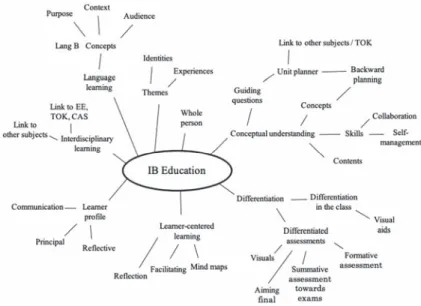
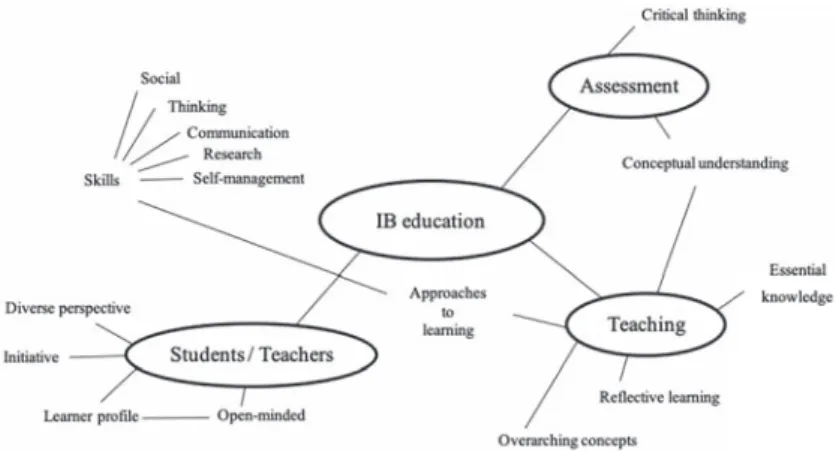
The first goal of the current study was to investigate participants’ understanding of IB education. First, participants’ concept maps, which are shown in Figures 1, 2 and 3, were examined in response to the question “Which aspects of IB education were salient parts of participants’
understanding?” Three general categories of concepts were found in the participants’ maps. The first category encompassed concepts related to the
philosophical underpinnings of IB education. This included terms such as “learner-centered learning”
and “learner profile”, which were shown on all three maps, as well as “conceptual understanding” and
“inquiry learning”, which were shown on two out of three maps, and “differentiation”, which was shown on only one of the maps. The second category included terms or ideas related to the structure of the IB curriculum, such as reference to assessment, shown on all three maps, as well as interdisciplinary learning or the distinction between themes, concepts, and topic. The third category included terms related to concrete classroom practices such as reflection, or skills or examples of approaches to learning such as self-management, collaboration, or discussion.
All three maps included some reference to elements in all of the categories.
Figure 1. Conceptual map (Participant A)
3.2 Understanding of Salient Concepts The nature of participants’ understanding of these concepts was explored by analyzing the concept maps and interviews in response to the following three sub-questions: (a) Was detail or elaboration provided for each concept? (b) Were connections made between concepts in the different categories described above (e.g., philosophical underpinnings, curriculum structure, and classroom practices)?, and (c) Were there striking individual differences in participants’ understanding? The questions will be addressed for each participant.
Participant A had experienced both the Middle Years Program (MYP) and Diploma Program (DP) as a student. Her teaching practicum was completed at a public high school in Japan, which was an IB World School. Her subject area is English B.
Participant A’s map (Figure 1) shows the most extensive detail among the three maps. For example, the key word “differentiation” was further linked to
“differentiation in the class” and “differentiated assessments”. “Differentiated assessments” was then elaborated into “formative assessments”,
“summative assessments”, “aiming toward final
Figure 2. Conceptual map (Participant B)
Figure 3. Conceptual map (Participant C)
exams” and “visuals”. Similarly, the concept
“conceptual understanding” branches out to
“guiding questions”, “concepts”, “skills”, and
“content”. “Guiding questions” and “concepts” are further connected to “unit planner”, “backward planning”, and “links to other subjects”. The ways in which each concept is elaborated in the map show that the participant is able to make links between abstract concepts that we have categorized as representing a philosophical underpinning of IB education (e.g., “differentiation”), elements of the curriculum (e.g., “assessment”) as well as practical classroom practices (e.g., “the use of visual aids”).
Participant B had also experienced the DP program as a student. Her subject area was also English B, and she completed her teaching practicum at an international IB World school in Japan.
Participant B’s map (Figure 2) does not reflect the detail and elaboration that is present in the map of Participant A. However, her map does show important links between the different sections or clusters within her map. For example, she links the
“teaching” cluster to the skills cluster through the concept “approaches to learning,” and she links the
“teaching” cluster to the “assessment” cluster through the concept “conceptual understanding.” In her interview, she articulated rich detail about each of the components in her map. For example, with respect to conceptual understanding, she explained that “there are always links between subjects, and those concepts link to different subjects, and because there are these concepts, I think students are able to make the learning relevant to themselves, and in addition to what they learn that is evaluated. I think conceptual understanding is reflected when they are able to apply the concepts to their own situation or when they encounter a different situation.” She is able to elaborate on how she understands the concept in concrete terms. With respect to “assessment,” she said, “The foundation is having criteria for the assessment, and also for what students produce. It’s
a matter of the reasoning underlying their opinions and conclusions and how logical their thinking is...
and also how logical the assessment itself is… when explaining students’ grades, it is logical to be able to always explain that this is the grade if this criteria is not fulfilled…”. In this way, she shows her own understanding of each of the concepts and how they are related to classroom practice.
Finally, Participant C had no firsthand experience of IB education as a student, encountering ideas about IB education for the first time in the Introduction to IB Programmes course. This is a crucial distinction from Participants A and B. Her IB subject is Japanese B. Her map (Figure 3) showed that she was aware of key components related to the philosophical underpinnings of IB education (“inquiry learning”, “student-centered learning”, and the IB “learner profile”) as well as aspects of the curriculum such as assessment (“exam”) and
“theme,” “topic,” and “concept” and classroom practice (“dialogue”). Nonetheless, in her interview, as she described her map, she also described her uncertainty about the details of some of these concepts or about how they applied to the actual classroom. For example, she stated, “the first thing that popped into my head was inquiry learning…
and one of the unique aspects of inquiry learning is that research and discussions are student-centered.
During my teaching practicum, I was asked how inquiry learning fits with language learning, and this is something I am still not sure about.”
3.3 Learning Experiences
The concept maps, interviews, and teaching practicum portfolios revealed insights about specific aspects of participants’ learning experiences during the teacher education program. Participant A emphasized two aspects of her coursework in her interview, with respect to developing her understanding about IB education: theoretical knowledge and micro-teaching. First, she explained
that her understanding deepened as she learned about the theoretical foundations of IB education, especially in reading a book on conceptual understanding for coursework. She said:
Since I had experienced MYP and DP as a student, I knew from the start generally what students do, but through the IB teacher certification program, I deepened my understanding about the theoretical background to the practice … After I learned about conceptual learning, I looked back on my learning in high school and could recognize, oh that was what was going on in my Japanese A class in high school… what the teacher intended or the reason behind the lessons I experienced and so the spring term [course title: Introduction to IB Programmes] was really interesting.
She went on to explain that in the autumn term [course title: Seminar in Philosophy of IB Education:
DP], she learned more about theory. Then she explained that the course Teaching, Learning and Assessment in the IB Programmes: MYP and DP was the first opportunity to actually try out the unit planner that she had made in the autumn term. She said, “actually trying it out made me think, and like even when you say differentiation, it is hard to do it and so in the winter term, I was able to apply the theory I learned to my actual teaching.”
With respect to her teaching practicum, journal entries included reference to salient concepts in her concept map (Figure 1). In particular, she made note of teachers’ use of guiding questions throughout her observations of lessons during her practicum.
Towards the beginning of her practicum, she wrote for example, “It seemed like students enjoyed grappling with questions that had no clear answer, and I realized that this attitude was created by how the teachers engaged with the students and how they developed the lesson.” Around this same time, she also wrote of her own teaching, “It was hard for me to come up spontaneously with questions to elicit students’ thoughts.” However, later on, she wrote, “I
prepared multiple questions so that I could select questions to use according to students’ reactions. I realized that concrete questions worked better than questions that were too abstract.”
When asked about the role of her teaching practicum in her learning process, Participant A explained that her teaching practice made her think about the contrast between studying to get points on the DP exam versus teaching according to IB principles. She remembered her own experience during high school and her own need to study toward the test during the few months preceding the exam, and contrasted that with the lessons that she observed during her practicum, that were based on IB principles and did not appear to be directly related to actual practice for the exam.
In summary, Participant A started with a general knowledge of the IB curriculum but was able to acquire a deeper understanding of the philosophical underpinnings of IB education through her coursework. She made connections between the principles and concrete classroom practices during micro-teaching and during her teaching practicum.
During her teaching practicum, it seems that she was further able to view IB education within the larger context of high school education in Japan, or within the school lives of the students.
Similar to Participant A, Participant B also started the course with knowledge about the IB curriculum from the student perspective. In her interview, she described two aspects of coursework that were especially influential in understanding, as she stated it, the “teacher’s perspective.” She described in detail learning activities in a course focused on MYP, which she did not take for credit, but audited.
She stated:
Even though I couldn’t attend all the classes, I was able to deepen my understanding of concepts because of this class. We had a reading, which was really difficult, and then we made a concept- based lesson plan. We were free to choose our
own concept, but then we didn’t focus on the subject that we had studied so far, like English B, but we were told like you are in charge of physical education. How would you apply this concept to physical education? We didn’t know how. But then because we didn’t know how, we discussed it a lot and I really remember that. I don’t think we really reached an answer but really thinking about it helped me to reflect the concept in my lesson plan.
As with Participant A, Participant B also emphasized the importance of micro-teaching during the course Learning, Teaching, and Assessment in IB Programmes. Interestingly, she mentioned that because her classmates were mainly from Japanese backgrounds, she felt she realized a difference between her own experience in an international school overseas and that of students within the Japanese school system. She added, “it might be that this perspective was built up because I had been taking my English language teaching certificate.”
Finally, with respect to her teaching practicum, Participant B’s journal entries made frequent reference to how the teacher created conditions for learner-centered learning. She noted quite a few examples of how the teacher encouraged self- management on the part of the students. For example, she noted:
The teacher reminded the students by talking about the schedule for next week. He did not mention in a way to force students to work outside of class. Rather, in order to achieve their quality of assignments to their expectation, he mentioned how it would require time outside of class. I felt students’ self-responsibility skills as well as a collaborative attitude in order to succeed.
In addition, she mentioned student-centered learning as follows:
Also, especially because the classes are currently conducted online, the teacher constantly asked
students for progress on their work. Overall, I learned that the balance between tracking student’s progress and giving space for them to work on their own pace is very important in student-centered learning.
She also noted connections between classroom practices and the final assessment:
When the teacher instructed the group discussion, he not only mentioned expectations of active participation but also clarified how to say your opinions by making connections to what classmates are saying. This skill is also important for them to succeed in their final assessments. I used to think that class discussions are conducted for the students to be more interactive and feel comfortable to speak up. But through the observations, I learned how the class discussion would be helpful to prepare for their finals too. I think this is a unique part of IB education, where contents, as well as the learning strategies, are highly related to their final assessments.
In summary, it seems that Participant B also was able to deepen her understanding of IB education through her coursework and also during her practicum, finding ways to connect the more abstract principles to actual classroom practices in both learning contexts.
Finally, Participant C described two experiences in particular in her interview. First, was her visit to observe an IB World School during the first course, Introduction to IB Programmes. During her interview, she recalled her visit as follows:
I had been somewhat frustrated at the time that I did not really understand what I was studying about, but then I saw with my own eyes that it was possible to create an environment for learning that I found very attractive, and that motivated me to continue to study more.
Her statement suggests that her visit to the IB school was crucial in helping her to overcome difficulties that were presented with coming to terms
with IB education in her coursework. Furthermore, she described her teaching practicum as the most powerful experience during the program as follows:
What I learned or did in class has gone into the edge of my memory…but my teaching practicum is very clear in my memory. What I discussed with the teachers there and what I discussed with the students remains a very big part of me.
She further explained about conversations with the teachers at the IB World School that stimulated her to think more deeply about IB education, such as the relationship between inquiry learning and language learning or about the challenges with teaching a foreign language within the IB curriculum.
In her teaching practicum portfolio, Participant C described the insights she gained about IB education, especially by contrasting what she had experienced in her own education and during her first practicum for her teaching license. For example, she wrote, “In IB education, students were encouraged to interact with others and come up with their original ideas to a question. The knowledge was not presented by the teacher, but the students built their knowledge by themselves.” Her quote here shows her appreciation for student-centered learning. Then, she continued:
Accordingly, the course and the class itself had a structure that allows the teacher and students to do so. Each class was created by following a theme, not grammatical items, so that students can learn in inquiry-based learning. This was the fundamental difference that I saw doing a practicum in two schools.
This quote shows that she recognized one of the fundamental principles of IB education and its relation to the curriculum and was able to articulate them in her own words, even if they were not articulated in more detail in connection with more specific classroom practices.
In summary, the findings above seem to show that Participant C benefitted greatly from her opportunities to observe and participate in IB
education firsthand, and that these experiences were essential to her learning.
The findings show that overall, all three participants, had formed their own representations of IB education that were thoughtful and integrated.
Their concept maps, interviews, and practicum portfolios showed that their learning consisted of theoretical knowledge, opportunities to make connections to practice within their courses, and opportunities to make connections between theory, practice, and the educational context in their practicum. These findings will be discussed below in relation to the implications for preservice teacher education.
4. Discussion
The implications for preservice teacher education meant to prepare students to teach in an IB context will now be discussed, with particular attention paid to what has been learned from the analysis of the three participants’ responses and potential improvements for such preservice education programs.
First, it should not be surprising that teachers who themselves have been IB students are better positioned to draw connections between key concepts, related practices, and underlying philosophical principals of an IB education.
Published literature documents teachers returning to their own primary and secondary learning experiences when embarking on their own teaching career, regardless of curriculum framework (Davis et al., 2006; Raymond, 1997; Zembal-Saul et al., 2002). Given that, their own formative educational experiences informed their understanding as practitioners, allowing them to make connections more quickly or of differing sophistication to practitioners for whom an IB education was first introduced in a tertiary setting. Whilst an IB education is no prerequisite for success as an IB
educator, and simply put, IB schools still form a minority of schools worldwide, teacher-preparation programs would not normally expect a substantial intake of IB-educated candidates. However, it is possible that such programs are subject to a self- selection bias; potential teachers who themselves were IB-educated could be more likely to select IB- focused preparation programs given their familiarity and presumed comfort with the program. The potential challenge facing tertiary administration and curriculum design faculty then becomes how to better position the learning engagements to leverage the experience of IB-educated preservice teachers to inform and enrich the understanding of those who did not have an IB education, and to do so early in the tertiary teacher preparation curriculum rather than near the end of the program. During classroom conversations with the participants in this study, it quickly became evident that preservice teachers with an IB background more readily embraced and engaged with activities that modelled ‘best practice’
as promoted by the IB such as open-ended inquiry, collaborative learning, concept-based education, and student-teacher codesigned criteria and rubrics.
Students who had come from non-IB schools struggled at first; when queried about their tertiary education, it appeared that those classes were also more teacher-centered and lecture-heavy. When asked about this one student in the MYP Education course, for example, replied, “Well, we did some group work, but the actual assessments we had were pretty traditional.” Faculties of education should therefore consider consistently modelling practices the preservice teachers themselves are encouraged to employ in their own practice, and do so from as early as the first year of the program, in order to remediate the lack of familiarity.
Second, a clear theme from the participants was that it was only after they began their practicums that all the pieces fell together. This, too, is supported in published literature, since it is often in the
application and reflection phases of an inquiry cycle that key understandings are achieved (Pedaste et al., 2015). The implication here is that the sooner a preservice teacher education program can bring the preservice teachers into actual classroom contexts, the more likely the preservice teachers are to make critical connections between theory and practice, and to better link disparate concepts together. Using the SOLO framework (Biggs & Collis, 2014) as a reference, the goal is to move preservice teachers from unistructural to multistructural understanding as quickly as possible, positioning them to achieve extended abstraction, through which they are able to apply concepts and skills in novel situations. This comes to mean their first teaching positions post- graduation in the context of this study. This proposed model of teacher education is not new. The University of Hawaiʻi at Mānoa’s MEdT Program, for example, has featured this model since the early 1990s, though it is not IB-specific. The need for practical experience is also a point made in an initial study of the first four IB teacher certification programs in Japan at the time of their inception (Ishida, 2016). By situating cohorts of preservice teachers within IB schools from the very start of the program, preservice teachers would be able to observe and experience an IB education ‘from the inside,” fostering conceptual and skill development long before the actual practicum. This would require a partnership with willing IB World Schools, but such partnerships would not be difficult to develop, given the IB’s strong support for broad community connections (e.g. Tsuru University and Yamanashi Gakuin High School (Asahi Newspaper, 2017)) . As one participant remarked during the concluding interview for their practicum, “I wish I could have practiced in a school like this much sooner because working with the teachers here helped me understand what the IB is all about.”
Lastly, it can be seen from the concept maps created by the participants in this study that such
mapping approaches offer a powerful tool for reflection and articulation of conceptual understanding; a concept-based curriculum such as the IB might have greater need for this approach than traditional content-based curricula. This would also model desirable practices for their own teaching careers.
5. Conclusions, Limitations, & Directions for Further Research
The current study focused on a small number of participants from just one IB teacher certification program in Japan. Therefore, the results are in no way representative of IB teacher education in this context. Since each participant is a unique case, it was only possible to provide a partial view of the learning taking place within this area and within the particular program. Still, the focus on a small number of participants in a specific program allowed for in-depth analysis and description of the data and made it possible to make meaningful connections between the curriculum and the learning process.
Expanding the project to include more students in the future will help to establish a more comprehensive view of the range of learning experiences in the program and within Japan. In addition, more longitudinal research that tracks student learning and the development of their cognition over the course of their studies would also contribute to further understanding of how curriculum elements interact and are integrated into preservice teacher learning.
Despite these limitations, the current study was able to bring to light the dimensions of learning that took place during this particular IB teacher education program, and highlighted in particular, the integration of theoretical and practical learning and how that learning was mediated by students’ past experiences as well as opportunities for experiential learning in the university classroom and in the
practicum classrooms. Importantly, the findings of this exploratory study suggest the need to insure that students have ample opportunity within the university classroom to learn from their peers, to participate in the kinds of teaching methods, principles, and assessments that they are learning about, and also for students to have contact with IB education from an early stage in their learning. The study itself also demonstrated a collaborative research endeavor between IB practitioners and university faculty, which is also an important step in ensuring collaboration in curriculum innovation and delivery.
Finally, concept maps were found to be a useful method to tap into students’ understandings for both pedagogical and research purposes. Further studies may expand the use of concept maps through quantitative analysis or in other ways, such as through examining changes in students’ maps across time.
References
Bailie, A. L. (2017). Developing preservice secondary science teachers’ pedagogical content knowledge through subject area methods courses: A content analysis. Journal of Science Teacher Education, 28(7), 631-649. doi:10.1080/10 46560X.2017.1394773
Biggs, J. B., & Collis, K. F. (2014). Evaluating the quality of learning: The SOLO taxonomy (Structure of the Observed Learning Outcome). Academic Press.
Borg, S. (2003). Teacher cognition in language teaching: A review of research on what language teachers think, know, believe, and do. Language Teaching, 36(2), 81-109. doi:10.1017/
S0261444803001903
Bransford, J. D., Brown, A. L., & Cocking, R. R. (2000).
How people learn. Washington, DC: National Academy Press.
Chichekian, T., & Shore, B. M. (2013). Concept maps provide a window onto preservice elementary teachers’ knowledge in the teaching and learning of mathematics. Canadian Journal of Education, 36(3), 47-71.
Davis, E. A., Debra, P., & Julie, S. (2006). Challenges new science teachers face. Review of Educational
Research, 76(4), 607-651.
Desimone, L. M., Porter, A. C., Garet, M. S., Yoon, K. S., &
Birman, B. F. (2002). Effects of professional development on teachers’ instruction: Results from a three-year longitudinal study. Educational Evaluation and Policy Analysis, 24(2), 81-112.
doi:10.3102/01623737024002081
Fang, Z. (1996). A review of research on teacher beliefs and practices. Educational Research (Windsor), 38(1), 47-65. doi:10.1080/0013188960380104 Farrell, T. S., & Ives, J. (2015). Exploring teacher beliefs
and classroom practices through reflective practice: A case study. Language Teaching Research : LTR, 19(5), 594-610.
doi:10.1177/1362168814541722
Finson, K. D., Beaver, J. B., & Cramond, B. L. (1995).
Development and field test of a checklist for the draw-A-scientist test. School Science and Mathematics, 95(4), 195-205.
doi:10.1111/j.1949-8594.1995.tb15762.x
Forrest, S. (2018). Can CPD enhance student-centred teaching and encourage explicit instruction of international baccalaureate approaches to learning skills? A qualitative formative assessment and summative evaluation of an IB school’s in- house CPD programme. Journal of Research in International Education, 17(3), 262-285.
doi:10.1177/1475240918816401
Gore, J. M., Griffiths, T., & Ladwig, J. G. (2004). Towards better teaching: Productive pedagogy as a framework for teacher education. Teaching and Teacher Education, 20(4), 375-387. doi:10.1016/j.
tate.2004.02.010
Government of Japan, Prime Minister’s Office. (2013).
Japan is Back. Retrieved from http://www.kantei.
go.jp/jp/singi/keizaisaisei/pdf/saikou_jpn.pdf International Baccalaureate Organization (2019).
What is an IB education? International Baccalaureate Organization.
Ishida, K. (2016). Nihon ni okeru kokusai bakaroreako suishin no haikei to kyoin yosei no kadai—
daigaku ni okeru kokusai bakarorea kyoin yosei ni chakumoku shite [The background to the promotion of International Baccalaureate schools in Japan and the agenda for teacher training : Focusing on IB teacher training in Universities].
Tokyo Daigaku Daigakuin Kyoikugaku Kenkyuka Kiyou [Bulletin of the Graduate School of Education, the University of Tokyo], 56, 157-166.
Iwasaki, K. (2018). Nihon: Gurobaruka to karikyuramu kaikaku [Japan: Globalization and curricular reform]. In K. Iwasaki (Eds.), Kokusai bakarorea no chosen: gurobaru jidai no sekai hyojun puroguramu [The challenge of international baccalaureate:
World standard program in the global era]. (pp.
155-174). Tokyo: Akashishoten.
Kelly, L. B. (2018). Preservice teachers’ developing conceptions of teaching English learners. TESOL Quarterly, 52(1), 110-136. doi:10.1002/tesq.375 Kokusai bakarorea koko to daigaku renkei Tsuru
Bunkadai Yamanashi Gakuin Ko [International Baccalaureate high school and university collaboration Tsuru University Yamanashi Gakuin Senior High School] (2017, May 26). Asahi Shimbun
Marx, R.W., Blumenfeld, P.C., Krajcik, J.S., Fishman, B, Soloway, E, Geier, R and Tal R.T. (2004). Inquiry- based science in the middle grades: Assessment of learning in urban systemic reform. Journal of Research in Science Teaching, 41(10), 1063-1080.
Miele, E. (2014). Using the draw-a-scientist test for inquiry and evaluation. Journal of College Science Teaching, 43(4), 36-40. doi:10.2505/4/
jcst14_043_04_36
Pajares, M. F. (1992). Teachers’ beliefs and educational research: Cleaning up a messy construct. Review of Educational Research, 62, 307-332.
doi:10.3102/00346543062003307
Peacock, M. (2001). Pre-service ESL teachers’ beliefs about second language learning: a longitudinal study. System, 29, 177-195.
Pedaste, M., Mäeots, M., Siiman, L. A., De Jong, T., Van Riesen, S. A., Kamp, E. T., Manoli, C., Zacharia, Z., &
Tsourlidaki, E. (2015). Phases of inquiry-based learning: Definitions and the inquiry cycle.
Educational Research Review, 14, 47-61.
Raymond, A. M. (1997). Inconsistency between a beginning elementary school teacher’s mathematics beliefs and teaching practice.
Journal for Research in Mathematics Education, 28(5), 550-576. doi:10.2307/749691
Ryan, A., Heineke, A., & Steindam, C. (2014). Preparing Globally Minded Teachers Through the Incorporation of the International Baccalaureate.
The Journal of Education, 194(3), 39-51.
Sheridan, L. (2016). Examining changes in pre-service teachers’ beliefs of pedagogy. The Australian Journal of Teacher Education, 41(3), 1-20.
doi:10.14221/ajte.2016v41n3.1
Shulman, L. S., & Shulman, J. H. (2004). How and what teachers learn: A shifting perspective. Journal of Curriculum Studies, 36(2), 257-271.
doi:10.1080/0022027032000148298
Twigg, V. V. (2010). Teachers’ practices, values and beliefs for successful inquiry-based teaching in the international baccalaureate primary years programme. Journal of Research in International
Education, 9(1), 40-65.
doi:10.1177/1475240909356947
Wheeldon, J., & Faubert, J. (2009). Framing experience:
Concept maps, mind maps, and data collection in qualitative research. International Journal of Qualitative Methods, 8(3), 68-83.
doi:10.1177/160940690900800307
Zak, K. M., & Munson, B. H. (2008). An exploratory study of elementary preservice teachers’
understanding of ecology using concept maps. The Journal of Environmental Education, 39(3), 32-46. doi:10.3200/JOEE.39.3.32- 46
Zembal-Saul, C., Krajcik, J., & Blumenfeld, P. (2002).
Elementary student teachers’ science content representations. Journal of Research in Science Teaching, 39(6), 443-463. doi:10.1002/tea.10032 Zhang, H., Yuan, R., & Liao, W. (2019). EFL teacher
development facilitated by lesson study: A Chinese perspective. TESOL Quarterly, 53(2), 542- 552.