Paper
Mukai, Yuka
* 1Yamashita, Ryohei
* 2Nagai, Mikiko
* 3Relative evaluation of Laotian students’ awareness of environmental issues
Introduction Background
Development within the Lao People’s Democratic Republic uses rich natural resources. At the same time, the country faces environmental issues such as water scarcity and deforestation. There are 23.68 million hectares of natural state land, out of which around six million hectares are deforested.
Around 0.77 million hectares of this area has been cleared to cultivate cash crops and plant trees (Phaengsuwan, 2017). Slash and burn agricultures are practiced in the mountain ranges; yet the extension of usable areas has rapidly progressed accompanied by the shortening of the fallow period since the 1980s (Inoue, 2015). This has resulted in land degradation, soil loss, and loss of diversity.
Approximately 90% of Laos’ land lies in the catchment area of the Mekong River allowing
for rich water resources; the electricity produced from hydroelectric power is the chief export. The creation of many hydroelectric power dams has forced emigration and changes within the river environment.
In Laos, an awareness of environmental issues is important to help solve these problems and make a sustainable society for the future. Laos’ current economy is growing rapidly; in 2017, the economic growth rate saw an increase of 6.8% (JETRO, 2018). As a result, the education sector is also expanding. The national gross enrolment ratio for the lower secondary education was 82.2% in 2016, an increase of 67.2% from the 1990s. Despite the national gross enrolment ratio for upper secondary schools being below 20% in the early 1990s, it increased to 47.8% in 2016 (Laos PDR, 2018). However, there are different frequencies of picking up garbage within the schools between elementary school and university, students pick up garbage in various regions under the guidance of a teacher who is a non-governmental organization (NGO) member.
* 1 4th year student, Department of Environmental Sciences, Ishikawa Prefectural University
* 2 Department of Environmental Sciences, Ishikawa Prefectural University
* 3 The United Nations University Institute for the Advanced Study for Sustainability, Operating Unit Ishikawa/Kanazawa
Abstract
This paper analyzed differences in the awareness of environmental issues and environmental educational experience among Laotian students who received positive environmental education and Japanese students who did not. Despite Laos having rich natural resources, there are scarce water resources, and there has been much deforestation due to plantations and slash and burn agriculture.
Young people’s awareness of environmental issues is important to solve these issues. We performed a questionnaire survey, and the analysis revealed that Laotian students had good experiences in environmental education and a good awareness of environmental issues but did not have positive knowledge concerning environmentally considerate behavior, implying that environmental education in Laos must change to include this behavior.
Keywords: Environmental Education / Laos / Awareness of Environmental Issues / Questionnaire Survey
Motivationandoutlineofthisresearch
B a s e d o n t h e p r e v i o u s s t u d i e s , w e hypothesized that many young people in Laos have experienced environment protection activities. To verify this hypothesis, participant observation in the actual education field was carried out to gain a deeper understanding of the present situation. The information obtained on the actual condition of environmental education and consciousness of the students was analyzed exploratively. The targets of this research were Laotian students who received positive environmental education and Japanese students who did not receive positive environmental education. As the awareness of environmental issues and the experience of environmental education of the Laotian young people are not well known, the research framework described below was designed using the question contents allowed in the participant observation.
There were two reasons behind the hypothesis. First, it was easy to separate the students by region in order to assess whether t h e y d i d o r d i d n o t r e c e i v e p o s i t i v e environmental education. In Ishikawa, the United Nations University Institute for the Advanced Study for Sustainability, Operating Unit Ishikawa Kanazawa (UNU-IAS OUIK) conducts environmental education in accordance with the sustainable development goals (SDGs) in the Noto area and collaborates with different regions. Both Suzu and Komatsu City are certified as the SDGs’ “Future Cities”;
thus it is easy to distinguish the environmental efforts depending on the region. Second, there have been many preceding studies regarding the Ishikawa people’s awareness of environmental issues.
Ishikawa has a globally important agricultural heritage system (GIAHS) as well as a biosphere conservation area and national park, and the biodiversity and nature in Ishikawa are globally acknowledged. Ishikawa also has a tiger beetle, Abroscelisanchoralis, that has been categorized as an endangered species by
the Japanese Ministry of the Environment. To protect them, some institutes, including the Ishikawa Prefectural University, have studied the Ishikawa people’s awareness of environmental issues.
There is abundant research on the effects of environmental education. However, studies on the common measures in different countries for international comparisons are not enough.
T h e r e f o r e , a n a c c u m u l a t i o n o f b a s i c considerations based on qualitative analysis using relative comparison is considered significant.
Areaofresearch
Geographicalinformation
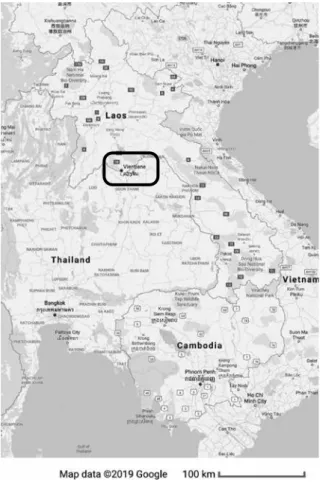
The research areas were Vientiane in Laos and Kanazawa, Kahoku, and Suzu City in Ishikawa, Japan. Laos is landlocked between Vietnam, Thailand, Cambodia, Myanmar, and China (Fig. 1), with a land area of 240,000
Fig. 1 Location of Vientiane Source: Google Map
Motivationandoutlineofthisresearch
B a s e d o n t h e p r e v i o u s s t u d i e s , w e hypothesized that many young people in Laos have experienced environment protection activities. To verify this hypothesis, participant observation in the actual education field was carried out to gain a deeper understanding of the present situation. The information obtained on the actual condition of environmental education and consciousness of the students was analyzed exploratively. The targets of this research were Laotian students who received positive environmental education and Japanese students who did not receive positive environmental education. As the awareness of environmental issues and the experience of environmental education of the Laotian young people are not well known, the research framework described below was designed using the question contents allowed in the participant observation.
There were two reasons behind the hypothesis. First, it was easy to separate the students by region in order to assess whether t h e y d i d o r d i d n o t r e c e i v e p o s i t i v e environmental education. In Ishikawa, the United Nations University Institute for the Advanced Study for Sustainability, Operating Unit Ishikawa Kanazawa (UNU-IAS OUIK) conducts environmental education in accordance with the sustainable development goals (SDGs) in the Noto area and collaborates with different regions. Both Suzu and Komatsu City are certified as the SDGs’ “Future Cities”;
thus it is easy to distinguish the environmental efforts depending on the region. Second, there have been many preceding studies regarding the Ishikawa people’s awareness of environmental issues.
Ishikawa has a globally important agricultural heritage system (GIAHS) as well as a biosphere conservation area and national park, and the biodiversity and nature in Ishikawa are globally acknowledged. Ishikawa also has a tiger beetle, Abroscelisanchoralis, that has been categorized as an endangered species by
the Japanese Ministry of the Environment. To protect them, some institutes, including the Ishikawa Prefectural University, have studied the Ishikawa people’s awareness of environmental issues.
There is abundant research on the effects of environmental education. However, studies on the common measures in different countries for international comparisons are not enough.
T h e r e f o r e , a n a c c u m u l a t i o n o f b a s i c considerations based on qualitative analysis using relative comparison is considered significant.
Areaofresearch
Geographicalinformation
The research areas were Vientiane in Laos and Kanazawa, Kahoku, and Suzu City in Ishikawa, Japan. Laos is landlocked between Vietnam, Thailand, Cambodia, Myanmar, and China (Fig. 1), with a land area of 240,000
Fig. 1 Location of Vientiane Source: Google Map
square kilometers and a population of approximately 6.49 million people (Ministry of Foreign Affairs, 2019). Vientiane is the capital city, with a population of around 907,000 people. A secondary school, high school, and an international school were the study sites in Vientiane. Compulsory education in Laos is nine years of elementary school and junior high school, similar to Japan.
Ishikawa is located in the center of the main island of Japan, on the coast (Fig. 2). It has a land area of around 4,185 square kilometers and a population of roughly 1,140,000 people.
The area north of Hakui City is called the Noto area (Ishikawa Prefecture, 2019).
ThelocalityofSuzuCityandKanazawa In 2011, the Noto peninsula was certified as having a GIAHS. Environmental education activities were conducted in the area in collaboration with the schools in the region.
The purpose of the education was to instill pride among students in the culture and nature of the Noto area. Workshops concerning environmental education were held by UNU- IAS OUIK in the Noto area to further spread environmental education. In addition, Suzu City was selected as an SDGs Future City. Therefore,
the students at elementary, junior high, and high schools received the SDGs’ environmental education. However, since 2010, 17 elementary schools in Kanazawa City have carried out activities to protect the environment, whereas only four junior high schools have participated in these activities. Thus, we presumed that there are many students who did not receive environmental education after graduating from elementary school.
AnalyticalFramework Method
We performed a questionnaire survey in three areas within the Noto locality: (i) where students received positive environmental education, (ii) near Kanazawa where students did not receive positive environmental education, and (iii) with students in Laos.
The questionnaire survey in Vientiane, Laos was conducted on December 11-13, 2018, and on January 16, 2019 (Fig. 3). On the other hand, the surveys in Kanazawa and Kahoku City, and Iida High School in Suzu City (Fig. 4), Japan were held on September 2018 and June to July 2019. There were 12 questions, but only 9 of them were used in this research analysis.
Students chose one answer in accordance with their viewpoint from the possible five response choices provided. In Vientiane, we assessed the questionnaire soon after the students had answered it.
Comparisonitems
We compared the answers obtained from Vientiane, Iida High School, and Kanazawa and Kahoku. The questions used for the comparisons are given in Table 1. Questions on the awareness of the environment around our daily lives, activities that protect the environment, and environmental education and its effects were asked in this survey. The answer choices are shown in Table 2. The sample sizes of each questionnaire were as follows: 198 in Vientiane, 43 in Iida High school in Suzu city, and 250 in other Japanese junior and high schools in Kanazawa and its suburbs.
Fig. 2 Location of Ishikawa prefecture
Resultsanddiscussion
Awarenessofenvironmentalissues
From all the answers obtained, the ones given to questions 1, 2, 3, and 9 were used for the analysis in this section.
For question 1, around 95% of all students answered with responses 4 and 5; 66.8% of the Laotian students’ and 76.7% of the Iida chose response 5 (Fig. 5). It seems that the opinion that the environment should be protected was common regardless of the respondentsʼ attributes.
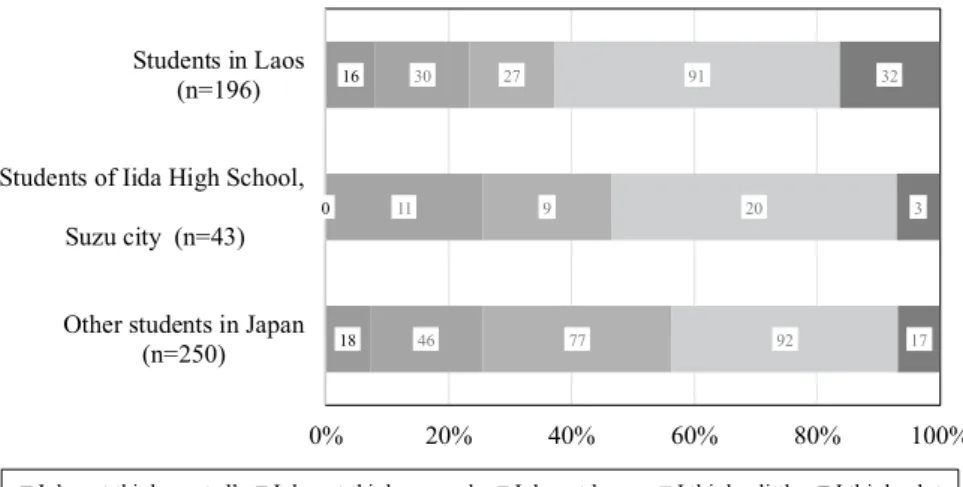
Question 2 found that Laos had the largest number of students who stated that we should protect the environment, despite a decrease in their quality of life. On the other hand, there is
no clear difference in the existence of environmental education in Japanese schools (Fig. 6).
For question 3, 46.9% of the Laotian students chose response 1. This accounted for the largest majority; 63.7% chose response 1 or 2, which was the lowest in these three categories of respondents. That is to say, the proportion becomes a little lower than the group which did not carry out environmental education in Japan when the students who chose "I do not think so much" are included (Fig. 7).
Fig. 3 View of survey in Vientiane (Photo by Mukai. Y)
Fig. 4 View of student answering a questionnaire at Iida High School
(Photo by Mukai. Y)
Table 2. Survey responses Choice Responses
1 I do not think so at all / I have never done it 2 I do not think so much/ I have only done it once 3 I do not know
4 I think a little / I have done it several times 5 I think a lot / I have done it many times
Table 1. Survey questions No. Questions
1 Do you think that we should protect the
environment (living things and water) around us?
2 If you had to decrease your quality of life to protect the environment, for example, use a motor bike less than normal, do you still think that you would try to protect the environment?
3 Do you think that you do not have to carry out environmental protection because someone else does it?
4 Have you participated in any events to protect the environment, such as picking up garbage?
5 Have you learned about garbage separation at school?
6 Do you think that life has changed after learning about garbage separation?
7 Have you learned about water resource management in school? For example, water pollution?
8 Do you think that life has changed after learning about water resource management?
9 Do you think it is troublesome to continue activities that protect the environment, even if the action is known to be good for it?
Resultsanddiscussion
Awarenessofenvironmentalissues
From all the answers obtained, the ones given to questions 1, 2, 3, and 9 were used for the analysis in this section.
For question 1, around 95% of all students answered with responses 4 and 5; 66.8% of the Laotian students’ and 76.7% of the Iida chose response 5 (Fig. 5). It seems that the opinion that the environment should be protected was common regardless of the respondentsʼ attributes.
Question 2 found that Laos had the largest number of students who stated that we should protect the environment, despite a decrease in their quality of life. On the other hand, there is
no clear difference in the existence of environmental education in Japanese schools (Fig. 6).
For question 3, 46.9% of the Laotian students chose response 1. This accounted for the largest majority; 63.7% chose response 1 or 2, which was the lowest in these three categories of respondents. That is to say, the proportion becomes a little lower than the group which did not carry out environmental education in Japan when the students who chose "I do not think so much" are included (Fig. 7).
Fig. 3 View of survey in Vientiane (Photo by Mukai. Y)
Fig. 4 View of student answering a questionnaire at Iida High School
(Photo by Mukai. Y)
Table 2. Survey responses Choice Responses
1 I do not think so at all / I have never done it 2 I do not think so much/ I have only done it once 3 I do not know
4 I think a little / I have done it several times 5 I think a lot / I have done it many times
Table 1. Survey questions No. Questions
1 Do you think that we should protect the
environment (living things and water) around us?
2 If you had to decrease your quality of life to protect the environment, for example, use a motor bike less than normal, do you still think that you would try to protect the environment?
3 Do you think that you do not have to carry out environmental protection because someone else does it?
4 Have you participated in any events to protect the environment, such as picking up garbage?
5 Have you learned about garbage separation at school?
6 Do you think that life has changed after learning about garbage separation?
7 Have you learned about water resource management in school? For example, water pollution?
8 Do you think that life has changed after learning about water resource management?
9 Do you think it is troublesome to continue activities that protect the environment, even if the action is known to be good for it?
For question 9, 41.8% of the Laotian students’
thought that continuing the activities to protect the environment was troublesome, which was the largest result (Fig. 8). These results found that the Laotian students had a comparatively good awareness of environmental issues, but they were not in favor of the activities for environmental protection.
Experienceofenvironmentaleducationandits effects
For question 4 of the survey, 86.3% of the Laotian students answered that they had participated in an event for environmental
protection, as against 67.5% of the Iida students (Fig. 9). In addition, 66.9% of the Laotian students answered that they had participated many times, as against 24.1% of the Iida students. There was no difference in the experiences of environmental education regarding garbage separation, but there were differences in its effects. In Laos, 41.4% of students answered that life had changed as a result, which was the largest in these three categories. For question 7, the Laotian students answered that they have not learned much on water resource management in school; yet the rate of the Laotian students who felt affected
Fig. 5 Responses to question one: Do you think that we should protect the environment (living things and water)around us? (Differentiated by respondent attributes)
84 9
57
152 33
131
0% 20% 40% 60% 80% 100%
Other students in Japan (n=250) Students of Iida High School,
Suzu city (n=43) Students in Laos
(n=196)
I do not think so at all I do not think so much I do not know I think a little I think a lot
Fig. 6 Responses to question two: If you had to decrease your quality of life to protect the environment, for example, use a motor bike less than normal, do you still think that you would try to protect the environment?
(Differentiated by respondent attributes)
18 0
16
46 11
30
77 9 27
92 20 91
17 3 32
0% 20% 40% 60% 80% 100%
Other students in Japan (n=250) Students of Iida High School,
Suzu city (n=43) Students in Laos
(n=196)
I do not think so at all I do not think so much I do not know I think a little I think a lot
by this was the largest. These results show that activities for environmental protection had been held many times and have influenced the students.
Discussion
The analysis results reveal that the Laotian students received comparatively better environmental education and had a good awareness of environmental issues. Their lives had changed through this, yet they felt that the action required for environmental protection was troublesome. We expect that the recent environmental education within Laos focuses on improving the awareness of environmental issues, rather than focusing on a
Fig. 7 Responses to question three: Do you think that you do not have to carry out environmental protection because someone else does it? (Differentiated by respondent attributes)
57 12
92
109 23
33
47 3 17
25 5 31
12 0 23
0% 20% 40% 60% 80% 100%
Other students in Japan (n=250) Students of Iida High School,
Suzu city (n=43) Students in Laos
(n=196)
I do not think so at all I do not think so much I do not know I think a little I think a lot
Fig. 8 Responses to question nine: Do you think it is troublesome to continue activities that protect the environment, even if the action is known to be good for it? (Differentiated by respondent attributes)
10 2
55
35 7
13
54 6
11
104 25 34
40 3 81
0% 20% 40% 60% 80% 100%
Other students in Japan (n=243) Students of Iida High School,
Suzu city (n=43) Students in Laos
(n=194)
I do not think so at all I do not think so much I do not know I think a little I think a lot
continuation of actions for environmental protection. This must change to a style that reflects the environmental issues around us and considers approaches to solve this problem through action. However, we should account for the educational inequalities between the local and urban areas. In local areas, many students do not receive compulsory education.
Hence, such areas must be surveyed. In the future, we must consider the differences in awareness and the methods of environmental education.
Conclusion
This paper analyzed the differences in
awareness of environmental issues and the
by this was the largest. These results show that activities for environmental protection had been held many times and have influenced the students.
Discussion
The analysis results reveal that the Laotian students received comparatively better environmental education and had a good awareness of environmental issues. Their lives had changed through this, yet they felt that the action required for environmental protection was troublesome. We expect that the recent environmental education within Laos focuses on improving the awareness of environmental issues, rather than focusing on a
Fig. 7 Responses to question three: Do you think that you do not have to carry out environmental protection because someone else does it? (Differentiated by respondent attributes)
57 12
92
109 23
33
47 3 17
25 5 31
12 0 23
0% 20% 40% 60% 80% 100%
Other students in Japan (n=250) Students of Iida High School,
Suzu city (n=43) Students in Laos
(n=196)
I do not think so at all I do not think so much I do not know I think a little I think a lot
Fig. 8 Responses to question nine: Do you think it is troublesome to continue activities that protect the environment, even if the action is known to be good for it? (Differentiated by respondent attributes)
10 2
55
35 7
13
54 6
11
104 25 34
40 3 81
0% 20% 40% 60% 80% 100%
Other students in Japan (n=243) Students of Iida High School,
Suzu city (n=43) Students in Laos
(n=194)
I do not think so at all I do not think so much I do not know I think a little I think a lot
continuation of actions for environmental protection. This must change to a style that reflects the environmental issues around us and considers approaches to solve this problem through action. However, we should account for the educational inequalities between the local and urban areas. In local areas, many students do not receive compulsory education.
Hence, such areas must be surveyed. In the future, we must consider the differences in awareness and the methods of environmental education.
Conclusion
This paper analyzed the differences in awareness of environmental issues and the
Fig. 9 Responses to question four: Have you participated in any events to protect the environment, such as picking up garbage? (Differentiated by respondent attributes)
45 2 7
39 7 17
32 5 3
96 22 56
38 7 113
0% 20% 40% 60% 80% 100%
Other students in Japan (n=250) Students of Iida High School,
Suzu city (n=43) Students in Laos
(n=196)
I have never done I have only done it once I do not know I have done it several times I have done it many times
experience of positive environmental education among Laotian students as compared to the negative education among Japanese students.
The results of the analysis found that the Laotian students had a good experience in environmental education and a good awareness of environmental issues but were not positive about environmentally considerate behavior.
Therefore, the focus of education must change from establishing awareness to remaining active in environmental protection practices.
Our current societies must pay attention to the educational inequalities between the local and the urban areas. Otherwise, the disparities in environmental awareness and the gap between the resulting capacities to act may widen within regions of the country and between countries.
However, the study has some limitations since it is based on the data collected through short-term participant observation. First, among the questions in Table 1, there were no clear differences other than those mentioned in Figures 5, 6, 7, 8, and 9, but the reasons for these differences cannot be clearly understood from the existing information. The second limitation is that each student was simply categorized according to whether environmental education is carried out by the school to which he/she belonged. Individual differences such as
the degree of understanding of environmental education of each student, which should be strictly grasped, were discarded. Third, as we performed this survey in an urban area, not in a local area. We need to consider the differences in awareness and the methods of environmental education in the future.
Acknowledgments
This research was supported by the program to support the overseas students by the Ministry of Education, Culture, Sports, Science and Technology (Tobitate!next, Japan) and financially by JSPS KAKENHI (18H03447, 19H03076). We appreciate the Laos and Japanese school officials who contributed to the survey and the staff of The United Nations University Institute for the Advanced Study of Sustainability, Operating Unit Ishikawa/
Kanagawa (UNU-IAS OUIK).
References
Phaengsuwan, A. 2012. Current environmental conditions in Laos, touching upon the policy and strategy of central and local governments. OECC Magazine.
https://www.oecc.or.jp/info/public/detail/575/.
(Accessed September 23, 2019).
Inoue, Y. 2015. Land-use and carbon stock of slash and burn ecosystems in mountains of Southeast
石川県立大学 生物資源環境学部 環境科学科 4 年生 向 由佳
石川県立大学 生物資源環境学部 環境科学科 山下 良平
国連大学サスティナビリティ高等研究所 OUIK 永井 三岐子
ラオス人学生の環境意識の相対的評価
Abstract
ラオスは豊かな天然資源を保有しているにもかかわらず、プランテーションや焼畑による森林減少や水 資源問題を引き起こしている。他方で、日本においても SDGs に関する教育が萌芽し、その成果の国内評 価や国際的な相対評価が望まれている。本稿では、ラオス人学生と積極的に環境教育を受けている日本人 学生、積極的に環境教育を受けていない日本人学生の、環境意識と環境教育受講経験の違いを分析した。
これらの課題を解決するためには、若い世代の環境意識が重要である。そこで、アンケート調査を実施し、
クロス集計によって各属性にみられる環境意識の差違を評価した。その結果、ラオスの学生の環境意識は 総じて高く、環境教育の受講経験の差違でみた日本の学生にも差が確認された。
キーワード : 環境教育/ラオス/環境意識/アンケート調査 Asia. (In Japanese). Journal of the Remote Sensing
Society of Japan 35(2):105–108.
https://www.jstage.jst.go.jp/article/rssj/35/2/35_105/_
pdf/-char/ja. (Accessed September 23, 2019).
Voluntary national review on the implementation of the 2030 agenda for sustainable development. 2018.
Lao People’s Democratic Republic.
http://www.la.one.un.org/images/publications/
VNR-web-very-low-resolution-.pdf. (Accessed September 12, 2019).
Global trade and investment report: Global economy connected via digitalization. 2018. JETRO.
https://www.jetro.go.jp/ext_images/world/
gtir/2018/13.pdf. (Accessed September 12, 2019).
Ministry of Foreign Affairs of Japan. 2019. Basic data.
https://www.mofa.go.jp/mofaj/area/laos/data.
html#section1. (Accessed September 12, 2019).