Ⅰ Introduction
Liver transplant (LT) recipients with hepatitis C virus (HCV) have a risk of recurrent hepatitis C. Liver cirrhosis (LC) due to the recurrence of HCV is a major cause of graft loss after LT. Interferon (IFN)-based therapy (IFN or peg-IFN with/without ribavirin [RBV]) has been administered for recurrent hepatitis C after LT, and a response rate of 30-40 % was reported
1)2). LT recipients frequently discontinued these treat
ments due to the relatively high incidence of compli
cations and an increased risk of rejection.
Some direct-acting antiviral agents (DAAs) have been approved and high sustained virological re
sponse (SVR) rates in non-LT HCV patients treated with DAAs have been reported
3)-7). Historically, DAAs have been used with IFN, (peg-IFN+RBV+tela
previr [TVR]/ simeprevir [SMV]). These regimens have been used in LT patients, and improved SVR rates have been observed. However, the frequency of adverse events with these regimens remains high
8)-10). Recent IFN-free DAA regimens, including combinations of daclatasvir (DCV) and asunaprevir (ASV)
3)4), sofosbuvir (SOF) and ledipasvir (LDV)
5)6), and SOF and RBV
7)reportedly have greater safety and efficacy. The regimens resulted in high rates of SVR in LT patients
11), and even remained high in patients with failed IFN therapy. Meanwhile, DAA
Interferon-free Anti-hepatitis C Virus Treatment for Long-term Liver Transplantation Recipients with
Failed Interferon Therapy
Kiyotaka H
osoda, Yuichi M
asuda*, Atsuyoshi M
itaand Akira K
obayashiFirst Department of Surgery, Shinshu University school of Medicine
Background : Recurrent hepatitis and cirrhosis due to hepatitis C virus (HCV) infection is a major cause of graft loss in liver transplant (LT) patients. Although interferon (IFN)-based therapy has been used in patients with recurrent hepatitis C after LT, the safety and efficacy of treatment remains unclear. IFN-free regimens with direct-acting antiviral agents (DAAs) against HCV showed excellent results in terms of sustained virological response (SVR) in non-LT patients. Recently, the efficacy of DAAs for LT patients has been reported. However, drug-drug interactions, the increasing risk of hepatocellular carcinoma (HCC), and the existence of drug- resistant gene variants require investigation in LT patients.
Method : This study included patients with recurrent hepatitis C after LT who failed IFN therapy and received IFN-free therapy. Medical records were reviewed retrospectively.
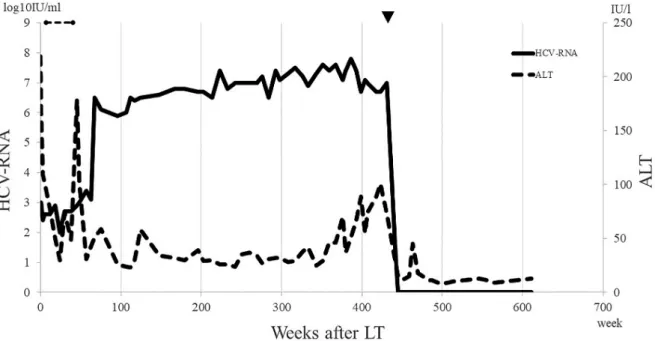
Results : Seven recipients were included. The median duration from LT to DAA treatment was 124 (34-181) months. HCV genotype was 1b in 6 patients and 2a in 1 patient. The Child-Pugh classification at IFN-free therapy was A in 6 patients and B in 1 patient. DAAs were used as follows : daclatasvir and asunaprevir in 3 patients, ledipasvir and sofosbuvir in 3, and sofosbuvir and ribavirin in 1. In all patients, sustained virologic response at week 24 was achieved without significant adverse events. No evidence of HCC has been observed.
Conclusion : HCV can be eradicated with interferon-free therapy in LT recipients with failed IFN therapy.
Shinshu Med J 67 : 417―423, 2019
(Received for publication March 28, 2019 ; accepted in revised form July 4, 2019) Key words : direct-acting antiviral agents, interferon, liver transplantation, hepatitis C virus
* Corresponding author : Yuichi Masuda
First Department of Surgery, Shinshu University School of Medicine, 3-1-1 Asahi, Matsumoto, Nagano 390-8621, Japan E-mail : [email protected]