The 7th International Conference of Asian Concrete Federation
“SUSTAINABLE CONCRETE FOR NOW AND THE FUTURE”
30 Oct – 02 Nov, 2016, Hanoi, Vietnam www.acf2016.vn
A STUDY ON UNDERSTANDIONG THE HYDRATION REACTION OF BLAST FURNACE CEMENT FOUCUS ON THE AMOUNT OF WATER CONSUMED
Takeshi Iyoda1, Takahiro Kameyama2 andYoko Harasawa3
1Professor, Shibaura Institute of Technology, Tokyo, Japan
2Penta-Ocean Construction Co. Ltd., Tokyo, Japan
3Tokyu Construction Co. Ltd., Tokyo, Japan
ABSTRACT: Hydration reaction of blast furnace cement has not yet been elucidated. According to previous research, it have been measured and evaluated the hydration reaction ratio such as ignition loss on the total binder.In this study we attempted to separate each of the amount of bounding water of Ordinary Portland cement and ground granulated blast furnace slag. Therefore, in addition to the total amount of bounding water, we have measured the hydration ratio of 4 minerals of cement. After that it was determined the water consumption of ground granulated blast furnace slag. As a result, BFS was found to increase the amount of water consumed by hydrationwith higherreplacement ratio of BFS.
Further the hydration of Ordinary Portland cement was confirmed to have been activatedin the high replacement of BFS of cement.
1 INTRODUCTIONS
In the field of Japanese civil engineering, it has been widely utilized blast furnace cement. So many studies have been recommended. It is progressed that the understanding of the characteristics of the concrete using the blast furnace cement. Furthermore, the researches which is cleared the mechanism for hydration of cement and blast furnace slag, and changed hydration products, are done as same as Ordinary Portland cement. However it is not clear the mechanism of hydration of blast furnace slag with cement, because the two different binder such as cement and blast furnace slag will be hydrated with water at the same time. So we will clear the hydration of both binder, we will check the assumed water for any binder hydration. The basic information to evaluate the conventional hydration ratio is used an amount of bounding water ratio. Until now there area lot of research has been done for the amount of bounding water ratio for hydration ratio. However many research are seeking for an amount of bonding water for not only each binder but also total of all binders.
In this study, the water of hydration reaction for the blast furnace cement such as total binders tried to separate asfor Ordinary Portland cement use and blast furnace slag powder use to bond (hereafter,called water consumption).In addition, for grasping the consumption amount of water of each binder ashydration time, it aimed at comparing the consumption balance and its speed of bonding water (water consumption) between the two members such as Ordinary Portland cement and blast furnace slag.In this study, we focused on the consumption amount of water, and we tried to clarify the hydration reaction of the blast furnace cement.
2 EXPERIMENT
2.1 Outline of specimens and method of sample processing 2.1.1 Outline of samples
The chemical components of the ordinary Portland cement for research (hereinafter referred to as N) and ground granulated blast furnace slag (hereinafter as BFS) used in this study shown in Table 1.The reason why the using the ordinary Portland cement for research, generally there is a report that limestone powder although the reaction rate of the cement mineral unchanged, but the reaction of the slag is affected. Therefore, the ordinary Portland cement for research that does not have limestone powder used in this research in order to remove these influences.Also Table 2 shows the cement type used in the study. Blast furnace cement in the Japanese standard (JIS), type A, Type B, Type C and more replacement ratio, it was replaced 20, 45, 70 and 85%of BFS in the part of the N. The water-binder ratio of the specimen was 35 and 55%.The reason for selecting this mix proportion, the amount of BFS on replacement as N, there is a change in the amount of water consumed by the hydration reaction in order to clear N and BFS. Further differences of the water-binder ratio is due to differences in the amount of water to provide a change in consumption amount of water in N and BFS.
Table1. Chemical components.
Table2. Mix proportion in this study (Binding ratio).
2.1.2 Method of sample processing
Mixing of the cement paste was carried out for 2 minutes by a hand mixer in a constant temperature at 20 degree Celsius and relative humidity at 60 %. It should be noted that it was put the batter in order to except the inference of bleeding. The sample was casting the thin dish is shown in Photo 1.After casting, it put a glass plate on the samples, it was allowed to stand for one day in a constant temperature and humidity room. The sample was sealed with a directly lap without removal from the mold on the next day. It was then cured to a predetermined timber age. The sample used for measuring the degree of hydration and the consumption amount of water was the preparation period on 4, 8, 12, 16 hours and 1, 2, 3, 5, 7, 14, 21, 28 days. After sample of passed period was released from the mold and was coarsely crushed by a hammer. Then sample put into a large amount of acetone for stopping hydration, and vacuum dried to obtain a sample was finely ground using grounding mill.
SiO2 Al2O3 Fe2O3 CaO MgO SO3 Na2O K2O TiO2 P2O5 MnO Cl OPC 3.16 3490 0.07 5.45 2.83 64.96 1.54 2.05 0.32 0.48 0.27 0.31 0.08 0.025
BFS 2.91 4230 35.29 14.53 - 43.85 4.64 - 0.22 0.34 0.53 0.01 0.12 0.01 cement
Specific surface area
[cm2/g]
Density [g/cm3]
contents(mass%)
OPC BFS
N 100
-
B20 80 20
B45 55 45
B70 30 70
B85 15 85
Name Binder ratio
Photo 1. Sample size.
2.2 Testing methods 2.2.1 X-Ray diffraction meter
It is analyzed the hydration ratio and hydration products by measurement of the powder X-ray diffraction as the D2 PHASER (BrukerAXS Inc.).It was carried out by adding the corundum(α-Al2O3) as inner dividing 10%. The measurement conditions of the powder X-ray diffraction isas following. X-rays source Cu-Kα, voltage 30 kV, current 10 mA, scanning range 2θ = 5 - 60 °, step width 0.025 °, and a scan speed 0.025 ° / min. The analysis using performed multiple peak separation by software TOPAS4.2, were calculated integrated intensity of the diffraction at each mineral peaks separated.Quantification using Igarashi’s researchwas conducted analysis from the result of measurement.Table 3 shows the target mineral of analysis in this study.
Table3. Peak data on XRD analysis.
The hydration rate calculated from resulting integrated intensity of each fourminerals by the equation (1).
∝𝑖 𝑡 = 100 −
𝑆 𝑖(𝑡)
𝑆 𝐴𝑙 2𝑂3(𝑡)×100 −𝐼𝑔 .𝑙𝑜𝑠𝑠 (𝑡)100 𝑆 𝑖(0)
𝑆 𝐴𝑙 2𝑂3(0)× 100 100 −𝐼𝑔 .𝑙𝑜𝑠𝑠 (0)
× 100 (1)
Here, t: period (hours),αi(t): hydration ratio of sample i during hydration period t (%) Si(t): Peak area of hydration period t by XRD, SAl2O3(t): peak area of Al2O3 by XRD
Si(0): peak area of un-hydrated sample by XRD, SAl2O3(0): Peak area of Al2O3 at un-hydrated time Ig.loss(t): ig.loss of hydration period t, Ig.loss(0): ig.loss of un-hydrated sample
In addition, the sum of hydration reaction rate of 4 minerals on Ordinary Portland cement referring to the research of Sagawa et al determined from the equation (2). However it is determined the quantitative value of 4 minerals obtained from the Rietveld analysis.In this study it was decided to use the value of the integrated intensity of 4 mineral.
𝑇𝑜𝑡𝑎𝑙 𝑜𝑓 𝑦𝑑𝑟𝑎𝑡𝑖𝑜𝑛 𝑟𝑎𝑡𝑖𝑜 𝑜𝑛 4 𝑚𝑖𝑛𝑒𝑟𝑎𝑙𝑠 𝑜𝑓 𝑐𝑒𝑚𝑒𝑛𝑡 % =
Minerals C3S C2S C3A C4AF α-Al2O3
Range 51.4-52.2 40.8-42.0 33.1-33.5 11.0-12.3 52.2-52.9 Peak 51.6、51.9 41.0、41.3、41.6 33.2 10.1、12.2 52.5
Used peak 51.6、51.9 41.0、41.6 33.2 12.2 52.5
100 − 𝑇𝑜𝑡𝑎𝑙 𝑜𝑓 𝑖𝑛𝑡𝑒𝑔𝑟𝑎𝑡𝑒𝑑 𝑖𝑛𝑡𝑒𝑛𝑠𝑖𝑡𝑦 𝑜𝑓 𝑦𝑑𝑟𝑎𝑡𝑒𝑑 4 𝑚𝑖𝑛𝑒𝑟𝑎𝑙
𝑇𝑜𝑡𝑎𝑙 𝑜𝑓 𝑖𝑛𝑡𝑒𝑔𝑟𝑎𝑡𝑒𝑑 𝑖𝑛𝑡𝑒 𝑛𝑠𝑖𝑡𝑦 𝑜𝑓 𝑢𝑛 −𝑦𝑑𝑟𝑎𝑡𝑒𝑑 4 𝑚𝑖𝑛𝑒𝑟𝑎𝑙𝑠 (2) 2.2.2 TG-DTA
It was analyzed the amount of the calcium hydroxide (CH) and theIg.loss by TG-DTA test(BrukerAXS Co., Ltd.). The measurement was carried out until 1000 degree Celsius rising rate of 10 degree Celsius / min on N2 flow environment. Calcium hydrate was calculated using the weight change amount of the TG curve from the inflection point of the DTA curve. In addition, to calculate the amount of bounding water from the weight loss value from 105 degree Celsiusto 1000 degree Celsius.
3 EXPERIMENTAL RESULTS AND DISCUSSIONS 3.1 Hydration of blast furnace slag cement 3.1.1 Ignition loss
Figure 1 shows the results of amount of bounding water was measured by TG-DTA in each formulation.
It can be seen that the amount of bounding water is reduced due to generally increase of BFS replacement rate in the water-binder ratio. The amount of bounding water is high as the higher water- binder ratio and slope of hydration ratio after 7days is flat. It means the hydration is continuing until long age. On the other hand, in the low water binder ratio, until the age of 7 days is a steep slope of the graph. Thereafter, the flat. Reaction is rapid until the age of 7 days, after that it gently reacted.
Figure 1. Total amount of water ratio on different cement type.
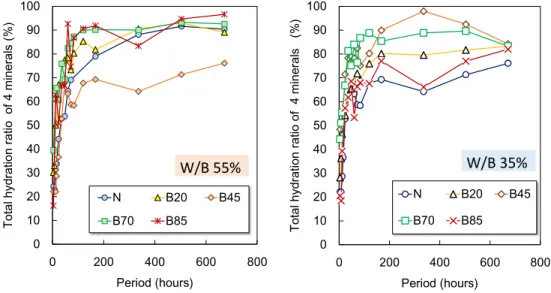
3.1.2 Total hydration ratio of cement
It shows the sum of the reaction rate of the cement 4 minerals were quantified from XRD in each formulation in Figure 2. Compared to that of the N single by also replacing the BFS in either water binder ratio, the reaction of the cement 4 minerals can be confirmed to have been activated in all mix proportions except B55 of B45 on water binder ratio 0.55. The cause of this B45 only anomalous result is obtained, but experimental error and the like are considered, not clear, is believed to require even re- experiment, we examined or the like in the future. In addition, the results of those in the only N on small
0.0 2.0 4.0 6.0 8.0 10.0 12.0 14.0 16.0 18.0 20.0
0 200 400 600 800
Total amout of water ratio ( ig.loss) (%)
Period (hours)
N B20 B45
B70 B85
W/B 55%
0.0 2.0 4.0 6.0 8.0 10.0 12.0 14.0 16.0 18.0 20.0
0 200 400 600 800
Total amount of water ratio (ig.loss) (%)
Period (hours)
N B20 B45
B70 B85
W/B 35%
water binder ratio is low, the reaction rate of the cement 4 mineral was obtained. In high water binder ratio, in which the system is in the vicinity of the initial in the BFS substituted system Although the reaction of the cement 4 minerals (age of up to 7 days) is activated except for the B45 age of 28 days (672hr) also it became the same level of reaction rate. On the other hand, in the low water-binder ratio is compared to the reaction rate of the cement 4 mineral system was BFS replaced by age of 28 days, the results of those of the reaction rate of the cement 4 mineral at the N alone is low is obtained.
Figure 2. Total hydration ratio of 4 minerals of cement on different cement type.
3.2 Consumption of water for hydrations 3.2.1 Method of calculate consumption water
It has been reported that the total amount of bounding water and reaction rate on 4 minerals of cement obtained is highly correlated. This study focuses on that, the relationship of the amount of bounding water of Ordinary Portland cement is assumed to be same as the different cement types. From this assumption, the amount of bounding water in each mix proportion, the product of the content of Ordinary Portland cement in the blast-furnace slag cement, it was assumed the amount of bounding water of Ordinary Portland cement in the blast-furnace slag cement in formula (3).
𝐴𝑚𝑜𝑢𝑛𝑡 𝑜𝑓 𝑏𝑜𝑢𝑛𝑑𝑖𝑛𝑔 𝑤𝑎𝑡𝑒𝑟 𝑜𝑓 𝑁 𝑖𝑛 𝑡𝑒 𝑏𝑙𝑎𝑠𝑡 𝑓𝑢𝑟𝑛𝑎𝑐𝑒 𝑠𝑙𝑎𝑔 𝑐𝑒𝑚𝑒𝑛𝑡 % =
𝑇𝑜𝑡𝑎𝑙 𝑎𝑚𝑜𝑢𝑛𝑡 𝑜𝑓 𝑏𝑜𝑢𝑛𝑑𝑖𝑛𝑔 𝑤𝑎𝑡𝑒𝑟 % × 𝑐𝑜𝑛𝑡𝑒𝑛𝑡 𝑜𝑓 𝑁 𝑖𝑛 𝑏𝑙𝑎𝑠𝑡 𝑓𝑢𝑟𝑛𝑎𝑐𝑒 𝑠𝑙𝑎𝑔 𝑐𝑒𝑚𝑒𝑛𝑡 (%)(3)
The separation of the consumption water amount by using the above method, was performed in the following procedure.
Figure 3 shows the relationship between the amount of bounding water andthe total hydration ratio of the 4 mineral of cement on Water binder ratio is 0.55 of the N cement.As described
0 10 20 30 40 50 60 70 80 90 100
0 200 400 600 800
Total hydration ratio of 4 minerals (%)
Period (hours)
N B20 B45
B70 B85
W/B 55%
0 10 20 30 40 50 60 70 80 90 100
0 200 400 600 800
Total hydration ratio of 4 minerals (%)
Period (hours)
N B20 B45
B70 B85
W/B 35%
Figure 3. Relationship between hydration ratio of 4 minerals and Consumed water ratio.
Figure 4. Relationship between total hydration ratio of 4 minerals and Consumed water ratio.
above,it assumedthe hydration ratio of N on each mix proportion by using multiplied the bounding water and content ratio of N. The results are shown in Figure 4.
For example, in the case of B70, it has been obtainedthe entire amount of bounding water of the total hydration ratio and hydration ratio of the cement 4 mineral in this experimentin Figure 5. Therefore, it substituted the sum of the hydration ratio of the 4 minerals cement, it is possible to calculate the consumed amount of water on Ordinary Portland cement and blast furnace slagfrom equation (4)
0.0 5.0 10.0 15.0 20.0
0 20 40 60 80 100
Consumed water ratio (%)
Total hydration ratio of 4 minerals (%)
y = 0.1462x + 0.4167
0.0 2.0 4.0 6.0 8.0 10.0 12.0 14.0 16.0 18.0
0 20 40 60 80 100
Consumed water ratio (%)
Total hydration ratio of 4 minerals (%)
B20-55%
y = 0.1005x + 0.2865
0.0 2.0 4.0 6.0 8.0 10.0 12.0 14.0 16.0 18.0
0 20 40 60 80 100
Consumed water ratio (%)
Total hydration ratio of 4 minerals (%)
B45-55%
y = 0.0557x + 0.133
0.0 2.0 4.0 6.0 8.0 10.0 12.0 14.0 16.0 18.0
0 20 40 60 80 100
Consumed water ratio (%)
Total hydration ratio of 4 minerals (%)
B70-55%
y = 0.0274x + 0.0781
0.0 2.0 4.0 6.0 8.0 10.0 12.0 14.0 16.0 18.0
0 20 40 60 80 100
Consumed water ratio (%)
Total hydration ratio of 4 minerals (%)
B85-55%
𝐶𝑜𝑛𝑠𝑢𝑚𝑒𝑑 𝑤𝑎𝑡𝑒𝑟 𝑜𝑓 𝐵𝐹𝑆 % =
𝑇𝑜𝑡𝑎𝑙 𝑖𝑔. 𝑙𝑜𝑠𝑠 𝑜𝑓 𝑐𝑒𝑚𝑒𝑛𝑡 % − 𝑐𝑜𝑛𝑠𝑢𝑚𝑒𝑑 𝑤𝑎𝑡𝑒𝑟 𝑜𝑓 𝑁 𝑖𝑛 𝑏𝑙𝑎𝑠𝑡 𝑓𝑢𝑟𝑛𝑎𝑐𝑒 𝑠𝑙𝑎𝑔 𝑐𝑒𝑚𝑒𝑛𝑡 (%) (4)
Figure 5. Estimated method for amount of consumed water of BFS.
3.2.2 Different of consumption water
It obtained by the separation method was performed in 3.2.1, the result of consumption water content of N and BFS for each mix proportion is shown in Figure 6. The estimate value of B20 is under zero, which is presumed to become such a result for the original calculation of the assumptions. In this study, it was considered the case of under zero bounding water of BFS doesnot consume water. First, in the highwaterbinder ratio with an increase in the replacement rate of BFS, consumption water increases.It was the result which consumed amount of water in B70 is larger than the N. The consume water is not consumed in early ageon B20 and B45. On the other hand, it can be seen that continues to consume water over time with B70. In the lowwaterbinder ratio, with an increase in the high water binder ratio as well as the replacement rate, it is also increasing consumption water content of BFS. This less water that can bind because it is low water binder ratio, reaction is stopped on N and also BFS, it believed that there may not be consumed water. On the other hand, in the case of high water binder ratio such as B70 are consuming water in long term, BFS is considered to consume water comparedwith N. Thus since the high water binder ratio are present a lot of water that can be consumed, N and also BFSare thought react well.
y = 0.0557x + 0.133
0 2 4 6 8 10 12 14 16 18 20
0 20 40 60 80 100
Consumed water ratio (%)
Total hydration ratio of 4 minerals (%)
OPC B70
B70-55%
Amount of water consumption derived from the BFS
Figure 6. Estimated Consumed water ratio of BFS on different cement type.
4 CONCLUSION
It was summered in this study as following
(1) The amount of bounding water is decreased due to the increase in the replacement ratio of BFS on Blast furnace slag cement. In addition, the results of bounding water on lowwaterbinder ratio is slightly smaller compared with highwaterbinder ratio.
(2) When it coexisting with BFS and N, total hydration ratio of 4 minerals on N cement is high value compared with that in N alone. It think about the reason why BFS is activated the reaction of N.
(3) With the increase of the replacement ratio of BFS instead of N, the consumption water content tends to increase. In the case of high replacementof BFS such as B70, the consumption water content of BFS is increased compared with N.
(4) In the case of high water binder ratio, the reaction is able to reaction well for lots of react able water. On the other hand, in the case of the low waterbinder ratio, it is considered that there is not possibility for reaction.
References
Harutake IMOTO, Etuo SAKAI and Masaki DAIMON. (2003) “Hydration analysis on blended cement”, Journal of JCI Annual convention, 25(1): 41-46
Takahiro SAGAWA, Tetsuya ISHIDA, Yao LUAN and Toyoharu NAWA (2010) “Hydration composition analysis and micro structure characteristics of Portland cement- Blast furnace slag system”, Journal of JSCE E, 66(3): 311-324
(4.0) (2.0) 0.0 2.0 4.0 6.0 8.0 10.0 12.0 14.0 16.0
0 200 400 600 800
Consumed water ratio (%)
Period (houts)
N BFS
B45-55%
(4.0) (2.0) 0.0 2.0 4.0 6.0 8.0 10.0 12.0 14.0 16.0
0 200 400 600 800
Consumed water ratio (%)
Period (houts)
N BFS
B70-35%
(4.0) (2.0) 0.0 2.0 4.0 6.0 8.0 10.0 12.0 14.0 16.0
0 200 400 600 800
Consumed water ratio (%)
Period (houts)
N BFS
B20-55%
(4.0) (2.0) 0.0 2.0 4.0 6.0 8.0 10.0 12.0 14.0 16.0
0 200 400 600 800
Consumed water ratio (%)
Period (houts)
N BFS
B45-35%
(4.0) (2.0) 0.0 2.0 4.0 6.0 8.0 10.0 12.0 14.0 16.0
0 200 400 600 800
Consumed water ratio (%)
Period (houts)
N BFS
B20-35%
(4.0) (2.0) 0.0 2.0 4.0 6.0 8.0 10.0 12.0 14.0 16.0
0 200 400 600 800
Consumed water ratio (%)
Period (houts)
N BFS
B70-55%