ソフト溶液反応による酸化亜鉛粒子膜 の精密構造制御と高次機能性
殷 澍 Shu YIN
E-mail: [email protected]
第27回無機材料に関する最近の研究成果発表会 東海大学校友会館, Jan. 25, 2010
Institute of Multidisciplinary Research for Advanced Materials, Tohoku University
2-1-1 Katahira, Aoba-ku, Sendai 980-8577, JAPAN
微細構造、形態制御によるセラミックス材料の環境刺激応答機能性制御 1.微粒子; 2.薄膜の微細構造と形態・組成制御
ソフト溶液反応は有効、且つ環境にやさしい材料合成手段
可視光応答型光触媒 紫外線遮蔽材料 高輝度発光材料 表面機能材料
h+ e-
hυ
Eb UV遮蔽材料
光触媒材料
発光材料 e- + h+→hυ hυ→ e- + h+ e- + O2→ ・O2- h+ + OH- → ・OH
光誘起機能
超撥水性 超親水性
Absorption
オゾン層
皮膚
UV
窒素ドープ酸化チタン 光触媒
大気浄 化
脱臭
防汚 浄水
抗菌
NOx、SOx
タバコ臭
有機塩素 化合物
細菌
砂、埃
溶液プロセスによる機能性無機材料のナノ構造制御--研究のコンセプト
TiO 2 CeO 2 Re 2 O 3 ZnO
Temperature (T)
Free energy (G)
Va por P la sma
S uperc ooled melt
Aqe ous solution
S olid C era m ic
m ater ials (solid)
Melt Glass
△Gv
△Gm
△Ga q.s ol
Ultra high
P ressure Environmenta lly str essed High pr essure
Hydr othe rmal S olution
F lux
S olid sta te r ea ction Melt Environm enta lly stresse d
Va por de position
Environmenta lly str essed
P la sma
Ultra high tem per ature
0 1000 2000
Temperature (ÞC)
10 12 14
0 8 6 4
Log pressure (Pascal) 2
Fig. Schematic energy diagram (G-T) in a single component system[*]. Fig. Schematic P-T diagram for preparative techniques[*].
*M.Yoshimura etc. Solid State Ionics, 98, 197-208, 1997
処理プロセスとエネルギー消費 - 溶液プロセス ---- 環境に優しいプロセス
Introduction
Table Advanced Oxide Powder Process Comparison [*, **]
Conventional Sol-Gel Coprecipitation Hydrothermal / Solvothermal
Cost Low-moderate High Moderate Moderate
Composition Control Poor Excellent Good Excellent
Morphology Control Poor Moderate Moderate Good
Powder reactivity Poor Good Good Good
Purity(%) < 99.5 > 99.5 > 99.5 > 99.5
Homogeneity Poor Very good Good Very good
Agglomeration Moderate Moderate High Low
Calcination step Yes Yes Yes No
Milling step Yes Yes Yes No
Ref.* Dawson, W. J., 1988, Am. Ceram. Soc. Bull., 67, 1673-1678.
**Cousin, P., and Ross, R. A., 1990, Mater. Sci. Eng., A130, 119-125.
Why Hydrothermal / Solvothermal ?
Hydrothermal Process
It has become a promising method for material synthesis because of the possibility of producing nanosize crystals with soft agglomeration, and controlling the phase
composition or morphology by optimizing reaction
conditions, shows advantages in novel material synthesis.
Instead of water, some organic solvents can be used as reaction media Æ Solvothermal Process
Table Physical properties of various solvents[*]
Solvent b.p. Viscosity Dielectric Thermal (25oC) Constant conductivity / oC / mPas (20oC) (25oC)/ Wm-1K-1
Water 100 0.890 80.1 0.607
EtOH 78.2 1.074 25.3 0.169
Propanol 97.2 0.321 20.8 0.154
Butanol 117.7 2.544 17.84 0.154
Ethylene glycol 197.8 16.1 41.4 0.256
Glycerol 290 934 45.7 0.292
1,2-Propanediol 187.6 40.4 27.5 0.200
1,3-Propanediol 214.4 - 35.1 -
1,3-Butanediol 207.5 - 28.8 -
1,4-Butanediol 230 - 31.9 -
1,5-Pantanediol 238 - 26.2 -
1,6-Hexanediol 208 - 25.86 -
*D.Lide and H.Frederikse (ed.) CRC Handbook of Chemistry and Physics, 76th Edn., CRC Press, Inc., NeYork, 1995-1996.
溶液反応に用いられる溶媒の性質
Introduction
Photographs: http://www.ruilaibao.com/html/index.html
ZnO:
古くて新しい素材幅広い応用
ウルツ鉱結晶構造: 六方晶、c-axis: 極性 近年:
半導体としての新しい性質が注目されて いる:
圧電性(中心対称を持たないため) 酸化亜鉛透明導電膜(In代替材 ) 色素増感太陽電池
青色発光LED(GaN代替材 ) など
顔料
化粧品 医薬品
食品添加剤
電子材料 工業原料
ゴム添加剤
陶器
Zhonglin Wang, et Piezoelectric Nanogenerators Based on Zinc Oxide Nanowire Arrays
Science, 312,2006,242
Introduction
ZnO のユニークな形態を応用する研究例 Nanogenerators
Zhonglin Wang, et
Piezoelectric Nanogenerators Based on Zinc Oxide Nanowire Arrays
Science, 312,2006,242
Introduction
ZnO のユニークな形態を応用する研究例Nanogenerators
Z.L. Wang, et alPiezoelectric Nanogenerators Based on Zinc Oxide Nanowire Arrays, Science, 312,2006,242
Z.L. Wang, Self-assembled nanoarchitectures of polar nanobelts/nanowires, J.Mater.Chem, 15,2005, 1021
Introduction
ZnO has wide applications in short-wavelength ultraviolet lasers, blue light emitting diodes (LEDs), photocatalytic reaction, solar cell, sensor, pigments, UV shielding material, etc. It is expected that the physical-chemical properties greatly change with the morphology of the zinc oxide crystals. It is important to synthesize ZnO with
high specific surface area and controllable morphology.
ZnO is a very old material, recently, very new functions were discovered.
Solid-State Thermal Sublimation Process:
微細構造の制御された酸化亜鉛はバルク材料にないスマートな特性が期待される
In the present talk:
溶液プロセスによる酸化亜鉛の形態制御realize the morphological control by a low-temperature heating process using various organic solvents;
clarify the crystalline growth mechanism of ZnO with nano structures.
Effect of zinc concentration, reaction time, reaction media, kinds of precipitates
C6H12N4+ 6H2O Æ6HCHO + 4NH3 (Hydrolysis) (1)
N2H4CO + H2O ÆCO2+ 2NH3 (Hydrolysis) (2)
Zn2++ 4NH3 + 4H2OÆZn(OH)2+4NH4++ 2OH-
Æ [Zn(NH3)4]2+ +4H2OÆ ZnO + 2OH- + 4NH4++H2O (Precipitation & Crystallization) (3)
Precursor: [Zn2+]: Zn(NO3)2 ・6H2O : ZnCl2; Zn(AC)2・2H2O; ZnSO4 Precipitates: Hexamethylenetetramine (HMT, C6H12N4) ; Urea(N2H4CO)
[Zn2+ ] : [HMT] or [urea]= 1:1 Reaction Media/Additives: Aqueous solution
Organic solvent-aqueous solutions mixture
(e.g. Alcohols, Hexane, Ethylene Glycol ) et al.
Reaction Conditions: 95oC, 3-192 h,
together with a glass substrate
特性評価例:
発光特性 光触媒活性 UV遮蔽特性 親水性、撥水性
センサー特性
キーワード:精密構造制御と高次機能性
Effect of Zn
2+concentration ---- Aqueous reaction system
核生成速度制御Fig. SEM photographs of ZnO powders prepared by heating various concentration of Zn2+-HMT aqueous solution at 95oC for 3h.
1M [Zn2+] 0.01M [Zn2+]
0.0001M [Zn2+] 0.001M [Zn2+]
0.1M [Zn2+]
0.001M [Zn2+]
Homogeneous ZnO film on substrate with
well -dispersed fine hexagonal particles
ZnO nano-rod can not be produced at high zinc concentration [Zn
2+] > 1 M
- Low concentration/precipitation rate prefer to form perfect crystalline structure
The crystalline size & aspect ratio of nano-rod decreased with [Zn
2+] concentration
Morphological Control ---- in Aqueous reaction system
SEM images of (a)hexagonal and (b)screw-like ZnO nano rod prepared by heating Zn
2+-HMT aqueous solution at 95
oC for 3 and 76 h, respectively.
95
oC, 3h 95
oC, 76h
Microstructure of ZnO also changed with treatment time
Zn/HMT = 1:1
Formation mechanism of the nanoscrews from nanorods
During the “Dissolution - Reprecipitation” process:
The existence of complex and molecules may affect the precipitation position
NH4+adsorption site : Dissolution Site
[Zn(NH3)4]2+ complex site : Precipitation Site
Selective precipitation on different direction /surface
In most case, because of the repulsion force among the disks, [Zn(NH3)4]2+ complex preferred to be adsorbed on the edge of the disks and crystallized to form large (001) area and lead to the “Formation of Parallel Disks”.
-- Low concentration prefers to form thin and large circle structure ?
Formation mechanism of ZnO nano screw
192 h 76 h
3.0 h
Microstructure:Related to the Dissolution - Reprecipitation process Dissolution: lead to decrease of diameter of
HEXAGONReprecipitation [at very low Zn
2+concentration]:
Lead to increase of diameter of
SCREW&
surface area001 001
001 001 001
110 100- 010
J.Mater.Chem., 15, 4584-4587, 2005.
[0001]
SEM, TEM, and electronic diffraction pattern of the screw-like ZnO nano particles prepared by heating Zn
2+-HMT aqueous solution at 95
oC for 192h.
ZnO Nano Screw --- Oriented growth of Zinc Oxide
001 001
Solvent effect:
different dielectric constant viscosity
shows different diffusion coefficient different solubility of ZnO
lead to different nuclear formation rate different morphology
during the dissolution-reprecipitation process.
Surfactant / Additive:
affect the adsorption of ions on different crystal planes
Zinc complex formation:
affect the nuclear growth during the reprecipitation Zinc ion: easy to form 4-coordinated tetrahedron structure
6-coordinated octahedron structure Structure of zinc complex: affected by the existence of
ammonia, HCHO, CO
2and solvent (e.g. EG)
Effect factors on the microstructure of ZnO particles:
Photocatalyst: Light Induced Hydrophilic Mechanism A.Fujishima, Nature,388, 431 1997
Lotus Leaf: Microstructure Hydrophobic Mechanism http://www.snpc.org.cn/train/view.asp?ID=1061
Water-repellent legs of water striders
L.Jiang, Nature,432, 36, 2004
Application:
Self Cleaning
Hydrophilicity of ZnO film with various morphologies
Superhydrophobic surface
Superhydrophilic surface
光照射なし!光触媒と異なる超親水化メカニズム!
超溌水
超親水
同一材料にもかかわらず、形態の異なるものは正反対的な性質を示す
Superhydrophobic surface Superhydrophilic surface
Fig. The chemical luminous intensity and the contact angle of water drops on the surface of ZnO films of ZnO films prepared by heating Zn
2+-HMT
aqueous solution at 95
oC for various reaction times.
Physical-Chemical Properties
0 40 80 120 160
0 25 50 75 100 125 150 175 200
Contact Angle (degree)
Reaction time (h)
Nano rod superstructures
Nano-screw superstructures
0 2000 4000 6000 8000 10000
0 20 40 60 80 100 120 140
Chemical Luminous Intensity (cps)
Reaction time (h) Superhydrophobic
Surface
Superhydrophilic Surface
Active oxygen species Water contact angle
Effect of EG Additive & Reaction Time
(a)-12h (a)-24h (a)-120h
( b)-120h
SEM images of ZnO crystal prepared in (a) aqueous solution (b) 50%EG solution for 12h; 24h; and 120h.
( b)-12h ( b)-24h
SEM images of ZnO crystals prepared in EG Solution with different concentrations (a) 30% (b)50% (c)70% (d)80%
30 40 50 60 70 80 0
1 2 3 4 5 6
aspect ratio
EG vol.%
(a) (b)
(c) (d)
Effect of EG additive on the morphologies of ZnO
Selective synthesis of ZnO nanorods with various aspect ratios
アスペクト比の制御
Effect of Precursors: 50% EG-50%aqueous solution system
SEM photographs of ZnO particles prepared from (a)0.001M Zn(NO3)2, (b)0.05M Zn(NO3)2, (c) 0.05M ZnCl2, (d)0.05M (Zn(CH3COO)2 solutions with 50% EG additive at 95oC for 3h.
ZnO:
Monodispersed nano rod
L ≒ 1.35 µ;
D≒0.19 µ ; Aspect ≒ 7, in ZnNO3
Zn5(OH)8Cl2・H2O:
Simonkoleite
in ZnCl2
ZnO Nut:
In
Zn(CH3COO)2
ZnO:
Porous Rod
in ZnNO3 前躯体の影響
[Zn
2+]: 0.01M 0.05M 0.1M
EG: 0%
EG: 50%
Fig. SEM photographs of the crystals prepared at 95oC for 12h in (a) 0.01M, (b) 0.05M, (c) 0.1M and in (d) 0.01M, (e) 0.05M, (f) 0.1M ZnCl2 - HMT mixed 50vol.% EG aqueous solution.
Effect of ZnCl2 - HMT mixed solution concentration and EG additive on the morphology
Zn5(OH)8Cl2.H2O ZnO
S. YIN et al, Nanoscale Res. Lett., 4, 247-253 (2009)
板状酸化亜鉛の合成
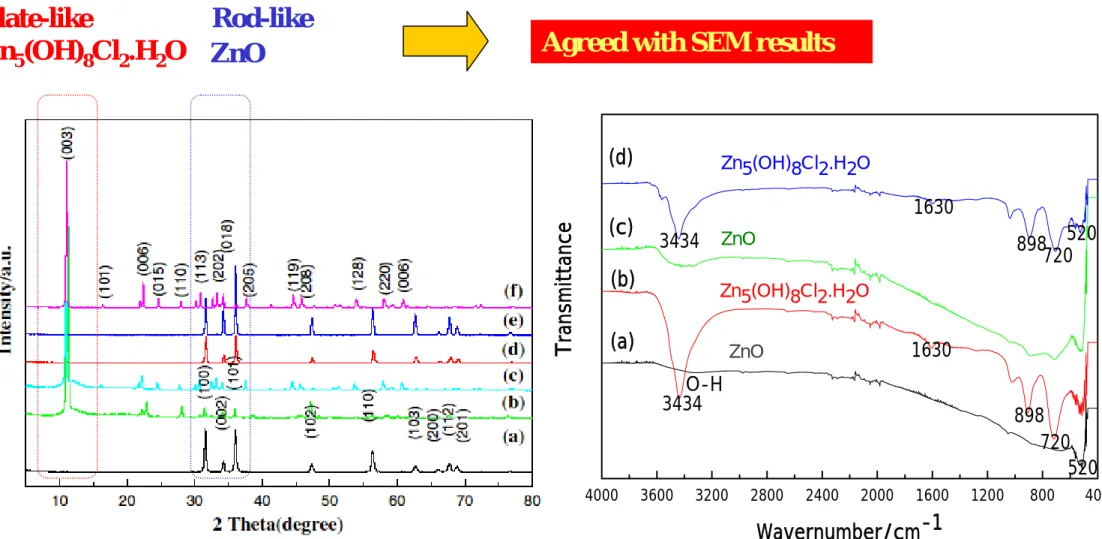
Fig. XRD patterns and FTIR spectra of the products prepared at 95oC for 12h in (a) 0.01M, (b) 0.05M, (c) 0.1M ZnCl2 - HMT mixed aqueous solution and in (d) 0.01M, (e) 0.05M, (f) 0.1M ZnCl2 - HMT mixed 50vol.% EG solution. (b),(c), (f): simonkolleite:
Zn5(OH)8Cl2.H2O; (a), (d), (e): wurtzite ZnO XRD & FTIR
Zn5(OH)8Cl2.H2O ZnO Plate-like Rod-like
Agreed with SEM results
4000 3600 3200 2800 2400 2000 1600 1200 800 400 ZnO
ZnO
Zn5(OH)8Cl2.H2O
1630
520
520520
720
720 3434 898
(d)
(c) (b)
Transmittance
Wavernumber/cm-1 (a)
3434 898
O-H
1630 Zn5(OH)8Cl2.H2O
S. YIN et al, Nanoscale Res. Lett., 4, 247-253 (2009)
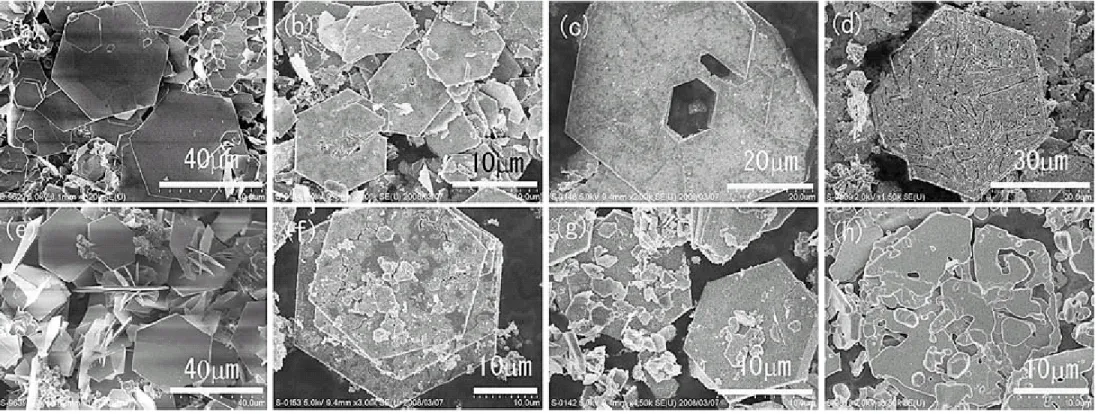
Fig. SEM images of samples prepared in (a) 0.05M ZnCl2 - HMT mixed aqueous solution followed by calcination at (b) 300oC, (c) 600oC, (d) 1200oC; and in (e) 0.1M ZnCl2 - HMT mixed 50 vol.% EG aqueous solution followed by calcination at (f) 300oC, (g) 600oC, (h) 1200oC.
S. YIN et al, Nanoscale Res. Lett., 4, 247-253 (2009)
板状酸化亜鉛の合成
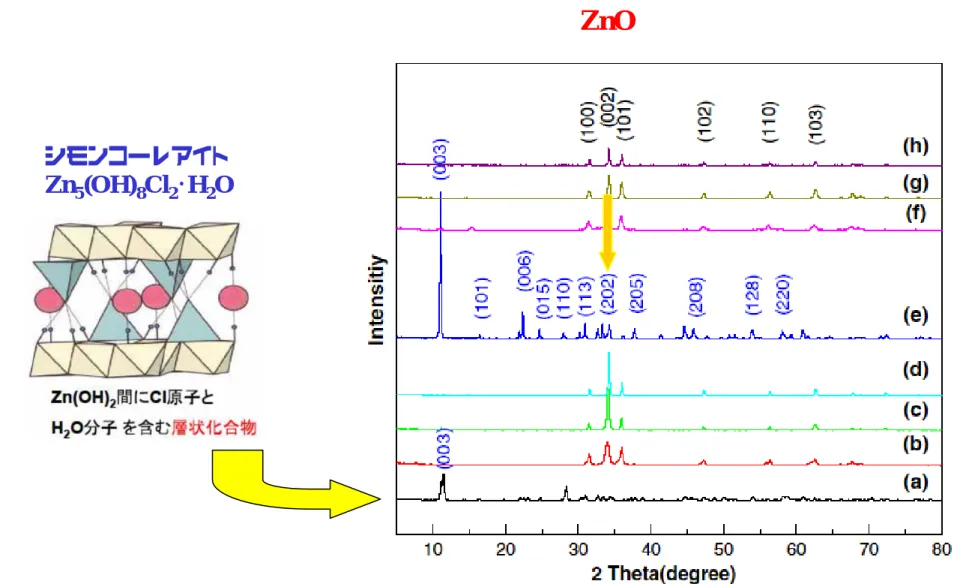
Fig. XRD patterns of samples prepared in (a) 0.05M ZnCl2 - HMT mixed aqueous solution followed by calcination at (b) 300oC, (c) 600oC, (d) 1200oC; and in (e) 0.1M ZnCl2 - HMT mixed 50 vol.% EG aqueous solution followed by calcination at (f) 300oC, (g) 600oC, (h) 1200oC.
ZnO
シモンコーレアイト Zn5(OH)8Cl2・H2O
(002)に配向した板状酸化亜鉛
Fig. Experimental apparatus used for photocatalytic destruction of nitrogen monoxide. A:
Sealed opaque reactor (Plastic, 373cm3); B: Glass holder; C: Catalyst (20×16×0.5 mm); D:
Colorless and transparent plastic cover; E: 510 nm cut off filter (Fuji, triacetyl cellulose); F:
400 nm cut off filter (Kenko, L41 Super Pro(W)), ; G: 450W high-pressure mercury lamp; H:
Pyrex jacket (cut off the light λ < 290nm); I: Cooling water (30oC); J: Electric fun; K: 2ppm standard NO gas (Flow rate: 100ml/min); L: Air (Flow rate: 100ml/min); M: Gas mixer;
N,O,P: Three-way cock; Q: Thermometer; R: NOx analyzer (Yanaco, ECL-88A)
DeNOx光触媒評価装置 Continuous Reaction System
H
NOx
Yanaco
ELC-88A
G I
J F, λ>400nm
E, λ>510nm
165mm
K, NO gas L, Air
M
N
A B C
D
Q
O P
R
NO → HNO
2and/or HNO
3h ν
Fig. DRS spectra of samples prepared at 95oC in ZnCl2 - HMT mixed aqueous solution. (a) plate-like simonkolleite; (b) rod-like ZnO; (c) plate-like ZnO; (d) commercial ZnO nanoparticles.
200 300 400 500 600 700
0 20 40 60 80 100
Reflectance / %
(b) Rod-like ZnO
Wavelength / nm (a) Plate-like
simonkolleite
(d) Commercial ZnO
(c) Plate-like ZnO
板状酸化亜鉛のUV吸収特性と光触媒活性
Fig. XRD patterns (Left) and room-temperature photoluminescence spectra (Right) of the ZnO thin films consisted of different superstructures. (a) sphere-like (b) 3D flower-like.
球状粒子・
3D
バラ状粒子の合成と特性400 500 600
0 100 200 300 400 500
(b)
Intensity(a.u.) (a)
Wavelength(nm)
(a) sphere-like (b) 3D flower-like
468 nm
388 nm
10 20 30 40 50 60 70 80
-500 0 500 1000 1500 2000 2500 3000 3500 4000 4500 5000
200
103112 102 110
100 002
(b)
Intensive/a.u.
2 Theta(degree)
(a) as prepared (b) after modified
(a) 101
Sphere-like ZnO 3D flower-like ZnO
Fig. Photoluminescence spectrum of ZnO crystals with different morphologies.
様々な形態を示す酸化亜鉛の発光特性
(A) (B) (C)
(D) (F) (H)
(E) (G) (I)
ユニークな形態を有する酸化亜鉛粒子
Table DeNO
xability of the samples prepared at different conditions
ユニークな形態を有する酸化亜鉛粒子の光触媒特性
表面構造が発達させることによって、光触媒活性が向上した!
Synthesis and Photocatalytic Activity of TiO2-xNy / ZnO Nano-screw / TiO2-xNy composites
Concept:
光閉じ込め効果による光触媒活性の向上:窒素ドープ酸化チタン/酸化亜鉛ナノスクリュー/窒素ドープ酸化チタン サンドイッチ構造 ZnO
ソルボサーマル反応による
アナターゼTiO2-xNyナノ粒子を利用:
S.Yin, etc., J.Mater.Chem., 2005,15, 674.
Rod-like and Spherical Morphologies: Prepared by using HMT as precipitation reagent
Fig. TEM photographs of nitrogen doped titania prepared under solvothermal conditions.
Brookite
Rutile Anatase
Share coeners & 3 edges With neibour octahedra
Share coeners & 4 edges With neibour octahedra
Share coeners & 2 edges With neibour octahedra
S.Yin, etc., J.Mater.Chem., 2005,15, 674.
ソルボサーマル反応による窒素ドープ酸化チタンの合成:異なる結晶相を選択的合成できる
Anatase TiO2-xNy-サンドイッチ複合構造に使用
(a) (b)
(a) (b) (c)
(c)
Scanning electron micrographs of (a)TiO
2-xN
ythin film, (b)ZnO screw film, and (c)TiO
2-xN
y/ZnO composite film. Upper: cross section; Lower: Top view.
SEM
95oC Zn2+
Solution
Zn2+
Solution
TiO2-xNy
Glass substrate
TiO2-xNy
Glass substrate Spin-Coating
Spin-Coating
Sintering (400℃, 10 min)
TiO2-xNy-ZnO-TiO2-xNyサンドイッチ複合構造の作製
Diffuse reflectance spectra of (a)TiO
2-xN
ythin film, (b)ZnO screw film, and (c)TiO
2-xN
y– ZnO composite film.
DRS
0 20 40 60 80 100
200 300 400 500 600 700
Reflectance / %
Wavelength / nm (a)
(b) (c)
(a)TiO2-xNythin film (c)TiO2-xNy– ZnO composite film
(b)ZnO screw film
TiO2-xNy-ZnO-TiO2-xNyサンドイッチ複合構造膜の光吸収特性
0 20 40 60 80 100
λ > 510 510 > λ > 400 400 > λ > 290
DeNOx ability / %
Wavelength / nm (a)
(a)
(a) (b) (b)
(b) (c) (c)
(c)
(B) Vis >510 Vis >510-400 UV-Vis >400-290
0.00 0.02 0.04 0.06 0.08 0.10
Quantum Effiency / %
(a)
(a) (a)
(b) (b)
(b) (c) (c)
(c)
(C) Vis >510 Vis >510-400 UV-Vis >400-290
Photocatalytic deNOx ability and Quantium effiency of the thin film of ( (b)ZnO screw film, and (c)TiO2-xNy – ZnO composite film. The data were treated against various wavelength ranges.
DeNO
x& QE
複合化行うことによって、
光の利用効率が向上し、
光触媒活性と量子収率が向上した!
S.Yin, et al
Res. Chem. Intermed., 34, 393-402 ,2008.
Photocatalytic deNOx ability
(a)TiO2-xNy thin film, (b)ZnO screw film,
(c)TiO2-xNy/ZnO/ TiO2-xNy composite film
Photocatalytic Quantium effciency
今後の展開、将来の展望
本課題を通して様々な形態を有する酸化亜鉛粒子及び粒子膜の合 成に成功し、
UV-
熱線遮蔽材料、導電性薄膜材料、ガスセンサー、体 質顔料としての応用を展開しており、薄膜のみならず、粉体としての性 能発揮も期待でき、ユニークな形態に起因するスマートな新機能性の 検討を行うと共に、デバイスの構築など実用化へ向けた更なる研究を 推進する予定である。溶液プロセスによるZnO以外の無機材料の形態制御例
CeO2
Re2O3
TiO2-xNy
100nm
500nm 50nm
K0.81Ti1.73Li0.27O4 Ce2(PO4)2HPO4 . H2O
Thank you for your attention !
謝辞:
本研究は平成
18
年度日本板硝子材料工学助成会の研究助成を受けて行ったものである。同助成会に心より感謝致します。
![Fig. Schematic energy diagram (G-T) in a single component system[*]. Fig. Schematic P-T diagram for preparative techniques[*].](https://thumb-ap.123doks.com/thumbv2/123deta/7494500.2495693/3.1263.172.1155.118.649/schematic-energy-diagram-component-schematic-diagram-preparative-techniques.webp)
![Table Advanced Oxide Powder Process Comparison [*, **]](https://thumb-ap.123doks.com/thumbv2/123deta/7494500.2495693/4.1263.33.1201.78.774/table-advanced-oxide-powder-process-comparison.webp)
![Table Physical properties of various solvents [*]](https://thumb-ap.123doks.com/thumbv2/123deta/7494500.2495693/5.1263.87.1171.183.716/table-physical-properties-of-various-solvents.webp)