Integrated Management of Reservoir Sediment Routing by Flushing, Replenishing, and Bypassing Sediments in Japanese River Basins
Tetsuya Sumi
Disaster Prevention Research Institute, Kyoto University Goka-sho, Uji-shi, 611-0011, Japan
Sameh Ahmed Kantoush
Disaster Prevention Research Institute, Kyoto University Goka-sho, Uji-shi, 611-0011, Japan
Abstract: Dam construction dramatically influences the river basin balance with respect to water sediment inflow and outflow, which upsets downstream reaches. The objective of water and sediment incorporation is to manipulate the river-reservoir system to achieve sediment balance while maximizing the beneficial storage, and minimizing environmental impacts and socioeconomic costs. Such costs could be avoided if reservoir sedimentation was minimized and dams were allowed to live forever. Sediment flushing is one of the most attractive methods from the costs and sediment supply point of view. Attempts to replenish the excavated and dredged sediment to the downstream river and sediment bypassing system have been undertaken. Therefore, it is important to predict how anticipated phenomena will impact on the environment and to conduct studies to develop feasible measures that minimize them. The paper aims at identifying some of water and sediment management options in Japan. An analysis of sediment flushing operations to date, the effect of sediment flushing on the river’s sediment balance and physical environment is presented. The results show that, the successful reservoir sediment management proceeds from a permanent change in river management. This may involve strategies to enhance water and sediment release by a combination of several countermeasures. There is a need to define the water discharge with disturbance and managing the sediment quantity and quality. Careful planning should be studied for the flow and sediment regimes which may be changed frequently before and after a flood as a result of maintaining the water and sediment release from the dams by sediment flushing, replenishing, or bypassing.
Keywords: Reservoir sedimentation, water and sediment release, flushing, sediment replenishment, sediment bypassing, sediment routing, environmental impacts of dams, river restoration.
Introduction
Japan has geologically young mountains, steep and short rivers with flashy flow regimes, and densely populated floodplains. Japan suffers from frequent heavy storms. Generally, the Pacific side of Japan has heavy rain in June and July (rainy season) and between August and October (Typhoons). On the side of the Japan Sea flow peaks during the snowmelt period in spring. The combination of steep catchments and heavy storms results in widespread hill slope failures and landslides and extensive flood discharges.
Reservoirs and dams are developed by modern human activities to deal with the variability of water supplies over time. Dams and their reservoirs are constructed and operated for multipurpose including flood control, drinking water, agricultural water supply, power generation, recreation and others. Until now the common engineering practice has been to design and operate reservoirs to fill with sediment slowly. With such an approach, the consequences of sedimentation and project abandonment are left to be taken care of by future generations. For many dams this future has already arrived. Therefore we need to develop ingenious solutions for integrated sediment and water management; unless we will lose the struggle to enhance the available water resources and ecological environment.
Regardless of their purpose, all multipurpose dams trap sediment and inevitably lead to physical and ecological changes downstream of the reservoir site, as well as in the reservoir itself, and in some cases also upstream. Kondolf (1997) has described that, by changing flow regime and sediment load, dams can produce adjustments in alluvial channels, the nature of which depends upon the characteristics of the original and altered flow regimes and sediment loads. Downstream impacts develop through discontinuity in downstream gradients, e.g., sediment supply, water quality, temperature, flow and sediment regimes.
Sediment deficit is not only an environmental issue but also a socio-economic problem, for instance due
to loss of reservoir capacity (e.g., Fan and Springer, 1993). In addition, dams alter the downstream flow regime of rivers (Williams and Wolman, 1984), which controls many physical and ecological aspects of river form and processes, including sediment transport and nutrient exchange (Poff et al., 1997).
Morphological effects on the river channel (e.g., Kondolf and Matthews, 1993; Kantoush et al., 2010) that includes riverbed incision, riverbank instability, upstream erosion in tributaries, groundwater over drafting, damage to bridges, embankments and levees (e.g., Kondolf, 1997; Batalla, 2003), and changes in channel width. Hydrological effects caused by dams include changes in flood frequency and magnitude, reduction in overall flows, changes in seasonal flows, and altered timing of releases. If flows released from dams have sufficient capacity to move coarse sediment, water becomes ‘hungry water’ (Kondolf, 1997), which may transport sediment downstream without replacement from upstream and the ecological effects on the fluvial and deltaic systems.
Inventory of sediment management measures
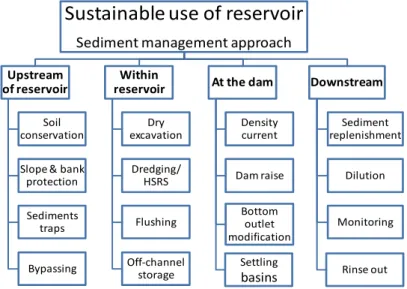
Several methods for sediment management are available and have been implemented in practice. These methods can be categorized as shown in Figure 1.
Sustainable use of reservoir
Sediment management approach Upstream
of reservoir Soil conservation
Slope & bank protection
Sediments traps
Bypassing
Within reservoir
Dry excavation
Dredging/
HSRS
Flushing
Off‐channel storage
At the dam
Density current
Dam raise
Bottom outlet modification
Settling
basins
Downstream
Sediment replenishment
Dilution
Monitoring
Rinse out
Figure 1: Inventory of measures for sediment management
Downstream, water released from the dam possesses the energy to erode the channel bed and banks, but has little or no sediment load. The rapid reservoir sedimentation not only decreases the storage capacity, but also increases the probability of flood inundation in the upstream reaches due to heightening of the bed elevations at the upstream end of the reservoir and the confluences of the tributaries (Liu et al., 2004).
The necessity for the reservoir sediment management in Japan can be summarized as: (1) to prevent the siltation of intake facilities and aggradations of upstream river bed, accompanied by the sedimentation process in reservoirs; (2) to maintain storage function of reservoirs, and realize sustainable water resources management for the next generation; (3) to release sediment from dams as a perspective on comprehensive sediment management in a sediment routing system.
The objectives of this paper are: (a) to make a general review of impacts of dam on downstream reaches and river improvement methods; (b) to analysis the environmental impacts of sediment flushing at the Kurobe River; (c) to illustrate and analyze the sediment replenishment through a regulated fluvial system, Nunome and Managawa Rivers; (d) to discuss the role of slit type check dams and flood mitigation dams;
(e) to draw some general conclusions in terms of future strategies for sediment management.
Dam Impacts and New Options of River Instream Flow Improvement
Dam effects can vary, depending on the distance to the dam and other boundary conditions. Depending on the supply from the tributaries the main river will have to erode sediments from the banks to compensate for the supply limitation. Channel erosion may lead to an interruption of lateral connectivity with the adjacent floodplain. At the same time, dams often reduce flood discharges significantly, that reduce the transport capacity of the river downstream. The number of the worldwide large rivers that do not reach
the ocean any more is one rise and their river deltas suffer dramatic changes. If a river runs into the sea, regulating the river will probably have an effect in and around its mouth (Sumi, 2006).
Environmental changes in downstream rivers and proposed mitigation measures
Environmental issues associated with reservoir sedimentation include the consequences of altered sediment and flow release, serious environmental changes occurred in downstream rivers below dams as shown in Figure 2. These changes can be categorized as follows:
River channel changes: Fixed sand bars; degradation and tree growth in river channels.
Riverbed material change: Armoring and decrease of small porosity.
Figure 2: Environmental changes in downstream rivers: (a) Kazaya Dam and (b) Kuzuryu River Sustainable management of sediment in river basins must be done on a regional basis, restoring the continuity of sediment transport where possible and encouraging alternatives to river-derived aggregate sources. Different management and ecological restoration measures to compensate the sediment deficit downstream from dams are conducted in some rivers (Kondolf, 1997). For instance, controlled flow releases (flushing flows) and beach nourishment with imported sediment dredged from reservoirs and harbors has been implemented along many rivers (Everts, 1985; Sumi et al. 2006; Sumi 2009; Kantoush et al 2009). These measures range from optimizing the compensation discharges, to reconnecting the river water bodies, and artificial sediment feeding (sediment replenishment). Today, rehabilitation of damaged and modified aquatic ecosystems has become an integral part of catchment and river management.
Sediment transport and associated channel bed mobility are recognized as key processes for creating and maintaining physical habitats, aquatic and riparian ecosystems. In this context, various river restoration projects have been initiated or implemented in many countries. Some examples include creation of secondary channels along the Rhine River, reconnecting the Danube side-arm system to the main channel (Tockner et al. 1998), removing bank protection structures, and removing dams in North America (Poff et al. 1997) to re-establish the river continuum.
Ikebuchi, et al. (2007) discussed new options in order to improve the above situations, the following measures are currently proposed and implemented in Japanese River basin system:
Conservation of flow regime River instream flow Flexible dam operation Flushing flow
Conservation of sediment flow
Sediment replenishment (restoration) Large scale sediment management measures
Suspended and bedload sediment bypass
Sediment scouring gate
Flexible Dam Operation method (FDO)
The Flexible Dam Operation (FDO) is a dam management method to enhance conservation and restoration of the river environment located in the downstream of a dam via utilizing “usable capacity”
without interrupting prime flood control. The “usable capacity” is a vacant portion of dam’s capacity, which is reserved for actual flood event during the rainy/typhoon seasons. The water stored in the capacity is called “usable water”. The FDO requires storing water temporarily up to its design level or
(a) (b)
“usable water level” within the flood control storage capacity as illustrated in Figure 3. This utilization storage capacity that has been newly created is used for utilization discharge as follows:
1) Discharge to increase the instream flow: Its purpose is to improve the scenery and the habitat for fishes.
2) Flushing discharge: Its purpose is to stir up the riverbed and flush out silt and slack water on the riverbed.
Since 1997, a “Flexible Dam Operation” has been underway at dam under the jurisdiction of MLIT with the purpose of improving the river environment downstream of dams. The positive effects that have been obtained by the investigation are summarized in Table 1 according to each discharge type.
surcharge water level
normal water level
normal top water level for flood control
stage
time usable water level prior flow
usable flow flood control
flexibility dam control, nomal dam control
Removing part of old colonies Improving Vicinity
Objectives Results
Improving fish habitat and migration opportunities
Enhancing continuity of stretch and increasing in fish population Improving water quality Maintaining desirable water quality
Conservation of downstream environment
Restoring wetlands on downstream
Flushing flow
Enhancement of rejuvenation of algae Solving odor and vicinity
problem
Flushing stagnant water Improving vicinity
sediments and attached mud location observed vicinity improved Instream flow
of dams 90% of community at the trial
Removing problematic floating algae,
Figure 3: Multipurpose dam operation system – the “normal-top-water-for-flood-season” system
Reservoir Flushing in the Kurobe River, Japan
Drawdown flushing is the lowering the water levels in a reservoir. Hydraulic flushing involves reservoir drawdown by opening the bottom outlet to generate and accelerate unsteady flow towards the outlet. This accelerated flow possesses an increased stream power and consequently eroding a channel through the deposits and flushing the fine and coarse sediments through the outlet. During this process a progressive and a retrogressive erosion patterns can occurs in the tail reach and delta reach of the reservoir, respectively. The Dashidaira dam and the Unazuki dam in the Kurobe River system have begun efforts to empty the reservoirs in a coordinated manner and to flush sediment deposited in the reservoirs. In July 2006, the Dashidaira dam flushes out 910,000 m3 of sediment which includes 420,000 m3 of newly inflowing sediment. The Unazuki dam has an inflow of 1,380,000 m3 of sediment. From this inflow, the dam is passing through 1,010,000 m3, or 73%, which mainly consists of fine sediments smaller than 2 mm.
The amount of coarse sediments larger than 2 mm passing through the Unazuki dam is only 20,000 m3, or 10%, and 90% is currently trapped at the reservoir. This method has been used for small dams but not for large dams because it takes time to refill a large reservoir after flushing and because it makes difficult to maintain the dam’s power-generating functions. However, it was easy to introduce this method at these dams because the risk relating to refilling the reservoirs is low due to the large volume of water flow compared to the capacities of the reservoirs and because the impact of sediment flushing on the riverbed downstream is relatively small due to the steepness of the river downstream from the dams and the short distance to the Japan Sea (30 kilometers from the two dams). The flushed water quality deteriorates when sediment is flushed after being deposited in a reservoir for a long period of time. Therefore, the feature of the dam sediment flushing has been conducted as frequently as possible at times of flood, and turbidity and dissolved oxygen levels in the river, mouth of a river and the sea area have been monitored while looking at the impact of sediment flushing on the lower river basin.
Physical environment changes in the downstream river channel
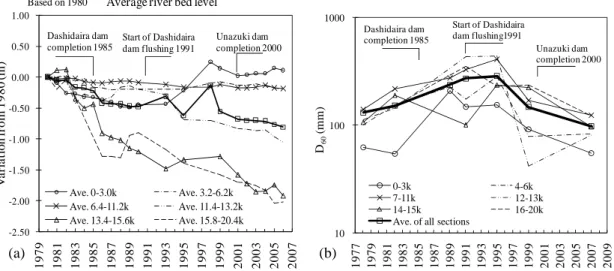
In the Kurobe River downstream, 0-6 km from the river mouth is braided channel, and 6-13 km from the river mouth is single bar. Figure 4(a) shows the average riverbed level for each section from year to year based on the one in 1980 before the Dashidaira dam was completed. While the riverbed degradation had been occurred over all sections of the downstream river channel, after sediment flushing was begun, the riverbed began to rise again, mainly in the sections closest to the river mouth. Slightly riverbed degradation started again after the Unazuki dam was completed, but we can now notice the riverbed aggradations again, reflecting the coordinated sediment flushing. Figure 4(b) shows these changes in Table 1 Results of the FDO trails for different flow types
terms of the riverbed materials. This figure indicates that for a representative grain size of D60 (mm), the riverbed materials had generally been getting larger after the completion of the Dashidaira dam by
“armoring”; however, after the start of sediment flushing, they began to get smaller in all sections. This is considered to be due to the supply of the sand component.
-2.50 -2.00 -1.50 -1.00 -0.50 0.00 0.50 1.00
1979 1981 1983 1985 1987 1989 1991 1993 1995 1997 1999 2001 2003 2005 2007
Variation from 1980 (m)
Average river bed level
Ave. 0-3.0k Ave. 3.2-6.2k Ave. 6.4-11.2k Ave. 11.4-13.2k Ave. 13.4-15.6k Ave. 15.8-20.4k Based on 1980
Dashidaira dam completion 1985
Start of Dashidaira dam flushing 1991
Unazuki dam completion 2000
10 100 1000
1977 1979 1981 1983 1985 1987 1989 1991 1993 1995 1997 1999 2001 2003 2005 2007 2009
D60(mm)
0-3k 4-6k
7-11k 12-13k
14-15k 16-20k
Ave. of all sections Dashidaira dam completion 1985
Start of Dashidaira dam flushing1991
Unazuki dam completion 2000
Figure 4: Relationship between (a) river bed level; (b) representative grain size (D60), and annual sediment flushing at different cross sections
Sediment Replenishment
In Japan, it is common practice to remove accumulated coarse sediment by excavation and dredging, and to make effective use of the removed sediment. Sediment replenishment method is one of new measures of sediment management. In this method, trapped coarse sediment is periodically excavated (or dredged depending on the site conditions) and then transported and placed temporarily on the channel downstream of the dam, in a manner decided according to the sediment transport capacity of the channel and the environmental conditions. The replenishment processes are efficient to restore the bed load transport and the associated habited by coupling reintroduction with floodplain habitat restoration. In Figure 5 along the Nunome River, several cross sections are identified to survey after replenishment.
Location of placed sediment (yellow area)
Newly formed sand bar after sediment replenishment
Under water deposition
Deposition and vegetation after replenishment over point sand bar
Stream flow
Point bar and vegetation Stilling basin
Figure 5: Aerial photos of Nunome dam and the downstream reaches with morphological changes due to sediment replenishment below the dam and the self forming sand bar (14-10-2009) (a) (b)
0 10 20 30 40 50 60 70 80 90 100
0.01 0.1 1 10 100
粒 径 ( m m )
通過質量百分率(%)
試 料 A:採 取 地 試 料 B:採 取 地 試 料 C:設 置 土 砂
Diameter (mm) Replenished
sediment
Grain size distribution (%)
0 10 20 30 40 50 60 70 80 90 100
0.01 0.1 1 10 100
粒 径 ( m m )
通過質量百分率(%)
試 料 A:採 取 地 試 料 B:採 取 地 試 料 C:設 置 土 砂
Diameter (mm) Replenished
sediment
Grain size distribution (%)
0 10 20 30 40 50 60 70 80 90 100
0.01 0.1 1 10 100
粒 径 ( m m )
通過質量百分率(%)
試 料 A:採 取 地 試 料 B:採 取 地 試 料 C:設 置 土 砂
Diameter (mm) Replenished
sediment
Grain size distribution (%)
Figure 6: Placed sediment before and after flushing flow and its grain size distribution respectively Newly depositions over sand bars and in the river channel are shown in photos Figure 5. Moreover, a completely new sand bar is formed after 600 m from dam. Large Japanese rivers are often trained to a large extent, to maintain services such as navigation, hydropower generation and flood defense. Okano et al., (2004) summarize sediment replenishment projects in large Japanese Rivers such as Tenryu, Abukuma, Ara, Oi, Naka, Kuzuryu, Yodo, and Tone, have been conducted. Kantoush et al., (2010), investigate the morphological evolution and corresponding flow field during replenishment experiments in Uda River. In case of Managawa dam, above mentioned sediment restoration trial is also planned to enhance river refreshment. Figure 6 shows placed sediment before and after flushing flow below Managawa dam and its grain size distribution respectively. The main objective of the flushing flow is to move bed gravels and initiate detaching attached algae on them which are very important to provide fresh food sources to ‘Ayu’
fish species. Peak discharges of 30m3/s and 50m3/s, and with and without sediment restoration were compared from the view points of water level, flow velocity, temperature, turbidity, suspended sediment concentration, movement of river bed materials and so on. Rate of detached algae on river bed gravels were also measured both upstream and downstream of sediment placed point.
Bypassing Tunnels
Another possible approach to sediment management, next to the reduction of sediment inflow itself, is to route sediment inflow so as not to allow it to accumulate in reservoirs. In Japan, the following techniques are adopted: 1) sediment bypass by directly diverting total load of sediment transport flow, and 2) density current venting by using a nature of high-concentration sediment transport flow. Although this technique involves high cost caused by tunnel construction, there are several advantages such that it is also applicable to existing dams; it does not involve drawdown of reservoir level and therefore no storage capacity loss; and it has relatively small impact on environment because sediment is discharged not so rapidly as sediment flushing, which is described later. Recently, the bypassing effect is clarified after completion of the Asahi dam (Figure 7), and the planning and construction of the bypass have been advanced also in the Miwa, Matsukawa and Koshibu dams.
Figure 7: Coarse sediment load bypass around an Asahi instream reservoir using a bypass tunnel Tunnel
intake Low head dam to divert coarse and fine sediment
To Asahi bypass tunnel
Open Check Dams and Flood Mitigation Dams
Check dams have been built to stop sediment and prevent from sediment disasters downstream. Open check dams can be divided into two categories, beam dams and slit dams characterized by a different management of sediment transport: beam dams are characterized by wide openings. To be more precise, the erosion control dams in the upstream region are planned to be converted to slit dams with notches, which are so designed as to pass, not to trap, as much fine sediment carrying less risk of sediment disaster as possible. In recent years, check dams assembled from steel pipes or concrete dams having slit(s) have been built to stop sediment only at times when sediment outflow is great and to let sediment rundown into lower river basins at times when water and sediment outflow is small (Figure 8 (right)).
Figure 8: (left) Masudagawa flood mitigation dam; (right) Slit check dam from steel pipes
Flood mitigation dam (FMD) is a gateless outlet dam designed only for the purpose of flood control which provides long-term and efficient protection against floods, e.g. Masudagawa dam in Figure 8. Its bottom outlets are installed at the original river bed to facilitate the sediment transport during flood and flush out the deposited sediment at the end of flood. FMD is one of good solutions in dam engineering for sustainable management of reservoirs, downstream river environment, and sediment transport. FMD is expected as environmentally friendly, since almost all incoming sediment during flood periods can pass through dam bottom outlets and there will be fewer impacts to downstream river environment.
Design of water and sediment release
Water and sediment management in river basins has tended to deal with local issues associated with water discharge and water disturbance, managing the quantity and quality of sediment, and timing. Water discharge and associated turbulence are important and required by environmental aspect independently from the sediment issues, to enhance the biodiversity. Both of low-flow conditions and high-flow conditions can be characterized by the magnitude, duration, frequency, timing and rate of change of flow, and by their temporal and spatial variability. Furthermore, the release of water has influence to scour and transport the sediment according its capacity. Not only the water has importance for the river basin but also the sediment should be supplied with specific quantity and quality. To select a reasonable sediment management measure for a specific reservoir-river system, the above characteristics for water sediment release should be clarified. There are many different sediment management options available and that management options may impact differently on different river basin. For example, the necessary water is discharged artificially or naturally according to the river basin conditions for sediment replenishment option. Furthermore, during drawdown flushing there is a time delay between water and sediment release.
This introduces the need to involve in recognition of the detrimental effects with the sediment quality (grain size distribution); we should define both of quantity and quality in the design criteria.
Conclusion
Various integrated management strategies of water and sediment incorporation to preserve river environments downstream of dams in Japan are presented. Water management measures are presented as
“Flexible Dam Operation” and instream flow which discharge rate is defined to maintain habitats of river biota, water quality in the each studied section of the rivers depending on each season. For sediment management measures are reservoir flushing, sediment replenishment, bypass tunnel, and flood mitigation dams are discussed. The present problem for maintaining river health is to determine the
adaptive range of the river system to the flow and sediment regimes, which is the basic of all the measure.
In detail, it is necessary to find out flow and sediment release which can meet demands of various functions based on data of hydrology, water quality, ecosystem, etc. Furthermore, the integrated management measure for flow and sediment should be researched further, which means how to realize the reasonable and order exploitation and how to regulate and control reasonably by large hydropower project.
The sediment flushing of the Kurobe River is extremely important from both sides of the sustainable management of dam reservoir and the securing of the sediment mobility in the sediment routing system.
By replenishing sand at different locations of the Nunome and Managwa Rivers within the downstream reaches, the replenishment may direct future supplements for a more widespread dispersal of suitable sand for fish spawning.
References
Batalla, R.J. 2003. Sediment deficit in rivers caused by dams and instream gravel mining. A review with examples from NE Spain. Cuaternario y Geomorfología 17 (3–4):79–91.
Everts, C.H. 1985. Effects of small protective devices on beaches. In:McGrath, J. (Ed.), California's Battered Coast. Proceedings from a Conference on Coastal Erosion. California Coastal Commission, 127–138.
Fan, S., and F.E. Springer. 1993. Major sedimentation issues at the Federal Energy Regulatory Commission. In: Fan, S., Morris, G. (Eds.), Notes on Sediment Management in Reservoirs.
Water Resources Publications, Colorado, USA, 1–8.
Ikebuchi, S., T. Sumi, , A. Kobayashi and I. Oomoto. 2007. Dams and Environmental Flows: Concept and Implementation in Japan, 10th International River Symposium, Brisbane.
Kantoush, S. A. 2008. Experimental study on the influence of the geometry of shallow reservoirs on flow patterns and sedimentation by suspended sediments. Communication 37 of the Laboratory of Hydraulic Constructions (LCH), Ed. A. Schleiss and PhD Thesis, No 4048, École Polytechnique Fédérale de Lausanne, Switzerland.
Kantoush, S. A. and A. J. Schleiss. 2009. Channel Formation in Large Shallow Reservoirs with Different Geometries during Flushing. Journal of Environmental Technology. 30(8): 855-863.
Kantoush, S. A., and T. Sumi, A. Kubota, and T. Suzuki. 2010. The impacts of sediment replenishment below dams on flow behavior and bed morphology of river channel and river mouth. First International Conference, Alexandria, Egypt, 6-10 March 2010.
Kondolf, G.M., 1997. Hungry water: effects of dams and gravel mining on river channels. Environmental Management, 21(4): 533–551.
Kondolf, G.M., W.V.G. Matthews. 1993. Management of Coarse Sediment in Regulated Rivers of California. University of California, Water Resources Center, Davis, CA.
Okano, M., M. Kikui, H. Ishida, and T. Sumi. 2004. Reservoir sedimentation management by coarse sediment replenishment below dams. Proceedings of the Ninth International Symposium on River Sedimentation. Yichang, China, 1070-1078.
Poff, N.L., J.D. Allan, M.B. Bain, J.R. Karr, K.L. Prestegaard, B.D. Richter, R.E. Sparks, and J.C.
Stromberg. 1997. The natural flow regime: a paradigm for river conservation and restoration.
Bioscience 47(11):769–784.
Sumi, T. and H. Kanazawa. 2006. Environmental Study on Sediment Flushing in the Kurobe River. 22nd International Congress on Large Dams, Barcelona, Q.85-R.16, 219-242.
Sumi, T., K. Kobayshi, K. Yamaguchi, and Y. Takata. 2009. Study on the applicability of the asset management for reservoir sediment management. International Congress on Large Dams, Brasilia, Q.89-R.4.
Tockner, K., F. Schiemer, and J.V. Ward. 1998. Conservation by restoration: the management concept for a river floodplain system on the Danube River in Austria. Aquatic Conservation: Marine and Freshwater Ecosystems 8:71–86.
Williams, G.P., and M.G. Wolman. 1984. Downstream effects of dams on Alluvial Rivers. US Geological Survey Professional Paper 1286.