Propagation and Focusing Characteristics of Intense Terahertz Pulses Generated from a Large Aperture Photoconductive Antenna
Keiji Tukamoto, Rakchanok Rungsawang, Toshiaki Hattori, and Hiroki Nakatsuka Institute of Applied Physics, University of Tsukuba
1-1-1 Tennodai, Tsukuba, Ibaraki 305-8573, Japan phone: +81-298-53-5118, fax: +81-298-53-5035,
email: [email protected]
Propagation and focusing characteristics of intense terahertz electromagnetic pulses generated from a large aperture photoconductive antenna were stud- ied by using the electro-optic sampling technique.
Waveguide effects of metal apertures and frequency- dependent focusing were observed.
Introduction
The most promising antenna structure for the genera- tion of intense terahertz electromagnetic pulses is the large aperture photoconductive (LAP) antenna since the achievable electric field is scaled to the emitter size. Although several groups have generated THz pulses by this method, a thorough investigation in the propagation features of these pulses has not yet been conducted and leaves an interestingfield of physics to explore. The peak THzfield achieved by this method exceeds a few kV/cm, which is where nonlinear ef- fects of semiconductor materials arise. The broad fre- quency spectrum of the THz pulse results in prop- agation effects not seen in optical pulses. We must first fully understand the propagation effects of these pulses in free space for utilizing the high peak field in various applications. In addition, it is important to experimentally characterize the focusing of a THz beam and observe the spatial distribution of the fo- cused beam in order to achieve intense THz field.
In this study, we have conducted several experi- ments to characterize the propagation and focusing of THz pulses generated from a LAP antenna.
The LAP antenna we constructed consists of a non- doped GaAs wafer (thickness 350 µm) and two alu- minum electrodes mechanically attached to it with a spacing of 30 mm. Pulsed electrical voltage up to 20 kV was applied to the electrodes synchronously with the pump laser pulse. Regeneratively amplified Ti:sapphire laser pulses with a duration of150 fs were used to pump the emitter. We utilized the electro- optic (EO) sampling method to measure the temporal electric field waveform of the emitted THz pulses. In this setup, we have observed peak THz field as high as11.1kV/cm, with a temporal pulse width of 650 fs.
Waveguide effects
Most often, THz pulse waveforms obtained with LAP antennas have been reported to have a large negative
tail. We have found that this negative tail is a con- sequence of the waveguide effects of the metal holder of the EO crystal or similar optical elements placed in the course of the THz pulse propagation, and that almost half-cycle pulses can be achieved by focusing the THz pulses using carefully aligned optics.
The waveguide effects were demonstrated by plac- ing an aluminum plate with a circular aperture of a 3.8 mm or 2.5 mm diameter in front of the EO crystal (ZnTe). By comparing the waveforms shown in fig.
1, change in the negative tail of the waveforms is no- table. The Fourier amplitudes of the waveforms with the metal aperture showed a drop in low frequency components. The transition frequencies of the drop almost agree with the calculated cutofffrequencies of metal waveguides with the same aperture diameter as the experimentally used metal plates (46 GHz and 70 GHz).
Knife edge beam size measurement of a focused THz beam
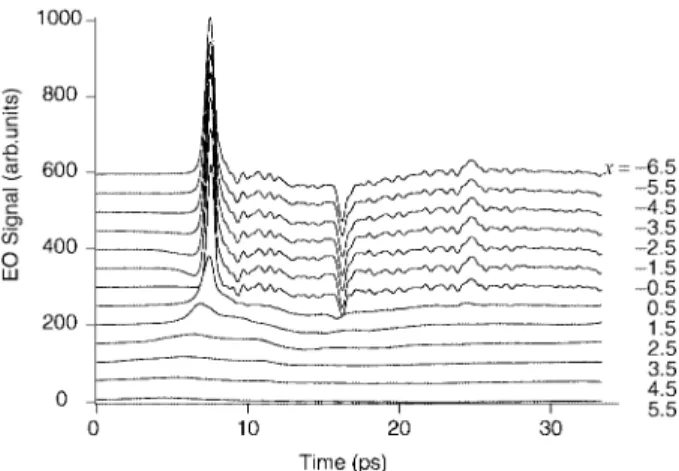
We have conducted an experiment equivalent to the knife edge test of a focused optical beam to observe the spatial distribution of a focused THz beam. The emitted THz beam was once focused and next col- limated, and then again focused by three off-axis parabolic mirrors (50.8 mm focal length), and the waveform at the second focus was measured with an EO sampling setup, as shown infig. 2. Axisx(mm) is the path perpendicular to the propagation axis in which the edge passes through the optical (high-
Fig. 1: THz field waveform change when passing
through metal circular apertures.
Fig. 2: The experimental setup for the knife edge mea- surement. Axis xis the path which the edge of the aluminum plate passes through. The origin of x is taken as the optical focus of the mirror.
frequency-limit) focus. The origin of x is taken at this focus.
Figure 3 shows the THz waveform change as the edge of the aluminum plate (200 µm in thickness) moves along the x axis. The most striking differ- ence in waveform can be seen between the data sets of x=−0.5 mm and 0.5 mm. The amplitude of the oscillations after the main peak seen in datax=−0.5 mm drastically decreases in x= 0.5 mm. These os- cillations are trails of water vapor absorption in air (peak resonance at1.7 THz).
The corresponding Fourier amplitudes of the wave- forms were calculated and ratios were taken with the denominator being the data set of x = −6.5 mm, which are shown infig. 4. Asxincreases to−0.5 mm, the low frequency components of the pulse decrease gradually. This trend changes markedly at x = 0.5 mm, showing drastic decrease in high frequency com- ponents of the pulse. Asxincreases further, the low
Fig. 3: THz field waveform change with distance x (mm). Each data set is shifted vertically by an inter- val of 50.
Fig. 4: Relative Fourier amplitude of the THz wave- forms shown infig. 3, which is normalized to the value forx=−6.5 mm.
frequency components decrease slowly.
The drastic changes seen in both the waveforms and the Fourier amplitudes between data sets ofx=−0.5 mm and 0.5 mm show that the focused THz beam has a frequency dependent circular spatial distribu- tion, i.e., higher frequency components of the pulse are focused to a smaller area.
Scanning x with the time delayfixed at the peak of waveform x =−6.5 mm, the THz beam size was measured to be 700 µm. Since the focus optics has anf-number of nearly 1, the smallest focused beam size should be almost equal to the wavelength of each frequency component. The peak frequency of the THz pulse is approximately 200 GHz, which corresponds to 1.5 mm in wavelength. The present experimental results are in agreement with this simple theoretical analysis.
Conclusion
We have experimentally confirmed that a THz beam generated from a LAP antenna can be steered by mir- rors and focused to a reasonable beam size to form a high peakfield pulse. The focused THz pulse devel- oped a negative tail in its temporal waveform when passed through a metal circular aperture whose calcu- lated cutofffrequency was confirmed to be consistent with the experimental results. This negative tail of the waveform can be obstacles for some applications because the polarity of the THzfield determines mate- rial responses to the THz pulse. Measuring temporal waveforms as a metal knife edge passes through the focus of a THz pulse led us to measure the spatial dis- tribution of the focused THzfield. Higher frequency components of the THz pulse was found to be focused to a smaller area. The knowledge of these propagation characteristics will prove to be useful in future experi- mental measurements of nonlinear material responses to intense THz pulses.