Meghalaya Resource Based Industry
(Electric Power and Cement) Development Study
Study Report
March 2006
Engineering and Consulting Firms Association, Japan Japan Development Institute
Tokyo Electric Power Engineering Company
This work was subsidized by the Japan Keirin Association through its Promotion funds from KEIRIN RACE.
Coal Depot in Jaintia Hills Coal transported by over- loaded trucks
Local Town near Coal mining Cable car used by Chattak cement
Cement factory in North East India (Bangladesh Border)
Contents Photos
List of Tables... iii
List of Figures... iv
Abbreviations... v
Executive Summary... vi
1. Background and Objective of Project... 1
2. Socio-economic Profile of North-East Region and Maghalaya State... 1
2.1. North East Region of India ... 1
2.2. Region’s Challenges and Opportunities in Project Development ... 5
2.3. Meghalaya State... 6
2.4. Coal and Limestone Deposits in Meghalaya ... 7
2.4.1. Coal Deposits of Meghalaya ... 7
2.4.2. Limestone Deposit of Meghalaya ... 10
2.5. Investment Incentives for the region... 13
3. Basic Profile and Development Plan of Cement Project... 13
3.1. Existing Cement Industry in Maghalaya ... 13
3.2. Cement Industry of Bangladesh... 13
3.3. Potential Cement Project for Export to Bangladesh ... 14
3.4. Proposed Concept and Scenario for Future Projects Implementation... 17
3.4.1. Mutually Beneficial and Economically Sound Project... 17
3.4.2. Political Support ... 17
3.4.3. Further Trade and Investment between Two Countries... 18
4. Coal Fired Power Project: Potentials and Challenges... 18
4.1. Status of Electric Power Supply and Peak Demand in Meghalaya State... 18
4.2. Potential for Power in North East India ... 21
4.3. Future Projection and Power Development Scenario ... 21
4.4. Coal Mine and Supply of Coal: Existing and Future ... 21
4.5. Proposed Coal Fired Power Plant ... 22
4.5.1. Scale of Power Station and Type of Power Plants ... 22
4.5.2. Planned Location of Power Station ... 22
4.5.3. Climatic Conditions ... 23
4.5.4. Impact on Environment ... 26
4.5.5. Primal Specifications of Power Plant ... 26
4.5.6. Scope of Supply for Power Station ... 26
4.5.7. Development Plan ... 27
4.6. Financial and Economic Analysis ... 30
4.6.1. Financial Analysis ... 30
4.6.2. Economic Analysis ... 37
4.6.3. Evaluation ... 38
5. Summary and Recommendations... 38
5.1. Potential Economic Development Projects in Meghalaya ... 38
5.2. Cement Based Industry... 38
5.3. Coal Based Industry: Coal Fired Power Plant ... 39
Appendixes... 41
Industrial policy (1997) ... 41
Related Environment Laws and Required Standards on Thermal Power Plant ... 42
List of Tables
Table. 2-1 Geographical Land and Census as of 2001... 2
Table. 2-2 Contribution of Major Sectors to NSDP (at current prices): 1996-7 .... 3
Table. 2-3 Contribution of Secondary and Tertiary Sectors to NSDP: 1996-7 ... 4
Table. 2-4 Cultivation Practices in the North East States 1995-96... 5
Table. 2-5 Major Mineral Resources of North East Region (unit: million tons) .... 5
Table. 2-6 Contribution to NSDP by Industry at Current Prices in Meghalaya ... 6
Table. 2-7 Major Coal Deposit Sites in Meghalaya State ... 8
Table. 2-8 Major Limestone Deposit Sites in Meghalaya State ... 10
Table. 3-1 Bangladeshi Cement Demand and Proposed Joint Cement Projects Production Capacity ... 14
Table. 4-1 Existing Power Plants in Meghalaya State (as of the end of the year 2005)... 19
Table. 4-2 Power Supply and Peak Demand Forecast in Meghalaya State... 20
Table. 4-3 Properties of West Darranggiri Coal... 23
Table. 4-4 Primal Specification of Proposed Power Plant ... 26
Table. 4-5 Planning for Loans ... 30
Table. 4-6 Interest Conditions... 31
Table. 4-7 Annual O&M Costs... 31
Table. 4-8 Financial Internal Rate of Return ... 33
Table. 4-9 Flow Chart of Revenue and Expense of Coal Field Power Plant Project ... 34
Table. 4-10 FIRR of Coal Field Power Plant Project... 34
Table. 4-11 Sensitivity Analysis ... 35
Table. 4-12 Annual Average Capital Cost in Debt Service Period ... 36
Table. 4-13 Summary of Annual Capital Cost in the Repayment Period... 36
List of Figures
Figure. 2-1 Map of North East Region of India... 2
Figure. 2-2 Map of Meghalaya State... 7
Figure. 2-3 Mineral Map of Meghalaya ... 12
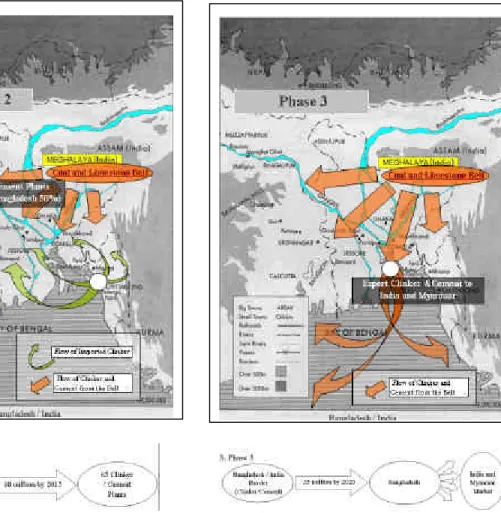
Figure. 3-1 Current and Proposed Flow Models in Phases of Cement Clinker in Bangladesh... 16
Figure. 4-1 Power Transmission Line in Meghalaya State ... 24
Figure. 4-2 Candidate Location of Nangalbibra Power Station ... 25
Figure. 4-3 General Construction Schedule of Coal Field Power Plant ... 28
Figure. 4-4 General Arrangement of Coal Field Power Station ... 29
Figure. 4-5 Sensitivity Analysis... 35
Abbreviations
CEA : Central Electric Authority CST : Central Sales Tax
C.V. : Calorific Value
ECFA : Engineering Consulting Firms Association of Japan EIA : Environmental Impact Assessment
EIRR : Economic Internal Rate of Return EP : Electric Static Precipitator
F.C. : Fixed Carbon
FGD : Flue Gas Desulphurization FIRR : Financial Internal Rate of Return
ICT : Information and Communication Technology IPP : Independent Power Producer
IRR : Internal Rate of Return
JBIC : Japan Bank for International Cooperation JDI : Japan Development Institute
MBADP : Meghalaya Border Ares Development Plan MeSEB : Meghalaya State Electricity Board
MIDC : Meghalaya Industrial Development Corporation Ltd.
NER : North East Region
NSDP : Net State Domestic Product NPV : Net Present Value
O&M : Operation and Management ROI : Return on Investment
TEPSCO : Tokyo Electric Power Services Company SEZ : Special Economic Zone
VAT : Value Added Tax V.M. : Volatile Matter
Executive Summary Background
Japan Development Institute (JDI) has been proposing Regional Development Programme in North-East Region of India. JDI visited Maghalaya in 2005 and met the Chief Secretary of Maghalaya State. During the meeting, possible developments of coal thermal power plant and cement industry were discussed and a preliminary request for JDI’s support was made. The proposed preliminary industrial development program is expected to contribute to the region’s realization of the economic growth, export earnings, generation of employment and poverty reduction targets. In response to the request, JDI formed a study team in collaboration with Tokyo Electric Power Services Company (TEPSCO) and conducted a pre-feasibility study on those subjects with a partial sponsorship from Engineering and Consulting Firms Association of Japan (ECFA).
One important strategy for the projects is the utilization of coal deposit and limestone in Meghalaya State in North East Region of India. In this study report, the possible optimal approach to develop a coal thermal power plant of 450 MW and a regional economic integration with Bangladesh through cement and clinker manufacturing are proposed.
The inter-regional transport of limestone and the processed clinker/cement is considered targeting both domestic and export market to Bangladesh. The field mission is, thus, planned to visit India and Bangladesh in order to discuss the feasibility of project among relevant stakeholders and formulate preliminary consensus between concerned countries in the period between 13th January and 27th January, 2006.
North East Region and Meghalaya State
The North East Region of India has been one of the poorest regions in India, yet received an enhanced initiative from the central government to shore up the economic growth with infusions of public resources. The creation of a dedicated Ministry of Development of North Eastern Region, together with signs of the Prime Minister’s initiatives for funding various regional development plans and projects signifies the commitment of the Government of India to accelerate the pace of economic development of the region, yet the region has to tackle several challenges in order to maximize its opportunities.
Meghalaya State situates in the southern part of North East Region and share the border with Bangladesh. The State is well endowed with rich natural resources, yet the economic growth of the State has been slow hereby it is realized the potentials of the State has not be explored. Namely, the region has identified problems of still poorer state of infrastructure for supporting business and economic growth and less-integrated and inactive trade network with neighboring countries. The opportunities are lying in the Region with utilizing mineral and natural resources, tourism and, introducing high-valued added produced like horticulture & herb based agriculture or ICT outsourcing industry, which could mitigate the geographical constraint of remoteness from the market.
Coal Thermal Power Plant
Based on field survey and discussions with key officials in Bangladesh, Meghalaya and Indian Central Government, we consider that three major projects can be promoted in foreseeable future (2006-2010).
Focused on the coal, the coal reserve of Meghalaya is estimated from 520 million to 640 million tons and then the current production is assumed to be about 5 million ton per year. It is projected that the coal production can continue over 100 years. Considering the mountainous physical condition of Meghalaya, yet the coal is difficult to export to mainland India or other countries. One of the best ways to utilize the coal is thus using as fuel for power plant near the coal mine sites.
Currently, power supply in the State is limited to 180 MW and the installed power shortage reaches about 80 MW. The situation is expected to worsen without quick actions for the power development plan. Meghalaya State is already started to develop additional 120 MW of hydropower plants in the eastern region of Meghalaya by 2015.
However, considering the future prospect of region’s industrial development, the power shortage is foreseeable and the current power development plan may encounter troubles in shortage of installed capacity and overdependence on hydropower, which may risk a stable source of power during dry season.
In order to solve the power problems, we are recommending the following development plan:
(1) Additional Coal Thermal Power Plant starting 450 MW and adding more 100 to 200 MW depending on the future power demand and possible export opportunity to neighboring State of Assam.
(2) Strengthening transmission lines connecting western parts to eastern parts of Meghalaya and Assam State in North. Eventually economical and dependable power supply system with lower cost will be achieved.
Action plan recommended
(1) Detail Feasibility Study jointly with JDI financed by Japan and Meghalaya State.(within 2006)
(2) Submission of proposal to the central Government for financial assistance either from the central Government or JBIC Loan from Japan. (2006 to 2007)
(3) Implementation of Phase one: may start from 2008 and to be completed by 2012.
After financial and economic analysis is conducted, it is found that the coal thermal power plant project can generate a positive financial return and economic impacts in the region. This project can be a potential candidate for Independent Power Producer (IPP) project scheme to be adopted, and in the sense of power security, the proposed coal thermal plant is applicable. The proposed power project can offer a competitive cost value of power generation, which eventually contributes to the State’s and even region’s industrial development, and it will contribute to the region’s industrial development and
electrification of the communities. The realization of this project is, thus, highly significant from the perspective of improving the socio-economic and business-related environment in the region.
Limestone/Cement Industry
Our proposal for utilizing locally available limestone is closely interlinked as to how the inter-regional trade can be enhanced. Due to in-availability of limestone in Bangladesh, currently, only a state-owned cement company, Chattak Cement in Bangladesh, has imported limestone from North East India to produce clinker, which is ultimately processed as cement and consumed locally. Consequently the rest of required material of clinker has to be imported from overseas. In order to increase domestic production capacity of cement/clinker, Bangladesh envisions a desirable border trade with North East Region of India. Expected demand for cement in Bangladesh is 15.0 million tons by 2015 and 25.0 million tons in 2020. Meghalaya State may be able to capture 50% to 70% of the demand in Bangladeshi by 2010 mainly due to the lower cost of production and transportation to Bangladesh consumers. The border area may be able to develop 6.0 million tons cement plants by 2010, 15.0 million tons by 2015 and 30 million tons by 2020.
Action Plan recommended:
(1) Political discussions between concerned partners of Bangladesh, Meghalaya and Central Indian Government, and the agreement to a Joint Development Plan of Resource based industry especially cement & clinker production.(within 2006).
(2) Carrying out Meghalaya Border Ares Development Plan (MBADP) focusing on cement/clinker production and supporting infrastructure such as roads, waterways and telecommunication system (Within 2006).
(3) Carrying out a pilot cement/clinker project (3 million tons/year) feasibility study (By the middle of 2007) and expand similar cement/clinker projects.
(4) Continue additional cement/clinker projects by following the MBADP achieving the goal set by the Bangladesh, Meghalaya State Government and Indian Government.
(5) In order to implement the proposed joint projects, a permanent Trouble Shooting Committee should be organized and quarantine the smooth and quick implementation of the joint cement/clinker projects.
Shoichi Kobayashi, Ph.D.
Team Leader of the Study &
Chairman of Japan Development Institute
1. Background and Objective of Project
Japan Development Institute (JDI), which has been proposing a Regional Development Programme in North-East Region of India, visited Meghalaya State in 2005 and met the Chief Secretary of Meghalaya regional government. During the meeting, possible installation of coal thermal power plant and development of cement industry were discussed. One important remark for promoting these projects will be the usability of abundant coal and limestone deposits in the region. For locationwise, coal thermal power plant was proposed to situate near a major mining site in Meghalaya, and the production of cement was proposed to be integrated with Bangladesh market, since the relation between North Eastern India and Bangladeshi in the cement industry is regarded to be mutually complemental.
Consequently, one objective of the study is to grasp the scale of mineral deposits in Meghalaya region, and to study the feasibility of a 300 MW coal thermal power station.
And the other is observing the actual operation and management of cement industries in both countries and to find an economically rational way of transacting cement related products between India and Bangladesh.
The project proposal was supported by the Engineering and Consulting Firms Association of Japan (ECFA), and then the preliminary Feasibility Study for the Meghalaya Resource Based Industry (Electric Power and Cement) was carried out. As the study team, JDI asked Tokyo Electric Power Services Company (TEPSCO) to join the field survey covering the technical aspect of coal thermal electric power generation.
The joint study team thus covers the field study in Dhaka in Bangladesh, Meghalaya State and New Delhi in India from January 17 to 26, 2006 and, studied the feasibility of the proposed resource based industries especially the coal thermal electric power generation and export-oriented cement industry in Meghalaya.
2. Socio-economic Profile of North-East Region and Maghalaya State 2.1. North East Region of India
1) Physical features
The North East Region of India is comprised of the eight states of Assam, Arunachal Pradesh, Manipur, Meghalaya, Mizoram, Nagaland, Sikkim and Tripura. The region is virtually isolated from the mainland India and the large proportion of internal transaction of goods is confined through a narrow corridor with North Bengal, which is sometimes referred to as the Siliguri Neck or "Chicken's Neck".
The North East region is formed with hills and plains, and they are mainly categorized into the Shillong Plateau, the North Eastern hill Basin and the Brahmaputra Valley.
The most characteristic climatic feature of the region is that during the rainy season, some parts of the region1 receive intensive rainfall and the annual rainfall could reach about 1080cm, which is the highest rainfall in the world.
Figure. 2-1 Map of North East Region of India
Source: Study Team 2) Demography
While the region accounts for 8% of the Indian territory, the population constitutes about 4% of the total population of the country. The spatial demography is reflected with the region’s difficult terrain in that the population is unevenly distributed.
Uniquely tribal population forms a majority in four states out of 8 states i.e., Mizoram, Meghalaya, Nagaland and Arunachal Pradesh, and especially in Mizoram, tribal community constitute as high as 95% of the population, which has caused some social instability in the region.
Table. 2-1 Geographical Land and Census as of 2001
State Geographical Area (sq. km)
Population (million)
Population density (per sq. km)
Arunachal Pradesh 83,743 1.09 13
Assam 78,438 26.65 340
Manipur 22,327 2.29 103
Meghalaya 22,429 2.31 103
Mizoram 21,087 0.89 42
Nagaland 16,579 1.99 120
Tripura 10,486 3.19 305
All North East 262,185 38.98 149
All India 3,287,263 1,028.61 313
Source: Census data, 2001
3) Economy and Major Industries
The economic growth of the region has commenced in recent years largely due to interventions from the central government initiatives. The per capita income in the region grows on an average of 12,918 Rupees (Rs.), and yet it is not still much lower than the national average of Rs. 17,823 in 2001-02.
Confined to the availability of updated date sources on the overall regional economic features, yet, according to the following tables, the contribution of agriculture to state domestic income seems the highest in this region. Forestry and logging is a relatively larger contributor followed by public administration and other service sectors. In Meghalaya and Assam, mining is an important contributor to Net State Domestic Product (NSDP).
The industrial/secondary sector is deemed to be steadily grown in the region and, it is noted that the contribution of construction is high in this region. The border trade with Myanmar and Bangladesh accounts for major portion of trade in the region, and currently, Meghalaya, Assam and Nagaland have a larger proportion of the sectoral contribution. Moreover, reportedly, the region’s share of service sector, especially Information and Communication Technology (ICT) related outsourcing sector has shown a positive growth, and the sector’s characteristics that not substantially affected by the physical remoteness from the market can be suited for a future business development model of the region.
Consequently, it can be realized that the region is still primarily agrarian-based economy and major manufacturing industries are confined to Assam and, in other parts of the region, mining, construction, public administration and service sectors are still major sources of their income.
Table. 2-2 Contribution of Major Sectors to NSDP (at current prices): 1996-7 (%) Sectors Arunachal Assam Manipur Meghalaya Mizoram Nagaland Tripura Agriculture 27.34 38.84 32.52 24.13 N/A 29.03 35.91 Forestry and
Logging 6.73 2.03 3.06 1.2 N/A 3.14 2.73
Fishing 0.71 1.75 2.63 0.82 NA 0.37 3.77
Mining and
Quarrying 0.37 3.88 0.0006 5.21 N/A N/A 0.87 Public
Administration 9.63 6.79 14.35 12.98 N/A 16.58 13.84 Other Services 14.15 9.93 13.82 10 N/A 17.27 18.8 Source: Directorate of Economics and Statistics, Government of India
Table. 2-3 Contribution of Secondary and Tertiary Sectors to NSDP: 1996-7 (%) Sectors Arunachal Assam Manipur Meghalaya Mizoram Nagaland Tripura
Manufacturing 3.08 7.7 3.21 3.3 N/A 1.45 2.26
Construction 26.87 7.37 10.16 12.85 N/A 10.36 8.02 Electricity,
Gas & Water Supply
0.03 0.34 -3.14 -0.192 N/A -0.75 -3.64 Transport and
Communication 0.6 3.42 2.8 6.73 N/A 3.01 3.31
Trade 6.01 9.79 5.2 15.62 N/A 7.62 5.72
Bank &
Insurance 1.33 3.96 0.86 2.67 N/A 0.98 3,32 Other services 14.15 9.93 13.82 10.00 N/A 17.27 18.80 Source: Directorate of Economics and Statistics, Government of India
4) Agriculture
Regional agricultural products are sold mainly in the local markets, and not exported in the form of value-added products perhaps except for tea. The region’s agricultural system is largely confined to the traditional husbandry. The land availability is a restraint and the overall cultivable land for the North East region of 25% is much smaller than the national average of 59%. Moreover, the extent of cultivated land in the North East region varies from state to state, yet the region’s overall cultivated land is limited to 62% of the cultivable land, which is inferior to the national average of 73%.
Since the region has hilly terrain, a large-scale cultivation and cheap transportation of agricultural products would not be attained. Besides, in order to improve the region’s agricultural sector, an improvement of productivity and profitability must be attained.
In order to overcome those challenges, an introduction of horticultural products and high-valued vegetable is recommended so that the high-value products can contain the disadvantages of the region’s remoteness to the market.
Table. 2-4 Cultivation Practices in the North East States 1995-96
State
Total Geographical.
Area (000’ha)
Cultivable Land (000’ha)
% of Cultivable
Area
Cultivated Area (000’ha)
% of Cultivated Area Used Arunachal
Pradesh 8,374 293 4% 185 63%
Assam 7,844 3,387 43% 2,780 82%
Manipur 2,233 164 7% 140 85%
Meghalaya 2,243 1,074 48% 206 19%
Mizoram 2,108 445 21% 109 24%
Nagaland 1,658 626 38% 211 34%
Tripura 1,049 310 30% 277 89%
All North East 25,508 6,299 25% 3,908 62%
All India 328,726 194,680 59% 142,215 73%
Source: CMIE Report on Agriculture, 1997 and 1998 5) Mineral Resource
The North East region is endowed with rich natural resources and hold considerable potential for its use. The following is the brief data inventory of the region’s mineral resources.
Table. 2-5 Major Mineral Resources of North East Region (unit: million tons) Coal Lime-stone Oil & Gas Clay Iron ore
Proven 327.3 181.3 - 0.6 -
Probable 253.4 888.5 - 20.1 3.6
Possible 451.0 4,412.9 2323 93.6 19.9
Source: Mineral Year Book, Task Force Report, Ministry of Mines, 1997
2.2. Region’s Challenges and Opportunities in Project Development 1) Existing Problems and Potential of North Easter Region
Although the creation of a dedicated Ministry of Development of North Eastern Region, together with signs of the Prime Minister’s initiatives for funding various regional development plans and projects signifies the commitment of the Government of India to accelerate the pace of economic development of the region, the region has to tackle several challenges and maximize its opportunities.
The followings are the summary of identified problems and opportunities in the North East Region of India.
(1) Major Challenges
(1) Poor accessibility from Mainland India and the rest of World (2) High mountains and hilly conditions in the most territory (3) Security problems in a few states
(4) Poor Infrastructure: (road, railway, power, telecommunication and industrial estates and water/sewerage facilities)
(5) Less-integrated and inactive inter-regional trade with neighboring countries (2) Potential Industries
(1) Resource Based Industries (Oil, Limestone, Coal) (2) Adventure/nature & Culture based Tourism (3) Horticulture & herb based agriculture (4) ICT outsourcing Industry
2.3. Meghalaya State
Like most other North East states, Meghalaya is based on agriculture and public and service-oriented economy to a large extent. Besides, Meghalaya state has rich deposits of coal and limestone, and the mining sector contributes to the state's income in some extent. In 1999-2000, the contribution of the sector to the NSDP reaches 4.27%. In case of per capita income, however, Meghalaya can not keep up with the national average and, in fact, the gap has widened further.
Table. 2-6 Contribution to NSDP by Industry at Current Prices in Meghalaya (%)
Industry 1997-98 1998-99 1999-00
Agriculture 26.86 24.48 24.18
Forestry and Lodging 1.38 1.24 1.17
Fishing 0.72 0.64 0.57
Mining & Quarrying 2.85 4.72 4.27
Sub Total: Primary Sector 31.81 31.08 30.19
Manufacturing (Total) 1.95 1.72 1.74
Registered 0.7 0.54 0.63
Un-registered 1.24 1.18 1.1
Construction 9.56 8.68 8.46
Electricity, Gas & Water Supply 0.84 0.71 0.82
Sub Total: Secondary Sector 12.35 11.12 11.02
Transport, Storage & Communication (Total) 3.18 3.39 3.5
Transport by other means 2.9 3.1 3.2
Storage 0.005 0.004 0.005
Communication 0.27 0.29 0.29
Trade, Hotel & Restaurant 14.59 15.11 15.16
Banking & Finance 2.66 2.51 2.54
Real Estate, Ownership of dwelling & Business services 11.71 10.74 10.19
Public Administration 14.75 16.17 15.79
Other services 8.95 9.88 11.61
Sub Total: Tertiary Sector 55.85 57.8 58.79
Source: Directorate of Economics and Statistics, Government of Meghalaya
For the mining industry, small scale private entrepreneurs have been operating the extraction and transport of the minerals to Assam and Bangladesh in raw form. Thus, in the absence of down stream industries in Meghalaya, little value-added processes are performed. The related mineral-based industries in the state are confined to the manufacture of cement, lime, small-scale steel plants, granite cutting and polishing.
Almost all of them are of medium scale industry and other small scale industries are tailoring, wooden furniture making, cane and bamboo works, flour and rice mills, weaving, and bakery.
Figure. 2-2 Map of Meghalaya State
Source: Department of Information and Public Relations, Government of Meghalaya
2.4. Coal and Limestone Deposits in Meghalaya 2.4.1. Coal Deposits of Meghalaya
The coal deposits of Meghalaya, belonging to the Eocene age, are to be found mostly on the southern slopes of the State. Some prominent coalfields in the State are Siju, East and West Darranggiri, Cherrapunjee, Mawlong, Pyndengrei and Balpakram, Langrin, Bapung and Laitryngew. The total estimated reserve of coal in Meghalaya ranges from 525 million to 640 million tons, out of which, the majority is supposed to be found in Garo Hills.
The inferred reserves of known mineral resources in Meghalaya state are given below, yet they are provided under the premise that actual reserves of the deposits can be differed due to the inconsistency and complexity of local exploratory research and some of the out-dated reference sources.
Table. 2-7 Major Coal Deposit Sites in Meghalaya State
Location (Area coverage)
Reserve million tons (Reported by)
Quality Remarks Laitryngew (Khasi Hills)
(31 sq.kms)
2.7
(Geological Survey of India)
Moisture : 1.4%
Ash : 11.5%
V.M. : 41.2%
F.C. : 45.9%
C.V. : 6,761 KCal/kg Caking property : Coking Cherrapunjee (Khasi Hills)
(36 sq.kms)
19.0
(Geological Survey of India)
Moisture : 1.4 - 2.0%
Ash : 4.3 - 10.3%
V.M. : 41.5 - 42.5%
F.C. : 46.8 - 51.2%
C.V. : 7,233 - 7,644 KCal/kg Laitduh (Khasi Hills)
(0.12 sq.kms)
0.12 Moisture : 2.8 - 8.16%
Ash : 4.16 - 18.53%
V.M. : 29.13 - 54.01%
F.C. : 32.53 - 50.75%
Mawbehlakar (Khasi Hills) (0.1 sq.kms)
0.12 Moisture : 3.9%
Ash : 2.9%
V.M. : 45.1%
F.C. : 48.1%
Mawlong (Khasi Hills) (8 sq.kms)
9 Moisture : 4.40%
Ash : 7.94%
V.M. : 33.92%
F.C. : 51.74%
Sulphur : 3.46%
C.V. : 6,772 Kcal/kg Mawsynram (Khasi Hills)
(2.4 sq.kms)
0.32 Moisture : 6.98%
Ash : 13.90%
V.M. : 34.90%
F.C. : 44.22%
Sulphur : 1.99%
C.V. : 5,859 KCal/kg Lumdidom (Khasi Hills)
(0.2 sq.kms)
0.2
(Directorate of Mineral Resource Meghalaya)
Moisture : 1.4 - 7.4%
Ash : 24.5 - 62.0%
V.M. : 30.8 - 36.0%
F.C. : 35.5 - 37.8%
Sulphur : 2.2 - 2.6%
C.V. : 5,730 - 6,510 Kcal/kg
Langrin (Khasi Hills) 97.61
(Geological survey of India)
Moisture : 1.9 - 6.9%
Ash : 2.7 - 9.2%
V.M. : 40.9 - 56.6%
F.C. : 34.3 - 49.2%
Sulphur : 3.0 - 4.2%
East Darranggiri (Khasi and Garo Hills)
(21 sq.kms)
31.5 V.M. : 4.84 - 8.42%
F.C. : 36.84 - 41.40%
Ash : 46.10 - 51.34%
Sulphur : 3.74 - 8.34%
C.V. : 11,000 - 12,325 B.Th. U/lb
West Darranggiri (Garo Hills)
(47 sq.kms)
64
(Geological survey of India, Directorate of Mineral Resource Meghalaya)
Moisture : 6.9 - 12.5%
V.M. : 39.6 - 43.0%
F.C. : 44.9 - 47.1%
Ash : 1.3 - 10.2%
Sulphur : 1.0 - 3.5%
C.V. : 5,730 – 6,535 kcal/kg Siju (Garo Hills)
(11 sq.kms)
125 Moisture : 3.30%
Ash : 4.16%
V.M. : 38.58%
F.C. : 53.36%
Sulphur : 1.8%
C.V. : 12,450 B.Th. U/lb Coking properties : Coking Pendengrew and
Balphakram (Garo Hills) (13 sq.kms)
107 Moisture : 1.60 - 11.20%
Ash : 3 - 15%
V.M. : 37 - 50%
F.C. : 37.40 - 48.40%
Umlatdoh - Lakadong (Jaintia Hills) (3 sq.kms)
1.5 F.C. : 44.76 - 59.86%
V.M. : 29.68 - 33.50%
Ash : 2.25 - 24.70%
Moisture : 0.44 - 0.86%
Sulphur : 3.40 - 4.96%
C.V. : 10,250 - 13,500 B.Th. U/lb
Bapung (Jaintia Hills) (46 sq.kms)
5.7
(Directorate of Mineral Resource Meghalaya)
Moisture : 2.2 - 9.2%
Ash : 2.6 - 7.87%
V.M. : 38.3 - 44.3%
F.C. : 46.6 - 52.3%
C.V. : 7,015 - 7.490 Kcal/kg Sulphur : 4.7 - 7.1 %
Character of coal : Bright to Dull coal
Jarain and Tkentalan (Jaintia Hills)
(2.8 sq.kms)
1.1 Moisture : 1.22 - 1.6 %
Ash : 4.4 - 6.7%
V.M. : 41.6 - 48.1%
F.C. : 45.9 - 50.46%
Source: Directorate of Mineral Resources, Government of Meghalaya “Technical date on the various limestone deposits of Meghalaya”, 2002
The main characteristics of the coal obtained in Meghalaya State are its low ash content and high volatile matter with high calorific value (ranging from 6,500 to 7,500 kcal/kg);
however, its high sulphur content constrains its use in broad yet certain domain of industries ranging from power, fertilizer, cement and textile to paper, rubber, brick burning and pottery based industries, but certainly not recommendable in corks-based industries unless sulphur controlling devices was installed.
2.4.2. Limestone Deposit of Meghalaya
Limestone is another prospective mineral that is laid in the southern belt of the State (approximately 200 km long) along the Bangladeshi border. The quality of the limestone found here varies from cement grade to chemical grade. The total reserves of limestone within the state (exploration status) are estimated around 4 to 5 trillion tons.
Some prominent limestone deposits are Cherrapunjee, Mawlong-Ishamati, Komorrah, Shella, Borsora in Khasi Hills, Siju and Nangwalbibra in Garo Hills, Lumshnong, Sutnga, Nongkhlieh, Syndai and Lakadong in Jaintia Hills as shown below.
Table. 2-8 Major Limestone Deposit Sites in Meghalaya State
Location (Area coverage)
Reserves million tons (Reported by)
Quality Remarks Cherrapunji (Khasi Hills)
(1.4 sq.kms)
31.15
(Geological survey of India, Directorate of Mineral Resource Meghalaya)
CaO : 30.64 - 53.53%
MgO : 0.33 - 2.24%
AL :1.06 - 3.37%
Laitrynqew (Khasi Hills) N/A CaO : 52.02 - 54.41%
MgO : 0.15 - 2.25%
AL : 3.00%
Mawlonq (Khasi Hills) (13.75 sq.kms)
395
(Geological survey of India) 2,166
(Directorate of Geology and Mining, Assam)
CaO : 51.91 - 53.04%
MgO : 0.43 - 0.76%
R2O3% : 0.78 - 1.04%
AL : 0.91 - 1.85%
Komorrah (Khasi Hills) (0.36 sq.kms)
14.2
(Directorate of Mineral Resource Meghalaya)
CaO : 51.97%
MgO : 1.46%
Fe2O3 : 1.11%
Al : 1.90%
Shella (Khasi Hills) (2.76 sq.kms)
180
(Directorate of Mineral Resource Meghalaya)
CaO : 49.44 - 53.88%
MgO : 1.53 - 2.66%
Fe2O3 : 0.28 - 0.69%
Al : 0.51 - 0.97%
Borsora (West Khasi Hills) (1.0 sq.kms)
37
(Directorate of Mineral Resource Meghalaya)
CaO : 51.47 - 54.16%
MgO : 0.25 - 2.08%
SiO2 : 0.08 - 1.26%
Al2O3 : 0.32 - 2.20%
Fe2O3 0.23 - 0.86%
Lumshnong (Jaintia Hills) (76.8 sq.kms)
652
(Geological survey of India) 291.21
(Directorate of Mineral Resource Meghalaya)
CaO : 46.81 - 53.22%
MgO : 0.16 - 1.69%
Fe2O3 : 0.55 - 3.36%
Al2O3 : 0.20 - 3.05%
East Block 23.6 CaO : 52.57%
Fe2O3 : 0.49%
SiO : 0.74%
Al2O3 : 1.41%
MgO : 1.12%
West Block 4.5 CaO : 52.64%
Fe2O3 : 0.47%
SiO : 1.50%
Al2O3 : 0.86%
MgO : 1.12%
Nongkhlieh (Jaintia Hills) (4.01 sq.kms)
16
(Directorate of Mineral Resource Meghalaya)
CaO : 46.0 - 52.58%
MgO : 0.38 - 1.67%
Fe2O3 : 0.68 - 8.0%
Al : 2.05 - 4.36%
Lakadong (Jaintia Hills) (26 sq.kms)
N/A CaO : 53.06%
MgO : 1.00%
R2O3 : 0.48%
Al : 0.90%
Syndai (Jaintia Hills) (2.086 sq.kms)
95.85
(Directorate of Mineral Resource Meghalaya)
CaO : 34.0 - 49.36%
MgO : 0.56 - 16.13%
R2O3 : 0.42 - 2.31%
Al : 3.2 - 13.9%
Darrang-Era-Aning (West Garo Hills)
(1.94 sq.kms)
47.7 CaO : 40.90 to 52.23%
MgO : 0.21 to 6.23%
Al2O3 : 0.37 to 10.33%
Fe2O3 : 0.28 to 7.92%
AI : 1.92 to 8.02%
Sijiartheka (West Garo Hills)
(5.7 sq.kms)
27 CaO : 46.90%
MgO : 1.72%
Fe2O3 : 3.47%
Al2O3 : 2.69%
Source: Directorate of Mineral Resources, Government of Meghalaya “Technical data on the various limestone deposits of Meghalaya”, 2002
The quality of limestone in the state has CaO content of even 53% and can be regarded as high grade suitable for the cement, steel, fertilizer and chemical industries. The existing local cement plants are using local limestone, yet the industrial scale is still limited at Cherrapunjee in Khasi Hills and Damas in Garo Hills.
Figure. 2-3 Mineral Map of Meghalaya
Scale: 1 inch = 16 miles or 1: 1013760
Source: Directorate of Mineral Resources, Government of Meghalaya “Technical date on the various limestone deposits of Meghalaya”
2.5. Investment Incentives for the region
The State Government promotes to attract investment projects in agro-processing &
horticulture, mineral-based industries like cement and electronic-based industries, information technology and tourism. In administrative procedures, investment approvals and licenses are deemed to be provided smoothly through a Single Window Agency under the chairmanship of the Chief Secretary at the State level as well as at district level.
The Meghalaya Industrial Development Corporation Ltd. (MIDC) also provides supportive services for investors to ensure quick and effective setting up of industries in the State.
Besides the State Government offering subsidies on cost of infrastructure, transport, training, power, the Central Government has since initiated the development in the North-Eastern Region it is now for income/corporate tax to be exempted for five years from the date of commercial operation. The essence of the industrial policy (1997) is shown in Appendix..
3. Basic Profile and Development Plan of Cement Project
3.1. Existing Cement Industry in Maghalaya
Two cement projects with each having one million tons/year capacity were commissioned recently and one project has started operation and other project is near completion now. Thereafter it is expected to produce about two million tons in eastern region of Meghalaya within a few years. Expected demand in Meghalaya and other North Eastern states will be around 2.5 million tons/year and the on-going two projects will saturate the North Eastern Regional demand and no additional market in India is feasible from Meghalaya state due to costly transportation to the mainland India.
3.2. Cement Industry of Bangladesh
1) Consumptions and Production of Cement
Consumption of cement in Bangladesh is currently about 8.0 million tons per year and growing about 10% annually. Due to limited availability of limestone, Bangladesh import nearly 100% of clinker (processed product of limestone) from Asian countries including Indonesia, Philippines, Malaysia and China. The domestic clinker production is limited in the government-owned cement company (Chattak Cement Factory) located in Sylhey district with importation of limestone from Meghalaya State, India. The production of cement is about 200,000 tons year. The Chattak Cement was established in 1937 that is prior to the independence of Bangladesh. The cement plant now reaches nearly 60 years from the construction, and the technology used for processing is outdated wet type technology, thus productivity is quite low.
In the current local cement market, cement companies are mostly dealing with imported clinker which is processed in about 65 grinding plants nationwide. These 65 cement companies have value addition processes of only grinding and mixing local fly ash and gypsum, and packaging into bags for the local market. Consequently it comes to that the Bangladesh has low value addition yet incurs higher prices of cement compared with the international market due to higher transportation cost of importing raw material from overseas. Accordingly, the average cost of clinker is about US Dollar 40-45 per ton and the final cement prices come to around US Dollar 70-75, which is much higher standard than the case in most of other countries.
The following is a summary of current state of Bangladesh cement industry.
1) No limestone available in Bangladeshi: import nearly 100% of clinker
2) 65 cement companies are too many and only grinding and packing processes carried out: value addition is very small extent
3) The price of cement is well above the international prices: perhaps 50% higher.
3.3. Potential Cement Project for Export to Bangladesh
Providing the fact that Bangladesh is located so close to limestone deposits of Meghalaya and the demand for cement has already been large quantity of 8.0 million tons per year, and growing 10% annually, a joint project between Meghalaya State and Bangladesh is a rational and mutually profitable business and development model for both regions
Table. 3-1 Bangladeshi Cement Demand and Proposed Joint Cement Projects Production Capacity (million tons)
Year 2006 2010 2015 2020
Bangladesh Cement Demand 8.0 13.0 18 25
Proposed Joint Cement Projects 1.5 10.0 18.0 35 Source: Study Team
We are proposing the following joint cement projects for Meghalaya and Bangladesh area by three phases to become from a large importer to a net exporter as shown below:
1) Phase 1: Import-Substitution Stage from 2006 to 2010
Due to unavailability of limestone in Bangladesh, only a state-owned cement company, Chattak Cement, has imported limestone from North East India. As a new project, currently, a modern cement plant which has an estimated annual production capacity of 1.5 million tons is under construction near Sylhey receiving limestone from Meghalaya State. In order to increase domestic production capacity of cement/clinker in Bangladesh and Indian border area, the cross border trade of these products should be encouraged and expanded as soon as possible to respond to the Bangladesh domestic demand of 8 million tons of clinker, which is supplied from
South East Asia and China. The tentative production capacity target is about 8 to 10 millions ton by 2010.
2) Phase 2: Self Sufficiency Stage from 2011 to 2015
In this Phase 2 from 2011 to 2015, Bangladesh and India should work together to expand both cement and clinker production at the Meghalaya/Bangladesh border area to meet 100% of the expected demand for Bangladesh. The total production is targeted as 18 million tons by 2015.
3) Phase 3: Net-Exporting Stage form 2016 to 2020
In this Phase 3 period, the Meghalaya/Bangladesh border area should try to expand the clinker production further to become net exporter of clinker/cement. Possible exporting destinations of clinker will be Eastern India to neighboring country of Myanmar, and even to mainland India via seaway. Considering the large volume of limestone reserve in Meghalaya State and a good transport networks by waterways which enable to transport the heavy clinker in competitively cheap cost, the Meghalaya/Bangladesh border are likely to be a major producer of clinker/cement in the region. Total target production of cement and clinker will be 35 million tons by 2020.
Figure. 3-1 Current and Proposed Flow Models in Phases of Cement Clinker in Bangladesh
Source: Study Team
For setting up cement and clinker production plant, the following criteria are to be considered.
Criteria for finding the suitable location for cement plant a. Status of prospecting of the limestone deposit
b. Accessibility and other infrastructure as available in the deposits
c. Quality and reserves of the limestone suitable for manufacture of cement d. Availability of the limestone for the proposed project
e. Water is available from the nearby river f. Power is also available near the deposit
3.4. Proposed Concept and Scenario for Future Projects Implementation 3.4.1. Mutually Beneficial and Economically Sound Project
Meghalaya which is a part of the NER of India is cut off from the Indian mainland by East Pakistan at first after a bitter fighting during the independence from Briton during the late 1940’s and then now cut off by Bangladesh which became an independent country separated from Pakistan in 1971. NER of India and Bangladesh is a natural economic partner due to physical closeness. NER of India and Bangladesh are so close to each other and complemented in many aspects. One of such complemental industries is cement industry. NER especially Meghalaya State has abundant limestone and coal at the border area with Bangladesh. Due to isolated hilly sites near Bangladesh border, the abundant limestone is not feasible to convert to clinker/cement for the mainland Indian market due to difficulty to transport heavy cement/clinker. On the other hand Bangladesh did not have sufficient limestone to produce linker/cement at home and those products can be conveyed via channel through waterway. Therefore, converting this abundant limestone of Meghalaya to clinker/cement is feasible and competitive in the global market if these products are transported within Bangladesh or transported through Bangladesh by waterways to other countries including Indian mainland and Myanmar.
3.4.2. Political Support
Although two neighboring countries have been separated for three decades, NER and Bangladesh are a possible mutual partner and, beneficial trade and investment between two natural partners are possible. However, due to changes in political attitude between India and neighboring countries of Pakistan and Bangladesh in the recent years, the cooperation between India and Bangladesh became possible. Proposed clinker/cement projects in the Meghalaya/Bangladesh border area seems to one of such mutually beneficial feasible projects. If the proposed clinker project is well balanced to benefit both India and Bangladesh, the proposed clinker project has a good chance to be approved by both governments and materialized in the near future.
3.4.3. Further Trade and Investment between Two Countries
If the proposed clinker/cement project jointly between Meghalaya and Bangladesh are implemented successfully, further collaborations between Meghalaya/NER and Bangladesh are likely to expand rapidly into many sectors such as exporting of mineral resources, agricultural and forestry products from Meghalaya/NER to Bangladesh and eastern India through Bangladesh mainly using waterways which are one of the most economical transports of goods. NER are likely to also benefit from importing goods from Bangladesh and other countries including Indian mainland. This clinker project may become a good pilot project for encouraging the joint projects by NER of India and Bangladesh.
4. Coal Fired Power Project: Potentials and Challenges
4.1. Status of Electric Power Supply and Peak Demand in Meghalaya State
The total capacity of power plants in the state of Meghalaya was 185.2 MW as of the end of year 2005. The entire portion of the capacity is comprised of hydro power plants and is owned by the Meghalaya State Electricity Board (MeSEB). Table 4-1 shows the existing power plants in Meghalaya State. On the other hand, the peak demand in fiscal year 2005 is expected to reach 361 MW and this will be far in excess of the power supply of 247 MW including power purchased from other states. For this reason, the state of Meghalaya has to deal with the approximately 114 MW of power shortage through rotational blackout. This trend can be expected to continue after fiscal 2006 due to the booming economy particularly among ICT industries, industrialization and use of power in agriculture and to generate significant power shortage in the future. The growth of peak power demand in the state of Meghalaya is expected to show extremely high levels in the coming 2 to 3 years ranging from 20% to 30% and even after 2008, the annual growth of more than 10% is expected. Even giving consideration to the plan to develop hydro power plants (84 MW: to be put into operation in 2007; currently under construction and 80 MW: to be put into operation in 2009; currently being planned), unless large coal fired power plants are installed, power shortage of about 500 MW is expected in the fiscal year 2011. For this reason, there is the need to promote a development plan for a 400 to 500 MW power station and in such development, since the existing power plants in the state of Meghalaya are all hydro power plants and there are numerous years in which output needs to be limited due to climatic change (inadequacy of rainfall), the MeSEB desires to install thermal power plants and in particular, large coal fired power plants that use abundant coal in the state of Meghalaya from the perspective of the best mix of the use of energy resources. Consequently it is said that the construction of large scale coal fired power plants which generally require within 4 to 5 years should be started soon. Table 4-2 shows the power supply and peak demand forecast in Meghalaya State over the past 2 years and coming 7 years.
Table. 4-1 Existing Power Plants in Meghalaya State (as of the end of the year 2005)
SI No. Power Station Location Unit Capacity Commissioning Date I Umiam Umtrew Stage I Sumer I 9 MW 21.02.1965
II 9 MW 16.03.1965 III 9 MW 06.09.1965 IV 9 MW 11.09.1965 II Umiam Umtrew Stage II Um Sumer I 9 MW 22.07.1970 II 9 MW 24.07.1970 III Umiam Umtrew Stage III Kyrdemkulai I 30 MW 26.01.1979 II 30 MW 30.03.1979 IV Umiam Umtrew Stage IV Nongkhylem I 30 MW 11.08.1992 II 30 MW 16.09.1992
V Umtrew Dehal I 2.8 MW 01.04.1957
II 2.8 MW 01.04.1957 III 2.8 MW 01.04.1957 IV 2.8 MW 01.04.1968 Note: All of the power plants in the tabel are hydro power plants.
Source: MeSEB
Table. 4-2 Power Supply and Peak Demand Forecast in Meghalaya State
4.2. Potential for Power in North East India
The region’s hydro electric power potential (34,920 MW) is accounting for 41.50% of all India potential. As per 1978 - 87 assessment by Central Electric Authority (CEA) India has a total of 84,044 MW at 60% load factor (1,40,073 MW installed capacity).
As for natural gas, 151.68 billions cubic feet is available and its capacity is equivalent to generating 7,500 MW for 10 years.
Region’s coal has an estimated reserve of 864.78 million tones. With the reserves in the North East Region, approximately 240 MW/day can be generated for a period of 100 years or about 1,000MW for 25 years.
However, so far only developed power generation capacity in the NER is less than 5%
of the total potential power generation.
4.3. Future Projection and Power Development Scenario
As shown in Table 4-2, the current power demand in 2004 was estimated 262 MW and supply capacity was only 181MW creating a shortage of 41MW. Because of the shortage of power, a power rationing system is currently practiced. The power shortage is likely to worsen unless the drastic expansion of power supply is implemented in the near future. The future power demand is expected to increase at a high growth rate (20-30%/year) in the near future due to increasing public investments in infrastructure and private investments in Meghalaya State. From 2008, the power demand is likely to decline to 10% a year range until 2012. Based on the scenario, the total power demand will reach 730 MW by 2012. The current power supply plan is entirely by hydro power and planned additional power supply is also hydro power (84MW by 2007 and 80MW by 2009).
In order to meet the rapidly growing power demand and stabilizing the power supply system, additional 450-500 MW by coal fired power plant is needed. Considering the availability of coal in Meghalaya State and balancing power supply system between hydro and thermal power system, the 450 MW coal fired power plant is the best scenario for Meghalaya State by 2012 as shown in Table 4-2.
4.4. Coal Mine and Supply of Coal: Existing and Future
The coal reserve of Meghalaya is estimated from 520 million to 640 million tons and the current production is assumed to be about 5 million tons per year. In this study, it is projected that the coal production can continue over 100 years. Considering the mountainous physical condition of Meghalaya, yet the coal is difficult to export to mainland India or other countries. One of the best ways to utilize the coal is using as fuel for power plant near the coal mine sites. Therefore, we are highly recommending introduction of the first 450 MW coal fired power plant by 2012 and expand capacity further in the future. Considering the coal reserve of over 500 million tons, the power
plant may be able to expand 1,500 MW level and still able to operate about 50 to 60 years.
4.5. Proposed Coal Fired Power Plant
4.5.1. Scale of Power Station and Type of Power Plants
As shown above, unless large power plants are installed, an inadequacy of power of about 500 MW is forecasted in the fiscal year 2011. Consequently, it is desirable to install a plurality of power plants taking into consideration maintenance and emergency stop of power plants. This report describes a plan for installing a power station consisting of 150 MW times 3 units (equivalent to the total output of 450 MW) of power plant. Moreover, the type of power plant shall be the coal fired power plant that uses abundant coal produced in the state of Meghalaya.
4.5.2. Planned Location of Power Station
With consideration given to the conditions required for the location of the power station, the power station is planned to be located in Nangalbibra (25 degrees 25 minutes north latitude, 90 degrees 40 minutes east longitude) in the South Garo Hills region of the state of Meghalaya. This location is along the Simsang River that is in the Garo Hills canyon about 120 km west of Shillong, the state capital of Meghalaya.
The followings are the conditions for suitability of the location:
1) Access to water resource
The large volume cooling water used for the condenser of the steam turbine and the make-up feed water for the boiler may be obtained from the adjacent Simsang River.
The Simsang River does not dry up the year through and it is possible to utilize about 5,000 m3/hr of water which is an adequate amount.
2) Connection to substation
Within the premise of planned location, there is Nangalbibra 132 kV substation and it is easy to connect to the 132 kV transmission line. The 132 kV transmission line is capable of supplying power generated to Shillong. Moreover, in parallel with the above transmission line, a 220 kV transmission line is planned to be constructed as well as a 132 kV transmission line in order to provide a link between Nangalbibra and Agia (the state of Assam). Figure. 4-1 shows the power transmission line in Meghalaya state.
3) Access to Coal
The state of Meghalaya is blessed with ample high quality coal and it is possible to supply coal from many coal mines as fuel for power plants. This power station will use the coal from the West Darranggiri Coal Mine (deposit of 62 million tons) about 1.5 km east of the power station and the coal will be transported from the mine to the power station by truck. The higher heating value of this coal is 5,720
to 7,633 kcal/kg with high grindalibility and while the sulphur content is high at 2.0% to 3.0%, it can be said to be high quality fuel for power plants. The properties of the West Darranggiri coal are shown in Table 4-3. The price of this coal is Rs. 1520/MT (inclusive of tax and transport cost) and this is significantly lower than the international price of coal.
Table. 4-3 Properties of West Darranggiri Coal Proximate Analysis
Moisture 6.98-12.50%
Ash 1.30-10.20%
Volatile matter 36.60-43.00%
Fixed carbon 44.90-47.10%
Total sulphur 2.00-3.00%
Higher heating value 5,720-7,633kcal/kg
Source: Technical Data on Various Coal Deposits of Meghalaya State 4) Transport of Equipment
The transport of the power plant equipment will be over land from Kolkota Port.
The time required for transport to the site is about 2 weeks including customs clearance. Details on the transport will need to be investigated in the future.
The candidate location of Nangalbibra Power Station is shown in Figure. 4-2. The MeSEB has planned 60 ha of construction land (owned by Coal India) in Nangalbibra and the major breakdown of this is 40 ha of land for installing the power plants, 10 ha for coal yard and ash pond and 10 ha for other uses. The planned location is in the coal mining area and there are no residential areas or environment protection areas in the vicinity.
4.5.3. Climatic Conditions
The climatic conditions of Nangalbibra are as follows.
Maximum/Minimum temperature : 39.4°C / 5.0°C Average annual rainfall : 3362 mm Average relative humidity : 77.5%
Maximum wind speed : 19 km/hr
Cooling water temperature (at the Simsang river)
: Max. 31°C Source: MeSEB
Figure. 4-1 Power Transmission Line in Meghalaya State
N A N G A L B I B R A T O A G I A
( A S S A M )
T O G U W A H A T I ( A S S A M )
Figure. 4-2 Candidate Location of Nangalbibra Power Station
NANGALBIBRA 3units×150MW
4.5.4. Impact on Environment
Environment laws in India are The Air Prevention and Control of Pollution Act and The Water Prevention and Control of Pollution Act among others. In installing coal fired power plants, the those standards need to be satisfied (Refer to Appendix). Moreover, India implements Environment Impact Assessment (EIA) will be also needed to be satisfied.
4.5.5. Primal Specifications of Power Plant
The type of boiler will be natural circulation and coal fired. At the boiler outlet, electric static precipitator (EP) will be equipped to collect efficiently the ash in the exhaust gas, the exhaust gas will be dispersed into the atmosphere from the stack. As the sulphur content of the coal is high, there is the possibility of installing an independent flue gas desulphurization plant (FGD). The main particulars of the power plants are shown below.
Table. 4-4 Primal Specification of Proposed Power Plant Capacity of power station : 450 MW
Power plant configuration
(rated capacity × unit number) : 150 MW × 3 units
Type of boiler : Natural circulation, coal fired Type of turbine : Tandem compound reheat cycle,
single flow Main steam pressure
(at the main stop valve)
: 14.0 MPa Main steam temperature
(at the main stop valve)
: 540°C Reheat steam temperature
(at the IP stop valve)
: 540°C
Vacuum condition : 942.0 hPa (705 mmHg)
Turbine speed : 3000 rpm
Generator capacity : 187.5 MVA / PF 0.8 Generator voltage : 15 kV
Frequency : 50 Hz
Source: Study Team
4.5.6. Scope of Supply for Power Station
In the construction of the power station, the following will be required. Boiler, steam turbine-generator as well as electrical facilities and their accessories, electric static precipitator, flue gas desulphurization plant (as required), water intake and discharge
plant, industrial water treatment plant, coal yard, ash pond, civil and architectural works and in addition to this, reinforcement and development of roads for transport of the equipment and the expansion of Nangalbibra 132 kV substation will be required.
4.5.7. Development Plan
The plant capacity shall be 150 MW and the plant will consist of 3 units of coal fired power plants. The civil engineering work will commence in June 2008 and 2 units (300 MW) will start commercial operation in fiscal 2011 as Phase I and 1 unit (150 MW) will start commercial operation in fiscal 2012 as Phase II. Figure. 4-3 shows the general construction schedule of coal fired power plant. The total period for construction is 36 months including a 6 month period of commissioning.
Figure. 4-3 General Construction Schedule of Coal Field Power Plant
Milestone -1 1 2 3 4 5 6 7 8 9 10 11 12 13 14 15 16 17 18 19 20 21 22 23 24 25 26 27 28 29 30 31 32 33 34 35 36
Civil &
Architectural Work
Manufacturing &
Shipping
Commissioning Overall Time
Schedule
Demolition Work and Foundation
Erection of Structual Steel for Station Building
Commissioning Electrical Works
Boiler Erection Works
Turbine Installation Works
Construction for Station Building and Foundation Works for Machines
Start of Foundation Structual Steel Erection Header Lifting Boiler Hydrostatic Pressure Test Initial Firing
Receiving Power Synchronization
Desing, Fabrication, Transportation
Start of Commercial Operation
Source: Study Team
STACK
CONVEYER COAL STORAGE YARD
S.Tr
132kV SWITCH YARD
BOP AREA
WASTE WATER TREATMENT EQUIPMENT
RAW WATER
COOLING TOWER FOR UNIT No.3 UNIT No.3
MAINTENANCE AREA UNIT No.1
UNIT No.2
COOLING TOWER FOR UNIT No.2
COOLING TOWER FOR UNIT No.1 ADMINISTRATION
BUILDING
BOP AREA