Resolving the Impacts and Feedback of
Ocean Optics on Upper Ocean Ecology ...
W. Paul Bissett
Florida Environmental Research Institute. Tampa, Florida USA Oscar Schofieid, Scott Glenn
Rutgers University. New Brunswick, New Jersey USA John J. Cullen, William L. Miller
Dalhousie University. Hafifax, Nova Scotia Canada Albert J. Plueddemann
Woods Hole Oceanographic Institution • Woods Hole, Massachusetts Curtis D. Mobley
Sequoia Scientific, Inc. • Redmond, Washington USA
USA
December 30, 1831 - "The deep water differs as much from that near shore, as an inland lake does from a little pool.
- It is not only the darkness of the blue, but the brilliancy of its tint when contrasted with the white curling tip that gives such a novel beauty to the scene."
--Charles Darwin, The Beagle Diaries
Introduction
The abundance and fecundity of life on this planet is directly related to the energy supplied by the sun.
The pyramid of life starts with the absorption of a frac- tion of this energy, followed by its conversion from electromagnetic to chemical energy (photosynthesis) and its subsequent storage into biomass (primary pro- duction). This chemical energy supports, in one w a y or another, the myriad of food webs that exist on the earth 1. Thus, the study of food webs and their dynam- ics is to a first order defined by the basic energy inputs into the ecosystem, and therefore the study of life requires understanding of the amount of energy avail- able to feed b i o l o g i c a l s y s t e m s .
The study of energy propagation to the planet is called geophysical optics, and is sub-divided into two categories, meteorologic optics (energy and atmo- sphere) and hydrologic optics (energy and water;
Preisendorfer, 1976). The majority of solar energy strik- ing the earth falls into two broad bands of the electro- magnetic spectrum, visible energy (approximately 400 to 700 run) and infrared energy (700 nm to 100 ~tm). As
water is nearly opaque to infrared energy (Figure 1), the study of ocean optics has been primarily concerned with propagation of visible energy, i.e. light. This is also a natural starting point for the study of ocean ecology as photosynthesis is driven (with a few exceptions) by energy within the visible light spectrum, which has suf- ficient energy per photon to induce photochemistry. As phytoplankton accumulations also impact the color and clarity of the water column, there is a direct link between the studies of ocean optics and ocean ecology (Yentsch and Phinney, 1989).
_r l l l i l l l l l ] l i l U l l l t l n i J l U
1 . 5 - x 1 0 3 3 ~ , " " "
~ -
=_i ,.o _:-
-
o.s 2
Z
o 0.4 o.o ~.2 ~.e 2,o 2.4
~. {~m)
Figure 1. Spectrum of downwelling irradiance at the sea surface and at various depths within the upper ocean.
From Kraus and Businger (1994), "Atmosphere Ocean Interaction". Copyright Oxford University Press.
1 We are ignoring chemosynthesis using reduced inorganic molecular products around hydrothermal vents.
Oceanography • VoL 14 • No. 3/2001
30
Photosynthetic organisms grow and alter the fun- damental optical aspects of the medium in which they exist; as phytoplankton grow and accumulate, the total light absorption increases, reducing the total light flux to deeper levels. Thus, the very act of photochemical conversion of visible energy to biomass is a negative biological feedback, creating instabilities for the future growth rate of the phytoplankton (Lorenzen, 1972).
This reduction of light is evident to the eye, as areas rich in phytoplankton appear darker, less transparent, and more "green" than in areas where phytoplankton are less abundant. It was this effect to which Charles Darwin was referring in his entry to his diaries. In turn, the quantitative recognition of the influence of phyto- plankton absorption on ocean color (Yentsch, 1957;
Yentsch, 1960) led to the creation of the Coastal Zone Color Scanner (CZCS) satellite, launched in 1978 (Mitchell, 1994), and more recently the Sea Wide Field of View Sensor (SeaWiFS), launched in 1997 (Figure 2).
These sensors firmly established the relevance of ocean optics to a broad suite of physical, chemical, and bio- logical oceanographic studies.
Circulation and water column mixing are con- stantly moving the phytoplankton relative to a particu- lar light level and to each other. Diurnal, seasonal, and latitudinal variations in visible and infrared energy supply drive differential heating and cooling of the
Figure 2. Global SeaWiFS Composite image for March 2000 (provided by the SeaWiFS Project, NASA/Goddard Space Flight Center and ORBIMAGE). Ocean blue indi- cates areas of low phytoplankton pigments; red indicates areas of high phytoplankton pigments. The color bar at the bottom displays the pigment concentrations associated with each color. On a global scale the warm oligotrophic gyres contain lower pigment concentrations than the colder, high latitude and the coastal regions. This is a function of higher solar irradiance, lower wind-driven
mixing, and higher stratification in oligotrophic regions that result in a nutrient-poor euphotic zone. This figure displays the general inverse relationship between sea sur- face temperature and phytoplankton biomass.
ocean and atmosphere. The differences of energy deliv- ery combined with other geophysical processes, e.g.
latitudinal variations in the vertical component of the earth's rotation, drive a coupled ocean-atmospheric system that yields winds, waves, and currents. On a global scale, the sum of these physical interactions on the ocean results in a thermo-haline circulation pattern (Broecker and Takahashi, 1985). This circulation pattern helps determine the global distribution of chemical, biological, and optical material in the ocean. On a local scale, atmospheric-oceanic interactions yield winds, waves, and precipitation that determine the vertical mixing of the water column. Such mixing controls the location of phytoplankton with respect to the incoming visible energy, as well as the supply of nutrients from areas of lower concentrations to areas of higher con- centrations (Figures 3 and 4). Thus, the distribution of phytoplankton will depend on the physical movement of water, as well as the propagation of light through the water column.
Water column chemistry plays a critical role in the growth and accumulation of phytoplankton. To consid- er its importance in a broad sense, one might divide chemical processes into two components: those that require direct chemical absorption of sunlight (photo- chemistry) and those that do not. The cycling and sup- ply of inorganic and organic elements necessary for phytoplankton growth can depend on both types of reactions. For the most part, the cycling of inorganic macro-nutrients such as nitrogen, phosphorous and sil- ica do not depend on photochemistry. The dissolved concentrations of these nutrients in the photic zone are most often related to biological activity in the water with plant growth removal and microbial regeneration.
Physical mixing from locations of high concentration to low concentration is also important and can complete- ly overshadow in situ chemical processes in some areas. The supply of other essential micro-nutrients such as cobalt, iron, manganese, and vitamins can rely on biological, "dark" chemical, as well as photochemi- cal reactions.
Photochemistry depends on the direct absorption of sunlight, predominantly by complex organic mole- cules and less often by inorganic compounds. Direct effects of this light absorption (mainly from high ener- gy ultraviolet [UV] radiation with wavelengths less than 400 mn) include photo-destruction of chemical bonds and fragmentation of the complex molecule into smaller, different compounds. Secondary reactions between energized organic molecules and dissolved oxygen in seawater will also form highly reactive com- pounds such as hydrogen peroxide and hydroxyl radi- cals. The overall result of these photochemical reactions can both promote (by breaking down complex mole- cules and increasing accessibility of organic carbon and some inorganic nutrients) and retard (by damaging cel- lular constituents) biological processes.
The supply of organic chemicals by biological and
Oceanography • Vol. 14 • No. 3/2001
31
Figure 3. In cooler, high-wind environments, water is mixed down to the base of the sea- sonal thermocline, increasing the supply of nutrients to the sun-lit waters and support- ing higher levels of phytoplankton biomass, larger phytoplankton species, and lower water clarity.
/ Figure 4. In warmer, lower wind environ- ments, water is only shallowly mixed, and surface phytoplankton quickly exhaust ambi- ent nutrient supplies. Total phytoplankton populations are small, dominated by smaller species. Those trapped in the surface mixed layer are supported mainly by regenerated production, while those at the deepest levels are supported by small diffusive supplies across the main thermocline.
/
V~-
Figure 5. River discharge supplies both nutrients for phytoplankton growth, and dis- solved matter that reduces water column clarity. The river water is less dense, than the ambient ocean water, so that the buoyant plume riding atop the denser ocean water acts to stratify the near-surface water column until it is dispersed via mixing and dilution processes. Near shore, the more highly atten- uating plume decreases light intensity below the plume, reducing phytoplankton growth within the underlying ocean water. As the river plume spreads and mixes down, the clarity of the water column increases, allow- ing light and nutrients to penetrate to deeper depth.
Oceanography • Vol. 14 • No. 3/2001
32
physical processes changes ocean optics, particularly in the coastal environment where terrestrial runoff and river outflows may provide dark, organic rich waters to nutrient-limited ocean regimes (Figure 5). These buoyant outflows not only concentrates photochemical activity near the surface, but also attenuates biological- ly and photo-chemically active UV, protecting biologi- cal components from damage (Arrigo and Brown, 1996). The example in Figure 5 of water column optical constituents illustrates the physical, chemical, and bio- logical processes that drive the distribution of inherent optical properties in the ocean. Thus, the study of ocean optics requires a clear understanding of the oceanic ecological system. By extension, it is also clear that the study of upper water ocean ecology requires a clear understanding of ocean optics. These two fields are intricately linked and one could argue that future developments in either of these fields will require inte- grated approaches to both of their studies.
While the early development of the individual fields of physical, biological, chemical, and optical oceanography tended to be separate lines of inquiry, early scientists concerned with oceanic ecological processes, such as Henry Bigelow, realized that knowl- edge in this field will only result from inter-disci- plinary approaches. These problems are some of the most difficult in oceanography. Modern day oceanog- raphers are asked ecology-based questions similar to those posed to the Kiel Commission in 1870, recog- nized as the first organization focused on an oceano- graphic problem--the prediction of Prussian fisheries yields (Mills, 1989). In particular, oceanographers are asked to determine the controlling mechanisms for the distribution of plants and alzimals in the ocean, and are increasingly asked to forecast the impacts of short-term weather, long-term climatic, and anthropogenic changes to these distributions. Forecasting requires understanding the individual physical, chemical, bio- logical, and optical response functions to a forcing event, as well as the feedback of those responses into the larger combined system. In theory, quantification of energetic responses and system feedbacks could yield a prognostic framework within which to study, and hopefully predict, upper ocean ecology. This quantifi- cation would also yield a method to predict the optical properties of the water column. While oceanographers have made great strides in forecasting abilities since that first commission, there is still a great amount of work to be accomplished. Thus, this paper will discuss the impact of solar irradiance on the individual physi- cal, chemical, and biological components of oceanogra- phy, and discuss methods for resolving these impacts and their feedbacks into a predictive ecological model.
Optics and Physical Processes
Ocean optics and physical processes are funda- mentally linked via the radiative heating component of solar radiation absorbed by the ocean water mixture
(pure water + particulate and dissolved matter). Of particular interest is the influence of radiative heating on sea surface temperature (SST) and near-surface stratification (the rate of change of density with depth).
Since solar radiation penetrating the atmosphere has a spectral distribution, i.e. each wavelength contains a varying fraction of the total downwelling energy, the distribution of radiative heating in the water column is dependent on both the spectra of incoming light and spectrum of optical properties of the water column.
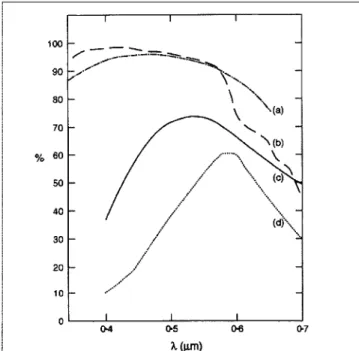
P e n e t r a t i v e R a d i a t i o n a n d U p p e r O c e a n H e a t i n g The solar radiation that reaches the sea surface is concentrated in the visible and near infrared. Of the energy that penetrates the ocean surface, the vast majority (> 99%) of infrared is absorbed within the first 1.5 m of the water column (Figure 1), but within the vis- ible part of the spectrum, the depth of penetration varies dramatically with the optical characteristics of the water (Figure 6). The radiation absorbed in the upper ocean is converted to heat and its depth-distri- bution is determined by the transmission function, T(X,z). Although Ed(0-), the surface downwelling irradi- ance just above the sea surface (see Box i for definitions of optical properties), is routinely obtained locally from ships and buoys during oceanographic experiments, and can be obtained globally from satellite remote sens- ing products, T is not routinely measured. Instead, var- ious parameterizations are used to account for the expected depth dependence of T for discrete wave- length bands. For most water types, variability in T is
100 90 8O
7O
% 60 50 40 30 20 10 0
I I I
\ "~,(a)
. ~\..
/ /
/ / .,..e
I I I
0,4 0.5 0.6 0"7
~. (~m)
Figure 6. The percent transmittance in the visible band through one meter of water for various water types: (a) Clear Mediterranean, (b) Crater Lake, (c) coastal: medium transparency, (d) coastal: low transparency (Kraus and Businger, 1994). Copyright Oxford University Press.
Oceanography • Vol. 14 • No. 3/2001
33
primarily due to phytoplankton pigments, the most ubiquitous of which is chlorophyll a, and this chloro- phyll concentration can be used as the basis for a T parameterization. Detailed parameterizations m a y include more than 100 wavelength bands (Morel and Antoine, 1994), while more commonly used parame- terizations (e.g. Paulson and Simpson, 1977) use just two bands. It has been shown that a high degree of fidelity in reproducing the vertical structure of T below the first 10-30 cm can be obtained by using between three and four bands in models of penetrating radia- tion and local heating (Kantha and Clayson, 1994;
Morel and Antoine, 1994; Ohlmann and Siegel, 2000).
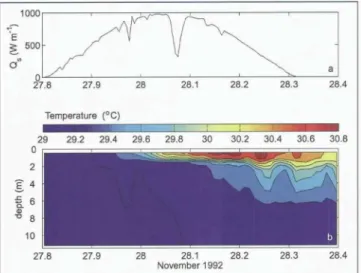
The impact of the absorbed radiation on the SST is a complicated inter-play between the net surface heat flux T, the rate of mixing just below the sea surface, and the depth to which this mixing occurs. This depth is typically called the Mixed Layer Depth (MLD). When surface irradiance is large and mixing rates are low (e.g. on calm, clear days in the tropics), the effect of radiative heating can be dramatic (Figure 7). Seasonal changes in SST and stratification, although on signifi- cantly different time and depth scales, are strikingly similar in character to diurnal changes (Figure 8). In both cases it is notable that relatively well-mixed, nutrient rich water is "temporarily" (e.g. for a day or a season) isolated from the surface by strong, near sur- face thermal stratification. Thermal stratification is gradually introduced to deeper water by the blue- green portion of the irradiance spectrum. The deeper water remaIns isolated until surface heat losses a n d / o r Increased mechanical mixing are sufficient to break
1000 . . . . . . .
Temperature (°C)
29 29.2 29.4
0 2
g 4
£ a
~ 8
10
a 2 8 . 4
29.6 29.8 30 30.2 30.4 30.6 30.8
27.8 27.9 28 28.1 28.2 28.3 28.4
November 1992
Figure 7. Radiative heating of the upper ocean under low wind conditions. (top) Shortwave (285-2800 nm) down- welling irradiance at the sea surface and (bottom) Temperature vs. depth and time for a site in the western tropical Pacific (1.75°S, 156°E). The pre-dawn MLD was about 30 m. Wind speed during the day was < 2 m/s. The strongest heating was within the upper 1.5 m due to the absorption of infrared radiation, and SST increased by nearly 2 ° C.
7.5 8.5 9,5 10.5 1 1 . 5 12.5 13.5 14,3
~ ~ , ,
1 2 o 1 4 o 1 6 0 1 8 0 2 0 o 220 2 4 o
y e o r d o y 1 9 9 1
.I . . . I . . . I . . . I . . . I ....
MAY JUN JUL AUG SEP
Figure 8. Contours of daily average temperature from a site in the subarctic north Atlantic (59.5°N, 21°W). The
"spring transition" from net surface cooling and nearly uniform upper ocean temperature to net heating and the establishment of near-surface stratification is seen near 22 May. The rate of change of upper ocean heat content was approximately balanced by the surface heat flux from mid May through early August (Plueddemann et al., 1995).
Copyright American Geophysical Union.
down the near-surface stratification. On daily time scales, the absence of downwelllng irradiance at night is the principal factor, whereas on seasonal time scales the gradual reduction of daily average downwelling irradiance, the increase in atmospheric storm activity, and the presence of oceanic fronts and eddies all play a role. The breakdown of stratification brings nutrients and stored heat back in contact with the surface.
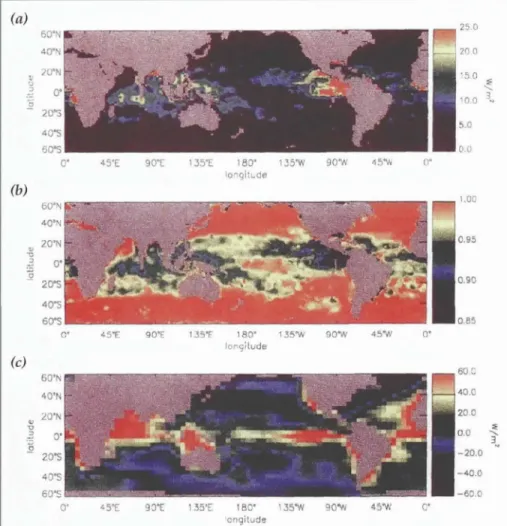
Because the ocean's immediate impact on the atmosphere is largely determined by SST, which mod- ulates the transfer of sensible and latent heat, the cycle of heat storage and release in the upper ocean are cru- cial to regulating the rate at which the ocean responds to atmospheric forcing and how it feeds back to the atmosphere. Some heat is sequestered below the MLD on seasonal time scales throughout the worlds' oceans, but in the tropics, where the downwelling surface irra- diance is large, the water is clear, and the MLD is shal- low, this process can be important on inter-annual and longer time scales (Figure 9). The fact that the heat flux to depths below the annual maximum MLD can be a significant fraction of the annual mean for much of the tropics (Lewis et al., 1990) indicates that that coupled air-sea models that seek to predict weather patterns and ocean currents require accurate parameterizations of spectral transmission within these regions.
The Diurnal Cycle of Thermal Stratification
While daylight reliably produces net surface heat-
Oceanography • Vol. 14 • No. 3/2001
34
(a)
(b)
(c)
5 . / .t.'y"
2 C 4 0 " i : 60"S
C" 4 :: L ~: :
, o " g i t u~.le
~ 25.0
.... 2 0 0
1,00
20 ' 0,95
G"
20"2 :~90
40%
60"3 :~ ~5
O" 4-5"F 90"~ 1 ~5"~ ', ~q"p i ~5',", .ci~'¢.' ,~-b'¢, ,1"
t o , ' g ; { u d e
L
a : " . 2 , : - ,
5 "
2 0 : 40"5, 60%
O' 4 5 " ~3°E ! : i 5 ' ~ 83 ~ ' 35°', ~, :-,t" °,,'i ,"- L:"/; ~:.~
engitud?
Figure 9. (a) Estimates of the net irradiance at a depth equal to the largest climato- logical monthly-mean MLD. This represents the heat /lux into water that is below the annual maximum MLD. (b) The fraction of net irradiance just below the sea sur- face that is converted to heat within the mixed layer on an annual basis. At high lat- itudes all of the surface heat flux goes into mixed layer heating. In the tropics, as much as 15% of the surface heat flux goes towards heating waters deeper than the annual maximum MLD. (c) Climatological mean air-sea heat flux. Comparison with (a) shows that the heat "lost"from the mixed layer due to penetrative radiation can be a significant fraction of the total heat flux in some locations (Ohlmann et aI., 1996). Copyright American Meteorological Society.
ing, radiative cooling (quasi-black b o d y longwave emission) along with sensible and latent heat losses typically produce net surface cool- ing at night. Strong diurnal cycling of MLD can result when daytime heating and nighttime cooling are of similar amplitude (Figure 10). If not properly accounted for, this variability in stratification can con- found attempts to determine the mean vertical structure of any physical, chemical, or biological property that is strongly affected by stratification. Attempts to deter- mine the vertical structure of the wind-driven velocity illustrate this problem.
Because mass and momentum are mixed vertically in a similar way, there is a diurnal cycle in the penetration depth of the wind-driv- en velocity that corresponds to the MLD. Price et al. (1986) showed that during periods of diurnal cycling in MLD the time-average velocity had a vertical structure that is similar to an Ekman spiral.
However, the classical Ekman spi- ral is derived in the absence of ver- tical stratification, whereas the spi- ral described by Price et al. (1986) is primarily due to the temporal vari- ability of stratification. With suffi- cient vertical resolution, the under- lying structure of velocity, i.e.
without the "smearing" due to MLD cycling, can be determined by time averaging in a vertical coordi- nate relative to the (changing) strat- ification rather than at fixed depth.
Plueddemann and Weller (1999)
( a ) ~ 6 o o r - ~ ~ = ' ~ q
0 - 2 0 0 ~ ~ " ,
(b) O=
£
GI. 4 0
6 0 -
10 1 5 2 0
M a y 1991
2~5 3 0
Figure 10. Time series of(a) net heat flux and (b) MLD for a site in the subarctic north Atlantic (59.5°N, 21°W). Note the strong diurnal cycling of MLD during the first 10 days in response to rel- atively strong nighttime cooling and weak daytime heating. MLD variability is reduced abruptly when the nighttime cooling is decreased.
Oceanography • VoL 14 • No. 3/2001
35
found that time-averaged velocity profiles in a coordi- nate system tied to MLD showed a tendency for "slab- like" flow in the mixed layer with shear and rotation concentrated in a weakly stratified transition layer below it.
This result is consistent with a high-viscosity mixed layer where particles are mixed rapidly, and a transition layer characterized by lower viscosity, partial mixing, and shear instability. It is likely that the distinct proper- ties of these two layers influence bio-optical variability through particle re-distribution and nutrient dynamics.
In order to investigate such influences in observations and models, it is necessary to determine the diurnal cycle of heating and cooling (which requires knowledge of the air-sea heat flux and an accurate representation of T) and to resolve the variability in MLD (which requires high vertical resolution).
F e e d b a c k s
The transmission function can vary significantly on synoptic time scales as a result of changes in parti- cle type and concentration. The principal effect results from the change in the distribution of phytoplankton.
Consistent with estimates based on satellite obser- vations and climatological surface heat fluxes and den- sity profiles (Lewis et al., 1990), study in the tropical Pacific, where irradiance and chlorophyll profiles were measured simultaneously, found an increase in the radiant heating rate of 0.11 ° C per month in the upper 30 m associated with a phytoplankton bloom that fol- lowed a westerly wind event (Siegel et al., 1995). A feedback mechanism was suggested whereby wind events deepen the generally shallow MLD, bringing up nutrients from below and setting off a phytoplankton bloom. The increase in phytoplankton concentration increases SST via enhancement of near-surface heating rates. The increased SST may then increase vertical convection in the atmosphere and hasten the decay of the westerly wind event.
Variability in the concentration of phytoplankton may also play a role in regulating SST on seasonal time scales. In particular, there is the possibility of positive feedback between near-surface stratification and bio- logical production (Sathyendranath et al., 1991). In this scenario, increased thermal stratification resulting from increased phytoplankton concentration results in a shallow MLD and reduces the likelihood that synop- tic surface forcing will significantly deepen the MLD.
Reduction of the depth of mixing may help to keep phytoplankton within the sunlit surfaces waters, where the rate of phytoplankton production exceeds the rate of phytoplankton respiration. If there are suffi- cient nutrients, the "trapping" in the upper photic zone by the shallow MLD provides more favorable condi- tions for growth. Increased growth yields a greater pro- duction of biomass and pigments that reduces the transmission of radiant energy, which increases strati- fication and reinforces the bloom response.
Nonuniform distributions of phytoplankton in strati- fied waters can also interact with penetrating solar irra- diance to influence thermal structure. In tropical waters, the typical increase of chlorophyll concentra- tion (hence absorption of light by phytoplankton and concomitant local heating) can give rise to local heating rates that increase with depth (Lewis, 1987). This can lead to vertical motions influenced directly by biologi- cal processes.
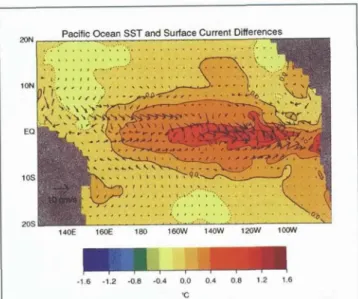
The increasing interest in climatological variability in the world's oceans has stimulated interest in the role of penetrative radiation in regulating SST variability and air-sea interaction on long time scales. A complete assessment of potential feedbacks would require a cou- pled global ecosystem model with near-surface vertical resolution of order 1 m. These requirements are beyond present capabilities. However, the impact of penetra- tive radiation can be assessed by including progres- sively more realistic parameterizations of T. In a recent study, Murtugudde et al. (in press) considered the impact of including a spatially variable T (based on satellite ocean color data) in an Ocean General Circulation Model (OGCM), rather than a constant pen- etration depth. They concluded that some of the limita- tions of commonly used (constant penetration depth) OGCMs, such as under-estimation of SST in the eastern tropical Pacific cold tongue, may be due to inaccurate representation of T (Figure 11). Progress in the predic- tion of atmospheric and oceanic systems will require explicitly addressing the temporal and spatial variabil- ity of ocean optical properties, and their impacts on the air-sea heat flux.
Optics and Chemical Processes
The close link between optical and chemical processes in the ocean is a relatively new development.
The link has largely strengthened as the field of marine photochemistry has evolved over the last 20 years from a novelty to a necessity in the study of elemental cycling, ocean optics, and ecological models of the upper ocean. Over the past two decades, we have dis- covered that the majority of ultraviolet sunlight (<400 nm) in the sea is absorbed by chromophoric (colored) dissolved organic matter (CDOM), and that this absorbed energy drives photochemical reactions in the surface ocean. The main result of this absorption is to energize electrons within the CDOM: an event that leads to the breaking of molecular bonds and the pro- duction of a suite of chemically distinct organic com- pounds. It also initiates secondary reactions between
"excited" CDOM and other chemicals in the surround- ing seawater, mainly oxygen, to drive the oxidation and reduction of chemical compounds such as trace metals and sulfur compounds. As these photochemical reac- tions proceed, the surface water optical properties change, with a concomitant accumulation of photo- chemical reaction products that include a complex mix- ture of reactive oxygen species, inorganic nutrients, and
Oceanography • Vol. 14 • No. 3/2001
36
Pmcifie Ocean SST a n d S u r f a c e Current Differences
180 160W 140W 120W IOOW
140E 160E
-1,6 -'1.2 -0.8 -0,4 O.O 0,4 0.8 1.2 1.6
"C
Figure 11. Annual mean difference in SST (contours) and surface currents (arrows)for an OGCM with spatially variable attenuation depth relative to one with a constant attenuation depth of17 m. In both cases the depth depend- ence of penetrative radiation is parameterized using a sin- gle exponential function (Murtugudde et al., 2001).
Copyright American Meteorological Society.
I
trace gases. These reaction products may also cause changes in the biological availability of dissolved organic matter.
The Photochemical Driver: CDOM
The absorption of solar radiation by CDOM is the pivotal event that drives most aquatic photochemistry and its subsequent involvement in biogeochemical process in natural waters. The CDOM present in sea- water is a complex mixture of biochemical breakdown products originating in terrestrial, freshwater, and marine systems. Interestingly, while phytoplankton production undoubtedly supplies the majority of the biochemical starting materials in the open ocean that comprise "marine" CDOM, a tight coupling between phytoplankton and CDOM concentration is not always observed (Rochell-Newall et al., 1999; Del Castillo et al., 2000). The literature supports terrestrial runoff (Nelson and Guarda, 1995; Nieke et al., 1997), coastal sediments (Rochell-Newall et al., 1999; Boss et al., 2001), and in situ microbial processes (Nelson et al., 1998; Rochell-Newall et al., 1999; Del Castillo and Coble, 2000; Letelier et al., 2000) as the dominant sources for CDOM in the ocean. Of course, the relative importance of these sources depends greatly on loca- tion and local hydrographic conditions, and seasonal cycles of CDOM are observed in both coastal (DeGrandpre et al., 1996; Kuwahara et al., 2000; Kahru and Mitchell, 2001) and open ocean settings (Nelson et al., 1998).
While some progress has been made, a precise pic-
ture of the complex suite of chromophores that CDOM represents has not yet been presented. Virtually all nat- ural waters confirm this complexity of potential electron transitions and chemical functionality, and this com- plexity can be seen in the smooth exponential decrease in CDOM absorbance from the UV to the visible portion of the spectrum. CDOM UV absorbance dominants UV absorption in the ocean and even in the clearest open ocean waters makes up as much as 50% of the non- water "blue" absorbance (440 nm; Nelson et al., 1998).
As a consequence of this spectral absorption shape, the energetic UV radiation in sunlight is the principal com- ponent that drives photochemistry in the ocean.
While CDOM is thought to have several sources in the ocean, a single process is believed to dominate its sink. As CDOM initiated photochemistry proceeds, there is a loss of the ability to absorb radiation across the entire CDOM absorbance spectrum due to chro- mophore degradation. This process is called photo- bleaching or photochemical fading and is observed both in laboratory irradiations (Gao and Zepp, 1998;
Grzybowski, 2000) and in the field (Siegel and Michaels, 1996; Vodacek et al., 1997; Nelson et al., 1998).
Fading alters both the spectral driver for photochemi- cal reactions and the inherent optical properties of nat- ural surface waters.
To examine the rate of fading at a given wave- length, one must quantify the amount of radiation absorbed by CDOM and the efficiency with which CDOM loses its color (i.e. how much absorbance is lost per photon absorbed?). To complicate these seemingly simple relationships, CDOM both absorbs radiation and photo-bleaches poly-chromatically. In other words, for every single wavelength of fight absorbed by CDOM, color loss occurs not only at the absorbed wavelength, but also across the entire absorbance spec- trum. For this reason, the photochemical efficiency of CDOM fading cannot be described with a simple two- dimensional function (product vs. wavelength) like many other photochemical reactions. N e w three- dimensional approaches that define photochemical fading with efficiency surfaces, such as the one shown in Figure 12, are being developed to quantitatively describe the spectral response for CDOM fading and integrate this process into ecological models that include photochemical product formation and chang- ing biological damage from UV radiation. The impact of this second effect is discussed below.
Photochemical Products
Some 25 years ago, Zafiriou (1977) published a
"preview" of the field of marine photochemistry that contained predictions of its potential significance in marine chemistry. From that point on, a great number of papers have tested those predictions and uncovered a wide variety of additional photochemical processes in both fresh and saltwater environments. A cursory sur- vey of the sunlight-induced processes (other than fad-
Oceanography • Vol. 14 • No. 3/2001
37
x I0 "?
4 ~
" 3 , 5 -
~ 1-5-
0.5.
480 t'6(~ 4~0 4 ~ 40(~ ~ 3rio ~ 340 320 300 ~ 0 R e s l x ~ s e Wavelength (nm)
Figure 12. A 3-dimensional surface describing the photo- chemical fading efficiency of chromophoric dissolved organic matter (CDOM) in the surface ocean. The effi- ciency of this process (the height of the surface in the fig- ure) is defined as the change in CDOM's capacity to absorb radiation at a particular wavelength per photon of radiation absorbed at any given wavelength. The "expo- sure wavelength" axis represents the radiation absorbed by CDOM which causes fading and the "response wave- length" axis represents the position in the CDOM spec- trum that fading occurs. Note that fading is most efficient when high-energy UV-B radiation (< 320 nm) is absorbed by CDOM and that fading at wavelengths below 350 nm is more efficient than longer wavelengths regardless of the wavelength absorbed.
ing) that constitute feedbacks to ocean ecology includes trace gas reactions, trace metal and radical chemistry, and the fragmentation and alteration of dis- solved organic carbon (DOC).
Several atmospherically reactive trace gases such as carbonyl sulfide (OCS; Andreae and Ferek, 1992;
Weiss et al., 1995; Uher and Andrea, 1997; Preiswerk and Najjar, 2000), carbon disulfide (CS2; Xie et al., 1998), methyl iodide (CH3I; Moore and Zafiriou, 1994) and carbon monoxide (CO; Valentine and Zepp, 1993) have oceanic sources of global significance that depend on CDOM distributions and photochemical reactions.
Dimethyl sulfide (a cloud forming aerosol particle pro- duced by phytoplankton) has a photochemical sink in the ocean. A suite of oxygen radicals (hydrogen perox- ide, superoxide, hydroxyl radicals) and reduced metals (iron, copper, and manganese) are also produced by marine photochemistry and can Influence surface water redox conditions and subsequent chemical cycles and the biological availability of trace nutrients (reviews by Miller, 1994; Blough, 1995). As CDOM (a subset of the total DOC) undergoes photochemical reactions, there is a general reduction in the average
molecular weight of DOC coincident with the produc- tion of a large array of low molecular weight (LMW) carbon compounds including carbonyls and organic acids (Miller, 1994; Zepp et al., 1995). Moran and Zepp (1997) recently reviewed the literature on biologically
available organic compounds generated by photo-
chemical reactions involving CDOM and listed 13 dif- ferent carbon substrates from eight separate references.
In 1991, Mopper et al. (1991) reported that carbon monoxide was by far the most rapidly produced carbon photoproduct measurable in seawater at the time.
Miller and Zepp (1995) reported that dissolved inor- ganic carbon (DIC, measured as the sum of carbon dioxide, bicarbonate and carbonate ions) was produced from CDOM about twenty times as fast as carbon monoxide in the near coastal water of the Mississippi River plume. Further comparison by Miller and Moran (1997) found DIC production to be fifteen times as fast as carbon monoxide production for coastal marsh water. Other studies support the fact that the direct
f Elemental Composition, MW Distr~ulion, Chemical Structure, Biological Lability
f ~ Light Absorption ~
Organic Complexes
Properties Properties
~ Photobleaching ~ Ph oto-oxid ation
Small Organic Compounds, Trace Gases, Metal Redox Rxns,
~.~. Nutrients, Oxygen Radicals, U.coloured Compounds J
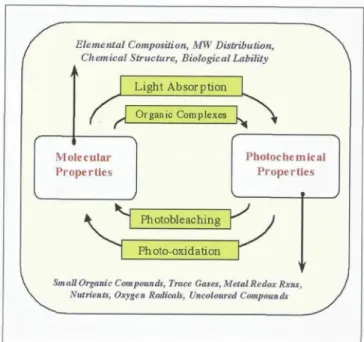
Figure 13. A simple diagram of the interrelationship between molecular properties of absorbing molecules in the ocean and their photochemical properties. It is a com- pound's molecular properties (examples in text at top of figure) that determine its potential for photochemical reac- tivity. (What organic complexes are present? How does it absorb light?) Depending on these molecular properties, photochemistry will result in specific product formation and transformations (examples in text at bottom of figure) and, through photo-oxidation and photobleaching, change the starting molecular properties responsible for photo- chemical reactivity in the first place. The system is con- stantly modified by input of new compounds from physi- cal mixing and biological activity and by feedback between photochemical reactions and molecular properties as CDOM and other photoreactive compounds are cycled through the photic zone.
Oceanography • Vol. 14 • No. 3//2001
38
• . . . . . . .