of online shopping on their shopping behavior Masami Asakawa and Masao Okano
Abstract
This study examined the factors influencing consumers’ perception of online shopping and developed a causal model that explains how this perception affects their online-shopping behavior.
We administered a questionnaire survey to 297 college students. By utilizing the answers to 13 questions pertaining to consumer perceptions, we conducted a factor analysis that identified the following three factors: “convenience”, “anxiety regarding security” and “poor navigation”. On the basis of this result, a causal model was developed, and its validity was investigated by using a covariance structure analysis. It was found that while the “security” factor negatively influences online-shopping behavior, the “convenience” factor positively influences it.
I. Purpose
With the increasing popularity of the Internet, online shopping is penetrating the lives of people. There are several researches on online shopping (Blake, B. F., Neuendorf, K. A., & Valdiserri, C. M., 2003; Grabner- Kraeuter, S., 2002; Miyazaki, A. D., & Fernandez A., 2001; Novak, T. P., Hoffmann, D. L., & Yung, Y., 2000).
Lim & Dubinsky (2004) investigated the evaluative criterion that consumers use when selecting an online shopping website. They extracted four components of e-shopping: merchandise, interactivity, reliability, and navigation. Furthermore, a multiple regression analysis adopting the four components of consumer perception as independent variables and the attitude toward online shopping as a dependent variable shows that merchandise and reliability indeed have a positive influence on consumers’ attitudes toward online shopping.
Accordingly, it was confirmed that consumers’ perception of online shopping websites affects their attitudes toward online shopping.
Martínez-López, F. J., Luna, P., & Martínez, F. J. (2005) investigated the relationship between consumers’
perceptions and the Internet, their perceptions regarding the convenience of home shopping, attitudes toward the Internet, trust in the reliability of online shopping, and online-shopping behavior. The results revealed that website design had the strongest influence on consumers’ attitudes toward the Internet. In addition, social benefits produced by the use of the Internet and the issue of the invasion of privacy also had an influence.
Furthermore, it was observed that attitudes toward the Internet affected the level of trust in the reliability of online shopping and that trust had a strong influence on online-shopping behavior. Through this research, consumers’ perceptions of the Internet, attitudes, and trust in the reliability of online shopping are considered as factors that explain online-shopping behavior.
As described above, several studies examined the indirect influence of the perception of an online website or the Internet on online-shopping behavior, but not the perception of online shopping itself. Therefore, in this research, we decided to clarify the relationship between consumers’ perception of online shopping and e- shopping behavior. Hypothesizing that attitudes toward online shopping mediate the relation between consumers’ perceptions and behavior with respect to net shopping, we aimed to clarify the relationship among the three elements of perception, attitude, and behavior.
II The method of investigation
1. Outline of the Investigation
A questionnaire survey was administered to 297 female students in September 2007.
2. Method of Selecting an Item for Measurement
An outline of the items that were considered in the investigation is presented in Table 1.
In the 13 items of Q5, the item prefixed with “**” was selected from Lim & Dubinsky (2004). The item with prefixed with “*” was selected from Asakawa (2008). Moreover, items considered to be insufficient were supplemented (e.g., 3 of Q5 and 7 of Q5 of Table 1). In addition, Q5 and Q6 were set to be answered as per a seven-step rating.
Table 1 Items considered in the investigation Q1 Actual prevalence of online shopping
Q2 The products group purchased by online shopping Q3 Online-shopping expenditure over a one-year period Q4 Online shopping frequency over a one-year period Q5 Perception of online shopping
* 1) I think that one should be able to shop at any time, 24 hours a day.
** 2) Consumers’ comments (the ranking of products, etc.) are helpful.
3) It is fun to browse through shopping websites.
* 4) I am worried that personal information might be revealed.
** 5) It takes time to access the web page of an online store.
** 6) I am worried that my password or credit card number might be revealed.
7) Even if no products are not urgently needed, some shopping may be done through the internet.
** 8) It is easy to look for the required products through a search function.
* 9) I like the fact that it saves the trouble of having to make shopping trips.
** 10) Many kinds of products are available through online shopping.
** 11) I can acquire detailed information about products.
** 12) It takes time to access the web page after clicking on the advertisements.
** 13) I am worried that an online shop might misuse either my personal or credit card information.
Q6 Attitude toward online shopping
I like purchasing items over the internet.
(Note) * Source: Asakawa (2008).
* * Source: Lim & Dubinsky (2004)
III. Results and discussion
1. Actual prevalence of online shopping
A simple aggregation performed on the subjects’ online-shopping behavior revealed that 66.59% had some experience in shopping online whereas 33.41% had none.
33.41%
66.59%
experienced inexperienced
Fig. 1 Actual prevalence of online shopping
The online-shopping frequency over a one-year period is shown in Fig.2. The subjects shopped online at an average frequency of 2.3 times.
0 5 10 15 20 25 30 35 40 45
0 1 2 3 4 5 6 7 8 9 10 12 15 20 40
Frequency
%
Fig. 2 Online shopping frequency over a one-year period
The online shopping expenditure over a one-year period is shown in Fig.3. The average online shopping expenditure for one year was 11,904 yen.
0 5 10 15 20 25 30 35 40 45
0 500
1,000 1,500
2,000 3,000
3,500 4,000
5,000 6,000
6,800 7,000
8,000 10,000
12,000 15,000
16,000 17,000
18,000 20,000
20,500 25,000
26,000 30,000
40,000 45,000
50,000 60,000
70,000 80,000
90,000 100,000
150,000 200,000
250,000 300,000
Japanese Yen
%
Fig. 3 Online-shopping spending over a one-year period
The products purchased via online shopping are shown in Fig.4.
We observed that many students purchased books, magazines, and audio CDs.
0 5 10 15 20 25 30 35 40 45 50
Miscellaneous items
Clothes Accessories Books and a magazines
Audio CDs Tickets, such as concert and theater ticket
Others
Fig. 4 The products purchased by online shopping
2. Influence of the perception of e-shopping on online-shopping behavior 1) Result of the factor analysis of the perception of online shopping
A factor analysis based on the maximum likelihood method was performed on the data in which the 297 subjects rated 13 items pertaining to their perception of online shopping, and promax rotation was applied.
Based on the scree test on the number of components extracted from the correlation matrix between items of 13 × 13, it became evident that considering 3 factors was suitable.
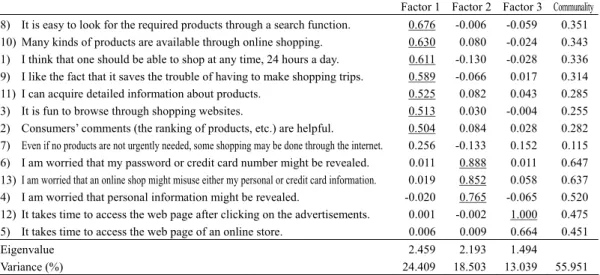
The result is shown in Table 2.
Table 2 Result of the factor analysis of perception of online shopping (pattern matrix after the promax rotation) Factor 1 Factor 2 Factor 3 Communality 8) It is easy to look for the required products through a search function. 0.676 -0.006 -0.059 0.351 10) Many kinds of products are available through online shopping. 0.630 0.080 -0.024 0.343 1) I think that one should be able to shop at any time, 24 hours a day. 0.611 -0.130 -0.028 0.336 9) I like the fact that it saves the trouble of having to make shopping trips. 0.589 -0.066 0.017 0.314 11) I can acquire detailed information about products. 0.525 0.082 0.043 0.285 3) It is fun to browse through shopping websites. 0.513 0.030 -0.004 0.255 2) Consumers’ comments (the ranking of products, etc.) are helpful. 0.504 0.084 0.028 0.282 7) Even if no products are not urgently needed, some shopping may be done through the internet. 0.256 -0.133 0.152 0.115 6) I am worried that my password or credit card number might be revealed. 0.011 0.888 0.011 0.647 13) I am worried that an online shop might misuse either my personal or credit card information. 0.019 0.852 0.058 0.637 4) I am worried that personal information might be revealed. -0.020 0.765 -0.065 0.520 12) It takes time to access the web page after clicking on the advertisements. 0.001 -0.002 1.000 0.475 5) It takes time to access the web page of an online store. 0.006 0.009 0.664 0.451
Eigenvalue 2.459 2.193 1.494
Variance (%) 24.409 18.503 13.039 55.951
(1) The first factor: “convenience”
The items that exhibited a positive high loading (hereafter, items with a high loading are defined as those with an absolute value of 0.400 or more) with respect to “convenience” were as follows: “It is easy to look for the required products through a search function”; “Many kinds of products are available through online shopping”; (In other words, you can buy items that cannot be easily obtained in an ordinary store.) “I think that one should be able to shop at any time, 24 hours a day”; “I like the fact that it saves the trouble of having to make shopping trips”; “I can acquire detailed information about products”; “It is fun to browse through shopping websites”; and “Consumers’ comments (the ranking of products, etc.) are helpful.”
(2) The second factor: “anxiety regarding security”
The items that exhibited a positive high loading with respect to the second factor, “anxiety regarding security,” were as follows: “I am worried that my password or credit card number may be revealed”; “I am worried that an online shop might misuse my personal or credit card information”; and “I am worried that personal information may be revealed.”
(3) The third factor: “poor navigation”
The items that exhibited a positive high loading with respect to “poor navigation” were as follows: “It takes time to access the web page after clicking on the advertisements” and “It takes time to access the web
page of an online shop.”
2) Influence of the perception of online shopping on consumer behavior
With regard to the relationship between the characteristics of “perception” and “behavior,” a model for considering of the mediation function of “attitude” was created, and is illustrated in Fig. 5. The validity of the model was verified through a covariance structure analysis. “Attitude” was measured through the item “I like buying products on the Internet.” “Behavior” was measured through the number of times online a subject shopped in the past year.
0,
convenience
I like the fact that it saves the trouble of having to make shopping trips.
0, e4
1 1
I think that one should be able to shop at any time, 24 hours a day.
0, e31
Many kinds of products are available through online shopping.
0, e21
It is easy to look for the required products through a search function.
0, e11
0,
anxiety regarding security
I am worried that personal information might be revealed.
0, e7
1 1
I am worried that an online shop might misuse either my personal or credit card
information.
0, e6 1
I am worried that my password or credit card number might be revealed.
0, e51
0,
poor navigation It takes time to access the web page of
an online store.
0, e9
1 1
It takes time to access the web page after clicking on the advertisements.
0, e8 1
frequency of online shopping
0, e11 attitude toward 1
online shopping
0, e10
1
Fig. 5 Causal model of the influence of the perception of online shopping on behavior
As for the fit index of the model, the values of CFI and RMSEA were 0.986 and 0.036, respectively.
Accordingly, the goodness of fit of the model was judged to be high. However, the path coefficient from “poor navigation” to “attitude,” the covariance between “convenience” and “anxiety regarding security,” that between
“convenience” and “poor navigation,” and that between “anxiety regarding security” and “poor navigation”
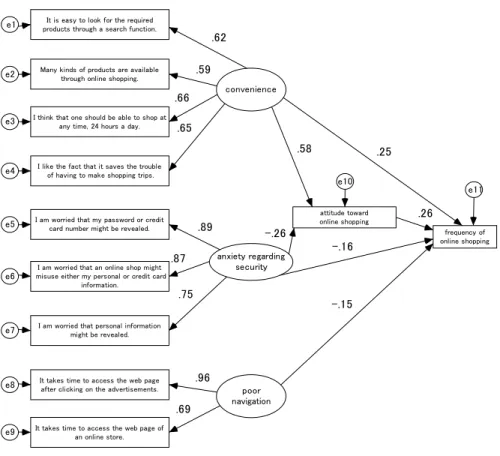
were not significant at the 5% level. Therefore, these paths were omitted and the model was rebuilt. The validity of the modified model was verified through another covariance structure analysis; the result is as shown in Fig. 2.
convenience
I like the fact that it saves the trouble of having to make shopping trips.
e4
.65
I think that one should be able to shop at any time, 24 hours a day.
e3
.66
Many kinds of products are available through online shopping.
e2
It is easy to look for the required products through a search function.
e1
anxiety regarding security
I am worried that personal information might be revealed.
e7
I am worried that an online shop might misuse either my personal or credit card
information.
e6
.87
I am worried that my password or credit card number might be revealed.
e5
poor navigation
It takes time to access the web page of an online store.
e9
.69
It takes time to access the web page after clicking on the advertisements.
e8 .96
frequency of online shopping
e11
attitude toward online shopping
e10
-.15 .59
.62
.75 .89
-.16 .58
-.26
.25
.26
Fig. 6 Modified model of the influence of the perceptions of online shopping on behavior
With regard to the fit index of the model, the value of CFI was 0.988 and RMSEA was 0.033. Accordingly, the goodness of fit of the model was judged to be high. On the basis of this result, the direct and indirect influences of “perceptions” on “behavior” are considered to be as follows.
(1) Direct and indirect influences of “convenience” on “behavior”
As shown in Fig. 6, the path coefficient (0.255) from the “convenience” characteristic to “behavior” (i.e., the frequency of online shopping over a one-year period) was significant only at the 5% level. In other words,
“convenience” was accepted to have a direct positive influence on “behavior.”
On the other hand, the path coefficient from “convenience” to “attitude” was 0.582 and was significant at the 5% level. Moreover, the path coefficient from “attitude” to “behavior” was 0.264 and was significant at the 5% level. Therefore, the path coefficient between “convenience” and “behavior” in terms of “attitude” was 0.582 × 0.264 ≒ 0.154. Therefore, it was observed that “convenience” had a positive indirect influence on
“behavior.” The total effect was 0.255 + 0.154 ≒ 0.409.
(2) Direct and indirect influences of “anxiety about security” on “behavior”
As shown in Fig. 2, the path coefficient (-0.164) from the “anxiety regarding security” characteristic to
“behavior” was significant only at the 5% level.
In other words, it was observed that “anxiety regarding security” has a negative direct influence on
“behavior.” On the other hand, the path coefficient from “anxiety about security” to “attitude” was -0.260 and was significant at the 5% level. Moreover, as stated previously, the path coefficient from “attitude” to
“behavior” was 0.264 and was significant at the 5% level. Therefore, the path coefficient between “anxiety regarding security” and “behavior” in terms of “attitude” is -0.260 × 0.264 ≒ -0.068.
Accordingly, it was observed that “anxiety about security” has a weak negative indirect influence on
“behavior.” The total effect was -0.164 + (-0.068) ≒ -0.233.
(3) Direct and indirect influences of “poor navigation” on “behavior”
As shown in Fig. 2, the path coefficient (-0.149) from the “poor navigation” characteristic to “behavior”
was significant at the 5% level. Accordingly, it was identified that “anxiety regarding security” has a direct negative influence on “behavior.”
IV. Conclusion
In this research, we examined the direct and indirect influences of the perceptions of online shopping on consumer behavior. For this, we investigated 297 students, administering questionnaire surveys pertaining to their perception of online shopping, and their attitudes and behaviors in this respect.
First, a factor analysis was conducted on the student’s perception of 13 items, and three factors—
convenience, anxiety regarding security, and “poor navigation”—were extracted. A model was created reflecting the direct influence of these three “perception”-related factors on behavior or their indirect influence through consumers’ attitudes.
The validity of the model was examined through a covariance structure analysis, and the model was corrected by removing paths that were not significant at the 5% level. When the validity of the modified model was verified through the covariance structure analysis, its goodness of fit was high.
Thus, through an interpreting the model, it was identified that “convenience” had a positive influence on online shopping. Additionally, “anxiety regarding security” and “poor navigation” had a negative influence.
Accordingly, it was suggested that if online shopping is evaluated as having a high level of convenience, the frequency at which people shop online will increase. On the other hand, when the user experiences anxiety related to the of security personal information or considers the navigation on the website to be poor, the frequency of online shopping will decrease.
References
Asakawa, M. (2008) The influence of consumers’ perception of net shopping on net shopping behavior. The Bulletin of Bunkyo Women's Junior College. 51, 1-6.
Blake, B. F., Neuendorf, K. A. & Valdiserri, C. M. (2003) Innovativeness and variety of internet shopping.
Internet Research. 13(3). 156-164.
Grabner-Kraeuter, S. (2002) The role of consumers’ trust in online-shopping. Journal of Business Ethics. 39.
43-50.
Lim, H. & Dubinsky, A.(2004) Consumers' perceptions of e-shopping characteristics: an expectancy-value
approach. Journal of Services Marketing. 18(7). 500-513.
Martínez-López, F. J. Luna, P., & Martínez, F. J. (2005) Online shopping, the standard learning hierarchy, and consumer’s internet experience. Internet Research. 15(3). 312-334.
Miyazaki, A. D. & Fernandez A. (2001) Consumer perception of privacy and security risks for online shopping.
The Journal of Consumer Affairs. 35(1). 27-44.
Novak, T. P., Hoffmann, D. L. & Yung, Y. (2000) Measuring the customer experience in online environments: a structural modeling approach. Marketing Science, 19(1). 22-42.
Vijayasarathy, L. R. (2002) Product characteristics and internet shopping intentions. Internet Research. 12(5).
411-426.