Original Article: Clinical Investigation
Prognostic impact of non-urothelial carcinoma of the upper urinary tract: Analysis of hospital-based cancer registry data in Japan
Yoshiyuki Nagumo,
1Koji Kawai,
2Takahiro Kojima,
1Masanobu Shiga,
1Kosuke Kojo,
1Ken Tanaka,
1Shuya Kandori,
1Tomokazu Kimura,
1Takashi Kawahara,
1Ayako Okuyama,
3Takahiro Higashi
3and Hiroyuki Nishiyama
11Department of Urology, University of Tsukuba, Tsukuba, Ibaraki,2Department of Urology, International University of Health and Welfare, Narita, Chiba, and3Center for Cancer Registries, Center for Cancer Control and Information Service, National Cancer Center, Tokyo, Japan
Abbreviations & Acronyms AC = adenocarcinoma DCCH = designated cancer care hospital
HBCR = hospital-based cancer registry
ICD-O-3 = International Classification of Disease for Oncology 3rd edition OS = overall survival SmC = small cell carcinoma SQ = squamous cell carcinoma
UC = urothelial carcinoma UUT = upper urinary tract UUTC = upper urinary tract cancer
Correspondence:Hiroyuki Nishiyama M.D., Ph.D., Department of Urology, University of Tsukuba, 1-1-1 Tennodai, Tsukuba, Ibaraki 305- 8575, Japan. Email:
[email protected] Received 21 May 2020;
accepted 31 August 2020.
Online publication 9 November 2020
Objectives: To identify the prognosis of patients with non-urothelial carcinoma of the upper urinary tract and compare it with that of patients with urothelial carcinoma.
Methods: We used hospital-based cancer registry data in Japan to extract histologically confirmed non-urothelial carcinoma and urothelial carcinoma cases of the upper urinary tract diagnosed in 2008–2009. We estimated the 5-year overall survival by a Kaplan–Meier analysis. The Cox proportional hazards regression analysis was used to evaluate prognostic factors.
Results: A total of 2567 upper urinary tract cancer patients with confirmed histological subtypes were identified. The most common histology of non-urothelial carcinoma was squamous cell carcinoma (n=88, 3.4%) followed by adenocarcinoma (n=33, 1.3%) and small cell carcinoma (n =10, 0.4%). The proportion of advanced stage in the squamous cell carcinoma patients was significantly higher than that in the urothelial carcinoma patients (P=0.003). In stage IV, the proportion of patients who received a combination of surgery+chemotherapy in the urothelial carcinoma group was higher than that in the non-urothelial carcinoma group (34%vs16%, respectively). The 5-year overall survival rates of the non-urothelial carcinoma patients at stages I–III and stage IV were significantly worse than those of the urothelial carcinoma patients (P=0.003,P<0.001, respectively). In multivariate analyses, age ≥73 years, advanced stage (stage IV), tumor location (ureter) and the presence of non-urothelial carcinoma histology were independent poor prognosis factors.
Conclusion: The prognosis of non-urothelial carcinoma patients is worse than that of urothelial carcinoma patients, especially for non-urothelial carcinoma patients at stage IV. More effective systemic therapies are required to improve these patients’
oncological outcomes.
Key words: hospital-based cancer registry, non-urothelial carcinoma, overall survival, population-based study, upper urinary tract.
Introduction
UUTC is rare and accounts for approximately 5% of all urothelial cancers.1 The most common histology of UUTC is pure UC, which is similar to that of bladder cancers.
However, several studies reported that approximately 10% of patients with UUTC had a non-UC component, such as squamous cell differentiation, and glandular cell differentia- tion.2–4
In UUTC patients, the prognostic impact of a non-UC component is largely unknown, due to its rarity. Several studies have showed that UUTC with non-UC component is associated with poorer prognosis.3,5–7 Among non-UCs, SQ is much more rare, with just 1.3–6% of UUTC being SQ.8,9 The proportions of AC and SmC are approximately 1% and <0.5%, respectively.10,11 Due to the rarity of non-UC of the UUT, limited information is available regarding its prognosis.
Herein, to identify the prognosis of patients with non-UC of the UUT compared with the prognosis of those with UC of the UUT, we retrospectively analyzed the cases of patients newly diagnosed with AC, SQ and SmC by using the HBCR data from nationwide DCCHs in Japan. To our knowledge, this is the first large study of patients with non-UC of the UUT in the world.
Methods
Data sourcesThe Japanese Ministry of Health, Labor and Welfare has DCCHs in Japan to provide high-quality cancer care. As pre- viously described, the HBCR data including patients’ charac- teristics, stage information orfirst-course of treatments, from these hospitals are submitted annually to the Center for Can- cer Control and Information Services at the National Cancer Center, analyzed and distributed as the National Cancer Statistics Report.12 We used the HBCR data from Japan’s DCCHs to identify UUTC patients diagnosed in 2008–2009.
We selected this patient cohort because during the planning phase of the present study, the data on patients’survival after their diagnoses were available only for patients diagnosed in 2008–2009. The 2008–2009 cohort’s data from 251 DCCHs had the patients’ survival information for 5 years after the diagnosis. These data were obtained from the hospitals that had a>90% follow-up rate for all cancer patients. The infor- mation of patients who are newly diagnosed with cancer is routinely collected by these hospitals. Well-trained cancer registrars at each hospital register the details of diagnosed cancer cases based on standardized criteria.
The HBCR’s data include the patients’ demographics, tumor characteristics and thefirst course of treatment, which is defined as a treatment that is planned for improving the cancer prognosis at an initial diagnosis. As treatment modali- ties, surgery includes open or laparoscopic surgery. In the cases of UUTC, open or laparoscopic surgery generally included radical nephroureterectomy.
Identification of cases with non-UC of the UUT We identified eligible cases from the HBCR data by using the following inclusion criteria: (i) patients who were newly diagnosed with a malignant tumor of the renal pelvis (C65) or the ureter (C66) in 2008–2009; (ii) patients who received the first course of treatment at a DCCH; (iii) patients who had a histologically confirmed tumor with ICD-O-3 histology codes, such as 8120-8131 for UC, 8070 for SQ, 8140-8310 for AC or 8041 for SmC; and (iv) patients who were diag- nosed with clinical stage I–IV. We excluded 21 cases with the histology code 8000, as we could not specify the histo- logical subtype. We also excluded 13 cases with renal cell carcinoma and metastatic carcinoma. In the 2008–2009 cohort, the staging information was based on the sixth Union for International Cancer Control TNM classification. In addi- tion, this cohort did not include cases with carcinomain situ.
We therefore excluded cases at stage 0 (Ta and TisN0M0) from the present analyses, although 83 cases in the database were identified as TaN0M0.
Statistical analysis
We compared variables between groups using the Fisher’s exact probability test for categorical variables, and the Mann–
Whitney U-test for continuous variables. The 5-year OS rate was analyzed by the Kaplan–Meier method and compared between groups by the log–rank test. A Cox proportional hazards regression analysis was used to evaluate prognostic factors associated with the OS. All statistical comparisons were two-sided, and P<0.05 were considered significant.
SPSS25.0 for Windows (SPSS, Chicago, IL, USA) was used.
Ethical considerations
The study protocol and data processing were approved by the Tsukuba University Hospital Ethical Board (H29-267). In rare disease research, there are some diseases for which the num- ber of cases is<10, and the patients’privacy in such a situa- tion should be considered before a study’s publication, as the data’s publication could lead to the identification of individ- ual patients. We have therefore reported the proportion of those cases in the text or table in accord with the recommen- dations of Japan’s Ministry of Health, Labor and Welfare.
As the present study was a retrospective analysis, the requirement for the accordance of studies involving human participants with institutional ethical standards and the Hel- sinki Declaration or comparable ethical standards is not appli- cable.
Results
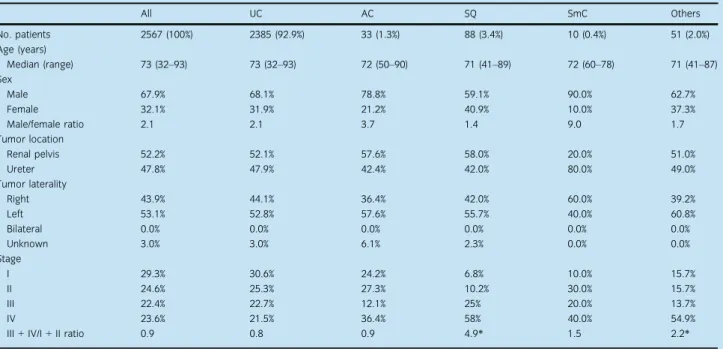
A total of 2567 UUTC patients with confirmed histological subtypes were identified (Fig. 1). Table 1 summarizes the clinical characteristics of the eligible patients. A total of 131 (5.1%) patients had non-UC. The most common histology of non-UC was SQ (n=88, 3.4% of all UUTCs) followed by AC (n=33, 1.3%) and SmC (n=10, 0.4%). “Others”
included histological subtypes, such as carcinoma (not other- wise specified), sarcoma and malignant lymphoma. We excluded these cases from further analysis, as the number of most of the subtypes was small (<10 cases). Therefore, the term “non-UC” in the following tables and figures includes AC, SQ and SmC.
The median age of all patients was 73 years (range 32– 93 years), and there were no significant differences in the patients’ ages among the histological subtypes. In the group of patients with SQ, the proportion of women (41%) tended to be higher than that in the UC group (32%). In contrast, most of the patients with SmC (90%) were men (although the number of patients was small). In terms of clinical stages, the ratio of stage III/IV in the patients with SQ was significantly higher than that of the UC patients; in particular, the propor- tion of SQ patients at stage IV was the highest (58%). In contrast, the ratio of stage III/IV AC and SmC patients was similar to that of the UC patients.
Table 2 shows the treatment patterns by stage and histo- logical subtype. Most of the stage I–III patients received sur- gery alone, and there were no significant differences in the proportion between the UC and non-UC groups. Among the Upper urinary tract non-urothelial carcinoma
stage IV patients, the proportion of patients who received a combination of surgery and chemotherapy in the UC group was significantly higher than that in the non-UC group (34%
vs16%, respectively).
The 3- and 5-year OS rates for all of the UC patients were 63% and 52%, whereas those for all of the non-UC patients were 32% and 26%, respectively. Both the 3- and 5-year OS rates of the non-UC patients were significantly worse than those of the UC patients (P <0.001). In the analysis of the OS according to stage, we classified two subgroups, stage I–III and stage IV. There were two main reasons for the clas- sification in this category. First, the number of non-UC cases at stages I, II and III was too small to estimate statistical sig- nificance. The corresponding subgroup numbers were 15, 21 and 28, respectively. Second, there were major differences in the pattern of treatment; chemotherapy was mainly used for stage IV patients, whereas surgery was usually carried out for
stage I–III patients. As shown in Figure 2, the OS rates of non-UC patients at both stages I–III and stage IV were sig- nificantly worse than those of the UC patients at those stages (P=0.003 and P <0.001, respectively). In particular, the OS rate of the stage IV non-UC patients was poor; the 5-year OS rates of the stage IV patients with non-UC and UC were 5% and 17%, respectively. In terms of histological subtypes, the 5-year OS rates of the patients with SQ, AC and SmC were significantly worse than that of the patients with UC (Fig. 3). The 3- and 5-year OS rates of all patients with AC, SQ and SmC were 41% and 34%, 30% and 24%, and 12%
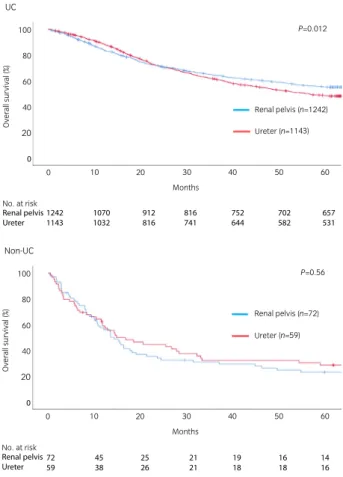
and 12%, respectively. As shown in Figure 4, there was no significant difference in the OS for non-UC patients between the renal pelvis and the ureter (P=0.56). In contrast, the OS rates of UC patients whose tumors were located in the ureter were significantly worse than those in the renal pelvis (P=0.012). In UUTC of the renal pelvis, the OS rates of All patients from HBCR data
diagnosed in 2008-2009
Extracted malignant tumor of the pelvis (C65) and the ureter (C66) Malignancies of the UUT
n=3862
Extracted the patients with histological diagnosis Extracted cases with clinical stage I−IV
Histologically confirmed UUT tumors at stage l−lV
n=2601
Excluded cases with histology codes 8000 (ICD-O-3)
Excluded cases with renal cell carcinoma and metastatic carcinoma Eligible patients
n=2567
•
•
•
•
•
Fig. 1 Eligibility of patients with malignant tumors of the UUT.
Table 1 Clinical characteristics of the patients with malignant tumors of the UUT
All UC AC SQ SmC Others
No. patients 2567 (100%) 2385 (92.9%) 33 (1.3%) 88 (3.4%) 10 (0.4%) 51 (2.0%)
Age (years)
Median (range) 73 (32–93) 73 (32–93) 72 (50–90) 71 (41–89) 72 (60–78) 71 (41–87)
Sex
Male 67.9% 68.1% 78.8% 59.1% 90.0% 62.7%
Female 32.1% 31.9% 21.2% 40.9% 10.0% 37.3%
Male/female ratio 2.1 2.1 3.7 1.4 9.0 1.7
Tumor location
Renal pelvis 52.2% 52.1% 57.6% 58.0% 20.0% 51.0%
Ureter 47.8% 47.9% 42.4% 42.0% 80.0% 49.0%
Tumor laterality
Right 43.9% 44.1% 36.4% 42.0% 60.0% 39.2%
Left 53.1% 52.8% 57.6% 55.7% 40.0% 60.8%
Bilateral 0.0% 0.0% 0.0% 0.0% 0.0% 0.0%
Unknown 3.0% 3.0% 6.1% 2.3% 0.0% 0.0%
Stage
I 29.3% 30.6% 24.2% 6.8% 10.0% 15.7%
II 24.6% 25.3% 27.3% 10.2% 30.0% 15.7%
III 22.4% 22.7% 12.1% 25% 20.0% 13.7%
IV 23.6% 21.5% 36.4% 58% 40.0% 54.9%
III+IV/I+II ratio 0.9 0.8 0.9 4.9* 1.5 2.2*
*P<0.01 compared with UC.
non-UC patients at both stages I–III and stage IV were sig- nificantly worse than those of the UC patients at those stages (Fig. S1). The patients with UUTC of the ureter also showed the same results (Fig. S2).
Table 3 provides the results of the univariate and multi- variate analyses of the prognostic factors for OS in the UC and non-UC groups. In both the univariate and multivariate
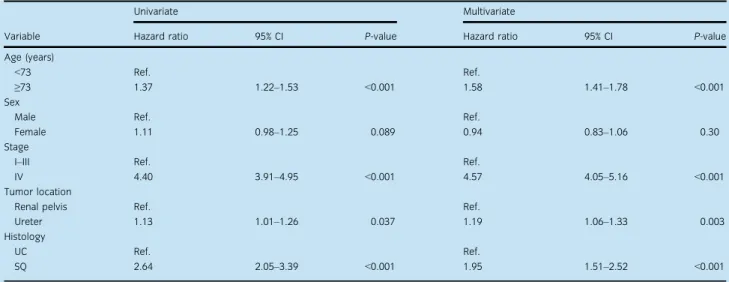
analyses, age ≥73 years, advanced stage (stage IV), tumor location (ureter) and the presence of non-UC histology were associated with a worse OS. The patients with UC and SQ showed the same results in both the univariate and multivari- ate analyses (Table 4). When the relationship between tumor location and the OS was analyzed separately in UC and non- UC patients, the prognostic impact did not remain in non-UC patients (Table S1). In contrast, UUTC of the ureter was associated with a worse OS in UC patients (Table S2).
Discussion
Our present study, based on large-scale HBCR data including 131 patients with non-UC (AC, SQ and SmC) of the UUT, showed that the prognosis of the non-UC patients was signifi- cantly worse than that of the UC patients. We also observed several relevant findings regarding the trends of the clinico- pathological features and the management of patients with non-UC of the UUT. The most common histology of non-UC was SQ (3.4% of all UUTCs) followed by AC (1.3%) and SmC (0.4%). As shown in Table 1, the proportion of patients
Table 2 Pattern of treatment according to stage and histology
Surgery only
Surgery+
chemotherapy Chemotherapy only Radiation therapy only
Radiation+
chemotherapy No treatment Others Stage I
UC (n=729) 72.3% 11.9% 0.5% 0.0% 0.1% 1.5% 13.6%
Non-UC (n=15) 73.3% 20.0% 0.0% 0.0% 0.0% 0.0% 6.7%
Stage II
UC (n=603) 63.2% 25.4% 0.0% 0.5% 0.0% 1.3% 9.6%
Non-UC (n=21) 61.9% 19.0% 0.0% 0.0% 0.0% 0.0% 19.0%
Stage III
UC (n=541) 57.3% 32.2% 0.7% 0.2% 0.2% 1.3% 8.1%
Non-UC (n=28) 50.0% 28.6% 3.6% 3.6% 0.0% 0.0% 14.3%
Stage IV
UC (n=512) 18.9% 34.2%* 18.4% 3.5% 4.3% 5.1% 15.6%
Non-UC (n=67) 16.4% 16.4% 28.4% 6.0% 10.4% 7.5% 14.9%
*P=0.003 compared with UC.
Stage l-lll 100
80 60 40 20 0
0 10 20 30 40 50 60
Months No. at risk
Pure UC Non-UC
1873 64
1768 50
1569 40
1414 35
1286 32
1186 31
1104 27 UC (n=1873) Non-UC (n=64)
P=0.003
Overall survival (%)
Stage lV 100
80 60 40 20 0
0 10 20 30 40 50 60
Months No. at risk
Pure UC Non-UC
512 67
334 33
204 11
143 7
110 5
98 3
84 3 UC (n=512) Non-UC (n=67)
P<0.001
Overall survival (%)
Fig. 2 The OS of the UC and non-UC patients stratified by stage.
100 80 60 40 20 0
0 10 20 30 40 50 60
Months No. at risk
UC (n=2385) AC (n=33) SQ (n=88) SmC (n=10)
Overall survival (%)
*
**
**
2385 33 88 10 UC AC SQ SmC
2102 22 55 6
1772 15 34 2
1557 13 28 1
1396 11 25 1
1284 11 22 1
1188 9 20 1 Fig. 3 The OS of the patients stratified by histological subtypes.*P=0.02,
**P<0.001 compared with UC.
Upper urinary tract non-urothelial carcinoma
with advanced disease was significantly higher among the patients with SQ compared with the patients with UC. In the SQ group, 58% of the patients were diagnosed as stage IV.
Other studies have also reported a higher proportion of
advanced disease in UUTC patients with SQ compared with UC.8,9 In our present patient population, although the differ- ences were not significant, the proportion of female patients with SQ (41%) was higher compared with those with other histological subtypes. A relatively higher proportion of female patients was reported not only in cases of UUT SQ,8,9 but also in cases of bladder SQ.13It is not clear why the pro- portion of female patients with SQ is high; however, some investigators pointed out the relevance of chronic bladder inflammation in this trend.14
As shown in Figure 2, the prognosis of the non-UC patients with stages I–III and stage IV disease was signifi- cantly worse than that of the UC patients. In particular, the prognosis of the non-UC patients at stage IV was poor; the 5-year OS rates of the patients with non-UC and UC were 5% and 17%, respectively. As shown in Table 2, the propor- tion of non-UC patients with stage IV disease treated with surgery and chemotherapy was just 16.4%, which is signifi- cantly lower than that of the UC patients at 34.2%
(P=0.003). The lack of effective chemotherapy for non-UC patients might lead to less-aggressive treatment. In both blad- der cancer and UUTC, several studies have shown the clini- cal benefits of neoadjuvant or adjuvant chemotherapy for UC and several types of mixed variants.15–17In contrast, the ben- efits of perioperative chemotherapy have not been shown in non-UC patients, except for those with neuroendocrine tumors.15–17 The findings from previous investigations and the present study highlight the need for more effective sys- temic treatments for patients with non-UC of the UUT.
Overall, the prognoses of the present patients with AC, SQ and SmC were significantly worse than that of the patients with UC (Fig. 3). The 5-year OS rate of the AC patients was 34%, which tended to be better than the rates of the SQ and SmC patients (24% and 12%, respectively). However, there was no significant difference in the 5-year OS rate between the AC patients and other non-UC patients. Tully et al.
reported that prognosis of patients with AC of the renal
UC 100
80
60 40 20
0 10 20 30 40 50 60
Months No. at risk
Renal pelvis (n=1242) Ureter (n=1143)
P=0.012
Overall survival (%)
0
Renal pelvis Ureter 1242
1143 1070
1032 912
816 816
741 752
644 702
582 657
531
Non-UC 100
80 60 40 20
0 10 20 30 40 50 60
Months No. at risk
Renal pelvis (n=72) Ureter (n=59)
P=0.56
Overall survival (%)
0
Renal pelvis Ureter 72
59 45
38 25
26 21
21 19
18 16
18 14
16 Fig. 4 The OS of the UUTC patients with renal pelvis and ureter stratified by histological subtypes.
Table 3 Results of the univariate and multivariate analyses for the OS of the UC and non-UC patients
Variable
Univariate Multivariate
Hazard ratio 95% CI P-value Hazard ratio 95% CI P-value
Age (years)
<73 Ref. Ref.
≥73 1.35 1.20–1.51 <0.001 1.58 1.41–1.77 <0.001
Sex
Male Ref. Ref.
Female 1.09 0.97–1.23 0.140 0.93 0.83–1.05 0.24
Stage
I–III Ref. Ref.
IV 4.44 3.95–4.99 <0.001 4.63 4.11–5.22 <0.001
Tumor location
Renal pelvis Ref. Ref.
Ureter 1.13 1.01–1.27 0.031 1.19 1.06–1.33 0.002
Histology
UC Ref. Ref.
Non-UC 2.52 2.04–3.11 <0.001 2.06 1.67–2.55 <0.001
pelvis who were treated by surgery was significantly better than that of UC and SQ patients;15however, further analyses are necessary to determine the prognostic significance of each non-UC subtype, as that study was limited to patients with metastatic disease. There was limited information from case reports/case series on the prognostic impact between renal pelvic UUTC and ureteral UUTC in non-UC patients. In the present study, there was no significant difference in the OS for non-UC patients according to tumor location (Fig. 4). A recent study showed that the prognosis of UC patients with ureteral UUTC was worse than that of renal pelvic patients in both multivariate analysis and Kaplan–Meier curves.18 The presentfindings also showed that the OS rates of UC patients whose tumors were located in the ureter were significantly worse than those in the renal pelvis. Due to the small number of non-UC patients, further analysis is required to determine the impact of tumor location on prognosis.
Although the prognostic impact of non-UC of the UUT is ambiguous, the results of the present multivariate analysis showed that the presence of non-UC was an independent poor prognosis factor, as were older age and advanced stage (Table 3). The multivariate analysis results regarding the UC and SQ patients showed the same results (Table 4). Holm€ang et al. reported that the median survival of patients with SQ of the UUT was shorter than that of UC patients;9 however, they did not report a significant difference in the survival rates between SQ patients and UC patients at the same stage.
Berz et al. reported that the survival rates of patients with SQ and those with UC of the UUT were essentially identical when compared from stage to stage.8 In the present study, the presence of SQ histology was independently associated with poor prognosis compared with UC histology. The differ- ence in prognosis for localized or localized-advanced patients could be mainly based on the lack of definitive treatment strategy of radical surgery, as well as the lack of effective perioperative systemic therapies. In cases of UC patients, the European Association of Urology guidelines recommend a
radical nephroureterectomy for patients with high-risk non- metastatic UUTC and a template-based lymphadenectomy for patients with muscle-invasive UUTC.19 Unlike UC patients, there was no standard surgical management for SQ patients due to their rarity. The present findings show that the pres- ence of non-UC is an independent poor prognosis factor in UUTC patients. However, further investigation including the patient’s clinical status and treatment details is required to confirm the prognostic impact for patients with non-UC.
The present study had several limitations due to the availabil- ity of retrospective data in the HBCR. First, there was no detailed information about the clinical status or comorbidities of individual patients in this registry. Second, there was no detailed information about the patients’ surgery or chemotherapy. No information about the chemotherapy regimens or the setting of neoadjuvant or adjuvant therapy was available. Third, as there were no ICD-O-3 codes specified for the mixed UC cases, such as UC with variant histology, it was not possible to identify those mixed UC cases. Furthermore, there was no available information of the tumor grade. Fourth, the pathological diagno- sis did not undergo a central review. In addition, it was possible that several cases were diagnosed using tumor biopsy, so diag- nosing a pure histology with a small amount of specimen pre- sents some challenges. Finally, this report included only data from the DCCHs that play a central role in cancer care in the regional community. Despite these limitations, this is a large study of patients with non-UC of the UUT published to date.
In conclusion, the results of the present analyses showed that the prognoses of patients with AC, SQ and SmC of the UUT were worse than that of patients with UC. In particular, the prog- nosis of the non-UC patients at stage IV was poor. The further development of more effective systemic therapies is required to improve the oncological outcomes of these patients.
Conflict of interest
None declared.
Table 4 Results of the univariate and multivariate analyses for the OS of the UC and SQ patients
Variable
Univariate Multivariate
Hazard ratio 95% CI P-value Hazard ratio 95% CI P-value
Age (years)
<73 Ref. Ref.
≥73 1.37 1.22–1.53 <0.001 1.58 1.41–1.78 <0.001
Sex
Male Ref. Ref.
Female 1.11 0.98–1.25 0.089 0.94 0.83–1.06 0.30
Stage
I–III Ref. Ref.
IV 4.40 3.91–4.95 <0.001 4.57 4.05–5.16 <0.001
Tumor location
Renal pelvis Ref. Ref.
Ureter 1.13 1.01–1.26 0.037 1.19 1.06–1.33 0.003
Histology
UC Ref. Ref.
SQ 2.64 2.05–3.39 <0.001 1.95 1.51–2.52 <0.001
Upper urinary tract non-urothelial carcinoma
References
1 Munoz JJ, Ellison LM. Upper tract urothelial neoplasms: incidence and sur- vival during the last 2 decades.J. Urol.2000;164: 1523–5.
2 Sakano S, Matsuyama H, Kamiryo Yet al. Impact of variant histology on disease aggressiveness and outcome after nephroureterectomy in Japanese patients with upper tract urothelial carcinoma.Int. J. Clin. Oncol.2015;20:
362–8.
3 Kim JK, Moon KC, Jeong CW, Kwak C, Kim HH, Ku JH. Variant histology as a significant predictor of survival after radical nephroureterectomy in patients with upper urinary tract urothelial carcinoma.Urol. Oncol.2017;35:
458.e9–15.
4 Zamboni S, Foerster B, Abufaraj Met al. Incidence and survival outcomes in patients with upper urinary tract urothelial carcinoma diagnosed with variant histology and treated with nephroureterectomy.BJU Int.2019;124: 738–45.
5 Shibing Y, Turun S, Qiang Wet al. Effect of concomitant variant histology on the prognosis of patients with upper urinary tract urothelial carcinoma after radical nephroureterectomy.Urol. Oncol.2015;33: 204.e9–16.
6 Rink M, Robinson BD, Green DAet al. Impact of histological variants on clinical outcomes of patients with upper urinary tract urothelial carcinoma.J.
Urol.2012;188: 398–404.
7 Masson-Lecomte A, Colin P, Bozzini Get al. Impact of micropapillary histo- logical variant on survival after radical nephroureterectomy for upper tract urothelial carcinoma.World J. Urol.2014;32: 531–7.
8 Berz D, Rizack T, Weitzen S, Mega A, Renzulli J, Colvin G. Survival of patients with squamous cell malignancies of the upper urinary tract.Clin.
Med. Insights Oncol.2011;6: CMO.S8103.
9 Holmang S, Lele SM, Johansson SL. Squamous cell carcinoma of the renal pelvis and ureter: incidence, symptoms, treatment and outcome. J Urol.
2007;178: 51–6.
10 Lai C, Teng X-D. Primary enteric-type mucinous adenocarcinoma of the renal pelvis masquerading as cystic renal cell carcinoma: a case report and review of the literature.Pathol. Res. Pract.2016;212: 842–8.
11 Nakasato T, Hiramatsu A, Matsui Yet al. Systematic review and two new cases of primary upper urinary tract neuroendocrine carcinomas. Cancer Treat. Res. Commun.2018;17: 23–30.
12 Higashi T, Nakamura F, Shibata Aet al. The national databases of hospital- based cancer registries: a nationwide infrastructure to support evidence-based
cancer care and cancer control policy in Japan.Jpn. J. Clin. Oncol.2014;
44: 2–8.
13 Johansson SL, Cohen SM. Epidemiology and etiology of bladder cancer.
Semin. Surg. Oncol.1997;13: 291–8.
14 Mungan NA, Aben KKH, Schoenberg MPet al. Gender differences in stage- adjusted bladder cancer survival.Urology2000;55: 876–80.
15 Tully KH, Krimphove Md MJ, Huynh MJet al. Differences in survival and impact of adjuvant chemotherapy in patients with variant histology of tumors of the renal pelvis.World J. Urol.2020;38: 2227–36.
16 Berg S, D’Andrea D, Vetterlein MWet al. Impact of adjuvant chemotherapy in patients with adverse features and variant histology at radical cystectomy for muscle-invasive carcinoma of the bladder: Does histologic subtype mat- ter?Cancer2019;125: 1449–58.
17 Vetterlein MW, Wankowicz SAM, Seisen Tet al. Neoadjuvant chemother- apy prior to radical cystectomy for muscle-invasive bladder cancer with vari- ant histology.Cancer2017;123: 4346–55.
18 Lwin AA, Hsu CH, Chipollini J. Urothelial carcinoma of the renal pelvis and ureter: does location make a difference?Clin. Genitourin. Cancer2020;18:
45–49.e1.
19 Roupr^et M, Babjuk M, Burger Met al. European Association of Urology guidelines on upper urinary tract urothelial carcinoma: 2020 Update. Eur.
Urol.2020; https://doi.org/10.1016/j.eururo.2020.05.042.
Supporting information
Additional Supporting Information may be found in the online version of this article at the publisher’s web-site:
Figure S1. The OS of the UC and non-UC patients of the renal pelvis stratified by stage.
Figure S2. The OS of the UC and non-UC patients of the ureter stratified by stage.
Table S1.The results of the univariate and multivariate anal- yses for the OS of the non-UC patients.
Table S2.The results of the univariate and multivariate anal- yses for the OS of the UC patients.
Editorial Comment
Editorial Comment to Prognostic impact of non-urothelial carcinoma of the upper urinary tract: Analysis of hospital-based cancer registry data in Japan
Upper tract urothelial carcinoma (UTUC) is a relatively rare disease that accounts for just 5–10% of urothelial carcinoma (UC) of the urinary tract and UTUC with pure non-UC his- tology is even more rare.1 Therefore, it is crucial to utilize large databases, such as nationwide and worldwide databases, to clarify the clinical characteristics of UTUC with pure non- UC histology.
In the study by Nagumo et al. using large-scale hospital- based cancer registry data from nationwide designated cancer care hospitals in Japan, it was reported that the prognosis of non-UC patients was significantly worse than that of UC patients, especially for non-UC patients with stage IV dis- ease.2 They suggested that the poor prognosis of non-UC patients is due to the lack of timely radical surgery and definitive systemic chemotherapy.
Little is currently known about the prognosis of patients with non-UC histology in an era when immune checkpoint inhibitors (ICIs) can be used.3The treatment strategy for UC
has changed dramatically since ICIs were introduced in the field of UC management. Unfortunately, almost all clinical trials excluded cases with non-UC histology, so the therapeu- tic role of ICIs in these non-UC histology cases remains unclear. Despite this, the SAUL trial, which was a single- arm, international, multicenter, open-label, phase 3B safety study of atezolizumab for locally advanced or metastatic UC, recruited patients who would not normally be candidates for clinical trials.4Patients with non-UC or mixed UC accounted for approximately 5% of the study population, and patients with UTUC approximately 20%, and the tolerability and effectiveness of atezolizumab in a real-world population in thefield of metastatic UC was confirmed.
Large-scale studies tend to lack detailed patient back- grounds, and their study also did not provide clinical infor- mation, such as baseline renal function, the presence or absence of hydronephrosis, diagnostic procedures, surgical modality and systemic chemotherapy regimens. Further large-