• 検索結果がありません。

微分代数包含式の摩擦と接触のモデル化への応用

N/A
N/A
Protected

Academic year: 2021

シェア "微分代数包含式の摩擦と接触のモデル化への応用"

Copied!
116
0
0

読み込み中.... (全文を見る)

全文

(1)

九州大学学術情報リポジトリ

Kyushu University Institutional Repository

微分代数包含式の摩擦と接触のモデル化への応用

熊, 小剛

https://doi.org/10.15017/1441188

出版情報:Kyushu University, 2013, 博士(工学), 課程博士 バージョン:

権利関係:Fulltext available.

(2)

APPLICATIONS OF DIFFERENTIAL ALGEBRAIC INCLUSIONS TO THE MODELING OF FRICTION AND CONTACT

by

XIAOGANG XIONG

(3)

Acknowledgments

The writing of this dissertation would have never been possible without the financial sup- port provided by the scholarships from the government of the P. R. of China and Kyushu University in Japan, and emotional support from many people during my Ph.D. research at Kyushu University.

I first would like to sincerely thank my chief supervisor, Professor Motoji Yamamoto, for providing me lots of help during my study in Kyushu University. He gave me the opportunity and courage to study in Japan. His kindness, encouragement, and patience have been great support throughout my research.

I would like to particularly thank my co-supervisor, Associate Professor Ryo Kikuuwe, for his enthusiastic and patient academic guidance. Any progression I made on my academic research cannot happen without his direction, education, and inspiration. I have benefited a lot from his excitation to science and engineering research.

I wish to express my thanks to Professor Takahiro Kondou, Professor Joichi Sugimura, Professor Svinin Mikhail, Associate Professor Kenji Tahara, Assistant Professor Takeshi Ikeda for their suggestions and comments throughout my Ph.D. research. I am also grateful to Mr. Kouki Shinya and Ms. Midori Tateyama for their help in various forms. Furthermore, I want to thank all previous and current Ph.D. and master students of Control Engineering Laboratory, Dr. Katsuki , Dr. Jin, Mr. Aung, Mr. Iwatani, and so on, for various interesting talks and discussions.

Finally, I am deeply thankful to my parents for their moral support and encouragement throughout my Ph.D. research.

I

(4)

Contents

List of figures V

List of abbreviations XIII

1 Introduction 1

1.1 Mechanical systems involving friction and contact . . . . 1

1.2 Differential inclusion . . . . 2

1.3 Friction modeling . . . . 3

1.4 Contact modeling . . . . 7

1.5 Major achievements . . . . 11

1.6 Organization . . . . 12

2 Mathematical preliminaries 13 2.1 Signum function . . . . 13

2.2 Diode function . . . . 14

2.3 General notations . . . . 15

3 Mechanical systems involving Coulomb friction and rigid unilateral contact 17 3.1 Previous simulation approaches . . . . 18

3.1.1 Coulomb friction . . . . 18

3.1.2 Rigid unilateral contact . . . . 19

3.2 New simulation approach . . . . 21

3.2.1 Coulomb friction . . . . 21

3.2.2 Rigid unilateral contact . . . . 24

3.2.3 Coulomb-frictional, rigid unilateral contact . . . . 27

II

(5)

CONTENTS III

3.2.4 General procedure . . . . 28

3.3 Examples and simulation results . . . . 30

3.3.1 Example I: A rolling sphere with collision and slip . . . . 30

3.3.2 Example II: Multiple friction with multiple rigid unilateral contacts 33 3.3.3 Example III: Periodic motion . . . . 37

3.4 Summary . . . . 40

4 A friction model with realistic presliding behavior 41 4.1 Related work . . . . 42

4.1.1 LuGre model, single-state elastoplastic model, Leuven model and modified Leuven model . . . . 42

4.1.2 Generalized Maxwell-Slip friction model . . . . 43

4.1.3 Differential-algebraic single-state friction model . . . . 44

4.2 New multistate friction model . . . . 46

4.2.1 Extension to include Stribeck effect . . . . 46

4.2.2 Extension to include presliding hysteresis with nonlocal memory . . 47

4.2.3 Extension to include frictional lag . . . . 48

4.3 Theoretical analysis . . . . 50

4.4 Simulation and comparison . . . . 51

4.4.1 Nondrifting and stick-slip oscillation . . . . 51

4.4.2 Rate independency and amplitude dependency of hysteresis loop . . 53

4.4.3 Frictional lag . . . . 56

4.4.4 Comparison between GMS model and new model . . . . 57

4.5 Summary . . . . 58

5 A contact model with nonlinear compliance 65 5.1 Related work . . . . 66

5.2 New contact model . . . . 69

5.2.1 Formulation of new model . . . . 69

5.2.2 Comparison to HC model . . . . 70

5.3 Effects of parameters β1, β2 and γ . . . . 72

(6)

Contents IV

5.3.1 Force-indentation curves . . . . 72 5.3.2 Coefficient of restitution (COR) . . . . 79 5.4 Summary . . . . 80

6 Concluding remarks 81

References 84

Appendix 95

(7)

List of figures

1.1 (a) One of typical ways to model friction in hard-constraints approaches,

and (b) one of typical ways in regularization approaches . . . . 4

1.2 (a) One of typical ways to model contact in hard-constraints approaches, and (b) one of typical ways in regularization approaches . . . . 9

2.1 The signum function sgn(x) and saturation function sat(Z, x) . . . . 14

2.2 The diode function dio(x) and maximum functionmax(0, −x) . . . . 15

2.3 The normal cone of the set S at O 1 , O 2 , O 3 , and O 4 . . . . 16

3.1 One physical interpretation of (3.1) . . . . 18

3.2 One physical interpretation of (3.4) . . . . 20

3.3 A physical interpretation of (3.8). . . . 22

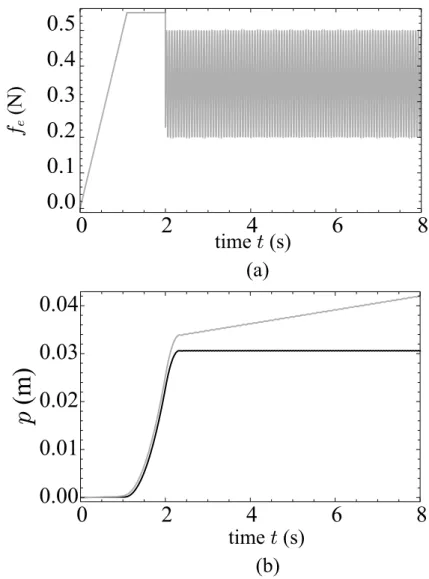
3.4 Simulation of the system (3.1); (a) provided external force f e described as (3.11); (b) simulation results by RK4 with the timestep size 0.001s. The parameters are chosen as; M = 1 kg, F = 0.5 N, K = 5 × 10 3 N/m, β = 2 × 10 −3 s. The initial conditions are; p = 0 m, p ˙ = 0 m/s. . . . 23

3.5 A physical interpretation of (3.12) . . . . 25

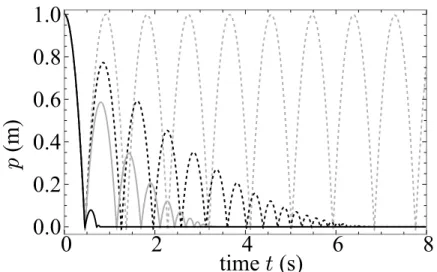
3.6 Simulation of the system (3.16) by RK4 with the timestep size 0.001s. The parameters are chosen as; M = 1 kg, f e = −9.8 N, K = 10 5 N/m, β = 0.01 s, α = 0.01 s(gray dashed), 0.007 s(black dashed), 0.005 s(gray solid), 0.001 s(black solid). The initial conditions are; p = 1 m, p ˙ = 0 m/s. . . . . 26

V

(8)

List of figures VI

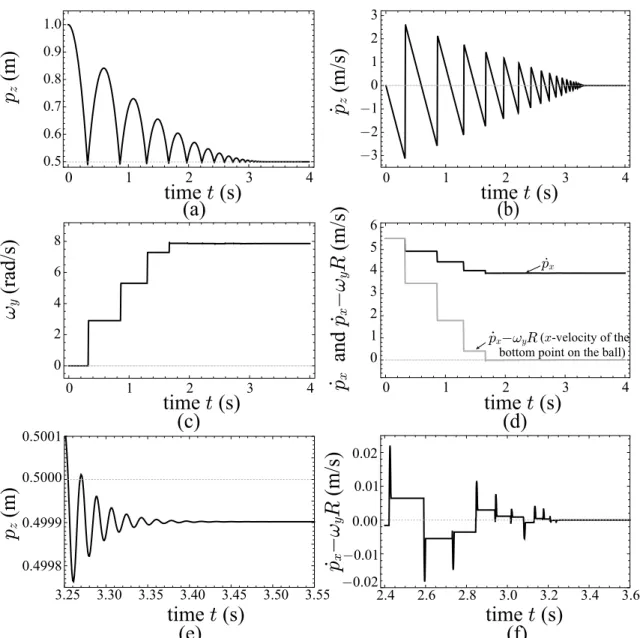
3.7 Example I: A rolling sphere with collision and slip. In the simulation, the parameters are chosen as; M = 1 kg, R = 0.5 m, µ = 0.1 and the initial conditions are; p ˙ = [5.5, 0, 0] T m/s, p = [0, 0, 2R] T m, ω = [0, 0, 0] T rad/s. 30 3.8 Simulation results of Example I by using (3.27) integrated by RK4 with

the timestep size 0.001 s. The parameters are chosen as; K 1 = K 2 = 1 × 10 5 N/m, β 1 = β 2 = 4 × 10 −3 s, α = 2.8 × 10 −3 s. . . . 31 3.9 Example II: Multiple friction contacts with multiple rigid unilateral con-

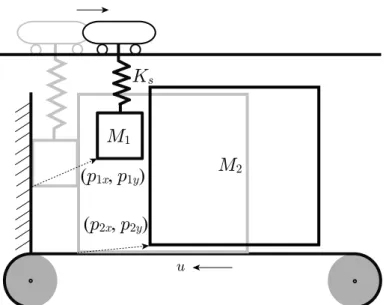
tacts. In the simulation, the parameters were chosen as; µ 1 = µ 2 = µ 3 = 0.5, M 1 = 0.5 kg, M 2 = 1 kg, K s = 100 N/m, u = 1 m/s and the initial conditions are; p = [0, 0.25, 0.05, 0] T m, p ˙ = [0, 0, 0, 0] T m/s. . . . . 34 3.10 Simulation results of Example II by using (3.35) integrated by RK4 with

timestep size 0.001s. The gray regions indicate the time periods in which the objects M 1 and M 2 are in contact with each other. The parameters are chosen as; K i = 5 × 10 5 N/m, β i = 2 × 10 −3 s (∀i ∈ {1, · · · , 6}), α i = 1.6 × 10 −3 s (∀i ∈ {1, 2, 3}). . . . 35 3.11 Example III: Periodic motion. In the simulation, the parameters were chosen

as; F = 0.2 N, M = 1 kg, k 1 = 1 N/m, k 2 = 1 N/m 3 , u = 1 m/s, V = 1 m/s, and the initial conditions are adopted from [1] for comparison;

p = 1.19149 m, w = 0 m/s. . . . . 37 3.12 Simulation results of Example III by using (3.40) and (3.41) integrated by

RK4 with timestep size 0.001 s. The parameters in (3.40) are chosen as;

K = 1 × 10 5 N/m, β = 0.5 s. The parameter in (3.41) is chosen as ϵ = 10 −5 m/s. . . . 38 4.1 A physical interpretation of (4.3b) and (4.3b). In the sliding regime, the

asperity deflections a i evolve so that the elastic forces |κ i a i | converge to λ i g(v ). The total friction force f is the sum of the viscoelastic forces of the elements. Figure and caption are reprinted, with permission from Springer:

Tribology letter, “A Multistate Friction Model Described by Continuous

Differential Equations”, vol. 51, no. 3, pp. 513–523, 2013, Xiaogang Xiong,

Ryo Kikuuwe, and Motoji Yamamoto, Fig. 2 (see Appendix A1). . . . 43

(9)

List of figures VII

4.2 A physical interpretation of the model (4.4a) and (4.4b). The viscoelas- tic force balances the friction force F c Sgn(v − a) ˙ both in the sliding and presliding regimes. Figure and caption are reprinted, with permission from Springer: Tribology letter, “A Multistate Friction Model Described by Con- tinuous Differential Equations”, vol. 51, no. 3, pp. 513–523, 2013, Xiaogang Xiong, Ryo Kikuuwe, and Motoji Yamamoto, Fig. 3 (see Appendix A1). . . 45 4.3 A physical interpretation of the model (4.10a) and (4.10b). Figure and

caption are reprinted, with permission from Springer: Tribology letter, “A Multistate Friction Model Described by Continuous Differential Equations”, vol. 51, no. 3, pp. 513–523, 2013, Xiaogang Xiong, Ryo Kikuuwe, and Mo- toji Yamamoto, Fig. 4 (see Appendix A1). . . . 49 4.4 Nondrifting property; (a) an external force as a function of time t; (b) the

friction force f as a function of position p. The parameters are chosen as; α = 2, v s = 5 µm/s, F c = 1 N, F s = 2.5 N, κ i = (5/i) N/µm, σ i = 0.02 Ns/µm, λ i = 0.1, i ∈ {1, 2, · · · , 10}, τ d = 0.02 s. The time-step size was 0.001 s. Figure and caption are reprinted, with permission from Springer: Tribology letter, “A Multistate Friction Model Described by Con- tinuous Differential Equations”, vol. 51, no. 3, pp. 513–523, 2013, Xiaogang Xiong, Ryo Kikuuwe, and Motoji Yamamoto, Fig. 4 (see Appendix A1). . . 52 4.5 The scenario of stick-slip oscillation . . . . 53 4.6 Stick-slip oscillation; (a) the position and velocity of the mass M as a func-

tion of time t; (b) the spring force and friction force as a function of time

t. The parameters were chosen identical to those in Fig. 4.4. The time-step

size was 0.005 s. Figure and caption are reprinted, with permission from

Springer: Tribology letter, “A Multistate Friction Model Described by Con-

tinuous Differential Equations”, vol. 51, no. 3, pp. 513–523, 2013, Xiaogang

Xiong, Ryo Kikuuwe, and Motoji Yamamoto, Fig. 5 (see Appendix A1). . . 54

(10)

List of figures VIII

4.7 Rate independency of hysteresis loop; (a) two positional inputs p as func- tions of time t (The gray curve is of 10 times the frequency of the black curve.); (b) the friction force f obtained for the two different input position signals p. The parameters were chosen identical to those in Fig. 4.4. The time-step size was 0.01 s. Figure and caption are reprinted, with permission from Springer: Tribology letter, “A Multistate Friction Model Described by Continuous Differential Equations”, vol. 51, no. 3, pp. 513–523, 2013, Xi- aogang Xiong, Ryo Kikuuwe, and Motoji Yamamoto, Fig. 6 (see Appendix A1). . . . 55 4.8 Amplitude dependency of hysteresis loop; (a) four positional inputs p with

different amplitudes as functions of time t; (b) the friction forces f obtained for the four different input position signals p. The parameters were cho- sen identical to those in Fig. 4.4. The time-step size was 0.001 s. Figure and caption are reprinted, with permission from Springer: Tribology letter,

“A Multistate Friction Model Described by Continuous Differential Equa- tions”, vol. 51, no. 3, pp. 513–523, 2013, Xiaogang Xiong, Ryo Kikuuwe, and Motoji Yamamoto, Fig. 7 (see Appendix A1). . . . 60 4.9 Frictional lag; (a) two velocity inputs v as functions of time t; (b) the friction

force f obtained for the two different input velocity signals v and two values

of τ d . The other parameters were chosen identical to those in Fig. 4.4. The

time-step size was 0.001 s. Figure and caption are reprinted, with permission

from Springer: Tribology letter, “A Multistate Friction Model Described by

Continuous Differential Equations”, vol. 51, no. 3, pp. 513–523, 2013, Xi-

aogang Xiong, Ryo Kikuuwe, and Motoji Yamamoto, Fig. 8 (see Appendix

A1). . . . 61

(11)

List of figures IX

4.10 Frictional lag effect on transition behavior; (a) two velocity input v as func- tions of time t; (b) the friction force f obtained for the two different input velocity signals v and two values of τ d . The other parameters were chosen identical to those in Fig. 4.4. The time-step was 0.001 s. Figure and caption are reprinted, with permission from Springer: Tribology letter, “A Multistate Friction Model Described by Continuous Differential Equations”, vol. 51, no. 3, pp. 513–523, 2013, Xiaogang Xiong, Ryo Kikuuwe, and Motoji Ya- mamoto, Fig. 9 (see Appendix A1). . . . . 62 4.11 Transition behaviors of the GMS model (4.3b)(4.3b) and new model (4.13a)

(4.13b) (4.13c); (a) a velocity input v as a functions of time t; (b)(c)(d) the friction force f obtained from the input velocity v; (e)(f)(g)(h) the friction force f and the number of elements in the presliding regimes; The gray ver- tical lines in (e)(f)(g)(h) indicate the time at which the number of elements in the presliding regime changes. The parameters were chosen identical to those in Fig. 4.4. The time-step size was 0.0001 s. (It should be noted that non-zero σ i has not been used in reported applications of the GMS model in the literature.) Figure and caption are reprinted, with permission from Springer: Tribology letter, “A Multistate Friction Model Described by Con- tinuous Differential Equations”, vol. 51, no. 3, pp. 513–523, 2013, Xiaogang Xiong, Ryo Kikuuwe, and Motoji Yamamoto, Fig. 10 (see Appendix A1). . 63 4.11 (Continued.) Figure and caption are reprinted, with permission from Springer:

Tribology letter, “A Multistate Friction Model Described by Continuous

Differential Equations”, vol. 51, no. 3, pp. 513–523, 2013, Xiaogang Xiong,

Ryo Kikuuwe, and Motoji Yamamoto, Fig. 10 (see Appendix A1). . . . 64

(12)

List of figures X

5.1 Force-indentation curves; (a) typical empirical result adopted from, e.g., [2, Fig. 4], [3, Fig. 2.6] and [4, Fig. 2], (b) KV model (5.1), (c) HC model (5.2) without any external force (solid) and with an external pulling force (dashed), (d) the author’s previous contact model (5.3). Figure and caption are reprinted, with permission from ASME: Journal of Applied Mechanics,

“A Multistate Friction Model Described by Continuous Differential Equa- tions”, vol. 81, no. 2, pp. 021003-1:8, 2014, Xiaogang Xiong, Ryo Kikuuwe, and Motoji Yamamoto, Fig. 2 (see Appendix A2). . . . 67 5.2 The force-indentation curves of the new model (5.6) and HC model (5.2);

The parameters are chosen as; f e = 0 N, λ = 1.5, K = 10 4 N/m 1.5 , γ = 2×10 3 s −1 , β 1 = 3×10 −3 s, β 2 = 0.1 s/m 1.5 and b 2 = 0.35 s/m. The ini- tial conditions are set as; p(0) = −0.1 m, p(0) = 2 ˙ m/s and a(0) = 0 m 1.5 . Figure and caption are reprinted, with permission from ASME: Journal of Applied Mechanics, “A Multistate Friction Model Described by Continu- ous Differential Equations”, vol. 81, no. 2, pp. 021003-1:8, 2014, Xiaogang Xiong, Ryo Kikuuwe, and Motoji Yamamoto, Fig. 3 (see Appendix A2). . . 70 5.3 Simulation of bouncing motion by using the new model (5.6) and HC model

(5.2). The parameters are set as; f e = M g, λ = 1.5, K = 10 4 N/m 1.5 , γ =

2 × 10 3 s −1 , β 1 = 1.45 × 10 −3 s, β 2 = 0.2 s/m 1.5 and b 2 = 0.2 s/m. The ini-

tial conditions are set as; p(0) = −0.5 m, p(0) = 0 ˙ m/s and a(0) = 0 m 1.5 .

Figure and caption are reprinted, with permission from ASME: Journal of

Applied Mechanics, “A Multistate Friction Model Described by Continu-

ous Differential Equations”, vol. 81, no. 2, pp. 021003-1:8, 2014, Xiaogang

Xiong, Ryo Kikuuwe, and Motoji Yamamoto, Fig. 4 (see Appendix A2). . . 71

(13)

List of figures XI

5.4 Influence of β 1 on the behaviors of the new model (5.5); The parameters are set as; f e = 0 N, λ = 1.5 and K = 10 4 N/m 1.5 . The initial conditions are set as; p(0) = −0.1 m, p(0) = 2 ˙ m/s and a(0) = 0 m 1.5 . Figure and caption are reprinted, with permission from ASME: Journal of Applied Mechanics, “A Multistate Friction Model Described by Continuous Differential Equations”, vol. 81, no. 2, pp. 021003-1:8, 2014, Xiaogang Xiong, Ryo Kikuuwe, and Motoji Yamamoto, Fig. 5 (see Appendix A2). . . . 73 5.5 Influence of β 2 on the behaviors of the new model (5.5); The parameters are

set as; f e = 0 N, λ = 1.5 and K = 10 4 N/m 1.5 . The initial conditions are set as; p(0) = −0.1 m, p(0) = 2 ˙ m/s and a(0) = 0 m 1.5 . Figure and caption are reprinted, with permission from ASME: Journal of Applied Mechanics, “A Multistate Friction Model Described by Continuous Differential Equations”, vol. 81, no. 2, pp. 021003-1:8, 2014, Xiaogang Xiong, Ryo Kikuuwe, and Motoji Yamamoto, Fig. 6 (see Appendix A2). . . . 74 5.6 Influence of γ on the behaviors of the new model (5.5); The parameters are

set as; f e = 0 N, λ = 1.5 and K = 10 4 N/m 1.5 . The initial conditions are set as; p(0) = −0.1 m and a(0) = 0 m 1.5 . Figure and caption are reprinted, with permission from ASME: Journal of Applied Mechanics, “A Multistate Friction Model Described by Continuous Differential Equations”, vol. 81, no. 2, pp. 021003-1:8, 2014, Xiaogang Xiong, Ryo Kikuuwe, and Motoji Yamamoto, Fig. 7 (see Appendix A2). . . . 75 5.7 (a)(b) The COR as a function of β 1 , β 2 and the impact velocity obtained

from of the new model (5.5). (c)(d) The COR as a function of impact veloc-

ity. The parameters are set as; f e = 0 N, λ = 1.5 and K = 10 4 N/m 1.5 . The

initial conditions are set as; p(0) = −0.1 m and a(0) = 0 m 1.5 . Figure and

caption are reprinted, with permission from ASME: Journal of Applied Me-

chanics, “A Multistate Friction Model Described by Continuous Differen-

tial Equations”, vol. 81, no. 2, pp. 021003-1:8, 2014, Xiaogang Xiong, Ryo

Kikuuwe, and Motoji Yamamoto, Fig. 8 (see Appendix A2). . . . 77

(14)

List of figures XII

5.8 (a) The COR as a function of γ and the impact velocity obtained from of the new model (5.5). (b) The COR as a function of impact velocity. The parameters are set as; f e = 0 N, λ = 1.5 and K = 10 4 N/m 1.5 . The initial conditions are set as; p(0) = −0.1 m and a(0) = 0 m 1.5 . Figure and caption are reprinted, with permission from ASME: Journal of Applied Mechanics,

“A Multistate Friction Model Described by Continuous Differential Equa-

tions”, vol. 81, no. 2, pp. 021003-1:8, 2014, Xiaogang Xiong, Ryo Kikuuwe,

and Motoji Yamamoto, Fig. 9 (see Appendix A2). . . . 78

(15)

List of abbreviations

DI Differential inclusion

DAI Differential algebraic inclusion HC Hunt-Crossley

GMS Generalized Maxwell-slip COR Coefficient of restitution ODE Ordinary differential equation PID Proportional integral derivative

XIII

(16)

Chapter 1 Introduction

1.1 Mechanical systems involving friction and contact

Friction and contact are common phenomena that occur in almost all mechanical systems.

The two phenomena seems simple, but in fact they are much complicated, involving many factors, such as temperature and materials. Although it is impossible to give exact mathe- matical descriptions for friction and contact, they can be modeled by different simplified ways in different cases. According to the simplifications of friction and contact models, this dissertation classifies the description methods of mechanical systems into two groups, hard-constraint approaches and regularization approaches.

In some cases, the deformations caused by the friction and contact phenomena are neg- ligible, comparing to the volume sizes of contact bodies. In those cases, the contact bodies can be idealized as rigid ones and can be assumed to be impenetrable to each other. From a mathematical point of view, friction and contact phenomena are described as tangential and normal constraints, respectively. This kind of descriptions for mechanical systems in- volving friction and contact are termed as hard-constraint approaches. They are preferred by academic researchers in the filed of multibody dynamical systems, because those hard- constraint approaches allow for great simplifications and lead to more robust numerical schemes for simulations of mechanical systems with friction and contact. Typical exam- ples of mechanical systems described by hard-constraint approaches include woodpecker

1

(17)

Chapter 1. Introduction 2

toy [5, 6], slider-crank mechanism with a translational clearance joint [7, 8], and granular material with large quantity [9–11].

In some other cases, friction and contact are modeled by considering the microscopic deformations from the physical point of view, as opposed to the mathematical point of view.

These models, usually consisting of spring and damper elements, are regularizations of the hard-constraint approaches. Those kind of description methods for mechanical systems are therefore termed as regularization approaches. They can be viewed as more realistic and closer to real systems than the hard-constraint approaches, because the variables and param- eters in regularization approaches represent specific physical meanings, such as displace- ments, stiffness, and viscosity. Regularization approaches are appreciated by engineers in the field of virtual reality, especially, in cases where the contact bodies are not so rigid or even soft [12]. Regularized models of friction and contact are also applicable in mechanical engineering, such as friction compensations with regularized friction models [13, 14] and property estimations of soft object with regularized contact models [2–4, 15].

The friction and contact models in regularization approaches can be continuously ex- tended to more sophistical models based on observations of experimental data. For example, the Hertz contact model is one of contact models in regularization approaches. It has been extended into Kelvin-Voigt model, Hunt-Crossly model [16], and other more complicated contact models [17].

1.2 Differential inclusion

Hard-constraint approaches describe mechanical systems involving friction and contact as differential inclusions (DIs), which are generalizations of ordinary differential equations (ODEs) as the following form:

d

dt x(t) ∈ F (x(t), u(t)) (1.1)

where x(t) is a vector that represents the states of systems, u(t) is another vector repre-

senting the inputs, and F (·, ·) is a set-valued map rather than a single-valued one. The

(18)

Chapter 1. Introduction 3

map F (x(t), u(t)) is only set-valued at countable points of x and is single-valued at other values of x. The DI description (1.1) has the difficulty in numerical integration due to its set-valued characteristic. For example, DIs in [7, 18] have to be discretized by some Euler- like methods and then integrated numerically by special mathematical solvers, such as linear complementary problem (LCP) solvers and mixed linear complementary (MLCP) solvers.

In some cases, DIs cannot be explicitly written in the form (1.1). They can only be written in the form of differential algebraic inclusions (DAIs) as follows:

0 ∈ F (x(t), x(t), u(t)). ˙ (1.2) In the main content of this dissertation, i.e., Chapter 3, 4, and 5, DIs in the form of (1.1) is regularized into DAIs (1.2) by considering the microscopic deformations caused by friction and contact. This way provides a new perspective for DI regularizations, which is different from the conventional regularization approaches.

1.3 Friction modeling

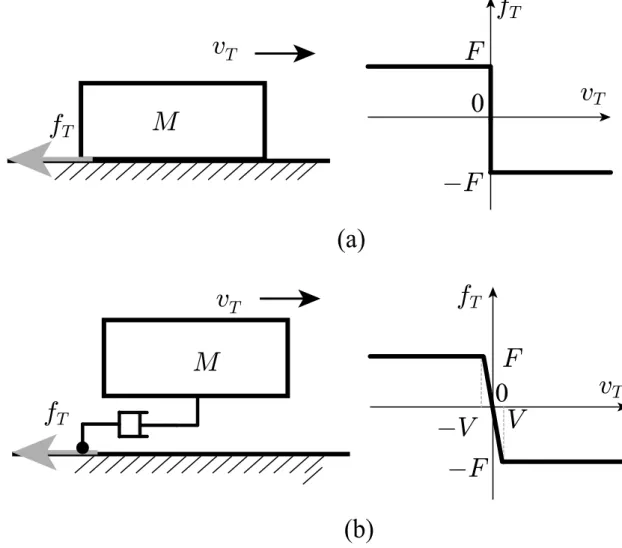
Hard-constraint approaches typically describe the friction force f T ∈ R as a set-valued function of the velocity v T ∈ R as follows [18, 19]:

f T ∈

 

 

 

 

 

 

−F if v T > 0 [−F, F ] if v T = 0 F if v T < 0

(1.3)

where F is the magnitude of kinetic friction force. The friction force at the static fric- tion state is set-valued within the range [−F, F ], as shown by the vertical line segment in Fig 1.1(a). Such kind of discontinuous characteristic is important to describe the static friction [14]. It is easy to imagine that the set-valued friction model (1.3) leads to DI de- scriptions for mechanical systems involving friction.

In regularization approaches, the friction force f T is typically described as a continuous

(19)

Chapter 1. Introduction 4

v T 0

F

¡ F f T

v T 0

F

¡ F f T

¡ V V v T

M

(a) v T

M

(b) f T

f T

Figure 1.1: (a) One of typical ways to model friction in hard-constraints approaches, and (b)

one of typical ways in regularization approaches

(20)

Chapter 1. Introduction 5

function of the velocity v T as follows:

f T =

 

 

 

 

 

 

−F if v T > V

−F v T /V if |v T | ≤ V F if v T < −V

(1.4)

where V > 0 is a threshold that is used to replace zero value for easinesses of numerical in- tegration and F/V > 0 can be interpreted as the viscosity coefficient. This friction force law is illustrated in Fig 1.1(b). One can notice that the vertical portion in Fig 1.1(a) is replaced by a line segment with slope −F/V . This implies that the friction force is a continuous function of the velocity. It is easy to imagine that such kind of friction model lead to ODE descriptions for mechanical systems involving friction, without any integration problems.

However, due to the lack of the discontinuous nature, such kind of friction models cause various strange behaviors. For example, the behavior of the friction model (1.4) heavily depends on the chosen value of the threshold V . Some more elaborately regularized models than (1.4), e.g., Dahl [20] and LuGre [21] friction models, produce positional drift in the static friction state.

Experimental data of friction in the literature, e.g., [22, 23], show that friction phenom-

ena are more complicated than what is described by Fig 1.1(a) and Fig 1.1(b). From static

friction to kinetic friction, friction is believed to experience two different regimes: the pres-

liding regime and the sliding regime [24]. The presliding regime is the time period within

which the major asperities in the contact surfaces are deformed elastically. The friction force

is a function of presliding displacement, which is a consequence of the elastic deformations

of asperities. In contrast, the sliding regime is the time period within which the major asper-

ities are deformed inelastically and the interconnections of asperities between the contact

surfaces are broken. The friction force is a function of the velocity, as roughly described

by Coulomb friction model. It has been pointed out [24, 25] that, in reality, the transitions

between the presliding and sliding regimes are not always sudden but gradual, and some

features are observed in each regime, such as the presliding hysteresis with nonlocal mem-

(21)

Chapter 1. Introduction 6

ory 1 in the presliding regime and frictional lag 2 in the sliding regime. Smooth transitions between the two regimes and the features in each regime should be appropriately described by friction models for applications such as precise control of machines [27, 28] and precise simulations of mechanical systems [29, 30].

The Dahl model [20], the LuGre model [21, 31], and the single state elastoplastic model [32] are relatively simple models that are preferred for control applications. Each of them has one internal state variable representing the average deflection of asperities in the contact surfaces, and thus they can be referred to as single-state friction models. As a price for their simplicity, these three models do not capture some important properties of friction phenomena in the presliding regime. For instance, the Dahl and LuGre models produce unbounded positional drift even when the applied force is smaller than the maximum static friction force [32, 33]. The single state elastoplastic model is free from this problem, but none of those three models produce presliding hysteresis with nonlocal memory.

The modified Leuven model [23, 34], the generalized Maxwell-slip (GMS) model [35], and the smoothed GMS model [36, 37] can be referred to as multistate friction models be- cause each of them includes more than one internal state variables. Those three multistate models are free from the aforementioned problems of the single-state friction models due to their sophisticated structures, but they still suffer from other problems. The modified Leuven model and the GMS models are described by equations involving discontinuities re- sulting from the switching between the presliding and sliding regimes. Such switching struc- tures cause the difficulty in on-line parameters identification [36, 37]. The smoothed GMS model does not involve such discontinuities, but comparing to the original GMS model, this smoothed version additionally includes two functions and three parameters, which increases the difficulty in parameter identification. The formulations of the smoothed GMS model are any order smoothly differentiable. This characteristic is originally motivated from the easi- ness of parameter identifications, without any physical meanings.

1 Hysteresis with nonlocal memory is defined as an input-output map, of which the output at any time instant depends on the output at some time instant in the past, the input since then, and the past extrema of the input or the output [22, 24]. This is in contrast to hysteresis with only local memory, of which the output only depends on the output at some time instant in the past [24].

2 Frictional lag is time delay in the friction force as a function of velocity. It results in the friction force

being larger during acceleration than that during deceleration [14, 21, 26].

(22)

Chapter 1. Introduction 7

There are some physically-motivated models that consider microscopic dynamics of contact surfaces. For example, generic models [38, 39] consider the effects of masses and geometries of asperities in the contact surfaces. As pointed out in [23, 40], the generic mod- els give good agreements with experimental data, but they can be too complex for control applications due to the necessity of massive computation. The Burridge-Knopoff [41] and its modified versions, such as [42], also consider the masses of asperities and the stiffness of the couplings among the asperities. Those models can also be computationally expensive compared to the LuGre, Leuven, and GMS models, which are suited for control applications.

In Chapter 3, a single-state friction model derived from a DAI is used to approximate the hard-constraint model (1.3). Unlike the regularized model (1.4), the Dahl model, and the LuGre model, this single-state model is independent from any velocity thresholds and does not produce unbounded positional drift, but it produces only linearly elastic behavior in the presliding regime. Chapter 4 extends the DAI proposed in Chapter 3 to a multistate version with including Stribeck and frictional lag effects. This multistate version is composed of parallel connection of a number of elastoplastic elements, having a similar structure to those of the conventional multistate models and others [43–46]. The force produced by the ex- tended model is analytically continuous with respect to the velocity and the state variables because it is transformable to a set of ODEs with continuous right-hand sides. Moreover, it captures the Stribeck effect, nondrifting property, stick-slip oscillation, presliding hysteresis with nonlocal memory, and frictional lag, which are major features of friction phenomena reported in the literature.

1.4 Contact modeling

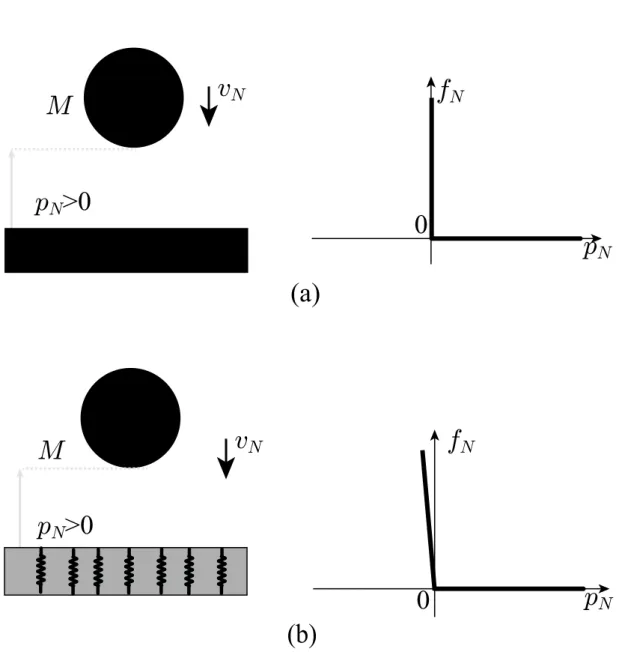
Hard-constraint approaches typically describe the contact force f N ∈ R as a set-valued function of the positional distance p N ∈ R as follows:

f N ∈

 

 

 

 

 

 

0 if p N > 0 [0, ∞] if p N = 0

∅ if p N < 0.

(1.5)

(23)

Chapter 1. Introduction 8

The contact force is set-valued within the scope [0, +∞] when the contact is closed, i.e., p N = 0, as shown by the vertical portion in Fig. 1.2(a). When the contact is open, i.e., p N > 0, the contact force is f N = 0. The empty set at p N < 0 implies that the contact bodies are idealized as rigid and impenetrable. The nonnegative force f N ≥ 0 in (1.5) implies that the contact bodies are not sticky to each other. One can notice the orthogonal corner at the origin in Fig 1.2(a), which shows the discontinuities of contact model (1.5).

It is easy to imagine that such a set-valued model leads to DI descriptions for mechanical systems involving contact.

In regularization approaches, the relation between f N and p N is typically described as a continuous function f N = max(0, −kp N ) where k can be interpreted as the stiffness. One can notice that the vertical portion in Fig 1.1(a) has been replaced by an inclined one with slope −k in Fig 1.2(b). The contact force is zero when the contact is open, i.e., p N > 0. The contact force is proportional to the penetration −p N when the contact is closed, p N ≤ 0.

The Hertz contact model can be viewed as a nonlinear extension of this regularized model.

The contact between two bodies is in fact more complicated than that described by the hard-constraint and regularization approaches in Fig 1.2(a) and (b). The force exerted by a contact varies according to nonlinear relations with time and the relative displacement, both during the contact and at the beginning and end of the contact. In order to precisely simulate the behaviors of various mechanical systems, such relations must be appropriately modeled. Much effort has been paid for the modeling of contact, especially those among biological tissues [2, 3], components of machinery [47, 48], rubber materials [4, 15, 49, 50]

and granular materials [51, 52].

The Kelvin-Voigt (KV) model is one of simply regularized models. It is based on a linear

spring-dashpot model and it captures energy dissipation during contact [53]. The drawback

of this model is that it produces a discontinuous jump in the force at the beginning of contact

and a sticky force (negative contact force) in the end of contact [16, 53, 54]. Hunt-Crossley

(HC) model [16] is another compliant contact model that is free from such weaknesses. HC

model is a combination of Hertz-like nonlinear compliance and an indentation-dependent

damping term. This model is extended in [12, 54–57] and empirically validated in [2, 3,

50, 58–60]. As pointed out in [55], however, HC model can produce unnatural sticky force

(24)

Chapter 1. Introduction 9

0

0 (a)

(b)

f N

p N

f N

p N v N

p N >0 M

v N

p N >0 M

Figure 1.2: (a) One of typical ways to model contact in hard-constraints approaches, and (b)

one of typical ways in regularization approaches

(25)

Chapter 1. Introduction 10

especially when the contact objects are separated rapidly by an external force. Moreover, the experiments in [60] show that the HC model is only consistent with empirical results when the coefficient of restitution (COR) is large [61].

The literature includes some report regarding the force-indentation curves obtained from real objects [2–4, 15, 49, 60]. Those force-indentation curves agree with the curves of HC model in most aspects, but differ in that, when the force arrives back in zero, the indentation is still not zero. That is, one can say that a contact force model should satisfy the following three conditions:

(i) the contact force should be continuous with respect to time at the time of contact;

(ii) the force-indentation curve can be designed to be nonlinear as is in Hertz’s contact model;

(iii) the indentation can be nonzero at the time of loss of contact force.

As discussed earlier, KV and HC models fail to satisfy two and one, respectively, of the three conditions. There have been some models [49, 61–64] that satisfy those conditions. These models, however, describes the restitution phase and the compression phase separately, in different equations from each other. As far as the author are aware, there have been no contact model that realizes the aforementioned features in a unified framework. In this dissertation, lacking of discontinuity nature is thought to be the reason for their problems of those models.

In Chapter 3, a linear contact model derived from a DAI is used to approximate the

hard-constraint model (1.5). This model does satisfy the conditions (i) and (iii) but does not

satisfy the condition (ii), producing a linear force-indentation curve. Chapter 5 extends the

DAI proposed in Chapter 3 to a new nonlinear DAI by adding a Hertz-like power-law non-

linearity and displacement-dependent viscosity such that the equivalent ODE formulation,

i.e., the new contact model, satisfies the aforementioned three conditions.

(26)

Chapter 1. Introduction 11

1.5 Major achievements

This dissertation focuses on modeling friction and contact for simulation and engineering applications. First, this dissertation regularizes DIs by using DAIs for simulations of me- chanical systems involving friction and contact. In contrast to previous regularization ap- proaches, the new approach preserve the discontinuity of original DIs. It is free from various problems of unnatural behaviors produced by the conventional regularization approaches.

Then, this dissertation extends the DAIs of friction and contact to more sophisticated formu- lations for engineering applications. Extensive simulation studies show that the properties of the new models derived from the extended DAIs are consistent with the experimental data reported in the literature. The major achievement are as follows:

• New simulation method for mechanical systems (Chapter 3)

This method provides a new perspective to regularize DIs for simulations of me- chanical systems. Different from straightforward approximations of DIs by ODEs in conventional regularization approaches, this new model first relaxes the rigid-bodies based DIs into DAIs with considering the deformations of bodies. Then, those DAIs are equivalently transformed into ODEs. Therefore, it has the features of both hard- constraint and regularization approaches and possesses both of their advantages. The new approximation method makes it feasible to simulate complicated mechanical sys- tems with an easy integration procedure as regularization approaches. On the other hand, it preserves the discontinuous nature of the original systems.

• New friction model (Chapter 4)

This new friction model is an extended version of the friction model proposed in

Chapter 3. This extended model is free of the positional drift problem of Dahl and

LuGre model, unnatural nondrifting behavior of Leuven model, and discontinuous

force of the GMS model. The problems of first three models are caused by lacking

of the discontinuous nature of friction between presliding and sliding regimes. The

GMS model does not suffer from the problems of the previous three models due to its

preservation of discontinuous nature, but it encounters the mathematical difficulty in

dealing with transitions between the presliding and sliding regimes. A pair of switch-

(27)

Chapter 1. Introduction 12

ing conditions have to be used in the GMS model for the transitions. On the contrary, the extended friction model not only preserves the discontinuous nature of friction, but also allows smooth transitions between the presliding and sliding regimes with- out any switching structures. In addition, the extended friction model captures all the properties of friction that the GMS model does.

• New contact model (Chapter 5)

This new model is a nonlinear extension of the contact model proposed in Chapter 3. It can simultaneously satisfy those three features of contact phenomena observed from experimental data without suffering from the problems of the KV and HC models.

Different from the KV and HC models, this new model has two viscosity terms for energy dissipation, which leads to adjustable coefficient of restitutions (CORs) even at low impact velocities. Those two terms have similar physical meanings with respect to those in the KV and HC models. Furthermore, it can produce similar behaviors to the KV and HC models by adjusting the two viscosity terms. Therefore, both the KV model and HC model can be viewed as special cases of this extended contact model in a unified form.

1.6 Organization

The rest of this dissertation is organized as follows. Chapter 2 provides mathematical pre-

liminaries that will be used throughout this dissertation. Chapter 3 proposes to regularize

DIs into DAIs for simulations of mechanical systems involving friction and contact. It illus-

trates the simplicity and efficiency of this new approach through three examples. Chapter 4

extends the single-state friction model in Chapter 3 to a multistate version and illustrates

the consistences between the extended model and experimental data reported in the litera-

ture. Chapter 5 extends the linear contact model in Chapter 3 to a new nonlinear version

and illustrates its properties through numerical simulations. Chapter 6 provides concluding

remarks.

(28)

Chapter 2

Mathematical preliminaries

For the discussion throughout this dissertation, this section introduces three functions: sgn, sat and dio. Some theorems regarding those functions are also presented. In the rest of this dissertation, R denotes the set of all real numbers and R + denotes the set of all nonnegative real numbers. The symbol 0 denotes the zero vector of an appropriate dimension.

2.1 Signum function

First, let us define the signum function sgn : R n → R n and the unit saturation function sat : R + × R n → R n as follows:

sgn(x) =

 

 

x/∥x∥ if ∥x∥ ̸= 0

{z ∈ R n | ∥z∥ ≤ 1} if ∥x∥ = 0

(2.1)

sat(Z, x) =

 

 

Zx/∥x∥ if ∥x∥ > Z x if ∥x∥ ≤ Z

(2.2)

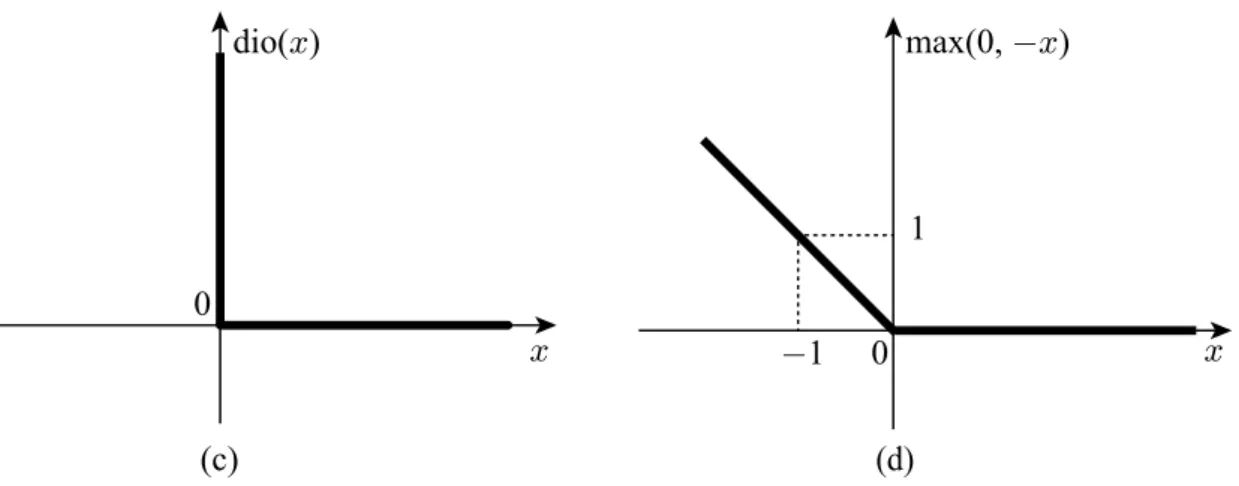
where x ∈ R n , Z ∈ R + and ∥ · ∥ denotes the vector two-norm. If n = 1, the sgn(x) and sat(Z, x) can be depicted as Fig. 2.1(a) and Fig. 2.1(b), respectively. The following theorem is useful to rewrite the DIs involving sgn as ODEs involving sat:

13

(29)

Chapter 2. Mathematical preliminaries 14

x sgn(x)

0 1

¡ 1

x sat(Z, x)

0

Z

¡ Z

(a) (b)

Z

¡ Z

Figure 2.1: The signum function sgn(x) and saturation function sat(Z, x) Theorem 1. For x, y ∈ R n and Z ∈ R + , the following relation holds true [65, 66]:

y ∈ Z sgn(x − y) ⇔ y = sat(Z, x). (2.3)

Proof. : A proof can be given as follows:

y ∈ Z sgn(x − y) ⇔ (y = Z (x − y)/∥x − y∥ ∧ x ̸= y) ∨ (y = x ∧ ∥y∥ ≤ Z )

⇔ (y = Zx/(Z + ∥x − y∥) ∧ x ̸= y ∧ ∥y∥ = Z) ∨ (y = x ∧ ∥x∥ ≤ Z)

⇔ (y = Zx/(Z + ∥x − y∥) ∧ ∥x∥ = Z + ∥x − y∥ > Z) ∨ (y = x ∧ ∥x∥ ≤ Z)

⇔ (y = Zx/∥x∥ ∧ ∥x∥ > Z) ∨ (y = x ∧ ∥x∥ ≤ Z) ⇔ y = sat(Z, x).

2.2 Diode function

Next, let us define the “diode” function dio : R + → R + as follows:

dio(x) =

 

 

0 if x > 0 R + if x = 0

(2.4)

(30)

Chapter 2. Mathematical preliminaries 15

dio(x)

0

x x

max(0, ¡ x)

0

(c) (d)

1

¡ 1

Figure 2.2: The diode function dio(x) and maximum functionmax(0, −x) where x ∈ R + . The following theorem is useful to rewrite DIs involving dio by ODEs:

Theorem 2. For x ∈ R and y ∈ R + , the following relation holds true:

y ∈ dio(x + y) ⇔ y = max(0, −x). (2.5)

Proof. : A proof can be given as follows:

y ∈ dio(x + y) ⇔ (y = 0 ∧ x + y > 0) ∨ (y ≥ 0 ∧ x + y = 0)

⇔ (y = 0 ∧ x > 0) ∨ (y ≥ 0 ∧ y = −x) ⇔ y = max(0, −x).

The graphs of dio(x) and max(0, −x) are illustrated as Fig. 2.2(a) and Fig. 2.2(b), re- spectively.

2.3 General notations

It must be noted that Theorem 1 and Theorem 2 are special cases of the following relation, which has been used in, e.g., [18, Appendix A.3], [19, eq.(2)] and [67, eq.(4)]:

x − y ∈ N S (y) ⇔ y = prox(S, x). (2.6)

(31)

Chapter 2. Mathematical preliminaries 16

O 1

O 2 O

3

O 4 S

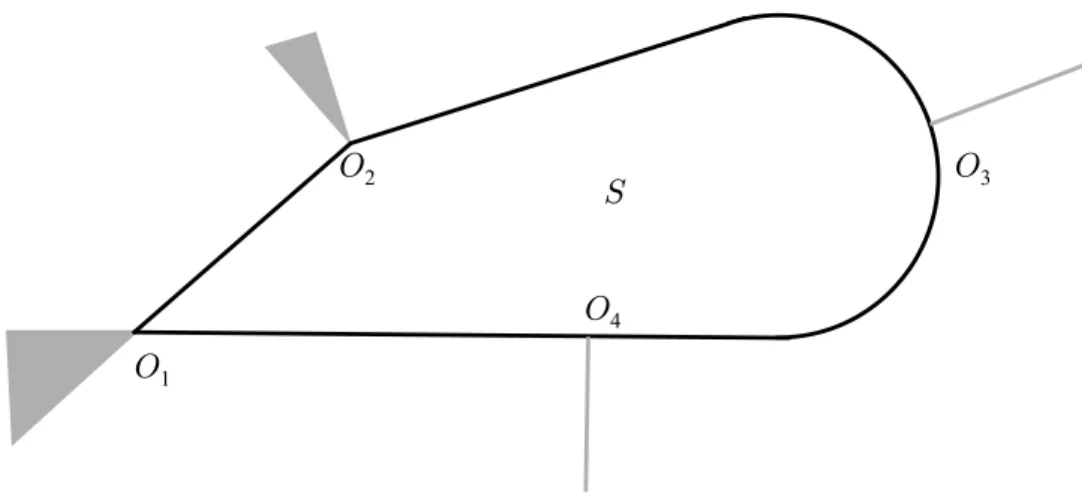
Figure 2.3: The normal cone of the set S at O 1 , O 2 , O 3 , and O 4 .

Here, x ∈ R n , y ∈ S ⊂ R n , S is a closed convex set, and N S (y) is the normal cone to the set S at y. The normal cone N S (y) is defined as follows:

N S (y) =

 

 

{z ∈ R n |z T (y − ξ) ≥ 0, ∀ξ ∈ S}, if y ∈ S

∅ otherwise.

(2.7)

Examples of two dimensional normal cone N S (y) to the set S at the points O 1 , O 2 , O 3 , and O 4 are illustrated in Fig. 2.3. The normal cones N S (y) at those points are colored with gray.

The function prox(S, x) represents the “proximal point” defined as follows:

prox(S, x) = argmin

z∈S

∥z − x∥ 2 . (2.8)

Theorem 1 and Theorem 2 can be obtained by using the relation (2.6) with S = {z ∈

R n | ∥z∥ ≤ Z } and S = R + , respectively.

(32)

Chapter 3

Mechanical systems involving Coulomb friction and rigid unilateral contact

Nonsmooth mechanical systems, which are mechanical systems involving Coulomb friction and rigid unilateral contact, are usually described as DIs. Those DIs may be approximated by ordinary differential equations (ODEs) by simply smoothing the discontinuities. Such ap- proximations, however, can produce unrealistic behaviors because the discontinuous natures of the original DIs are lost. This chapter presents a new algebraic procedure to approximate DIs describing nonsmooth mechanical systems by ODEs with preserving the discontinu- ities. The procedure is based on the fact that the DIs can be approximated by differential algebraic inclusions (DAIs) and thus they can be equivalently rewritten as ODEs. The pro- cedure is illustrated by some examples of nonsmooth mechanical systems with simulation results obtained by the fourth-order Runge-Kutta method.

The rest of this chapter is organized as follows. Section 3.1 overviews previous approx- imation methods for Coulomb friction and rigid unilateral contact. Section 3.2 gives the main contribution of the work. Section 3.3 provides two example applications of the new method. Finally, concluding remarks are given in Section 3.4.

⋆ The content of this chapter is partially published in [33].

17

(33)

Chapter 3. Mechanical systems involving Coulomb friction and rigid un . . . 18

p

f e M f

Figure 3.1: One physical interpretation of (3.1)

3.1 Previous simulation approaches

3.1.1 Coulomb friction

Let us consider the situation where a rigid mass M > 0, of which the position is p ∈ R r (r ∈ {1, 2}), is sliding on a fixed surface, as shown in Fig. 3.1. Let us assume that it is subject to the Coulomb friction force f ∈ R and an external force f e ∈ R . Then, the equation of motion of the mass is described as the following DI:

M p ¨ = f e − f (3.1)

where

f ∈ F sgn( ˙ p) (3.2)

and F > 0 is the magnitude of kinetic friction force 1 . The direct integration of (3.1)(3.2) is difficult since the value of sgn( ˙ p) is not determined at p ˙ = 0, according to the definition (2.1) of sgn.

Some previous friction models can be viewed as approximations of (3.2). One simple way is to employ a threshold velocity [13, 68] below which the velocity is considered zero.

This method may be useful to avoid the discontinuity in (3.2) but the non-physical threshold

1 Common definitions of Coulomb friction assume that the static friction force can be larger than the kinetic

friction force. This chapter leaves this out of consideration and assumes that the maximum static friction force

is equal to the kinetic friction force.

(34)

Chapter 3. Mechanical systems involving Coulomb friction and rigid un . . . 19

can produce unrealistic artifacts. Another way is to employ a new state variable which usually can be interpreted as the displacement of a viscoelastic element. For example, LuGre friction model [21, 31] without Stribeck effect can be described as follows:

˙

a = ˙ p − K∥ p∥a ˙

F (3.3a)

f = Ka + B( ˙ p − K ∥ p∥a/F ˙ ) + D p ˙ (3.3b) where a ∈ R r is the new state variable, K > 0 is a sufficiently large constant and B, D > 0 are constants appropriately chosen to suppress the oscillation in p. Dahl friction model [20] is a special case of LuGre friction model with D = B = 0. A disadvantage of those two models is that they produce unbounded positional drift in the static friction state under oscillatory external force even smaller than the maximum static friction force [69, 70].

Another type of regularized friction models are proposed by Kikuuwe et al. [69, Sec.III.C]

and Bastien and Lamarque [71] based on Backward-Euler method, and by Kikuuwe and Fu- jimoto [72] based on a modified Runge-Kutta method. A downside of their models is that they restrict the choice of methods for time integration.

In hard-constraint approaches, the equations of motion are discretized along time by Euler-like methods. Those discretized equations are usually formulated into complemen- tarity problems, which are then numerically solved. The literature includes some comple- mentarity formulations of Coulomb friction in one-dimensional space [8, 73] and in multi- dimensional space [74–77]. One exception is Kikuuwe et al.’s approach [69, Sec III.A], in which the discretized equation in a very simple case is analytically solved by the application of Theorem 2 in the present chapter.

3.1.2 Rigid unilateral contact

Let us consider the one-dimensional system composed of a rigid mass M , of which the

position is p ∈ R , and a fixed rigid wall whose position coincides with the origin, as shown

in Fig. 3.2. The rigid mass is subject to an external force f e ∈ R . Then, the equation of

(35)

Chapter 3. Mechanical systems involving Coulomb friction and rigid un . . . 20

p M

f e

f

Figure 3.2: One physical interpretation of (3.4)

motion of the rigid mass is described as the following DI:

M p ¨ = f − f e (3.4)

where

f ∈ dio(p). (3.5)

The integration of (3.4)(3.5) is also difficult due to dio(p), whose value is not determined at p = 0.

One of trivial methods to approximately realize the contact force f in (3.5) is as follows [18, 72, 78]:

f =

 

 

−Kp − B p ˙ if p ≤ 0 0 if p > 0

(3.6)

where K is a sufficiently large positive constant and B is a positive constant large enough

to suppress the oscillation in p. This force law can be viewed as a linear viscoelastic contact

model with the stiffness K and the viscosity B . As pointed out in [79, 80], one drawback of

(3.6) is that it produces an unnatural sucking force toward the wall. This drawback may be

(36)

Chapter 3. Mechanical systems involving Coulomb friction and rigid un . . . 21

overcome by using the following slightly different one:

f =

 

 

max(0, −Kp − B p) ˙ if p ≤ 0

0 if p > 0.

(3.7)

However, both (3.6) and (3.7) are discontinuous with respect to p and p. Thus, they are not ˙ suitable for the use with common ODE solvers.

As another example, the nonlinear viscoelastic contact model proposed by Hunt and Crossley [79] can also be viewed as an approximation of rigid unilateral contact. This model was extended in [12, 55, 81] and empirically validated in [59, 60, 82]. This model is continuous with respect to p and p, but it can also produce unnatural sucking force when ˙ p ˙ is large.

In hard-constraint approaches for rigid unilateral contact, the equations of motion are usually discretized by Euler-like methods and then solved numerically [8, 9, 73, 75, 83]. A different approach is in [18, Sec.1.4.3.2][80] where the discretized equations in very simple cases are solved analytically. Those methods can be used only with Euler-like methods.

3.2 New simulation approach

In this section, new ODE approximations are introduced for (3.1)(3.2) and (3.4)(3.5). Based on those simple approximations, a general procedure is presented for approximating nons- mooth mechanical systems involving many rigid-unilateral and Coulomb-frictional contacts.

3.2.1 Coulomb friction

The new approach for approximating (3.2) is motivated by Kikuuwe et al.’s work [69]. Their work (specifically, model-C in [69]) provides an idea to approximate (3.2) by the following DAI:

0 ∈ K(a + β a) ˙ − F sgn( ˙ p − a) ˙ (3.8a)

f = K(a + β a). ˙ (3.8b)

(37)

Chapter 3. Mechanical systems involving Coulomb friction and rigid un . . . 22

. .

. Massless object

K

p ¡ a f

p

p

p ¡ a a

stiffness

viscosity

Figure 3.3: A physical interpretation of (3.8).

Here, a ∈ R r is a state variable newly introduced, K > 0 is a sufficiently large constant and β > 0 is a constant appropriately chosen to suppress the oscillation in p. A physical interpretation of the approximation (3.8) can be illustrated as Fig. 3.3. A friction force described by F sgn( ˙ p− a) ˙ acts on a massless object whose velocity is p− ˙ a, and a viscoelastic ˙ element with the stiffness K and the viscosity Kβ produces the force f in (3.8b), which exactly balances the friction force.

In Kikuuwe et al.’s method, (3.8a) is discretized by Backward-Euler method, e.g., a ˙ is replaced by (a k − a k−1 )/T where T denotes the timestep size and the subscripts denote time indices, and then it is analytically solved with respect to a k by using Theorem 1. In Bastien and Lamarque’s model [71], a set of inclusions and equations with similar form to (3.8), are also discretized by Back-Euler method and then analytically solved.

The observation that motivated the new approach is that, (3.8) can be solved without using the Backward-Euler method. By the direct application of Theorem 1, (3.8) can be equivalently rewritten as the following ODE:

˙

a = (sat(F/K, a + β p) ˙ − a)/β (3.9a)

f = Ksat(F/K, a + β p). ˙ (3.9b)

As far as the author are aware, the literature includes no computational methods making

use of the equivalence between DAIs of the form of (3.8) and ODEs of the form of (3.9).

(38)

Chapter 3. Mechanical systems involving Coulomb friction and rigid un . . . 23

0 2 4 6 8

0.00 0.01 0.02 0.03 0.04

0 2 4 6 8

0.0 0.1 0.2 0.3 0.4 0.5

f e (N)

(a) time t (s)

p (m)

(b) time t (s)

Figure 3.4: Simulation of the system (3.1); (a) provided external force f e described as (3.11);

(b) simulation results by RK4 with the timestep size 0.001s. The parameters are chosen as;

M = 1 kg, F = 0.5 N, K = 5 × 10 3 N/m, β = 2 × 10 −3 s. The initial conditions are;

p = 0 m, p ˙ = 0 m/s.

After replacing (3.2) by (3.9b) and appending (3.9a) to the state-space model, the system

(39)

Chapter 3. Mechanical systems involving Coulomb friction and rigid un . . . 24

(3.1)(3.2) is approximated by the following ODE:

d dt

˙ p p a

=

(f e − Ksat(F/K, a + β p))/M ˙

˙ p

(sat(F/K, a + β p) ˙ − a)/β

. (3.10)

Fig. 3.4 shows the simulation result by using the ODE (3.10) with RK4. To illustrate the advantage of this method, it also presents the result of LuGre model (3.3) combined with (3.1). In the simulation, an external force f e was chosen as

f e =

 

 

min(0.55, 0.5t) N if t < 2 s 0.35 + 0.15cos(100t) N otherwise,

(3.11)

which is, after t = 2s, oscillatory below the static friction level F = 0.5 N. As shown in Fig. 3.4(b), LuGre model produces unrealistic positional drift, which has been known in the literature (e.g.,[69, 70]), while the presented method (3.10) does not. This implies that (3.9) is a better approximation of (3.2) than (3.3).

It should be mentioned that, (3.9) is derived by relaxing the rigid constraint between f and p ˙ in (3.2) by introducing an auxiliary variable a that has its own dynamics. In this sense, the proposed method may be viewed to be similar to Baumgarte’s method [84], in which constraints are relaxed to improve the numerical stability of the solutions of ODEs.

One of concerns regarding models based on DIs is the existence and uniqueness of solution, as discussed by Bastien and Lamarque [71]. As for the case of (3.8), on the other hand, it is clear because (3.8) is equivalent to the ODE (3.9).

3.2.2 Rigid unilateral contact

The new approach for approximating (3.5) is a modification of the work by Kikuuwe and Fujimoto [80]. In their approach, (3.5) is approximated by the following DAI:

0 ∈ K (e + β e) ˙ − dio(p + e) (3.12a)

(40)

Chapter 3. Mechanical systems involving Coulomb friction and rigid un . . . 25

K

Massless object

p f

p+e

K¯ e

p

p+e .

. .

Figure 3.5: A physical interpretation of (3.12)

f = K (e + β e) ˙ (3.12b)

where K and β are appropriate positive constants, e ∈ R is a state variable newly introduced.

A physical interpretation of (3.12) is illustrated as Fig. 3.5. Here, a massless object whose position is p + e is connected to the mass through a viscoelastic element with the stiffness K and the viscosity Kβ. Due to the contact, the contact force dio(p + e) acts on the massless object and it balances the force f from the viscoelastic element. In Kikuuwe and Fujimoto’s work, (3.12) was discretized by Backward-Euler method and then analytically solved by the application of Theorem 2. Unfortunately, (3.12) cannot be rewritten into an ODE because e ˙ cannot be obtained explicitly.

The new approach presented here is to add another term α e ˙ to the argument of dio(·), which yields the following DAI:

0 ∈ K(e + β e) ˙ − dio(p + e + α e) ˙ (3.13a)

f = K(e + β e) ˙ (3.13b)

where α > 0 is another appropriate constant. By using Theorem 2, (3.13) can be equiva- lently rewritten as the following ODE:

˙

e = max(−e/β, −(p + e)/α) (3.14a)

f = Kmax(0, e − β(p + e)/α). (3.14b)

(41)

Chapter 3. Mechanical systems involving Coulomb friction and rigid un . . . 26

0 2 4 6 8

0.0 0.2 0.4 0.6 0.8 1.0

time t (s)

p (m)

Figure 3.6: Simulation of the system (3.16) by RK4 with the timestep size 0.001s. The parameters are chosen as; M = 1 kg, f e = −9.8 N, K = 10 5 N/m, β = 0.01 s, α = 0.01 s(gray dashed), 0.007 s(black dashed), 0.005 s(gray solid), 0.001 s(black solid). The initial conditions are; p = 1 m, p ˙ = 0 m/s.

The equivalence between DAIs of the form of (3.13) and ODEs of the form of (3.14) has not been pointed out in the literature either. One can see that (3.14) is continuous with respect to p, p ˙ and e and it does not produce sucking force because the right-hand side of (3.14b) is always positive. This features in contrast to the conventional methods (3.6) and (3.7), which are discontinuous, and to Hunt and Crosley’s model [12, 55, 79], which produces a sucking force. It is also easy to see that (3.13), or equivalently, of (3.14) has a unique solution.

One possible interpretation of (3.13) and its equivalent expression (3.14) can be ex- plained by defining e ˜ = e + α e. By using ˙ ˜ e, (3.13) can be rewritten as follows:

0 ∈ L −1

[ L[K(˜ e + β e)] ˙˜

1 + αs

]

− dio(p + ˜ e) (3.15a) f = L −1

[ L[K(˜ e + β e)] ˙˜

1 + αs

]

. (3.15b)

where L denotes the Laplace transform. By noting the similarity between (3.15) and (3.12),

(42)

Chapter 3. Mechanical systems involving Coulomb friction and rigid un . . . 27

one can see that force f in (3.15b) can be interpreted as a low-pass filtered viscoelastic force although it does not exist in the real world. When α = β, (3.15) is equivalent to (3.12) with β = 0, which produces a perfectly elastic force. To preserve the effect of the viscous force and stability, it is presumable that α should be set smaller than β, although any tuning guidelines are not obtained yet.

By replacing (3.5) by (3.14b) and appending (3.14a) to the state-space model, the system (3.4)(3.5) is approximated by the following ODE:

d dt

˙ p p e

=

(f e + K max(0, e − β(p + e)/α))/M

˙ p

max(−e/β, −(p + e)/α)

. (3.16)

A set of numerical simulation of the ODE (3.16) was performed with different α val- ues and a fixed β value. Fig. 3.6 shows that the bouncing motion becomes smaller as α decreases. This is consistent with the interpretation based on (3.15), which implies that a smaller α strengthens the viscous effect in a high-frequency region. Detailed analysis on the relation between the parameter values and the achieved coefficient of restitution is left outside the scope of this chapter. What can be said is that the coefficient of restitution can be adjusted by appropriate choices of α and β on a trial-and-error basis.

3.2.3 Coulomb-frictional, rigid unilateral contact

The methods in Sec. 3.2.1 and Sec. 3.2.2 can be easily combined to describe a rigid unilateral contact involving Coulomb friction. Let us consider a rigid mass M of which the position is p ∈ R 3 and a rigid frictional surface perpendicular to the z axis and including the origin.

Then, the state-space model of the system can be described as the following DI:

d dt

p

˙ p

˙ p 1

M

µdio(p z )sgn( ˙ p xy ) dio(p z )

(3.17)

Figure 1.1: (a) One of typical ways to model friction in hard-constraints approaches, and (b) one of typical ways in regularization approaches
Figure 1.2: (a) One of typical ways to model contact in hard-constraints approaches, and (b) one of typical ways in regularization approaches
Figure 2.1: The signum function sgn(x) and saturation function sat(Z, x) Theorem 1. For x, y ∈ R n and Z ∈ R + , the following relation holds true [65, 66]:
Figure 2.2: The diode function dio(x) and maximum functionmax(0, −x) where x ∈ R + . The following theorem is useful to rewrite DIs involving dio by ODEs:
+7

参照

関連したドキュメント