九州大学学術情報リポジトリ
Kyushu University Institutional Repository
微分代数包含式の摩擦と接触のモデル化への応用
熊, 小剛
https://doi.org/10.15017/1441188
出版情報:Kyushu University, 2013, 博士(工学), 課程博士 バージョン:
権利関係:Fulltext available.
論 文 要 旨
区 分 甲 氏 名 熊 小剛
論文題名 APPLICATIONS OF DIFFERENTIAL ALGEBRAIC INCLUSIONS TO THE MODELING OF FRICTION AND CONTACT
(微分代数包含式の摩擦と接触のモデル化への応用)
論 文 内 容 の 要 旨
This dissertation focuses on the modeling of friction and contact by using differential algebraic inclusions (DAIs). It starts from the concept of differential inclusions (DIs) , which are set-valued generalizations of ordinary differential equations (ODEs). Mechanical systems invo lving friction and contact are described as DIs when the contact bodies are idealized as rigid ones and impenetrable to each other. Integrations of DIs are troublesome due to the DIs' set -valued characteristics. In conventional regularization approaches, DIs are directly approximated as ODEs for the easiness of numerical integration. Those straightforward approximations lack the discontinuous nature of original DIs and can cause problems of unnatural behaviors. In this dissertation, DIs are first regularize d as DAIs that inherit the discontinuous nature of original DIs. Then the DAIs provide a single -state friction model and a linear contact model to approximate DIs as ODEs. To enhance the applicability of friction and contact models in various engineering applications, the single-state friction and linear contact models are extended to more sophisticated versions such that they can capture more features of friction and contact phenomena. The single-state friction model is extend to a multistate version. It can capture the major friction properties that previous friction models do, such as nondrifting property, presliding hysteresis with nonlocal memory, and frictional lag. Moreover, it is free from the problems that previous models suffer from, such as unbounded positional drift or discontinuous force. The linear contact model is extended to a nonlinear version. It can simultaneously satisfy the major features of experimental data of soft-objects contact, such as continuity of the force at the time of collisio n, Hertz-like nonlinear force-indentation curve, and non-zero indentation at the time of loss of contact force. In contrast, previous contact models can only capture one or two of the three features.
Chapter 1 first overviews the approaches to describe mechanical systems involving friction and contact: hard-constraint approaches and regularization approaches. The hard-constraint approaches describe the mechanical systems as DIs by idealizing contact bodies as rigid ones. DIs capture the discontinuous nature of friction and contact, but they are troublesome to be integrated due to their set-valued characteristics. The regularization approaches describe mechanical systems as ODEs, which can be easily integrated by any ODE integrators. However, they can produce unnatural behaviors in
simulations due to their lacks of discontinuous nature of original DIs.
Chapter 2 introduces mathematical preliminaries for the discussion throughout this dissertation.
Chapter 3 provides a new method to regularize DIs into ODEs for the easiness of integrations. It provides an effective way to simulate mechanical systems with preserving the discontinuous nature of original DIs. The efficiency and simplicity of this method are illustrated through three numerical examples.
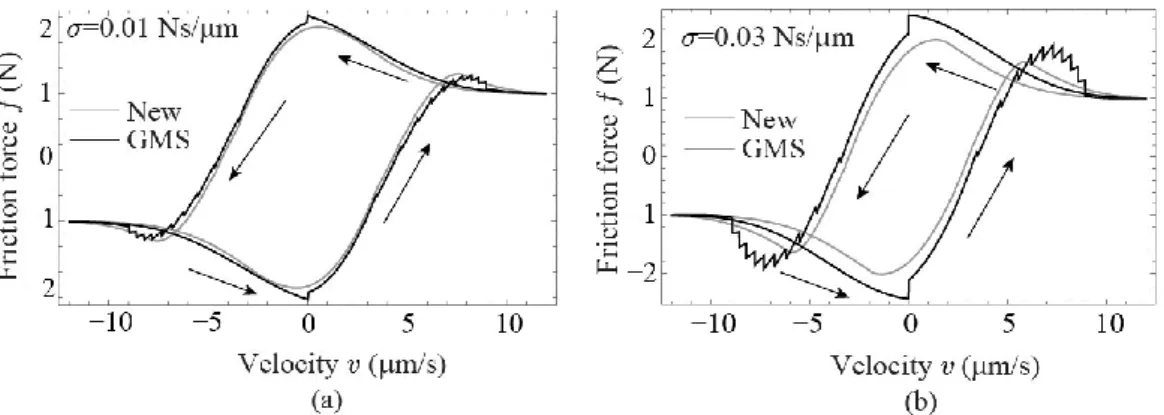
Figure 1: Transition behaviors of the GMS model and new model; (a) ¾=0.01Ns/m and (b) ¾=0.03Ns/m
Chapter 4 extends the single-state friction model in Chapter 3 to a multistate friction model. This extended model can capture major friction properties without suffering from various problems of previous models. For example, the generalized Maxwell-slip (GMS) model has the mathematical difficulty in dealing with transitions between the static and sliding friction states. This difficulty leads to discontinuous force, especially, as the viscosity ¾ increases, as illustrated by the black curves in Figure 1(a) and (b). The new model is free from such problem of the GMS model, as illustrated by the gray curves in Figure 1(a) and (b).
Figure 2: Force-indentation curves; (a) typical empirical data of soft-objects contact in the literature and (b) the new model and HC model.
Chapter 5 extends the linear contact model in Chapter 3 to a nonlinear version. This extended contact model simultaneously satisfies the major features of experimental data of soft-objects contact in the literature, as can be seen from the comparison of black curves in Figure 2(a) and (b). Conversely, previous contact models are inconsistent with the experimental data in some aspects. For example, the Hunt-Crossly (HC) contact model always produces zero indentation when the contact force is lost, as shown by the gray curve in Figure 2(b). This is very different from the feature of non-zero indentation
exhibited by the experimental data in Figure 2(a).
Chapter 6 concludes the dissertation with concluding remarks and future works.