Comparison of Affordability of Russian and Japanese Housing Markets
Mayu Michigami
Abstract
This paper shows how the Russian housing market and housing conditions have developed due to privatization and a government-adopted housing policy.
First, it compares housing affordability between Russia and Japan. The emergence of a private housing market increased access for the Russian people to housing from the demand side. Therefore, measuring housing affordability represents the development of the housing market in Russia. However, Russia’s rapid development in the private housing market temporally hampered people’s ability to solve it by themselves. At present, Russia suffers from a shortage of quality housing units and affordability to quality housing.
From this aspect, Japan remains a step ahead. Japanese housing loans have simultaneously promoted new housing construction and improved living environments. To solve this dual problem in Russia, this paper argues that Russia must introduce a combination of housing loan conditionality with building standards because the two countries have identical problems: the adoption of an effective housing policy under a low birth rate and declining population, and a shortage of quality housing units.
Keywords: Russian housing market, housing affordability, housing policy, housing loan
1. Introduction
The housing sector, which is an important factor to develop an economy, belongs to
Associate Professor, Faculty of Economics, Institute of Humanities, Social Science and Education, Niigata University, 8050, Ikarashi 2-no-cho, Nishi-ku, Niigata City, 950-2181, JAPAN; Phone & Fax:
+81-25-262-6518. E-mail: [email protected]
This paper is a product of the research supported by Grant-in-Aid for Young Scientists (B) (#21730232) and Grant-in-Aid for Scientific Research (B) (#21402025) from JSPS. An earlier version of this paper was presented at the workshop held at the Faculty of Economics, St. Petersburg State University, St.
Petersburg, Russia, 5 September, 2008 and at the Russian-Japanese Seminar “Natural Resource Development, Population and Environment in Russia: Their Present and Future in Relation to Japan,”
organized by the Institute of Geography, Russian Academy of Science, held at the Morozovka Hotel,
Moscow region, Russia, 13-14, September, 2010. I wish to thank Prof. Sadayoshi Ohtsu of Osaka Sangyo
University for his support of my research and the two referees of this paper.
the social welfare sector and intrinsically takes on the role of both private developers in the market and the public welfare. Therefore the balance between private and public actors is always inevitable and difficult. In the 1990s in Russia, the development of the housing market and a policy was a relatively low priority due to budget deficits, not only for public finance but also for family budgets. Since the Russian economy grew rapidly in the 2000s, investment in the housing sector returned, and the restrained housing demand obviously became an active actor in the Russian market economy.
Especially in such metropolitan areas as Moscow and St. Petersburg, housing prices soared and housing loans (mortgages) began to develop as one aspect of consumer loan development. Light is shed on the housing market by reflecting on the financial sector involved in housing loans. Furthermore, the same situation was caused by the labor market involved in the housing sector. That is, increases in personal income expose the longstanding improvement demand of residential environments that spills over into construction sector development. At the same time, the rapid concentration into metropolitan areas complicates getting desirable residential environments. To approach the dynamics of the housing sector in the Russian market, in this paper we specify the current problems of the Russian housing market, especially in respect to the demand side.
This paper clarifies the current problems of Russian housing by reflecting on the
experience of the Japanese housing market (since 1945). Such a comparison is
reportedly impossible, because the economic history and institutions between Russia
and Japan are quite different. Regarding the essence of housing problems, however,
both countries have experienced similar problems and tasks. First, they are both
currently worried about a low birth rate and declining population. Under such a
situation, they must implement an effective housing policy to supply enough quality
housing units. Narrow living spaces particularly represent the lack of quality housing in
both countries. Second, both countries must simultaneously encourage the construction
industry to provide an economic boost. What is critical is not just increasing housing
construction to solve their problems; they need to encourage the housing construction
industry to build enough comfortable quality housing, renovate inadequate facilities,
and simultaneously provide affordable housing for middle-class households. In both
countries, such a phenomenon has spread: the quality of affordable dwellings is low,
and desirable ones are unaffordable.
Fortunately, the present shortage of housing units has almost been solved in both countries. From the early postwar years, the housing shortage was serious. For example, Japan’s number of dwellings finally exceeded the number of households 40 years after WWII. Besides the housing quality, the quantity of housing units is now sufficient.
Furthermore, the quantity problem of housing units hasn’t arisen due to Japan’s low birth rate and her declining population. On the other hand, in the Soviet era, the state provided one apartment
1per household. The people were guaranteed the right of occupation, but not the right of ownership. Low utility expenses and rent were set.
However, the failure of the planned economy caused a lag in housing construction and a shortage of housing units, creating long waits for state housing and forcing people to temporarily live with other households
2. Therefore, in actuality, during the Soviet years, people got housing units but their quality was very low. Since the Russian privatization that began in 1992, people could privatize their occupied housing without any charge.
Besides the quality of living environments, such giving of their own housing by government created a low priority for housing reform at the beginning of marketarization. In addition, a low birth rate and a rapidly declining population in Russia forces stimulation of housing construction, renovation of current dwellings to comfortable levels, and the promotion of construction investment to stimulate the economy. In the 2000s, Russia’s high economic growth afforded an opportunity for fundamental government reform. Due to increases of individual income, households concerned about sharing one apartment begin to emerge in the housing market as a solvent demand. However, as the housing market developed, housing prices increased, dampening housing affordability for the Russian people. Consequently, the problems of housing quality and affordability remain unsolved in both countries: cramped living spaces, the necessity of renovating the existing utilities and facilities of dwellings, and the low level of affordability for middle-class households.
Moreover, both countries are trying to solve these problems with the aid of market forces. Both housing policies are being influenced by private agents to improve the housing environments based on the development of housing loans by private banks and public mortgage agencies in Russia and by a high degree of private housing loans
1
A maximum of 60 sq m per apartment was provided by the state (Mizoguchi 2004, p. 157).
2
Concerning housing conditions in the Soviet era, see Shinoda 1986, 1987, 1988, 1989.
(securitization) and deregulation in Japan. From this aspect, Japan has gone one step beyond Russia. In Japan, private agents (construction and real estate developers) are playing the main role in the housing market with the guidance of public housing policy.
Housing quality and quantity in Japan have gradually improved. On the other hand, Russia also needs to develop public and private housing loans. However, it has failed to actively improve the living quality and housing affordability because of high interest rates.
This paper compares Russia and Japan as follows. First, we briefly look at housing policy and affordability in Russia. Second, we describe the general characteristics of Russian housing loans and their supportive roles for improving living environments.
Third, we address the Russians own dissatisfaction with their housing, shown as an essence of quality housing problems. Next, we explore the Japanese housing market, its affordability, and the housing loan situation. Finally, we end with a short suggestion for the Russian housing market based on the experience of the Japanese housing market.
2. Russia’s housing policy and housing affordability 2.1 Russia’s housing policy and market
Federal laws finally established the privatization of housing and land
3in 1994 after repeatedly amending previous legislation from the end of 1991. In 1994, housing privatization was defined by ‘The Russian Federal Law ‘On the Privatization of the Housing Stock in the Russian Federation’ No.26-FZ and the ‘Housing Code of the Russian Federation’No.188-FZ. People could freely privatize their occupied housing based on these laws
4. The Russian government originally planned housing reform for 1996-2000. The reform contents were included in the following items: the protection of low-income households, the improvement of living environments for the military by federal monies, a support system for registered households that needed improvements of their living environments, the establishment of a long-term loan system for housing construction and purchasing, the promotion of housing privatization, the establishment of a competitive housing market, the acceleration of housing construction in urban and
3
This paper only treats housing as apartments and dwelling land mainly in urban areas, because apartment dwellings are the main dwellings in Russian urban areas.
4
Ref. Puzanov (2009), pp. 5.-7, Morishita (1995), p. 744, pp. 765-766, Komorida (2001), pp. 145-156,
and Komorida (2003), pp. 237-244
suburban areas, the targeted total area of housing construction, the renovation of utility facilities, and the gradual increase of utility fees.
From 1992, government developed charge-free privatization of housing units and held down utility fees below CPI levels. However, until the financial crisis of 1998, actual housing reform had not been implemented because of the confusion of system transformation and budget deficits. Nor had a long-term housing loan system been developed. In 1998, three years was the longest available loan term. Private banking concentrated on short-term government bonds and didn’t provide long-term loans for retail. In those days, few households could afford to repay long-term loans. Therefore, the actual development of a housing policy and a market was not seen before the end of the financial crisis in 1998 and the economic growth that started in 1999
5.
In the 2000s, economic growth brought a fiscal surplus and domestic demand expansion in Russia. In 2003-2004, the federal government drew up a housing policy to raise the housing affordability for middle-class households in a priority national project called “Affordable Housing for Russian people”
6. This national project contained some sub-projects that served as countermeasures for low birth rates and to address housing reform for 1996-2000. It supports young families whose parents are under 30 years old with children by offering preferential interest rates for housing loans and low utility fees.
In 2004, the government defined the following targets for 2010: expanding the average floor space per capita from 20 to 21.7 sq m; increasing the share of households available for housing loans from 9% to 30%; increasing housing construction from 41 to 80 million sq m; increasing the amount of housing loans from 20 to 415 billion rubles;
increasing the eligibility of young households for such aid from 181,700; raising housing subsidies for vulnerable groups from 132,300 households; improving housing utility services
7. This paper focuses on housing affordability, average floor space per capita, and housing loan.
The privatization of land also started in 1992, although it depended on the discretion of each city. For example, Moscow allows the right to use land for 49 years. On the
5
Ref. Puzanov (2009), pp. 2-19, Nozdrina (2006), pp. 30-32, and Institute for Urban Economics (2003), pp. 9-35
6
Ref. PNP Zhil’e. (http://www.rost.ru/), Glazunov, S. and Samoshin, V. ( 2004), Kosareva, N. (2005), and Kosareva, N. and Tumanov, A. (2007)
7
PNP Zhil’e. (http://www.rost.ru/), Prilozhenie No.1-9 k federal’noi tselevoi programme ‘Zhilishche’ na
2002-2010 gody (Appendix No.1-9 for the federal target program ‘Housing’ in 2002-2010).
other hand, St. Petersburg allows land ownership (Komorida 2003, p. 222). Local government policies are quite different. When the local government owns the land, it can intervene in its usage and profit allocation. The privatization of land for dwellings in urban areas is governed by local administrations who sponsor public bidding for land privatization or to sell the occupation rights. However, the bidding process is not completely transparent, and an interlocking relation between local administrations and big developers is rampant
8. In 2006, Dmitrii Medvedev, Russia’s first deputy prime minister, claimed that local administrations hamper public bidding on land and encourage corruption by giving land privatization or occupation rights. He advocated a new national housing project to diminish the corruption and the monopolistic structure around land by local administrations
9.
In Russia most of the developed housing markets center on Moscow and its population of 10 million. As the capital of Russia, most of the land in Moscow has already been developed into dwellings, factories, business centers, and government offices. Therefore, new sites for housing construction are very scarce. Developers who get a small land spot to develop from local administrations choose to develop luxurious apartments because they are more profitable. Economy class apartments for middle-class household supposedly yield 17% profitability, but the profit from elite apartments ranges from 25-50%
10. Furthermore, the large cost of infrastructure development is a heavy burden on developers. Since 1992, the Russian government and privatized utility companies have not renovated their facilities connected to individual apartments. Because the utility companies combine contractors with customer service for insufficient utility service reform, they have no incentive to renovate their facilities without permission to raise fees
11. Therefore, when the developers construct a new apartment building, they must subtract the connection cost of the utility facility’s renovation or construction to a new building from the utility companies
12. Such additional costs also encourage developers to build elite apartments or business centers rather than economy class apartments.
In Moscow, demand is high for quality level housing or offices. Consequently, such
8
Ref. Institute for Russian & Eastern European Economic Studies, 2006 a, pp. 10-11
9
On 15 March 2006, (http://www.rost.ru/themes/2006/03/152012_1829.shtml)
10
Institute for Russian & Eastern European Economic Studies, 2006 b, p. 4
11
Ref. Starodubrovskaya (2002), pp. 620-622.
12
Interviews with real-estate agents in St. Petersburg on September 2008.
unsatisfied demand for quality units, the insufficient supply of available housing for middle-class households and economic growth boost housing prices. This situation reduces housing affordability in Russia. Developers construct more economy class housing in suburban areas than in Moscow’s urban center because they can get dwelling land plots easier in the Moscow region
13. Some people continue to live in unsatisfactory and privatized housing, and others purchase a new housing in the suburbs. Whether continuing to live in existing housing or moving to buy a new housing in the suburbs depends on household income. The disparity of household income influences the decision to move or purchase a new house. In addition, the socially vulnerable are still waiting for municipal housing. A rental housing market is developing among the immigrant laborers in the city. This is the current situation in the Russian housing market, especially in Moscow, from the demand side.
2.2 Russia’s housing affordability
Next we observe the current status of housing privatization, prices, and affordability in Russia. Since the privatization of housing, the private ownership share of housing stock has rapidly grown. The percentage of privatization amounted to 82.2% of the total housing stock in 2008 (Fig. 1). Since then, Russian housing prices have continued to rise (Fig. 2). In Russia, the price of used houses often exceeds new houses because the former are already completely equipped with the necessary facilities. On the other hand, new houses require the installation of facilities (for example, kitchen fixtures, washroom, etc) by the purchasers themselves. Buyers face additional costs. In addition, the insufficient supply of new economy class housing reflects the increase of used housing prices, as mentioned above.
The housing price index shows a characteristic change in 2006. Considering that the growth rate of housing prices in 2006 largely exceeded the growth rate of CPI and construction costs, it rose dramatically. Although why prices rose so dramatically in 2006 remain unclear, the possibilities include the inflow of foreign capital investment, the launching of new housing loans, and the expansion of public housing loans by government insured securities. Such housing price growth beyond the growth rate of wages, GDP, construction costs, and even CPI was fueled by housing prices in such metropolitan areas as Moscow and St. Petersburg (Table 1). Especially in Moscow in
13
Suburban sprawl may emerge. Ref. Michigami, Tabata, and Nakamura (2009).
2006, prices grew drastically. The prices of these two cities show the characteristic continuance of growth and hovered at high levels, even during the stagnation of 2007 and 2008. On the contrary, in 2009 the housing price level in the Russian Federation recorded its first decline since 1992. The financial crisis of 2008 reflected the price decline from 2008 to 2009 and shows the potential for robust housing demand in Moscow and St. Petersburg. The development of a real estate market in Russia centers on metropolitan areas that haven’t completely spread over the entire Russian Federation.
Fig. 1 Housing stock in Russia
Fig. 2 Housing price index and related indexes in Russia
Table 1 Housing prices in Russian Federation, Moscow, and St. Petersburg
2000 2001 2002 2003 2004 2005 2006 2007 2008 2009
Price of new houses (rubles per sq m) Russian
Federation 8678 10567 12939 16320 20810 25394 36221 47482 52504 47715 Moscow 16281 21906 24331 35364 47058 58398 88590 113501 127246 131218 St.
Petersburg 11186 13263 16594 22081 26997 31343 45460 80251 88729 90162 Price of used houses (rubles per sq m)
Russian
Federation 6590 9072 11557 13967 17931 22166 36615 47206 56495 52895 Moscow 15414 20329 26810 34681 42132 52444 101334 127874 155271 158915 St.
Petersburg 10046 11436 13388 19267 27728 32224 48679 58995 79186 84195 Source: Rosstat 2007 and 2009a.
Although the housing privatization and housing markets simplified the process of getting a new house, housing affordability has actually worsened since the end of Soviet era, because the growth of personal income remains more modest than housing prices.
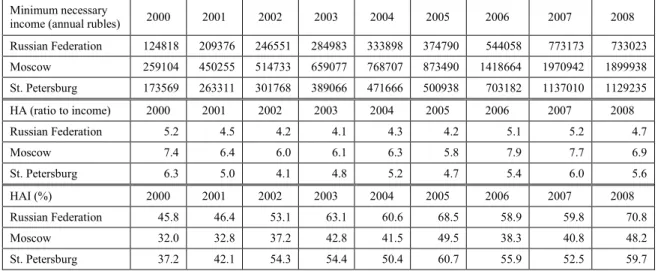
“Housing Affordability” (HA) means the number of a middle-class household’s annual income that equals the average housing price. This is the housing price to income ratio (Eq. (1) and Table 2). Fewer years mean a higher possibility for people to purchase a new dwelling, and they can buy one earlier, too. But more years indicate a lack of affordable housing for which people have to wait. Since 2004, the Russian government has implemented a policy called “Affordable Housing to Russian People”
14to decrease the number of years needed to purchase a new house. The goal is that by 2010 the HA value will be three years (PNPZhil’e, Appendix No. 8). That means that the middle-class household’s annual income for three years equals the price of a new house.
A middle-class household could buy a new house if it could save such an amount of money. The Russian government defines the standard housing floor space as 54 sq m (18 sq m per capita), and standard household size is three people. In this way, the HA value, which is the housing price divided by the income, is defined by Eq. (1):
14
Ref. PNP Zhil’e.
) 1 members) ...(
(3 income Household
m) sq (54 Price
HA
Another index exists to evaluate housing affordability. The “Housing Affordability Index” (HAI), which was developed in the USA, evaluates the ability to repay housing loans (Michigami 2008, p. 33 note 38) and shows whether a middle-class household can afford a new house with the aid of a housing loan. HAI calculation is based on the following assumptions. First, 70% of the housing price is borrowed. Second, 30% of the annual household income is repaid every year. This calculation is based on a repayment burden of the annual household income: 30%. The debt burden rate in Russia seems heavy for most households. Even in the USA, a 20-25% burden rate is commonly set up.
In Russia, the repayment percentage to annual household income is defined as 30% by the government. The lower the repayment percentage to annual income is, the lower (worse) the HAI value is, which is related to the HAI value and the share of households that can afford a new house.
The HAI value is defined by Eq. (2):
y : minimum needed household income to buy a new house with a loan H : housing price, α : loan to income (%), i : housing loan interest rate, T : repayment term, β : loan repayment to income (%)
The following is the evaluation:
If the HAI value exceeds 100%, it is possible to buy a new house with a housing loan.
If the HAI value falls below 100%, it is impossible to get a housing loan.
Therefore, the disparity between the calculated HAI value and 100% denotes the possibility of buying a house. It also indicates the minimum income needed to purchase a house and completely repay the housing loan. By calculating HAI, people can recognize whether to apply for a housing loan. The HAI calculation results in the Russian Federation and other regions show that the average income households cannot buy a standard level dwelling even with a housing loan (Table 2). The HAI value improved until 2004. However, since 2005, ironically, after the new housing policy was carried out, the HAI value has worsened, probably because it was affected by the price
, income 100 household
actual
y
HAI y 1 1 /( i 1 H i )
T ...( 2 )
boosts in 2005 and 2006. We must accurately analyze the reasons for the housing price boost in 2005 and 2006.
Table 2 Housing affordability in RF and metropolitan areas
Minimum necessary
income (annual rubles) 2000 2001 2002 2003 2004 2005 2006 2007 2008
Russian Federation 124818 209376 246551 284983 333898 374790 544058 773173 733023
Moscow 259104 450255 514733 659077 768707 873490 1418664 1970942 1899938
St. Petersburg 173569 263311 301768 389066 471666 500938 703182 1137010 1129235
HA (ratio to income) 2000 2001 2002 2003 2004 2005 2006 2007 2008
Russian Federation 5.2 4.5 4.2 4.1 4.3 4.2 5.1 5.2 4.7
Moscow 7.4 6.4 6.0 6.1 6.3 5.8 7.9 7.7 6.9
St. Petersburg 6.3 5.0 4.1 4.8 5.2 4.7 5.4 6.0 5.6
HAI (%) 2000 2001 2002 2003 2004 2005 2006 2007 2008
Russian Federation 45.8 46.4 53.1 63.1 60.6 68.5 58.9 59.8 70.8
Moscow 32.0 32.8 37.2 42.8 41.5 49.5 38.3 40.8 48.2
St. Petersburg 37.2 42.1 54.3 54.4 50.4 60.7 55.9 52.5 59.7
Source: calculation by author from Rosstat 2007 and 2009 and CBR 2008 and 2010 based on by real values. The values of Russian Federation in 2009 are 10,087,302 rubles, 4.0 years, and 22.2% by the author’s calculation from Rosstat 2010.
Having recognized what annual income is needed to buy a new house, we can grasp the population distribution for affordable housing (Figs. 3 and 4). Using the income levels of 2003, 2006, and 2008, the share of population who satisfies the goals of the
“Affordable Housing” policy is approximately 12.6 - 16.1% (price to income ratio) and 17.9-23.9% (HAI). The majority clearly can’t purchase a new house. The change of the population distribution from 2003 to 2008 is also slight, and the housing policy and economic growth effects are insignificant. The Russian government set a goal of expanding to 30% the percentage of households who can afford new houses in 2010.
The government invested 902.4 billion rubles and found that its policy goal remains very far from being achieved in the current Russian housing market. In addition, if we calculate HAI by a lower debt burden rate than 30%, its value greatly worsens. Even under the conditions of the government housing loan corporation in Japan, a household with a 35% burden rate on its annual income qualifies for a housing loan. However, the real debt burden rate of household income is mostly less than 25%
15.
15
Survey in 2008 by JHF.
Fig. 3 Distribution of population by income ratio to housing price (%)
Source: calculation by author from Table 2 and SEP 2010.
Fig. 4 Distribution of population by HAI (%)
Source: calculation by author from Table 2 and SEP2010.
2.3 Russian housing loans
Housing affordability represents a parameter of the ratio between income and
housing prices. If households can use housing loans, its value can be improved. The
Russian government is trying to promote a housing loan system from both private and
public channels. However, in fact, the high interest rate of housing loans and an insufficient supply of public housing loans hamper the development of housing loans for middle-class households.
The organization of housing loans in Russia (“housing loans” without collateral and Ipoteka “mortgage loans” with collateral from AIZhK and banks etc.) has fueled housing prices since 2006. In the Russian housing loan system, people can borrow a maximum of 90% of the house’s price even if they don’t have enough money to buy it.
The price boost from existing used houses makes people aware of their own asset value.
People can utilize their own houses as collateral with high asset value and can more easily borrow the money for their housing loan. Therefore, easier access to financing from housing loans opened the door for households that previously could never join housing markets. As a result, the expansion of housing demand for new dwellings exceeded the supply and raised the price of housing. The amount of loan money and users rapidly increased from 2006 to 2008 (Fig. 5). However, after the financial crisis of 2008, the amount of housing loans rapidly declined, causing overdue loan debt in 2009 (Table 3). Even though the lending of housing loans rapidly developed in Russia, its housing loan market remains very small compared with Japan (Tables 3 and 4). In Russia, the total housing loan share of GDP is around 2%, compared with around 37%
in Japan.
Fig. 5 Housing loan lendings in Russia
Table 3 Russia’s outstanding debt and overdue debt of housing loans and mortgages in 2008 and 2009
2008 2009
Russian Federation (million rubles) outstanding debt outstanding debt overdue debt
Housing loans 960578.4 966786.1 18525.6
Mortgages 776502.9 812774.7
Total loans / GDP (%) 2.3 2.5 0.05
Source: CBR 2008 and 2009. Total loans’ share to GDP was calculated by author with GDP data from Rosstat website. The interest rate on mortgages (with collateral) in Russia is usually lower than housing loans (without collateral).
Table 4 Japan's outstanding housing loan (Hundred million
JPY) 2004 2005 2006 2007 2008 2009
Housing loan balance 1,885,186 1,884,450 1,836,926 1,835,553 1,826,630 1,797,097 Housing loan / GDP
(%) 37.8 37.6 36.2 35.6 36.2 37.9
Source: author’s calculation from JHF and ESRI, SNA statistics.
One reason why the share of total housing loans to GDP remains small is the high interest rate on housing loans in Russia (Tables 5, 6, and 7). Although the interest rate in the latter half of the 2000s declined to rates less than that of 2004, the Russian interest rate for housing loans has always been much higher than in Japan. The high interest rate shows that the Russian housing loan system is premature and potential borrowers inside the country don’t exist, as the above HAI showed. On the contrary, this result suggests that speculative purchasing by a segment of the population might play an important role to raise housing demand and prices in the metropolitan areas of Russia. Consequently, the decline of credit risk and the maturation of the housing loan system are needed to obtain the availability of housing loans for middle-class households. Even though such a situation is time-consuming, the supply of public housing loans must be expanded like the previous Japanese case.
Table 5 Interest rate of mortgages for AIZhK in 2008 (%) Repayment terms Amount of loan
1-10 years 10-20 years 20-30 years 30 - 50% of housing price 10.75 11.00 11.25
50 - 70% 12.00 12.25 12.50
70 - 90% 13.50 13.75 14.00
Source: AIZhK Website accessed on 25 August 2008.
Table 6 Average interest rate (%)
2004 2005 2006 2007 2008 2009 Housing loans
Russian Federation 17.0 16.6 14.2 12.8 13.0 14.6
Moscow 17.0 16.6 14.1 12.8 13.6 14.8
St. Petersburg 17.0 16.6 14.0 12.4 13.3 14.7 Mortgage loans
Russian Federation 17.0 16.6 13.7 12.6 12.9 14.3
Moscow 17.0 16.6 14.0 12.5 13.3 14.5
St. Petersburg 17.0 16.6 13.7 12.3 13.4 14.7 Source: CBR.
Table 7 Interest rates for housing loans in Japan (%)
(%) 1967-69 1970-79 1980-1989 1990-1999 2000-2008
Major commercial banks 9.900 7.620-9.900 5.500-8.524 2.375-8.500 2.375-2.875 Government housing
loan corporations 5.500 5.500 4.550-5.500 2.200-5.500 2.400-3.680 Source: compiled by author from Bank of Japan, JKFK 2008, and Japanese Statistical Yearbook 2010.
2.4 Individual real estate investment
The boost of housing prices affected capital gains for individuals. If people sell their houses, they can buy a new house with the profit. Such a phenomenon reflects the individual behavior for real estate investment: speculation. Based on VTsIOM’s public opinion survey, today 82% of all Russian people expect that housing prices will continue to rise. Most answered that they can’t renovate or change their housing without a loan or some kind of financial assistance. Such a price boost encourages consumer behavior that leads to speculation. Taking this boost into account, some purchase additional dwellings not to change their housing life but to protect the value of their assets or earn profit from the margin. The desire to purchase more multiple dwellings than they actual need (household number) may accelerate more price boosts. Now Russian people aren’t considering depreciation in housing prices. Therefore, the sooner they buy a house, the higher price at which they can sell it. In such a situation, the affordability problem especially places a burden on first-time purchasers who cannot expect much resale gain of their own assets. To some extent, second purchasers, who have already bought/sold a house, can avoid the burden of expensive housing because they can add the resale profit to their budget. This practice depends on the expectation of stable rising housing prices and increasing personal income.
From one perspective, this investment behavior is proof that the housing market
works in Russia. From another view, however, many income groups who can’t afford to buy continue to live in their existing houses or are waiting to move to free or subsidized housing from the local government. The disparity between multiple dwelling owners and other owners may widen. Some people live in renovated or newly constructed dwellings. Others live in dwellings that desperately require renovation. In addition, publically-owned apartments have tended to be only reserved for socially vulnerable persons: pensioners, veterans, the handicapped, and the poor, as categorized by the government. The housing disparity may also widen between public and private housing.
The quality of public housing is generally described as lower than that of standard private housing. One reason is that municipal governments economize on the construction costs because renting public apartments to vulnerable persons is not profitable. As mentioned above, based on profitability, private developers tend to construct luxury housing in the center of urban areas. Consequently, middle-class households sometimes move to the suburbs where new subdivisions of economy class housing are being constructed, and the rich and poor households continue to live in the center of cities. This situation forces many workers to endure long commutes to work and traffic jams, lowering labor productivity under a declining population and labor force. To obtain sustainable economic growth, a housing policy needs to support a sufficient supply of housing in the center of the city.
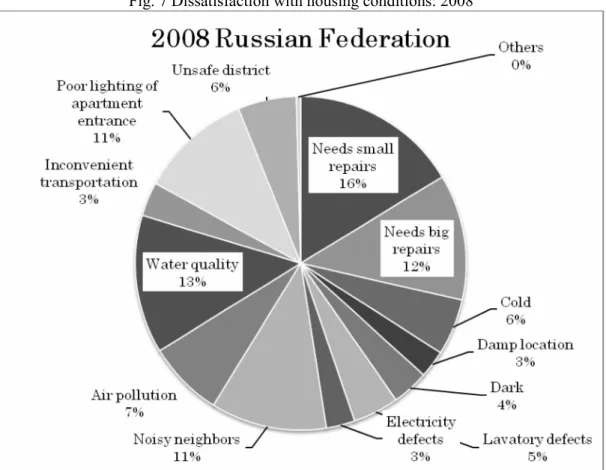
2.5 Dissatisfaction with housing conditions in Russia: housing quality problem In the Russian housing market, the shortage of quality housing units is critical. In 2000 the number of apartments in Russia (55.1 million units) exceeded the number of households (52.7 million in 2002 by Rosstat 2007 and 2009a). The quantity problem has already been solved. The essence of the housing problem has changed from a housing supply shortage to a quality housing shortage. As mentioned below, most Russians are unsatisfied with their own housing, which dates from the Soviet era. Therefore, the solution is not just increasing housing construction in the insufficient areas but promoting both the renovation of existing housing and housing construction toward a favorable quality level. Moreover, housing quality must influence the process that determines housing prices.
Figures 6 and 7 show the problems of existing dwellings. In 2006, the top item was
the size of the living spaces and the necessity of big repairs. Unfortunately, in the 2008
statistics, size was eliminated, but the necessity of big and small repairs increased more than in 2006. Besides the cramped living spaces, the existing housing stock also needs fundamental repair. In addition, entrance lights, water quality, and general dissatisfaction with common utilities are also increasing. The quality problems are too big for individual residents to solve.
One of the government’s goals is the expansion of dwelling area per capita to 21.7 sq m per capita
16. That goal’s macro level for the country was achieved in 2008 (Table 8). The average floor space per apartment in 2008 was 51.8 sq m. Based on income levels, low-income groups continue to live in very cramped dwellings and have no chance to change their dwellings without financial assistance (Rosstat 2007 and 2009b).
Fig. 6 Dissatisfaction with housing conditions: 2006
Source: compiled by author from SEP 2007, p. 308.
16
In Russia, the kitchen, bathroom, balcony, and lavatory are not counted as floor space.
Fig. 7 Dissatisfaction with housing conditions: 2008
Source: compiled by author from SEP 2009, p. 307.
Table 8 Average floor space per capita and apartment (sq m)
Floor space per capita 2000 2001 2002 2003 2004 2005 2006 2007 2008 Russian Federation 19.2 19.5 19.8 20.2 20.5 20.9 21.3 21.5 22.0
Moscow 18.3 18.3 18.5 18.8 19.1 19.4 19.7 19.9 20.1
St. Petersburg 19.8 20.1 20.5 20.9 21.4 21.9 22.4 23.1 23.5
Floor space per apartment (RF) 49.1 49.3 49.6 49.9 50.1 50.4 50.8 51.3 51.8 Source: Rosstat 2007 and 2009a.
As the population distribution of HA and HAI shows, the majority of the population can’t purchase new housing or used housing to solve their housing problems. The improvement of the Russian housing environment has been achieved not only by new dwelling construction. The renovation of entire apartment buildings is also necessary, including housing utilities and maintenance services, green spaces, and the environment and safety around buildings.
Since 1992 a common occurrence is that both privatized and non-privatized
dwellings have coexisted in the same apartment building, because residents themselves
can determine whether they want to privatize their own dwellings. In addition,
municipal governments often continue to rent dwellings for the vulnerable in apartment buildings. Therefore, among home ownership, agreeing about the renovation cost of a whole apartment building and its shared facilities is difficult. Therefore, a person who can afford a new apartment moves out; this weakens the consensus to renovate among the remaining persons. If non-renovated housing conditions continue, some apartment buildings may deteriorate into slums. The Moscow municipal government has started to tear down inferior apartment buildings built in the early 1960s during the Khrushchev era to prevent building areas from becoming dilapidated and to build new tall apartment building to maximize profit.
Moreover, even for new apartments that satisfy severe construction and environment standards, quality problems may emerge. The quality of a new apartment is not always guaranteed. Corruption and cost-cutting are common in Russia
17. Some construction companies will build a new apartment building cheaply and with inferior materials and technology to maximize profit. For example, in 2008 the price of cement was very expensive because there was a shortage of it. The cost of building materials also boosts housing prices. Some companies use inferior construction materials and economize labor cost by using immigrant labor who often work more cheaply and without benefits.
Even the quality of new houses is not absolutely guaranteed. This background is also one reason why buyers of new apartments face additional costs. If this situation continues, the dilapidated housings that often need repairs will have a disadvantage in the resale market. If the housing market collapses, the owners of such overvalued dwellings may default. A debt crisis may occur. Although the value of the overdue debt share to GDP was quite small in 2008, as mentioned above, we must pay attention to the overdue debt situation in Russia.
To summarize this section, the government’s role allows great leeway to improve housing quality and affordability in Russia. Her housing policy, which depends on the expansion of floor space, increased construction, and housing loans, is insufficient to solve the problems of quality housing. The answer is more than just tightening construction regulations; the conditions of housing loans related to housing quality levels must be introduced based on Japan’s experience.
17
Interview with construction supervisor in Zhukovskii Moscow region on 23 September 2008.
3. Japanese housing policy and housing affordability 3.1 Japanese housing policy and market
At the start of Japan’s post-war recovery, the volume of housing construction by private agents hadn’t been adequately developed. The shortage of dwellings amounted to 4.2 million. The Japanese government established three public housing acts: the Government Housing Loan Corporation (as noted below ‘public housing loan’), Public Housing, the Public Housing Corporation. Since 1945 these three pillars of public housing policy have played an important role in the Japanese housing market.
Public housingwas established for the lowest income groups by local administrations all around Japan. “1/2 to 2/3 of the construction costs were compensated by state subsidies (Shiozaki 2006, p. 69)”. Public housing cheaply rents apartments to the lowest income group. The share of the total housing stock is not so large. But “the share of a big city (Osaka) is large (11%), which is 1/3 of all rental units in Osaka (ibid.
p. 70)”.
The public housing corporation, which had rented apartments and sells condominiums for new salary workers in urban areas, was established to solve the housing shortage problems caused by the population concentration in urban areas. They didn’t belong to the lowest income group; they were a new group that could afford detached houses with housing loans. The public housing corporation targeted such middle groups and created modern housing developments and spread a new housing lifestyle.
In addition to these acts, public housing loans and a 5-year mass construction plan were carried out. Due to space limitations, we will concentrate on public housing loans.
For 20 years, the Japanese housing policy solved the housing shortage with three public
channels and a 5-year plan (Table 9). After the oil crisis in 1973 the Japanese housing
market entered an era of fluctuation: recession and the bubble economy. Due to the
recession dwelling construction plummeted. The government deregulated land use,
housing development, and the monetary system to recover. It planned many urban
development projects to stimulate private domestic investment and to solve the
problems of the quality of urban business life and housing life. This plan caused land
and real estate speculation. Japanese people had long believed that the price of land
never fell, because the Japanese land history proved this. Therefore belief in such a
myth accelerated investment in land and real estate as safe assets, and consequently the price of land and condominiums in urban areas soared. As deregulation continued, the role of public housing decreased. Construction by private agents largely exceeded that of public agents. Such land and housing speculation was called the ‘bubble economy’.
Economic expansion arrived not only in the real estate market but also in other commodity markets. However, since this bubble burst in 1991, the price trend of land and housing has stabilized downward.
Table 9 Japanese housing policy: tasks and measurement
Source: compiled by author from Shiozaki, (2006), p. 63, Table 4-1 and JSS (2007), p.117.
The characteristic points in the Japanese housing market include the balance between private and public agents, its dependence on the ownership of housing or apartments, and that it hasn’t sufficiently developed rental housing. Fig. 8 shows that private funds played a dominant role in the construction of new housing in Japan. The total average is 60% by private funds and only 40% by public funds. To what extent this fact of 60% private funds were mobilized in the Japanese housing market started a controversy among Japanese economists, urban planners, and policy makers that focused on what caused the insufficient quality of housing units and the insufficient rental housing supply in Japan.
Main problems Measures
1945 Housing shortage Housing supply by public funds Postwar
rehabilitation Quantity problem Government Housing Loan Corporation Public housing
1955 Public Housing Corporation
High Quantity problem Five-year plan of housing construction
economic From 1961 to 2006
growth Solution of housing shortage
1973 Improvement of housing quality
From quantity to quality Setting of dwelling environment level Quality problem Targeted dwelling standards
Low growth and bubble
Low level of housing standards:
overcrowded etc
Housing construction as measures to boost domestic demands
1990 Environmental pollution
Quality problem Deregulation
After bubble burst
Disaster (earthquake)- resistant
housing construction Improved market efficiency,
2005 Bubble burst More efficient use of private funds
Fig. 8 New housing construction in Japan
Source: compiled by author from MIC 2003, Chapter 9. Table 9-9, MLIT Housing Starts 2007, 2008, and 2009.
Some argue that private agents constructed too much small detached housing based on profitability. Such housing was provided as an affordable option for middle-class households. The Japanese government emphasized housing quantity over quality and promoted the sale of such dwellings to boost the economy (Adachi, Oizumi, Hashimoto and Yamada 2000, pp. 27-29, pp. 41-42). Instead of deregulation, some economists advocated improved and appropriate regulations. In addition, land and housing themselves have monopolistic features. Land and housing are non-reproductive goods and immovable assets. Therefore, the owners hold the dominant power in the market. In addition, the supply of land and housing is rigid. Such supply rigidity often causes price appreciation.
Others argue that overregulation by the Japanese government hampered the development of rental housing by private funds and the active development of housing building in city centers. Particularly, two laws, the Act for Sectional Ownership of Buildings and the Land Lease and House Lease Act, disrupted efficient market forces (Iwata and Hatta 1997, pp. 9-49, pp. 53-69). They advocated deregulation.
Consequently, since the 1990s Japanese housing policy has adopted deregulation to follow the latter argument.
This controversy is applicable to the Russian housing market, too. Today in Russia,
the official rental housing market remains largely undeveloped, and the government promotes housing construction instead of rental housing because the construction industry boosts the economy. Japan once found itself in such as situation; for most people, the quality of affordable dwellings was low and desirable ones were unaffordable, as in Russia. Furthermore, recently under the conditions of a low birth rate and a declining population, Japan has already oversupplied her new housing stock and today needs to liquidate and renovate the used and existing housing stock (‘Basic Housing Life Law’ in 2006 (MLIT, 2006b)). From this aspect, Japan has gone one step beyond Russia. The securitization of housing loans was introduced to support the renovation and liquidation of existing housing stock and to lower financing risk. The government housing loan corporation was privatized in 2007.
Russia’s mortgage system (AIZHK) also guarantees the securities of loans by the government. However, public and private agents in Russia have not yet sufficiently supplied suitable housing stock. Japanese housing policy and public housing loans have contributed to solving the housing supply and the quality problem to some extent, providing a hint for Russia, which needs to implement adequate deregulation, especially for the public bidding process on land plots, and to increase public housing loans for middle-class households.
3.2 Japan’s housing affordability
Next we observe the dynamics of housing affordability in Japan. This change of the Japanese housing market reflects the HA (housing price to income ratio) and HAI (affordability with mortgages) values. Table 10 and Fig. 9 show the changes of Japanese housing prices and of two housing affordability values in Japan for 33 years from 1975 to 2008. In the 1970s, the value of housing affordability gradually increased, and in the latter half of the 1980s, it suddenly worsened due to the bubble economy.
After the bubble economy burst, housing affordability improved. However, it
slightly worsened in the 2000s because of the recession and income decreases. Housing
affordability had been parallel to the dynamics of housing prices until the bubble
economy burst. On the other hand, the rapid decreasing of individual income changed
the value of housing affordability since the bubble economy burst.
Table 10 Average apartment price and price to income ratio in Japanese metropolitan areas
1975 1980 1985 1990 1995 2000 2001 Annual income (thousand JPY) 3270 4930 6340 7670 8560 8150 8130 Price (thousand JPY) 15300 24770 26830 61230 41480 40340 40260
Price to income ratio 4.7 5.0 4.2 8.0 4.8 4.9 5.0
Floor space (sq m) 56.8 63.1 62.8 65.6 66.7 74.7 77
2002 2003 2004 2005 2006 2007 2008 Annual income (thousand JPY) 8230 7830 7960 7900 7940 7980 7910 Price (thousand JPY) 40030 40690 41040 41070 42000 46440 47750
Price to income ratio 4.9 5.2 5.2 5.2 5.3 5.8 6.0
Floor space (sq m) 78 74.7 74.6 75.4 75.7 75.6 73.5
Source: compiled by author from JSS (2009) p. 111 and JKFK 2010, p. 77.
Fig. 9 Housing affordability index of Japanese metropolitan areas
Source: calculation by author from Bank of Japan, JKFK 2008, Japanese Statistical Yearbook 2010 and JSS (2009) p.111. Compiled by author from Tables 12 and 13.
Compared with the Russian case, middle-class households in Japan could buy new
housing except during the bubble economy era. HAI exceeded 100%. On the other hand,
Russia’s current situation resembled Japan’s bubble economy era. The price boost
influenced the decrease of housing affordability, and the depreciation of housing prices caused by the recession reflects the improvement of housing affordability. However, in Russia, a low HAI value below 100% continues. It will worsen unless Russia obtains sustainable economic growth, increases individual incomes, and develops mortgages.
Although Japan’s 5-year plan supplied mass housing construction, it was an indicative plan not an absolute one. Therefore the characteristics of the history of the Japanese housing market show that private funds mainly played an important role by guiding public agents. Abundant housing construction is crucial to advance housing affordability. However, the Japanese people remain dissatisfied with their own dwellings, even though the housing shortage evaporated (MLIT 2003). The problem remains residential quality.
3.3 Quality of dwellings in Japan and housing stock
Figure 10 shows the characteristics of the Japanese housing stock. In Japan, the average rented houses are small. Although a 5-year plan set a targeted residence level and a minimum amount of floor space to improve resident environments, Japanese apartments are still sometimes smaller than Russian apartments. To a certain degree, setting targets about the conditions of public housing loans improved residences.
However, the problem of quality housing remains unsolved. 42.7% remain dissatisfied with their own dwellings. The following are the points of dissatisfaction:
18poor design for senior citizens, lack of security, energy inefficient, inadequate safeguards against earthquakes, and a lack of storage space. One reason why the quality of Japanese housing remains low is that land regulation affected the behavior of private construction companies
19. Government permission is required when land speculators develop residential estates exceeding 1000 sq m within urban areas. So the development of land that didn’t need permission, areas less than 1000 sq m, greatly increased. Consequently many small (100 sq m) detached housings were built in urban areas and the suburbs, especially in the 1970s. Hence government deregulated some regulations since the 1980s.
18
MLIT, 2003, Housing Demand Condition Survey
19
Ref. Iwata and Hatta (1997), Adachi, Oizumi, Hashimoto and Yamada (2000) and Shiozaki (2006)
The Japanese government is currently trying to solve the quality problems of houses based on the promotion of private agents in the New Basic Housing Life Law, which mobilizes used housing stock and reduces the government’s intervention in the housing market and more actively promotes private agents. The Japanese government believes that the era of public housing has already passed and stresses that existing housing stock must be efficiently utilized by private agents. Consequently, the public housing corporation and government housing loan corporation were abolished. New construction for the lowest income groups of public housing in Tokyo has also stopped.
Public housing for the lowest income groups is mainly supplied after reconstruction of existing buildings, some of which have been privatized to decrease the public housing stock. In such a situation those who cannot live in private rented housing compete for a limited number of public housing units. Only the elderly, low-income, and single-mother households tend to live in the remaining public housing. They cannot renovate them by themselves or risk less government assistance. Therefore even economists are split over the necessity of public housing.
In 2007, the public housing loan was reorganized as the Japanese Housing Finance Agency, which secures private banking housing loans and guarantees housing loan securities. The money for housing loans is collected more widely from general investors who are buying such securities. It resembles subprime loans; Russia’s housing loan (AIZhK) adopts the same system. These measures ease the government finance burden and simplify housing finances.
Although such housing loans are common all around the world, they are risky if housing prices fall. Housing loan securities must continue to be attractive for investors.
That situation depends on the appreciation of housing prices and income increases by economic growth. If prices plummet, housing loan securities are removed from the market. We don’t know whether the Russian and Japanese governments can respond well enough to the risks. In addition, we must establish unified evaluated standards for the used dwellings in Russia as a counterplan to falling housing prices in the housing market. The current Russian situation depends on each real-estate company and agent.
On the other hand, the Japanese public housing loan system somewhat contributed
to the improvement of housing quality. Finally we argue the merit of Japanese public
housing loans for the housing quality problem.
3.4 Conditionality of Japanese public housing loans
The Government Housing Loan finances construction funds to private agents (individual and developers). Individuals mainly use such housing loans to build/purchase detached houses or buy apartments or condominiums. The government also promoted homeownership by public housing loans. Originally, few people applied for them because the conditionality
20was too severe. As the applicants gradually increased because of the low fixed interest rate with a long term, the loan limit was softened. The rate of public housing loans steadily increased due to the fixed and low rate of interest. In the 2000s there was almost no difference between major commercial banks and government housing loan corporations. The below conditionality of public housing loans remains valid in private mortgages even after the public housing loan system was abolished.
The following are the imposed conditionality to qualify for housing loans: (JHF’s website, JKFK (2008 and 2010), and JSS (1999-2007)):
The imposed conditionality was divided by the annual household income:
Households earning less than 4 million yen (about 36,363 US$ as of 2008) can borrow an amount of money equivalent to a debt to income ratio that is less than 30%.
Households earning less than 4 million yen can borrow an amount of money equivalent to a debt to income ratio that exceeds 35%.
Loan repayment period ranges from 15 to 35 years.
The amount of money that can be borrowed ranges from 1 million yen (about 9,090 US$) to 80 million yen (about 727,272 US$ as of 2008).
Interest rate is fixed at about 3% (2008).
The quality conditions for the dwellings for loans are shown in Table 11:
The dwellings must satisfy the building standards related to earthquake-resistant and fire-proofing standards, sanitation requirements etc.
In addition to inspections for building standards, two inspections of new houses
20
The following were the conditions in 1950: The area of a dwelling entitled to a loan ranged from 30 to 48 sq m. The loan limit was 75% of the total construction cost. Only households that always live with cohabiters in a house could receive loans. Households must have a down payment that exceeded 25% of the construction cost and a monthly income more than seven times of the redemption money if they borrow a housing loan. In addition, households must have three floor inspections before the completion of their new housing construction. Later, the loan limit was expanded and the inspection times were
decreased. Shiozaki, (2006), p. 68.
are imposed by the Japanese housing loan agency.
The dwelling must satisfy the minimum floor space of the housing standards or the targeted housing standard based on family size (Table 11).
Table 11 Japanese targeted dwellings level and housing loan conditions
Guidelines for area levels
of dwellings By family members 1 2 3 4
Minimum housing standards
Based on family size, required level for healthy life
Necessary level for all
households (sq m ) 25 30
(30) 40
(35) 50 (45)
For urban areas (sq m ) 40 55
(55) 75 (65) 95 (85) Targeted
housing standards
Based on family size, required level to realize comfortable life and various needs
For rural areas and mainly detached houses, not apartments or condominiums (sq m).
55 75
(75) 100
(87.5) 125 (112.5)
Building standards for Government Housing Loan Corporation lending:
( ) means floor space
households with a 3-5 year-old child
1. For detached house, the floor space must exceed 70 sq m. For apartments or condos, the floor space must exceed 30 sq m.
2. In principle, dwellings with more than two rooms and equipped with kitchen, lavatory, and bath.
3 Equipped heat shield materials
4 Dwelling must satisfy fire and earthquake resistance requirements.
5 Dwelling must stand more than two meters from the road.
Source: compiled by author from MLIT 2007 and 2010 White Paper, JHF website, and JSS 2007 and 2010.
Conditionality, floor space, and the building standards imposed by public housing loans raised the quality level of Japanese dwellings. The share of satisfaction with the targeted housing standards
21increased from 28.6% in 1974, to 31.6% in 1988, to 46.5%
in 1998, and to 52.3% in 2003. This suggests the applicability to the Russian housing sector that must develop housing loans and solve its quality housing problem. Double compliance imposes an additional unofficial transaction cost if a construction company wants to deviate informally from the standards. Raising transaction costs may slightly prevent such deviation. To prevent deviation from building standards and conditionality about dwellings, tax deductions should be introduced for compliance to standards. Of
21