29
On the Way to the Eurozone : the Case of Hungary
by Eva Ozsvald
Introduction
Hungary, together with seven other post-socialist countries of Central Eastern Europe (CEEs) and the Baltics, became the member of the European Union (EU) on 1 May 2004. The impor- tance of this event can hardly be overemphasized. From political point of view it signalled the end of the post World War II order that kept Europe divided for half a century. It also implied that the political regimes of the new members changed in such a way that they could meet the stan- dards of developed western democracies. To qualify as a member of the EU the candidate coun- tries had to transform not only their political institutions but also their economic systems. This process had started in the beginning of the 1990 s when central planning that characterised the former socialist countries was abandoned and the transition to a full-fledged market economy was set in motion. This meant a continuous reform process which was remarkable both in coverage and speed by any historical comparison.
When accounting for the factors of success of transition in Hungary and in her CEE peers, the opportunity to become a member of the European Union should be mentioned as a particularly important one. The criteria of EU accession provided a powerful anchor for institutional reforms and economic policy in general. Thanks to the EU guidelines and financial support even painful reforms were carried out within a relatively short time. Already before the actual date of the ac- cession a great deal of convergence with EU standards has been accomplished.
All the above, however, does not imply that the differences in institutions and especially in the levels of economic development and income have disappeared. Hungary and the other recently
accessed countries to the Union have much lower standards of living than the old members. To cite just one indicator : GDP per person employed in these countries is between 20% to 40% of the eurozone average.
It has been among the basic goals of the European integration to promote the catching up of those lagging behind. The new members of the EU are aiming at real convergence, which is a
30 A ;, _ 41 t0 2 T (2006.3)
term for convergence of productivity and income levels, economic structures and the quality of in- stitutions.
Nominal convergence, on the other hand, means narrowing the differences in the main macro- economic indicators—inflation rates in the first place—between the current eurozone members and the new entrants.
To follow the route of nominal convergence is a must for the new members since it is a pre- condition for meeting the next challenge : to join the European Monetary Union (EMU) which entails the adoption of the euro, the common currency of the EU. The conditions for this, i. e. the convergence criteria were formulated in the Treaty of Maastricht and include a minimum of two- year stay in the Exchange Rate Mechanism II (ERM II) of the EU before switching to the single currency.
The euro
On 1 January 1999, eleven EU countries made the final step in their monetary integration when they established the eurozone. The exchange rates of the currencies of the founding countries were irrevocably fixed and the euro officially became the common legal tender. On 1 January 2001 Greece successfully accomplished its efforts to become the 12 th country that switched to euro.
(www. euractiv. corn) Having the same currency means that these countries share a single monetary policy. It has become the task of European Central Bank (ECB, located in Frankfurt with the member countries being represented in its decision making bodies) to guard inflation, to determine interest rates, to take care of the exchange rate etc. for the eurozone.
At the beginning of the "euro-project" many economists and politicians were skeptical about its success. Some judged it as premature, while others found arguments against the euro in eco- nomic theory, notably in the Optimum Currency Area theory (pioneered by Robert Mundell') which did not warrant the efficient functioning of the eurozone. The viability of the combination of one supranational policy with a dozen of varying national fiscal policies was also questioned.
There were fears about losing control over monetary policy as a tool to stimulate growth.
Now the five years of experience with the common currency tells us that all in all, it has been a success story. The euro has become the most widely used international currency after the US dollar. Intra-regional trade grew at accelerated rate and European financial markets have become more dynamic and visibly more integrated. The European Central Bank has successfully estab- lished itself and has conducted a stability-oriented monetary policy for a union of more than 300
1 Mundell, R. A. (1961) : A Theory of Optimum Currency Areas. American Economic Review Vol. 51, 509-17
On the Way to the Eurozone : the Case of Hungary 31 million people. The common currency has been greatly contributing to the creation of a low- inflation environment in Europe. The chronic weaknesses of the European economy (sluggish growth, high unemployment and persistent fiscal imbalance in a number of member states) are not arguments against the monetary integration : they are present with or without the euro. The adoption of euro has clear economic advantages but its importance is also political : it is a symbol for unity of Europe. To see the whole picture, however, it is important to add that the three coun- tries that had the chance for opting-out of the eurozone (Great Britain, Sweden and Denmark) still regard their choices of sticking to their monetary independence as justified.
The new member countries do not have the option of staying out of the eurozone. They do have, however, the flexibility of deciding when to join. At the time of the accession enthusiasm regarding an early adoption of the euro prevailed among the newly joined CEEs. After one year, however, we can distinguish two groups among the new entrants. Five countries out of eight (the Baltic States, Slovenia and Slovakia) have proceeded according to the original plan and now they are all in the "waiting room" of the common currency as the ERM II arrangement is often called. For the other group to which the three bigger CEEs (the Czech Republic, Hungary and Poland) belong the plan for the early introduction of the euro was abandoned, optimistic atti- tudes have subdued and it is expected that the switch to the single currency will take place only
after 2010.
The gains and costs of switching to euro
It is axiomatic for small, open economies (and this is the category where all CEEs with the ex- ception of Poland belong) that on the longer run they derive huge gains from joining a currency area. A common currency results in increased transparency in price and cost comparisons and transaction costs arising from the need to operate with multiple currencies cease to exist. The ex- change rate risk in transactions is eliminated. These factors have strong trade-enhancing effect
among partners which leads to better allocation of resources, which, in turn, translates into higher growth rates. It has been proven by empirical analysis (Frankel and Rose, 2000) that most of the beneficial effects of currency unions on economic performance come through the pro- motion of trade. A single currency—in our case the euro—also boosts the integration of financial markets and can reduce the probability of financial crises. The European Monetary Union creates
stronger macroeconomic framework for its participants, they can count with low inflation and in- terest rates (Lavrac and Zumer, 2003) .
The price to be paid for the all above is giving up independent monetary policy. According to the Optimum Currency Area theory the magnitude of this sacrifice depends on the symmetry or
32 IA ;t 41 t 2 T (2006. 3)
asymmetry of shocks meaning the synchronization (or the lack of it) of business cycles of a given country with the rest of the eurozone members. Resignation from independent monetary
(interest rate) policy matters only if a member's cycle goes counter with those of the others. Em- pirical studies conducted on the subject showed that due to the intense trade relations with the EU some CEEs have a high degree of synchronisation of business cycles with the eurozone members. This particularly applies for Hungary whose trade is the most integrated with the EU.
In conclusion, the costs of the adoption of the euro by CEEs are dwarfed by the longer term potential advantages. Moreover, the benefits of the monetary union for insiders have the tendency to increase over time. Thus, the debate is not about whether to join or not, but about when to en- gage in fully in the EMU. For the Baltic States, Slovenia and Slovakia the strategy for the intro- duction of the euro meant the earliest possible occasion. In the case of the Czech Republic, Hun- gary and Poland the situation is more complex because of the tension that arose from the conflict between real convergence and the strict requirements spelt out in the Treaty of Maastricht for ap- proaching the EMU. These countries find a prolonged adjustment more suitable.
The Maastricht criteria
The Treaty of Maastricht (by its official name : the Treaty on the European Union) dates back to 1992. The Treaty covered a wide range of areas of integration and included the blueprint for the economic and monetary union of member countries. It envisaged three stages going through which the final goal, the adoption of the single currency was reached. The Treaty laid down the conditions which had to be fulfilled by individual nation states before they could adopt the com- mon currency. The essence of these macroeconomic conditions or as they are called, the conver- gence criteria are : low inflation rate, low level of interest rates, control of government deficit and debt and finally, stable exchange rates. These five criteria are detailed in the following :
1. Long-term price stability implies that inflation in the candidate country is of no more than 1. 5
% points higher than the average of the lowest three EU member states over the previous 12 month.
2. Long-term (ten year) nominal interest rates on the public debt are to be within 2 percent of the average in the three countries with the lowest inflation rates.
3. The sustainability of the government financial position means a ceiling on the general govern- ment deficit at 3 per cent of GDP or at least moving rapidly in that direction.
4. Manageable public debt is defined as less than 60% of GDP or, again moving in that direction.
5. To ensure exchange-rate stability a membership of the European Exchange Rate Mechanism II (ERM II) is required for two years without devaluation and without severe tensions and volatil-
On the Way to the Eurozone : the Case of Hungary 33 ity.
The new members are subjects of surveillance procedures. They are obliged to prepare Con- vergence programmes in which they formulate their strategies for sustainable convergence to- wards the Maastricht criteria. The programmes are evaluated by the Council of European Finance Ministers on the basis of reports by the European Commission and the ECB.
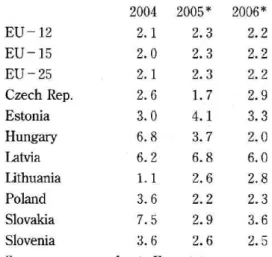
Table 2, 3 and 4 illustrate the progress the CEEs made towards meeting the conditions upon which their accession to the EMU is dependent. As a group they score very well on government debt ratios and the disinflation trend is also well in place. The weakest link is the budget deficit.
The small countries comply with the reference value (these countries are on the fast track of monetary integration) while the three big CEEs have been unable to improve significantly their public finances. Fiscal situation is especially worrisome in Hungary.
Hungary : eurozone' s entry delayed
The one and a half year that passed since Hungary's accession to the EU brought about mixed results. On one side, Hungary's catching-up has progressed well. In 2005, output expanded by more than 4 percent (forecasts thus have been exceeded—Table 1. ) and similarly dynamic growth is expected for 2006. For a few years now Hungary's GDP has grown over twice as fast as the euro area's average. During the last two years the composition of growth has become health-
ier : the economy is fuelled by exports and investments. The inflow of foreign direct investment, a crucial factor in Hungary's development has also accelerated since accession. Inflation has been contained successfully, the rate of which now is rapidly getting closer to the level that fulfils the requirement for the EMU entry (Table 2. ) .
On the negative side, the biggest burden for Hungary is her twin deficit, the huge gap in public finances and in the current account, the financing of which has been accompanied by a growing risk. Ranked on the basis of domestic and external debt Hungary is the worst performer among the new members of the EU (Table 3., 4., 5.) . In the light of Hungary's previous reputation of economic policy successes these negative records come as a surprise.
From the two imbalances it is the deficit of the state budget that constitutes the gravest prob- lem since the deficit of the current account is both directly and indirectly dependent on the state of public finances. Fiscal policy is the main culprit in hindering Hungary's smooth transition to the EMU. The persistence of this weakness has led to financial volatility, credit rating down- grades and to an uncomfortable position in which Hungary repeatedly draws censure from the EU Commission and other international agencies.
34 0 41 2 -- (2006. 3)
Table 1. Real GDP
EU-12 EU -15 EU - 25 Czech Rep.
Estonia Hungary Latvia Lithuania Poland Slovakia Slovenia Source : www.
annual change % 2004
2. 1 2.3 2.4 4.4 7.8 4.6 8.3 7.0 5.3 5.5 4.2 oenb.
2005*
1.3 1.4 1. 5 4.8 8.4 3.7 9. 1 7.0 3.4 5. 1 3.8 at; Eurostat
2006 * 1.9 2.0 2. 1 4.4 7.2 3.9 7.7 6.2 4.3 5.5 4.0
Table 2. Harmonized Consumer annual change %
EU -12 EU -15 EU-25 Czech Rep.
Estonia Hungary Latvia Lithuania Poland Slovakia Slovenia Source : www.
2004 2. 1 2.0 2.1 2.6 3.0 6.8 6.2 1.1 3.6 7.5 3.6
2005*
2.3 2.3 2.3 1.7 4.1 3.7 6.8 2.6 2.2 2.9 2.6 oenb. at ; Eurostat
*forecasts of the European Commission
Price Indices 2006*
2.2 2.2 2.2 2.9 3.3 2.0 6.0 2.8 2.3 3.6 2.5
*forecasts of the European Commission
Table 3. Budget balances % of GDP
EU -12 EU -15 EU - 25 Czech Rep.
Estonia Hungary Latvia Lithuania Poland Slovakia Slovenia Source : www.
2004 -2 .7 -2 .6 -2 .6 -3 .0 1.7 -5 .4 -0 .9 -1 .4 -3 .9 - 3. 1 - 2 . 1 oenb.
2005 * -2 .9 -2 .7 2.7 -3 .2 1. 1 - 6 . 1 -1 .2 -2 .0 -3 .6 - 4.1 -1 .7 Eurostat
2006*
-2 .8 -2 .7 -2 .7 -3 .7 0.6 -6 .7 -1 .5 -1 .8 -3 .6 -3 .0 -1 .9
Table 4. Government Debt Ratios %
EU -12 EU -15 EU - 25 Czech Rep.
Estonia Hungary Latvia Lithuania Poland Slovakia Slovenia Source : www.
2004 70.8 64.3 63.4 36.8 5.5 57.4 14.7 19.6 43.6 42.5 29.8
2005*
71.7 65.1 64. 1 36.2
5.1 57.2 12.8 20.7 46.3 36.7 29.3 oenb. at ; Eurostat
*forecasts of the European Commission
of GDP
2006*
71.7 65.2 64.2 36.6 4.0 58.0 13.0 20.2 47.0 38.2 29.5
*forecasts of the European Commission
Table 5. Current Account Balances %of GDP
EU-12 EU -15 EU-25 Czech Rep.
Estonia Hungary Latvia Lithuania Poland Slovakia Slovenia Source
2004 0.5 0.3 -0 .2 -5 .2 -12 .7 -8 .8 -12 .6 -8 .0 - 4 .2 -3 .4 -2 .0
2005*
0.0 - 0 . 1 -0 .3 -2 .9 -9 .9 -8 .4 -11 .1 -7 .4 -3 .2 -6 .6 -1 .6
2006*
-0 .2 -0 .2 -0 .3 - 2 . 6 -7 .7 -8 .4 -10 .5 - 7 . 1 -3 .5 -6 .2 -1 .8
On the Way to the Eurozone : the Case of Hungary 35 Hungary's fiscal policy lost its credibility due to frequent revisions of deficit targets, govern- ment's shying away from cuts is expenditure and from long overdue reforms. Attempts at window dressing and the deficiencies in calculating the deficits (e. g. expanding off-budget transactions) did not help credibility either. In 2005 the cash-flow based public sector deficit was 4.4 percent of GDP. Measured according to the European Systems of Accounts (ESA 95) methodology this fig- ure is 6.1 percent of GDP which is the double of what would be desirable to get closer to the EMU.
The outlook for the next year is not bright either. In April 2006 general election will take place and because of the fear of losing popularity it is very improbable that the present government would take any radical measure in fiscal retrenchment before that date. This, however, questions seriously the viability of the present official target date of 2010 for the adoption of the euro which would necessitate halving the budget deficit in two years. The measures of fiscal correction envis- aged in the revised version of the Convergence Program of late 2005 do not seem to be enough for meeting the Maastricht benchmark in 2008 when Hungary is supposed to join ERM II , the obligatory preparation period before the full EMU membership. In the view of continued erosion of fiscal discipline analysts now agree that the realistic date for joining the eurozone is sometime in or after 2012
It is not only the further delay of the introduction of the euro or losing the rivalry among the other CEEs which is at stake. Even if our national currency, the forint, stays with us for long into the future, mounting macroeconomic imbalances left untreated would create the risk of hard land- ing, including the unsustainability of external finances, already in the medium run. Prudent fiscal behaviour and launching structural reforms in areas such as public employment, health, educa- tion, pensions to reduce inefficiencies would be the only responsible moves of economic policy.
Admittedly, stringent austerity measures and acting against vested interests take political bravery for the present or the future government. If finally action is taken in the earnest, the prospect of the EMU membership could serve as an external anchor which would enforce financial discipline, thus helping Hungary to overcome the present difficulties. From this point of view, the journey counts as much as the destination.
Budapest, 10th January 2006.
References :
Buiter, W. H. (2004) : To Purgatory and Beyond : When and how should the accession countries from Cen- tral and Eastern Europe come full members of the EMU?
36 1A *1 As rc. 0 41 2 (2006.3)
Paper presented at the Conference on Challenges for Central Banks in an Enlarged EMU, February 20-21, 2004, at the Oesterreichische Nationalbank in Vienna.
CEE Quarterly (2005) VB Investmentbank AG IV. quarter.
EU News, Policy Positions and EU Actors online—www. euractiv. corn.
Frankel, J. A. and Rose, A. K (2000) : Estimating the Effect of Currency Unions on Trade and Output CEPR.
Discussion Paper No. 2631.
Lavrac, V., Zumer, T. (2003) : Exchange Rate Regimes of CEE Countries on the way to The EMU : Nominal Convergence, Real Convergence and Optimum Currency Area Criteria Ezone—plus Working Paper
No. 15.
OECD (2005) Economic Surveys, Hungary.
Schadler, S. (2004) : Charting a Course Toward Successful Euro Adoption. Finance and Development, June, pp. 29-33.