神戸市外国語大学 学術情報リポジトリ
Human capital kuznets curve with subsistence consumption level
著者 Matsuo Mikiu, Tomoda Yasunobu journal or
publication title
Kobe city university of foreign studies working paper series
number 43
page range 1‑8
year 2012‑04
URL http://id.nii.ac.jp/1085/00000483/
Creative Commons : 表示 ‑ 非営利 ‑ 改変禁止 http://creativecommons.org/licenses/by‑nc‑nd/3.0/deed.ja
Kobe City University of Foreign Studies (
43Working Paper Series
Human Capital Kuznets Curve with Subsistence Consumption Level
April 2012
Mikiu Matsuo
Kyushu International University Yasunobu Tomoda
Kobe City University of Foreign Studies
Institute for Foreign Studies
Kobe City University of Foreign Studies
Human Capital Kuznets Curve with Subsistence Consumption Level*
Miki Matsuo t, Yasunobu Tomoda*
Abstract
We examine the human capital Kuznets curve in a simple model that does not assume increasing returns to scale in human capital formation. With a utility function that specifies a subsistence consumption level, consumption is a necessary good and education is a luxury good. As the children of poor households receive a low level of education, the gap in human capital endowments expands between poor and rich households. Eventually, economic development increases income and expenditure for education, and income inequality declines.
Keywords: Human capital, Kuznets curve, Subsistence consumption level, Luxury goods JEL classification: 015
1 Introduction
Recently, several empirical studies have investigated the human capital Kuznets curve, a dynamic relationship in which human capital inequality increases during early phases of economic development and then decreases in later phases of development. The human capital Kuznets curve, as well as the original income Kuznets curve explored by Kuznets (1955), generates an inversed U relationship between human capital inequality and per capita human capital. The empirical evidence, however, is mixed. For example, De Gregorio and Lee (2002) demonstrate an inversed U relationship between education attainment and education dispersion, while Castello and Domenech (2002) find a negative correlation between the education gap and per capita education. One of the
* We thank Colin Davis and Kouichiro Sano. Financial support from Grants-in Aid for Scientific Research (No. 22830063) is also gratefully acknowledged.
t Faculty of Economics, Kyushu International University, 1-6-1, Hirano, Yahatahigashi-ward, Kitakyushu-city, 805-8512, Japan
:/: Corresponding Author; Kobe City University of Foreign Studies, 9-1, Gakuen Higashimachi, Nishi-ku, Kobe, 651-2187, Japan,
E-mail: [email protected]
1
main issues of the empirical literature concerns how to measure the level of human capital. Lim and Tang (2008) suggest that the use of average education as a proxy for human capital is subject to a margin of error, and instead estimate the human capital Kuznets curve by considering the decreasing returns to education in human capital formation.
The theoretical literature exammes the evolution of inequality with the Kuznets hypothesis in overlapping generations models where human capital accumulation is the engine of economic growth.! Galor and Tsiddon (1996) consider a small open economy with both technological development and human capital accumulation. Under the assumption that human capital accumulation has a positive but diminishing impact on improvements in technology, during the early phases of development, output exhibits increasing returns to human capital accumulation, and inequality in human capital rises. Then, in later phases, however, these increasing returns shift to decreasing returns and inequality declines. Glomm and Ravikmar (1998) present a sophisticated model in which increasing returns to scale expand the human capital gap between rich and poor individuals. However, if there is a complimentary relationship between the consumption of the older generation and the leisure of the younger generation, rich young individuals reduce their educational efforts and the speed of human capital accumulation falls; the human capital gap narrows. Although the literature develops convincing explanations, several questions remain: First, are increasing returns necessary for the derivation of the human capital Kuznets curve? Second, do children in rich households spend a shorter time studying?
The purpose of this paper is to develop a simple model that generates the human capital Kuznets curve without assuming increasing returns to education. To this end, we consider a utility function with a subsistence consumption leve1.2 As such, poor households must prioritize consumption for subsistence over their children's education;
they cannot afford to invest in the education of the next generation. Hence, consumption is a necessary good and education is a luxury good. In the early stages of economic development, as only rich households have large education expenditures, human capital inequality increases. In later stages, however, decreasing returns to human capital accumulation reduce inequality. The human capital Kuznets curve is therefore a natural outcome of the development process.
1 As these models assume the consumption good is produced by human capital alone with a linear technology, there is no distinction between human capital and income.
2 The empirical literature includes cross·country studies that investigate developing countries where many households live below the poverty line.
2 The Model
We consider an overlapping generations economy where individuals live for two periods: young and old. Both generations have constant populations and consist of a continuum of agents, each endowed with different levels of human capitaL The human capital of the i th individual in the t th generation is denoted by
h;.
For simplicity, we assume there are two types of individuals, rich and poor, in period zero. Their endowments of human capital are, respectively, h~ and ht, where ht < h~ .All individuals have a subsistence consumption level f., a necessary prerequisite for sustaining life. Moreover, we consider warm glow preferences: parents derive utility from expenditure on the education of their children. Formally, the preferences of individual i born in period t are denoted by
We ignore consumption in the young period. GI+ I and X{+I represent, respectively, consumption in the old period and expenditure on the education of children.
Individual levels of human capital formation are determined by education expenditure. In particular, considering diminishing returns to education, individuals born in period t+ 1 accumulate human capital according to
h;+1
=
A(X;y5, <5 E (0,1), A> O.The economy has a single consumption good, which is produced usmg a linear technology that employs human capital alone. The budget constraint of individual i in generation t is therefore
h1+1 i
=
GI+ I I+
X{+I • IMoreover, we set the following parameter assumption:
~( f3 )1~fJ ~
Assumption 1: Ah5 - - <51- 0 (1-<5) > f..
a+f3
3 Human capital Kuznets curve
Maximizing (1) subject to (3), each individual's consumption and education
3
expenditures are, respectively, derived as follows:
a jJ
c, = - - h , +---c,
a+jJ a+jJ-
x,=~h,-~c.
a+jJ a+jJ-
We define the income elasticity of consumption as e c and the Income elasticity of education expenditure as ex. From (4) and (5), we have e
=
ah, < 1 andc ah, + jJf
ex
= --'
h-
> 1; these conditions imply that consumption IS a necessary good and h, - feducation expenditure is a luxury good.
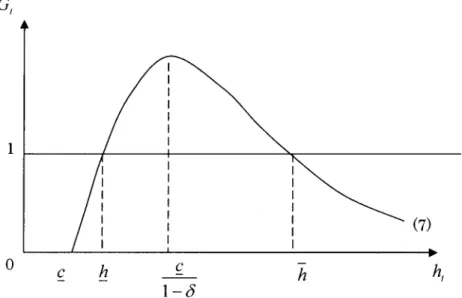
Next, we consider human capital accumulation. Substituting (5) into (2), we have
Under Assumption 1, (6) has two intersections with a 45 degree line in hI and hl+1
- -
space, as illustrated in Figure 1. We define these intersections as hand h (h < h).
We restrict our analysis to the range h < hoP < hor <
~.
We define the gross growth- 1-8
rate of human capital as G,:
As shown in Figure 2, (7) has single maximum point, - - - . The gross growth rate of c 1-8
each dynasty is increasing until human capital reaches - - - . After that, it decreases c 1-8
-
and convergences into h.
Since we consider two types of dynasties, we define the gap of human capital inequality as OJ, ==
K.
From (7), we haveh
,
P(8) Thus, we have the following proposition.
Proposition
This economy exhibits the human capital Kuznets curve.
Proof. In the case of
h.
< hiP < h; < 1~
5' we have Gt <G; ,
thus from (8) OJI < OJI+J IS valid; the inequality in human capital is increasing. From (6), hi is mbnotonic- c
increasing if hi < h. Thus, eventually - - -< ht < hlr holds. Since Gt >
G;
in this1-5
case, from (8), OJI > OJI+J holds; the gap in human capital is narrowing. The average of
1 -
human capital - (ht + h:) increases monotonically, and eventually converges to h.
2
Therefore, this economy exhibits the human capital Kuznets curve. Q.E.D.
4 Conclusion
In the theoretical literature, the human capital Kuznets curve is derived by assuming increasing returns to scale in models that set human capital accumulation as the engine of economic growth. Alternatively, introducing a subsistence consumption level, we show that the Kuznets curve can be derived, without assuming increasing returns, in a simple framework where consumption is a necessary good and education expenditure is a luxury good.
In the early stages of economIC development, poor individuals must prioritize consumption for subsistence over the education of their children. Only rich individuals can adequately educate their children as education is luxury good. Thus, the gap m human capital expands between poor and rich households. As the economy grows, however, education expenditure rises. The marginal productivity of education expenditure diminishes, and the gap in human capital falls. In the early stages of development, the former effect dominates the latter effect. Eventually, however, the relative strengths of these effects reverse, and thus the human capital Kuznets curve is observed.
References
Castello, A. and Domenech, R., 2002. Human capital inequality and economic growth:
Some new evidence. Economic Journal 112, 187-200.
De Gregorio, J. and Lee, J. W., 2002. Education and income inequality: New evidence
5
from cross-country data. Review ofIncome and Wealth 51, 395-416.
Galor, O. and Tsiddon, D., 1996. Income distribution and growth: the Kuznets hypothesis revisited. Economica 63, 103-117.
Glomm, G. and Ravikumar, B., 1998. Increasing returns, human capital, and the Kuznets curve. Journal of Development Economics 55,353-367.
Kuznets, S., 1955. Economic growth and income inequality. American Economic Review 45,1-28.
Lim, A. S. K. and Tang, H. W., 2006. Human capital inequality and the Kuznets curve.
The Developing Economics 46,26-51.
"":l ... 0 _-:::s-crq ~ ~ 0-; CO ,.... 1(") ~ Pl ::::s I-:::S-00 ... rt-... 0
~II(")
::::s 0 ..., ::r ~ 3 Pl ::::s (") Pl '1j ... rt- Pl ... -:::S-I
Figure 2: Gross growth rate of human capital
1
(7)
o
c h c -1-5 h