<MBA Degree Thesis>
AY 2016
E-commerce Environment Analysis in Chinese Market
Based on Case Analysis of Amazon China
35142339-1 LI JIAMIN
MANAGEMENT OF EXPERIENTIAL VALUES
C.E.
P
ROF. YAMAMOTO, HISATOSHI
D.E.
P
ROF. NISHIYAMA, SHIGERU
D.E.P
ROF. MANO, YOSHIKI
Summary
Electronic Commerce (E-commerce) has become an essential part for most of the people and people are now getting used to the new pattern of shopping. Under this background, the whole E-commerce market would be expected to keep growing and expanding, and Chinese market would be one of the largest E-commerce market in terms of transaction volume, number of online shopper and penetration rate. In this case, the US giant Amazon also hopes to expand its business to this new but potential market and it expects that the business there would be just as successful as that in US.
However, the fact is that after entering Chinese market for 10 years, Amazon China still can not beat such local competitors as Taobao, Jingdong and Suning. There must be internal and external reasons to explain it. Starting from the theory of E-business and E-commerce, the thesis firstly tries to clarify the definition of E-business and E-commerce. Although in most cases people could use the two terms interchangeably, technically speaking there are some differences in the two terms. Then the
understand the essence and main features of E-business in China and compare them to that in global market. Secondly the thesis focuses on the analysis of the current E-commerce market in China and global market. Because of the difference of culture, technology, economy, and other factors, the pace of developing E-commerce in different areas would be different, and therefore in China there are some unique features. And in this part the thesis spends some effort to analyze the largest competitor—Taobao, in terms of market shares, online traffic, payment systems and supply chain.
When discussing about the E-commerce market, Taobao is an unavoidable brand and all the E-commerce companies have to come up with some ideas to deal with it. By doing this, the thesis hopes to figure out the features of Chinese E-commerce market and then come up with some ideas for Amazon to gain more market shares in the local market. The third chapter is mainly about the current performance of Amazon China. The customer’s purchasing behaviors would be different in each areas due to different reasons, and by analyzing the online shopping trends for customers on Amazon, the thesis hopes to understand the target customers for Amazon and what is happening on Amazon and therefore it might be possible to forecast what would happen in the future so that Amazon could set strategies accordingly. Also how does Amazon localize its business is also mentioned here, and the thesis hopes to follow the current strategies from the management and come up with something special and innovative. The next part is mainly about the SWOT analysis of the Amazon China and tries to estimate the strengths and weaknesses of Amazon China. The purpose of the thesis is to evaluate the current performance of Amazon in China and try to help it get more profits, so a SWOT analysis would help have a better understanding of the current position of Amazon and check if it is possible and needed for Amazon China to fight in the future. And the last
part mainly introduces the potential strategies that could be applied by Amazon China, such as the cross-border business and fresh-food market. The thesis hopes to conclude the analysis of global and Chinese market, the current performance of Amazon China and the SWOT analysis and then come up with some practical and feasible ideas.
KEY WORDS: Amazon China; E-commerce market; SWOT Analysis; Cross-border Business;
Taobao; Online Shopping; Purchasing Behavior
<Inside Cover>
E-commerce Environment Analysis in Chinese Market
Based on Case Analysis of Amazon China
35142339-1 LI JIAMIN
MANAGEMENT OF EXPERIENTIAL VALUES
C.E.
P
ROF. YAMAMOTO, HISATOSHI
D.E.
P
ROF. NISHIYAMA, SHIGERU
D.E.P
ROF. MANO, YOSHIKI
TABLE OF CONTENTS
1. Introduction...8
2. Review of Current E-commerce Environment...17
2.1 Global E-commerce environment features………18
2.1.1 Matured capitalized market...19
2.1.2 Mobile-oriented Business Era...20
2.1.3 The development of Sharing economy ...21
2.1.4 The emergence of online shopping festivals...23
2.2 Chinese E-commerce environment ...24
2.2.1 The growing E-commerce market scale...26
2.2.2 The spending power of China online shopper...27
2.2.3 Mobile shopping market surpassing the PC client...30
2.2.4 Urban versus rural...32
2.2.5 The Chinese E-business giant: Alibaba ...33
3. Review of the current situation of Amazon China...37
3.1 Online shopping trend on Amazon China ...39
3.1.1 Customers are younger and more well-educated ...39
3.1.2 Online shopping penetration rate is increasing ...40
3.1.3 Desired products are diversified and internationalized...40
3.2 A response to the Chinese market by Amazon...41
3.2.1 Kindle unlimited service...43
3.2.2 ‘Cross-border purchasing’ service ...45
3.2.3 Official flagship store in Taobao ...46
4. SWOT analysis of Amazon China ...47
4.1 Amazon’s strengths in Chinese market ...47
4.1.1 A large capital accumulation ...48
4.1.2 High efficient fulfillment centers...50
4.1.3 Accumulated media resources ...51
4.1.4 Cross-border shopping business preparation ...52
4.2 Amazon’s weaknesses in Chinese market...54
4.2.1 Taobao’s incomparable advantage of online traffic...54
4.2.2 Amazon’s slow localization process...57
4.2.3 Different attitudes to Email marketing promotion ...60
4.3 Amazon’s opportunities in Chinese market...62
4.3.1 the future trend: C2C to B2C...63
4.3.2 Growing Chinese E-book Market ...64
4.3.3 The Last Cake on Chinese Online Market: Fresh Food Market ...68
4.4 Amazon’s threats in Chinese market...74
4.4.1 New taxes policy on cross-border e-commerce retail imports...75
4.4.2 Local competitors and mobile era...79
5.1 ‘Brick and Click’ strategy ...82
5.2 Cross-border business being the main weapon...84
5.3 Cooperation with local competitors...85
6. Conclusion ...87
Reference ...89
TABLE OF FIGURES
Figure 1 IPO E-Business Companies in 2014 (based-on own research)...20
Figure 2 Mobile Share of E-Commerce Transactions...21
Figure 3 The largest Internet companies in 2013 by revenue (wiki) ...22
Figure 4 Cyber Monday Sales Comparison ...24
Figure 5 Quarterly GDP Growth...25
Figure 6 McKinsey Global Institute, China’s e-tail revolution: Online shopping as a catalyst for growth...27
Figure 7 China Online Shopping Users in 2014 ...28
Figure 8 Online Shoppers' Annucal Per Capita Consumption in 2012 (RMB) ...29
Figure 9 China Online Shoppers by Age Group ...29
Figure 10 Mobile Shopping Market vs PC Client...30
Figure 11 Mobile Shopping Transaction Sales and Growth Rate...31
Figure 12 China Online Shopping Users (million) in 2014 ...33
Figure 13 Five Biggest U.S. IPOs...34
Figure 14 China Top B2C Websites Market Share...35
Figure 15 Share of China Online Shopping B2C and C2C Websites 2010-2017...36
Figure 16 Timeline of Amazon...38
Figure 17 Amazon’s Business Segments and Sales Revenue ...42
Figure 18 Books Available on Each Booksellers...44
Figure 19 Price of Selected Acquisitions by Amazon from 1999 to 2014...49
Figure 20 Number of Active Buyers of Alibaba and Amazon...56
Figure 21 Alibaba Chinese Online Retail Market Share...64
Figure 22 Market Share of Overall US Ebook Unit Sales Held by Each Retailer ...65
Figure 23 Chinese Online Fresh Food Market Scale and Forecast ...69
Figure 24 What Types of Channel Would the Customers Like to Choose When They Purchase Fresh Food ...70
Figure 25 Distribution of Education Level of Chinese Customers on the Online Fresh Food Market Percentage...71
Figure 26 Distribution of Revenue of Online Fresh Food Users in China...72
Figure 27 Brand Awareness of Online Fresh Food Company in China...74
Figure 28 Previous version of cross-border tax policy ...76
Figure 29 Current version of cross-border tax policy ...76
Figure 30 Comparison of tax amount on different transaction value...77
Figure 31 Place of Latest Purchase of Consumer Electronics and Electrical Appliances...80
Figure 32 Market Share of China Mobile Shopping Enterprises by GMV Q1 2014-Q1 2015...81
Introduction
Under the background of economic and information globalization, as a new and burgeoning trading pattern, E-commerce has greatly accelerated the exchange of information, goods, capitals and technologies among countries and individuals. Based on the Internet technology, E-commerce pattern mainly contains virtual trade other than cash trade or barter trade and it has greatly affected almost all the industries and changed the world trade pattern. As the E-commerce trading pattern has been widely accepted and developed among the world, transnational transaction is playing an important role in the business world, and in addition to that, E-commerce itself could be a business activity to break through the geographical and time limits. Therefore, E-commerce pattern must be the mainstream to do businesses in the future. Amazon, as the most popular online shopping website in US, would like to expand its business to China, which is commonly regarded as the biggest market for online shopping. However, when it found Amazon China in 2004, it unexpectedly failed to attract the local customers and had been struggling in the market for years. In 2014, the market share of Amazon in China was only 1.8%, whereas it succeeded in dominating the US market and gained a 22% market share. In spite of its own strategy, why did such an online giant fail to enter Chinese market? The paper is going to find out a solution to deal with it. Starting with a literature review of the E-commerce theory, the paper makes it clear that the core value of Amazon is to satisfy the customer and focus on the experiential value. Then, in order to analyze the various factors contributing to the situation, the paper explains the current global market trends, and analyze Chinese market from the perspective of economy, policy, geography, current competition, etc. After
that, the thesis tries to give a brief introduction of the current situation of Amazon China, and it hopes to dig out the strategies behind it. The thesis also presents the strengths and weaknesses of Amazon China, utilizing the SWOT analysis.
Amazon China has been struggling and losing great profits in the local market. Under this circumstance, finding a suitable business mode and coping strategy is imminent.
1. Literature Review
This part provides an overview of previous research on the E-commerce business model and strategy by summarizing the definition of E-commerce and E-business, the historical development of Chinese E-commerce market and whether ‘brick and click’ would be an ideal strategy for E-commerce companies to promote its brand awareness and customer satisfaction.
1.1 E-business and E-commerce
The short but drastic IT revolution has been mentioned too many times in the recent years, and as the process is accelerating, any kind of instruction would be obsolete (Manuel Castells, 2000).
The E-business originated from information system and Internet technology, and as time goes by, the application of information technology and Internet technology was introduced into the business area, and therefore it contributed to the revolution of business activities. At the same time there were an increasing number of research on the theory of E-business. In nature, E-commerce refers to the
use of electronic means and technologies to conduct commerce (sales, purchase, transfer, or exchange of products, services and/or information), including within business, business-to-business, and business-to-consumer interaction. Delivery of product or service may occur over or outside of the Internet (Whinston, Choi, &Stahl, 1997). Currently, regarding E-business and E-commerce, there are four terms of definition (Amir Manzoor, 2010).
1.1.1. In terms of scope
Due to the reasons of language, culture and history, each country has its unique way to use the phrases. ‘E-commerce’ is mainly supported by the government and organization, which ‘E-business’
is often used by companies and firms, and under certain circumstances, ‘E-business’ and
‘E-commerce’ can be used interchangeably (Amir Manzoor, 2010). However, ‘E-business’ has a wider scope as a business activity because it contains not only such operational activities as commercial trade but also some non-commercial activities, such as governmental issues or school education. ‘E-commerce’ means a certain way to use information technology to conduct business trade of service or products while ‘E-business’ refers to an application of information technology to commercialize business process, business system, etc (Whinston, Choi, &Stahl, 1997). It can be concluded into a formula: E-business=E-commerce+ Business Intelligence+ Customer Relationship Management+ Supply Chain Management+ Enterprise Resource Planning (Weill P, Vitale M., 2001).
1.1.2. In terms of contents
E-business is a relatively new business method, and it helps redesign and reconstruct the company business. There are three levels of E-business: E-business in firms, E-business in market and E-business in society (IDC, 2005). Actually the most representative view about E-business and E-commerce comes from IBM. ‘The term E-business contains intranet, extranet and E-commerce and it focuses on the combined application of intranet and extranet. Also, in order to maximize the effect of E-business, ‘3C’ issues have to be deal with. The first ‘C’ is commerce, which means the trade on the Internet. The second ‘C’ means content, which means the information on the Internet.
The last one is collaboration (G Boyce, 2002).
1.1.3. In terms of flow
From the point view of business procedure, E-business refers to an application which caters to the automation of business and workflow (Ravi Kalakota & Andrew B, 1997). Also based on open network, E-business is a method to replace manual work with information to deal with different businesses. In any types of business activities, there must be four business procedures: commerce flow, information flow, material flow and capital flow (Gefen, David, and Detmar W. Straub, 2004).
Commerce flow refers to the transfer of property ownership based on the concept of equal-value exchange. Information flow refers to the communication with the business partner before, during and after the business. Material flow means the movement of products from one place to another. Capital flow means the process of transferring the capital, which includes payment, transfer, etc. Based on this theory, E-commerce is still a part of E-business (Rayport, Jeffrey F.& Bernard J. Jaworski, 2000)
1.1.4. In terms of technology
The business and technology are the keys to understand the theory of E-business.
E-business refers to an electronic way rather than a direct or indirect physical exchange or fact-to-face contact to complete any kind of business trade. The ‘electronic way’ includes Electronic Data Interchange (EDI), electronic payment method, electronic ordering system, electronic mailing, Internet, picture processing, etc(G Boyce, 2002). Also, Internet is the basis of E-business and E-business focuses on the combination of intranet, extranet and Internet and buyers, sellers, banks and other business partners have to work together on the electronic application based on the Internet environment (SONG ling, 2000)
1.2. Historical Development of E-commerce in China
Information Technology has deeply affected people’s way of living, producing, thinking, and managing, and E-commerce and/or E-business has evolved based on the development of Information Technology. Since 1993, E-commerce in China has been through four different periods (ZHENG Shurong, 2005).
1.2.1 1993-1997: Exploration
On the INET annual conference in 1993, Chinese computer specialists called for Internet access for the Chinese public as a whole, which received support from their overseas colleagues (SCIO, 2010). Also in 1994, the Education and Research demonstration net in the Zhongguan area could get access to the Internet. During this period, the E-business developed following the three aspects.
First of all, Internet infrastructure construction. The development of E-business relies on the scale of Internet infrastructure (LI Jing& YI Jianxiang, 2001). During 1997-2009, 4300 billion RMB has been invested on the construction of Internet infrastructure, 99.3% of the villages and towns and 91.5% of the administrative villages could get access to the Internet (Office of the Council of State, 2010). The completion of the construction of Internet infrastructure greatly help the application and development of Internet.
Then, it comes to the theoretical thinking. The International E-business form held in Beijing in 1994 was the first step for ‘E-business’ to enter China. Then the E-business seminar held on October 1994 helped the development of concept of E-business. ISO, Global Information Infrastructure Committee (GIIC), major multinational companies, governments and scholars were coming up with the concept of E-business, and therefore a lot of research results were published. At the same time, Chinese government, research institute, and schools also held seminars, and forms to popularize the E-business knowledge (ZHENG Shurong & LV Qinghua, 2011).
Last of all, the application of theory and knowledge. In 1995 the Chinese Internet was commercialized, and Internet companies were found. In 1996, Chinese international electronic commerce center (CIECC) was found. In 1997, online advertisements were created and used, and Chinese Goods Ordering System (CGOS) started to run at the same year.
The features at this period are: the development of the Internet and E-business relies on the administrative control, and the government would encourage firms and individuals to use the
emphasizes the promotion and application of high-technology; governments at all levels, schools and research institutes take part in the E-business first and then firms could follow (XIANG Xin, 2000).
1.2.2 1998-2001: Prototype
During this period, the Internet was for civil use. In 1998, the China Post invested 7 billion RMB and launched 169 multimedia communication networks and therefore the costs of using Internet decreased dramatically (DENG Shunguo & GUO Fan, 1998). There are three features in this period.
First of all, Internet companies having web portal are found. A web portal is most often one specially designed website that brings information together from diverse sources in a uniform way (Wiki, 2016). Depending on the type of service it serves, it could be divided into search portals, such as corporate portals, cultural portals, stock portals, etc (YU Miao, 2001). In 1999, Sohu opened its news and contents channel and it made the prototype of the portal sites in China. Then, Sina, Wangyi, Yahoo, Tencent were found and entered its market.
Then, it could attract investment quickly and therefore these company could go public. Since the number of Internet users were increasing dramatically, the portal sites provided a new way to operate the business and gain the profits, so venture capitals were quite interested in this new industry (WANG Danping, 2011). The Internet companies followed the development path of traditional companies and a lot of them went public in US market in 2000, and then the NASDAQ reached its peak on March, 2000 (M Ingebretsen, 2002).
In addition to that, some companies experienced the waves of failure. The definition of Network Concept Stock decided that these portal sites were not making a profit, and without the support of the profit, the stock price was essentially a bubble. And when the investors realized the fact, the ‘Internet Bubble’ busted. In 2001 the stock index decreased by 80% and 537 Internet companies went bankruptcy in the global area, and during 2000 and 2001, more than 75% of the E-business –model companies quitted the market in China, and most of them were either acquired or leaving (PAN Honggang & WU Jiyi, 2012).
1.2.3 2002-2009: Growth
After the ‘Internet Bubble’, people started to have a deeper understanding of the Internet, and the E-business moved from the venture capital market to the physical market. Since then, some of the leaders in the industry showed up and they started to make some profits. The quality of E-business technology and platforms was greatly improved and the software and solution was localized. During this period, three main achievements were made.
First of all, broadband network replaced dial-up network. Until December 2009, the number of Internet user in China reached 100 million while the people using dial-up decreased by 3.3 million (DENG Shunguo & GUO Fan, 2011). The broadband network was faster and cheaper, and therefore in the E-business area there were diversified business application.
Secondly, diversified business applications were created. Different from those in the prototype period, companies in this period created more diversified applications, such as online chatting,
searching, online gaming, online advertisement, trip reservation, etc, and such companies as Tencent, Baidu, Shengda became the giants at that time. During this time, third-party platforms were becoming the mainstream and B2B, B2C and C2C were the core business patterns (Boyce, Gordon, 2002).
Thirdly, the ‘E-businessmen’ showed up. In 2004, Jack Ma, the CEO of Taobao, came up with concept of ‘E-businessmen’, who referred to such individuals as firm representatives, businessmen and business operators that use E-business model to do business activities. As the development of this idea, the industry chain was well-arranged and clear. This group showed up in 2003, became mature in 2006, rose in 2007, grew to be ecological in 2008 and social in 2009, and it proved that the trading pattern, trading rules, promotion methods, payment methods and delivery systems were stronger and better than that in traditional businesses (LI Qi, 2012).
1.2.4 2010-2012: Popularization
During 2010 and 2012, the E-business in China developed dramatically, and such applications as mobile Internet, online video, online chatting, online shopping became popular. In this period, three features could be concluded.
First of all, the size of the E-business was vast. It has developed through the period of exploration, prototype and growth, and therefore such factors as transaction volume, number of Internet user, Internet penetration, online shopping, number of website, online payment has reached a certain scale. For example, the transaction volume increased by four times from 2005 to 2012
(CHEN, Hailiang, 2015). Also, B2C online shopping has been popular among the Internet users. In 2012, the number of online shopper reached 242 million and it increased by 32.3% compared to that in 2011 (CAI Yin &XIE Ping, 2013).
Secondly, the E-business applications were upgraded. Large E-business firms developed from using such basic functions as online posting, procurement, online sales to more advanced ones, such online design among firms, manufacturing and planning management. Large firms having E-business systems accounted for more than 50%, mid-sized firms looking for suppliers online accounted for 30% and 24% of the mid and small sized firms would do online promotion campaigns (Office of the Council of State, 2010) because of its low cost, low barrier, diversified forms. Also, the E-business has evolved from a platform provider to a service provider, and a system with comprehensive service, digital certificate, electronic payment, logistic was formed.
Then, the mobile Internet became the new engine to expand the demand. In 2012, the number of user, application and market scale increased dramatically, thanks to the Sina Weibo, Baidu search engine, Taobao online shopping platform and Alipay. It would greatly affect the future online shopping trend and people’s lifestyle (XING Linbo, 2010).
2. Review of Current E-commerce Environment
In 1995, Amazon.com and eBay went online in US, and such retailers as Otto Group and Argos started to engage in E-commerce area in Europe. Since then, the world started to enter E-commerce era. Therefore, researching on the current global E-commerce environment helps to understand what
is happening in the world and forecast what will happen in the near future. Not only Amazon but also other E-commerce companies will be able to get a view of the whole industry and set the strategies accordingly.
Since the thesis aims at the E-commerce market in China, a comprehensive analysis of the China market from different perspectives is important. For example, a better understanding of the current economy helps to analyze people’s spending power, and therefore these companies could better forecast the future growth rate. Or, different policies at different periods may affect the selling strategy and such business as cross-border selling could be available understand certain circumstances. On the other hand, the geography situation has something to do with the logistic part and the company would decide whether to use the local logistic companies or build its own logistic warehouse.
2.1 Global E-commerce environment features
E-commerce market has been popular after the 21stcentury. In 2014, 16 E-commerce companies went public in different stock markets, considering the fact that the capital market was fully aware of the role these companies were playing at the business world. Also, it has been quite obvious that the mobile internet has been widely used by the customers and in the future it could be clear that mobile devices other than the desktops would be the mainstreams in the future and companies have to allocate more capitals to the mobile development. In addition to that, the ‘sharing economy’ might change the traditional consumption patterns and therefore the social resources could be better shared among
citizens. What is more, various types of shopping festivals should be a phenomenon that could not be ignored. For example, Tmall’s ‘single-day festival’ created 91.2 billion RMB on 11st November, 2015, with 68% of the sales contributed by the mobile devices. In this case, a better understanding of the global trends helps to adjust to the E-commerce market and gain more market shares in the competitive market.
2.1.1 Matured capitalized market
In recent years, E-business market has attracted great attention from the capital market and 16 E-business companies went public in 2014, with 6 companies from Europe, 4 companies from US, 4 from China, 1 from India and 1 from Australia(Fig.1). Also, the IPO firms scales up as time goes.
For example, Alibaba and Jingdong became one of the biggest E-business companies since they went public.
In addition, the private equity market was transferring its attention towards O2O and mobile E-business and they became the main targets for venture capitals. More startup companies successfully got support from the venture capital and many companies entered ‘unicorn club’ within the first years of their foundations.
Figure 1 IPO E-Business Companies in 2014 (based-on own research) 2.1.2 Mobile-oriented Business Era
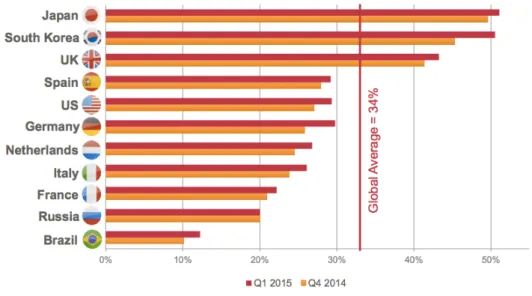
Since the smartphone was sold in 2007, the mobile Internet technology are getting mature and well-developed, and 2014 was a watershed year, with a clear before and after. According to the data from We Are Social (2014), the penetration of individuals using mobile devices reached 50% of the world population in September, 2014. Also, the number of mobile devices getting access to the Internet was 7 billion. On the other hand, Goldman Sachs forecasted that the transactions on mobile devices may account for 27.2% of the total transaction amount in 2014 and the number would reach to 40.5% in 2015. In addition to that, according to the data from Criteo, the transaction volume made by mobile devices in 4thquarter accounted for 30% of the total online retailing ones.
It also can not be ignored that the countries in South Asia areas leaded the trend to use mobile devices and the transactions made by mobile devices accounted for 50% of the total retailing transaction volume in China, Japan and Korea in 2014, and therefore the mobile channel became the
No. Company Business pattern Location
Corporate Value ($
million) Listing location
1 Alibaba Online shopping China 263400 NYSE
2 Jingdong Online shopping China 32800 NASDAQ
3 Zalando AG Fashion E-business Germany 5900 Frankfurt 4 Cnova N.V. Online shopping Netherlands 3200 NASDAQ
5 Grubhub Food ordering US 2900 NYSE
6 Justeat Food ordering UK 2800 London
7 JUMEI Costmetics China 2000 NYSE
8 Truecar Car E-business US 1800 NASDAQ
9 Warfair Furniture E-business US 1600 NYSE
10 Coupon.com Coupon US 1400 NYSE
11 Boohoo.com Fashion E-business UK 700 London
12 Tuniu Online traveling China 600 NASDAQ
13 Bravofly Rumbo Online traveling Switzerland 220 Switzerland 14 Mysale.com Fashion E-business Australia 200 London 15 eDreams Odigeo Online traveling Luxembourg 190 Madrid
16 Koovs Fashion E-business India 60 London
IPO E-BUSINESS COMPANIES IN 2014
mainstream(Fig.2). In the 4thquarter in 2014, the mobile devices contributed 49% and 45% to the total online retailing transaction volume in Japan and Korea respectively. Also it is clear that in the future the mobile-end would play a more important role in the E-business era and someday this method would replace the pc-end to become the most popular one.
Not only Asia areas, but also people from North America and West Europe tried to catch up the trend. Based on the data from Criteo, the mobile devices contributed 41% to the total online retailing turnover in UK and the it contributed more than 20% in Spain, US, Germany, Italy, etc.
Figure 2 Mobile Share of E-Commerce Transactions
(source: http://www.slideshare.net/CriteoReports/criteo-state-of-mobile-commerce-q1-2015) 2.1.3 The development of Sharing economy
The financial crisis in 2008 deeply affected people’s consumption patterns. The old patterns focused on the individual spending and a large proportion of the social resources were wasted.
Under this circumstances, a new economy pattern called ‘sharing economy’ became popular.
model (in between owning and gift giving) which refers to ‘peer-to-peer-based sharing of access to goods and services which is coordinated through community-based online services’ (Wiki, 2015). In this case, ‘what is mine is yours, for a fee’ is the core value of the new pattern. This sharing economy is a new market, a new method of development which promotes the efficiency of social resources.
Car renting application Uber and house renting application Airbnb are the classic representatives of sharing economy, both of which became the most popular application in its own industries. Also, Amazon released its Amazon Website Service recently and it would rent its servers to other companies and provide different kinds of web service. For now, the revenue of AWS enjoys the fastest growth rate and it is expected by Trefis (2016) that in 2016 the AWS would generate $3.5 billion, which accounts for 28% of the total revenue(Fig.3).
Figure 3 The largest Internet companies in 2013 by revenue (wiki) (source: https://en.wikipedia.org/wiki/List_of_largest_Internet_companies)
Generally speaking, the development of sharing economy has a great impact on the traditional economy order in society, and the traditional firms held a negative attitude towards this new economy patterns and claim it is illegal and it would destroy the industries. In addition, the government departments are quite strict with these new companies, such as the tax issue and
operations. So, in order to develop further, firms applying this new sharing economy have to adjust to the policy and try to avoid legal dispute.
2.1.4 The emergence of online shopping festivals
Two online shopping festivals are the symbols of the development of E-business: Cyber Monday in US and ‘sing-day festival’ in China.
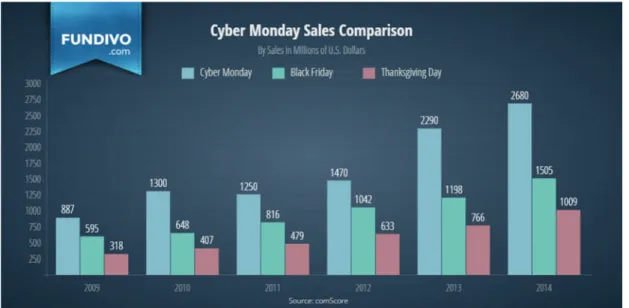
November and December are the Christmas Shopping period, and the sales revenue in this 61 days in 2014 reached $616.9 billion, with the major proportion contributed on Black Friday, Super Saturday, Thanksgiving day, Cyber Monday, Green Monday and Free shipping day. Among them, Super Saturday, Black Friday and Thanksgiving day festivals still focus on traditional shopping, while the the online part contributed 20% of the sales to the total amounts in 2014, according to ShopperTrak (2015).
On the other hand, Cyber Monday, Green Monday and Free shipping day main apply the online-selling patterns. According to comScore, Cyber Monday is the biggest online shopping festival, and the sales amount in 2014 was $2.585 billion. In addition, the sales amount on ‘Black Friday’ and Thanksgiving day was $1.941 billion and $1.37 billion respectively(Fig.4).
The ‘sing-day festival’ is a relatively new shopping festival found by Alibaba, China. Although only people in China would be able to enjoy the huge discounts at that day, no other festivals could beat the ‘single-day festival’ in terms of daily business transaction. As mentioned above, Tmall’s
‘single-day festival’ created 91.2 billion RMB, or 15 billion dollars, on 11st November, 2015. Also, Jingdong, another online retailing giant in China, created more than 20 million orders in a single day,
and the mobile-end devices contributed more than 70% to the total sales. During the festival, almost all the commercial products sold on Taobao would have a 50% discount an in most cases the customers do not have to pay for the shipping fees, and all the Chinese customers just can not deny that.
However, compared with Taobao or Jingdong, Amazon China does not really put much effort to the
‘sing-day festival’, or at least the customers could not get a big discount on that day. On the contrary, Amazon China opens its cross-broader shopping business.
Figure 4 Cyber Monday Sales Comparison
(source: http://knowyourmeme.com/photos/1048038-cyber-monday)
2.2 Chinese E-commerce environment
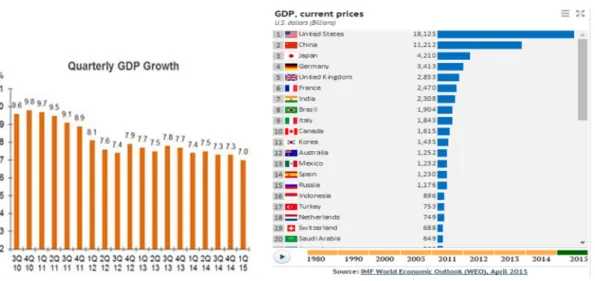
Generally speaking, Chinese E-commerce market became a non-negligible part for all the investors and competitors in the world. Resulting from the high economic growth and government’s encouragement policies, the E-commerce pattern has contributed greater to the retailing industries in China. According to the research report from Macquarie Research (2014), the total retail E-commerce sales in China reached $194 billion, $15 billion lower than that in US in 2012.
However, since 2013, the retail E-commerce sales in China enjoyed a greater growth and the amount reached $265 billion, which was higher than $230 billion sales in US. What is more, the sales gap between China and US will be bigger and Chinese E-business market will still enjoy a 30% annual growth in the near future(Fig.5).
Figure 5 Quarterly GDP Growth (source:
http://defenceforumindia.com/forum/threads/imf-world-economic-outlook-weo-april-2014-released.5990 1/)
In addition, the distribution of online spending by China online shoppers could be another issue.
Considering the large base of population and the growing GDP, the spending power of the online shopper will be stronger in the future. Geographically speaking, which cities contribute most to the online retailing sales? What kinds of products do they prefer? These issues should also be taken into consideration when a retailing company sets strategies regarding logistic and location issues, especially for a foreign company. Also, should a company focus on the mobile end or the pc end?
How to defeat a local competitor? If the questions could be solved, the company may be on the way to success.
Lastly, when talking about Chinese E-business market, Taobao is a brand name that could not be ignored. Any new comer who wants to enter Chinese market has to think about how to ‘steal’
some market shares from Taobao. Since this thesis aims at entering Chinese market and it mainly talks about Amazon, it mainly analyzes Taobao’s weaknesses and hopes to find some opportunities for the outsiders.
2.2.1 The growing E-commerce market scale
Chinese E-commerce market started booming since 2010. Thanks to Jack Ma and his Taobao, Chinese began to change the traditional purchasing habit and they started to enjoy the experience and huge discounts provided by this magical online shopping website. In 2011, the Chinese online retailing market firstly exceeded Japan and therefore it became the second largest market in the world. Since then, the America realized the Chinese market could not be ignored and they started to feel the threat, and that explained why such firms as Walmart, eBay and Amazon strongly desired to enter Chinese market. On the other hand, the growth rate of the Chinese online retail market is quite impressive. According toChina’s e-retail revolution: Online shopping as a catalyst for growthby McKinsey Global Institute, the compound average growth rate (CAGR) of Chinese online retail market was 120% from 2003 to 2011, while the CAGR in US was only 17% and that in Japan was 27%(Fig.6). Therefore, it could be easily judged that the potential of Chinese market is huge and dominating the local market would bring a great amount of sales revenue.
Figure 6 McKinsey Global Institute, China’s e-tail revolution: Online shopping as a catalyst for growth (source:
http://www.amcham-shanghai.org/NR/rdonlyres/8D451012-FF51-4F2F-BCB9-D7FED8866423/21419/F rankLavinExportNowMarch2014.pdf)
Domestically speaking, China online retail sales contributes greater to the total retail sales since 2014. According to eMarketer (2015), the E-commerce sales was 7.9% of total retail sales in 2015, while it was only around 6% in US. Also, it is expected that the number would increase from 7.9%
to 10.9% in 2016, and the percentage would double that in 2015 and therefore 24% of the total retail sales would come from online retailing area. Regarding the E-commerce sales amount, in 2015 the total sales amount reached 333.39 billion dollars and it will increase to 505.74 billion in 2016 and 1410 billion in 2019.
2.2.2 The spending power of China online shopper
As the whole economic situation in China is getting clearer and better, the number of online shopping user in China has been increasing dramatically, and the spending power of the China
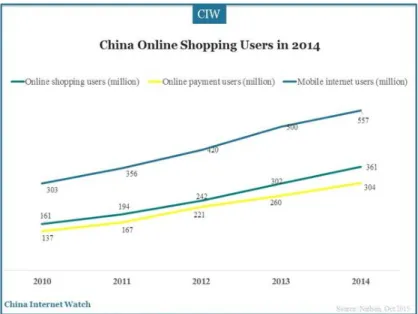
On one hand, the number of online shopping user is increasing. Based on the data from Nielson (2015), the number of online shopping user in 2010 was 303 million and it increased by 15% in 2011 and then the number increased from 500 million in 2013 to 557 million in 2014, and the number will be expected to keep increasing in the future, considering that people in relatively poor areas would be able to use Internet more frequently and that the logistic companies could get more access to these areas. It should also be noticed that the number of mobile Internet user is increasing faster than the users using desktop ones. In 2010, about 50% of the online shopping users would choose to use mobile devices for shopping, while in 2014, 70% of the online shopping users would use mobile Internet(Fig.7). That is another point worth researching.
Figure 7 China Online Shopping Users in 2014
(source:http://www.chinainternetwatch.com/15361/online-shopper-insight-2015/)
On the other hand, the Chinese online shoppers’ per capita consumption is getting higher than before. According to 2012 Online Shopping Market in China Research Report by CNNIC, the shoppers’ per capita consumption was RMB 5023, or $850, with an annual growth rate of 25%, and
22.6% of the users would spend RMB 2,001-5,000, and users spending over RMB 5,000 accounts for around 17% of the total users(Fig.8).
Figure 8 Online Shoppers' Annucal Per Capita Consumption in 2012 (RMB) (source: CNNIC, 2012 Online Shopping Market in China Research Report”, March 2013)
In terms of age group, people aging between 25 and 44 are responsible for 60% of the total online retail sales amount while people aging over 45 contribute less to the total sales(Fig.9). One of the most serious social problems in China is the aging society phenomenon, and since the average age of Chinese citizens is getting older and the average revenue is increasing, it could be forecasted that the there is still some room foronline shoppers’ per capita consumption.
Figure 9 China Online Shoppers by Age Group
(source:http://www.chinainternetwatch.com/15361/online-shopper-insight-2015/)
2.2.3 Mobile shopping market surpassing the PC client
In correspondence with the global trend, Chinese online shoppers prefer mobile devices when they go shopping online. In Japan, the mobile shares of E-commerce transaction exceeded the pc client in Q1, 2015, and the online shoppers in China tried to keep up with the trends and developments and the mobile shares increased from 47.6% to 50.8% in Q2, 2015(Fig.10). Also, the mobile shares will be expected to keep growing, considering the fact the mobile phone penetration rate in the rural areas is increasing. In addition, the promotion of Alipay brings convenience to the customers and it greatly helps the sales in Taobao. When the online shopper hopes to buy something on its website, all he or she has to do is to take out the phone and click the ‘purchase’ button on the screen. In this case, the whole purchasing process will take less than one minute, which improves the customer experience.
Figure 10 Mobile Shopping Market vs PC Client
(source: http://www.chinainternetwatch.com/16540/mobile-online-shopping-q3-2015/)
Some analysts might argue that even if the online shoppers are transferring to use mobile devices, will they spend the amount of money they would do via PC client? Are they afraid of the security issue? The fact is that, the number of mobile shopper increases dramatically, and the amount of money they spend via mobile phone increases too.
As mentioned above, 2014 was a watershed year. According to the report made by iResearch on December 2015, the transaction value of mobile online shopping market in Q1 2014 was 13.51 billion yuan in China, and amazingly the amount almost doubled in Q3, 2014 and it reached 38.02 billion yuan in Q4, 2014. What’s more, in 2015 the amount kept increasing and in Q3 2015 it reached 52 billion yuan(Fig.11). The growth rate kept at a 30% standard in two years, which was unpredictable for the outside investors.
Figure 11 Mobile Shopping Transaction Sales and Growth Rate
(source:http://www.chinainternetwatch.com/15361/online-shopper-insight-2015/)
2.2.4 Urban versus rural
It is reasonable that people in urban areas would spend more than people living in rural areas, considering that the income gap between the two areas could be huge. Top 10 provinces with the highest average online shopping spends on Taobao areShanghai, Zhejiang, Jiangsu, Fujian, Guangdong, Xinjiang, Sichuan, Tianjin,Beijingand Liaoning according to Taobao based on data from October 2014 to September 2015. Provinces with the lowest average spends are Gansu, Qinghai and Tibet. (2016)
Among them, Jiangsu, Zhejiang and Shanghai in total account for 15% national delivery packages on Double 11 shopping festival (or single-day festival) in 2015. The reason behind this situation was that in most cases, online shoppers living in these areas don't have to pay for the shipping fee and the sellers will cover the expense. It looks like a promotion method, but it seems to be a tradition and or a rule on Taobao. Also, these provinces could be called the most advanced provinces in China, with the most GDP contribution.
However, recently the biggest online shopping companies are trying to transfer its business focus from urban areas to rural areas. Accordingly, the logistic companies are setting the warehouses in the west areas in China, hoping the orders from these areas would increase. Actually, the traditional commerce in some north-west areas was not as developed as east areas, so people living there would rely heavily on the online channel for buying daily supplies. In 2013, the number of online shopping users in rural areas was around 45 million while it increased to 60 million in 2014 (Fig.12), and the number is expected to increase to 85 million in 2016. Since the demand for the
online shopping channel is huge in rural areas, such companies as Amazon could consider to move its business focus to the areas.
Figure 12 China Online Shopping Users (million) in 2014
(source:http://www.chinainternetwatch.com/15361/online-shopper-insight-2015/) 2.2.5 The Chinese E-business giant: Alibaba
Taobao is an E-business platform created by Alibaba group in 2003, and Alibaba went public in 2014, with a $68 per share initial price. Its success in Chinese market and future strategy in internationalization helped it attract many foreign investors and they really held a positive attitude towards Alibaba’s future performance in the global market. As a result, the price per share increased by 38.07% on the first transaction day and therefore the price per share became $93.89. This IPO helped Alibaba gain more than $21 billion capitals, which became the biggest IPO case in US (Fig.13).
Figure 13 Five Biggest U.S. IPOs
(source: http://www.hotstockmarket.com/t/279404/baba-alibaba/20)
Considering the fact that the Chinese E-business market will surpass $1trillion in the near future, Alibaba’s 57% market share in the current market would help bring in a huge amount of capitals, which helps Alibaba invest more on different business areas and improve its growths. Unlike Amazon, Taobao mainly serves as a platform for dealers and buyers, and it does not sell goods under its brand, while Amazon itself owns the products and services under Amazon’s brand, such as Kindle and Amazon Website Service (AWS). However, as one of the oldest E-business platform, Taobao succeeded in dominating the local market by providing cheaper price, diversified categories, and localized website design. Taobao’s business mainly relies on customer to customer (C2C) area and it accounted for 95% in the C2C market (2015) while its business to customer area (B2C) accounted for only 58% in the B2C market(Fig.14). Because of its dominating position in the local market, outsiders would find it quite difficult to compete with Taobao.
Figure 14 China Top B2C Websites Market Share (source: http://www.chinainternetwatch.com/8021/b2c-q2-2014/)
However, Taobao is not really unbeatable. Chinese analysts and customers have been discussing about one problem for a long time: counterfeit products.In 2015, Alibaba had gotten criticism from China’s regulatory authority SAIC (State Administration for Industry and Commerce) for not doing enough to curtail illegal activities on its Taobao marketplace, and customers have been worrying about buying counterfeit products from the sellers online. Since the platform mainly provides C2C business service, and there are around 7 million sellers on the platform now, it is really difficult for Taobao to manage all the sellers and clear all the counterfeit. In this case, it is easy for Taobao to get involved into lawsuit issues regarding counterfeiting or trademark. If this situation keeps going in the future, the customers may not trust the shopping website anymore and Taobao would probably encounter with more lawsuits and therefore this company has to put much effort and money to deal with it.
In additionto that, it should be noticed that the Chinese E-business market has a trend to focus more on B2C market rather than C2C market. In 2010, C2C part accounted for 86.3% of the total
online shopping area while B2C part accounted for only 13.7%. Since then, the share of C2C part has been decreasing and in 2017 it would be expected to decrease to 47.3% in 2017. On the other hand, regarding the B2C market, the share will be expected to increase to 52.7%, which means that B2C market would probably surpass C2C and therefore it would become the main business segment in the market(Fig.15). However, it may not be a good news for Taobao. Since it mainly focuses on C2C segment, B2C segment might be a weakness for Taobao and transferring from C2C to B2C can be costly and low-efficient. As a result, the total market share of Taobao in Chinese E-business market could drop dramatically in the future due to its ‘C2C burden’ and there might be some opportunities for other E-business companies to gain more shares by following this trend and moving faster.
Figure 15 Share of China Online Shopping B2C and C2C Websites 2010-2017 (source: http://www2.alizila.com/chinas-b2c-market-grew-65-percent-2013-charts)
3. Review of the current situation of Amazon China
Starting as an online book seller in 1994, Amazon has been through ups and downs in US and finally it became one of the most famous online shopping website in the world. Generally speaking, Amazon is well-known as a book seller. However, recently it prefers to call itself a ‘technology company’, because Jeff Bezos, the founder and CEO of Amazon.com, insists that the core values of Amazon are ‘customer satisfaction’ and ‘innovation’, and therefore he keeps seeking more opportunities to satisfy its customers and selling books alone could not meet the requirements. As a result, in 2007 Amazon launched its Amazon Website Service (AWS), which provides such services as servers-renting, consulting, etc. In addition, Amazon started to sell its own electronical devices in 2007, and the sales of Kindle and fire phone take up a large proportion of the whole sales revenue.
Because of the constant effort by the whole company, the market capitalization increases to $150 billion in 2014.(Fig.16)
In order to expand its business border and globalize its brand, Amazon acquired Joyo.com, who used to be the main online book dealer in China, with the investment of $75 million in 2004.
However, although Amazon hoped to make up for the losses in global market by making more profits in Chinese market, as an outsider, it actually failed to ‘steal’ the market shares from such competitors as Taobao and Jingdong, and the market share has been below 2% for a few years. Since Amazon’s financial statement only reveals the sales of international segment rather than Chinese ones, the thesis assumes the transaction volume to be 30 trillion RMB and the market share of Amazon to be 0.9% based on the report by IResearch (2015), and therefore the sales of Amazon
China are expected to be $4.5 billion and it may account for 10% of the international sales. In this case, considering the huge transaction volume in Chinese market, if Amazon China could succeed in increase its market shares to around 5%, it might greatly contribute to the international sales and more profits could be earned.
Figure 16 Timeline of Amazon (source:
http://www.economist.com/news/briefing/21604559-20-amazon-bulking-up-it-notyetslowing-down-relen tlesscom)
3.1 Online shopping trend on Amazon China
Amazon China will release the online shopping trends every year so that it could follow the trends and set strategies. In general, it concluded the trends from the perspective of aging, geography, product category, and shopping time. Since the E-commerce still takes up the largest part of the revenue, focusing on the shopping trend could be essential. And in the next chapter, the thesis will try to find the opportunities to gain more profits in Chinese market, based on the current shopping trend in China.
3.1.1 Customers are younger and more well-educated
As mentioned above, the number of customer aging below 35 accounts for 65% of the total ones in Chinese E-business market, while on Amazon, the number of customers aging below 35 accounts for more than 80% of the total ones, and customers aging below 25% takes up 35%. In addition, in terms of education level, people holding bachelor degree or above takes up more than 90% of the total ones. The situation is quite unique and special, because it means that well-educated customers are willing to shop on Amazon. Although it is hard to collect the relevant data of Taobao due to the large base, it still can be concluded that Amazon could be really attractive to well-educated people. The situation might be explained by the fact that Amazon is famous for selling such products as book, game, video and other digital goods, which are more favored by well-educated people.
3.1.2 Online shopping penetration rate is increasing
Although such first-tier cities as Beijing, Shanghai, Guangzhou and Shenzhen contribute greatly to the total sales in China, the sales from second-tier and third tier cities contribute even greater and the sales account for 65% of the total amount. In addition, the fastest growing comes from Nanjing, Suzhou, Jinan, Hefei and Kunming, and north area contributes more than south area does.
As mentioned above, the biggest online shopping companies are trying to transfer its business focus from urban areas to rural areas. Therefore, it could be expected that the third-tier cities or even fourth-tier cities would be business focuses for Amazon.
3.1.3 Desired products are diversified and internationalized
According to the White Paper by Amazon (2016), imported products become the customers’
new favorites. For example, the sales of imported wine have increased by 6 times in 2015 compared to that in 2014, and the sales of fresh food have increased by 5.5 times. Among the ‘top 100 favorite food’ list, the number of imported food accounts for 47%, and 70% of the ‘top 100 fresh food’ come from oversea areas. What’s more, regarding the wine part, more than 60 types come from countries other than China.
In addition, ‘the eight best-selling categories on Amazon China in 2014 were alcoholic beverages, Kindle and accessories, musical instruments, pet products, foods, sports & outdoors and shoes as well as personal care. Five out of eight categories are new on the list’, said by RetailAnalysis (2015).
Compared to the same products sold on Taobao, the price of the products sold on Amazon are higher and the customers have to pay for the shipping fee. However, the customers seem to prefer Amazon when they want to buy these categories, and maybe it could be explained by the fact that Amazon is an international brand and it could be trusted when it comes to imported goods. Amazon has overseen this situation and it starts the business so that customers could be able to buy products from overseas websites.
3.1.4 Mobile shopping are becoming the mainstream
It could be predictable that customers start to use mobile device to go shopping online. Also, it should be noticed that the peak shopping time are from 11am to 1pm and from 8pm and 11pm, and the sales during these periods account for 40% of the total sales. It is an interesting finding because from the data it could be found that customers start to go shopping in leisure time. In addition, the traffic coming from new social media increases by 35% and the sales amount increases by 81%.
3.2 A response to the Chinese market by Amazon
It has been more than a decade since Amazon entered Chinese market. During this period, Amazon has done much efforts to attract the local customers. However, after the ‘honeymoon period’, Amazon started to struggle and tried to survive under the pressure from local competitors like Taobao and Jingdong. Generally speaking, the localization process has been slow from the very beginning due to the conservative management style, but after 2010, when everyone realized how
big the Chinese E-business market could be, every company hoped to adjust itself to the local market, and so was Amazon.
For Amazon, a company started as an online book seller, it relies on its media (books, dvds, and music) for making revenue(Fig.17). And as time goes by, when Amazon has developed itself to a certain level, third party sellers start to sell their products on Amazon, and the electronics and general merchandise take up the largest proportion in the total sales. In 2015, the net income of this part accounted for more than 70% of the total incomes, and the Amazon Website Service owned the largest margin. In order to give a brief introduction of Amazon’s strategies, some examples will be referred and analyzed.
Figure 17 Amazon’s Business Segments and Sales Revenue
(source:http://www.trefis.com/stock/amzn/model/trefis?easyAccessToken=PROVIDER_c0f66335235682 7f87091d2164ed90f2cc253a52&from=widget:forecast)
3.2.1 Kindle unlimited service
In order to boost its media sales in China, Amazon started to open a new subscription service that offers all-you-can-read books for 12 yuan per month in 2016. For now, more than 40,000 Chinese books and 3,500 foreign books are available for the readers, and the number is expected to increase in the near future.
Kindle is a digital book reader found by Amazon and it has been put on Chinese market in 2013, and the e-book shop store was opened at the end of 2012. Since then, the number of readers who are willing to pay for contents has increased by 37 times by the end of 2015. Actually Chinese book industry has been strongly damaged by the pirated book and copyright issues, and most customers are not willing to pay for the books they want to read. Under this circumstance, Amazon released its digital book reader at a relatively low price and hoped to change the traditional thought. Compared with other book reader at that time, the price of Kindle was quite cheap and Amazon did not expect to make a profit from the very beginning. On the contrary, Amazon hoped to make some profits from the digital books it sold on its online store, which accounted for around 17% of the total profits.
However, will this unlimited service be effective in China? Since this service is relatively new in China, it might be better to research the result in US market. Josh Centers (2014) once did a research on how many books are available for the service subscribers, and tried to compare it to Oyster, Scribd and the overdrive at private library(Fig.18).
Figure 18 Books Available on Each Booksellers (http://tidbits.com/static/html/TidBITS-1234.html)
30 books with different ages and themes are listed for researching. Judging from the result, it is clear to find out that 6 out of the 30 books are available if the subscriber uses kindle unlimited service, while 7 books could be found by using Oyster and 8 are available by using Scribd. In addition, from the financial perspective, the value of all the books found on kindle unlimited would be $51.48, while that found on Oyster is $40.54 and that found on Scribd is $56.53. In conclusion, considering that the subscription fee is $9.99 per month, if one thinks he or she could finish reading more than 5 books within a month, it worth the money. On the other hand, if only 3 or less books could be finished within a month, it does not worth it.
The situation could be similar in Chinese market. Since it is a new service and currently the number of books available is limited, plus that Chinese customers are quite cautious and conservative when it comes to pay for reading, it might take some time for the new business to attract more customers and make an influence in the local market.
3.2.2 ‘Cross-border purchasing’ service
For Chinese customers, Amazon has been seen as an outsider and therefore products from the outside area could be quite attractive. Before Amazon starts the business, customers have to look for overseas purchasing agents on Taobao if they want some foreign brands, but on the other hand they also worry about the quality and cost of the product.
After the Free Trading Area (FTA) has been built up by the Chinese government in Shanghai, Amazon China decided to open its cross-border purchasing business so that customers could directly purchase the products sold on its US websites and Amazon would be responsible for the logistic part.
In order to ensure the efficiency and quality of the business strategy, on one hand Amazon would firstly ship the goods from US market and then store its products into the warehouse in FTA and when the customers make the orders, Amazon would send them to the customers by the domestic logistic system. On the other hand, local customers would be able to check the US Amazon website and make orders from it. After that, Amazon would be responsible for shipping the goods from overseas and sending the products to the customers.
According to 100ec.com (2014), the transaction volume of Chinese ‘cross-border purchasing’
market will be expected to grow to 1 trillion RMB in 2018 and 35.6 million customers will be involved into this new business segment. In this case, a lot of local E-business companies are trying to expand their business to this area. For example, Alibaba released its ‘Tianmao International’
website, which mainly aimed at oversea products, Jingdong also opened its oversea purchasing channel, and Suning started its global purchasing activity recently. However, almost all of these Chinese website purchase the products from the wholesalers or local distributors, while Amazon’s products come from the oversea plants or are bought at the original place. As a result, the quality of the products could be guaranteed and the brand might be trusted, and the deliver days would be shortened to 6 to 8 days, which is beyond customers’ expectation.
However, on the other hand, whether Amazon could succeed in integrating its resources in Chinese market and US market remains doubtful.
3.2.3 Official flagship store in Taobao
In 2015, Amazon opened the official flagship store on Taobao, and the store mainly sold food, shoes toys, etc. For the outsiders, they might feel quite surprised and could not understand why Amazon would be willing to open its store on its competitor’s website. However, from Amazon’s perspective, it should be understandable.
For Amazon, the international section accounted for 48% of the total revenue in 2009, while it dropped to 38% in 2014, and it means that Amazon is losing this competitiveness on international
market. What is more, Amazon has been doing poorly in Chinese market and the market shares have been remaining at around 2%. In this case, for Amazon, whose first goal is to keep its footing rather than making the most profits, traffic would be essential. In this case, choosing Taobao, whose market shares are more than 50% in the local market, would be an efficient and effective way to increase the traffic and attract more customers to use Amazon’s service. Also, it also helps localize its brand in China.
4. SWOT analysis of Amazon China
In the last few parts, the thesis aims at analyzing the characteristics of global and Chinese E-business market, hoping to find out the future trends of the E-business market. Some characteristics in Chinese E-business market are quite clear and easy to follow, while whether Amazon, the global E-business giant, is really ready to fight in this competitive market remains a question. That is to say, is Amazon really eligible for taking a piece this ‘big cake’?
To answer this question, the thesis tries to adopt the SWOT (strength, weakness, opportunity and threat) analysis to evaluate the current Amazon China and hopes to give some feasible solutions to deal with the current dilemma in Chinese market.
4.1 Amazon’s strengths in Chinese market
As an outsider who is the industry leader in US market, Amazon has gain this advantages in recent decades by its great innovation and customer-focus strategy. For example, Amazon is holding huge amounts of capitals and therefore Amazon is able to invest in different areas to expand its
business border. Also, in order to ensure the efficiency and accuracy of its business, Amazon has its self-support logistics and it invests a huge amount of money to build the logistic system which includes the warehouse and the automatic logistic machine, etc. What’s more, as mentioned above, Amazon started its business as an online book seller and the media segment is still taking up about 20% of the total revenue. In the recently 20 years, Amazon has successfully made it a trustworthy book dealer and it has become the first choice when the customers are trying to buy the books online.
Lastly, Amazon takes advantages of its global resources and it provides cross-border business which greatly attracts the local customers, and Chinese customers could be able to not only buy the goods from overseas but also open their own shops on the global Amazon websites so that they could sell their own goods to the global market. From that, Amazon could increase its brand reputation and sales revenue.
When Amazon entered Chinese market, these strengths should also be utilized to maximize its market share in the local market, but these features are not fully realized and utilized for now.
4.1.1 A large capital accumulation
Since Amazon went public on 15thMay 1997 with an initial stock price of $18 per share, it has gained great capitals from the market. Also, Jeff Bezos, the CEO of Amazon, kept in mind that the core value of this company was to satisfy its customers with innovation and thoughtful services.
Therefore, in order to maintain its competitiveness and expand its business border, Amazon spent most of its revenue investing on different industries(Fig.19). According to its financial statement in
expense was only $596 million. That is to say, the profit rate was nearly 0. In this case, it is pretty clear that Amazon is willing to pay for maintaining its business and explore different areas.
Figure 19 Price of Selected Acquisitions by Amazon from 1999 to 2014 (Data collected from the Internet)
Amazon has successfully entered different markets by acquiring several companies in US, and it has turned from a single book seller to a comprehensive Internet company. So, if Amazon really want to take a place on Chinese market, acquiring some competitive Chinese companies could be an option. By doing so, Amazon could get strong local human resource, which is very rare and hard to recruit in local market. Also, local channels and other resources become possible.
Interestingly, in 2014, Amazon invested $20 million to Yummy 77, a fresh food seller in Shanghai. The purpose is pretty clear, and Amazon is aiming at Chinese fresh food market. This is an example to show the strength of Amazon. That is, if Amazon is willing to invest and increase its market share in China, it could afford to do it.
Company name Year Price ($million)
Zappos 2009 1200
Twitch 2014 970
KIVA Systems 2012 775
Quidsi 2010 545
Lovefilm 2011 312
Audible 2008 300
Alexa 1999 250
Goodreads 2013 150
Woot! 2010 110
Price of selected acquisitions by Amazon from 1999 to 2014
4.1.2 High efficient fulfillment centers
To ensure fast and accurate delivery, Amazon adopted its fulfillment network strategy.
Therefore, a large proportion of the expenses come from different size and style of fulfillment centers. As of March, 2016, Amazon has been operating 154 different distribution infrastructure, which include 72 fulfillment centers and redistribution centers, 23 sortation centers, 59 prime now hubs and fresh delivery stations, and the total active square feet is more than 66,322,900. As a result, the total sales revenue of EGM (Electronics and General Merchandise), which are mostly distributed by Amazon logistic system, will be expected to be $58.9 billion and account for more than 50% of the total revenue, and the fulfillment centers must contribute greatly to it.
Also, by adopting the FBA (Fulfillment By Amazon) service, Amazon could be able to partly offset its operating expanse because the third party has to pay for the permission fee. To be specific, when the third party ships and stores its products at Amazon fulfillment center, they would be classified into different categories and stored safely. Then, if some customer buys the product on Amazon, the fulfillment center would be responsible for packing and shipping, and then the third party shipping company would take charge of the rest shipping job. In this case, when Amazon gets the permission fee from the third party seller, the strategy itself is helping Amazon gain some extra profits.
So, the same logistic model could be applied in Chinese market. If Amazon’s logistic system could cover most of areas in China and run smoothly and efficiently, it would be able to expand its