学 位 論 文 題 名
博士(理学) 于
雪 芳
Theoretical Studies on theMechanism of Excited‑State
Proton Transfer in Hydrogen‑Bonded Dimers and Complex
(水 素 結 合二 量 体お よ び 水素 結 合複 合 体 における 励 起 プロ ト ン 移動 に 関す る 理 論的 研究)
学位論文内容の要旨
Excited‑state proton transfer plays significant roles in physics, chemistry, and biology [1]. In this thesis,I focus on mechanism of excited‑state proton transfer in hydrogen‑bonded dimers and complexes by applying modem quantum chemical approaches. In Chapter l, the current status of experimental and theoretical studies for excited‑state proton transfer is presented as general introduction. Through the present work, I choose 7‑azaindole (7AI) as a target molecule, which contains both proton donor and proton acceptor parts, so that excited‑state proton transfer can take place via self‑associated hydrogen‑bonded dimers and via solvent bridge relay. Excited‑state double proton transfer (ESDPT) in 7AI dimer has received particular attentions, because this process can be taken as a model of the photoinduced mutation in DNA base pairs [2‑4]. For 7AI dimer, one major question has been put forward through the intensive studies: Does the ESDPT follow a concerted mechanism or a stepwise mechanism? Figure l shows schematic pictures of the mechanisms of the ESDPT in 7AI dimer from the normal dimer (ND) to the tautomer dimer (TD). In the concerted mechanism, two protons are simultaneously transferred through a single transition state, without forming any intermediate for single‑proton‑transferred (SPT) component, while, in the stepwise mechanisW an intermediate is formed by the first SPT from ND, followed by the second SPT to TD. This intermediate can have either a zwitterionic character or a neutral character. As to mechanism of the ESDPT in 7AI dimer, there is still controversy in both experiments and theoretical calculations. In Chapter 2, my theoretical calculations on the ESDPT in 7AI dimer (homodimer) and (3‑methyl‑7AI)‑7AI complex (heterodimer) are reported and the mechanism is discussed. In this study I employ the better methodology in both ab initio and density functional theory (DFT) calculations than the previous ones; the long‑range corrected time‑dependent DFT (LC‑TDDFT) and ab initio multireference 2nd‑order perturbation theory (CASPT2) methods are used to get the reliable energy profiles of the ESDPT process along the reaction pathways for the respective dimers. The calculated potential energy profiles clearly indicate that the
瓢ヨ露 tH7 / SPT
め め め `
Normal dimcr Tautomer dimer ND (ND) (TD)
(
a
) Concerted mechanism (b) Stepwisc mechanI珊Fig. 1. Concerted mechanism vs. stepwise mechanism for ESDPT in 7AI dimer
―
129
―ESDPT reactions in both dimers take place in the locally excited state following the concerted mechanism, in which each proton‑transfer process occurs simultaneously without forming any stable zwitterionic intermediate. The concerted ESDPT reactions are found to proceed asynchronously in Cs symmetry.
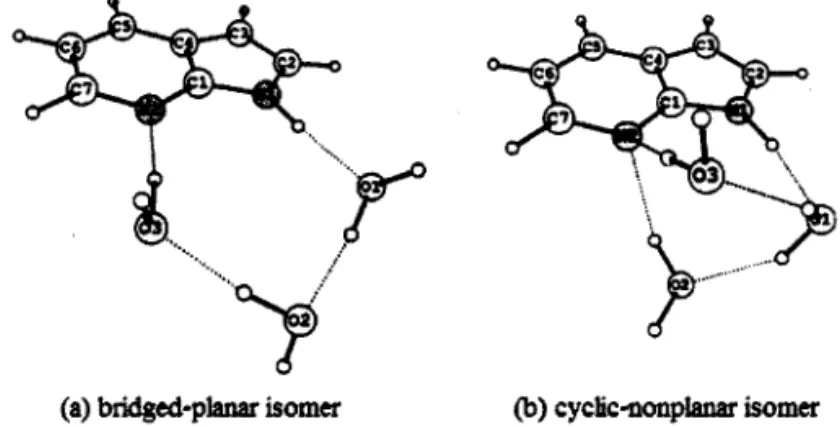
In Chapter 3, my theoretical calculations on the excited‑state multiple‑proton transfer (ESMPT) in 7AI(H20)3 cluster are reported and the mechanism is discussed. Recently, Pino et al. [5] reported experimental studies on ESMPT through the hydrogen bond networks in 7AI(H20)3 cluster by resonance enhanced multi‑photon ionhation (REMPI) and fluorescence excitation (FE) spectra. With a help of theoretical calculations, they proposed that isomerization of hydrogen bond network in 7AI(H20)3 0CCUfS after photoexcitaion, followed by ESMPT. Figure 2 shows typical equilibrium structures of two isomers, referred to as the bridged‑planar and cyclic‑nonplanar isomers. The potential energy profiles for 7AI(H20)3 cluster in the first excited state show that the reaction path of triple proton transfer after the rearrangement of hydrogen bond structure of water molecules from a bridged‑planar isomer to a cyclic‑nonplanar isomer is more favorable than the reaction path of quadruple proton transfer without hydrogen bond rearrangement. The calculated results show good consistency with the experimental observations such as the electronic spectra and excited‑state lifetime of 7AI(H20)3 cluster [5].
(a) bridgedIph
舳r
岱On丗O
)CycKc
噛伽pIaD
缸1恥m館Fig. 2. Equilibrium structures of 7AI(H20)3 in the excited
In Chapter 4, a general conclusion of the present work is presented. My theoretical calculations on 7AI homodimer, heterodimer, and complexes with waters have provided consistent results in both ab initio and DFT calculations, as well as with available experimental data. It is concluded that reliable theoretical calculations can provide a strong support to understand the mechanism of ESMPT for hydrogen‑bonded complexes.
References
(1) Hydrogen‑Transfer Reactions; J. T. Hynes, J. P. Klinman, H.‑H. Limbach and R. L. Schowen, Eds.; Wiley‑VCH: Weinheim, 2007.
(2) (3) (4) (5)
S. Takeuchi and T. Tahara, Proc. Natl. Acad. Sci. USA, 2007, 104, 5285
O.‑H. Kwon and A. H. Zewail, Proc. Natl. Acad. Sci. USA, 2007, 104, 8703.
Y. Komoto, K. Sakota and H. Sekiya, Chem. Phys. Lett., 2005, 406, 15.
G A. Pino, I. Alata, C. Dedonder, C. Jouvet, K. Sakota and H. Sekiya, Phys. Chem. Chem.
Phys., 2011, 13, 6325.
―
130 ‑
学 位 論 文 審 査 の 要旨
主 査 教 授 武 次 徹 也 副 査 教 授 武 田 定 副 査 教 授 坂 口 和 靖 副査 特任准教授 野呂武司
学 位 論 文 題 名
Theoretical Studies on the R/Iechanism of Excited ― State Proton Transfer in Hydrogen ― Bonded Dimers and Complex ( 水 素 結 合 二 量 体 お よ び 水 素 結 合 複 合 体 に お け る 励起プロトン移動に関する理論的研究)
博士学 位論文審査等の結果について(報告)
核酸塩基のモデル分子として取り上げられる7アザインドール(7AI)は水素結合のdonor、
acceptor
を有し、水素結合を通して容易にニ量体や溶媒分子との複合体を形成して、電子励 起状態で多重プロトン移動を示す。近年分光実験技術の進歩により、電子励起状態における 多重プロトン移動のメカニズム、ダイナミクスについても実験的に調べられるようになって きたが、微視的機構を理解する上では理論計算の果たす役割はきわめて大きい。核酸塩基対 のモデルとなる7AIの二量体については、電子励起状態で二重水素移動が起こり異性化する ことがわかっていたが、そのメカニズムが段階的機構か協奏的機構かについて複数の実験グ ループが異なる主張を行い、世界的な論争となっていた。多くの理論研究も行われたが、理 論 計 算 の 中 で も 一 致 し た 結 果 は 得 ら れ ず 、 混 沌 と し た 状 況 と な っ て い た 。本論文では、
7AI
ニ量体の励起状態における二重プロトン移動について、これまでの理論 計算を凌駕する高精度な計算手法を適用することによって、二重プロトン移動のメカニズム が非同期的協奏移動機構であることを理論の立場から明らかにした。電子励起状態の理論計 算にはabinitio法と密度汎関数(DFT)法の2つのアプローチがあるが、abinitio法ではコス トと精度の観点から、多配置SCF法で反応経路を決めて多参照摂動法で経路に沿ったエネル ギーを見積もるやり方が主流であった。本論文では、多大な計算コストをかけ反応経路の決 定にも多参照摂動法を適用したところ、従来のabinitio計算の結果と異なり協奏機構を支持 す る結果が 得られ た。さら に、DFT法に長 距離補 正法を導入したLC‐TDDFT
法を適用する ことにより、abinitio法とDFT法が同じ結果を与えることを示し、理論計算の立場から分光 実験の結果を矛盾なく説明することに成功した。同じ計算手法を適用することにより、7AI 二量体において一方の分子にメチル置換基を導入した誘導体においても反応機構が変化し ないことや、7AIと水分子3
っからなるクラスターにおける励起多重プロトン移動では水素 結合の組み換えが重要であることも明らかにしている。これを要するに、著者は、水素結合ニ量体および複合体の電子励起状態における多重プロ トン移動について、世界的論争となっていた問題に決着をっけ、高精度な理論計算に基づき 微視的メカニズムを解明したものと評価でき、水素結合系の励起多重プロトン移動の微視的 理解に対して貢献するところ大なるものがある。
よって著者は、北海道大学博士(理学)の学位を授与される資格があるものと認める。
―