R1:様式甲/Style Kou 2-1
学位論文の要旨
Abstract of Thesis 研究科
School
Graduate School of Environmental and Life Science
専 攻
Division
Environmental Science
学生番号
Student No.
77428451
氏 名
Name
PHAM VAN DINH
学位論文題目 Title of Thesis(学位論文題目が英語の場合は和訳を付記)
Developing a High-Rate Two-Stage Anaerobic Digestion Model to Deal with Biodegradable Municipal Solid Waste
In Japanese:
生物分解性都市ごみを対象とした高速二段嫌気性消化モデルの開発
学位論文の要旨 Abstract of Thesis
1. INTRODUCTION
Solid waste generation is an inevitable consequence of human activities and its rapid increase in recent years has caused significant problems that humankind has to deal with. In which, biodegradable municipal solid waste (BMSW) was often reported around 50-60% of total municipal solid waste, which had been cast off in landfills for many years. This leads to various issues that threaten the environment and public health. Meanwhile, anaerobic digestion (AD) systems can convert biodegradable waste into energy gas, thus have attracted remarkable attention within the scientific community.
Anaerobic digestion system is constituted from (bio)reactors to perform a series of bi-metabolism steps, including hydrolysis/acidogenesis, acetogenesis, and methanogenesis. The most applied AD system is the single-stage anaerobic digestion (SAD) which allows all the four steps occur in the same reactor. The recent studies showed that the two-stage anaerobic digestion (TAD) which separates hydrolysis and methanogenesis in two different reactors, has been proved better than the dry SAD. However, the application of TAD to treat BMSW has been still limited in the literature. Furthermore, the major concerns in TAD that have focused on methane reactor because methanogens have a much slower growth rate comparing to other group bacteria. There are two different mechanisms in the operation of methane reactors, including the suspended sludge process and the granular sludge process. The first technic is simple but having a low organic loading rate (OLR). The second one has much higher OLR comparing to the first one. However, it requires a high-speed flow to maintain well contact between granular sludge and substrate (fluidized zone). Therefore, this process might cost much water consumption and relevant energy when applying to deal with high solid concentration substrates such as BMSW.
Therefore, this study aims to develop a new TAD system to treat BMSW. In which, TAD system applied a special technique that allowed using both suspended sludge and granular sludge processes in the same methane reactor with a low- speed flow. The influences of operating parameters (pH, OLR, and retention time –RT) on the TAD system were studied to find out its characteristics. Also, the impacts of the effluent recirculation to the TAD were also investigated for optimizing water and alkaline consumption.
2. METHODOLOGY
2.1. Materials: Municipal solid waste at the east clean centre in Okayama City was sorted to collect the biodegradable fraction (OFMSW). It was cut into small size and mixed for homogenizing, and then grind into fine particles before storing in a freezer. Fresh horse dung (HD) and vegetable waste (VW) was collected at Okayama University.
2.1. Experimental models and setups
Starting up methane reactor: Methanogens were enriched from HD (after removing pathogens by thermal method at 55oC for 48h). Then methanogens were taken into the reactor and then was operated with VW leachate diluted (CODinput of 3.16 g/L, OLR of 1kg-COD/m3/d) until appearing granular sludge.
R1:様式甲/Style Kou 2-2 Name
PHAM VAN DINH
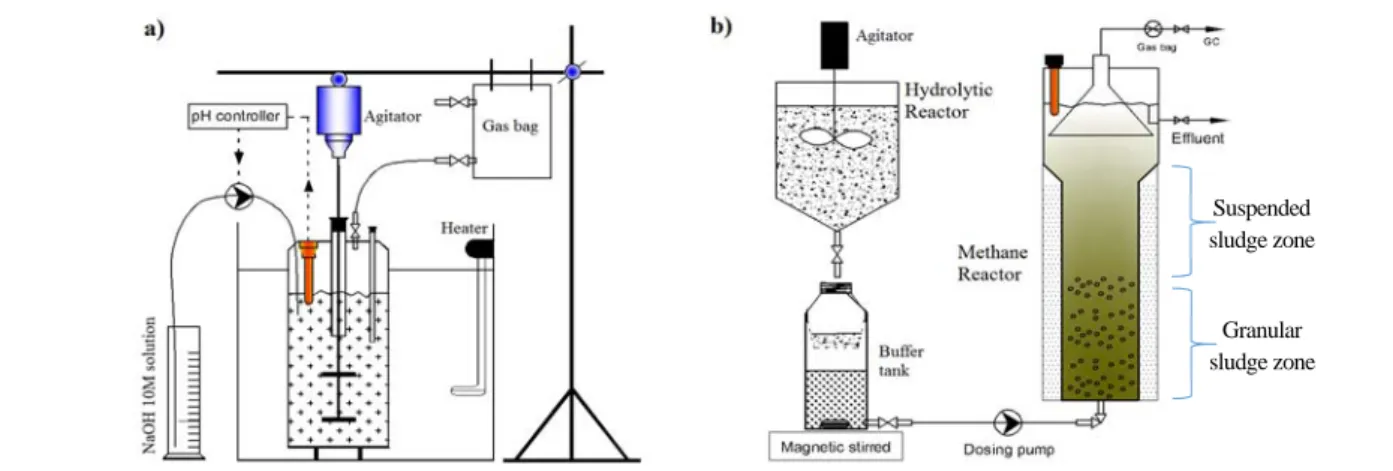
SAD with VW: Feedstock A was a mixture of VW and HD with a ratio of 1:10 (wet basis). The feedstock A was introduced into two continuous stirred tank reactors (CSTR) then operated in the batch mode at 36oC and pH 6.5 as shown in Fig. 1(a) with TS condition of 3% and 5%.
TAD with VW: Feedstock A was hydrolyzed within 9 day at 36oC then diluted by water in a buffer tank as shown in Fig.
1(b). The liquid part was collected then pumped into the methane reactor (36oC). There were three stages with the different dilution rates (n) of 10, 5, and 2.5, respectively. Each stage was operated within 24 days.
TAD with BMSW: BMSW was mixed with HD (9:1) for inoculation of the hydrolysis process. Initial total solid of this mixture was adjusted at 12% for hydrolysis with retention time (RT) of 5 days. The pH of hydrolysis reaction was controlled with different levels of 4.5, 5.0, 5.5, 6.0 and 6.5. The hydrolyzate was diluted (ratios of 1, 2, 3) and separated from the solid fraction at a buffer tank. It was then pumped into methane reactor. There were 16 stages and each stage was operated within 12 days.
TAD with the effluent recirculation: Instead of using tap water, this experiment recirculated the effluent out from the methane reactor to dilute feedstock and hydrolysable mater. There were four stages with the different recirculation rates of 3, 2, 1, and 0.5, respectively. Each stage operated within 12 days.
Fig. 1. Experimental models: a) Single-stage digestion and b) Two-stage digestion 2.2 Chemical analysis
Carbon (C) and nitrogen (N) of the substrate were determined using a CHN analyser (2400 II, PerkinElmer, USA). TS, VS, and pH were carried out by APHA standard methods. Total carbon and inorganic carbon of the liquid samples were measured by a TOC-L analyser (Shimadzu, Japan). TCOD, COD and TN were measured by a spectrophotometer (MD600, Lovibond, UK). VFAs were determined by a GC-14A (Shimadzu, Japan) equipped with a capillary column and a flame ionization detector. Gas component was analyzed using a GC-2014 equipped with a packed column and a thermal conductivity detector (Shimadzu, Japan).
2.3 Assessment methods
* General parameters: Biogas yield Nml/g-VS; Methane yield Nml/g-VS; COD removal (%); CH4 %.
* Kinetic rate constant
For single-stage digestion, using DINH model as written below
1 exp 1 1
1
. . . exp . 1 2
Where, Gt = accumulative methane yield (Nml/g-VS); A = methane yield potential (Nml/g- VS); t = digestion time (day); to = time when the biogas rate gets maximum (day); m = intermediate coefficient; km1 = average rate kinetic coefficient (1/day). The kinetic coefficients in Eq. 1 were determined by the least squares fitting method.
For two-stage digestion
. 3
Where Si = concentration of substrate in influent (mg- COD/L); Se = concentration of substrate in effluent (mg- COD/L); HRT = hydraulic retention time (day).
3. RESULTS
3.1. Comparisons between SAD and TAD:
The SAD experiments completed after a long digestion time (143 days) and was characterized by the kinetic rate constant k=0.02 day-1 which was much lower than that in the TAD (k = 0.66-2.16 day-1). The SAD seemed to be inhibited due to the high concentration of free ammonia and low inoculum to substrate ratio. In the SAD, only 17.8-22.3% of the initial carbon could be converted into biogas (equivalent to 91-110 Nml/g-VS) with low methane content (44.1-48.7%). Meanwhile, TAD converted 41.67% initial carbon to biogas (equivalent to 299.0-374.6 Nml/g-VS) with high methane content (71.68-81.0%).
Granular sludge zone
Suspended sludge zone
R1:様式甲/Style Kou 2-3 Name
PHAM VAN DINH
Moreover, the methanogenesis in the TAD had high stability which helped it get back to normal state after only several days although the concentrations of the influent increased double in the range of 6.5-24.5 g-COD/l. As these results, the TAD was much more stable, faster, and stronger than that in the SAD.
3.2. Influences of operating parameters on TAD:
Hydrolytic reactor. Raising the pH of hydrolysis in the range of 4.5-6.5 required significantly increasing alkaline consumption. However, this work had brought a significant benefit of increasing 7.5% TCOD at pH 5.5 and 16.8% TCOD at pH 6.5.
In methane reactor. The efficiency of the reactor had a major change in biogas yield and methane concentrations in the range of 193.3-327.0 Nml/g-TS and 58.9-71.6%, respectively. This reflected that the impacts of operating parameters were significant. And the details of these effects are shown in the figure below.
Fig. 2. Effects of pH and OLRs on biogas
Effect of the pH input on the performance of methane reactor was more and more strong follow the increase of OLR.
Moreover, the increase in OLR had significantly reduced both methane concentration and biogas yield. Meanwhile, OLR is the ratio between the input concentration (CODin) and HRT. Therefore, increasing concentration or reducing retention time badly affected the efficiency of the reactor.
3.3. Influences of the effluent recirculation
Results in hydrolysis showed that using the effluent recirculation brought stabilization at the pH 6.5, resulting in TCOD of 35.2 g/L and SCOD of 21.75 g/L. Meanwhile, without recirculating the effluent, it had to consume a dose of 76.7 g-NaOH/kg- TS to obtain the same results as in the previous experiment. Moreover, using a lower alkaline consumption of 49.9 g- NaOH/kg-TS caused a decrease of the pH down to 5.5 leading to reduction of 7.9% TCOD and 6.5% SCOD. Meanwhile, results in methane reactor indicated that the best recirculation ratio was with TCOD input of 35 g-O2/L to gaining biogas yield 289.5 Nml/g-TS and 92.7% COD removal. At higher RR, contact time between biomass sludge and substrate flow was not long enough. At lower RRs, activities of microorganism were inhibited by direct contact to high concentration of hydrolysate. Especially, methane concentration in the methane reactor had a strong linear positive correlation with pH input and negative correlation with input substrate concentration. It means both acetotrophic and hydrogenotrophic bacteria were severely impacted by acidic condition and high concentrations of substrates. However, acetotrophic one was adapted better than hydrogenotrophic one.
4. CONCLUSIONS
The TAD had many outstanding points comparing to the SAD: higher conversion of solid carbon into biogas + much faster rate kinetics of methanogens, and much higher methane concentration. Furthermore, the high stability of the TAD was proved. Therefore, the TAD is much more potential for performing high-rate digestion.
The developed TAD system had been proved operating smoothly with a very high OLR up to 11.4 kg-TS/l/d. Especially, the methane reactor of this system allowed working with a low pH (down to 4.5) of the influent at high OLR (7.6 kg-TS/l/d).
These features reflected that the system developed was so powerful.
pHs, OLRs, and HRT were significant factors that affected the TAD. Especially, an increase of pH in the range of 4.5-6.5 led to significantly raise the performance of both hydrolytic and methanogenic reactors. However, this work might cost a large amount of alkaline. The mentioned issue above can be solved by the effluent recirculation. Moreover, it brought significant benefits of increasing both biogas yield and CH4 concentration in the methanogenesis. The best recirculation rate was with TCOD input of 31 g-O2/L. At higher RR, contact time between biomass sludge and substrate flow was not long enough. At lower RRs, activities of microorganism were inhibited by direct contact to a high concentration of hydrolysate.
Both acetotrophic and hydrogenotrophic bacteria were impacted by acidic condition and high concentrations of substrates. However, acetotrophic one was adapted better than hydrogenotrophic one at these conditions.
50 55 60 65 70 75
4.00 4.50 5.00 5.50 6.00 6.50 7.00
CH4 %
the pH input
Effect of pHs on CH4% at different OLRs
OLR 1.9 gTS/L/d OLR 3.8 gTS/L/d OLR 7.6 gTS/L/d
150 200 250 300 350
4.00 4.50 5.00 5.50 6.00 6.50 7.00
biogas yield (Nml/g-TS)
the pH input
Effect of pHs on biogas yield at different OLRs
OLR 1.9 gTS/L/d OLR 1.9 gTS/L/d OLR 7.6 gTS/L/d