Japan Advanced Institute of Science and Technology
Title
V字型クロムナノアレイからの第二高調波発生Author(s)
Ngo, Khoa QuangCitation
Issue Date
2014‑09Type
Thesis or DissertationText version
ETDURL
http://hdl.handle.net/10119/12306Rights
Description
Supervisor:水谷 五郎, マテリアルサイエンス研究科, 博士
Optical Second Harmonic Generation from V-Shaped Chromium Nanohole Arrays
Mizutani laboratory S1040205 Ngo Khoa Quang
Introduction
In this thesis, analytical approach of local surface contribution (electric dipole) and nonlocal bulk contribution (magnetic dipole and electric quadrupole) of chromium metal was presented by examining the nonlinear optical response of V-shaped nanohole arrays. The optical second harmonic generation data achieved in this work would give rise to the intriguing phenomenon of metamaterial. Additionally, controlling the optical behavior of Cr nanostructures will make a significant impact for optical device application.
In the field of plasmonics, gold or silver was widely adopted as the substrate material because they are favorable for surface plasmon resonance (SPR) where the electromagnetic waves could be confined to propagate along the interface between two media [1,2]. Since these metals have very poor adhesion, chromium is usually employed as a reliable adhesion layer before depositing Au or Ag thin film and shaping the structures. Nevertheless, according to my calculation, plasmon excitation of Cr is possible and more feasible compared with part of the other metals. Indeed, A.
Shalabney et al. found surface plasmon resonance in Cr columnar thin film in the Kretschmann configuration [3]. In addition, to avoid SPR’s loss, a very thin and uniform film is required and Cr is the best material [4]. Because of its importance in plasmonics it is very necessary to address the optical behavior of Cr. Within this aim, the goal of my work is considering the optical response of Cr metal in nanoscale.
Objectives
There are various approaches used to reveal the optical properties of metallic nanostructure. Among these, surface second harmonic generation (SHG) method has become a potential technique, which is very sensitive to the structures lacking inversion symmetry. Thus, V-shaped Cr nanoholes should generate strong SHG intensity. The nonlinear optical response should be recognized in the obtained second order nonlinear susceptibility tensor elements.
From second order optical standpoint, plasmonics has been expected to improve the nonlinear efficiency as well as shrink the nonlinear components in size. Noticeably, the recent reports researched on the second order optical effects in plasmonic structures have emphasized that metal materials give rise to a very complicated state, especially at nanoscale [5,6]. Both surface (electric dipole) and bulk (magnetic dipole and electric quadrupole) contributions can appear equally in the SHG magnitude whereas the surface term is usually considered as feasible candidate. Up to now, examination of dipole and multipoles terms in the geometric nanostructrues is still the significant challenge of second order optical effects. Thus, clarifying the role of the local surface and nonlocal bulk contribution becomes particularly necessary to control and optimize the nonlinear optical behavior of the metallic nanostructures for the functional applications. Furthermore, as far as I know there is no information available on surface second harmonic generation of Cr metal. Hence, in my work, the attention was paid on the proper estimation between dipole and multipole effects in
(c)
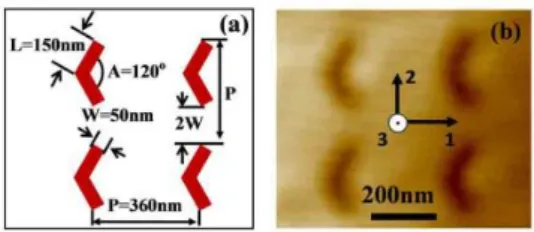
Fig. 1. Structure of V-shaped subwavelength nanohole array: (a) scheme of the designed parameters, (b) atomic force microscopy image.
Fig. 2. Decomposition of SHG intensity from V-shaped nanoholes when one of the nonlinear susceptibility elements χijk(2) is set equal to a calculated value and all the other elements are set equal to zero. The intensities are arbitrary but on a common scale. ijk are the suffices of the nonlinear susceptibility elements.
V-shaped Cr nanohole structure. The new information could contribute to well understanding of nonlinear optical effects occurring in artificial materials.
Experimental Result
In this research, I have fabricated the arrays of V-shaped nanoholes (see Fig. 1) by JEOL JBX-9300FS Electron Beam Lithography System and measured the azimuthal angle dependence of the SHG intensity. The phenomenological analysis indicated that four nonlinear susceptibility elements including χ313(2), χ322(2), χ311(2), and χ333(2) present the predominant contribution as shown in Fig. 2. Here 1-axis presents the bisector of the V shape passing through its apex in the sample surface plane. 2-axis is perpendicular to 1-axis and lies on the sample surface, too. 3-axis is normal to the sample surface plane (see Fig. 1(b)).
As for the origins of χ311(2), χ322(2), and χ333(2) elements, it is impossible to distinguish between the contribution of the V- shaped Cr nanoholes and the bare Cr substrate since these two susceptibility elements appear simultaneously under Cs (V- shaped hole) and C∞ (bare Cr substrate) symmetries.
On the other hand, the contribution of the nonlinear susceptibility element χ313(2) should be purely from the nanoholes because it emerges owing to the symmetry breaking in 1-axis created by the V-shaped nanoholes. For favorable material exploited for artificial nanostructures such as gold, plasmon exciation enhancing nonlinear optical effect could be accomplished. However, in the case of Cr metal plasmon was silent when I examined the physical origin of the large contribution of the χ313(2) element. Interestingly, the observed SHG response was attributed to the nonlocal bulk contribution of the Cr metal. Under scrutiny, there are vertical metallic sidewalls within each V-shaped hole leading to existence of air-chromium metal boundaries. This has a strong effect on the field gradient in 1-axis because of the rate of spatial change of the field at the boundary of the nanohole surface. The field gradient were thus found to induce considerable contribution of χ313(2). In particular,
instead of local surface contribution (electric dipole effect), nonlocal bulk contribution (higher multipole effects) demonstrated predominance with respect to the SHG signal. It is fascinating insight of the V-shaped Cr nanohole arrays since local surface contribution is usually the feasible candidate. My achievement implies the fact that the nonlinear optical behavior of the metamaterials should not be merely treated by usual electric dipole approximation because it is
Fig. 4. The normalized SHG intensity emitted from each V shape.
not sufficient to provide the comprehensive description. In metal nanostructures, there is an inherent complication since the reflected SHG signal generally contains both surface and volume nonlinear contributions. The difficulty in estimating the electric dipole and the precise role of
higher multipole effects is the issue lasting for long time from the early stages of nonlinear optics and still under intriguing process of examination.
Therefore, the proper estimation between surface and bulk effects in my work is particularly essential to improve the understanding of the nonlinear optical response of metal nanostructures and metamaterials.
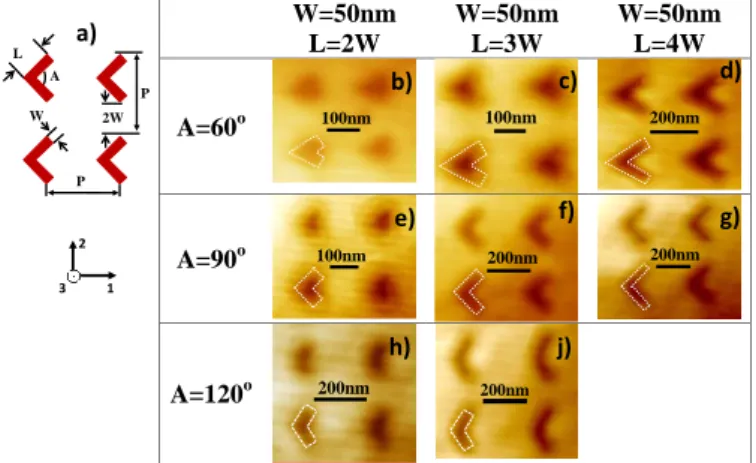
In a further work, I have attempted to examine the dependence of the SHG response on the structural parameters of V-shaped chromium nanoholes. It is expected to understand the origin of the SHG in problem if we consider how the SHG intensity alters when the arm length and the apex angle are changed. Thus, three sets of the V-shaped nanoholes were fabricated (see Fig. 3) and their SHG intensities in the azimuthal angle dependence were compared with each other. In particular, SHG
intensity created by individual V shape increased when the
arm length or the apex angle increased (see Fig. 4). A simple model calculation was presented to deduce the experimental results. It provided valuable insight that there was a systematic dependence of the SHG intensity on the designed parameters of Cr nanoholes.
The clarification shows that the nonlinear optical
behavior resulted from the bulk contribution of metallic electrons. This work therefore provides the new information in adjustment of the nonlinear optical behavior of metamaterial for functional applications.
References
[1] B. K. Canfield, S. Kujala, M. Kauranen, K. Jefimovs, T. Vallius, and J. Turunen, Appl. Phys. Lett. 86, 183109 (2005).
[2] M. Sukharev, J. Sung, K. G. Spears, and T. Seideman, Phys. Rev. B 76, 184302 (2007).
[3] A. Shalabney, A. Lakhtakia, I. Abdulhalima, A. Lahav, Christian Patzig, I. Hazek, A. Karabchevsky, Bernd Rauschenbach, F. Zhang, and J.Xu: Photonics Nanostruct.: Fundam. Appl. 7 (2009) 176.
[4] A. D. Rakic, A. B. Djurišic, J. M. Elazar, and M. L. Majewski, Appl. Opt. 37, 5271 (1998) [5] A. Benedetti, M. Centini, M. Bertolotti, and C. Sibilia, Opt. Express 19, 26752 (2011).
[6] M. Zdanowicz, S. Kujala, H. Husu, and M. Kauranen, New J. Phys. 13, 023025 (2011).
Fig. 3. Structure of V-shaped subwavelength nanohole array:
(a) scheme of the designed parameters and atomic force microscopy image of the first set (b-d) of V-shaped arrays with 60o apex angle, the second set (e-g) of V-shaped arrays with 90o apex angle, and the third set (h-j) of V-shaped arrays with 120o apex angle. The dotted line shows the designed “V”-shapes.
W=50nm L=2W
W=50nm L=3W
W=50nm L=4W
A=60o
A=90o
A=120o
100nm 100nm 200nm
100nm 200nm 200nm
200nm 200nm
L A
P W 2W
P
2
1 3
g)
c) d)
e) f)
a)
b)
h) j)
TABLE OF CONTENTS
CHAPTER 1 Page
INTRODUCTION 1
CHAPTER 2
THEORETICAL BACKGROUND 10
CHAPTER 3
LITERATURE REVIEW 44
CHAPTER 4
V-SHAPED NANOHOLE ARRAYS’ FABRICATION TECHNOLOGY AND MEASUREMENT METHOD
62
CHAPTER 5
RESULTS AND DISCUSSION 67
CHAPTER 6
GENERAL CONCLUSION 84
LIST OF PUBLICATION
1. Ngo Khoa Quang, Yoshihiro Miyauchi, Goro Mizutani, Martin D. Charlton, Ruiqi Chen, Stuart Boden, and Harvey Rutt, “Optical second harmonic generation from V-shaped chromium nanohole arrays”, Jpn. J. Appl. Phys. 53, 02BC11-1- 02BC11-5 (2014).
2. Ngo Khoa Quang, Yoshihiro Miyauchi, Goro Mizutani, Martin D. Charlton, Ruiqi Chen, Stuart Boden, and Harvey Rutt, “Optical second harmonic generation of V-shaped chromium nanoholes---dependence on the structure parameters of the nanoholes”, Surf. Interface Anal. (2014).
Keywords: Second harmonic generation (SHG); Cr metal; Nanoholes; V-shaped structure; bulk contribution.