
Japan Advanced Institute of Science and Technology
JAIST Repository
https://dspace.jaist.ac.jp/
Title Sectoral System of Innovation in China - the Case of Software Sector
Author(s) Qiong, Wu; Miyazaki, Kumiko Citation
Issue Date 2005-11
Type Conference Paper
Text version publisher
URL http://hdl.handle.net/10119/3855
Rights ⓒ2005 JAIST Press
Description
The original publication is available at JAIST Press http://www.jaist.ac.jp/library/jaist-press/index.html, IFSR 2005 : Proceedings of the First World Congress of the International
Federation for Systems Research : The New Roles of Systems Sciences For a Knowledge-based Society : Nov. 14-17, 2065, Kobe, Japan, Symposium 1, Session 4 : Technology Creation Based on Knowledge Science Knowledge/Technology Management(1)
Sectoral System of Innovation in China - the Case of Software Sector
Qiong Wu1, Kumiko Miyazaki2 1
Graduate School of Decision Science and Technology, Tokyo Institute of Technology 2-12-1 Ookayama, Meguro-ku, Tokyo, 152-8550, Japan
Graduate School of Innovation Management, Tokyo Institute of Technology 2-12-1 Ookayama, Meguro-ku, Tokyo, 152-8550, Japan
ABSTRACT
As many researchers of economics and management pointed out, China is emerging as one of the most important providers of software products and IT services, as well as a large software consuming market. This paper explores the current status and features of the sectoral system of innovation (SSI) of the Chinese software industry. These features could be found by analyzing the software industry in three dimensions, namely: evolution, industrial structure (which including technology, product and market structure), interlinkages between firms. The paper demonstrates that the Chinese software industry is characterized by high shares of application software and related IT services rather than system or middleware software. The structure of the Chinese software industry has inhibited the development of independent software firms. The dependence of Chinese software firms on foreign partners along side this structure hinders innovativeness of Chinese software firms. Furthermore, the problems of the SSI are identified in the paper. Implications for government policy are also discussed.
Keywords: Sectoral Systems of Innovation, Software
Industry, Industrial Structure, China
1. INTRODUCTION
As a systemic approach to analyze economic and technological change, the SSI is not new. SSI can easily capture the process of networking, which involves various actors, agencies and institutions.[[11]]In addition, it has been found useful for analyzing knowledge intensive technology sectors, such as the software sector. The objectives of this paper are two-fold. The first one is to explore the salient features of the Chinese SSI of the software industry. The other one is to identify problems in the innovation system and make suggestion for policy makers.
This paper is organized as follows. Section 2 presents an analytical framework with respect to the SSI in Chinese software industry. Section 3 introduces the methodology
for analyzing the SSI of the Chinese software industry. As the main part of this paper, section 4 puts into perspective the distinctive features of the Chinese software industry and discusses the problems faced by Chinese SSI on software industry. Section 5 presents implications for government policy.
2. CONCEPTUAL FRAMEWORK
System of innovation can be viewed in different level: regional, national, global, sectoral.[[33]][[44]][[55]][[66]][[77]][[88]]
Researchers such as Freeman[[33]],Lundvall[[55]], Edquist[[44]], Nelson and Rosenberg [[66]] , Niosi et al. [[77]] studied the system of innovation at a national level. They all emphasized the importance of national institutions and innovative capabilities.
The concept of ‘regional innovation system’ appeared in the early 1990s [[99]] [[1100]]. Cooke argued that a regional system of innovation would be a relevant category of analysis if innovation processes would be characterized by region-specific factors.
The definition of ‘sectoral systems of innovation’ is based on an ‘industry’ or ‘sector’. SSI can be understood as a set of different actors, such as firms, universities, industry associations, public research institute, and government agencies, which cooperate and even under certain circumstances, compete against one another within a sector. [[1111]] These actors interact mutually in order to benefit from their respective knowledge and competencies.[[55]][[1122]].
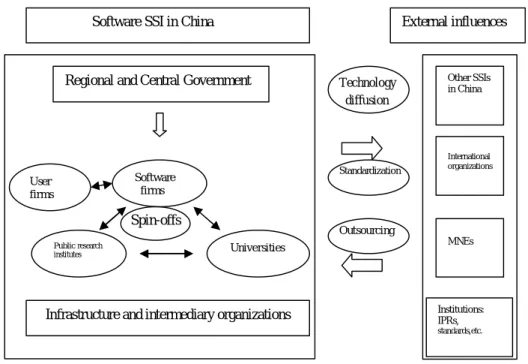
We propose an analytical framework as shown in Figure 1, which is based on the concept of SSI. Under the proposal framework, main actors include various kinds of software-related firms, universities, public research institutes and bridging institutions. The main interactions among these actors include cooperation between software firms and university/public research institutes, spin-off activities of academic organizations, cooperation and corresponding technology diffusion between software firms or between firms from software sector
and other sectors, such as computer hardware and telecommunications. Government plays an important role on influencing the behavior of software firms and preceding interaction by funding different programs and industrial policies. On the other hand, outsourcing business makes it possible for Chinese incumbent software firms to receive transfer of knowledge and technologies from foreign public and private institutions.
3. METHODOLOGY
We adopt a hybrid approach to analyze the SSI with respect to the Chinese software industry,combining qualitative and quantitative data sources. The
information is obtained from: 1) bulletins and annual reports of large companies; 2) national business association statistics; 3) business and trade press reports; 4) in-depth interviews with managers in software firms and government officials; 5) article database including Sciencedirect, EBSCO and Compendex.
In order to understand the performance of large market players, the top 50 firms in Chinese software industry were selected as a sample for the further analysis. For the sake of understanding networks of large market players, the status of network of 5 top firms in chinese software industry were selected as sample as well.
Figure 1 The Framework of Chinese Software Sectoral System of Innovation
0 50 100 150 200 250 300 1992 1993 1994 1995 1996 1997 1998 1999 2000 2001 2002 2003 2004
Figure 2. Revenues of Chinese software industry, 1992-2004(unit: 100 million RMB) Source: Chinese Software Industry Association (CSIA)[[1133]]
Infrastructure and intermediary organizations Regional and Central Government
Software SSI in China
Universities Publicresearch institutes Software firms Other SSIs in China International organizations MNEs External influences Spin-offs Technology diffusion Outsourcing Standardization User firms Institutions: IPRs, standards,etc.
4. FEATURES OF THE CHINESE SOFTWARE INDUSTRY
As many researchers have pointed out, China is emerging as one of the most important providers of software products and IT services, as well as a large software consuming market. China began developing its software industry in the early 1980s. As Figure 1 shows, by the end of 2004, the revenue of software industry reached the level of 240.49 billion RMB compared with 4.365 billion in 1992. By 2004, China had over 10 thousand software firms, with 720 thousand employees.1133]] 4.1. Main events in the evolution of Chinese software industry
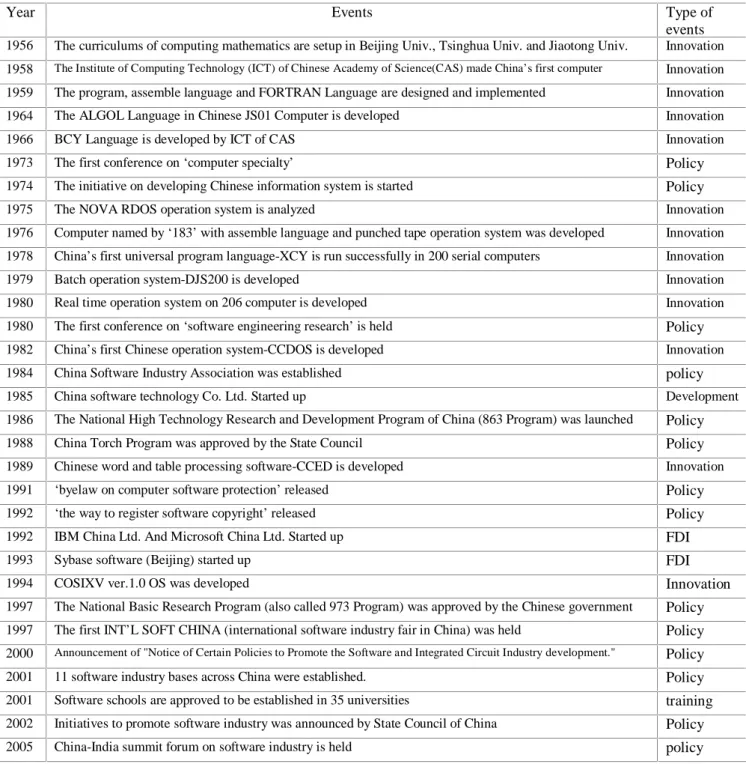
Since government policies and actions are believed to be important in spurring innovation in software, we discuss the main events in the history of Chinese software industry development. They include: important technological innovations, development in industry, significant FDI, new policies (concerning technology innovation, the training of professional talents and service improvement, program on developing basic research and high tech industry’s growth) and actions stimulating software exports.
Table 1 summarizes the main events affecting Chinese software industry. Although the growth process of this sector is very complex, the whole process can be divided into three stages in terms of the revenue growth of the software sector, which highlights the important role played by the government and different constraint according to specific stages.
It is useful to interpret the industry events as the following three periods:
1. Time of the planned economy (1949-1977)
At this stage, government controlled and coordinated all R&D activities. The most important department, the State Development Planning Commission, allocated all resources throughout the national economy. All software-related R&D activities were conducted by the Chinese Academy of Sciences (CAS) dedicated to conduct basic research. It should be noticed that there were many interesting technological innovations, ranging from computing languages, new computers, to operation systems. Nevertheless, all these innovations were restricted to the fields of astronautics and military applications, such as nuclear weapons and artificial satellites. As a result, there were few IT firms.
On the other hand, universities introduced curriculums related to computer or software, but focused on teaching rather than research.
At that time, no innovation system existed yet. There were hardly any linkage between universities, firms and public research institutes. China fell behind more advanced countries in the development of IT industry, and software couldn’t be regarded as an independent sector in China in that period.
2. Transition to market-oriented economy with underdeveloped software sector (1978-1999)
At this stage, along with a reform towards market-oriented economy, China started boost in its economic system at very high speed. Government made efforts to attract foreign investment and regarded it as a major way to acquire foreign advanced technology (so-called ‘market change technology’). As a result, Oracle, Sybase, IBM and other companies set up their affiliates in China, and soon dominated local market. In the meantime, software became an independent sector, and the establishment of China software technology Co.Ltd could be regarded as the marking point of its development.
On the other hand, for the sake of promoting the university-based research, which was neglected for a long time, and increasing the linkages between public research institutes, universities and firms, many programs on developing basic research and high tech industry’s growth and actions were started. There include: 1) so-called ‘863 plan’, which allocated approximately 5 billion RMB between 1986 and 2000 to projects designed to train a new generation of researchers and advance Chinese innovative capabilities in high technologies; 2) so-called ‘torch plan’, which proposed to create a supportive environment for the development of high-tech enterprises; 3) the National Basic Research Program (also called ‘973 Program’), which gathered together strong expertise to launch innovation studies of major scientific issues, related to sustainable development in line with the national goals and tasks for the economic, social and science and technology development.
In general, at that time, linkages between public research institutes, universities and firms were gradually increasing, but the linkage remained weakest in software within China’s IT sector. China focused on the computer, telecommunication and hardware manufacturing rather than software sector.
3. Time for software sector-focus (1999-now)
Facing the astonishing success of Indian software industry, the Chinese government, recognizing the weakness of domestic industry, has targeted software in the 10th Five-Year Plan. The year of 1999 became a turning point as the State Council Document 18, formally known as "Notice of Certain Policies to Promote the Software and Integrated Circuit Industry Development",
was released to encourage the development of software industry and integrated circuit (IC) industry. This document included many effective policies and actions to promote the establishment of new software enterprises, including tax reductions and export subsidies.
As a result, from year 2000, rapid growth on software industry has continued (as Figure 2 shows).In the
meantime, a large number of software parks were opened throughout China. They concentrate in areas, where public research institutes and universities exist, and help promote interactions between firms and academia. Many spin-offs from universities and public research institutes intensify these interactions.
Year Events Type of
events
1956 The curriculums of computing mathematics are setup in Beijing Univ., Tsinghua Univ. and Jiaotong Univ. Innovation
1958 The Institute of Computing Technology (ICT) of Chinese Academy of Science(CAS) made China’s first computer Innovation
1959 The program, assemble language and FORTRAN Language are designed and implemented Innovation
1964 The ALGOL Language in Chinese JS01 Computer is developed Innovation
1966 BCY Language is developed by ICT of CAS Innovation
1973 The first conference on ‘computer specialty’ Policy
1974 The initiative on developing Chinese information system is started Policy
1975 The NOVA RDOS operation system is analyzed Innovation
1976 Computer named by ‘183’ with assemble language and punched tape operation system was developed Innovation
1978 China’s first universal program language-XCY is run successfully in 200 serial computers Innovation
1979 Batch operation system-DJS200 is developed Innovation
1980 Real time operation system on 206 computer is developed Innovation
1980 The first conference on ‘software engineering research’ is held Policy
1982 China’s first Chinese operation system-CCDOS is developed Innovation
1984 China Software Industry Association was established policy
1985 China software technology Co. Ltd. Started up Development
1986 The National High Technology Research and Development Program of China (863 Program) was launched Policy
1988 China Torch Program was approved by the State Council Policy
1989 Chinese word and table processing software-CCED is developed Innovation
1991 ‘byelaw on computer software protection’ released Policy
1992 ‘the way to register software copyright’ released Policy
1992 IBM China Ltd. And Microsoft China Ltd. Started up FDI
1993 Sybase software (Beijing) started up FDI
1994 COSIXV ver.1.0 OS was developed Innovation
1997 The National Basic Research Program (also called 973 Program) was approved by the Chinese government Policy
1997 The first INT’L SOFT CHINA (international software industry fair in China) was held Policy
2000 Announcement of "Notice of Certain Policies to Promote the Software and Integrated Circuit Industry development." Policy
2001 11 software industry bases across China were established. Policy
2001 Software schools are approved to be established in 35 universities training
2002 Initiatives to promote software industry was announced by State Council of China Policy
2005 China-India summit forum on software industry is held policy
Table 1 Main events affecting Chinese software industry 1956-2005
Sources: CSIA, MII (Ministry of Information Industry), National Basic Research Program, China Torch Program, The National Basic Research Program and the website of the State Council of China.
4.2 Technology and product structure
According to the analyses of CSIA (Chinese Software Industry Association) and MII (Ministry of Information Industry), we propose a typology of software. We divide the entire software industry into two parts, one related to software products and the other one is related to IT service. The IT service division includes system integration and software service. On the other hand, the software product market has three main segments: system software, middleware software and application software.[[1122]]
The segment-wise composition of the Chinese software product market is shown in Figure 3.
system software, 9.70% application software, 73.90% middleware software, 16.40%
Figure 3. The composition of revenues of the Chinese software product market (2003)[[1133]] Source: Chinese Software Industry (CSIA) The figure demonstrates that the application software is the dominant segment with a 73.9% market share, consisting of enterprise software, word processing packages, multimedia software, game software, publishing software and other application types.
Along with competitive advantages derived from a better understanding of the domestic market, localization strategies and lower prices, indigenous Chinese firms
found their opportunities in five areas: internet based software solutions,; Linux operating system and related applications; development of middleware; embedded software solutions in consumer electronics; and information security products.
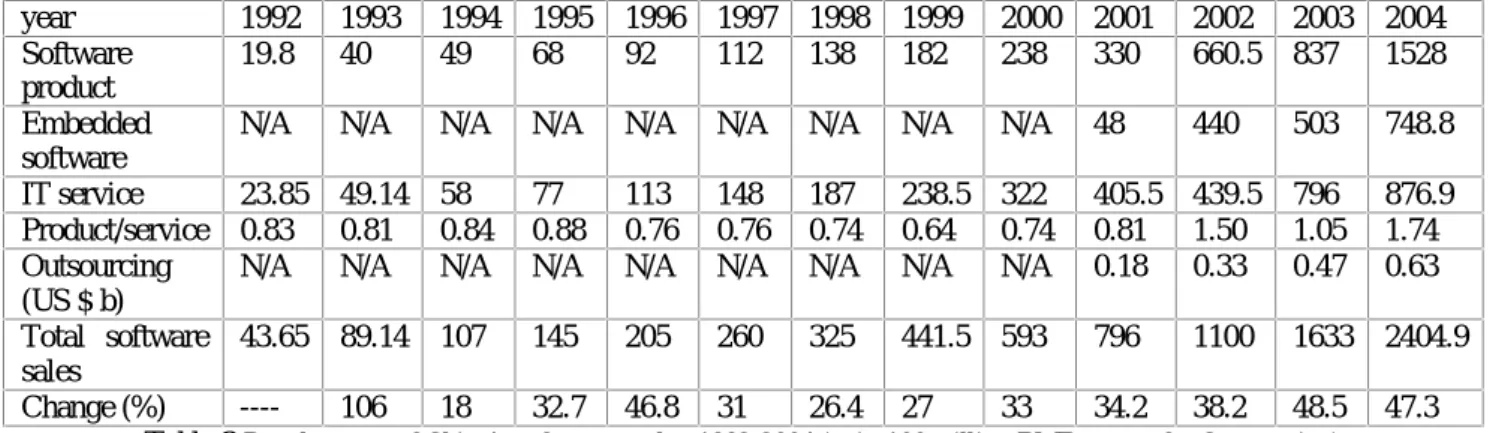
The growth of various segments over years is shown in Table 2, which reveals the unusually rapid growth of application software in the entire product structure.
System software Middleware
software
Application software Year
revenue share revenue share revenue share
1992 1.6 8% 5.4 27% 12.8 65% 1993 3.6 9% 10.8 27% 25.6 64% 1994 4.5 9% 13.2 27% 31.3 64% 1995 6.5 10% 15.0 22% 46.5 68% 1996 8.5 9% 20.0 22% 63.5 67% 1997 13.7 12% 27.5 25% 70.8 63% 1998 17.4 13% 35.9 26% 84.7 61% 1999 21.0 12% 44.8 25% 110.2 63% 2000 33.2 14% 49.6 21% 155.0 65% 2001 50.0 15% 81.9 25% 198.1 60% 2002 68.0 13% 110.6 22% 328.8 65% 2003 78.0 9.7% 132.0 16.4% 595.0 73.9%
Table 2Revenues of various segments in Chinese software product market (unit: 100 million RMB)
Source:Chinese Software Industry Association (CSIA)[[1133]] The growth of the Chinese software market is shown in Table 3, revealing a continuous increase in software sales since 1992, significantly higher than the global growth rate. [[1144]]
Additionally, it must be noted that recent data shows that outsourcing revenues in Chinese software industry grow very rapidly.
The composition of software output reflects the gradually more important role of software products partly due to the rapid growth of embedded software segment.
year 1992 1993 1994 1995 1996 1997 1998 1999 2000 2001 2002 2003 2004 Software product 19.8 40 49 68 92 112 138 182 238 330 660.5 837 1528 Embedded software
N/A N/A N/A N/A N/A N/A N/A N/A N/A 48 440 503 748.8 IT service 23.85 49.14 58 77 113 148 187 238.5 322 405.5 439.5 796 876.9 Product/service 0.83 0.81 0.84 0.88 0.76 0.76 0.74 0.64 0.74 0.81 1.50 1.05 1.74 Outsourcing
(US $ b)
N/A N/A N/A N/A N/A N/A N/A N/A N/A 0.18 0.33 0.47 0.63 Total software
sales
43.65 89.14 107 145 205 260 325 441.5 593 796 1100 1633 2404.9 Change (%) ---- 106 18 32.7 46.8 31 26.4 27 33 34.2 38.2 48.5 47.3
Table 3Development of China’s software market 1992-2004 (unit: 100 million RMB except for Outsourcing)
4.3 Market structure
1. Market structure by industry
Table 4 demonstrates the demand structure in the Chinese software market.
Customer segment Sales Market
share 1 Telecommunication 270.0 33.5% 2 Government 103.2 12.8% 3 Banking/insurance 81.2 10.1% 4 Manufacturing 75.0 9.3% 5 Electric power 30.0 3.7% 6 Medicine 28.0 3.5% 7 Education 27.8 3.4% 8 Transportation 25.0 3.1% 9 Aviation 18.0 2.2% 10 Entertainment 16.0 2.0% 11 Construction 15.0 1.8% 12 Energy 13.5 1.6% 13 Press 11.0 1.3% 14 Automobile 10.0 1.2% 15 Electronics, IC 9.0 1.1% 16 Public affairs 9.0 1.1%
17 Broadcast, TV & film 8.0 1.0%
18 Tobacco 8.0 1.0% 19 Commerce 7.5 0.9% 20 Food 7.5 0.9% 21 Garment industry. 7.0 0.9% 22 Restaurants 7.0 0.9% 23 Water resource management 6.0 0.7% 24 Others 12.3 2.0% Total 805.0 100%
Table 4 The structure of customers (unit: 100 million RMB) Source: Chinese Software Industry Association (CSIA)[[1133]]
From Table 4, some interesting points could be concluded. Firstly, telecommunication industry is the biggest customer of Chinese software industry. That is no surprise, considering the historical strength of this industry. Secondly, government is also very important customer in the software market. This indicates government purchase has become significant as a part of government policies. Thirdly, enterprise customers are more important than weak private customers. Interviews with managers of software firms indicated additionally that the lacking IPR protection might affect software firms approaching individual market.
2. Market structure by specification
Table 5 shows the distribution of application software product market by specialization. Embedded software accounted for a very large part of the application software market, followed by management software and network software. This is largely due to powerful positions of Chinese firms in the global market with
consumer electronics, computer and telecom. Development and strong manufacturing base is important factor boosting embedded software, management software. On the other side, rapid growth of Internet business stimulates the increase of market share of network software and security software.
Type of product Sales Market share
1 Embedded software 235.0 39.0% 2 MRP/ERP 116.6 20.0% 3 Network 113.7 19.0% 4 Security 28.6 5.0% 5 Business process 16.3 3.0% 6 CAD/CAM/CAE 14.9 3.0% 7 GIS/GPS/RS 13.4 2.0%
8 Testing and control 13.0 2.0%
9 Office management 12.1 2.0% 10 Word or graph processing 6.7 1.0% 11 Multimedia 6.3 1.0% 12 Logistics 6.1 1.0% 13 Business intelligence 4.2 0.7% 14 Others 8.1 1.3% Total 595.0 100%
Table 5the distribution of application software product market (unit: 100 million RMB)
Source:Chinese Software Industry Association (CSIA)[[1133]] 4.4 Characteristics and distribution of software firms
Our analytical framework includes all actors (such as users, computer makers and various software firms) involved in software development in China and illustrates interactions, through which software is developed.
In this section, an attempt is made to give a clear picture of the overall structure of the industry. We propose an analytical framework called the ‘hardware-driven’ pattern, which show how leading IT hardware manufacturers and IT users contributed to the formation of the existing market structure.
Due to the limitation of data, we select the top 50 firms in Chinese software industry (classified by MII, in 2004)
[
[1144]]
as the analyzed sample.
These firms can be divided into the following categories: computer-makers, telecommunication makers, electronic/electric makers, user-spin offs and independent software providers. Corresponding main types of software products and IT services, the number of new software products will be analyzed as well. As Table 6 shows, there are few specialized and dedicated “independent” Chinese software providers
while on the other hand, the hardware-related firms, including telecom makers and electronic/electric makers, play dominant roles.
It must be noted that because of the market domination of hardware manufacturers, there are high entry barriers for smaller software firms. This hardware-driven
structure hinders the development of an open market, which could facilitate the expansion of packaged software. Only an open market can enable software firms to develop high value-added software on their own initiative, and allow the users to select the most suitable software product at a relatively lower cost than in the case of customized software.
Top 50 firms Computer-maker Telecom maker Electronic/electric
maker User-spin off Independent software provider number 5 9 17 10 9 Main software product or services Application software, middleware, System software Embedded software, application solutions for telecoms Embedded software, system integration System integration Application software, system software, middleware Number of new software Product (2001-2004) 182 331 72 56 322
Table 6Characteristics and distribution of software firms
Source:Ministry of Information Industry (MII)
4.5 Linkages of large software firms
Figure 4 Network of 5 large firms in Chinese software industry
We analyze the linkages of 5 software firms (selected from top 10 software firms classified by MII [[1144]], in 2004) as the study object. As figure 4 shows, the partner
companies having the largest number of links to the top Chinese software firms are globally dominant vendors such as IBM, Oracle, SAP and so on. This reflects technology dependence of indigenous firms on foreign MNEs.
There are very close relations between MNEs and these firms, but only few linkages between domestic Chinese firms.
This prevents the formation of regional industry clusters: the largest IT services companies look rather for foreign technology providers, and smaller independent software companies could not enjoy sufficient business support in own countries.
5. CONCLUSIONS
This paper summarizes distinctive features of SSI and challenge faced by the Chinese software industry. The Chinese software industry is characterized by unbalanced high shares of application software rather than system or middleware software. This trend will influence the growth of local system/middleware software providers, which could facilitate eliminating dependence of local firms on foreign partners.
Chinese government’s support of open source software, such as Linux, could be a very important method to achieve self-sufficiency.
As the preceding analyses pointed out, more hardware-manufacturers than independent software providers dominate the local market. This structure hinders the growth of smaller firms, accordingly inhibiting their innovative activities.
There are very close linkages between MNEs and the top hardware manufacturing firms, but only few relations between domestic Chinese firms. This trend prevents the formation of software industry clusters. In this respect, government policies on opening software parks should be very effective for facilitating formatting regional software industry clusters. Government should stimulate the linkages between different actors to establish software industry clusters in a cohesive way.
Importance should be attached to the protection of intellectual property rights. The government should continue to fight against copyright piracy. A favorable legal environment is vital to the development of the software industry.
In general, along with the success in IT manufacturing (China has become the third large global IT manufacturer); the domestic demand will increase dynamically, spurring the growth in enterprise and embedded software. In the meantime, a balance should be carefully maintained between domestic and overseas markets, as well as between the existing hardware-led structure and the development of independent software firms.
REFERENCES
[1]. Mehra, K., 2001, Indian system of innovation in biotechnology, Technovation, 21, 15--23
[2]. Carlsson,B., et al., 2002, Innovation systems: analytical and methodological issues, Research Policy, 31, 233--245
[3]. Freeman, C. et al., 1987, Technology and Economic Performance: lessons from Japan, Pinter, London [4]. Edquist,C., 1997, System of Innovation: Technologies, Institutions and Organizations, Pinter, London
[5]. Lundvall,B., 1992, National Systems of Innovations: Towards a Theory of Innovation and Interactive
Learning, Frances Pinter, London
[6]. Nelson,R., Rosenberg, N., 1993, National Innovation Systems: a Comparative Analysis, Oxford University Press, Oxford
[7]. Niosi,J., et al., 1993, Nation system of innovation: in search of a workable concept, Technology in ociety,207-227
[8]. Wiig, H., Wood,M., 1995, what comprise a regional innovation system? An empirical study Paper prepared for Regional Association Conference.
[9]. Cooke, P., 1996, The new wave of regional innovation networks: Analysis, characteristics and strategy, Small Business Economics, 8, 159-171. [10]. Cooke, P, U. Gomez and G. Etxebarria ,1997, Regional innovation systems: Institutional and
organisational dimensions, Research Policy, 26, 475-491. [11]. Lundvall, B., 1988, Technological Change and Economic Theory, Pinter, London
[12]. Galli, R., Teubal, M., 1997, Systems of innovation: Technologies, Institutions and Organizations, Pinter, London
[13]. China Software Industry Association, 2005, report of 2004 China Software Industry
[14]. CCID Consulting, 2005, http://www.cciddata.com/, Top 100 in Chinese software industry,
![Table 4 The structure of customers (unit: 100 million RMB) Source: Chinese Software Industry Association (CSIA) [ [1 13 3]] From Table 4, some interesting points could be concluded](https://thumb-ap.123doks.com/thumbv2/123deta/6108725.1077145/7.892.449.814.260.571/structure-customers-chinese-software-industry-association-interesting-concluded.webp)
![Figure 4 Network of 5 large firms in Chinese software industry We analyze the linkages of 5 software firms (selected from top 10 software firms classified by MII [ [1 14 4]] , in 2004) as the study object](https://thumb-ap.123doks.com/thumbv2/123deta/6108725.1077145/8.892.71.444.716.996/network-chinese-software-industry-linkages-software-selected-classified.webp)
