JAIST Repository
https://dspace.jaist.ac.jp/
Title 発達論的自律学習フレームワークに基づく奥行き知覚
統合
Author(s) Prucksakorn, Tanapol Citation
Issue Date 2018‑12
Type Thesis or Dissertation Text version ETD
URL http://hdl.handle.net/10119/15755 Rights
Description Supervisor:丁 洛榮, 情報科学研究科, 博士
A Developmental and Autonomous Learning Framework for Integrated Active Depth Perception
Tanapol Prucksakorn
Japan Advanced Institute of Science and Technology
Doctoral Dissertation
A Developmental and Autonomous Learning Framework for Integrated Active Depth Perception
Tanapol Prucksakorn
Supervisor: Professor Nak Young Chong
School of Information Science
Japan Advanced Institute of Science and Technology
December 2018
Abstract
Developmental learning is essential for cognitive development. In this research, we examine one of its applications for robots which is active depth perception. Depth perception is one of the most fundamental problems for biological and artificial vision systems. Humans use several different cues to infer the depth layout of a scene or estimate the distance of individual objects. Usually, depth perception in humans is an active process involving different kinds of eye and/or body movements.
During active binocular vision, when an object is fixated with both eyes such that the optical axes of the two eyes intersect at a point on the object’s surface, the vergence angle between the two eyes provides an estimate of the object’s distance. When the observer moves sideways by a known distance, the eye rotations necessary to keep the object at the centers of gaze, the so-called motion parallax, also provide information about the object’s distance. When the observer approaches the object with a known velocity, the changing optic flow pattern created by the movement also provides information about the object’s distance. Note that while active depth perception based on vergence eye movements obviously requires at least two eyes, depth perception based on motion parallax or optic flow requires only a single eye.
However, humans do not only use one active depth perception for their whole lifetime. They can utilize multiple active depth perceptions when they move. Thus, we consider the full active depth perception which are stimulated when the observer moves in a direction and looking at a specific visual field. All of the three-active depth perception are then evoked as (1) the eye rotation that is necessary to keep the previous visual field to compensate the lateral body movement. (2) the eye rotation required to reduce the disparity between two eyes.
The main goal of the research is to implement a biological inspired active depth perception framework for robots which is developmental and has the ability of self-calibration. A literature review of various studies implementing the vision system indicates that there are several ways to implement the active depth perception. One way is to use the conventional computer techniques to create the depth perception algorithm. Despite their impressive accuracy of the depth perception, most of the frameworks fails to adapt and learn to various environment. So, to solve the problem, some studies proposed the framework with learning algorithms which generally solve the learning issue. However, the studies fail to create a link between action and perception which is important for creating a developmental learning framework.
In this thesis, we describe the works that relate to the research and how we solve the problem with the proposed frameworks such as generating smooth pursuit eye movement when the robot moves in a lateral direction, estimating the distance between the robot and the fixating object with motion parallax, extending the presented visual learning framework to accurately and autonomously represent the various ranges of absolute distance by using the pursuit eye movements from multiple lateral body movements, integrating motion parallax and stereo vision cue within one framework.
Finally, we show that the proposed models, which are implemented in the HOAP3 humanoid robot simulator, can successfully solve the problem that is raised toward achieving the main goal.
Keywords: Active Depth Perception, Cognitive Developmental Robot, Autonomous Learning, Motion Parallax, Self-Calibration, Active Efficient Coding, Integrated Cue, Distance Estimation, Developmental Vision, Eye pursuit, Sensory-motor Coordination
Acknowledgments
I would like to take this opportunity to express my gratitude to those who made a differ- ence in my research life for three years in JAIST. First and foremost, I am deeply indebted to my supervisor, Professor Nak Young Chong, for giving me an opportunity to engage researching at JAIST. He gave very helpful supports and wonderful advices. His guidance helped me in all the time of research.
Besides my advisor, I would like to thank Assistance Professor Sungmoon Jeong for his insightful comments and advices which incented me to widen my research from various perspectives. My sincere thanks also goes to Lee Hosun, and Kshitij Tiwari for their helps, suggestions and encouragements during my research. I would also like to show my gratitude to Professor Jochen Triesch, Vikram Narayan, Alexander Lelais, and Lukas Klimaschutz for the supports form Germany.
Last but no the least, I would like to thank my parents for supporting me to study, research, and writing this thesis here in Japan.
Table of Contents
Abstract i
Acknowledgments ii
Table of Contents iii
List of Figures vi
List of Tables xi
1 Introduction 1
1.1 Importance of Research and Its Challenges . . . 1
1.1.1 Cognitive Developmental Robotics . . . 2
1.2 Motivation and Research Goal . . . 3
1.3 Thesis Outline . . . 4
1.4 Summary . . . 5
2 Related Works 6 2.1 Keys to Realize the Biological Inspired Vision System . . . 7
2.1.1 Developmental Learning . . . 7
2.1.2 Action-perception Cycle . . . 7
2.2 Active Perception . . . 8
2.3 Summary . . . 9
3 Preliminaries 11 3.1 Developmental Learning and Active Depth Perception . . . 11
3.2 Sensory Coding . . . 13
3.3 Reinforcement Learning . . . 14
3.3.1 Actor-Critic . . . 15
3.3.2 Natural Actor Critic . . . 17
3.4 Neural Network . . . 18
4 Realizing of Active Perception 20 4.1 Philosophy of This Work . . . 20
4.2 Vergence Eye Movement . . . 20
4.3 Model Architecture . . . 21
4.3.1 Sensory Coding Model . . . 21
4.3.2 Multi-Scale Framework . . . 24
4.3.3 Reinforcement Learning . . . 25
4.4 Simulation & Results . . . 27
4.5 Summary . . . 28
5 Schemes of Motion Parallax Based 30 5.1 Philosophy of This Work . . . 30
5.2 Motion Parallax . . . 30
5.3 Smooth Pursuit Eye Movement . . . 32
5.4 Model Architecture . . . 32
5.5 Experiments & Results . . . 33
5.5.1 Simulation . . . 33
5.5.2 Real Hardware Experiment . . . 35
5.5.3 Robustness Test . . . 36
5.6 Summary . . . 37
6 Schemes of Motion Parallax Based with Multiple Lateral Movement 46 6.1 Philosophy of This Work . . . 46
6.2 Model Architectures . . . 47
6.2.1 Single & Multiple Lateral Positions . . . 48
6.2.2 Sensory Coding Model . . . 49
6.2.3 Reinforcement Learning . . . 50
6.2.4 Depth Representation . . . 51
6.3 Simulations & Results . . . 53
6.3.1 Experimental Setup . . . 53
6.3.2 Performance Comparison . . . 54
6.3.3 Robustness Test . . . 55
6.3.4 Distance Estimation . . . 56
6.4 Summary . . . 57
7 Schemes of Motion Parallax Based with Optimal Lateral Movement 72 7.1 Philosophy of This Work . . . 72
7.2 Model Architecture . . . 73
7.2.1 Optimal Lateral Movement Selection . . . 74
7.2.2 Sensory Coding Model . . . 77
7.2.3 Reinforcement Learning . . . 79
7.3 Simulations & Results . . . 80
7.3.1 Experimental Setup . . . 80
7.3.2 Eye Movement Analysis . . . 80
7.3.3 Optimal Lateral Movement . . . 81
7.4 Summary . . . 81
8 Integration of the Motion Parallax and Stereo Vision 88 8.1 Philosophy of This Work . . . 88
8.2 Model Architectures . . . 89
8.2.1 Sensory Coding Model . . . 90
8.2.2 Reinforcement Learning . . . 91
8.2.3 Depth Representation . . . 92
8.3 Simulations & Results . . . 93
8.3.1 Experimental Setup . . . 93
8.3.2 Development of the Visual Dictionary . . . 93
8.3.3 Eye Movement Performance . . . 93
8.3.4 Robustness Test . . . 94
8.4 Summary . . . 94
9 Conclusions 99 9.1 Summary . . . 99 9.2 Contributions . . . 100 9.3 Future Work . . . 101
Bibliography 102
Publications 115
List of Figures
1.1 Action cycle in most of developed organism . . . 4
3.1 Three different depth perception . . . 13
3.2 Basic diagram of reinforcement learning . . . 14
3.3 Actor-Critic model . . . 16
3.4 Two neural network implementing actor and critic . . . 17
4.1 Vergence eye movement . . . 21
4.2 Zhao et al.’s framework . . . 22
4.3 Inside of sensory coding model . . . 22
4.4 Images that are used in binocular vision framework simulation . . . 23
4.5 Multi-scale binocular vision model . . . 25
4.6 MAE of the simulation . . . 27
4.7 Example of some of results of the simulation . . . 28
4.8 Vergence tracking after training is finished . . . 28
4.9 Vergence error . . . 29
5.1 Images created by lateral movement from left to right . . . 31
5.2 Depth perception from motion parallax . . . 32
5.3 Motion parallax framework. Camera is at original position with pan angle initially set to φ0. After lateral movement the camera is panned addition- ally by ∆φ (φ(t) = φ(t −1) + ∆φ) which is a eye movement command received from reinforcement learner part. . . 38
5.4 Motion parallax framework simulation by using V-REP . . . 39
5.5 Example of motion parallax images from simulation (left to right) . . . 39
5.6 The neural network used in this simulation . . . 40
5.7 Example of object fixating in simulation . . . 40
5.8 MAE of HOAP3 simulation . . . 41
5.9 Neural network error histogram . . . 41
5.10 Setup for real world experiment . . . 42
5.11 XY-table and the object . . . 42
5.12 View from camera . . . 43
5.13 Example of object fixating image from real world . . . 43
5.14 MAE of real world experiment . . . 44
5.15 Neural network error histogram . . . 44
5.16 MAE of the simulation and the real world experiment after 20 degrees rotation perturbation . . . 45
6.1 Model architecture. The robot captures a reference image and then moves to the lateral position lk fromL. To perform the motion parallax, the suc- cessive images I(t) into the sensory encoders with multiple image scales. Then, an output reward signal generated from the sensory encoders is sent to the reinforcement learner to generate an appropriate eye movement to hold the fixation during the body movement. Finally, a pan command is sent to the robot and it generates the smooth pursuit eye movement to maximize the redundancy between the successive images. The memorized eye movements (q1, q2, . . . , qr) are used as an input for the neural net- work to represent the distance information which is given by human-robot interaction. . . 59
6.2 a shows a learning scheme when using only single lateral movement. It has only one scale of learning signal. While, b shows the flow of performing the same task but with multiple lateral body movement. It can provide multiple scale of learning signal to the reinforcement learner. . . 60
6.3 The lateral body movement of the robot and the total eye movements at each position. The robot moves laterally for a certain distance from L. Then it tries to generate eye movements q1, q2,· · · , qp,· · · , qr to fixate the visual stimulus at the center of the gaze. . . 61
6.4 The parallax angleq which is identical to the total eye movement required
to fixate the stimulus at a certain lateral distancel. . . 61
6.5 The 3 layers feed forward neural network for estimating the egocentric distance. The feature inputs are the eye movements from each lateral position in L. Sigmoid activation function is used in the hidden layer, while the output layer uses linear activation function. The output layer has only one node which is the absolute distance. . . 62
6.6 Eye movement MAE of single lateral position at 5 cm . . . 62
6.7 Eye movement MAE of single lateral position at 7 cm . . . 63
6.8 Eye movement MAE of single lateral position at 10 cm . . . 63
6.9 Eye movement MAE of single lateral position at 13 cm . . . 64
6.10 Eye movement MAE of single lateral position at 15 cm . . . 64
6.11 Eye movement MAE of single lateral position at 20 cm . . . 65
6.12 Eye movement MAE of multiple lateral position 5-10 cm . . . 65
6.13 Eye movement MAE of multiple lateral positions 5-20 cm . . . 66
6.14 Eye movement MAE of single lateral position at 5 cm after the disturbances 66 6.15 Eye movement MAE of single lateral position at 7 cm after the disturbances 67 6.16 Eye movement MAE of single lateral position at 10 cm after the disturbances 67 6.17 Eye movement MAE of single lateral position at 13 cm after the disturbances 68 6.18 Eye movement MAE of single lateral position at 15 cm after the disturbances 68 6.19 Eye movement MAE of single lateral position at 20 cm after the disturbances 69 6.20 Eye movement MAE of multiple lateral positions 5-10 cm after the distur- bances . . . 69
6.21 Eye movement MAE of multiple lateral positions 5-20 cm after the distur- bances . . . 70
6.22 Distance estimation error . . . 70
6.23 Distance estimation error at each distance after the disturbances . . . 71
7.1 The model of parallax occurs when moving laterally byl. θ represents the parallax angle that is formed when focusing on fixating point F while there is another object A in the field of view. d is the egocentric depth between the robot and the fixating object. M is the relative depth between the two objects. . . 74 7.2 The robot then captures a reference image and then moves to the lateral
positionl(t). To perform the motion parallax, the successive imagesI0 and Ip are input into the sensory encoders with multiple image scales. Then, an output reward signal generated from the sensory encoders is sent to the reinforcement learner to generate an appropriate eye movement to hold the fixation during the body movement. Finally, a pan command is sent to the robot and it generates the smooth pursuit eye movement to maximize the redundancy between the successive images. . . 83 7.3 Distinguish-ability between each pair of depth (depth-pair). Black repre-
sents ambiguous depths that are difficult to distinguish with respect to the lateral distance. While white shows the depths that are easy to distinguish.
e.g. at lateral distance 10 cm, it can easily tell the difference between depth 3.3 m and 3.4 m and the earlier depth-pairs. However, it can’t distinguish the depth-pairs from 3.4 m . . . 84 7.4 Eye movement mean absolute error (MAE) of the 4 simulations. Dashed
lines represent the variance between the simulations . . . 84 7.5 Heat-map represents the chosen lateral movement. Each row represents
lateral movement that the robot chose to stop at each trip. The bottom row shows the expected lateral movement . . . 85 7.6 Classification for each depth-pair from each trip. White(4) means all of the
4 simulations can successfully differentiate the depth-pair, while black(0) means none can distinguish the depth-pair. The bottom row shows the expected classification . . . 86
7.7 Distinguish-ability between each pair of the depth of the 4 simulations from the final trip. Black represents ambiguous depths that are difficult to dis- tinguish. White and gray represent how many simulations can distinguish the depth-pair. e.g. at lateral distance 10 cm, there are 3 simulations that can differentiate depth 2.4 and 2.6. . . 87 8.1 Model architecture. (1) At the first stepk1, to perform the motion parallax,
the robot captures the successive images Im,k1(t) during the self-induced lateral body movement which are fed into the sensory encoders with mul- tiple image scales. Later, an output reward signal, Rm,k1(t), is sent to the reinforcement learner to generate an appropriate eye movement to hold the fixation during the body movement. Finally, pan commandPm,k1(t) is sent to the robot and it generates the smooth pursuit eye movement for dominant eye camera to maximize the redundancy between the successive images. (2) At the second stepk2, stereo imagesIs,k2(t) are captured from both two cameras and sent to the sensory encoders. An output reward sig- nal, Rs,k2(t), is sent to the reinforcement learner to generate the vergence commandPs,k2(t) to maximize the redundancy between the stereo images.
The visual dictionaries are then updated based on visual reconstruction errors for both of visual depth cues. Finally, the stored eye movements (q1, q2,q3, andq4) are used as an input for the neural network to represent the depth information which is given by human-robot interaction. . . 95 8.2 Visualization of development of the visual dictionaries. The distribution
of the visual dictionaries using the first and second PCs at the initial time and the end of training, respectively. . . 96 8.3 The development of the system. visual representation (coding), eye move-
ment and depth estimation. a represents the eye movement MAE. b shows depth estimation MAE. . . 97 8.4 Robustness test. a eye movement MAE after perturbation. b MAE of the
depth perception after perturbation . . . 98 9.1 A candidate model that are designed by using deep-learning studies . . . . 102
List of Tables
2.1 Active perception studies versus the key issue. The works below the double
horizontal line represent the research in this thesis. . . 9
2.2 The mentioned studies in this chapter are categorized as whether they are developmental or has the action-perception (AP) cycle. . . 10
3.1 Natural Actor Critic Algorithm 3 in [95] . . . 18
5.1 HOAP3 simulation result (training depths) . . . 34
5.2 HOAP3 simulation result (random depths) . . . 35
5.3 Experimental result (training depths) . . . 36
5.4 Experimental result (random depths) . . . 36
6.1 Disparity score of the two input images at the beginning of each trial at 3 meters distance . . . 54
6.2 Performance of the single lateral position (Sing.) and multiple lateral po- sitions (Mult.) . . . 55
6.3 Performance of the single lateral position (Sing.) and multiple lateral po- sitions (Mult.) after perturbations applied. . . 56
6.4 Average distance estimation error for each range of distances. . . 57
6.5 Average distance estimation error after perturbations for each range of distances. . . 57
Chapter 1 Introduction
1.1 Importance of Research and Its Challenges
With the rise of new developments in robotics and artificial intelligence, they have brought many attentions recently. For examples, Alpha Go [1] won a human world champion in Go, a strategy board game, self-driving car [2, 3] that can learn how to drive by itself without a driver, a study on a very human-like robot that can display emotion [4], and very recent studies of a social humanoid robot, Pepper, that can do various things [5–7].
In the future, we may expect to see many kinds of robot that can learn and interact with us in our daily life like in many movies/novels. However, to reach the vision, a solid foundation of how the robot learns must be established first. Many studies are pursing the vision in many different field such as follows. In [8], they discuss how ubiquitous robotics could be in the far future. It combines the cloud technology which lets numbers of robots share information they learned together. It will open to space of applications such as companion assisting, co-working alongside people, and safety guarding. In [9], they described the state-of-the-art and the future direction of realizing a socialize-able robot which can learn and act alongside with human. Certainly, the development of the surgical robotics could save many lives. In [10] they reviewed the works in the surgical robotics field and highlighting the significant achievements. They described how the research in this field is progressing.
In [11], they described cognitive developmental robotics (CDR), an important key for achieving the vision. In general, there are 3 requirements.
1. Action and perception should be tightly coupled.
2. An agent must be able to learn sensorimotor mapping from experience.
3. An agent must be able to adapt itself to changes.
A robot that satisfied the above requirements should unlock the physical embodiment necessary to be an intelligence system [12,13]. However, most of the studies does not hold all of the requirements (more to discuss on Chapter 2). Therefore, implementing such a system that satisfies all of the conditions while the performance is in an acceptable range is one of the challenge in creating the cognitive developmental robot.
1.1.1 Cognitive Developmental Robotics
CDR gives the keys needed to create such a robot that can learn and perform a variety of complex tasks. It aims to realize and understand human’s cognitive functions by synthetic approach since there is little knowledge on the mechanism of the higher order human cognitive functions. To achieve the concept of CDR, physical embodiment is necessary.
In the early stage of the human, experiences gained through interacting with various environments effect how the individual’s information structuring such as body and image representation is formed. In the later stage, the individual then may learn by interacting to other agent or being exposed to a new environment. In other words, an individual can learn by obtaining meaningful information through their actions in any form. This concept is what shapes the physical embodiment [14–19].
The studies [20–28] consider the body representation of a robot which associate the visual and tactile sensation that let the robot realize the frame of reference or its own body. The studies share the important key, physical embodiment. They interact to the environment, in this case the robot itself, to gain the information needed to learn its own body representation. [29–38] study the development of joint attention. It simply means two or more agents looking at the same object. The studies share the concept of CDR.
The actions generated from the models are gazes, while the information they received is gazes from the other agents/supervisor. There are also other studies that concern CDR such as follows. [39–41] develop model that mimic vocal imitation that baby does. [42, 43]
proposed models distinct facial expression. [44–46] built lexicon acquisition models.
Recently, there are CDR studies [47–51] that consider gaze control. However, these works do not consider active depth perception under self-induced motion which is one of the abilities that infants use to learn and interact with various things. In this thesis, we further investigate and extend the proposed gaze control models for self-induced motion based active depth perception.
1.2 Motivation and Research Goal
To estimate the distance between a robot and an object, the robot must have depth perception mechanism in order to perceive the depth. There are many ways to estimate the depth such as, stereo vision which is widely used, and there are a lot of researches about stereo vision which give the depth perception ability to robots. However, there is a critical problem.
Most of monocular and binocular depth estimation researches does not only require calibrations before operating, it also requires that the configurations of the system must not be altered. So, if there is any situation or accident that interfere the configurations of the vision system a little bit, the system would begin to fail. Thus, some kind of autonomous and self calibrating mechanism would be needed in those kinds of situation.
In order to make a robot or a vision system that suitable for all environment and robust to interferences, the problems are very crucial and must be solved. A representation of vision system in developed organism, such as human, could be useful to overcome the problems, because humans vision system can adapt to many environment and can recover from interferences. A simple concept of perceiving vision or depth in our human brain is described in Fig. 1.1, the action cycle. The eyes send sensory information to the brain to create vision and depth perception, while the brain learn to control the eyes movement in order to make eye perceive the environment effectively.
The curiosity of creating an autonomous learning active depth perception has been the motivation of this research, such as what are the benefits of implementing the frame- work? Is it possible to combine the advantages of all active depth perception together by integration? Is it possible to find such a movement that is optimal for active depth perception? If the answers are positive, the research should be able to satisfy the CDR requirements and overcome the critical problem.
Figure 1.1: Action cycle in most of developed organism
Again, this research aims to satisfy the requirements and overcome the problem. The ultimate goal of the research is to implement a biological inspired active depth percep- tion framework for robots which is developmental and has the ability of self-calibration.
The proposed models will contain two important abilities, autonomous learning and self- calibrating. The system will be able to learn how to perform active depth perception.
This work will be an another step to create a full representation of biological vision system for artificial vision system.
1.3 Thesis Outline
The organization of this dissertation consists of 9 Chapters. They are organized as follows.
• Chapter 2 introduces the background and related works of this research. The researches in neural science, robotics, and computer vision field are mentioned and discussed how they are related and motivated to our work.
• Chapter 3explains the preliminaries that are required to implement this research.
• Chapter 4introduces the framework that the research is based on. It explains how to create the binocular active perception system for a robot.
• Chapter 5demonstrates how the framework is extended to understand the motion parallax phenomenon. The robot learns how to generate the smooth pursuit eye
• Chapter 6describes how the framework in Chapter 5 could be improved with the new learning strategy. It compares and analyzes the results with the two different schemes.
• Chapter 7questions the predefined lateral movement in the previous chapters that the movement should be learned by the robot. This chapter explains how the robot can learn the optimal lateral body movements.
• Chapter 8 integrates the two active depth perception cues together which are motion parallax and stereo vision. Dominant eye concept is used to create the unification of the two cues.
• Chapter 9Conclude and summarize the research that is done so far. It also shows the contributions of this study and discuss how to further improve the research in the future.
1.4 Summary
The unique points can be summed up as follows: (1) The research focuses on building a mimicked biological vision framework in order to implement the developmental learning vision system for robots, (2) to understand the model underlying in most of the devel- oped organism, (3) unified-learning of action and perception to encourage developmental learning, and (4) the information generated within the framework can be further used for distance and depth perception.
Chapter 2
Related Works
This chapter discusses the related works and where the thesis lies in implementing active depth perception.
The concept of realizing a vision system has been studied extensively in numerous of studies. There are also many applications benefit from the vision system such as mobile robot navigation [52], human-robot interaction [53], and active vision [54].
Remarkably, there are many studies [55–58] that proposed image processing and ma- chine learning techniques to implement depth perception for solving a given task. In [59], they utilize multiple frames captured with a single camera to predict distance. Prediction algorithm is designed and used as a distance estimator under the assumption that the camera motion is known. [60] proposed a biologically plausible visual attention system to selectively localize a salient area. [61–65] proposed image tracking models. [66] used an information theoretic approach to minimize an uncertainty. [67, 68] proposed models to create depth maps from head and eye movement. In [69], they utilized a monocu- lar vision-based obstacle avoidance system by coupling a reinforcement learning together with a linear regression method. [70] combines the triangulation from stereo vision and processed feature from monocular image to yield better depth estimation accuracy.
However, with the aforementioned works, it is quite challenging to create such a sys- tem that can develop and adapt itself to the different environments by developing both of perceptual and behavioral abilities at the same time. The main reason is that man- ual calibrations and prior knowledge are required to finely tune the system during their artificial life.
2.1 Keys to Realize the Biological Inspired Vision System
There are two keys to unlock the biological inspired vision which are developmental learn- ing, and action-perception cycle. By possessing these two keys, it is possible to endow the intelligent behavior to a robot.
2.1.1 Developmental Learning
As discussed in Section 3.1, developed organisms is able to understand the environment around them by learning through their lifetime. The ability to adapt and learn by them- selves during their life is usually referred asdevelopmental learning. Certainly, a biological inspired system should follow the developmental learning concept. Since this approach and the traditional approach may lead to similar results, it may seems to be unnecessary to develop the developmental system. However, a system that has the developmental learn- ing ability has a larger potential in terms of creating human-like behavior or adapting to various environments, because, for non-developmental systems, robot’s configuration and environment are difficult to model and able to change unpredictably [71].
Here are some of the studies that are great examples for having the developmental learning ability. In [72], they proposed a way to implement a developmental learning framework based on work in [73] of eye-head coordination by mimicking the human infants in humanoid robots. They use a constraint-based field-mapping approach for the learning of gaze control. In [74], a convolutional network was used to train vergence eye movements.
They use supervised signal to minimize the cost function. [75] proposed a learning model that integrates both static and self motion based visual cues for depth estimation.
2.1.2 Action-perception Cycle
By coupling the action and perception together, the system is able to achieve the physical embodiment, since physical bodies are able to bring the system into meaningful interaction with the physical environment [76]. Visual information improves the robot’s behavior, while the resulted actions effectively reinforce the perceptual learning.
In [77–79], they propose a visual servo method to create the link between action and
perception. They use the kinematic connection between the visual information and the camera velocity to realize the action-perception link.
2.2 Active Perception
In the previous section, we showed some of the studies that is related to each key. However, those studies do not have both of the abilities. The visual servo method [77–79] can connect the action and perception together, but it lacks the ability to learn and adapt to different configurations and environments since it need prior knowledge to construct the kinematic link. The gaze control studies [72, 74] achieved the developmental learning ability, however the connection between the action and perception is unclear.
Recently, in [47, 48] they proposed a framework that has the two keys. They use re- inforcement learning couple with efficient sensory coding [80–82] to create a vergence eye movement control with a unified cost function, i.e., perception learns to improve behav- ior and vice versa (joint development). This means that the action and perception are tightly connected resulting an action-perception cycle (Fig. 1.1) which exists in developed organisms.
This has been successfully demonstrated for the case of active binocular vision, where a representation of binocular disparity and the control of vergence eye movements need to be learned. In [83], they also took a similar approach with Gabor filter for binocular disparity coding and Hebbian learning for the eye movement control. In these mentioned studies, the behavior does not simply learn by itself, but it also learns with the help of the perception part, and vice versa. Also, in [50, 51], they showed that extending the frame- work with the representation of optic flow and pursuit eye movement is possible [50, 51].
Moreover, in [49], they integrated the learning of active stereo vision and active motion vi- sion together. They successfully demonstrated to generate multiple eye movements which are smooth pursuit and vergence eye movements to track an object.
Interestingly, the models are not explicitly trained to perform vergence or pursuit eye movements, but they discover that it is useful to engage in these behaviors, because it improves their coding efficiency. The models encourage the relation between action and perception which are learned by themselves without any supervision.
Table 2.1: Active perception studies versus the key issue. The works below the double horizontal line represent the research in this thesis.
Body Movement Key Issue Study
Stationary
Vergence eye movement control [47, 48]
Pursuit eye movement control [50, 51]
Vergence and pursuit eye movement control [49]
Lateral Movement (Motion Parallax)
Motion parallax with Depth Perception Chapter 5, 6 Motion parallax with Optimal Movement Chapter 7 Integration of stereo vision and motion parallax Chapter 8 frameworks by extending the previous studies [47–51] with self-induced motion parallax.
Also, we propose a new strategy to integrate stereo vision and motion parallax cues together by utilizing dominant eye concept. To list the contribution of each study, we can see Table 2.1.
2.3 Summary
This chapter presented the background of some of the studies that have attempted to implement a vision system. The studies are effective and specialized in their own way.
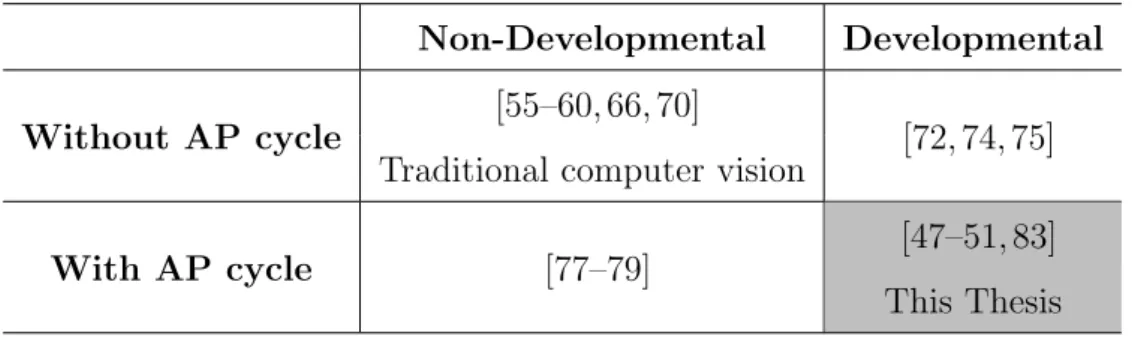
To summarize, the mentioned works are categorized as shown in the Table 2.2. However, with the traditional computer vision approaches, it is not possible to mimic the biological vision system which has the ability to adapt and learn. For the developmental learning approaches it can learn by their own to achieve the biological-like vision system. But, to realize the completed biological vision system, the action-perception cycle is required.
Thus, the studies that falls in the highlighted cell is preferred for creating the biological inspired vision system.
Table 2.2: The mentioned studies in this chapter are categorized as whether they are developmental or has the action-perception (AP) cycle.
Non-Developmental Developmental Without AP cycle [55–60, 66, 70]
[72, 74, 75]
Traditional computer vision
With AP cycle [77–79] [47–51, 83]
This Thesis
Chapter 3
Preliminaries
This chapter explains the concept, tools, and algorithms that are used in this research.
3.1 Developmental Learning and Active Depth Per- ception
For living organisms such as humans and mammals, when they were born they do not instantly understand how to use the information they perceived. They continuously learn and improve their perception while interacting with the environments during their lifetime.
This is usually described as developmental learning.
The essence of building the biologically plausible robot is based on the developmental learning of perceptual and behavioral abilities from humans and developed organisms.
Recently, there are many studies on computer vision related to human cognitive systems for autonomous robots, inspired by the facts that humans can autonomously develop and recover their perceptual and behavioral abilities to survive in various environments. These abilities are not only useful for extracting visual information for guiding actions, but they are also for perceiving the environments.
However, the data that are collected by human or animals organs are very noisy messy data. It is not self-explanatory meaningful information [84, 85]. In [86], they discussed that our brain did not programed to know how to use those data, but instead the brain is trained autonomously to learn how to translate those noisy unordered information into useful information.
Synthetic approaches based on explanation and design could be proposed to overcome the shallow knowledge [11], but it is still a very challenging task to implement the devel- opmental system in an autonomous learning manner. In order to realize a developmental robot, a system should equip the two important learning principals which are (1) au- tonomous development through their artificial life and (2) unified-learning of action and perception. By establishing a tight connection between action and perception, the visual information can be used to improve the robot’s behavior [76], while the resulted actions effectively reinforce the perceptual learning.
The same idea also applies to the active depth perception which is a process of pro- ducing different kinds of eye and body movement to utilize active visual depth cues.
Moreover, it is required that several cognitive developments such as visual representa- tion (sensory coding), eye movement control (action strategy), and depth representation (high-level sensory perception) should be simultaneously performed by integrating each other during their lifetime (life-long learning). However, the underlying ideas of the active depth perception are still unclear.
Depth perception is a visual ability to perceive the world in three dimensions and the distance of an object. Depth perception is the most fundamental artificial vision problem that must be solved. It is an active process that can involve different kinds of movement such as eyes movement, head movement, and body movement. By adapting the biological vision systems with the current artificial vision systems, we can get rid of the dearth of robustness. In neural science, to use information from sensory system, the system should efficiently encode the sensory information by taking advantages of redundancies. So, we may use the nature of the sensory systems in humans to adapt with our artificial vision system. Neurons are the cells that are in our body. They have an ability to propagate signals rapidly over large distances. Sensory neurons fire sequences of action potentials in various temporal patterns to change their activities. To resemble the neurons in our body, sparse coding is used to represent sensory inputs [87].
Active depth perception is depth perception with action of the agent [88], such as movement of the eyes, body, or manipulating the object. There are three approaches of active depth perception (Fig. 3.1). The first one is depth estimation based on the vergence angle between two eyes [89], or stereo vision [90] (Fig. 3.1a). The second one is estimation
(a) Vergence (b) Motion parallax (c) Optic flow
Figure 3.1: Three different depth perception
based on motion parallax [91, 92]. A controlled lateral movement produces a change of the angle under which the object is perceived (Fig. 3.1b). The depth can be estimated by this change. The last one is estimation based on optic flow [93, 94]. The pattern of optic flow or the visual size of the targeted object could be used to estimate the depth (Fig. 3.1c).
3.2 Sensory Coding
Sensory coding is the information processing that is occurring in nervous systems. Signals from each individual neurons are combined and converged to be be processed at the higher levels in the central nervous system to achieve a specific task such as recognizing an object in visual cortex for the visual sensory. To mimic and realize such a system, there are some hypotheses. In this research, we consider the efficient coding hypothesis in order to realize the visual sensory coding for active perception.
The efficient coding hypothesis [80–82] states that sensory systems should encode sensory information in an efficient manner by exploiting redundancies in their inputs.
The idea is very promising and lead to numbers of research. For example, it inspired a substantial amount of work on the statistics of natural sensory signals and how they may explain receptive field properties of sensory neurons in visual, auditory, or olfactory systems. This idea was used to extended to associate with active perception that involves the movements of the sense organs, because the statistics of sensory signal will always be
the product of the sensory environment, the characteristics of the sense organs and the agent’s behavior. Thus, it is possible to improve the sensory coding by learning to move sense organs in an optimal way.
3.3 Reinforcement Learning
In machine learning, we treat an environment as Markov decision process (MDP). Since a real-world environments are very complicated and involves many variables, reinforce- ment learning does not aim to fully realize the whole environment, but to simulate them with out prior knowledge about the environment model (unsupervised learning). This makes the reinforcement learning suit to this research. Through out this thesis, we use a reinforcement algorithm to represent the learning of behavior of the robot.
Reinforcement learning define a policy which maps the state of the actor in its envi- ronment to a specific action. The main concept is that an agent (the robot) do something, then it receives a reward with respect to the selected action (training) such as in Fig. 3.2.
Figure 3.2: Basic diagram of reinforcement learning
The foundation of every reinforcement learning model is that it has a set of environ-
ment states S, a set of actions A, and policy. The flow of the steps is as follows:
1. Observe state, st 2. Decide on an action, at 3. Perform action
4. Observe new state, st+1 5. Observe reward, rt+1 6. Learn from experience 7. Repeat step 1
The agent aims to find a suitable policy that maximizes the observed rewards over its lifetime. It considers two important functions. Value function evaluates the best rewards that the agent could get in its lifetime based on its action in the past.
Vπ(st) = R(st, π(s), st+1) +Vπ(st+1) (3.1) Where, R(st, π(st), st+1) is the reward that the agent would get, if the agent perform action at state st with respect to the policyπ to the statest+1.
The another function is a state-action value function Q(st, at). It is different from the previous value function Vπ(st). It shows the best reward that the agent could get if take the action at from state st.
Q(st, at) =R(st, at, st+1) + max
a0 Q(st+1, a0) (3.2) In this research, we use the Natural Actor-Critic Reinforcement Learning algorihtm [95], a modified actor-critic reinforcement learning. The next section will explain the basic of the actor-critic reinforcement learning and then the last section will explain the algorithm we use.
3.3.1 Actor-Critic
Actor-Critic is a reinforcement learning that consider two subconscious mind which are actor and critic. The actor generate an action based on the critic, by mapping states to
actions based on probabilistic. The critic criticize the action selected by the actor, by mapping states to expected cumulative future reward. In other word, the critic consider a prediction problem, while the actor focus on the control of the action. Both actor and critic shares the same error which is temporal difference (TD) as shown in Fig. 3.3.
The error is used to estimate the average reward for a state-action pair. TD error, δt, is defined by
δt=rt+1+γV(st+1)−V(st) (3.3) Critic: an action at is strengthened based on the TD error. TD error measures the selected action. Positive TD error means that the selected action at has a better reward, so the actionatshould be encouraged in the future. While, a negative TD error discourage the action at.
Actor: actor use the information from the critic to update the policy parameter of the actor, θ(st, at) as follows:
θ(st, at) =θ(st, at) +βδt (3.4)
Figure 3.3: Actor-Critic model
3.3.2 Natural Actor Critic
Natural actor critic proposed in [95] is considered as a reinforced actor critic reinforcement learning algorithm. They provide 4 variations of the algorithm. In this research, we choose the algorithm number 3, since it is also recommended by the creator themselves.
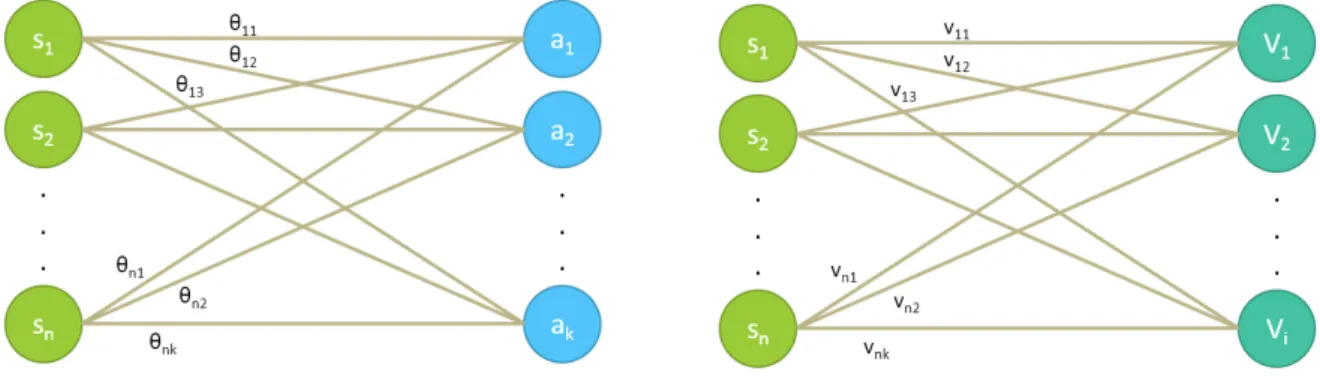
Natural actor critic uses two linear neural networks to implement the actor and the critic (Fig. 3.4).
Figure 3.4: Two neural network implementing actor and critic The selected algorithm is explained in Table 3.1 below.
• t is the iteration number.
• Jˆis average reward.
• fst is a feature vector for state st.
• v is neural network weights for feature vector fst.
• w is neural network weights for policy parameter vector θ.
• θ is policy parameter vector.
• α, β, ξ are step sizes for updating weight vector w, θ, and average reward ˆJ respec- tively.
• φstat is a feature vector for state-action pair.
for softmax activation policy, Gibbs distribution, which we use in this research π(st, at) = eθ|φstat
P
a0∈Aeθ|φsta0 (3.5)
Table 3.1: Natural Actor Critic Algorithm 3 in [95]
1: Input:
• Randomized parameterized policy π
• Value function feature vector fs 2: Initialization:
• Policy parameters θ =θ0
• Value function weight vector v =v0
• Step sizes α =α0, β=β0, ξ=cα0
• Initial state s0 3: for t= 0,1,2, ...do 4: Execution:
• Draw action at∼π(st, at)
5: Average Reward Update: Jˆt+1 = (1−ξt) ˆJt+ξtrt+1
6: TD Error: δt=rt+1−Jˆt+1+v|fst+1−vt|fst 7: Critic Update: vt+1 =vt+αtδtfst
wt+1 = [I−αtψstatψ|s
tat]wt+αtδtψstat 8: Actor Update: θt+1 =θt+βtwt+1
9: endfor
10: return Policy and value function parametersθ, v
ψstat =φstat − X
a0t∈A
π(st, a0t)φsta0t (3.6)
3.4 Neural Network
Neural network is an artificial systems that is inspired by the biological neural networks that can mostly be found in the developed organisms. The system learns to achieve the given tasks by accounting the given supervised examples. It can be used to predict or estimate a specific value if it is given enough of the examples.
Throughout the thesis, we consider only a basic neural network which contains only 3 layers of the artificial neurons for realizing the depth perception module. We chose
the neural network because it suits to our goal which is creating the biological inspired framework for robots.
Chapter 4
Realizing of Active Perception
This chapter explains the fundamental of each module in the framework proposed in [47, 48] which are the foundation of our research.
4.1 Philosophy of This Work
Before we start to explain the work in detail, we would like to emphasize the philosophy of the work. The work aims to generate the vergence eye movement that is require to minimize the disparity of the perceived images from the two cameras. This task can be done with the conventional computer vision techniques as discussed in the introduction chapter. However, the studies either lack of the link between action and perception or are non-developmental system. So, it is difficult to mimic the developing organisms visual systems which has the processes tightly coupled.
4.2 Vergence Eye Movement
When we look or focus at an object, the line of sights of the two eyes cross. The movement that is required to achieve that is called vergence eye movement. It is a simple function that control both eyes to point their fovea on a visual stimulus. Both eyes rotates in opposite direction to maintain the same binocular vision (Fig. 4.1). In case of the robot, two cameras are rotated around the vertical axis (pan) so that the observed images are similar.
Figure 4.1: Vergence eye movement
4.3 Model Architecture
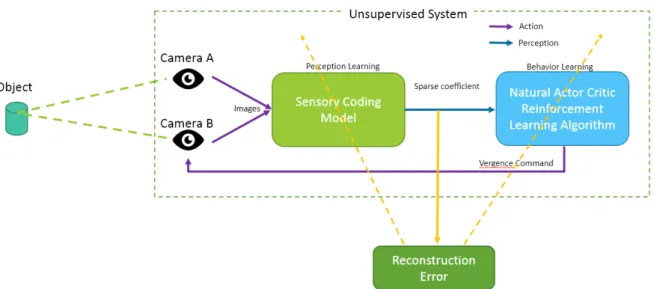
The work utilizes the active efficient coding theory together with a reinforcement learner to create the binocular active perception framework. It focuses to generate appropriate eye movements to fixate a visual stimulus for both eyes (vergence eye movement). Their framework is shown in Fig. 4.2. Two images are taken from two cameras and then input to the sensory coding model. Sensory coding model represent as the perception module of the robot. It encodes the input images into a sparsely encoded image vector which is then sent to the behavior module, the reinforcement leaner. Reinforcement learner learns to select a vergence eye movement based on the unified cost function which is the reconstruction error from the sensory encoder. This cost function measures how efficient the images could be encoded. Low reconstruction error means that the two input images are similar, thus the two images has low disparity, i.e. the two cameras are pointing at the similar point. The following sub-sections will explain the details of each module.
4.3.1 Sensory Coding Model
As discussed earlier in Chapter 1, a sensory system should encode sensory information efficiently by exploiting redundancies in their inputs. A sparse coding technique is used to implement the sensory coding model under the active efficient coding theory. It encodes the input images from the two cameras into a one dimensional sparse vector. It also computes the loss or the reconstruction error of the encoded vector. Each part of the
Figure 4.2: Zhao et al.’s framework sensory coding model is shown in Fig. 4.3
Figure 4.3: Inside of sensory coding model
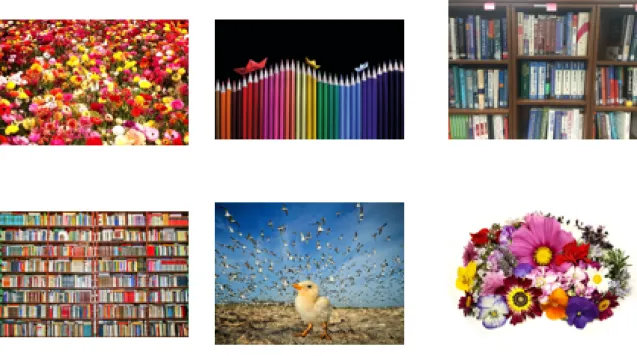
The inputs are the images taken from the two cameras. Disparities are measured by the horizontal shift of image of the object from left to right. Different depth makes different disparity. To understand the framework, we recreate the framework in a simulation. 6 images are used to test the framework (Fig. 4.4).
Throughout the simulation, the images are selected randomly every 10 iterations. To virtually simulate the image taken from cameras, the images are cropped with the windows size of 128 by 128 pixels in the center of the images. There are two crop windows to represent each camera. One window is fixed at the center, while the another window
Figure 4.4: Images that are used in binocular vision framework simulation
can be shifted horizontally to represent the vergence eye movement, i.e. the stereo pairs are artificially generated by shifting one of the input images horizontally. The goal of the framework is to generate the vergence eye movement that yields close to zero retinal disparity.
The two input images are converted to gray scale. Then, we extract images into a multiple of 8 by 8 pixel patches. The patches are extracted by shifting 1 pixel horizontally and vertically. The patches are then sub-sampled by a factor of 8 by using Gaussian pyramid algorithm. Finally the patches are converted to a vector and normalized to have zero mean and unit norm xi(t), where iis the index of the patches. The processed image vector from left and right eye are concatenated into a single vector x(t). The vector has P = 128 elements.
For the encoding part, the sensory encoder select a linear combination of basis func- tions drawn from an over-complete dictionary φ(t) = {φn(t)}Nn=1 to represent the sparse coding [87]. In our setup, we prepare a visual dictionary that containsN = 288 randomly generated normalized basis functions. Matching pursuit algorithm is used to estimate and
find the appropriate linear combination as follows:
xi(t)≈
N
X
n=1
ai,n(t)φn(t) (4.1)
We limit the number of non-zero scalar coefficientsai,n(t) used in the matching pursuit algorithm to 10 elements to enforce the sparsity of the encoded image (efficient coding).
The coefficients generated by the algorithm are the final product of this module which will be used later in the reinforcement learner as pooled activity. Pooled activity simply represent the activeness of each neuron (the coefficients). It consider the sum of all coefficient from every patches as follows:
fn(t) =
P
X
i=1
ai,n(t)2 (4.2)
To measure the redundancy in the input images, we use the reconstruction error which compares between the encoded images and the input images.
e(t) = 1 P
P
X
i=1
kxi(t)−PN
n=1ai,n(t)φn(t)k2
kxi(t)2k (4.3)
This error can be used to improve the visual dictionary by using the gradient descent updating technique. Importantly, this error will also be used in the reinforcement learner, thus the unified cost function.
4.3.2 Multi-Scale Framework
Binocular cells tuned to different disparity ranges in visual cortex areas. These cells adjust and adapt the controlling mechanism to generate fast or slow vergence response depending to the range of disparity [96]. In [48], they show that the framework proposed in [47] has the input disparities limitation which means that the framework could not generate an appropriate eye movement if the disparity is too high. So, [48] propose a strategy to overcome the problem. They use multi-scale input images to represent two areas, foveal and parafoveal area. The model use two scales of images which are fine scale and coarse scale as shown in Fig. 4.5. Fine scale images represent a foveal region in our eyes, as we can get more detail from the center of vision. The coarse scale represents a parafoveal area.
Figure 4.5: Multi-scale binocular vision model
The process is still similar to the above, but with multi-scale we add two 80x80 pix- els crop windows to represent the fine scale. The sub-sample factor for this scale is 2.
The patches are extracted by shifting 4 pixels horizontally and vertically. An additional dictionary is used to represent the fine scale’s visual dictionary.
4.3.3 Reinforcement Learning
Uni-scale Framework
As mentioned in Chapter 3, we use the natural actor critic reinforcement learning algo- rithm. The state is represented by the pooled activity, while the reward is a function of the reconstruction error (unified cost function). The pooled activities are used as state as follows:
fst =f(t) =
f1(t) f2(t)
... fP(t)
(4.4)
Actions that are generated from this reinforcement learner are the vergence eye move- ments. Negative of the reconstruction error is used as the reward to train the reinforcement learner.
rt=−e(t) (4.5)
The reinforcement learner learns to select actions that maximize the discounted cumula- tive future reward, i.e. minimizing the reconstruction error.
Actions are defined as A ={−2,−1,0,1,2}. The elements in A represents the num- ber of pixels to be horizontally shifted (virtual vergence eye movement). We use Gibbs distribution for choosing an action. In this simulation, the step sizes are set as follows:
• α= 0.1
• β = 0.01
• ξ= 0.01
The neural network weights v, w, and policy parameterθ are initially randomized.
Multi-Scale Framework
Similar to the above, we use the pooled activities to represent the current state. The difference is we concatenate the two pooled activity together.
fst =f(t) =
f1C(t) f2C(t)
... fPC(t) f1F(t) f2F(t)
... fPF(t)
(4.6)
The reward is also modified to consider the sum of the error from both scales.
rt =−(eC(t) +eF(t)) (4.7)
Superscript F means fine scale, while superscript C means coarse scale. We use the set of actions, step sizes, and softmax operation as the same in the uni-scale framework simulation setup.
4.4 Simulation & Results
We use mean absolute error (MAE) to measure the eye movement performance. It tracks the vergence error in the iteration before the image is changed which is every 9thiteration.
MAE is defined as follows:
M AE(t) = 1 100
99
X
k=0
|α(t+ 9 + 10k)−α∗(t+ 9 + 10k)| (4.8) whereα∗ is the target vergence at the current iteration. Fig. 4.6 shows the eye movement MAE from the simulation.
iteration ×104
0 2 4 6 8 10 12 14 16
AME (pixels)
1 2 3 4 5 6 7 8
Figure 4.6: MAE of the simulation
The error reduces over time and stays around 2 pixels. This means that with the current specification, the framework has learn its best from the available input images.
After the framework is trained to generate the overlapped images (Fig. 4.7), we perform another test to evaluate the framework at different disparities. Fig. 4.8 shows the actual vergence eye movement versus the desired vergence, while Fig. 4.9 shows the vergence error.
Figure 4.7: Example of some of results of the simulation
Figure 4.8: Vergence tracking after training is finished
We can see that the framework can properly control the vergence eye movement. It can handle the quick changes in disparity. It can maintain the disparity after reaching zero retinal disparity. The maximum error is around 1 pixels.
4.5 Summary
In this chapter, a novel framework proposed in [47] and multi-scale extension of the framework [48] have been explained and discussed. We showed that the system can
Figure 4.9: Vergence error
autonomously learn how to control left and right camera to generate vergence eye move- ment.
Chapter 5
Schemes of Motion Parallax Based
After we have studied and understand the previous framework in the chapter 4, this chapter explains the extended framework with motion parallax.
5.1 Philosophy of This Work
Estimating depth by using vision system has been continuously researched for a long time.
There are a lot of works that can estimate depth by using binocular disparity. However, there is little work on depth estimation by using monocular depth cue. Some of them require specific condition such as environment, some requires calibration. So, if there are some changes or interferences in environment or configuration of vision system, the solution seems to fail later. In order to overcome this problem, we extend the framework in the chapter 4.
The proposed model will have two important abilities, autonomous learning and self- calibrating. The system will be able to learn how to generate an appropriate eye movement during lateral movement for fixating an object. Finally, this chapter will show that ex- tending the stereo active depth perception to another kind of active depth perception is possible.
5.2 Motion Parallax
Parallax is derived from ”parallaxis”, a Greek word which means alteration. It is used
Combining with motion we get a phenomenon which happens when we move laterally. It let us to perceive the apparent position of an object from two different viewpoints.
It is an important effect that can be observed in daily life. It gives us useful information that helps to learn and understand the surrounding environments. When we moves in a lateral direction, we can observe various ranges of motion parallax effect occur by maintaining the visual fixation on an object. We perceive close object to move faster than the object that is farther as shown in Fig. 5.1. For an example, at start we can see red box and yellow box (Fig. 5.1a), but after we moved laterally we can see only the yellow box (Fig. 5.1b). We can conclude that yellow box is farther than the red box.
Usually, motion parallax effect provides two different kinds of depth perception which are the distance from the observer to the fixating object (egocentric distance), and the distance from the fixating object to another object (allocentric distance). Usually, allo- centric distance is extracted from the motion parallax phenomenon such as in [97] they discuss how it is possible to generalize the relationship between the eye movements and the allocentric distance. However, that is not only the strong point of utilizing the motion parallax effect. In [98], they show that it is possible for humans to extract the egocentric distance. Also, the retinal motion induced by the motion parallax effect can be utilized to observe the apparent depth (egocentric distance) appears on the sagittal plane [99].
For simplicity, in this thesis, depth and distance mean the egocentric distance.
(a) Start position (b) End position
Figure 5.1: Images created by lateral movement from left to right
5.3 Smooth Pursuit Eye Movement
To maintain fixation on an object, a smooth pursuit eye movement is required. It is simply an eye movement that keeps track of a visual stimulus. As shown in Fig. 5.2, the eye must rotate in the opposite direction of the movement to maintain the fixation. If the subject move to the left, the eye must rotate to the right, and vice versa.
Figure 5.2: Depth perception from motion parallax
5.4 Model Architecture
We consider different image input and camera control to extend the framework as shown in Fig. 5.3. Also, we only use one camera for the image input, since to achieve motion parallax one eye is sufficient. Two different viewpoint is achieve by moving camera later- ally. The images from the two viewpoints are used as the input images. The output of the reinforcement learner is the smooth pursuit eye movement. The goal of the framework is to generate the smooth pursuit eye movement to fixate the object at the center of the gaze after moving laterally. Then the movement information is used to estimate depth by using a two layer neural network. The neural network is supervised. It use the ground truth depth information.
5.5 Experiments & Results
We verify the framework with MATLAB and a robot simulator called V-REP. The main framework and algorithm are implemented in the MATLAB, while V-REP provides the environment simulation, Fig. 5.4. The simulation environment composes of a HOAP3 robot, an interchangeable texture box, and a background.
5.5.1 Simulation
Lateral movement of the robot is simply pick-and-place. The possible distance between the box and the robot are 1 meter to 2 meters. The robot moves laterally from left to right by 50 centimeters for 5 steps, thus we get 5 images for one lateral movement from left to right, Fig. 5.5. Two successive images are used as the input images. Similar to the previous chapter, we use the image shifting to simulate the eye movement.
After processing the first two successive images for 15 iteration, the sensory coding model selects the next pair of the successive images. After reaching the final pair of the successive images, the texture box is picked an d placed farther by 10 centimeters. The process is repeated until the depth reaches 2 meters, then the depth is reset to 1 meter.
Every 14 iterations, we record the number of shifting pixel q (eye movements) together with depth d at that point of the time in a depth data matrixD.
D=
q1 q2 q3 · · · d1 d2 d3 · · ·
(5.1)
After the framework can properly generate the smooth pursuit eye movement (by over- lapping the two successive images), we train the depth estimation part. Neural network is used to estimate the depth by learning from the depth data D. We use a two layer feed-forward neural network with a sigmoid transfer function in the hidden layer and a linear transfer function in the output layer (Fig. 5.6). The hidden layer has 10 neurons.
The training algorithm is Levenberg-Marquardt method. In the first row of the depth data matrix D, we use it for the input of neural network. We use the second row of the matrix to be the target. 70-percent of the data is reserved for training. 15-percent is for validating. And another 15-percent is for testing.