Japan Advanced Institute of Science and Technology
JAIST Repository
https://dspace.jaist.ac.jp/
Title ホームネットワーク環境における生活環境に注目した
活動認識フレームワーク
Author(s) Wongpatikaseree, Konlakorn Citation
Issue Date 2013‑09
Type Thesis or Dissertation Text version ETD
URL http://hdl.handle.net/10119/11557 Rights
Description Supervisor:丹 康雄, 情報科学研究科, 博士
High Performance Activity Recognition Framework for Ambient Assisted Living in The Home Network
Environment
Konlakorn Wongpatikaseree
Japan Advanced Institute of Science and Technology
High Performance Activity Recognition Framework for Ambient Assisted Living in The Home Network
Environment
by
Konlakorn Wongpatikaseree
Submitted to
Japan Advanced Institute of Science and Technology in partial fulfillment of the requirements
for the degree of Doctor of Philosophy
Supervisor: Professor Yasuo Tan
School of Information Science
Japan Advanced Institute of Science and Technology
September 2013
Dedication
To my respected parents, my beloved wife.
Abstract
Until now there has been continued growth in the size of the aging population living at home alone and suffering from physical disabilities. To this effect, many kinds of research are being developed for a system that can improve the quality of life of elderly or needy people in the ambient assisted living (AAL) environment, especially in the home domain. Nevertheless, the information, used in current research works, might not be enough in some circumstances. Other information might help improve the ability of the current research with human activity information being one of them. Thus, this research proposes a high performance activity framework for obtaining more reliable, reasonable, and accurate results.
Consequently, this dissertation describes a “High Performance Activity Recognition Framework for Ambient Assisted Living in the Home Network Environment.” The main goal of this study is to develop a high performance activity recognition framework for home application based on the results of this research.
To achieve the goal of this dissertation, Context-aware Activity Recognition Engine (CARE) architecture is designed as a human activity framework. The application re- quiring human activity information can be built on top of the CARE architecture, i.e.
the healthcare system, semantic ontology search system, home security system, etc. The CARE architecture consists of six layers each combining several technologies and tech- niques.
For building the practical architecture, this research proposes a context sensor network (CSN) in the real environment to collect the surrounding information in the home; in- cluding human information. The proposed CSN integrates several sensing techniques for obtaining the data and several communication networks for its transmission. Moreover, posture classification is also presented in this research with a novel range-based algorithm for classifying human posture. All the information will be conformed to the new user’s context, and sent to the proposed activity recognition system.
Ontology-Based Activity Recognition (OBAR) is introduced in this research for clas- sifying the human activity based on the new user’s context. The ontology approach is selected to define semantic information in the smart home and also to model human activ-
ity. The OBAR system is different from other existing activity recognition in terms of the new user’s context and history information. The original idea of using an ontology con- cept does not support temporal reasoning. However, the OBAR system is implemented together with the external program to keep track of temporal reasoning. Moreover, a new term of activity log introduces the activity’s location in activity log (AL2). The history of activity occurring at the current user’s location will be investigated. It improves the results more reasonably and reliably. Through experimental studies, the results reveal that the proposed CARE architecture can achieve an average accuracy of 96.60 %.
Since the proposed research can produce reliable, reasonable, and accurate results of activity recognition, several home applications in the research domain can become more efficient by utilizing the results of this research. For example, the activity information can be used in the healthcare domain for analyzing or recognizing a disease. In the provision of home service delivery, current research systems are dependent on the current situation.
However, if the system knows the user’s habits based on routine activity, it can prepare the home service automatically.
Acknowledgments
I would like to convey my gratitude to my principal advisor, Professor Dr. Yasuo Tan, who encouraged and advised me with ideas for my dissertation from beginning to end. I am delighted and grateful to be able to work under the excellent supervision of Professor Dr. Yasuo Tan. He provided me with unlimited support and cooperation. He gave me the opportunity to carry on my research at JAIST in Japan under The Graduate Research Program (GRP) scholarship. Without his help, I would not have been able to finish this research.
I gratefully acknowledge the generous support and cooperation of Associate Professor Dr. Azman Osman Lim, who is my sub-supervisor. He provided many valuable comments and intellectual support to my research. He helped me to realize how fun it is to undertake scientific research in Japan. I gained excellent knowledge on the production of a good publication from my sub-supervisor.
I am deeply grateful to my minor research supervisor Professor Dr. Mitsuru Ikeda, who has provided me with the ontology knowledge during my minor research work. Being a novice to ontology knowledge, he gave some helpful guidelines, discussions and suggestions throughout my research. He taught me not only academically, but also showed me the way to carry out the research. I still remember his talk “You do not need to do complicated research, but you have to make a research contribution.” I would like to thank, Dr.
Hideaki Kanai, Associate Professor in the School of Knowledge Science of JAIST, for his help. He gave me a great chance to conduct my first experiment in his research facility,
“AwareRium”.
I would like to express special thanks to my professors in Thailand. Assistant Pro- fessor Dr. Cholwich Nattee, Associate Professor Dr. Thanaruk Theeramunkong, Dr.
Thepchai Supnithi, Dr. Marut Buranarach, Dr. Ananlada Chotimongkol, and Dr. Den- duan Pradubsuwan. All of them have supported me absolutely throughout my Bachelor degree, and also inspired me to study Doctoral degree in Japan.
I devote my sincere thanks and appreciation to Mr. Marios Sioutis, Mr. Junsoo Kim, Mr. Yoshi Makino, Ms. Wai Wai Shein, and Mr. Zhengguo Yang, and all the members of
“Tan & Lim Lab” for their support and cooperation. Working with them has helped me to discover fun and enjoyment during my stay at JAIST. I am also grateful to my friends:
Mr. Chaianun Damrongrat, Mr.Kobkrit Viriyayudhakorn, Mr. Apimuk Muengkasem, and all my Thai friends who helped to make the three years fly by.
I would like to thank my parents, Mr. Siri Wongpatikaseree and Ms. Chantana Udompuksa, who kindly support me in all I do. Moreover, I am fortunate to have my beloved wife, Ms. Arunee Ratikan, whose kind support, encouragement and love always inspired and motivated me during the tensions and frustrations of my life.
Last but not least, my sincere thanks to all the JAIST staff and those who have co- operated with me. They have always been very helpful with any problems I have had during my stay in Japan.
Contents
Abstract i
Acknowledgments iii
1 Introduction 1
1.1 Introduction . . . 1
1.2 Statement of problems . . . 3
1.3 Research objectives . . . 4
1.4 Research methodologies and originalities . . . 5
1.5 Chapter Organization . . . 6
2 Literature Reviews 8 2.1 Introduction . . . 8
2.2 Ambient Assisted Living (AAL) System . . . 9
2.2.1 Home-based AAL System . . . 9
2.2.2 Current Approaches in Home-based AAL system . . . 16
2.3 Activity Recognition System . . . 19
2.3.1 Sensing . . . 20
2.3.2 Recognition . . . 23
2.4 Conclusion . . . 27
3 Context-aware Activity Recognition Engine (CARE) Architecture 28 3.1 Introduction . . . 28
3.2 A Layered Architecture of CARE Architecture . . . 29
3.3 CARE Architecture Overview . . . 30
3.4 Contributions of CARE architecture . . . 31
3.5 Conclusion . . . 33
4 Data Collection using CSN 34 4.1 Introduction . . . 34
4.2 Context Sensor Network (CSN) . . . 34
4.2.1 Home Appliance Sensor Network . . . 35
4.2.2 Home Furniture Sensor Network . . . 37
4.2.3 Human Sensor Network . . . 44
4.3 Conclusion . . . 46
5 Posture Classification 47 5.1 Introduction . . . 47
5.2 Posture classification . . . 47
5.3 Experiments and results of posture classification . . . 52
5.4 Discussion . . . 58
5.5 Conclusion . . . 60
6 Ontology-Based Activity Recognition (OBAR) 61 6.1 Introduction . . . 61
6.2 Data Organization . . . 62
6.2.1 Data Manager . . . 62
6.2.2 System Repository . . . 63
6.3 Ontology-Based Activity Recognition (OBAR) . . . 69
6.3.1 Ontology Modeling . . . 70
6.4 Recognition Engine . . . 77
6.5 Conclusion . . . 79
7 Activity Recognition using CARE 81 7.1 Introduction . . . 81
7.2 Impact of Description Logic Rule . . . 82
7.3 Environment Setup . . . 85
7.4 Performance Evaluation . . . 86
7.5 Findings . . . 89
7.5.1 Ambiguous Activity Problem . . . 89
7.5.2 Effect of Activity Log . . . 90
7.6 Discussion . . . 92
7.7 Conclusion . . . 94
8 Applications 96 8.1 Introduction . . . 96
8.2 Semantic Ontology Search . . . 96
8.3 Home Healthcare (HHC) . . . 98
8.3.1 Activity Information Analysis . . . 99
8.3.2 Object Interaction Analysis . . . 101
8.3.3 Human Location Analysis . . . 103
8.4 Home Security . . . 104
8.5 Human Behavior Schedule System . . . 105
8.6 Home Service Schedule System . . . 107
8.7 Smart Power Management System . . . 108
8.8 Conclusion . . . 109
9 Conclusion and Future Research 111 9.1 Conclusion . . . 111
9.2 Future Research . . . 114
Appendices 117
A List of Description Logics Rules 118
References 134
Publications 147
List of Figures
1.1 Next generation smart home network [7] . . . 3
1.2 Organization of this dissertation . . . 7
2.1 The example areas of AAL environment [12] . . . 10
2.2 Conceptual description of the home-based AAL system . . . 11
2.3 The example devices in [21] . . . 13
2.4 The basic concept of HHC . . . 18
2.5 The example of the activity ontology . . . 26
3.1 A layered architecture of the CARE architecture . . . 30
3.2 CARE architecture . . . 32
4.1 The smart home, iHouse, used for the real activity recognition experiment 35 4.2 Procedure of network communication of the home appliance sensor network 37 4.3 Flowchart of the procedure in the home appliance sensor network . . . 38
4.4 The force sensor . . . 40
4.5 The gyro sensor . . . 40
4.6 The “Cupboard” with magnetic sensor . . . 41
4.7 The network system in home furniture sensor network . . . 42
4.8 The Arduino Fio with external board and sensor . . . 43
4.9 Finite state machine of the sensor node. . . 44
4.10 The infrared sensor in iHouse . . . 45
4.11 Example scenario in [88] . . . 46
5.1 Physical patterns of “Standing” and “Sitting” . . . 48
5.2 Binary decision tree of the range-based algorithm . . . 49
5.3 FSM of the range-based algorithm . . . 49
5.4 Flowchart for PPR when the size of the adaptive posture window is 4 . . . 52
5.5 Experimental setup for posture classification . . . 53
5.6 Procedure of comparison between the range-based algorithm and the height- based algorithm . . . 54
5.7 The difference between the size of posture window and accuracy . . . 54
5.8 The error in “Lie-down→Sit” state . . . 57
5.9 Compares the results when there are a different number of sensors . . . 59
6.1 The data error from the shower sensor . . . 63
6.2 Data flow between the system repository and OBAR . . . 64
6.3 Mapping data process with OAM framework (1) . . . 66
6.4 Mapping data process with OAM framework (2) . . . 67
6.5 EER diagram of context-aware information . . . 68
6.6 The context-aware infrastructure ontology . . . 72
6.7 The relationship in the Context class, Sensor class, Object class, and Lo- cation class . . . 73
6.8 Functional activity ontology . . . 75
6.9 Activity log in the ontology model . . . 77
6.10 Example rule for the “Washing dishes” activity in Jena syntax . . . 79
6.11 Example activity instance of the “Washing dishes” activity in Jena syntax 79 7.1 Recognition accuracy for each activity . . . 84
7.2 Comparison of the activity recognition accuracy rate in existing research results . . . 88
7.3 Ambiguous activity problem . . . 90
7.4 Limitation of snapshot input data is solved in context id 872-873 . . . 91
7.5 The results of the semantic ontology search application, AL2 is used in Context id 29 . . . 92
8.1 The example of semantic ontology search application . . . 98
8.2 The activity information in human behavior analysis system . . . 100 8.3 The object interaction information in the human behavior analysis system 102
8.4 Human behavior schedule system . . . 105
8.5 Creating the human behavior patterns . . . 106
8.6 Home service schedule system . . . 108
9.1 Future research model . . . 115
A.1 Rule for “Sitting on the toilet” activity in Jena syntax . . . 118
A.2 Activity instance of “Sitting on the toilet” activity in Jena syntax . . . 119
A.3 Rule for “Taking a bath” activity in Jena syntax . . . 119
A.4 Activity instance of “Taking a bath” activity in Jena syntax . . . 120
A.5 Rule for “Lying down & relaxing” activity in Jena syntax . . . 120
A.6 Activity instance of “Lying down & relaxing” activity in Jena syntax . . . 121
A.7 Rule for “Sleeping” activity in Jena syntax . . . 121
A.8 Activity instance of “Sleeping” activity in Jena syntax . . . 122
A.9 Rule for “Making coffee” activity in Jena syntax (1) . . . 122
A.10 Rule for “Making coffee” activity in Jena syntax (2) . . . 123
A.11 Activity instance of “Making coffee” activity in Jena syntax . . . 123
A.12 Rule for “Cooking” activity in Jena syntax . . . 124
A.13 Activity instance of “Cooking” activity in Jena syntax . . . 124
A.14 Rule for “Eating or drinking” activity in Jena syntax (1) . . . 125
A.15 Rule for “Eating or drinking” activity in Jena syntax (2) . . . 125
A.16 Rule for “Eating or drinking” activity in Jena syntax (3) . . . 126
A.17 Activity instance of “Eating or drinking” activity in Jena syntax . . . 126
A.18 Rule for “Washing dishes” activity in Jena syntax . . . 127
A.19 Activity instance of “Washing dishes” activity in Jena syntax . . . 127
A.20 Rule for “Working on a computer” activity in Jena syntax . . . 128
A.21 Activity instance of “Working on a computer” activity in Jena syntax . . . 128
A.22 Rule for “Watching TV” activity in Jena syntax (1) . . . 129
A.23 Rule for “Watching TV” activity in Jena syntax (2) . . . 129
A.24 Activity instance of “Watching TV” activity in Jena syntax (1) . . . 130
A.25 Activity instance of “Watching TV” activity in Jena syntax (2) . . . 130
A.26 Rule for “Reading a book” activity in Jena syntax . . . 131
A.27 Activity instance of “Reading a book” activity in Jena syntax . . . 131
A.28 Rule for “Scrubbing the floor” activity in Jena syntax . . . 132
A.29 Activity instance of “Scrubbing the floor” activity in Jena syntax . . . 132
A.30 Rule for “Sweeping the floor” activity in Jena syntax . . . 133
A.31 Activity instance of “Sweeping the floor” activity in Jena syntax . . . 133
List of Tables
3.1 Target activities in this research . . . 29
4.1 Power consumption of three devices . . . 43
5.1 The example of posture patterns with a size of adaptive posture window of 4 51 5.2 Accuracy of the height-based algorithm and range-based algorithm in the static posture experiment . . . 55
5.3 Accuracy of the consequence postures experiment . . . 56
5.4 Accuracy of the fall-down detection experiment . . . 57
7.1 Recognition performance for each factor . . . 83
7.2 Accuracy of OBAR . . . 87
8.1 METS values in 14 activities . . . 101
Chapter 1 Introduction
1.1 Introduction
For the last 50 years [1], the world’s population has multiplied more rapidly than ever before, and is projected to grow even more rapidly in the future. From the statistics, the world population was 2.5 billion in 1950, 6.5 billion in 2005, and could reach more than 9 billion in 2050. The exponential growth poses problems for almost every country.
Each government faces the difficult task of dealing with the population in their country.
Meanwhile, the growth of high technology, especially in medicine, is one of the important and emerging factors that increases the average age of the population. The proportion of people who are over 60 years old is increasing faster than any other age group. For exam- ple, nearly 25 million Japanese are over 65 years old and approximately 20,000 citizens are over 100 years old. The World Health Organization [2] estimates that the original shape of the population will have inverted to an up-side-down pyramid by 2025, with people aged 80 and above accounting for the largest population group.
Improving the quality of life is attracting growing attention contributing to intensive thrusts from the latest technological development and application demands. The Ambient Assisted Living (AAL) environment is one of the areas that most researchers are aiming to develop to assist and support independent living and ageing in place. The basic idea of AAL is to provide assistant technologies for enhancing quality of life and supporting people in their daily activities. There are a number of ways that devices in the AAL
environment and connected to ICT technology can help to improve the quality of life and health of the elderly. For example, Panasonic [3] has introduced EW-NK63, a device used for measuring the calories consumed each day. Omron [4] has presented a Heart Scan device for monitoring and recording the ECG information. Based on these example technologies, users can monitor the condition of their own health, and the physician can utilize this data to recognize diseases. Nonetheless, the assistant technologies in the AAL environment are not only limited to medical services. A verities services can provide more comfort in everyday life, higher security in the living environment, or automatic home service and energy saving.
Nowadays, the concept of the AAL environment is also expanded to include the smart home domain. The smart home has emerged as one of the mainstream approaches to sup- port technology-driven independent living for elderly and disabled persons. The smart home concept [5, 6] is combined with several technologies i.e. wireless sensor network (WSN), data communication, and security to produce ambient intelligence in the home.
Figure 1.1 shows an example of the next generation smart home network.
Based on Figure 1.1, powerful and scalable user context can be obtained based on the AAL environment in the smart home. Diversity of sensors is embedded into the object in the home to obtain context-aware infrastructure information. The context-aware infras- tructure information in the smart home is useful in several home systems. For example, knowing how long the home user sleeps at night [8] is considered relevant information for the homecare system, furthermore, realizing the difference between the user’s sleep time and the status of door is useful for the home security system.
According to the ability of the AAL environment in the smart home, the activity recog- nition system plays an important role in realizing the information in the AAL environment and providing the relevant information back to the home application for supporting the independent living and ageing in place. Currently, activity recognition systems aim to capture what humans do on a daily basis [9, 10]. However, realizing the information from activity recognition in supporting the smart home based AAL environment rarely appears
Figure 1.1: Next generation smart home network [7]
in current research. Moreover, constructing the activity recognition is not an easy task.
It is difficult to accurately assess an individual activity pattern because each person has a different lifestyle. Therefore, the development of the high-performance activity recogni- tion framework for realizing the application in the smart home domain presents a number of challenging tasks.
1.2 Statement of problems
When considering activity recognition in the smart home domain, there is a huge amount of information affecting recognition accuracy. Existing research has attempted to classify human activity based on surrounding information in the home. However, most of the research encounters a low recognition accuracy due to various kinds of problems. For example, the system cannot classify human activity when several objects are being used at the same time. Moreover, each human has their own way of performing each activity.
One activity can be performed in a different order depending on the person. Due to these problems, low accuracy results appear in the activity recognition system and it cannot be used for processing by the intelligence system to enhance quality of life and support people in their daily activities in the home. In this sense, the high-performance activity
recognition framework is required for addressing the existing problems. In this section, summarization of the problems of existing research is illustrated as follows:
1. Although the human activity information is useful for several purposes in the smart home domain, it is not easy to achieve reliable results from the activity recognition system. Existing research work has failed to adequately identify human activity because of the variety of human lifestyles.
2. Based on the current research [8, 65, 66, 71], the basic context aware information (user’s location, object activation, and time) is used to conform the user’s context for the activity recognition system. The system provides only a common term of primitive activity and might not be realistic in some circumstances. For instance, most research protocols recognize the “sleeping” activity when a sensor attached to the bed is activated. Nevertheless, this is not always true because there are other possible activities (e.g., the user might sit on the bed and watch TV).
3. Context-aware information, especially object activation information, can lead to an ambiguous problem. For example, when several objects are being used at the same time the activity recognition system generates several possible resultant activities.
The system cannot know which one is the correct answer. This research refers to this problem as the “ambiguous activity problem”.
4. Data collection directly affects the accuracy of activity recognition. Most of the existing research relies on data collected from subjects under an artificial laboratory setting. It is not realistic in a real situation. Thus, data collection in the real home environment is relevant in proving the accuracy of the proposed activity recognition.
1.3 Research objectives
As exploratory research, the main purpose of this study is to develop the high-performance activity recognition framework and realize the applications in the smart home based on the results of the activity recognition framework. Hence, in pursuing this purpose, four objectives are introduced to answer the current problems as follows:
1. The proposed research should have an artificial intelligence module to collect the necessary context aware information in order to conform to a new type of user context in the activity recognition system.
2. The architecture of the system must be well designed to achieve a high performance activity recognition system. Moreover, the proposed activity system should have the ability to reduce the “ambiguous activity problem”.
3. The proposed activity recognition should be a practical system. The activity recog- nition has to demonstrate its operation in real scenarios with volunteer users. Thus, system verification will be introduced to the real environment.
4. Reusability of the recognition results with the applications in the smart home is presented in this research.
1.4 Research methodologies and originalities
To achieve the above objectives of this research, there are two main research methodolo- gies: a context-aware activity recognition engine (CARE) architecture, and an ontology- based activity recognition (OBAR). These are described as follows:
1. Context-aware Activity Recognition Engine (CARE) Architecture:
Designing the CARE architecture is the relevant process that needs to be consid- ered carefully. The CARE architecture is proposed as a human activity recognition framework in the smart home domain. It consists of six layers, each combining sev- eral technologies and techniques. For data collection in the CARE architecture, not all of the surrounding information in the home affects the system, therefore, it is necessary to focus on the relevant information to be used in the activity recognition system. Context sensor network (CSN) is introduced in the CARE architecture to obtain the surrounding information from the home and individual. Moreover, pos- ture classification is also proposed to collect novel information of human posture, in order to conform to a new user’s context.
The originality of this research methodology is that the proposed CARE architec- ture can provide the semantic information in the smart home and human activity information based on the new user’s context, which is obtained through the CSN and the posture classification. Compared with the traditional activity recognition system, the new user’s context shows the ability to reduce the “ambiguous activity problem” more successfully than in the existing system, which uses the common user’s context.
2. Ontology-Based Activity Recognition (OBAR):The ontology concept OBAR is the main approach in the development of activity recognition in this research.
The OBAR is introduced as a sub-system in the CARE architecture. The OBAR addresses the difficulty in explicitly handling huge amounts of information from a di- versity of sensors. Moreover, the ontology concept is used to define the surrounding information in the home and from the individual. Based on the proposed OBAR, the information history is also described in the activity log ontology. A new term in the activity log, called the activity location (AL2) is proposed in this research.
The originality of OBAR is a system that can handle an extra large amount of observing data and limit the training process. The advantage of the ontology con- cept also appears in the OBAR. For example, the OBAR creates the activity model as a standard model. This means the activity model is not specific to the person.
It is totally different to other methods in that the activity model will be specific only to the person who trains the data. Furthermore, the OBAR also shows high- performance activity recognition with the new user’s context and AL2. The AL2 shows this advantage overcomes the existing research, which utilizes the common activity log in activity recognition. The research on the OBAR exhibits not only high performance in classification, but also yields reliable and reasonable results.
1.5 Chapter Organization
This dissertation is organized into nine chapters as shown in Figure 1.2. Chapter 1 pro- vides the introduction of this dissertation, statement of problems, research objectives,
research methodologies and originalities of this research. Then, Chapter 2 describes a review of the existing research in the area of ambient assisted living and activity recogni- tion. Chapter 3 provides an explanation of the CARE architecture. Next, the process of CSN, which is used for collecting data; is described in Chapter 4. After that, a new algo- rithm in posture classification is presented in Chapter 5. This dissertation then presents data organization and describes the process in OBAR in Chapter 5. Chapter 6 shows the evaluation of the impact of the description logic rule used in the OBAR, and also presents the performance of the proposed activity recognition system. Chapter 8 exhibits possible applications which realize the results from the OBAR. Finally, the conclusion and ideas for future research are presented in Chapter 9.
Figure 1.2: Organization of this dissertation
Chapter 2
Literature Reviews
2.1 Introduction
Until now, the smart environment [11] has become popular with the realization of de- velopment technology. Together with the concept of Ambient Assisted Living (AAL), it can provide an interactive environment for improving the quality of life in place. The trend of AAL has expanded into several situations for various purposes. For example, the AAL system in hospitals is proposed for the purpose of healthcare, or the AAL in the smart home is introduced to help the elderly improve their quality of life. In this sense, the AAL system integrates several system concepts for living assistance; and the activity recognition system can improve the ability AAL. The activity recognition system has been explored in different environments, such as homes, hospitals, and factories. In this research, the smart home domain is considered to implement the activity recognition system. The increasing capabilities of generating massive amounts of sensor data related to the smart home environment could provide novel advanced activities of daily living (ADL) for several purposes in the AAL environment.
However, obtaining reliable and accurate results from the activity recognition system is not an easy task. There are several factors that affect recognition accuracy. Accordingly , to build high performance activity recognition for ambient assisted living (AAL), back- ground knowledge in both the AAL system and activity recognition system is required.
In this chapter, the main work reviewed from previous and current work relates to both
the AAL system and the activity recognition system.
2.2 Ambient Assisted Living (AAL) System
AAL is an intelligent system of assistance that aims to improve the quality of life of the elderly or other needy people. AAL systems are seamlessly embedded in the preferred living environment. The systems are capable of gathering environmental and personal information and reasoning with it. They also acquire knowledge of their surroundings with ambient intelligent technologies. The ambient intelligence technologies are widely developed in this domain and aim to construct a safe environment for assisted people and help maintain independent living. Consequently, the AAL system can provide an interactive environment for people based on ubiquitous sensing, environment interaction, and context-awareness.
Accordingly the AAL environment can be extended to incorporate a wide domain, such as hospitals, homes, or companies. Figure 2.1 shows the multifaceted AAL environment, presented in research by O’Grady et al. [12]. The home network environment is the main area of focus. Thus, in this section, research on the home-based AAL system will be reviewed.
2.2.1 Home-based AAL System
The definition of the home-based AAL system is to integrate two basic concepts; the smart home and the AAL. The smart home concept embeds the ambient intelligence technologies for sensing, reasoning, or controlling the environment in a person’s daily life. Meanwhile, the concept of the AAL uses information and communication technolo- gies (ICT) to provide individual support in a person’s preferred living environment. For example, Martin et al. [13] developed the wireless sensor networks (WSN) in the AAL environment to support the provision of future AAL service.
Figure 2.1: The example areas of AAL environment [12]
The definition of the home-based AAL system varies depending on the research, but its final goal is the same. The following is a good description of the home-based AAL system, proposed by Steg et al. [14]
“AAL aims to prolong the time people can live in a decent way in their own home by increasing their autonomy and self-confidence, the discharge of activities of daily living, to monitor and care for the elderly or ill person, to enhance security and save resources”
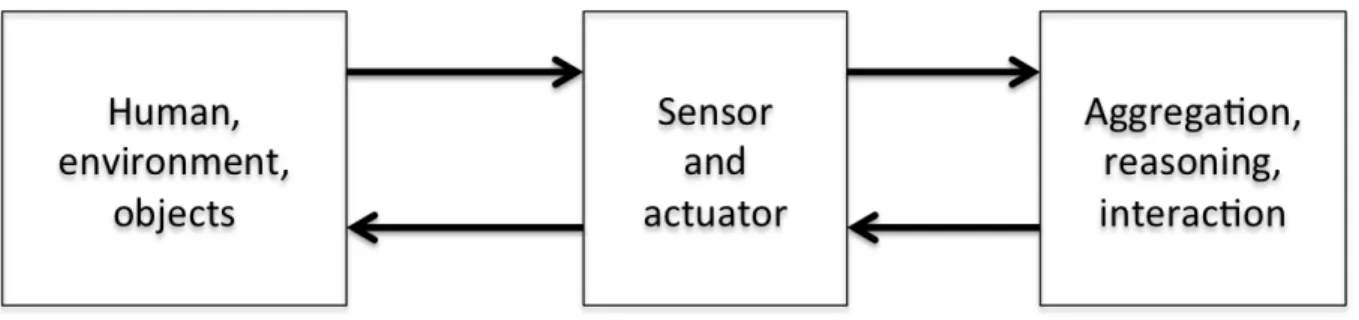
Recently, research on the home-based AAL system has become more popular. Several research studies propose novel architecture for processing the information in the AAL environment. Spanoudakis et al. [15] applied technological solutions in the HERA system for addressing the needs of the elderly suffering from moderate and mild Alzheimer’s Dis- ease. Near Field Communication (NFC) technology has also been developed in research of the home-based AAL system for identifying human location [16]. Human location is used to assist when taking care of people who have a problem with Alzheimer’s. Reichman et al. [17] described the general architecture of the ambient assisted living system. The conceptual description of the home-based AAL system is shown in Figure 2.2 with three
main components. It starts in the physical world. The system gains context-awareness information when humans interact with objects or the environment. For example, home users turn on the “Air-condition”, and the room temperature changes when the “Air- condition” is turned on. This kind of information is based on the observation of the ambient intelligent technology or sensor. The system will then process the data and send the results back to the actuator for the provision of services to the home user or control- ling objects in the home environment.
Figure 2.2: Conceptual description of the home-based AAL system
With the concept of the home-based AAL system, there are several technologies and techniques applied to each part. The following is a detailed description of each part of the home-based AAL system.
1. Human, Environment, Objects
Before providing services or controlling objects in the home, the context-aware in- formation in the home is necessary for later processing stages. In the evolution of homes in the 21st century the concept of ubiquity has been explored for presence- aware home control. The context-aware information in the home-based AAL system can provide various kinds of information, depending on the purpose of the research domain. For example, for the purpose of smart home automation, Beak, et al. [18]
proposed an intelligent home care system based on a sensor platform to acquire en- vironment data from the home. The context-aware information is used in the home appliance control system for managing the optimal performance of devices at home.
Considering in detail of the context-aware information, this can be divided into three types. Firstly, the human information obtained from the home user. For ex- ample, human activity information can be used for predicting or monitoring elderly people in the home. Virone et al. [19] proposed activity prediction for in-home activity monitoring. They used various housing contexts in the home such as an assisted living (AL) facility for a better understanding of behavior. Other human information can also be obtained directly from the user’s body. For example, the user’s health information (body temperature, blood pressure, or ECG) can be used for the home health care (HHC) system. Kang et al. [20] proposed a remote health monitoring and self-check health system. The physician can monitor the patient’s health information (heart rate, blood pressure, or body temperature) to anticipate or detect health risks.
Secondly, comes home environment information. Monitoring home environment in- formation is also useful for the home-based AAL system because it can be used for analysis purposes. For instance, the system observes the current room temperature, and adjusts the room temperature according to the occupants’ comfort. Other home environment information, such as smoke emission can be used in the home security system, or an ambient brightness system can perceive brightness information and control the light in each room for energy saving.
Lastly, there is object interaction information. This information is mainly used in the home-based AAL system for the provision of home service to the user. It is a simple idea to detect the object that the home user is using at that time, and provide a home service based on the activated object. For example, if the system detects that the home theatre is being used by the user, the system might provide an entertainment service to the home user by reducing the brightness in the room and controlling the proper room temperature. In the same way the system is able to perceive that the user is sleeping by detecting the use of the bed. The system might provide a security service by preventing theft.
2. Sensor and Actuator
Based on the information from the first part, sensor and actuator play an important role in collecting the data to interact with the physical world. For observing the data, there are several types of sensors, presented in existing research. Hui Wang et al. [21] proposed the information-based sensor tasking WBAN in u-Health systems.
They aim to prevent stroke disease by gaining health information obtained from portable healthcare devices (e.g. ECGs, EEGs, Blood pressure, Body Temperature, Pulse), shown in Figure 2.3. ature, Pulse), shown in Figure 2.3.
Figure 2.3: The example devices in [21]
To monitor the user’s health information in the AAL environment, the novel health care device is also presented in Lopez et al. [22]. They developed electronic textiles (e-textiles) for measuring physiological data. The advantage of e-textiles is not only for monitoring the patient’s health, but also their comfort. It does not disturb the user when using the e-textiles [23, 24]. For observing other information in the home, Rowe et al. [25] introduced a micro-climate for a personal tracking application in the indoor environment. Human location can be used for tracking elderly people or taking care of individuals with Alzheimer’s. Kovacshazy et al. [26] detected human motion through the passive infrared (PIR) motion sensors in the AAL en- vironment. The collected information can be used in the security application by
monitoring movement in the observed area, and also used for tracking the activity of elderly people in the home. Wei Wei et al. [27] proposed a home temperature control (HTC) system. They designed a PID controller for temperature control in the cyber-physical home system. Air-conditioners and windows are controlled by both PID hybrid controllers.
Using video cameras is one option to observe the information in the home-based AAL system. Poh et al. [28] presented a methodology for contactless measurement of cardiac pulse rate using a video camera. NaitCharif et al. [29] used an overhead camera to recognize human activity and investigate whether or not human activity is a good indicator for health. Foroughi et al. [30] presented an eigenspace-based approach for human fall detection through the video camera.
3. Aggregation, Reasoning, Interaction
After obtaining the context-aware information from the sensor, the responsibility of this part is to process the collected data. Normally, there are three main steps to this. First is the aggregation step. The context-aware information is gathered into the system. For example, for the purpose of healthcare, electronic health records have been introduced for several years. There are three kinds of electronic records widely used today: electronic medical records (EMR) [31], electronic health records (EHR) [32], and personal health records (PHR) [33]. These electronic health records are important in helping the patient monitor their own health information. More- over, the benefits of the electronic health records are also presented to improve the accuracy of diagnoses and health outcomes, increase patient participation in their care and reduce healthcare costs. In a different way , human activity information can be collected into the activity log for learning the model in the activity recogni- tion system.
The second step is reasoning. There are several techniques used for processing the data in the AAL environment. Xu et al. [34] proposed a Complex Event Process- ing (CEP) based on semantic technologies to detect typical situations in real-time.
The ontology concept is also presented to express the users’ preferences in order to personalize the system behavior, and also discover an interconnection of devices [35]. Meanwhile, the artificial intelligence (AI) domain is developed in the AAL en- vironment. Artificial neural networks (ANNs) are used to compute the time offsets of the controller in a heating system [36]. A rule-based engine is also developed in an ambient home care system (AHCS) in order to enable context-aware medication prompting [37]. In other research methodology areas, a computer vision approach is one methodology that uses the image processing technique for computing the image information in the AAL environment. Cardinaux et al. [38] proposed a taxonomic scheme in the computer vision approach for action recognition in the AAL environ- ment. They define the actions by individual posture features (e.g. bending over, lying, squatting, etc.) or by individual ambulatory information (motion tracking).
Following the same direction, Ovejero et al. [39] reviewed the image algorithms used for AAL services.
After processing the data and obtaining the results, interaction with the physical world is the last step of this part. Normally, the home-based AAL system will inter- act in two ways. Firstly, it sends an interaction command to control the object for a specific purpose, namely automation technology. For example, air-conditioners and windows are controlled by the system in order to adjust the room tempera- ture [27]. Lee et al. [40] proposed a bundle of context-aware information in home services. The system analyzes the context-aware information in the home to con- trol an object which may not be in use that time. For example, the system will turn off some devices in the living room while the user is cooking in the kitchen.
Secondly, it provides a service to the home user in the healthcare domain. For example, Park et al. [41] proposed the development of the u-Wellbeing Support System. Medical staff can diagnose a health condition from the patient’s vital signs collected from the wireless devices through the u-Wellbeing Support System. The doctor can then maintain the user’s wellbeing by offering a healthy meal and an exercise-recommendation service. In addition to wellbeing, a diet recommendation service has been proposed to support those at risk of obesity. Basic information
such as vital signs, family history of disease and food intake is considered to provide a diet recommendation service to the user [42].
2.2.2 Current Approaches in Home-based AAL system
As a traditional purpose of the home-based AAL system, several research studies have proposed applications that focus on the healthcare domain. Nevertheless, the ability of the home-based AAL system is not limited to merely healthcare. Recently, more and more projects are beginning to extend the concept of the home-based AAL system. Current applications in the home-based AAL system are capable of gathering environmental and personal information and reasoning on it. Below is a list of research domains applicable for the home-based AAL system.
1. Home Automation
The idea is such that the AAL environment plays an important role in applica- tion development in home automation. Applications in this domain aim to provide services to the home user according to their situation, location, time, and so on.
These services are performed by many kinds of home appliances in the user’s home.
Zamora-Izquierdo [43] presented the DOMOSEC platform that covers a home au- tomation solution. This platform has an ability to control appliances in the home.
For example, they control an automatic window opener and air-conditioner by ad- justing the desired temperature, or open and close the blinds according to the desired light intensity. Mynatt et al. [44] developed a wireless device that enables users to control different services within the smart home environment, such as closing the blinds, locking the door, and so on. Tiberkak et al. [45] proposed an automated policy-based system. The policy is used not only for controlling the household ap- pliance, but also the management of each room.
2. Home Security
Detecting an abnormal situation in the home environment, or anticipating an unex- pected situation is the main concept of the application in the home security domain.
Lee et al. [46] proposed the network-based fire-detection system in the smart home environment. A fire detector such as a smoke detector, heat detector, gas detector, etc. and actuators (e.g., guide light, fire wall, sprinkler, smoke ventilator, etc.) are connected to the home network. With the recent ongoing developments in home security, a combination of home automation and security is presented in the smart- home base AAL system. Balasubramanian et al. [47] introduced the remote control technique in home automation and security systems. The home user can switch on certain lamps to give the impression to others that the home user is inside, even if they are not.
3. Home Healthcare
For the purpose of the healthcare domain, several research studies aim to provide several kinds of services to the home user for optimum health at home. A home healthcare (HHC) system has been proposed to help people achieve this [48]. The concept of HHC is illustrated in Figure 2.4, consisting of three main parts. Firstly, the system collects the personal health information of the home user and summa- rizes their daily health situation. The physician then makes a diagnosis based on that summary. Finally, doctor will give recommendations to the home user for pre- vention or treatment.
With the user’s health information, certain is research presents the ambient tech- nology used for sensing that health information from the home user. Various kinds of health information have been collected. For example, Goh et al [49] has imple- mented home-based patient monitoring used for recognizing cardiac arrhythmias based on ECG data. The mobile health monitoring system (MHMS) architecture has been designed to monitor the heart rate from a RFID ring-type pulse sensor [50].
Figure 2.4: The basic concept of HHC
This section concludes with a description of the background knowledge of the AAL system from past present. The AAL system is an intelligent system of assistance that focuses on enhancing the quality of life of elderly or otherwise needy persons in the pre- ferred living environment. Several research studies have developed the AAL system in different environments, but the most popular and challenging is the home environment.
The home-based AAL system has been proposed according to the concepts of the smart home and the AAL. The home-based AAL environment is the same as the common AAL system, but mainly focuses on the home environment. The conceptual home-based AAL system has three main parts. The first is the physical world. The system will sense the data from both the home environment and the individual. The second part is the sen- sor and actuator. This is a part of ICT technology included in the concept of the AAL system. Diversity of sensors is deployed in the home facility, home environment, and also attached to the human body. The latter step has a duty to process the collected data.
All of the data is aggregated, computed, and interacted later.
The direction of the application in the home-based AAL system has been extended to several research domains. There are two main forms of information often used for imple- menting the application: the context-aware information and the user’s health information.
Information such as object activation, human information, room temperature, and so on, are gathered to conform with the context-aware information. The context-aware informa- tion can be used for analyzing the current situation in the home, and the application can control the home appliance based on the analyzed context-aware information. Meanwhile, the user’s health information is applied in relation to the healthcare domain. The system can detect abnormal signs from the user’s health information and alert the home user or physician to enable checking of the health condition.
Nevertheless, merely the context-aware information and user’s health information may not be sufficient for applications in the home-based AAL system in certain circumstances.
For example, when several objects are being used at the same time the system is unable to make a decision as to which home service is appropriate for the home user, or using only health information may be suitable for analyzing symptoms of a disease. Other information might help improve the ability of the current applications. Human activity information is one that can be used to analyze the current situation in the home. For instance, if the system knows the home user is performing the “Watching TV” activity, it should provide a home entertainment service On the other hand, if the system perceives the user to have a high daily food intake, the system can send a health service to the home user to prevent an obesity problem. Therefore, an explanation of the background knowledge in the field of activity recognition systems will be provided in the next section.
2.3 Activity Recognition System
As the results obtained from such a human activity recognition system are relevant for several purposes, the activity recognition system has been developed in several research domains such as surveillance-based security, pervasive computing, context-aware comput- ing and ambient assisted living, to name but a few. For example, in surveillance-based security, the system should be in the security mode, when recognizing that the home user is sleeping. In context-aware computing, the system can provide a suitable home service to the user if the system perceives current user activity. For example, if the system knows the home user is cooking, it should serve the home service that relates to the “Cooking”
activity. Furthermore, other useful information can be generated from the activity infor- mation such as daily life (ADL) [51], human behavior [52], or healthcare information [53].
These kinds of information are useful for analysis in several ways.
Nonetheless, implementing activity recognition is not an easy task. There are several factors that can affect the system. Among existing research efforts in this area, several ways to recognize daily physical activity have emerged. In the past, improving the ability of an activity recognition system has been a challenging task because of difficulties in terms of activity. For instance, individuals have a high degree of freedom in performing each activity, have unique lifestyles, habits, and abilities. Thus, each activity can be carried out in a different sequential order. For example, to make coffee, some individuals turn on the kettle first, whereas some prepare the cup of coffee and milk first. Such phenomena can occur depending on individual lifestyles. Currently, the process for developing activity recognition falls into two parts: sensing and recognition.
2.3.1 Sensing
For the sensing part, its main responsibility is to collect the necessary information. Imple- menting activity recognition requires a different type of data depending on the recognition technique. This section will review two main approaches used for sensing data for the activity recognition system.
1. Visual Sensing Approach
The visual sensing approach has been used in the computer vision area for several years [54, 55]. This approach is suitable for the long term monitoring of people because it is not affected by the life of the battery and does not need to attach any sensor to the human body. However, implementing activity recognition based on the visual sensing approach is not an easy task since people are free to move throughout the area of interest in any direction they like. In addition, it is hard to detect the transition state from one activity to another. For example, the “Cooking”
and “Washing dishes” activities have the same human posture and location. Thus, the system cannot classify the correct activity.
Based on this approach, a visual sensing device, such as a high-resolution camera, is mainly used for collecting images or video files. The image processing technique plays an important role in this approach to extract essential information from the video recording to classify human activity. Single viewpoint-based surveillance has been developed in some activity recognition research. A pose recognition algorithm has been proposed using a 3D camera [56]. This applies the depth of information to track the location of the individual in the image, and classifies the human poses by using the pose recognition algorithm. Wallhoff et al. [57] proposed activity recogni- tion with depth of information. Various kinds of techniques (person counting, face detection, and gesture recognition) are included in his research.
However, single viewpoint-based surveillance might not be suitable in large areas because of the angle and position of the camera. A distributed camera network has been proposed, not only to detect human action [58], but also to detect the appearance and determine traveling times of individuals in an area [59]. They separated the individual activities into four different classes: normal, break-in, stay, and sudden appearance/disappearance. This information is necessary to monitor the elderly, who live alone in the home. Nevertheless, a visual sensing approach has limitations in certain circumstances. For example, it is difficult to identify which object is being used by the user. In addition, the system cannot classify specific activities such as “watching TV,” “working on a computer,” or “sweeping the floor.”
Moreover, privacy is also a major problem in using this approach, especially in the home domain. Using a camera for continuous monitoring of human activity can be considered invasive and an intrusion of privacy. People might be annoyed or even feel threatened by revealing such aspects of their personal life.
2. Sensor Network Approach
Research in activity recognition has found the sensor network approach to be the most popular. In this approach, a network of diverse sensors is used on the objects, including the human body. The system entails collecting various kinds of informa- tion from the sensors. Thus, this approach can recognize human action through the information from the sensors directly. Based on the sensor network approach, it can
divide the data sensing into two techniques based on sensor placement.
First is the body sensor network (BSN) technique. Portable sensors are attached to an individual’s body in order to collect body movement information. There are several types of sensors used in the BSN technique. For example, accelerometer sensors are used to capture human movement by calculating the acceleration signal in three dimensions [60, 61]. Although the results of current activity recognition based on the BSN technique show a high performance; it is not realistic in some circumstances. Most of the existing works rely on data collected from subjects under artificially constrained laboratory settings to validate recognition results [62], whereas the performance of application, which collects data in natural or out-of- lab settings, is dropped [63]. Therefore, the BSN technique presents the following number of challenges:
• The real environment is essential to verify activity recognition systems on data collected under realistic circumstances because laboratory environments may artificially constrict, simplify, or influence subject activity patterns.
• The number of activities are limited when using only as body sensors. The system cannot know which object is being used by user.
• The size of the sensor and battery is the main problem that deters the user from wearing the sensor device. It is also difficult to attach sensors to every part of the body.
• It is difficult to discern human activity when the person does not move at all or very little, which leads to undetectable signals for identifying the posture.
Many recent research works, including this research, have studied activity recogni- tion as part of context awareness. The second technique is a home sensor network (HSN) technique for detecting which object is being used. The concept of HSN is
different from the BSN in terms of type of sensor, type of data and sensor place- ment. The sensor placement of the HSN technique is changed from the body part of an individual to the home facilities. Thus, the HSN technique does not need to attach any sensors to the human body. The context information or object activation information describes the situation or status of the user or device. Radio-frequency identification (RFID) technology [64, 65] is also used in this technique to find the user’s location or to observe which object is being used. Zhang et al. [66] proposed a system that recognizes human activity by monitoring what home appliance is be- ing used and for how long. Nevertheless, the HSN technique still encounters the following problems:
• Several sensors are required in the HSN technique to be built into the home facility such as in the toilet, TV, and bed, to detect what home facility is being used.
• Results from the use of the HSN technique can sometimes indicate several possible activities when several home facilities are being used at the same time, this is called the “ambiguous activity problem” [67].
2.3.2 Recognition
Having obtained sensing data, one can then recognize human activity by classification.
Numerous intelligent techniques have been proposed to recognize human activity. Existing research and recognition methods can be grouped into two approaches.
1. Data-driven Approach
The data-driven approach learns the activity model from a large-scale dataset of information based on probabilistic or statistical classifiers. The advantages of this approach are the capabilities of handling uncertainty and temporal information.
Current research on the activity recognition system has focused on this approach.
Several training and learning processes have been found in the activity recogni- tion system. Hidden Markov Models (HMMs), naive bayesian, or Support Vector Machines (SVMs) are the example techniques that are often used to determine the
results of classification. HMMs is a popular technique that is widely used in activity recognition. HMMs is a kind of stochastic state transit model, which treats discrete time sequences as the output of a Markov process whose states cannot be directly observed. He et al. [68] proposed a real-time activity classification framework based on the HMMs. The human activity series is considered as a Markov process, and activities are considered as states. In addition, in his framework, the Baum-Welch Algorithm is used to train the parameters of the model and the Viterbi algorithm is used to estimate the most probable hidden states. In the computer vision area, Chen et al. [69] proposed the HMM for activity recognition using star skeleton. Star skeleton is a fast skeletonization technique connecting the centroid of the target ob- ject to contour extremes. An action comprises a series of star skeletons over time and is transformed into a feature vector sequence for the HMM model. Nevertheless, the limitation of the HMMs technique means it is incapable of capturing transitive dependencies of the observations due to its strict independence assumptions.
Other probabilistic analysis methods are also presented in previous works. In the Bao et al study [70], 20 activities were classified with the accelerometer sensors.
In his research, the combination between decision tree classifiers and the nearest neighbor (NN) is the best technique, which achieved over 80%, compared with de- cision table, instance-based learning (IBL), and naive bayes. In the work by He et al. [71], autoregressive coefficients were extracted from tri-axial accelerometer data.
These essential coefficients are used as the input features of the SVM classifier. Four activities (running, still, jumping, and walking) are classified based on SVM with an average accuracy of 92.25%.
Even though the data-driven approach has a strong point of generating personalized activity, this approach still has limitations. The main problem is that the learning and training process requires a large data set for creating the activity model. If the dataset is too small, it can lead to the “cold start” problem. The “cold start”
problem occurs when new information has just entered the system, and there is not enough information to find similarities. Furthermore, the training model for each
person is not exactly the same because of lifestyle differences, so personalized ac- tivity models rely on the, person who trains the data. Consequently, this approach suffers from the problems of scalability and re-usability.
2. Knowledge-driven Approach
The basic idea of the knowledge-driven approach is to use logical formalisms to formalize and create domain knowledge theories, including axioms and a plan (i.e.
activity plan) library [72]. The concept of this approach is different to the data- driven approach because the knowledge-driven approach is more semantically clear in modeling and representation and elegant in inference and reasoning. In addition, the data collection does not affect the activity model in the knowledge-driven ap- proach, but in the data-driven approach, the data collection has an influence on the activity model. However, handling uncertainty and temporal information is a weak point of this approach.
The ontology concept is one of the knowledge-driven approaches, which consists of hierarchically organized concepts and the relationship between them. Normally, on- tology is used to explain and define the object appearing in the domain of interest.
The ontology concept has been adopted for defining semantic context information for explicitly and formally specifying shared conceptualization by knowledge engi- neering [73]. Domain knowledge can be modeled by using semantic information at a level of abstraction to prevent an over-large amount of observing data and limit the training process. To date, there are some ontology development tools such as prot´eg´e [74], Hozo [75], which provide support for creating various kinds of ontolo- gies.
The popular ontological language, the Web Ontology Language (OWL) [76] has been used to build activity ontologies, and to recognize activities based on context data.
Naturally, ontology uses Description Logic (DL) [77] to express the knowledge for representing and reasoning with conceptual knowledge. In the activity recognition area, the rationale of a logical approach is to exploit logical knowledge represen-
tation for activity, sensor data modeling and to use logical reasoning to perform activity recognition. Therefore, the conceptual level of activity class is described by a number of properties while these properties infer to the types of objects that are used to perform the activity. Figure 2.5 shows the example of activity ontology, which is centered on the Activity class.
Figure 2.5: The example of the activity ontology
Normally, using the ontology concept in activity recognition is not a new approach.
Several research groups have applied the ontology concept in activity recognition systems. Chen et al. [78] proposed an ontology for analyzing social interaction in a nursing home using video. They design and refine the ontology based on knowledge gained from 80 hours of video recorded in the public spaces of a nursing home. Riboni et al. [79] proposed a combination of ontological and statistical reasoning for context-aware activity recognition. The basic context environment (user location, activated object, and time) is conformed as the user’s context for activity recognition. Khattak et al [80] proposed the manipulation of recognized activities using Context-aware Activity Manipulation Engine (CAME). Within the CAME, ontology is used to define the higher level activity of a set of activities in a
series, whereas the location information, time and profile information of the subject are linked in the low level activities.
2.4 Conclusion
This chapter describes a detailed review of two previous proposals in the AAL system and activity recognition system. The purpose of the AAL system is to build the AAL environment with the ICT technologies with the aim of supporting and improving the life quality of the elderly or otherwise needy people in their preferred living environment.
In the same direction as the AAL system, the home-based AAL system was proposed with the same purpose of the AAL system, but focused specifically on the home area.
There are several technologies and techniques applied in the home-based AAL system.
However, the information currently used in the home-based AAL system might not be realistic in some circumstances. It requires other information to help improve the ability of the system, and activity information is one of them.
Consequently, the background knowledge of the activity recognition system was pro- vided in section 2.3. The activity recognition system has been proposed for capturing what humans are doing. The results of the activity recognition system are useful in sev- eral research domains. Nonetheless, to implement the activity recognition system is not an easy task. Most of the research suffers from the problem of the variety of human lifestyles.
Until now, the existing activity recognition research work have presented only a common term of primitive activity and might not be realistic in some circumstances. For example, most research protocols recognize the “sleeping” activity, when a sensor attached to the bed is activated. Nevertheless, this is not always true because there are other possible activities (e.g. the user might sit on the bed and watch TV). Consequently, the activity recognition system still needs to improve to support various kinds of problems, especially
“ambiguous activity problems”. Thus, the following chapter of this dissertation will de- scribe the proposed idea for studying human behavior to provide a health service based on the high-performance activity recognition system.
Chapter 3
Context-aware Activity Recognition Engine (CARE) Architecture
3.1 Introduction
The main aim of this chapter is to introduce the context-aware activity recognition engine (CARE) architecture, which is the core of this research. The proposed CARE architec- ture has the principal task of improving the ability of the activity recognition system, and providing results that are more accurate, more reasonable, and more reliable in the real environment.
The challenging tasks when designing the CARE architecture are presented. Firstly, when considering the smart home environment, how to observe enough necessary informa- tion for activity recognition. Secondly, how to handle the “ambiguous activity problem”, which easily occurs when the home user uses several objects at the same time. Thirdly, which intelligent approach is appropriate for recognizing human activity in this research.
Lastly, because each individual has their own lifestyle; improving the performance of the activity recognition system has to be observed.
Consequently, the CARE architecture is designed for recognition of human activity based on both human and context-aware information in the home. Several techniques are applied in the CARE architecture. For example, BSN and HSN techniques are developed
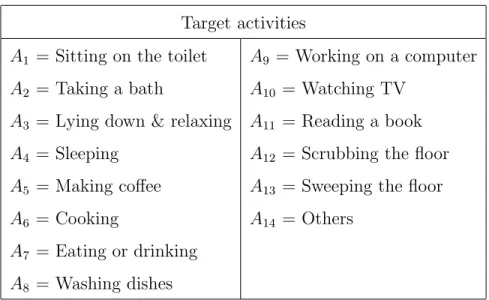
to collect information from the individual and their surroundings in the smart home. To classify human activity, this proposed architecture focuses on target activities that users often perform at home, examples of which are shown in Table 3.1.
Table 3.1: Target activities in this research Target activities
A1 = Sitting on the toilet A9 = Working on a computer A2 = Taking a bath A10 = Watching TV
A3 = Lying down & relaxing A11 = Reading a book A4 = Sleeping A12 = Scrubbing the floor A5 = Making coffee A13 = Sweeping the floor
A6 = Cooking A14 = Others
A7 = Eating or drinking A8 = Washing dishes
Note: A1 andA2 are bathroom activities, A3 is a living room activity, A4is a bedroom activity, A5–A8 are kitchen activities, and A9–A14 are location-agnostic activities.
3.2 A Layered Architecture of CARE Architecture
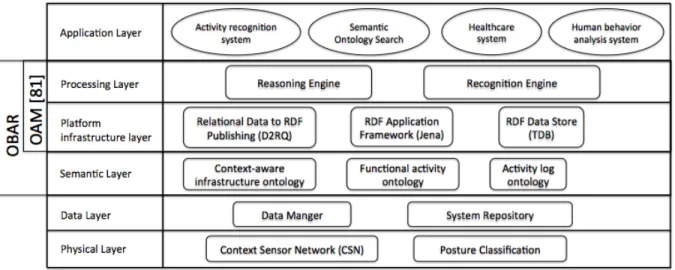
The CARE architecture is proposed as the human activity framework consisting of six layers as shown in Figure 3.1. The physical layer consists of hardware such as sensors, home appliances, or network components. This layer provides the context-aware and human information in the smart home The data layer has the responsibility of storing and organizing the data obtained from the physical layer. The semantic layer or the on- tology concept is the main approach used for defining the activity model in the CARE architecture. The ontology model will be converted into the RDF (Resource Description Framework) file and linked to the data in the platform infrastructure layer via ontology application management (OAM) framework [81]. After that, the intelligent technique is built in the processing layer for recognizing human activity based on the knowledge con-