
JAIST Repository
https://dspace.jaist.ac.jp/
Title シクロデキストリンへの複合体包接における分子間相
互作用
Author(s) Srihakulung, Ornin Citation
Issue Date 2018‑09
Type Thesis or Dissertation Text version ETD
URL http://hdl.handle.net/10119/15527 Rights
Description Supervisor:前園 涼, 情報科学研究科, 博士
Molecular Interactions in
Inclusion of Complexes with Cyclodextrins
Ornin Srihakulung
Japan Advanced Institute of Science and Technology
Doctoral Dissertation
Molecular Interactions in
Inclusion of Complexes with Cyclodextrins
Ornin Srihakulung
Supervisor: Prof. Ryo Maezono, Ph.D.
School of Information Science
Japan Advanced Institute of Science and Technology
September 2018
MOLECULAR INTERACTIONS IN INCLUSION OF COMPLEXES WITH CYCLODEXTRINS
A Dissertation Presented
By
ORNIN SRIHAKULUNG 1520205
Submitted to
School of Information Science
Japan Advanced Institute of Science and Technology In partial fulfillment of the requirement for the degree of
DOCTOR OF PHILOSOPHY
Approved as to style and content by
Supervisor: Prof. Ryo Maezono, Ph.D.
Second Supervisor: Prof. Hiroyuki Iida, Ph.D.
Committee Members: Prof. Satoshi Tojo, Ph.D.
Assoc Prof. Kenta Hongo, Ph.D.
External Examiner: Assoc Prof. Dam Hieu Chi, Ph.D.
Prof. Tamio Oguchi, Ph.D.
Assoc Prof. Luckhana Lawtrakul, Ph.D.
SEPTEMBER 2018
Abstract
MOLECULAR INTERACTIONS IN INCLUSION OF COMPLEXES WITH CYCLODEXTRINS
by
Ornin Srihakulung
Bachelor of Industrial Engineering, Chiangmai University, 2006 Master of Metallurgy Engineering, Chulalongkorn University, 2014
Most case studies of Thai traditional drugs (herbal products) have shown a similar prob- lem of the substance degradation that can cause the instability in the active compounds, including Plumbagin. Basically, encapsulation technique is adopted to address this problem and widely employed to improve the stability of numerous compounds in diverse industries.
Binding energy is an important value in the inter-molecular interaction between host and guest molecules, that can directly a↵ect the drug efficiency from the release of active com- pound to the target cell. Ab initio investigation of the binding energy is an important tool to provide useful theoretical predictions. Density Functional Theory (DFT) is most suited to do this. However, its dependence on the exchange-correlation (XC) functionals means that it is necessary to assess the strengths and weaknesses of these functionals for the relevant system. This is the main objective of this study.
To consider the molecular and organic system, B3LYP functional is generally viewed as the most suitable XC functional. However, it is unable to properly account for inter- molecular interaction, of which dispersion forces (and therefore, dispersion-corrected func- tionals) is a vital part. A total of five dispersion-corrected functionals were assessed in this study: CAM-B3LYP, B3LYP-GD3, CAM-B3LYP-GD3, M06-2X, and M06-2X-GD3. The conventional hybrid DFT (B3LYP) provides positive binding energy, which means it can- not capture the dispersion force from an inter-molecular interaction. Dispersion correction functionals, meanwhile, give negative values of binding energy, with DFT-GD3 providing the precise and lowest binding energies. Theseab initioresults are compared also with those
of semi-empirical methods. Of these, the PM7 method presents the lowest binding energy, though we observe significant overestimations.
Keywords: Cyclodextrins, Encapsulation, Inclusion complex, DFT, Dispersion func- tional
Acknowledgments
I would like to say ”Thank you” for everyone and everything surrounding me for all four years that I have started my Ph.D. life. Everyone have taught me so many things in the di↵erent ways since the beginning. First of all, I would like to give a big thank you to Ryo- sensei, who gave me an opportunity to start my story. In my first interview, I could not answer any difficult questions. My answers were just like ”Sorry, I don’t know”, however, he still gave me a chance to study. I still remember what I said, ”I want to use the computer to simulate instead of running the experiment as my previous study”. These days, I have learned a lot from him, not only the study life but also how to live a good life.
Another person who significant impacts my life is Luckhana-sensei. She has given me many chances and knowledges. Sometimes, I think she has been caring about me more than I have been caring about myself. When I feel so down, I always dress up and smile to myself in the mirror as her suggestion. The picture that I have seen in the mirror is not myself but it is Luckhana-sensei which drive me to do my best and keep doing the research. More than
”Thank you” that I can say to her.
In addition, I also would like to thanks Hongo-sensei, who is a very kind person. Al- though he is very busy, he always finds me time and chances. Moreover, thanks to all my colleague, who always stay beside me and provide me numerous suggestions. Thanks for Guo, who helped me to run simulation more e↵ectively and also tought me what a life is.
Many thanks for Adie, who provided me many suggestions and knowledge. Finally, I would like to Thanks Jiradett, who supports me everything and always stays beside me.
Thank you.
Table of Contents
Chapter Title Page
Abstract ii
Acknowledgments iv
Table of Contents v
List of Figures viii
List of Tables xi
List of Abbreviations xiii
1 Introduction 1
1.1 Motivation 1
1.2 Problem Statement 2
1.3 Objective and Scope 2
1.4 Our Contributions 3
1.5 Thesis Structure 4
1.6 Computer Software 4
1.7 Units 4
2 Target systems 5
2.1 Guest molecule 5
2.1.1 Plumbagin 6
2.2 Host molecules 7
2.2.1 Molecular structure 7
2.2.2 Applications 9
2.2.3 Types 10
2.2.4 -cyclodextrin and its derivatives 10
2.3 Interaction between host and guest 11
3 Theoretical framework 17
3.1 Formulation of bindings 17
3.2 Semi-empirical methods 18
3.2.1 Parameterized Model number 3 (PM3) 19
3.2.2 Parameterized Model number 6 (PM6) 19
3.2.3 Parameterized Model number 7 (PM7) 19
3.3 Ab initiomethod 20
3.3.1 Basis set 21
Minimal 22
Split Valence 22
3.3.2 Time-independent many-particle Schr¨odinger equation 22
3.3.3 Kohn-Sham Equations 23
3.3.4 Exchange and Correction Functionals 24
3.3.5 Dispersion Functional 26
3.4 Justifications for the methods 28
3.4.1 DFT functionals 29
3.4.2 Basis sets 31
3.5 Molecular Docking Simulation 34
3.6 Computational Procedure 35
3.6.1 Computers and softwares 36
Computers for Calculation 36
Software 36
3.6.2 Structure preparation and optimization 36
3.6.3 Molecular docking simulation (procedure) 37
3.6.4 Binding energy analysis 38
3.6.5 CBS and BSSE 38
The complete basis set (CBS) 38
The Basis Set Superposition Error (BSSE) 39
4 Results and Discussions 41
4.1 Geometry Optimization 41
4.1.1 Monomers optimization 41
4.1.2 Inclusion complex molecule 41
4.2 AutoDocking Results 42
4.3 Binding Energy Calculation 43
4.3.1 Semi-empirical 43
Plumbagin-BCD inclusion complex 48
Plumbagin-MBCD inclusion complex 48
Plumbagin-HPBCD inclusion complex 49
4.3.2 Conventional DFT functional 51
Comparison between two di↵erent basis sets 51
4.3.3 DFT dispersion correction functionals 51
4.3.4 Percentage of BSSE correction 54
4.4 Computational Cost 55
5 Summary 60
Appendix A: Conversion Units 63
References 63
Biography 76
This dissertation was prepared according to the curriculum for the Collaborative Education Program organized by Japan Advanced Institute of Science and Technology
and Sirindhorn International Institute of Technology.
List of Figures
Figure Page
2.1 Benjakul, a Thai traditional plant preparation from Piper chaba Linn., Zin- giber officinale Roscoe or ginger., Plumbaga indica Linn., Piper interrup- tum Opiz., Piper interruptum Opiz., and Piper samentosum Roxb, photos
are taken from literature [1]. 5
2.2 Plumbagin molecule. 6
2.3 The stability test result of plumbagin and piperine in %content, the accel- erated condition for testing the Benjakul ethanolic extract was set as 45+/- 2 Cwith 75+/-3%RH, data is taken from literature [2]. 9 2.4 ↵-D-glucopyranose molecule which consists two possible types of chair
conformation (I and II) and glycosidic oxygen bridge↵(1,4) between two molecules of glucopyranose, figure is taken from literature [3]. 10 2.5 Microstructure of cyclodextrin molecules of glucopyranose.↵-cyclodextrin
contains 6 molecules of glucoses, -cyclodextrin with 7 molecules and - cyclodextrin with 8 molecules, figure is taken from literature [4]. 11 2.6 Schematic representations of BCD and its derivertives (MBCD and HP-
BCD), which R1 and R2 position were substituted by methyl and hydroxylpropyl-
group, adapted from [5]. 12
2.7 Mechanism of inclusion complex between ligand and cyclodextrin, figure
is taken from literature [6]. 13
2.8 Host-guest interaction observed in↵-cyclodextrin complex with p-nitrophenol,
figure is taken from literature [7] 15
3.1 Schematic of Slater and Gaussian function, figure is taken from literature [8]. 21 3.2 Schematic classification of the correlation and dispersion problems on dif-
ferent electron correlation length, figure is taken from literature [9]. 26 3.3 DFT dispersion correction which currently used, adapted from [9]. All four
methods are used and compared in this study. 26
3.4 Schematic of short- and long-range behavior of dispersion interaction, fig-
ure is taken from literature [9]. 28
3.5 Force field evaluated binding of the molecules in two steps, the first is intra- molecular force in monomer molecule and then the intermolecular force
between ligand and host are evaluated. 34
3.6 The top and front view of all host molecule: BCD, MBCD and HPBCD, all of them were downloaded from CCDF and modified by removing the
solution. 37
3.7 Schematic basis set superposition error. (a) A and B are monomers molecule apart from other; (b) basis orbitals overlap when A interact to B; (c) the purple area indicates the part of the basis orbitals centered at B available to
describe A. 39
4.1 Monomer optimized structures of all host and guest with DFT/B3LYP/6-
31G(d) basis set. 42
4.2 Docking results of the inclusion complex between BCD and plumbagin, the percentage of occurrences are given in parentheses. 42 4.3 Two main possible conformations from docking calculation of inclusion
complex. Conformation-I is ”UP” which the methyl-group point up to the wider rim of the truncated cone and conformation-II is ”DOWN”, which the methyl-group of plumbagin molecule point in the opposite side. 43 4.4 Optimized structures after docking calculation, the candidate structures were
selected from the lowest energy and the highest percentage of occurence. 45 4.5 Binding energy of six conformations by semi-empirical methods, including
PM3, PM6 and PM7. PM7 provides the similar trend to PM3, but the binding energy illustrates lower than PM3 and PM6. 46 4.6 The average intermolecular bond length between host and guest using semi-
empirical method (PM3, PM6 and PM7), the intermolecular bonds were detected from Discovery Studio 4.0 visualizer program. PM6 provides the
lowest average intermolecular bond length. 47
4.7 BCD inclusion complex structures, which optimized in gas and water solu- tion phase. Plumbagin is illustrated as stick models. BCD molecules are as line model with van der Waals surface with the probe radius 1.4 Å. 48 4.8 MBCD inclusion complex structures, which fully optimized in gas and wa-
ter solution phase. Plumbagin is presented as stick models. MBCD are presented as line model with van der Waals surface with the probe radius
1.4 Å. 49
4.9 HPBCD inclusion complex structures, which fully optimized in gas and water solution phase. Plumbagin is presented as stick models. HPBCD are presented as line model with van der Waals surface with the probe radius
1.4 Å. 50
4.10 Comparison between two di↵erent basis sets of B3LYP6-31G(d) with B3LYP6- 31++G(d,p). B3LYP6-31++G(d,p) represents the smaller gap between
the raw binding and corrected results. 52
4.11 Calculation binding energy using conventional (B3LYP) and dispersion
corrected functionals. 53
4.12 Fraction of BSSE corrections. 54
4.13 Elapsed time of all calculations include semi-empirical (PM3, PM6, and PM7) and five di↵erent functionals of DFT calculation of BCD-I confor-
mation with single point run. 56
4.14 Left figure is illustrated the di↵erent types of semi-empirical method, and right is figure represented the di↵erent functionals calculation of DFT cal- culation. The elapsed time in second is used for comparison between the
di↵erent calculations. 57
4.15 The comparison between speed and number of cores of PM7 calculation.
The red dash line is the ideal speed, which means if using 10 cores the
speed will be increase 10 time with one core. 57
4.16 Elapsed time comparison between B3LYP and B3LYP-GD3 calculation.
The result shows the after around ten cores DFT-GD3 spent less time in
calculation than B3LYP. 58
5.1 Similar system of host-guest interaction between guest (pinostrobin) and three hosts: BCD, 2,6-DMBCD and HPBCD, figure is taken from literature
[10]. 61
List of Tables
Table Page
2.1 Properties of plumbagin. 7
2.2 Pharmaceutical products containing cyclodextrins, data is taken from litera-
ture [11]. 8
2.3 Comparing table of the properties of each type of cyclodextrin [12]. 11 2.4 -cyclodextrin and its derivative properties, data is taken from literature [6]. 12 2.5 Binding energy range of the similar system which is encapsulated with -
cyclodextrin. 14
3.1 Comparison of three semi-empirical methods, PM3, PM6 and PM7. 20 3.2 Mean Absolute Deviations (MADs, in kcal/mol) for common dispersion-
corrected DFT methods. 29
3.3 Literature review of the basis sets which are used in the cyclodextrins case
studies. 32
3.4 Literature review of the basis sets which are used in the cyclodextrins case
studies. 33
3.5 The grid box dimension of host molecule set by Autodock program (Number
of point). 38
4.1 Molecular docking calculation results of three host; BCD, MBCD and HP-
BCD with plumbagin by using PM3 method. 44
4.2 Molecular docking calculation results of three host; BCD, MBCD and HP-
BCD with plumbagin by using PM6 method. 44
4.3 Molecular docking calculation results of three host; BCD, MBCD and HP-
BCD with plumbagin by using PM7 method. 44
4.4 Molecular docking calculation results of three host; BCD, MBCD and HP- BCD with plumbagin by using DFT/B3LYP/6-31G(d). 45 4.5 Number of intermolecular bonding, consisting of hydrogen bond, C-H bond
and hydrophoblic interaction, for each case. Criteria of bonding detection from Discovery Studio 4.0 Visualizer program. The required Hydrogen bond
distance criterion is 2.5 Å. 47
4.6 Binding energy (kcal/mol) result between two di↵erent basis sets B3LYP6- 31G(d) with B3LYP6-31++G(d,p) with the raw and corrected result from
BSSE correction of all configuration. 51
4.7 The deviation of geometry optimization energy of inclusion complex (DEVcomp), hosts (DEVhosts), and guest (DEVguest) from average energies. The aver- age energies of complexes (BCD, MBCD and HPBCD) are -3,089,919.95, -3,435,058.86 and -3,211,091.48. The average energies for the hosts are -2,682,323.08, -3,027,462.65 and -2,803,494.05 respectively. Finally, the average energy of plumbagin molecule is -407,576.43 (in kcal/mol). 59 5.1 Thermodynamics of three inclusion complexes derived from Van’t Ho↵plots
[10]. 61
5.2 Binding energy result of DFT-GD3 functionals, which consistent with the small di↵erence observed between the binding energies of PNS/BCD and PNS/HPBCD in the work of Kicuntod or the experimental data. 62
A.1 Conversion factors for energy units. 63
List of Abbreviations
ACD/↵CD ↵-Cyclodextrin
ACFDT Adiabatic-Connection Fluctuation-Dissipation Theorem
B88 Becke 1988
BCD/ CD -Cyclodextrin
BSSE Basis Set Superposition Error B3LYP Becke, 3-parameter, Lee-Yang-Parr
CAM-B3LYP Coulomb-attenuating method-Becke, 3-parameter, Lee-Yang-Parr
CBS Complete Basis Set
CDs Cyclodextrins
CP Counterpoise Corrections
DFT Density Functional Theory GCD/ CD -Cyclodextrin
HF Hartree-Fock
HF-SCF Hartree-Fock Self- Consistent Field HPBCD Hydroxyl Propyl- -Cyclodextrin
HOF Heats of Formation
HOMO-LUMO Highest occupied molecular orbital - Lowest unoccupied molecular orbital
LC Long-range-corrected
LCAO Linear Combination of Atomic Orbitals
LPS Lipopolysaccharide
MBCD Methyl- -Cyclodextrin NCI The National Cancer Institute
NDDO Neglect of Diatomic Di↵erential Overlap NDO Neglect of di↵erential overlap
PB Plumbagin
PM3 Parameterization Method 3 PM6 Parameterization Method 6 PM7 Parameterization Method 7 SCF Self-Consistent Field
UEG Uniform electron gas
vdW van der Waals
vdW-DF van der Waals density functional
Chapter 1 Introduction
1.1 Motivation
Thai herbs are excellent examples of economically important plants, which can be dis- tributed in all kinds of high quality and usable products for the market, from pharmaceu- ticals, cosmetics, to food production. These products are related to challenging issues such as the compound instability, lack of aromatic permanence (e.g. perfumes), and other issues related to chemical and physical properties of the products. An important issue is that of the preservation of these products, which can lead complications in the production line and increase the cost of the product. Additionally, the use of herb products is required in a very large quantity, since there is no transformation or extraction of the active compound to be used directly. Usage of Thai herbs involve a greater amounts of herbs and frequency to get equally desired e↵ects as Chinese herbs and other traditional medicines. As a result, the packaging of Thai herb products is usually larger in quantity and volume, which can inflate the transportation costs and the shelf space in the logistic system. In addition, there are dif- ficulties and complications in its usage, which requires a novel technology to address these problems more efficiently. Some expensive rare herbs or active compounds such as Sandal- wood, Agarwood, and o↵-season plants usually su↵er from product shortage. In addition, they are unable to maintain a good condition due to the deterioration from air and sunlight, which can diminish the price and quality of these substances.
Consequently, the use of the highly e↵ective and a↵ordable technique of nanoencapsula- tion is recommended to prolong the period of compound retention and to provide protection from sunlight and humidity. Moreover, this technique can efficiently decrease the amount of herb used in the initial product, thus reducing the cost and increasing the value of herbal products. In the nanoencapsulation scheme, a ‘guest’ molecule is encapsulated or inserted inside a ‘host’ molecule, which protects it from harmful external factors. The inter-molecular interaction between ‘guest’ and ‘host’ is the key, since it determines much about the result- ing ‘host-guest inclusion complex’. A primary predictor in this mechanism is the binding energy, the existing potential energy between these molecules. It can be directly translated into how easily these complexes form when ‘guest’ and ‘host’ molecules interact with one
another, as well as how difficult it will be to coax the ‘host’ molecule to release the ‘guest’
when, for example, drugs need to be delivered to the target system.
A reliable theoretical prediction for the binding energy may be obtained using ab initio methods. Density Functional Theory (DFT) is a well-knownab initiomethod widely utilized to tackle such problems. However, the predictions of DFT is strongly related to the choice of exchange-correlation (XC) functional used in the calculation. The choice of XC functionals is an integral decision for researchers, made with respect to the quantum system investigated.
There has been little usage of DFT in evaluating host-guest inclusion complexes, which presents an issue as to the appropriate choice of XC functional. An assessment of available XC functionals is helpful to better inform future studies in this matter. This work aims to provide such an assessment.
As inter-molecular interaction is most important in predicting the binding energy, XC functionals which properly account for dispersion forces (dispersion-corrected functionals) are likely appropriate choices. We investigate a conventional hybrid XC functional (B3LYP) as well as dispersion-corrected functionals for a system of host-guest inclusion complex.
Calibration is also made with results from semi-empirical methods: PM3, PM6, and PM7.
We take plumbagin (the active compound in Benjakul) as the guest molecule, and encapsu- late it with cyclodextrins (host molecules). Calculation results may reveal pertinent infor- mation relating to the qualities of each XC functional, to better set a foundation for future endeavors.
1.2 Problem Statement
The main problem of this work is the instability of the active compounds or plumbagin in Benjakul. The compounds in Thai medicinal plants easily sublimate and loss their prop- erties. Plumbagin is unstable and very reactive with sunlight and sensitive to temperature.
Therefore, we have to keep it under low temperature ( 20 C), because of the low melting point of plumbagin at 76 78 C. As a result, those conditions increase the complexity and cost of the production process to preserve the anti-cancer activity of these compounds.
1.3 Objective and Scope
In this study, binding energies of several model host-guest inclusion complexes are calcu- lated by DFT with di↵erent choices of XC functionals. Plumbagin is chosen as the model guest molecule, while -cyclodextrin (BCD) and its derivatives, Methyl- - Cyclodextrin (MBCD) and Hydroxyl Propyl- -Cyclodextrin (HPBCD), are used as model host molecules.
The model host-guest inclusion complexes are taken to reside in a vacuum environment. The XC functionals investigated in this work include the conventional hybrid functional B3LYP
and dispersion-corrected functionals: CAM-B3LYP, M06-2X, B3LYP-GD3, M06-2X-GD3, and CAM-B3LYP-GD3. The results are calibrated with other results from semi-empirical methods: PM3, PM6, PM7, which will provide a point of comparison to determine a mea- sure of reliability for the calculated values. Therefore, this research aims to clarify the appropriateness, weaknesses, and limitations of each choice of XC functional.
1.4 Our Contributions
The geometry orientation of the guest molecule with respect to the host is a challenging as- pect of this study. This obstacle naturally arises for systems with a low degree of symmetry.
Inorganic crystal structures and a few simple organic molecules (e.g. benzene rings) gen- erally do not present this issue, while the opposite is true for most organic molecules, such as those investigated in this study [14]. Innumerable possibilities exist for the geometry of the host-guest complex, and the optimization of such structures are much too expensive for ab initiomethods. Ideally, a few candidate conformations needs to be selected from all the possible host-guest geometry configurations, while keeping a reasonable computational cost.
This selection process is the most challenging part in this work. Our approach is to employ a semi-empirical evaluation of the possible geometries by running docking calculations. The Lamarckian genetic algorithm is utilized in order to find the ideal candidate conformations.
The host molecule is considered fixed in a vacuum, while the guest molecule is allowed to have a free range of movement. 100 movements of the guest molecule are performed. The final geometries are collated and classified into groups of possible conformations, each with calculated values of binding energy and ’frequency of occurence. These values are the basis of selecting appropriate candidate conformations considered forab initiocalculations. From the results, we extract two possible conformations,’up’ and ’down’, based on the geometry orientation of the methyl group in plumbagin with respect to the wider rim of the fixed host molecules (as illustrated in Figure 4.3). With the three types of host molecules considered in this study, a total of 6 structures are selected for theab initiocalculations.
We have found that, the structures which calculated from the functional with DFT-GD3 calculation provide the precise and lower binding energy. For the semi-empirical calculation, PM7 provide the lowest binding energy, but the result is overestimated as shown in the previous studied, which expressed PM7 is good for only the small system. But it cannot describe the interaction in the large system [13] as our system. In conclusion, we found the most suitable functional which can express the weak intermolecular between two molecules and also found the suitable inclusion complex which is DFT-GD3.
1.5 Thesis Structure
This thesis contains five chapters, where the Chapter 1 gives an introduction of the research.
In addition, the problem statement, objective and scope, proposed approaches, and the con- tributions are included in this chapter. In Chapter 2, the background and related works on host and guest molecules, and the interaction between them are illustrated. The theoretical framework, such as the semi-empirical and ab initiomethod, including the computational procedure are provided in Chapter 3. In Chapter 4, results and discussions are presented.
Finally, Chapter 5 includes the conclusion and the recommendations for future studies.
1.6 Computer Software
All of the semi-empirical and DFT calculation described in this dissertation were carried out using Gaussian09 [15] program. GaussView5.0 [16] program package is used for final structural observation and constructing small molecule, electronic structure and energies of atoms, molecules, and surfaces which can produce various results using semi-empirical and ab initio method. The program can be used to investigate various systems by deploying Gaussian09, including inorganic or organic molecules. With Gaussian09, it can be used to predict the structures, binding energies, reactions and thermodynamic properties.
1.7 Units
Most of the calculation results are in kilocalorie per mole (kcal/mol), in which the author has stated beforehand. Otherwise, hartree atomic units (a.u.) will be conversed by 1 hartree of 627.509 kcal/mol. Please see the conversion factors between hartree atomic units (a.u.) and other units in Appendix A.
Chapter 2 Target systems
From our previous researches [17], we are interested in the active compound or plumbagin (Guest). We aim to find the suitable host to preserve this active compound in nanocapsule or cyclodextrin (Host). We studied the -cyclodextrin (BCD) and its derivatives which are widely used in many industrials, especially pharmaceuticals. In this chapter, we elaborate the literature review of the previous related works about our target systems, as well as the interaction between them. We will focus on the properties of the electrostatic force a↵ecting two compounds to bind together and to form the inclusion complex.
2.1 Guest molecule
Our guest molecule is plumbagin, which is one of the active compound of Benjakul. Ben- jakul is a Thai traditional formula being used in many applications including: health bal- ancing and adaptogen drug for cancer patients. It consists of five traditional herbs, includ- ing fruit of Piperchaba, root of Pipersamentosum, stem of Piperinteruptum, rhizome of Zingiber o f f icinale, and root ofPlumbagoin the same weigh ratio as shown in Figure 2.1.
Folk doctors use this traditional recipes as an adaptogenic to balance body element in pa- tients [18]. Benjakul also applied for cancer patients in order to provide the body balance
Figure 2.1: Benjakul, a Thai traditional plant preparation from Piper chaba Linn., Zingiber officinale Roscoe or ginger., Plumbaga indica Linn., Piper interruptum Opiz., Piper interrup- tum Opiz., and Piper samentosum Roxb, photos are taken from literature [1].
and improve the immunity before the chemotherapy [19]. It also contains anti-inflammatory by inhibiting the cytokine releasing in an inflammatory process induced by LPS in vitro study [1]. Five plant ingredients were collected and dried at 50 Cin oven. Next, the ethano- lic extraction process began with mixing 100 g of each dried-plants component. After that, we ground the plants into rough powder, then macerated with 95% ethanol. This solution was filtrated and concentrated under the reduced-pressure condition. The extract compound was kept at 20 C until start the experiments [1]. From the criteria by the National Cancer Institute guidelines (NCI) , the cytotoxic activity of extracts and pure substant with IC50 values<30µg/ml and<4µg/ml. Plumbagin is an active compounds, which can provide the best cytotoxic activity against lung cancer [18]. The active compound molecule is shown in Figure 2.2.
2.1.1 Plumbagin
The notation of plumbagin rooted from the plant Plumbago [20], while its molecule is from Nepenthes andGenera Drosera, carnivorous plant [21]. Plumbagin is an organic com- pound with the chemical formula of C11H8O3 or (5-hydroxy-2-methyl-1,4-napthoquinone) with the potentials of neuroprotective [22], and inhabit ectopic growth [23], such as anti- breast cancer [23] and anti-lung cancer [24].
Figure 2.2: Plumbagin molecule.
Plumbagin structure consists napthoquinone, which contains two oxygen atom at 1-4 position. One methyl group substitution at 2 positions and one Hydroxyl group substitutes at position 5. Generally, there is one problem with both active compounds, especially in plumbagin which is the instability related to their low melting point (76-78 C) [2]. The previous study [2] illustrated the degradation of two active compounds as shown in Figure 2.3. From this figure, plumbagin degrades from 100% to 28.70% within 2 months. On the other hand, piperine sublimates only 5% during the same period of time. The degradation of plumbagin is the main problem that we are focusing in this study. The issue from instability of active compounds can be resolved by encapsulation technique similar to other compounds in the pharmaceutical industry. This technique has normally been used for protecting the ingredients and controlling active compound’s releasing rate. The protection has also used to prevent the degradation from the light and oxygen or retard evaporation [25].
Table 2.1: Properties of plumbagin.
Properties Plumbagin Molecular formula C11H8O3
Molecular weight 188.18 Density (g/cm3) 1.354 Melting point ( C) 76-78 Boiling point ( C) 383.9
Solvent solubility Soluble in alcohol, acetone, benzene, acetic acid
and slightly soluble in hot water Stability Stable in closed place under dry and
well ventilated, but incompatible with strong oxidizing agents Commonly, there are several types of the encapsulations. Cyclodextrin is one of the technique that can be used for the encapsulation of the drug that contains hydrophobic prop- erties and the drug delivery through aqueous di↵usion-controlled barriers [26]. Therefore, cyclodextrin is one of the technique to e↵ectively prevent the degradation or sublimation of the compounds.
2.2 Host molecules
Cyclodextrins, discovered over a century [27], are the production of the starch interacted with an enzyme and can be used as the pharmaceutical excipients and complexing agents which can improve the aqueous solubility, stability and bio-availability or the active com- pound. Cyclodextrins is a natural cyclic oligosaccharide, that recently accessible as pharma- ceutical excipients. Many commercialized drugs nowadays are presented in Table 2.2 [28].
2.2.1 Molecular structure
Cyclodextrins are made from natural products that constructed by digestable cellulose. The cyclic oligosaccharide consists of (↵ 1,4)-linked ↵-D-glucopyranose. The center of the cavity in cyclodextrins has lipophilic properties and hydrophilic at outer surface of the struc- ture. Chair conformation of glucopyranose holds together with oxygen, and their orientation structure like cone as shown in Figure 2.4. The ↵ , and -cyclodextrin compose 6, 7 and 8 glucopyranose units [29]. Glucopyranoses are in chair conformation, which can a↵ect the cyclodextrins’ shape likes a truncated cone rather than the cylinders. The primary hy- droxyl groups position are at the narrow edge (C6), on the other hand the secondary hydroxyl groups (C2) and (C3) are at the wider rim of the cone. The apolar C3 and C5 hydrogens and ether-like are inside of the cone which can cause the central cavity to contain a lipophilic
Table 2.2: Pharmaceutical products containing cyclodextrins, data is taken from literature [11].
Drug/Cyclodextrin Trade Name Formulation Company/Country PGE 2/ CD Prostarmon E Sublingual tablet Ono, Japan PGE 1/↵CD Prostavastin i.v. solutions and
infusions Ono, Japan
Schwarz, Germany, USA
OP-1206/↵CD Opalmon Tablet Ono, Japan
Piroxicam/ CD Brexin, Flogene Cicladon
Tablet Suppository Liquid
Chiesi, Italy
several European countries Ache, Brasil
Benexate HCl/ CD Ulgut
Lonmiel Capsule Teikoku, Japan
Shionogi, Japan
Iodine/ CD Mena-Gargle Solution Kyushin, Japan
Dexamethasone/ CD Glymesason Ointment Fujinaga, Japan Nitroglycerin/ CD Nitropen Sublingual tablet Nihon Kayaku, Japan Cefotiam-hexetil/
↵CD Pansporin T Tablet Takeda, Japan
Cephalosporin (ME 1207)/ CD Meiact Tablet Meiji Seika, Japan Tiaprofenic acid/ CD Surgamyl Tablet Roussel-Maestrelli, Italy Diphenhydramin,
Chlortheophyllin/ CD Stada-Travel Chewing tablet Stada, Germany Chlordiazepoxide/ CD Transillium Tablet Gador, Argentina Hydrocortisone/HP CD Dexocort Solution Actavis, Iceland Itraconazole/HP CD Sporanox Oral and i.v.
olutions Janssen, Belgium and USA Cisapride/HP CD Propulsid Suppository Janssen, Belgium
Nimesulide/ CD Nimedex Tablets Novartis and others, Europe
Alprostadil/↵CD Rigidur i.v. solution Ferring, Denmark Nicotine/ CD Nicorette Sublingual tablets Pharmacia, Sweden Chloramphenicol/M CD Clorocil Eye drop solution Oftalder, Portugal Diclofenac-Na/HP CD Voltaren Eye drop solution Novartis, France 17 -Estradiol/RM CD Aerodiol Nasal Spray Servier, France Indomethacin/HP CD Indocid Eye drop solution Chauvin, France
Omeprazol/ CD Omebeta Tablet Betafarm, Germany
Voriconazole/SBE CD Vfend i.v. solution Pfizer, USA
Ziprasidone mesylate/SBE CD Geodon, Zeldox im solution Pfizer, USA & Europe
Dextromethorphan/ CD Rynathisol Synthelabo, Italy
Cetirzine/ CD Cetrizin Losan Pharma, Germany
Mitomycin/HP CD MitoExtra
Mitozytrex i.v. infusion Novartis, Switzerland Tc-99 Teoboroxime/HP CD Cardiotec i.v. solution Bracco, USA
Meloxicam Mobitil Tablet and
suppository Medical Union
Pharmaceuticals, Egypt Aripiprazole/SBE CD Abilify im solution Bristol-Myers Squibb, USA
Otsuka Pharm. Co., Japan
Figure 2.3: The stability test result of plumbagin and piperine in %content, the accelerated condition for testing the Benjakul ethanolic extract was set as 45+/-2 C with 75+/-3%RH, data is taken from literature [2].
property. The outside molecule shows hydrophilic character, which can dissolve in water.
As the result, the cavity of cyclodextrins can form the inclusion complexes with a wide and various of guests that contain hydrophobic character. From this property, several researches and works have used this useful functionality in many applications.
2.2.2 Applications
There are several applications of cyclodextrins that can make the CDs suitable for applica- tions in the field of analytical chemistry, pharmaceutical and food [30], such as:
• Sensitive substances (oxygen or light) stabilization;
• Substances (pigments or color) masking;
• Degradation of substances protection using micro-organisms;
• Liquid substances to powders modification;
• Chemical reactivity (guest molecules) modification;
• Volatile substances fixation;
• Ill smell and taste masking;
• Cyclodextrins with guest molecules catalytic activity.
Figure 2.4: ↵-D-glucopyranose molecule which consists two possible types of chair confor- mation (I and II) and glycosidic oxygen bridge↵(1,4) between two molecules of glucopy- ranose, figure is taken from literature [3].
2.2.3 Types
Basically, there are 3 types of cyclodextrin, which can be divided into 3 main types: ↵- cyclodextrin, -cyclodextrins and -cyclodextrin, derived from the first generation (parent cyclodextrins). The most accessible and economical type, -cyclodextrin, is commonly the most applicable in several industrials. On the other hand, ↵-cyclodextrin contains the least steric strain, while -cyclodextrin contains the highest strain [31]. Modifications can im- prove some of the properties as shown in the Table 2.3, consisting of the stability against oxygen or light, solubility, and also aids in controlling the guest molecules chemical activ- ity. Otherwise, the cavity volume is always the first property to consider to make it proper with the host, however, it is an optional than optimal solubility and safety data [32].
Because of the 6 Å of cavity in BCD, it is suitable for accommodating for aromatic groups. Therefore, many drug molecules were encapsulated by BCD molecule. From the previous work, the molecular modeling [33] and the experimental studies [34] have shown that plumbagin molecule is normally selected to form the inclusion complex with -cyclodextrin (BCD). Hence, this research is focusing on the inclusion complex, which are formed between plumbagin and BCDs molecules.
2.2.4 -cyclodextrin and its derivatives
From the parent cyclodextrins, many cyclodextrins derivatives have been further synthe- sized. The productions of the derivatives are aminations, esterifications of primary and sec- ondary hydroxyl groups of the cyclodextrins. The di↵erences of groups and number of sub- stitutions can make the properties of derivatives to change from their parents. Normally, all derivatives can change hydrophobic cavity volume. The improvement of solubility, stability
Figure 2.5: Microstructure of cyclodextrin molecules of glucopyranose. ↵-cyclodextrin con- tains 6 molecules of glucoses, -cyclodextrin with 7 molecules and -cyclodextrin with 8 molecules, figure is taken from literature [4].
Table 2.3: Comparing table of the properties of each type of cyclodextrin [12].
Properties ↵CD CD CD
Molecular weight 972 1,135 1,297
Glucose monomers 6 7 8
Internal cavity diameter (Å) 4.7-5.3 6.0-6.6 7.5-8.3 Water solubility (g/100mL @T=25 C) 14.2 18.5 23.2 Melting range ( C) 255-260 255-265 240-245
Water of crystallisation 10.2 13-15 8-18
Water molecules in cavity 6 11 17
Cavity volume (ml/mol) 174 262 472
Price (US/g pharma grade) 1.0 0.025 0.8
and chemical interaction of guest molecules are gained. In this research, the BCD contains the suitable cavity size with plumbagin, however the limitation of solubility is the main prob- lem of BCD (18.5 mg/mL). As a result, the derivatives are considered in this research with correlated two factors:
• Substitution group;
• Number of substitution.
2.3 Interaction between host and guest
The prominent point of cyclodextrins is the forming property of inclusion complex between host and guest in a wide range, even in the solid, liquid and gas phases [27]. The guest molecules are held in the cavity of cyclodextrins. The lipophilic cavity of cyclodextrins
Figure 2.6: Schematic representations of BCD and its derivertives (MBCD and HPBCD), which R1 and R2 position were substituted by methyl and hydroxylpropyl-group, adapted from [5].
Table 2.4: -cyclodextrin and its derivative properties, data is taken from literature [6].
Information BCD MBCD HPBCD
Product name Beta-cyclodextrin Methyl-beta-cyclodextrin Hydroxylpropyl-beta-cyclodextrin
Chemical formula C42-H70-O35 C56-H98-O35 C45-H76-O36
CAS# 7585-39-9 128446-36-6 94035-02-6
Molecular weight 1135 1310 1454
Melting point (C) 260 180-182 305
Flash point (C) - 187 -
Bulk Density - 400 kf/m3 -
Price (USD/g) 0.025 111.88 7.0781
o↵er the proper environment to non-polar of the host to form the inclusion complex [35].
The host and guest binding is a dynamic equilibrium, and the strength of binding is related to how suitable between host and guest are, also specific local interactions of their surface atoms.
The ability of formation of the inclusion complex between cyclodextrins and guest is a function of two key factors:
1. Steric or spatial arrangement of atoms in molecules that related to size of cyclodextrins cavity and guest. For instance, if the guest’s size is bigger than the host’s cavity, they are unable to fit properly.
2. The thermodynamic interaction between host and guest, for favorable case, the to- tal energy driving force is shown in negative value that will pull the guest into the cyclodextrins.
Figure 2.7: Mechanism of inclusion complex between ligand and cyclodextrin, figure is taken from literature [6].
Primarily, energetically supportive interactions consist of 4 types that can shift the equi- librium in order to form the inclusion complex:
1. Repulsive interactions decrement from the water environment and hydrophobic guest;
2. Hydrogen bonds increasing formed as displaced water depart to the larger pool;
3. Polar water molecules displacement from a non-polar cavity;
4. Hydrophobic interactions rising by inserting guest into polar CD cavity.
To form complex, the initial equilibrium is quite accelerated (in a minute), while on the other hand, the final equilibrium is time consuming to reach. Several techniques can be used to form the inclusion complexes, depending on the active compound (guest), equilibrium kinetics, processes and other ingredients. To visualize the inclusion complex, we can use the molecular modeling by computational chemistry. Table 3.3 summarizes the program and basic sets from the existing literatures.
If we consider the interaction between host and guest molecule directly, it does not re- lated to only size and shape molecule. Since our system consists of neutral guest and host, dipole-dipole interaction plays an the important role in intermolecular interaction. The non- covalent interactions are stabilized the inclusion complex molecules. The total stabilization of a molecule usually between 1 and 20 kcal/mol, which are considered as small binding energy compared to a covalent bond energy =100 kcal/mol. To describe non-covalent in- teractions, the accurate methods of quantum chemistry are required. Only semi-empirical or the conventional DFT are insufficient. The BCD inclusion complexes with others active compounds are reviewed and concluded as in Table. 2.5. The binding energies of PM3 are in the range of -33.19 to -3.36 kcal/mol. For PM6 is between -21.68 to 5.38 kcal/mol. For DFT calculation, we can group in to three parts; the basis set which consider BSSE calculation,
Figure 2.8: Host-guest interaction observed in ↵-cyclodextrin complex with p-nitrophenol, figure is taken from literature [7]
does not consider and the last one is DFT included dispersion functional calculation. The further information of the calculation method will be describe in the next chapter.
The interactions between host-guest molecules are consisted of:
1. hydrogen bond
The hydrogen bond between host-guest molecule can be divided into two types in- cluding:
• O-H, N-H and F-H, this type is the hydrogen bond between cyclodextrin’ hy- droxyl groups with guest molecule, which mostly restricted to the primary O(6)- H side. Because of the more flexible of the primary side than the secondary O(2) and O(3).
• C-H...O hydrogen bond, this type of hydrogen bonds are weaker hydrogen bond donor than O-H, N-H and F-H. Therefore their donor potential could not be ig- nored (ca 2-8 kJ/mol) [44]. These bonds is importance in many organic system, because this bond is more polarized than C(sp3)-H in pure hydrocarbons. The charge is+0.13 (compared to hydroxyl group is+0.34) [45]. Normally, C-H...O interaction appears between polar guest with the cavity lining of host molecules.
For the calculation, the estimated energies interaction slightly above 4 kJ/mol, which is a quarter to a third of conventional hydrogen bonds.
2. Electrostatic interactions
Table 2.5: Binding energy range of the similar system which is encapsulated with - cyclodextrin.
Method Guest binding energy (kcal/mol) reference
Calculation
1.1 semi-empirical
1.1.1 PM3 linalool -12.58 to -7.02 [36]
eugenal -9.72 to -7.57 [36]
methyl eugenol -13.53 to-10.09 [36]
estragole -7.01 to -5.39 [36]
eugenol -12.77 [36]
PNBA1 -9.80 to -8.20 [37]
PNBA2 -33.19 to -21.88 [37]
sulfonamide -4.45 to -3.36 [38]
carvacrol -25.12 to -23.09 [39]
1.1.2 PM6 tyrosine -21.68 to -18.19 [40]
sulfonamide 2.94 to 5.38 [38]
Ortho-Anisidine -13.50 to -13.20 [41]
1.1.3 PM7 tyrosine -53.17 to -51.89 [40]
1.2ab initio
1.2.1 B3LYP/3-21G* sulfonamide -22.65 to 34.97 [38]
1.2.2 B3LYP/6-31G(d) linalool -2.46 to -0.36 [36]
correction with BSSE eugenal -10.55 to 0.66 [36]
methyl eugenol 1.20 to 2.34 [36]
estragole -0.30 to 1.20 [36]
eugenol 2.01 [36]
PNBA1 -94.8 to 100.4 [37]
PNBA2 -12.53 to 0
carvacrol -11.62 to -6.07 [39]
1.2.3 M05-2x/6-31G(d) carvacrol -25.13 to -18.18 [39]
Experimental (Heat of formation)
carvacrol -3.74 [42]
t-cinnamaldehyde -3.51 [43]
Eugenol -1.82 [43]
Cinnamon bark extract -4.94 [43]
Clove bud extract -10.28 [43]
The electrostatic includes all of the electrostatic forces such as, force between the permanent charge or between dipoles and the higher dipoles. Electrostatic interac- tion consists 3 important types: ion-ion, ion-dipole and dipole-dipole interaction. For cyclodextrin inclusion complex system, therefore cyclodextrin normally exists as neu- tral molecules. In addition, the cyclodextrin are substituted with some appropriately functionals group.
The ion-dipole interactions of cyclodextrin system normally are increase from ionic charge of guest molecule. Some guests consists of the dianions such as SO42or CO32, which can be increase binding force from the tightly bond with cyclodextrins. The dipole moments of cyclodextrin were study, the range between 10-20 D is suggested as a highly polarized [46]. For the normally the cyclodextrin complex contains small dipole moment in the range of 2-4 D, which obtain from the various theoretical meth- ods. In the case of high dipole moment that can play in the important role in the inter molecular interaction in this system. For dipole-dipole interactions, many study about several substitution benzene derivative of guest which expresses dipole [47,48]. Their dipoles are anti parallel to host molecule. Dipole-dipole play in the important role to stabilizing the complex, and it related to the orientation of guest molecule.
3. Van der Waals interactions
Van der Waals forces or London dispersion interaction consists of the combination between induction and dispersion forces and only dispersion force. Nowadays, this force is the important evident which are responsible for many phenomena in physic, chemistry and biology. While vdW interaction is very weak force comparing to ionic, metallic and covalent bonding, but this force plays in the important role to determine the stability and structure of various compounds.
Many researches express about vdW force is play in the important role of cyclodextrin inclusion complex system. Normally the hydrophobic interactions between two non- polar molecules provide a positive enthalpy process, on the other hand, van der Waals interactions are observed as in the opposite. The negative enthalpy occurs in the van der Waals case.
According to van der Waals interaction in cyclodextrin inclusion complexes, many works consider this system in gas phase to avoid the solvent e↵ect. While they con- clude vdW interaction is the major contribution to form then inclusion complexes.
4. Hydrophobic interaction
Hydrophobic interaction in CDs complexation is a underdiscussion problem. Nor- mally, hydrophobicity was specified to be the results of enhanced structure of the water molecules in the near vicinity of the non-polar solution, It would cause large
entropy loss during the hydration. In the experimental, non-polar molecules associate in water is normally found the positive enthalpy and positive entropy change, it seem like a signature of hydrophobic interaction. The fact that most of the experimental enthalpy and entropy alterations of CD complexation are negative seems to show that the hydrophobicity is not an important force in CD inclusion complex.
Chapter 3
Theoretical framework
In this chapter, we focus on the theoretical framework in this research. For the first step, we will start with the formulation of bindings. The method used in the calculations includes semi-empirical andab initiomethod. Finally, the computer procedure is described, starting from the computers and softwares that are used in the simulation, as well as to prepara- tion of the input file, monomer optimization, molecular docking simulation, binding energy analysis, Complete Basis Set (CBS), and Basis Set Superposition Error (BSSE) corrections.
3.1 Formulation of bindings
The binding energy between host-guest molecules are considered as one factor, which influ- ence to the stability of binding of the inclusion complex molecule. In order to understanding of the binding, a lot of theoretical methods including Molecular Mechanics (MM), Molec- ular Dynamics (MD), and more recently, Quantum Mechanical (QM) methods such as ab initioand Density Functional Theory (DFT), have also been used to study the CD complexes.
Sometime when the experiments are in sufficient, the computational can help us to explain the mechanism of molecular interaction. Within quantum mechanics, there are methods (semi-empirical,ab initio) to calculate observable energy, and to evaluate the minima point of the potential energy, which related to the stationary point or quasi-stable of relaxed ge- ometry. The optimized geometry expresses the preferable structure or the relaxed structure of this molecule. To find the binding energy, the di↵erence of geometry optimization energy between the inclusion complex and the monomer molecule are performed. Binding energy is one of the factor to consider whether it is preferable to form the inclusion complex. The calculation is following this equation:
Ebinding=Ecomplex (Ehost+Eguest) (3.1) where Ecomplex is the inclusion complex energy between host and guest; Eguest is the en- ergy of guest molecule; and Ehost is the energy of host or BCD and two derivatives MBCD and HPBCD. The inclusion complex with the lowest energy or negative value presents the most stable inclusion complex. On the other hand, the positive value shows that they are
unfavoable to form the inclusion complexes.
3.2 Semi-empirical methods
Generally, quantum mechanic method can be classified asab initioor semi-empirical. Inab initio, the calculations are derived directly from theoretical principle, no experimental data included. On the other hand, semi-empirical methods are the simplified versions of Hartree- Fock theory using empirical or experiment data for the correction in order to improve the performance of the calculation. As a result, this calculation is faster than ab initiocalcula- tion. Semi-empirical calculations are also very successful for the organic chemistry systems, that contain a few elements in used and the very large molecule size. In semi-empirical, we use empirical parameters to evaluate SCF equation, while ab initio does not use such em- pirical calculation. There are many ways to consider the electron-electron interactions when the molecules overlaps. Normally, we can separated the interactions in three groups.
1. The extended Huckel method
This method is the model which neglect all electron-electron interactions that can make the computation very fast but not accurate.
2. Neglect of di↵erential overlap (NDO) model
This method can neglect some of electron-electron interactions. The Hartree-Fock Self-Consistent Field (HF-SCF) is used to solve the Schr¨odinger equation with vari- ous approximations. The model includes; CNDO, INDO, MINDO/3, ZINDO/1 and ZINDO/S.
3. Neglect of Diatomic Di↵erential Overlap (NDDO)
This model is a modern semi-empirical model which is based on INDO and included the overlap density between two orbitals on one atom interacting with the same or another atom.
NDDO is the best level, which can maintain the higher number of multi-poles of charge and the distribution between two center atoms interaction.
Integral evaluation commonly computes from three approaches consisting of the exper- imental data, calculated from corresponding analytical formulas, and from suitable para- metric expressions. The most realistic balance between the repulsive and attractive force in molecules is the method considering the parametric functions. MNDO (Modified Ne- glect of Diatomic Overlap) is the widely used method considering the valence-electron with SCF-MO uses the minimal basis set of AOs or atomic orbitals. Generally, PM3, PM6, and PM7 are also under MNDO model [49], which are usually applied in host-guest inclusion complex interactions. Consequently, this research focuses on these three methods of MNDO model:
3.2.1 Parameterized Model number 3 (PM3)
This calculation utilizes the semi-empirical method for the quantum calculation of electronic structure. This method employs modern semi-empirical model or NDDO, and it is accurate to some degree. On the other hand, previous work [50, 51] compared the accuracy for gas phase heats of formation (HOF), the results of accuracy have been shown in the increasing in the order of PM3<PDDG<PM6. DDO is ignored in integral approximation is used for the calculation. Elements that have been parametrized in PM3 include H, C, N, O, F, Al, Si, P, S, Cl, Br, I, Ca, Ti, V, Cr, Mn, Fe, Co, Ni, Cu, Zn, Zr, Mo, Tc, Ru, Rh, Pd, Hf, Ta, W, Re, Os, Ir, Pt, and Gd. Various number metals have been parameterized in later work.
The cyclodextrins inclusion complex studies get the coincide binding energy result with the experimental observations from PM3.
PM3 deals with hydrogen bond (O-H...O) and reproduces the crystalline structure rel- atively well [51, 52]. As a result, PM3 was selected for the calculation in several stud- ies [50, 53] including our previous work [17]. PM6 method [54] adds some improvement of PM3 in the geometries prediction, for instance, replacing Gaussian core-core corrections to core-core correction introduced by Voityuk and Rosch [55].
3.2.2 Parameterized Model number 6 (PM6)
PM6 performs pairwise parameter and also uses di↵erent core-core repulsion potentials for N-H, O-H, C-C and Si-O which also improve some weaknesses in the parametrization. The previous studies also show good performance of this method in cyclodextrin inclusion com- plex system, which improves the stability of inclusion complex structure by adding damping functional [56, 57]. Some works [58] express the thermodynamic parameters results from PM6 in gas and water according to MD simulations and the experiment as results [38,59,60].
3.2.3 Parameterized Model number 7 (PM7)
PM7 method [61] improves some part of PM6 appending explicit terms to describe non- covalent interactions or non-bonding interaction, for instance, hydrophobic-hydrophobic in- teractions and long range bonding interaction or hydrogen bond, which is the interaction between host-guest of our system. The accuracy of this method can be compared to the higher level of theoretical methods, while requiring of low computational cost. This method also provides good results in G , H and S comparing to the experimental value [62].
Basically, PM7 illustrates high value of EHOMO LUMO energy gap of BCD molecule with CENs-prolinate, which means that the compound is stable [63]. PM7 is also successful used to predict the parameter of geometry structure and reactive trend in complex between micro- cystins and nodularins with cyclodextrin [64]. On the other hand, there are some limitations of this method including large error for the non-covalent interaction energy [59].
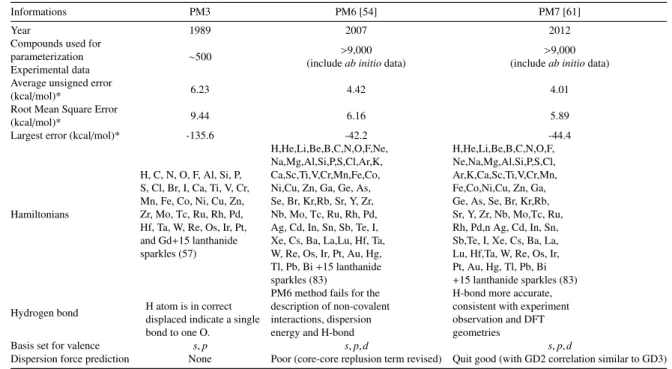
Table 3.1: Comparison of three semi-empirical methods, PM3, PM6 and PM7.
Informations PM3 PM6 [54] PM7 [61]
Year 1989 2007 2012
Compounds used for parameterization
Experimental data ⇠500 >9,000
(includeab initiodata) >9,000
(includeab initiodata) Average unsigned error
(kcal/mol)* 6.23 4.42 4.01
Root Mean Square Error
(kcal/mol)* 9.44 6.16 5.89
Largest error (kcal/mol)* -135.6 -42.2 -44.4
Hamiltonians
H, C, N, O, F, Al, Si, P, S, Cl, Br, I, Ca, Ti, V, Cr, Mn, Fe, Co, Ni, Cu, Zn, Zr, Mo, Tc, Ru, Rh, Pd, Hf, Ta, W, Re, Os, Ir, Pt, and Gd+15 lanthanide sparkles (57)
H,He,Li,Be,B,C,N,O,F,Ne, Na,Mg,Al,Si,P,S,Cl,Ar,K, Ca,Sc,Ti,V,Cr,Mn,Fe,Co, Ni,Cu, Zn, Ga, Ge, As, Se, Br, Kr,Rb, Sr, Y, Zr, Nb, Mo, Tc, Ru, Rh, Pd, Ag, Cd, In, Sn, Sb, Te, I, Xe, Cs, Ba, La,Lu, Hf, Ta, W, Re, Os, Ir, Pt, Au, Hg, Tl, Pb, Bi+15 lanthanide sparkles (83)
H,He,Li,Be,B,C,N,O,F, Ne,Na,Mg,Al,Si,P,S,Cl, Ar,K,Ca,Sc,Ti,V,Cr,Mn, Fe,Co,Ni,Cu, Zn, Ga, Ge, As, Se, Br, Kr,Rb, Sr, Y, Zr, Nb, Mo,Tc, Ru, Rh, Pd,n Ag, Cd, In, Sn, Sb,Te, I, Xe, Cs, Ba, La, Lu, Hf,Ta, W, Re, Os, Ir, Pt, Au, Hg, Tl, Pb, Bi +15 lanthanide sparkles (83) Hydrogen bond H atom is in correct
displaced indicate a single bond to one O.
PM6 method fails for the description of non-covalent interactions, dispersion energy and H-bond
H-bond more accurate, consistent with experiment observation and DFT geometries
Basis set for valence s,p s,p,d s,p,d
Dispersion force prediction None Poor (core-core replusion term revised) Quit good (with GD2 correlation similar to GD3)
Comparison of errors in heats of formation for a set of 1,366 compounds containing only C, H , F, O, N, Br, S, P and Cl.
Table 3.1 illustrates the comparison between three semi-empirical methods (PM3, PM6 and PM7). The information is from MOPAC, the semi-empirical program website developed by Stewart [54,61]. We can see the development of the PM version from the starting, which including the number of compound used for parameterization. PM6 and PM7 included the immense number of data which are from the experimental andab initiomethod. The errors were reduced that we can notice by the decrease number of Average unsigned error, Root Mean Square Error and Largest error. Finally, the dispersion energy were include in to PM7 method, which is the newest version of PM series.
3.3 Ab initio method
Ab initioquantum chemistry is an important tool to study atoms and molecules, where the number of studies have been increasing every year in the material and biology area. The main idea of this tool is the computational solution derived directly from theoretical principles or electronic Schr¨odinger equation, and the calculations exclude experimental data. To find
“good-enough” solutions of electronic Schr¨odinger equation to explain some systems, many of theoretical chemistry have been performed. It is an approximations, that are usually mathematical approximations using a simple functional form to find approximate solution from di↵erential equation.
Many types of ab initiomethods have been used nowadays. Popularab initio methods comprise Molecular orbital (MO), Density Functional Theory (DFT) and Quantum Monte
Carlo (QMC). Normally,ab initioprovides a good qualitative results and also increasingly the accuracy in qauntitative results. It is very useful for providing the initial, the first level of prediction. The structures and vibrational frequencies of stable molecules and transi- tion states are performed reasonably. However, this method neglects of electron correlation makes it unsuitable for some purposes. For example, it is insufficient for accurate modeling of the energetic of reactions and bond dissociation.
There is some senses that one would not expect any empirical data to be included within an ab initioframework. In reality, ab initio methods regularly utilize insights gained from empirical observation. This can be seen, for example, in the B3LYP exchange-correlation functional and others (Minnesota Functionals, DFT-GD3), which include empirical param- eters and fitting. Approximations are also featured regularly in ab initio methods. Here it is evident thatab initiodoes not necessarily mandate a rigorous derivation from purely the- oretical grounds. Having mentioned this,ab initio methods are most rigorous with respect to the theoretical principles, much more so than semi-empirical and empirical methods. The approximations utilized within ab initio are generally numerical in nature, approximating numerical equations instead of the physical picture. These approximations are geared more toward reducing computational costs instead of modelling a physical reality. As a result, it can be said thatab initiomethods do not aggressively use approximations. This tendency is the distinct characteristic ofab initiomethods.
3.3.1 Basis set
To describe the shape of atomic orbital of our target system, the basis set of wave function is required. The level of approximation is related directly to our selected basis set. Therefore, we have to balance between the CPU time and accuracy of our results. In this thesis, we consider Gaussian basis set. Figure 3.1 represents two types of orbital, the first one is Slater Type Orbitals (STOs), which can explain shape of AOs closely than the Gaussian Type Orbitals (GTOs). However, GTOs is easier and faster to compute and combine numerous orbital than STOs. Hence, GTOs are commonly used to describe AOs than STOs [65].
Figure 3.1: Schematic of Slater and Gaussian function, figure is taken from literature [8].
Minimal
To explain the atomic orbital, this kind of basis set uses only one functional or STO to describe it. STO-nG, where n=2,...,6. (usuallyn< 3 provide too poor results)nGTO are used to describe by STO. Therefore, STO-3G is the minimal basis set. The minimal basis set is used when our target system is very small, or we want to find the qualitative result of the huge target system.
Split Valence
The most popular one normally used for organic molecules is called Pople basis sets. For this basis set, we can select number of GTO used for core and valence electron. The notation is K-LMG, whereK presents the number of sp-type (inner shell GTOs). The notation of L means the number of s and p type of inner valence. M indicates s and p type of outer valence. Finally, G means that GTOs type is used. For instance, 6-31G : 6 GTOs are set for core, while 3 GTOs are used for inner valence and 1 GTOs explains the outer valence electron. Gaussian program consist many types of split valence, such as 3-21G, 4-31G, 4-22G, 6-31G, 6-311G, 7-41Getc.
To make the setting better describing the target system, we can set the electron move- ment, far or near the nucleus by setting di↵use orbitals. This setting is used to excite the state and our molecules consisting of lone pair and anion case. We can set it by adding plus (+) and double plus sign (++) in front of G.++means di↵use functions adding to all atom while+means di↵use functions adding to all except hydrogen atom.
The polarization also can be set to our target system, which can be set by adding *, **
or (d) and (d,p). This setting is set when our target system get polarized from surrounding case. * or (d) means d-type functional adding on atom except hydrogen atom and f-type function is added to transition metals. ** or (d,p) indicates p-type functionals are added to hydrogen and d-type functionals are added to other atoms. Finally f-type functionas are added to transition metal.
3.3.2 Time-independent many-particle Schr¨odinger equation For time-independent many-particle Schr¨odinger equation can be presented as:
H ˆ =E (3.2)
where, ˆH is Hamiltonian operator and is a set of solutions, which is (r~1, ...,r~N), or eigenstates of the Hamiltonian. The solutions related to eigenvalue,Enis a real number that satisfies the eigenvalue equation. If we consider further like particle in a box or harmonic
oscillator, the complete description of the Schr¨odinger equation is 266666
664 }2 2m
XN i=1
r2i+ XN
i=1
V(~ri)+ XN
i=1
X
i<j
U(~ri,r~j) 377777
775 =E (3.3)
Three terms are defined as follows:
• }2 2m
PN
i=1r2i is the kinetic energy operator of each electron.
• V(~ri) is the interaction energy between each electron and the collection of atomic nu- clei.
• U(~ri,r~j) is the interaction between di↵erent electrons.
is the electronic wave function of each spatial coordinates of each of theNelectrons, =
(r~1, ...,r~N) and Eis the ground state energy of the electrons. The electron wave function is
a function of each of the coordinates, of allNelectrons, it is possible to map this many-body, interacting problem to a set of one-body noninteracting problem (Kohn-Sham equations) as described below.
3.3.3 Kohn-Sham Equations
In principle, the ground-state energy is also solved by minimizing the total energy with all state| i, with densityn(~r).
E[n]= min
!n(~r)[h |Tˆ| i+h |Vˆint| i]+ Z
d~rVext(~r)n(~r)
⌘F[n]+ Z
d~rVext(~r)n(~r)
(3.4)
Vext is the external potential whileF[n] is universal functional and it is difficult to find this part. Therefore, it is corresponding for solving many-particle following the Kohn-Sham equation. This equation considers complications of many-body e↵ects in interacting system as in F[n], which contains a few correction to total energy of auxiliary system with the many-body e↵ects. DFT can be rewritten for ground-state energy as functional of density the following equation:
Eaux[n]=Ts[n]+EH[n]+ Z
d~rVext(~r)n(~r) (3.5)
![Table 2.2: Pharmaceutical products containing cyclodextrins, data is taken from literature [11].](https://thumb-ap.123doks.com/thumbv2/123deta/6129745.1079345/24.892.132.792.235.1098/table-pharmaceutical-products-containing-cyclodextrins-data-taken-literature.webp)
![Figure 2.3: The stability test result of plumbagin and piperine in %content, the accelerated condition for testing the Benjakul ethanolic extract was set as 45 +/ -2 C with 75 +/ -3%RH, data is taken from literature [2].](https://thumb-ap.123doks.com/thumbv2/123deta/6129745.1079345/25.892.266.654.106.492/stability-plumbagin-piperine-accelerated-condition-benjakul-ethanolic-literature.webp)
![Figure 2.4: ↵-D-glucopyranose molecule which consists two possible types of chair confor- confor-mation (I and II) and glycosidic oxygen bridge ↵ (1,4) between two molecules of glucopy-ranose, figure is taken from literature [3].](https://thumb-ap.123doks.com/thumbv2/123deta/6129745.1079345/26.892.201.719.103.386/figure-glucopyranose-molecule-consists-possible-glycosidic-molecules-literature.webp)
![Table 2.3: Comparing table of the properties of each type of cyclodextrin [12].](https://thumb-ap.123doks.com/thumbv2/123deta/6129745.1079345/27.892.230.692.558.758/table-comparing-table-properties-type-cyclodextrin.webp)
![Table 2.4: -cyclodextrin and its derivative properties, data is taken from literature [6].](https://thumb-ap.123doks.com/thumbv2/123deta/6129745.1079345/28.892.162.759.609.769/table-cyclodextrin-derivative-properties-data-taken-literature.webp)
![Figure 2.7: Mechanism of inclusion complex between ligand and cyclodextrin, figure is taken from literature [6].](https://thumb-ap.123doks.com/thumbv2/123deta/6129745.1079345/29.892.181.745.120.356/figure-mechanism-inclusion-complex-ligand-cyclodextrin-figure-literature.webp)
![Figure 2.8: Host-guest interaction observed in ↵-cyclodextrin complex with p-nitrophenol, figure is taken from literature [7]](https://thumb-ap.123doks.com/thumbv2/123deta/6129745.1079345/30.892.268.630.114.430/figure-interaction-observed-cyclodextrin-complex-nitrophenol-figure-literature.webp)

![Figure 3.1: Schematic of Slater and Gaussian function, figure is taken from literature [8].](https://thumb-ap.123doks.com/thumbv2/123deta/6129745.1079345/38.892.274.656.903.1113/figure-schematic-slater-gaussian-function-figure-taken-literature.webp)
