ABSTRACT
Creative knowledge is vital today, because the dynamic application of organi-zational capability of management resources inside the firm and intra-firms influ-ences competitive predominance. In this research, it would be examined and dis-cussed to what extent it would be significant for the firms to share management philosophy and the vision inside the organization for knowledge creation. From the survey results of major Japanese and US automobile and information appli-ances firms, the relevant hypotheses on enablers of knowledge creation are empir-ically verified and clarified by the multiple regression analysis. In addition, knowl-edge creation process and international deployment of best practices are also clari-fied by statistical analysis and case studies of 3 major Japanese firms.
From the case studies, we could find out that the main purpose of knowledge cre-ation should increase a customer satisfaction and brand value. It is important to foster personnel training through the“Ba”using IT tool and organizational learn-ing, to expose individual experienced knowledge, tacit knowledge and know-how toward the realization, and to increase them as an organizational knowledge.
INTRODUCTION
Knowledge is recognized as an important asset, since firms tend to accumulate intangi-ble capabilities in global basis. Therefore, firm’s business model that drive its search for innovation activities must be unique and be open in the transition from products to servic-es1).
There is a phenomenon of the low job satisfaction by employees against excessive per-formance-based wage system. In this difficult circumstance for firms to manage their
inno-― 3 inno-―
Enabling Knowledge Creation and International
Deployment of Best Practices in Large Japanese Firms
Hideo Ueki
Mariko Ueki
vative and talented employees, what are the exertions of creativity by employees, sharing of a target and a vision in the firm, and mechanisms of shared value?
In this research, in order to raise the organizational capability of firms, it is significant to clarify what type of devices firms are doing. It will be presumed that interchange of knowledge is active at the innovated firms. In such type of firm, will it be related to set up sharing management philosophy and the vision inside the organization? In addition, are knowledge creation process and international deployment of best practices also positive in such type of firm? Under these research questions, the features derived from the question-naire survey results are examined by statistical analysis of survey results derived from major Japanese and US automobile and information appliances firms, and we would clarify the state of arts from the case studies of 3 major Japanese firms. Besides, we would also clarify that it is vital for all of the employees to share corporate objectives and values for the realization of creativity by the formation of organizational climates.
With the dynamic“Ba”to which knowledge creation is urged, what is the secret to be explored from the case studies of three major firms?
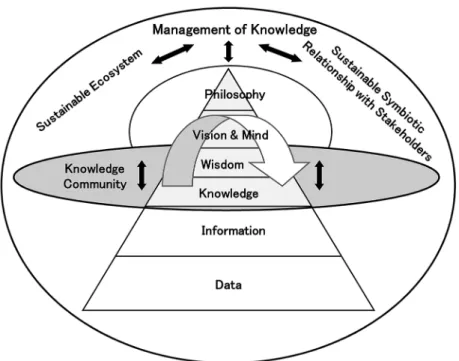
We adopt the concept of knowledge in a broad sense as follows; wisdom, and new knowledge such as creation of know-how, business process reengineering and an improve-ment, problem-solving capability, creative thinking, creation of a brand and a customer’s
value etc. shall be created in the dynamic knowledge community of practice as dynamic “Ba,”which enables the wisdom, the vision & mind and corporate philosophy by sharing
data, information and knowledge.
1.Preceding Literature
1-1.Knowledge Creation and Organizational Learning
Knowledge creation includes radical as well as incremental innovation, business process reengineering, problem-solving leading to the enhancements of customer value and brand power.
Such broadly defined knowledge creation spans all firm units not just production. The challenge before management is how to stimulate this highly complex process effectively. Different authors have emphasized different aspects. One of the key issues for manage-ment is to create what is known as a‘learning organization’with high capabilities for cre-ation, acquisition and transfer of knowledge(Garvin, 1993). Senge(1990)points out that this process cannot be static but must be based on continuous improvement of capabilities. Some authors like Davenport(1998)emphasize that many organizations fail to utilize their internal knowledge resources well or waste them. Authors like Ulrich(1998)point out that a firm's capability to learn quickly is a key competitive advantage that is very dif-ficult to copy. In this capability, the role of human resources development plays a crucial role(Bartlett and Ghoshal, 2002). Quinn, Anderson and Finkelstein(1996, 2004)place emphasis on the management and evaluation of professionals who are considered the key to knowledge creation. Argyris(1993)views organizational learning as long term acquisi-tion of knowledge leading to performance improvement through double-loop learning.
Davenport(1998)writes about the importance of Chief Knowledge Officers(CKO), knowledge activists and knowledge workers in the process of organizational knowledge creation. Garvin(1993)tries to identify management tools for organizational learning that very successful firms employ.
Japanese authors working in collaboration with Western scholars place emphasis on other aspects of knowledge creation. Ito(1999, 2000), for instance, sees the sharing of val-ues in organizations and the building of the corporate brand - which embodies the vision and dreams of members - as the most important factor that differentiates competitive firms. Georg, Ichijo and Nonaka(2000)express the view that many organizations have overemphasized the use of IT and other measurement tools in the process of knowledge
management. In this way they are guilty of attempting to control something that is inher-ently uncontrollable. In their fascinating study of Toyota, Takeuchi, Osono and Shimizu (2008)recognize the importance of workers accumulating wisdom and experience(chie)
and sharing culture based on strong values and vision. That culture based on modesty, open communication and a passion for improvement and learning at heart recognizes and embraces contradictions. Toyota deliberately fosters contradictory viewpoints and chal-lenges employees to find innovative solutions by transcending differences rather than resorting to compromises. Such a system is quite different from the common perception of Japanese firms primarily relying on compromise and consensus. Toyota’s success shows that the Japanese have evolved sophisticated capabilities of making both incremental and radical innovations(Takeuchi, Osono, Shimizu; 2008).
1-2.Deployment of Best Practices
As Teece(2007)noted that implementing best practice may help an enterprise become or remain viable, but best practices that are already widely adopted cannot by themselves in a competitive market situation enable an enterprise to earn more than its cost of capital, or outperform its competitors. Likewise, invention and innovation by them-selves are insufficient to generate success2).
However, deployment of best practices is effective for the first step of knowledge cre-ation. Carla O’Dell and Grayson, C. J.(2002)wrote in terms of transferring internal best practices3). Every organization takes advantage of the tremendous untapped reservoir of knowledge in their own backyard to reduce costs and increase revenue, speed, and cus-tomer satisfaction. For instance,(1)Internal transfer is a people-to-people process; rela-tionships seem to precede and be required for meaningful sharing and transfer.(2) Learning and transfer is an interactive, ongoing and dynamic process that cannot rest on a static body of knowledge. Employees are inventing, improvising, and learning something new every day.(3)A personal and organizational willingness and desire to learn are keys. A vibrant sense of curiosity and a deep respect and desire for learning from others may be the real keys.
2.The Framework of Research and Hypothetical Model
2-1.The Framework of Research
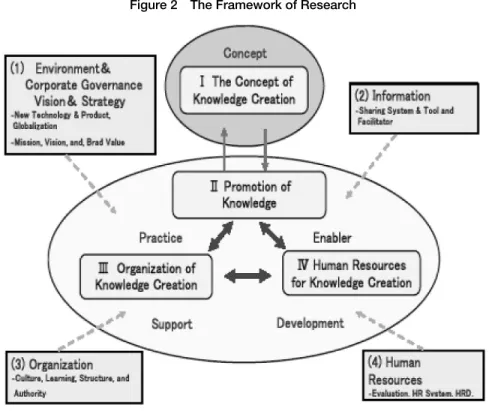
organizational processing because it provides a means to significantly boost corporate value. The large center circle tells us that knowledge creation is promoted by having sup-portive organizational arrangements and developed human resources.
The four square boxes outside this circle describe the enablers of knowledge creation. Technological and global trends in the environment, as well as corporate vision and strate-gy, create new demands for knowledge creation. Information shared through systems and information processing tools provide new means for knowledge creation. Organizational culture and structure, learning processes and authority relationships provide the setting for knowledge creation. And finally, human resources systems encourage and develop the people who are to be the creators of new knowledge.
2-2.Research Hypotheses and A Hypothetical Model
In accordance with our preliminary field study, this study explores the following research hypotheses:
H1-1 : Knowledge creation is greater in firms where management strategy and vision permeate the organization.
― 7 ―
H1-2 : Knowledge creation is greater in firms that strive to improve brand value and customer satisfaction.
H2 : Knowledge creation is greater in firms that encourage close two-way information-sharing. H3 : Knowledge creation is greater in firms whose corporate culture produces strong trusted
relationship both inside the firm and outside organizations.
H4 : Knowledge creation is greater in firms that deploy human resources development practices systematically.
The causal relationships linking these factors are shown more explicitly in the hypo-thetical model below in Figure 3. On the basis of our research results we set out to verify this model of how organizational learning and human resources development enable knowl-edge creation inside firms.
The model suggests that a change in the global business environment influences lead-ership at the top of the organization provides a context for the management philosophy and vision, business strategy and brand value, determines its brand acceptance in the mar-ketplace. Brand value in turn influences customer satisfaction. These contextual factors
shape the organization’s structure and organizational culture, shown in the center at com-munity of practice of“Ba”for dynamic knowledge creation. The organization provides the setting where information sharing and systemization can create organizational learning. What is ultimately achieved, however, depends on employee evaluation, so supportive human resources development practices are crucial to facilitating knowledge creation.
2-3.Research Sample
The research involved extensive interviews with executives from two industries in Japan and the USA and a survey of a wide array of their managers. The research explored methods these organizations use to stimulate knowledge creation and gathered opinions regarding the effectiveness of these methods.
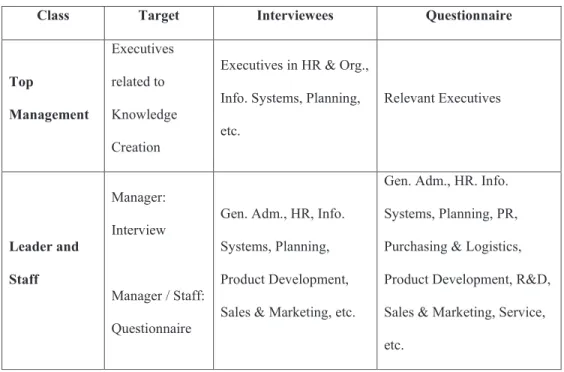
The firms participating in this survey were 28 major Japanese and US firms in the automobile and information appliances industries. All are leading firms, highly regarded for creating knowledge that has global impact. The researchers met executives at firm head-quarters in both Japan and the USA and at their local subsidiaries in each country. Interviews were conducted with 171 persons in positions listed in Table 1 above.
Interview subjects were executives in Human Resources & Organization, Information
― 9 ―
Systems, Planning, Product Development, Sales and Marketing, etc. All these executives had some awareness of the knowledge creation activities inside their firms. Though Japanese and American workplaces did not use the expression“Knowledge creation”as much, they were clearly engaged in knowledge creation activities. During the years of 2005-2007, 171 persons were interviewed. The vast majority of US respondents(over 85%) were employed by Japanese firms located in the USA More than 70% of survey respon-dents(1106)were core persons(above manager level)in both countries.
3.Data Analysis
3-1.Enabling Factors for Knowledge Creation
1.Factor Analysis and Dependent Variable“Knowledge Creation”
“Knowledge creation enabled by organizational learning(knowledge creation)”is something that was extracted from the 45 items regarding the recognition of Japan and the US reply samples using factor analysis(Eigen value: over 1.0, Cumulative contribution rate: Japan 58.6%, USA 56.9%). In Japan and the US samples, 3 items such as “Implementation of job rotation and recognition on knowledge creation,”“The improved human resources development and recognition on knowledge creation,”and“Group train-ing and e-learntrain-ing in cross- functional and cross- organization and recognition on knowl-edge creation”formed the dependent variable“Knowlknowl-edge creation enabled by organiza-tional learning”(Japanα=0.77, US α=0.77).
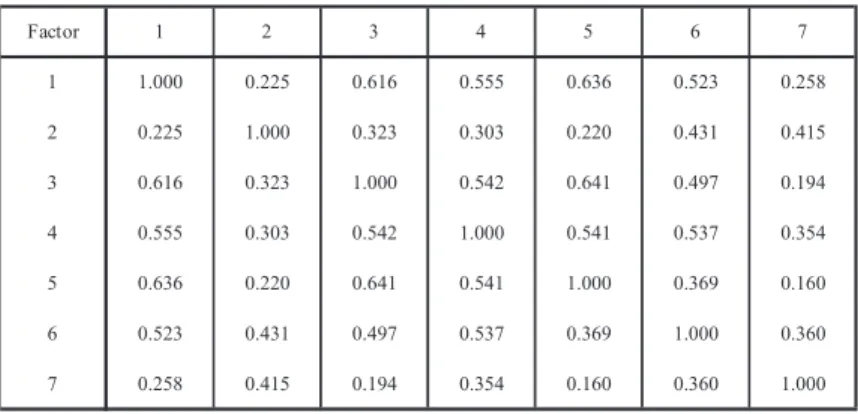
The details of a factor analysis result are as follows; In Japanese based firms, the 45 items regarding the recognition of knowledge creation extracted 7 factors such as 1) Management strategy enabled by knowledge creation(α=0.89), 2)Information sharing enabled by knowledge creation(α=0.86), 3)HRM enabled by knowledge creation(α =0.85), 4)High climate of reliance enabled by knowledge creation(α=0.83), 5) Organizational learning enabled by knowledge creation(α=0.77), 6)Free and generous job enabled by knowledge creation(α=0.83), 7)Corporate culture enabled by knowledge creation(α=0.76)as shown in Table 2.
Table 3 shows correlation of 7 factors extracted from Table 2. A“knowledge creation variable”5)Organizational learning enabled by knowledge creation for verification of hypotheses shows positive correlation with other 6 variables from about 0.4 to 0.6 range.
In the US based firms, the 45 items regarding the recognition of knowledge creation extracted 7 factors such as 1)Corporate culture based on confidential relation enabled by
― 11 ―
knowledge creation(α=0.91), 2)Management strategy enabled by knowledge creation (α=0.86), 3)Information-sharing enabled by knowledge creation(α=0.88), 4)HRM enabled by knowledge creation(α=0.81), 5)Organizational learning enabled by knowl-edge creation(α=0.77), 6)Brand value & customer satisfaction enabled by knowledge creation(α=0.78), 7)Corporate culture enabled by knowledge creation(α=0.76)as shown in Table 4.
In both Japan and the USA in order to examine inner compatibility, when the Cronbach’s alpha coefficient was computed, it was a sufficient high value respectively.
Table 5 showes correlation of 7 factors extracted from Table 4. A“Knowledge cre-ation variable”5)Organizcre-ational learning enabled by knowledge crecre-ation for verificcre-ation of hypotheses shows positive correlation with other 3 variables such as 1)Corporate cul-ture based on confidential relation enabled by knowledge creation(0.64), 3)Information-sharing enabled by knowledge creation(0.64), 4)HRM enabled by knowledge creation (0.54)ranging from 0.4 to 0.6.
Whereas the variable 5 shows relatively lower positive correlation with other 2 vari-ables such as 2)Management strategy enabled by knowledge creation(0.22), 6)Brand value & customer satisfaction enabled by knowledge creation(0.37), and 7)Corporate cul-ture enabled by knowledge creation(0.16)ranging from about 0.1 to 0.3.
In addition, in this research,“Organizational learning enabled by knowledge creation” which serves as a latent variable extracted by previous factor analysis as an operation con-cept of“knowledge creation”will be adopted as analysis. Then, in order to verify the model what are enabling factors which specify“knowledge creation”based on five research hypotheses, multiple regression analysis as shown below was conducted.
― 13 ―
3-3.The Result of Hypothesis Test
Then, in order to verify what enabling factors are which specify“knowledge creation” based on five research hypotheses, multiple regression analysis as shown below was con-ducted.
Hypothesis 1-1
H1-1 : Knowledge creation is greater in firms where management strategy and clear vision per-meate the organization.
The model suggests that shared management philosophy and clear vision play a role in promoting knowledge creation. Japanese respondents report that strategy and vision are widely shared in their organizations, much more than was reported by US respondents. However, Japanese were also less enthusiastic about the impact of shared understanding of business strategy and shared acceptance of corporate mission and vision. Whereas both groups see these factors as enablers of knowledge creation, US respondents were signifi-cantly more likely to report positive value in using them(Figure 4).
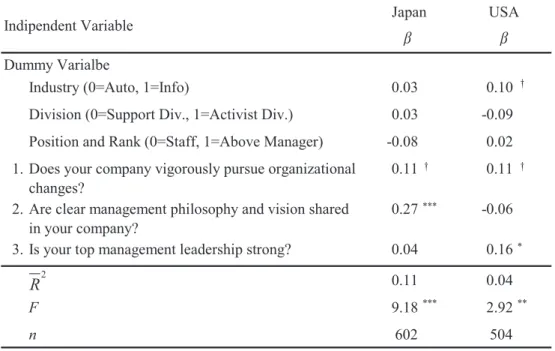
The items whose standard partial regression coefficient(β)with the dependent vari-able“knowledge creation enabled by organizational learning(“knowledge creation”)” were statistically significant in a multiple regression analysis are as follows; in Japan,“2. Sharing a clear management philosophy and vision,”and in the USA“3. Top management leadership is strong.”These had a positive effect on“knowledge creation”(Table 6). As Table 6 also shows the type of division in which the respondents worked did not impact answers, showing that responses did not depend on the particular departmental function
― 15 ―
Figure 4 Average Values of Japanese and American Responses(H1-1)
performed. The items whose standard partial regression coefficient(β)with the depend-ent variable“knowledge creation enabled by organizational learning(“knowledge cre-ation”)”were statistically significant in a multiple regression analysis are as follows; in Japan,“2. Sharing a clear management philosophy and vision,”and in the USA“3. Top management leadership is strong.”These had a positive effect on“knowledge creation” (Table 6). As Table 6 also shows industrial characteristics do not affect the result except
USA(p<0.10). Besides, the type of division in which the respondents worked did not impact answers, showing that responses did not depend on the particular departmental function performed.
Hypothesis 1-2
H1-2 : Knowledge creation is greater in firms that strive to improve brand value and customer satisfaction.
The model suggests that efforts to improve brand value and customer satisfaction cre-ate organizational conditions that promote the knowledge creation. The data reveal that both groups believe these factors can play a positive role in knowledge creation. Japanese respondents are more likely to report their firms emphasize customer satisfaction, but other differences were not statistically significant. Both groups report that efforts to improve brand value and customer satisfaction have a positive impact on knowledge cre-ation.(Table 7). Industrial characteristics do not affect the result except USA(p<0.01).
Hypothesis 2
H2 : Knowledge creation is greater in firms that encourage close two-directional information-sharing.
“Application of knowledge portal”in the USA, there were no statistically significant results(Table 8). Industrial characteristics do not affect the result except USA(p<0.05).
These items explored whether developing two-way information sharing inside the firm, and two-way information sharing between business organizations, have a positive effect on knowledge creation. They also explored whether specific kinds of communication tools such as a“knowledge portal”and specific kinds of software such as groupware promote knowledge creation. A knowledge portal for the automobile industry, for example, is a web-site where dealers and the manufacturer share details about new model cars. The data show that Japanese are more likely to report using these methods, but Americans are more likely to see positive benefits in using them. Overall, both groups view these factors as enablers of knowledge creation. Developing close information-sharing and two-directional information flows promotes knowledge creation.
The items whose standard partial regression coefficient were statistically significant in
― 17 ―
Table 8 Multiple Regression Analysis of Knowledge Creation Figure 6 Average Values of Japanese and American Responses(H2)
a multiple regression analysis with“Knowledge creation”as the dependent variable are as follows: in Japan,“3. Application of knowledge portal”in the USA, there were no statisti-cally significant results(Table 8). Industrial characteristics do not affect the result except USA(p<0.05).
Hypothesis 3
H3 : Knowledge creation is greater in firms whose corporate culture produces strongly trusted relationship both inside the firm and outside organizations.
Here the questions explored the strength of management leadership, the encourage-ment of employee initiatives, and the depth of corporate culture. They also examined the
― 19 ―
level of trust in vertical relationship, the level of trust in relationship with other organiza-tions, and the degree to which corporate culture encourages organizational learning. The model suggests all these factors are enablers of knowledge creation.
The data reveal both Japanese and US respondents see these factors as enablers of knowledge creation. Japanese respondents are more likely to report their organizations have strong leadership and more likely attach importance to employee initiatives. But Americans are more likely to hold positive opinions about these enablers. They dramatical-ly emphasize the benefits of trusted relationship, both internaldramatical-ly and across organizational boundaries, perhaps because these conditions are less common in American firms. They also emphasize the value of a corporate culture that supports organizational learning. Japanese, on the other hand, place more emphasis on employee initiatives, perhaps because these activities are less common in group-oriented Japanese society.
The items whose standard partial regression coefficient were statistically significant in a multiple regression analysis with“knowledge creation”as the dependent variable are as follows: in Japan,“1. Challenging initiatives of employees,”and in the USA“2. Promotion of delegation of authority.”These were positively related to“knowledge creation”(Table 9). Industrial characteristics do not affect the result except USA(p<0.10).
Hypothesis 4
H4 : Knowledge creation is promoted in firms that deploy human resources development practices systematically.
The model suggests that some human resources development practices are important to facilitating knowledge creation. Those explored here include group e-learning, formal career development, job rotation, improved training programs, and cross-functional train-ing. Japanese respondents more likely report they use cross-functional group training; e-learning experiences and have career development programs. Japanese were also more likely to report use of job rotation, which Americans report not using.
Both Americans and Japanese see value in using these methods to promote knowledge creation. The methods include career development programs, job rotation, improved train-ing and education, and cross-functional and cross-organizational group traintrain-ing. Once again,
― 21 ―
though both groups believe these methods are useful, Americans are more enthusiastic about the positive use of these methods. Knowledge creation is promoted in the firms which deploy human resources development systematically.
Japanese make strides in the improvements brought on by these enablers. Americans are more enthused with them.
The items whose standard partial regression coefficient were statistically significant in a multiple regression analysis with“knowledge creation”as the dependent variable are as follows: in Japan,“1. Execution of cross-functional projects,”“2. Group training and e-learn-ing that are cross-functional and cross-organizational,”“3. Carrier support systems,”and “4. Implementation of jobs rotation”showed a positive effect on“knowledge creation” (Table 10). Industrial characteristics do not affect the result except USA(p<0.10).
3-4.Implication from the Data Analysis
In this research, automobile and information appliances firms in Japan and the USA were studied to determine how they use various enabling factors for knowledge creation and whether these enabling factors are useful in promoting knowledge creation. The vast majority of respondents were executives of non production departments of Japanese and
American firms located in Japan and of Japanese firms located in the USA. The responses of a minority of respondents who were employees of American firms located in the USA appeared not to differ from the responses of those employed by Japanese firms located in the USA(although the small number in this former group did not allow for an analysis of statistical significance).
The significant differences in the results demonstrate the impact of location on the sys-tem of knowledge creation. Firms located in Japan seem to be implementing a different model of knowledge creation than those located in the USA(including Japanese firms located there). This finding has important implications.
In our study we relied on managerial perceptions and did not study objective indica-tors of knowledge creation such as patents. We did discover consistent patterns of how the components of knowledge creation system are seen(or experienced by the responding executives)as functioning together in the case of Japanese based organizations and how many components of such a system hypothesized in Figure 3 seem to be lacking in US based organizations. In the former case most of the hypotheses of our model were verified while in the latter only a few. This contrast is represented in the figure below:
(1)Empirically Verified Model of Knowledge Creation Enablers - Japan Based Firms: Knowledge Creation(KC)is enhanced by strong management strategy and clear vision (H1).
KC is enhanced in firms striving to improve brand value and customer satisfaction(H1-2). KC is enhanced in firms that encourage two way information sharing(which includes com-munication tools such as digitalized knowledge portal)(H2).
KC is enhanced when firms provide challenging initiatives and tolerate failure(embracing contradictions)(H3).
KC is enhanced through systematically applying comprehensive HRD practices such as cross functional projects, job rotation, career development and group training and e-learn-ing(H4).
(2)Empirically Verified Model of Knowledge Creation Enablers - US Based Firms: KC is enhanced by strong top management leadership(H1).
KC is enhanced in firms striving to improve brand value and customer satisfaction(H1-2). KC is enhanced through delegation of authority by management(H3).
KC is enhanced through group training and e-learning(H4).
The contrast between the two models of what drives knowledge creation is revealing. The models are based not simply on declared support by executives for a particular idea,
but on multiple regression analysis of statistically significant correlation with knowledge creation as the dependent variable. Unlike the Japan based firm which seems to be close to realizing the dynamic“Ba”model, the US based firms rely on strong leadership rather than strategy and vision. In both locations we do note the significance of customer satisfac-tion and brand value for knowledge creasatisfac-tion. The US based respondents support the idea of trust and information sharing in the survey, but the only factor representing trusted relationships correlated with knowledge creation in the US based firms is delegation of authority.
Finally, as in previous studies, the importance of HRD practices such as job rotation and cross functional projects appears not to be important to knowledge creation in the US based firms, whereas only group training and e-learning correlate with knowledge creation. Thus knowledge creation appears to function differently in the same industries located in Japan and the USA. This finding lends support to the idea that culture and location retains importance for management practice even in such globalized industries as automotive and information appliances.
The results are actually in some degree consistent with past comparative research of the US and Japanese firm's practices. They are also consistent with the declared goals of many Japanese firms which have been striving to find ways of improving innovation and white collar productivity and of extending the effectiveness of the modified Japanese man-agement model beyond excellence in production. Earlier studies of Quality manman-agement systems(TQM)being transferred by Japanese firms to their subsidiaries in the USA showed significant lags in implementation between the Japan based and the US based plants which took time to catch up with the standards prevalent in Japan based plants. So also in the case of knowledge creation systems, as our study shows, such a lag may be in place. In our study the US based executives acknowledge the value and potential of the system but seem not to be fully implementing it nor do they see a logical link of its compo-nents with knowledge creation in their minds. The Japan based executives are perhaps less enthusiastic but perceive the system functioning logically as a whole. Clearly the research question to be answered next would be: what are the key barriers which are present in the USA that may hinder the dynamic“Ba”system from flourishing. Do they bear some similarity to the factors that have made quality improvement to Japanese stan-dards such a challenge in the US based firms?
4.Case Studies
4-1.The Example of Large Automobile Firm A4)
Performance index of firm A occupies major status in the industry, such as sales, oper-ating income, net profit, ROE and plant-and-equipment investment, and R&D expenditure. Way management, an idea, and a standard of conduct are shared and dealer education and employees’education will be developed from 1998 even in the USA. The USA sales firm A holds sharing and meeting of best practices by horizontal deployment with local distribu-tors(new car education, leader education, etc.). The educational program using the US materials are utilized.
Two major personnel training institutions are established in Japan and the USA, and the talented people in the world are provided with the“Ba”and opportunity for learning. First one is the Japanese training organization aiming at a global leader’s training and sec-ond one is the corporate university in the USA.
The global knowledge center(GKC)which manages and supports a distributor's knowledge, special capability, and best practice integrated from the world was constructed in the GKC promoted communication across boundaries between distributors and dealers, without letting the head quarter pass, and formed communities of practice for sharing and utilizing knowledge.
The vision and missions of a way of global sales are clarified. Then, a performance by utilizing best practice of sales is measured to what extent it is helpful.
Managing and sharing the best practice in the world enable to compare the feature and competitive superiority between each unit of multinational firms.
Establishment of peculiar“Kata(Model)”from which knowledge based on success & failure experiences were shared organizationally and global deployment can be expected dynamically.
In that sense, focus on face to face communication is important like“three actual prin-ciples,”such as“go and see, and actual understanding.”A knowledge institutes for learn-ing & sharlearn-ing are needed by utilizlearn-ing the local resources as overseas production and sales increases(ex. GKC). Education for new model and leadership are very useful even though different types of model and situations.
1)Sharing a clear management philosophy and vision in firms
While auto industry average of Japan is comparatively high at 1.88, firm A is set to
2.22 beyond the industry average. While the US auto industry average is 1.03, firm A in the USA is set to 2.17 beyond the industry average, and is putting power into practice of shar-ing of a management concept and a vision.
2)Attaching importance to so called“three actual principles,”such as“go and see, and actual understanding”
While auto industry average of Japan is comparatively high at 1.74, firm A is set to 2.57 beyond the industry average considerably. While the US auto industry average is 0.65, firm A in the USA is set to 1.52 beyond the industry average. Thus, firm A is emphasizing the practice of three actual principles in the US auto industry as well.
3)Sharing best practices
While auto industry average of Japan is comparatively low at 0.56, firm A is set to 1.11 beyond the average of industry. While the US auto industry average is 0.55, firm A in the USA is set to 1.69 beyond the industry average. Therefore, firm A is deploying best prac-tices internationally compared to other auto industry.
4-2.The Example of Large Information Appliances Firm B5)
Characteristics of firm B are consciousness of futurity, using high-value-added goods. And a design, sensitivity, and a luxurious feeling are considered apart from the past norms of price, function, and quality.
High performance is enabled by business strategy based on a leadership of top man-agement and organizational change. An organizational change is developed by“Flat & Web”system.
4-2-1.Example of IT Section
The speed of TTM(Time to Market)and enforcement of TTP(Time to Profit)are deployed in the whole firm. As part of a business strategy, vertical take-off is carried out by world simultaneous marketing sales. A development lead time and component purchase speed are shortened. If knowledge which is not yet visualized is to be clear, it will be a future subject how management changes. Knowledge had remained in individual without transformation into explicit knowledge as an organizational knowledge. A failure example and knowledge are systematized in advance at a phase of design.
4-2-2. Explicit Knowledge
In vertical take-off, a process is arranged from product planning to sale and after-sale service, and they are visualization and documentation.
Afterwards, it expands in the USA, Europe, and China from the 2005 model.
Information sharing was carried out through navigation of design and office solution. This enabled sharing information mutually before and after the problem. Hence the cost was reduced to 30%.
Utilization of the information from a channel, an organization, a web, and a call center was limited due to the management of separated business domains.
The shared information from which each organization differs was enabled by one por-tal to visualize knowledge and know-how.
4-2-3. The Evaluation Toward Effectiveness of Knowledge Management
Cost is reduced by whole purchases through common use of the parts across each domain.
Firm B integrate design firms and it contents of 18,000, such as a design, materials, the quality of the material and an idea are put in a database and visualized. G mark(good design mark)acquisition rate improves dramatically.
4-2-4. R&D in the USA
Since the mobility of talented employees is intense in the USA, sharing all of data, a product, intellectual property, a report, etc. as a database is important.
Since the results of research differ for each research center, there is an opportunity for each director to report the result at a quarterly joint meeting(since 2006).
The engineer of network technology and a device specialist are doing opinion exchange by wiki, video conferencing, etc. on an exclusive website.
Knowledge creation is active at firm B, as there are two or more domains(inside where the technology to treat is broad)and technology of the firm which purchased through the exchange of cross-industrial fields.
4-2-5. Implication of Firm B
The situation where know-how of individual is not conveyed in firm arises, thus a suc-cessor does not grow up easily. Hence at firm B, such knowledge as data, products, intellec-tual property and reports, etc. are shared by data base as organizational knowledge.
From a viewpoint of accumulation and sharing of individual and organizational knowl-edge, the personnel training of a global management layer or a specialized staff based on the development scheme of leadership competency is systematically expanded at the in-firm training institute, and success is achieved.
In the past, participated management by all the members, the tacit understanding of personal experienced knowledge through QCC and TQC activities, off- site meetings, and
suggestion plans were mainly implemented. The measure which transforms tacit knowl-edge to explicit knowlknowl-edge as a model of knowlknowl-edge creation through using IT. An utiliza-tion of various informautiliza-tion from a channel, an organizautiliza-tion, a web and a call center was dif-ficult at the management for every business domain.
Hence, sharing information from each organization by one portal, and knowledge and know-how were visualized. Knowledge and know-how of an individual and an organization are rendered“visible,”and“systematized”through IT, besides drastic scheme is deployed through the dynamic“Ba”which creates innovative ideas.
Inefficient business is eliminated by deployment of Flat & Web as a firm-wide meas-ure, and practice of knowledge management and thoroughness of empowerment are real-ized.
The information system for securing the environment optimized by how to commit an individual and the purpose, the optimal environment where new knowledge is obtained from heterogeneous knowledge, the environment which raises the quality of planning, pro-motion and evaluation, etc. is introduced.
The measure which raises maturity of sharing and creating knowledge within firm up to the creative routines for the further knowledge creation cycle has been achieving suc-cess, and has contributed to improvement in corporate earnings.
“Maturity degree of sharing and creating knowledge”is shown as follows;“0: aban-doned,”“1: visualization,”“2: sharing,”“3: utilization,”“4: creative routines for the knowl-edge creation cycle.”
1)Sharing a clear management philosophy and vision in firms
While the average of information appliances industry in Japan is comparatively high at 1.58, firm B is set to 2.00 beyond the industry average. Firm B in the USA is putting power into practice of sharing of a management concept and a vision at 1.43, whereas the average in the USA is set to 1.29.
2)Attaching importance to so called“three actual principles,”such as“go and see, and actual understanding”
While average of information appliances industry in Japan is 1.20, firm B is set to 1.88 beyond the industry average. While average of US industry is 0.35, firm B in the USA is much less than the average of 0.52. Besides, deployment of the three actual principles in the US sales firm B is limited.
3)Top management’s leadership
aver-age of information appliances industry on both sides of the present status and opinion in Japan and the USA. This has proved that firm B has succeeded in an organizational change under direct control of president.
4)An improvement of customer satisfaction and brand value
An improvement of customer satisfaction and brand value are higher than the average of information appliances industry in both present status and opinion. They have also brought a plus effect to knowledge creation in Japan and the USA.
5)Sharing best practices
While the average of information appliances industry in Japan is 1.12, firm B is lower at 0.97 beyond the average of industry. While the average of industry in the US is 0.62, firm B in the US is lower at -0.08, thus deployment of three actual principles is limited.
4-3. The Example of Large Information Appliances Firm C6)
Two brands will be integrated at the US base in April, 2007. No less than four dealer-oriented brands were integrated to three. Although three firms where each corporate cul-ture differs were purchased, and the promotion of one ID became difficult, lingua-franca was shared by the balanced scorecard. Sales increased by 3 times in ten years. It is a big reform since 1984, and one vision is made to share in 2007. By redefinition of a vision, it makes a vision link to the communication to a strategy, BSC, and all of employees. It decides upon a mid-term plan every three years.
In firm C, as an improvement in a customer value, they are segmentation and cus-tomization through customer relationship management. The employees of a back office also understand a customer’s worth and sharing of knowledge. Those understanding contribute to corporate profitability.
In terms of“Ba of knowledge creation," an inspiration is obtained from brainstorming and face to face communication. Internal opportunities, such as a visitor on business and a presentation by the professor of the exterior. If output is interesting, it ties to the next step. Structuring system is carried out for problem solving. CFT is effective on knowledge creation.(It succeeds in application in the U.S. acquiring firms.)
As shown in Figure 9, this firm considers four views in human resources development such as;
a. An employee’s autonomy is pulled out,
b. The climate, where specialty can be improved and demonstrated is built, c. Fair evaluation and treatment based on performances,
d. The climate is easy to work.
A strategic target takes shapes through the sharing and osmosis process of manage-ment philosophy and vision among organization members, and the employees’challenging spirits are evoked. Then, fair evaluation & treatment, and a sense of accomplishment are given to employees to the performance as the result. Such a good circulation strengthens the pride to work at the firm more. This example shows that these combination of sharing vision and strategy with good HRD have played an important role of enabling factors on knowledge creation.
1)Sharing a clear management philosophy and vision in firms
While the average of information appliances industry in Japan is 1.58, firm C is high at 2.00 beyond the industry average. Firm C in the USA is low at 1.14, whereas the average of information appliances industry in the USA is set to 1.29.
2)Attaching importance to so called“three actual principles,”such as“go and see, and actual understanding”
While the average of information appliances industry in Japan is 1.20, firm C is higher at 1.59 beyond the average of industry. While the average of industry in the USA is 0.35, firm C in the U.S. is low at 0.25, thus deployment of three actual principles is limited. However, in the question item about opinion, three actual principles are expected noting that it brings a high effect to knowledge creation.
3)Sharing best practices
While the average of information appliances industry in Japan is 1.12, firm C is higher at 1.40 beyond the average of industry. While the average of industry in the USA is 0.62, firm C in the USA is low at 0.74, thus deployment of three actual principles is limited.
Figure 9 Sharing Vision and Strategy Combined with HRD
As implication from firm C, emphasis is put on the promotion in which the role of the leadership in firm C reforms firm activation and a corporate culture. As a promotion meas-ure of knowledge creation, devices such as reflection to the treatment and the remunera-tion to the employees for putting organizaremunera-tion osmosis of a management philosophy and a vision into execution, compensations and a succession plan(succession planning)etc. are made at Firm C. The organizational climates in which the employees create value in firm are developed for customer value creation and customer relationship management.
4-4.Implication From the Case Studies
Individual factors, such as top management’s leadership, a management concept and a vision, management strategy, improvement in brand value, and improvement in customer satisfaction, united through dynamic“Ba.”That makes epoch-making effect for knowledge creation.
Since the management styles of sharing information, organizational learning and per-sonnel training also differ, construction of peculiar“model of knowledge creation manage-ment”is needed in accordance with the difference between a country and a type of indus-try.
“Sharing knowledge by organization osmosis and visualization of a management strate-gy and a vision”and importance of“organizational knowledge”of the tacit and experi-enced knowledge of employees based on“three actual principles”(“go and see, and actual understanding”)and“personnel training”were clarified from case analysis.
Support by CEO for management strategy and an information system is an important enabling factor which raises the corporate value that is mainly concerned with brand value or customer satisfaction by the global deployment.
Sharing of a management mission and vision is used as a base, and since management strategy is important as a drive factor which determines the vector of the“Ba”of dynam-ic knowledge creation, it is important to foster the construction capability of management strategy.
The main purpose of knowledge creation should increase customer satisfaction and brand value. It is important to foster personnel training through the“Ba”using IT tools and organizational learning, to transform individual experienced knowledge, tacit knowl-edge and know-how toward the innovated realization, and to increase them as an organiza-tional knowledge.
“Ba”for knowledge creation increases the degree of maturation through the cycle of
the dynamic knowledge creation, and it is important to upgrade the maturity as a creative routine.
5.Conclusions
Interestingly knowledge creation system is built on the foundations of previous Japanese excellence in strong firm visions, human resources development, open communi-cations, trust relationship inside and outside firm, and job rotation. Besides, the Japanese firms have added and integrated enhancement of brand value and customer satisfaction, the management of dialectical contradictions(tolerance of failure, challenging initiatives), and career development.
Further research might want to evaluate the objective effectiveness of the peculiar “Ba”model as compared with the more open Western systems of innovating. So far even critics acknowledge the effectiveness of how leading Japanese firms in such global indus-tries as automotive and information appliances have managed knowledge creation and innovations, and have translated this into success in the marketplace.
1. Our results support the comprehensive view of knowledge creation systems in firms, which was shown in the framework and causal model of factors affecting knowledge creation. The business environment of firms, management strategy, the practical use of information systems, organizational learning and culture, and personnel training affect each other. Besides they are linked to the knowledge community of practice as a dynamic“Ba” for knowledge creation. The pattern is evident in both Japanese and the US workplaces albeit with some significant differences in the degree to which the system is implemented.
2. Figures 4, 5, 6, 7 and 8 show statistically the actual use of knowledge management methods in firms in Japan and the USA, and the gap in recognition. Although actual use in the USA is low, they are recognized as useful for the creation of knowledge. In addition, the multiple regression analysis showed the primary factors supporting knowledge cre-ation. Adopting both statistical approaches, we found good support for our hypotheses (Table 6, 7, 8, 9 and 10).
3. The results support the idea of organizational osmosis of management concept and vision throughout the organization. Such osmosis may occur by ensuring that the corporate vision and goal are“visualized”at the individual performance level. The ability of Japanese firms to inculcate and redefine their corporate principle and vision broadly and deeply in the organization stands out. At the firms in the USA, leadership demonstrated by
top management plays a big effect at the time of knowledge creation.
4. Improving the brand value(a product/corporate brand)and customer satisfaction enable conditions that promote knowledge creation. Two-directional information-sharing with dealers or customers is also seen as contributing to this process. Especially at the firms in Japan, application of the knowledge portal showed a positive effect on knowledge creation.
5. In both the Japanese and American contexts, trusted relationship both inside and outside the firm are seen as important enablers of knowledge creation. Especially at firms in Japan, challenging initiatives, whereas in the USA, the delegation of authority showed a positive effect on knowledge creation.
6. The systematic support of human resources development through such methods as job rotation, formal career development, execution of functional projects, and cross-functional group training and e-learning is also viewed as an important enabler of knowl-edge creation and organizational learning. However, these were implemented to a different degree in practice in Japan and the USA.
7. The comparative results of this survey are reminiscent of previous, older studies of Japanese management of human resources or of technology. Again, the difference between the American and Japanese context is not that the US based firms do not want to embrace the more“holistic”approach. Indeed our results show that American respondents are enthusiastically supportive of most elements of such an approach to knowledge manage-ment. As before, however, the difference appears to lie in the greater ability of the Japanese to more thoroughly implement many of the practical techniques needed to enable the system to reach its potential through the dynamic“Ba.”This may explain the Japanese uncanny ability to outperform the West in innovation.
8. As we showed from 3 case studies, we could find out that“sharing knowledge by organization osmosis and visualization of a management strategy and a vision" and impor-tance of“organizational knowledge”of the tacit and experienced knowledge of employees based on“three actual principles,”(go and see, and actual understanding)and“person-nel training" were effective for knowledge creation. Top management leadership and their management strategy are a key for raising the corporate value that is mainly concerned with brand value and customer satisfaction by the global deployment. We also mentioned that sharing of a management philosophy and vision is vital among all of the employees, and management strategy is crucial as a drive factor which determines the vector of the “Ba”of dynamic knowledge creation.
9. Besides, our finding suggests that it is vital importance to foster personnel training through the“Ba”using IT tools and organizational learning, to transform individual expe-rienced knowledge, tacit knowledge and know-how toward the innovative realization, and improving the matured cycle of knowledge creation, hence fostering the organizational capability as a creative routine for the sustainable corporate growth.
Footnotes
1)Chesbrough, H. W. 2006, p. 131. and Oliva, R. and Kallenberg, R. 2003, pp. 160-172. 2)Teece, D. J. 2007, p.1321.
3)Carla O'Dell and Grayson, C. J. 2002, p. 619.
4)Interviews with an executive and managers were conducted in May-June, 2005 in Japan and in September, 2005 and 2007 in the USA.
5)Interviews with an executive and managers were conducted in June-July, 2006 in Japan and in September, 2006 and 2007 in the USA.
6)Interviews with an executive and managers were conducted in June-July, 2006 in Japan and in September, 2006 and 2007 in the USA.
Acknowledgement
This research was awarded a grant for scientific research by Japan Society for the Promotion of Science during 2004-2008. We appreciate all of the relevant corporate people who have kindly cooperated in this study, and comments from scholars such as Prof. Takeshi Saito, Prof. Kiyoshi Miyashita, Prof. Richard Linowes, Prof. Tomasz Mroczkowski, and Prof. Francis Tuggle.
References
Argyris, C. 1993. On Organizational Learning. Cambridge: Blackwell Publishers.
Bartlett, C.A. and Ghoshal, S. 2002.“Building competitive advantage through people,”MIT Sloan Management Review, 43(2): 34-41.
Carla O'Dell and Grayson, C. J. 2002. Identifying and Transferring Internal Best Practices. In C. W. Holsapple(ed.), Handbook on Knowledge management: 1 Knowledge Matters, 601-618, Springer. Chesbrough, H. W. 2006. Open Business Models: How to Thrive in the New Innovation Landscape,
Boston: Harvard Business School Press.
Collins, J.C. and Porras, J.I. 1994. Built to Last: Successful Habits of Visionary Firms. NY: Harper Business Essentials.
Davenport, T.H. and Prusak, L. 1998. Working Knowledge: How Organizations Manage What They Know. Boston: Harvard Business School Press.
Garvin, D.A. 1993.“Building Learning Organizations,”Harvard Business Review, 71(4): 78-91. Georg von K., Ichijo, K., and Nonaka, I. 2000. Enabling Knowledge Creation. NY: Oxford University
Press.
Shinpousya(in Jpanaese).
Ito, K. 2000. Kooporeito Varyu(Management of Corporate Brand), Tokyo: Nihon Keizai Shinbunsya(in Japanese).
Quinn, J.B., Anderson, P., and Finkelstein, S. 1996.“Managing Professional Intellect: Making the Most of the Best,”Harvard Business Review, 74(2): 71-80.
Quinn, J.B., Anderson, P. and Finkelstein, S. 2004.“Leveraging intellect,”Academy of Management Executive, 10(3): 7-27.
Rogelio, O. and Kallenberg, R. 2003.“Managing the transition from products to services,” International Journal of Service Industry Management, 4(2): 160-172.
Senge, P. M. 1993. The Fifth Discipline, London: Century Business.
Takanashi, T. 2004.“Chi no Ba to Chi no Kata no Hanashi(Ba and Style of Knowledge),” Knowledge Management Society of Japan, KM Report(in Japanese).
Takeuchi H, Osono E, Shimizu N. 2008.“The Contradictions that Drive Toyota’s Success,” Harvard Business Review, June 2008.
Teece, D. J. 2000. Managing Intellectual Capital: Organizational, Strategic, and Policy Dimensions. Oxford, U.K : Oxfrod University Press.
Teece, D. J. 2007.“Explicating Dynamic Capabilities: The Nature and Microfoundations of (Sustainable)Enterprise Performance,”Strategic Management Journal, 28: pp. 1319-1350. Ueki, H., Ueki, M., and Miyashita, K. 2005.“Nichibei-Kigyou ni miru Narejji-Manejimento no Tenkai
(Deployment of Knowledge Management in Japanese and American Automobile Firms: Hybridization of SCM and Knowledge Management),”The Journal of Tokyo Keizai University, No.244, pp.3-17(in Japanese).
Ueki, H. 2005.“Chi no Kokusai-Iten to Sosikikan-Gakushuu(Transfer of Knowledge and Learning between Organizations : Case Study of NUMMI),”The Journal of Tokyo Keizai University, No. 246,pp. 13-27(in Japanese).
Ueki, H., Ueki, M., Saito, T., and Miyashita, K. 2007.“Nichibei-Jidousya-Kigyou niokeru Narejji-Manejimento(Knowledge Creation in Japan - US Automobile Firms),”The Annual Bulletin of Japan Academy of International Business Studies, No.13, pp.83-95(in Japanese).
Ulrich, D. 1998.“A new mandate for human resources,”Harvard Business Review, 78(1): 124-134. Wenger, E.C. and Snyder, W.M. 2000.“Communities of Practice: The Organizational Frontier,”
Harvard Business Review, 80(1): 139-145.
―― 2009 年 11 月 25 日受領――