
Residual Inter-Contact Time for Opportunistic Networks with Pareto Inter-Contact Time: Two Nodes Case
4
0
0
全文
(2) IPSJ SIG Technical Report. alyzing synthetic mobility models (such as random waypoint, random walk), the authors [6], [7] also concluded that Pareto distribution is a reasonable distribution for characterizing intercontact time (refer to our report [8] for more related works on inter-contact time). Based on such findings, researchers studied the distribution of residual inter-contact time for OppNets with Pareto inter-contact time. The authors [5] derived upper and lower bounds for the distribution of residual inter-contact time. Later, the authors [6] presented a general expression for calculating the accurate distribution of residual intercontact time, but arrived at a wrong distribution result for OppNets with Pareto inter-contact time [9]. The authors [9] attempted to derive the correct distribution of residual intercontact time, however, they used the limiting time-average fraction of residual time less than given value to represent the real distribution of residual inter-contact time, which is not justified. Our contribution in this paper is to rigorously derive the accurate distribution of residual inter-contact time for homogeneous OppNets, where inter-contact times of all node pairs follow the same Pareto distribution. Our work also justifies the result in [9]. • First, we formulate the contact process of a pair of mobile nodes as a renewal process, where the inter-contact time features the popular Pareto distribution [5], [10]. • Then, we derive, based on the renewal theory, closedform results for transient distribution of residual intercontact time and also its limiting distribution as time goes to infinity. For a tagged node, we also derive the distribution of the shortest residual inter-contact time between that node and all other nodes. • Finally, we conduct simulations to validate the theoretical results on distribution of residual inter-contact time. Our results on distribution of residual inter-contact time can be used to analyze delay performance of popular routing protocols in OppNets, such as epidemic routing and two-hop relay routing protocols. The rest of this paper is organized as follows. In Section II, we present problem formulation by rigorously defining intercontact time, residual inter-contact time and relative quantities. We then derive both transient and limiting distributions for residual inter-contact time in Section III. We present simulation results to validate our derived distribution in Section IV. Finally, we conclude this paper in Section V. II. P ROBLEM F ORMULATION Suppose two mobile nodes u1 and u2 move around in an OppNet, they employ the same wireless transmission range as shown in Fig.1a. We define the following terms for the two nodes. Contact: We say node u1 contacts node u2 if u2 moves into the wireless transmission rang of u1 , as illustrated in Fig.1a. Contact Epoch: A contact epoch is the time instant at which u1 contacts u2 . We denote successive contact epochs of u1 and u2 by S0 , S1 , S2 , · · · where 0 = S0 < S1 < S2 < · · · .. ⓒ 2015 Information Processing Society of Japan. Vol.2015-MPS-104 No.10 2015/7/27. Fig. 2. Sample path of contact process N (t) for u1 and u2 .. Inter-Contact Time: An inter-contact time X for u1 and u2 is the time interval between their two consecutive contacts, as shown in Fig.1b. Thus, the i-th inter-contact time Xi = Si − Si−1 , where i ≥ 1. We assume Xi ’s are independent and identically distributed (IID) random variables as previous works [5]–[7]. Contact Process: The contact process of u1 and u2 is denoted by {N (t); t > 0} where N (t) records the number of total contacts between u1 and u2 occurring in time interval (0, t], i.e., up to and including time t. Then, N (t) = n if and only if Sn ≤ t < Sn+1 , as shown in Fig.2. Note also that if u1 and u2 contact at time t then SN (t) = t. Since all inter-contact times are IID, the contact process is actually a renewal process (a renewal process is an arrival process where all inter-arrival intervals are positive IID random variables) [11]. Residual Inter-Contact Time: Assume a message arrives at u1 at time t, then the time interval from t to the next time node u1 contacts node u2 is defined to be the residual intercontact time for that message at time t, which is denoted by R(t) and R(t) = SN (t)+1 −t > 0, i.e., the time interval within the inter-contact time as shown in Fig.2. Age of Inter-Contact Time: Assume a message arrives at u1 at time t, then the time interval from the most recent contact between u1 and u2 before/at t to time t is defined to be the the age of inter-contact time for that message at time t, which is denoted by A(t) and A(t) = t − SN (t) ≥ 0, as shown in Fig.2. Note that if N (t) = 0 at time t, it means that no contact has happened between u1 and u2 in time interval (0, t], then the first inter-contact time X1 must satisfy X1 > t and consequently A(t) = t − S0 = t; if N (t) ≥ 1 at time t, then SN (t) > 0 and A(t) = t−SN (t) < t. To sum up, 0 ≤ A(t) ≤ t. Concerned Inter-Contact Time: Assume a message arrives at u1 at time t, then the time interval from the most recent contact epoch of u1 and u2 before/at t, SN (t) , to the next time they contact each other, SN (t)+1 , is defined to be the e concerned inter-contact time, which is denoted by X(t) and e X(t) = SN (t)+1 − SN (t) = XN (t)+1 > 0. e From the definitions of R(t), A(t) and X(t), we have the e e followings: X(t) = R(t) + A(t) and X(t) > A(t), for any. 2.
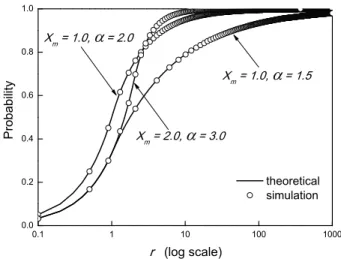
(3) Vol.2015-MPS-104 No.10 2015/7/27. IPSJ SIG Technical Report. t ≥ 0. Pareto Inter-Contact Time: Analysis of real mobility traces and synthetic mobility models suggests that Pareto distribution can well approximate the distribution of intercontact times in OppNets [5]–[7]. Thus, we assume all intercontact times Xi ’s for node u1 and u2 feature a Pareto distribution with scalar parameters xm > 0 and α > 1 as follow [6], [9], { ( )α 1 − xxm if x ≥ xm , FX (x) = P r{X ≤ x} = 0 if 0 < x < xm , (1) from which we also have the mean value αxm . X = E{X} = α−1. (2). III. I NTER -C ONTACT T IME A NALYSIS In this section we derive closed-form results for the distribution of residual inter-contact time. We first present a lemma below, which will be used in our following derivation. Lemma 1. Consider the contact process {N (t); t > 0} between u1 and u2 defined before. Suppose a message arrives at u1 at time t. For given constant a, δ and x satisfying 0 ≤ a < a + δ ≤ t, a + 2δ ≤ x, let E denote the following event e E = {a ≤ A(t) < a + δ, x − δ < X(t) ≤ x},. (3). where A(t) is the age of inter-contact time at time t for that e message, X(t) is the concerned inter-contact time. Then, we have ( )( ) P r{E} = m(t − a) − m(t − a − δ) FX (x) − FX (x − δ) (4) where m(t) = E{N (t)}.. Theorem 2. For an opportunistic network with Pareto intercontact time given in (1), the limiting distribution of residual inter-contact time R(t) of a message as t → ∞ is { ( )α−1 if r ≥ xm , 1 − α1 xrm lim P r{R(t) ≤ r} = rα−r t→∞ if 0 < r < xm . αxm (6) Proof. Due to space limitation, see our report [8] for a complete proof. Finally, we want to find out how long it will take a node with a new arrival message to contact another node in the OppNet, thus having opportunities to forward the message to the next node. Suppose a homogeneous opportunistic network of W nodes, where all nodes move independently and the inter-contact times of every pair of nodes feature the same Pareto distribution given in (1). Let Rij (t) be the residual inter-contact time for node i and node j, then the time interval R∗ (t) from time t the message arrives at node u1 to the time u1 contacts any one of the other W − 1 nodes in the network is { } R∗ (t) = min R12 (t), R13 (t), · · · , R1W (t) (7) Lemma 2. The limiting distribution of R∗ (t) is given as follows. lim P r{R∗ (t) ≤ r} t→∞ { ( )W −1 ( xm )(α−1)(W −1) 1 − α1 = ( αxm −rα+rr)W −1 1− αxm. if r ≥ xm , if 0 < r < xm . (8). Proof. P r{R∗ (t) ≤ r} = 1 − P r{R∗ (t) > r}. (9). Proof. Since the contact process forms a renewal process, this lemma follows directly from Theorem 5.7.2 [11].. =1 − P r{R12 (t) > r, R13 (t) > r, · · · , R1W (t) > r} (10) =1 − P r{R12 (t) > r}P r{R13 (t) > r} · · · P r{R1W (t) > r} (11). Now, we derive the transient distribution of residual intercontact time for nodes u1 and u2 .. where (11) follows from the independence of node mobility. After substituting (6) into (11), we got (8).. Theorem 1. For an OppNet with Pareto inter-contact times given in (1), the transient distribution of residual inter-contact time R(t) for a message at time t is ( x )α ( x )α m m P r{R(t) ≤ r} = − t t+r ∫ t ( ) + FX (t − τ + r) − FX (t − τ ) dm(τ ). IV. S IMULATION R ESULTS. 0. (5) where r > 0. Proof. Due to space limitation, see our report [8] for a complete proof. Next, we derive the limiting distribution of residual intercontact time R(t) as t → ∞.. ⓒ 2015 Information Processing Society of Japan. To validate the derived distribution of residual inter-contact time, we developed a customized simulator in C++ to simulate the contact process between two nodes u1 , u2 , the random message arrival process to node u1 , and observe the residual inter-contact times regarding message arrivals. Specifically, we simulated three different network scenarios where inter-contact times between u1 and u2 all follow Pareto distribution but with different scalar parameter settings: (xm = 1.0, α = 1.5), (xm = 1.0, α = 2.0) and (xm = 2.0, α = 3.0). We assume messages arrive at node u1 according to a Poisson process with arrival rate of 0.001. During simulations, we measured the residual inter-contact time for a message as the time interval from the time it arrives at u1 to the next time u1 contacts u2 . From the measured residual inter-contact times,. 3.
(4) Vol.2015-MPS-104 No.10 2015/7/27. IPSJ SIG Technical Report. we calculated their distribution. The simulated distributions under three network scenarios are presented in Fig.3, where corresponding theoretical distributions are also given for comparison. From Fig.3, we can see that our derived distributions for residual inter-contact time perfectly match the simulated ones, verifying our theoretical results.. 1.0. X. m. = 1.0,. = 2.0. Probability. 0.8. X. m. = 1.0,. = 1.5. 0.6. X. 0.4. m. = 2.0,. = 3.0. theoretical. 0.2. simulation. [5] A. Chaintreau, P. Hui, J. Crowcroft, C. Diot, R. Gass, and J. Scott, “Impact of human mobility on opportunistic forwarding algorithms,” IEEE Transactions on Mobile Computing, vol. 6, no. 6, pp. 606–620, April 2007. [6] T. Karagiannis, J.-Y. L. Boudec, and M. Vojnovic, “Power law and exponential decay of intercontact times between mobile devices,” IEEE Transactions on Mobile Computing, vol. 9, no. 10, pp. 1377–1390, August 2010. [7] H. Cai and D. Y. Eun, “Crossing over the bounded domain: From exponential to power-law intermeeting time in mobile ad hoc networks,” IEEE/ACM Transactions on Networking, vol. 17, no. 5, pp. 1578–1591, October 2009. [8] J. Gao and M. Ito, “Residual inter-contact time for opportunistic networks with pareto inter-contact time: Two nodes case,” NAIST, Tech. Rep., June 2015, [Online]. Available: http://researchplatform.blogspot.jp/. [9] C. Boldrini, M. Conti, and A. Passarella, “From pareto inter-contact times to residuals,” IEEE Communications Letters, vol. 15, no. 11, pp. 1256–1258, November 2011. [10] A. Clauset, C. R. Shalizi, and M. E. J. Newman, “Power-law distributions in empirical data,” SIAM Review, vol. 51, no. 4, pp. 661–703, 2009. [11] R. G. Gallager, Stochastic Processes: Theory for Applications. Cambridge University Press, February 2014. [12] J. Leguay, T. Friedman, and V. Conan, “Evaluating mobility pattern space routing for dtns,” in Proceedings of 25th IEEE International Conference on Computer Communications (INFOCOM), 2006.. 0.0 0.1. 1. 10. r. 100. 1000. (log scale). Fig. 3. Disbribution of residual inter-contact time under different Pareto distribution parameters.. V. C ONCLUSION In this paper, we rigorously derived the distribution of residual inter-contact time for opportunistic networks with Pareto inter-contact times. Our results have important implications for applications (by the law of large numbers): for a homogeneous OppNet, where contacts of all node pairs follow common inter-contact time distribution (e.g., students in a campus and corporate users [12]), the distribution of residual inter-contact times can be found out by collecting samples of residual intercontact times from all node pairs in stead of collecting samples from the same node pair for a long time. This creates great experiment convenience, since long-time tracking of the same pair of nodes is usually prohibited due to privacy while shorttime tracking all node pairs is much easier. R EFERENCES [1] L. Pelusi, A. Passarella, and M. Conti, “Opportunistic networking: Data forwarding in disconnected mobile ad hoc networks,” IEEE Communications Magazine, vol. 44, no. 11, pp. 134–141, November 2006. [2] M. McNett and G. M. Voelker, “Access and mobility of wireless pda users,” ACM SIGMOBILE Mobile Computing and Communications Review, vol. 9, no. 2, pp. 40–55, April 2005. [3] J. Su, A. Chin, A. Popivanova, A. Goel, and E. de Lara, “User mobility for opportunistic ad-hoc networking,” in Proceedings of the Sixth IEEE Workshop on Mobile Computing Systems and Applications (WMCSA), 2004. [4] N. Eagle and A. Pentland, “Reality mining: sensing complex social systems,” Personal and Ubiquitous Computing, vol. 10, no. 4, pp. 255– 268, May 2006.. ⓒ 2015 Information Processing Society of Japan. 4.
(5)
図


関連したドキュメント
We extend a technique for lower-bounding the mixing time of card-shuffling Markov chains, and use it to bound the mixing time of the Rudvalis Markov chain, as well as two
T. In this paper we consider one-dimensional two-phase Stefan problems for a class of parabolic equations with nonlinear heat source terms and with nonlinear flux conditions on the
Key words: Benjamin-Ono equation, time local well-posedness, smoothing effect.. ∗ Faculty of Education and Culture, Miyazaki University, Nishi 1-1, Gakuen kiharudai, Miyazaki
Therefore, motivated by the impact of topological structures and the delays on the dynamics of the networks, this paper mainly focuses on the effect of delays on inner
In Proceedings Fourth International Conference on Inverse Problems in Engineering (Rio de Janeiro, 2002), H. Orlande, Ed., vol. An explicit finite difference method and a new
Keywords: continuous time random walk, Brownian motion, collision time, skew Young tableaux, tandem queue.. AMS 2000 Subject Classification: Primary:
Chu, “H ∞ filtering for singular systems with time-varying delay,” International Journal of Robust and Nonlinear Control, vol. Gan, “H ∞ filtering for continuous-time
Keywords: Lévy processes, stable processes, hitting times, positive self-similar Markov pro- cesses, Lamperti representation, real self-similar Markov processes,
