Society of Japan
Vo!. 26, No. 3, September 1983
OPTIMAL SCHEDULE IN A GT-TYPE FLOW-SHOP UNDER
SERIES-P ARALLEL PRECEDENCE CONSTRAINTS
Yasuki Sekiguchi Hokkaido University
(Received September 24,1982; Revised April 7, 1983)
Abstract The following two-machine flow-shop scheduling problem is solved. Given jobs are classified into groups, and each machine needs some setup before the first job in a group is started processing. If a job in a group is started its process, all jobs in the group must be finished before a job in another group is processed. Each job may have a specified lag time between machines. Moreover, a series-parallel precedence relation may be specified among groups. Find inter- and intra-group schedules minimizing the total elapsed times on both machines. The proposed method for this problem is based on a new definition of composite jobs and Sidney's theory about series-parallel algorithms. The proposed method can also solve a version of the problem where each job has setup times not included in the processing times and a series-parallel precedence relation is specified among jobs in a group.
1. Introduction
Group technology (GT) is one of the techniques for improving efficiency of job-shop type production. GT is based on classifying parts according to similarity of geometric shape and size, and/or of production process. A shop where GT is implemented can be modelled as follows.
"Jobs to be processed are classified into groups and all jobs in a par-ticular group need some common setup at each production step." Of course, each iob may require a particular setup inherent to it. But, such setup oper-ations can often be regarded as a part of machining operoper-ations which require the setups. We will treat such cases first, and the results will afterward be shown applicable for cases where setup at each production step of each job must be regarded as an operation independent of machining operation.
Most scheduling problems are very difficult to solve and efficient solu-tion procedures have been developed for a few of them. Most problems with
Optimal Schedule in a GT-Type Flow-Shop 227
such a convenient property consist of one or two production steps. Our prob-lem here is also one in a two-production-step shop.
In the previous paper [18], a scheduling problem in a two-machine job-shop where GT is implemented was discussed, and an efficient procedure for finding schedules which minimize the total elapsed times, i.e. the maximum completion times, on both machines under arbitrary time lags was proposed. For the problem, no precedence constaint among groups was imposed, though it imposed a GT-type constraint that jobs are divided into groups and all jobs in a group must be finished without interruption once processing of a job in the group is started.
On the contrary to this, we will treat a problem where a series-parallel precedence constraint is imposed among groups of jobs. But, the shop discuss-ed is not a general job-shop but a two-machine flow-shop where a time lag between the first and the second machines may be specified for each job. The objective is to minimize the total elapsed times on both machines. Our solu-tion allows arbitrary values for parameters and variables such as the number of groups, the number of jobs in a group, lag times, setup times and series-parallel precedence constraints. Various two-machine problems solved in Johnson [4], Mitten [ll]-Johnson [5], Jackson [3], Kurisu [6], Sidney [19], Monma [13], Maggu, et al. [10] and Sekiguchi [18] become special cases of our problem by fixing the parameters and/or variables at some specific values. Furthermore, some interesting and unsolved problems such as flow-shop or job-shop problems where setup times for jobs are specified independently of pro-cessing times can also be deduced.
In the two succeeding sections, the problem is stated in detail, some basic notations are defined and the results in the preceding paper [18] are briefly introduced. An objective here is to show that Johnson's rule is applicable for a fairly general situation.
Kurisu [6] first introduced precedence constraints on a flow-shop sched-uling problem, and Kurisu [7], Sidney [19], Monma [13] and some others have tried to generalize or to improve his study. Our problem will be analyzed along with Sidney's theory. In that, a concept of composite jobs plays a substantial role. Because our problem is fairly general, composite jobs occasionally have negative processing times, and composition of composite jobs needs more general treatment than that of ordinary jobs. This issue is discussed in 4.
Series-parallel precedence constraints are introduced in 5. A procedure for finding an optimal schedule of our problem imposed series-parallel con-straints is proposed. The last section discusses the power of the new
solu-tion and the unsolved issues.
2. Preliminary
Consider a shop with two machines, A and B. The buffer capacity between machines is assumed to be big enough and there is no restriction on the
quan-tity of in-process inventory. A job given to this shop has one of the four technological orders shown in Fig. 2.1 (a). Jobs finished only through machine A (B) are said to be type-A (B), and those finished through machine A
type-A jobs
I
aachine A
aachine B
type-AB jobs
type-BA jobs
I
type-B jobs
(a )
Typesof jobs.
group
setup time
job
processing tiae
lag tille
No.
A BNo.
A B i1Ail
-
-i2
A12
B12
D12
iSAi
SBi
i3.-
B i3
-14
A14
B14
Di4
i5
Ai5
-
-(b )
A typical job group: G
i
={i I. 1.2. . . '. i5
t •
Fig. 2. 1
Illustrations of the problea.
Optimal Schedule in a GT-Type Flow-Shop 229
and then machine Bare type-AB. Suppose that g job groups are given:
G.=
{il, t.i2,
...
,
in.,.}, n.> 1, i= 1, 2, ... , g.v t.= A • • t.J and B • • t.J are processing times of job
ij on machines A and B, respectively. I f job ij is type-A (B), only A •• (B •. )
t.J t.J is given.
A lag time of a type-AB job is a specified time which must be at least spent from the start of its operation on machine A until its start on machine B (a start lag) , and from the completion of its operation on machine A until its completion on machine B (a stop lag). Practically, a start lag of a job may be different from its stop lag, but one of them is actually effective. Without loss of generality, we assume that a lag time D ..
t.J each type-AB and type-BA job ij. I f D.
_=
min {A •• , B .• },t.J t.J t.J
may be specified on job ij is equivalent to a job without a lag time. Lag times can be applied for expressing over-lapping productions, transport times between machines and operations on non-bottleneck machines (see [12) for details), and also for improving lower bounds in a branch and bound method for multistage flow shop problems ([8),
[17)) .
Denote by
BAi
andBBi
setup times ofG
i
on machines A and B, which must be spent before the first job in the group is started processing. Job groups which includes at least one type-AB job and no type-BA job are called type-AB groups (Fig. 2.1 (b». Similarly, type-BA groups are defined. A type-A (B) ~ consists of type-A (B) jobs only.In the previous paper [18), a procedure which gives an optimal permuta-tion schedule under no precedence constraint when a job group can be anyone of those four types. A permutation schedule here is consists of inter-group and intra-group schedules and the orders of type-AB (BA) jobs and type-AB
(BA) groups on machine B (A) must be the same as those on machine A (B). However, all job groups in the present paper are type-AB except in the last section. The problem to be solved is "given g type-AB groups and a precedence constraint among them described as a series-parallel network (see 5.), find an optimal permutation schedule minimizing the maximum completion times on machines A and B."
Let time 0 be the time when machine A can start processing the first job in the given groups and
to
(~ 0) be the time when machine B can start pro-cessing the first job. The pair (0,to)
is called an initial condition [16). Denote by TA(a)
and TB(a)
the completion times on machines A and B,respec-tively, when a permutation schedule a is implemented under an initial condi-tion.
o·ij
is the schedule made by concatinating jobij
after a schedule o. Calculation of completion times ofa·ij
depends on the type ofij
and is done by (2.1)- (2.3).(2.1) type-A
TA (a' ij)= TA (a)+ A
ij
, TB
(0'ij)= TB (a).
(2.2) type-B
TA (a' ij)= TA
(0),TB (a' ij)= TB (a)+ Bij .
(2.3) type-ABTA (a' ij)= TA (a)+ Aij ,
T (a' B
J
TA (a)+ A ..
1-J+
D •• } 1-Jij)=
maxTA (a)+
D • •+
B ••1-J 1-J
TB
(a)+
B •.1-J
When G
i
is scheduled just after a, machines A and B are ready forpro-cessing jobs in it at (2.4)
Therefore, we assume here for convenience that
TA
(a) and TB (a) in (2.1)-(2.3) are replaced by the respective terms in (2.4) for the first job in G ..
1-~ denotes an empty schedule. It is possible to understand an initial condition as a pair of completion times of ~, i.e.
(2.5)
The completion times of G
i
is the maximum completion times on machinesA and B among jobs in G
i . An intra-group schedule which minimize the comple-tion times of G. scheduled just after 0 will minimize also the completion
1-times under the initial condition (2.5), where
to=
TB(a)+ SBi- {TA (a)+ SAiL
The problem finding such a schedule is called an intra-group scheduling prob-lem. This problem has been solved as follows (cf. theorem
2
in[18]).
Theorem 1.
(an optimal intra-group schedule). LetNA
(NB) be a set of type-A (B) jobs,NAB'
I (NAB'Jt
be a set of type-AB jobs such(Aij~Bi}'
andGi=NAUNAB ,
IUNAB' rrUNB' whereNAB'
InNAB'Aij= Bij ,
jobij
must be in exactly one of NAB' I and NAB' rr)'ules as follows.
a
A
(aB):
an arbitrary schedule of jobs inNA (NB)'
that A •• < B ••
1-J= 1-J
rr =: ~ (Le. i f
Define
Optimal Schedule in a GT-Type Flow-Shop 231
D • ••
1-J
0AB' 11: a schedule of jobs in NAB' 11 arranged in nonincreasing order of
D • ••
1-J
An optimal schedule for an intra-group scheduling problem is a permutation schedule 0* where the schedule on machine A is 0AB' I·oAB' II·oA and one on machine B is °B·oAB' I·oAB' 11·
Theorem 1 is a composition of the results by Jackson [3] and Mitten [11]. It is important that the intra-group scheduling problem has been solved under arbitrary initial conditions. Thus, the next theorem is almost evident.
Theorem 2.
Given an arbitrary inter-group schedule, let 0* be this schedule with its intra-group schedules determined by theorem 1. Let ° be a schedule with the same inter-group schedule but with intra-group schedules different from those of 0*. Then, the following hold.This theorem asserts that, in order to obtain an optimal permutation schedule, intra-group schedules can be fixed at those determined by theorem 1 and finding an optimal inter-group schedule is the remaining problem. This inter-group scheduling problem will be reduced to a problem equivalent to an intra-group scheduling problem by introducing a concept of composite jobs.
Define a triplet (ai' ~i' Si) corresponding to a schedule of type-AB jobs in G
i
.
Let TB be the completion time on machine B of the schedule underinitial condition (0, 0). Then,
ai = TB- ENB UN
AB Bij+ SAi- SBi'
Si= TB- EN UNA .. ~
A AB 1-J
~.= T
B
+
SA.- max {a., O}- max {S., O}.1- 1- 1-
1-This triplet is a set of durations a., S. when exactly one of the machines is
t. ~~
busy and a duration ~. when both machine:; are busy (or idle). A typical
situ-
1-ation is illustrated in Fig. 2.2. As it is easily understood, S. can be
1-negative if EN A •. is large and the sign of a
i depends on the values of SBi
A 1-J and EN B •.•
B 1-J
Suppose that
G
setup
SAi
is surely started atTA
(0), and all operations on machine A can be performed consecutively without intermediate idle time even if TB (0) is much larger thanTA
(0). The setupSBi
is surely started at TB (0) and operations in NB can be performed consecutively without intermediate idle time even ifTA
(0) is larger than TB (0). But, notice that operations in NAB may not be started on machine B when all operations in NB have just been completed, ifTA
(0) is not smaller enough thanTB
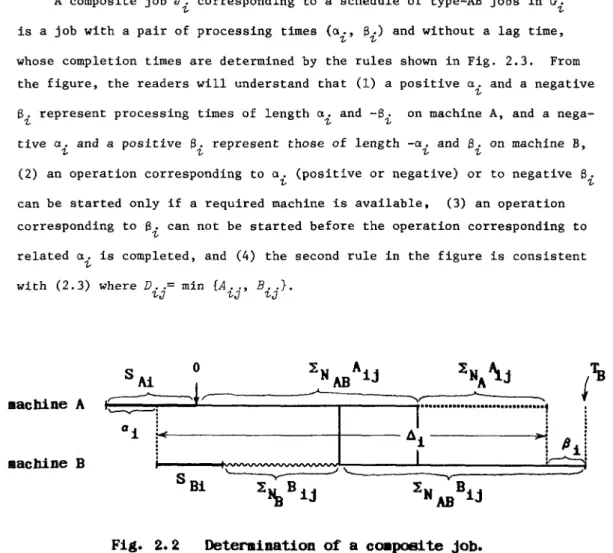
(0). Based on this observation, a com-posite job is defined as follows.A composite job J
i
corresponding to a schedule of type-AB jobs inG
i
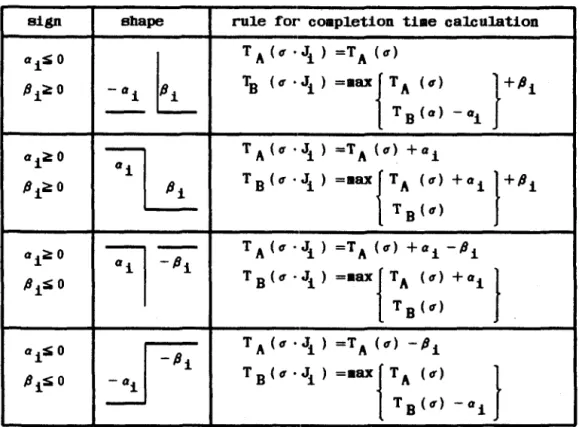
is a job with a pair of processing times (a., ~.) and without a lag time,
'Z-
'Z-whose completion times are determined by the rules shown in Fig. 2.3. From the figure, the readers will understand that (1) a positive a. and a negative
'Z-~i represent processing times of length a
i
and -~i on machine A, and anega-tive a. and a posinega-tive ~. represent those of length -a. and ~. on machine B,
'Z- 'Z- 'Z-
'Z-(2) an operation corresponding to a. (positive or negative) or to negative ~.
'Z-
'Z-can be started only if a required machine is available, (3) an operation corresponding to ~i can not be started before the operation corresponding to related a. is completed, and (4) the second rule in the figure is consistent
'Z-with (2.3) whereD .. =min {A .. , B .. }.
'Z-J 'Z-J 'Z-J
S Ai
0
};N AB Aij
machine
A
~'-v--'i
r---~---~...
~,
:: I a i : + - - - + - - -4i
;.!
machine
BOptimal Schedule in Gr GT-Type Flow-Shop 233
The definition of composite jobs above is different from that in Kurisu [6] or Sidney [19], where lag times are used as a basic tool. Our definition makes it easy to expand the concept of c:omposite jobs. That is, it is con-venient to define composite jobs by lag times if ai and Si are positive, because the difference L~ in theorem 3 does not occur. But, this definition does not seem to be able to deal with negative a and S. In order to systema-tize the theory, it will be benificial to reduce a scheduling problem with lag times ([11] and [5]) into the Johnson problem [4] by introducing compos-ite jobs defined in the present paper (see lines 6-12 of p.786 in [19]).
Denote by 0J an arbitrary schedule of composite jobs J
i
(i=
1, 2, ... , g)corresponding to specific schedules of type-AB jobs in
G.'s.
Let·o be a
"Z-sign
a
i=- 0
Pi~O ai~O Pi~O ai~OPi=- 0
ai=- 0
Pi=- 0
shape
rule :for- co.pletion tiae calculation
- ' i
l
T It
(eT • Ji ) =T
It (eT)'IB (.
·Ji )
-0Blf{T A (.)
r
Pi
TB
(a) - ai
T A
(eT • Ji ) =T
It (eT) +ai~
PiT B ( • .
Ji )
-II8X {T A (.)
+,
i }
+
Pi
TB(eT)
1
-
T A
(eT • Ji ) =T
It (eT)+
a
i - Pi
- Pi
T B ( • .
Ji )
-'OX {
TA (.)
+ai}
TB(eT)
f
T It
(eT • Ji ) =T A
(eT) -Pi
-ai
T BC ••
Ji )
-0Blf {T A (.)
-Oi}
TB(eT)
Fig. 2. 3 CoIIpoei te jobs and rules :for
completion time calculation.
permutation schedule with the inter-group schedule 0J and intra-group sched-ules used in defining Ji's. The completion times of 0J and 0 are calculated by Fig. 2.3. and (2.1)-(2.3), respectively. Then, the next theorem can be proved
[18].
Theorem 3.
The following relations hold under arbitrary initial condi-tions.TA
(0)=TA
(OJ)+E~=
1~i·
TB
(0)=TB
(oJ)+E~=
1~i·
This theorem asserts that the problem of finding an optimal inter-group schedule under intra-group schedules specified for job groups is equivalent to that of finding an optimal composite job schedule, where the composite job for a group corresponds to the specified intra-group schedule. An ordinary type-AB job is equivalent to the second type in Fig. 2.3 and its completion time is determined by the same formula as (2.3), where D .• = min {A .. , B .• }.
1-J 1-J 1-J
It is understood that the problem of finding an optimal composite job schedule is a generalization of the classic flow-shop problem (or the intra-group scheduling problem) in Bellman
[1]
and Johnson [4]. Notice that the compu-tational rules in Fig. 2.3 are equivalent toTA
(0· J.)=TA
(0)+ max {a.,O}-
min {a, B.},(2.6) 1- 1-
1-TB
(0· J i)= max{TA
(0)+ max {a., a} 1+ max {B.,a}.
1-
1-TB (0)-
min{a,
ail3. Dominance Relations among Composite Jobs
The author resolved the composite job scheduling problem in the previous paper (theorem
8
in[18]).
The result and its proof will be given in a sim-pler form.Definition
(dominance relation). When one of the following relations holds. J. is said to dominate J., and denoted by J.< J ..1- J 1-= J
(3.1) a.< Bi' a.< .B., a.< a.,
1-= J= J 1-= J (3.2) a.< 8 i , a.> 8., 1-= J= J (3.3) ai~ Bi , a.> 8., J= J 8.> 1-= 8 .. J
Optimal Schedule in fJ. GT-Type Flow-Shop 235
Both a.< S. and a.> S. are true if a.= S. holds, but we assume that a.=
-z,= -z, -z,= -z, -z,. -z, -z,
8i is never interpreted as ai;;;, Si in on'~ place and as ai~ Si in another place. That is, i f ai
=
Si is interpreted as a{';" 8i when composite job i is first
compared to another one, it must be interpreted as a
i;;;, Si in all comparisons.
This assumption is called a unique int~rpretation assumption (UIA). Notice that UIA does not prohibit from interpreting a.= 8. as a.> 8. when a.=
S.
-z, -z, -z,= -z, J J
(i~ J') is interpreted as a.< S·. J= J
Theorem
4. The dominance relation;;;, is transitive under UIA.Proof:
Suppose Ji
;;;,
Jj and Jj;;;, Jk. When Ji
and Jj satisfy :3.1), Jj andJ
k must satisfy (3.1) or (3.2). In the former case, Ji and Jk satisfies (3.1), and in the latter case (3.2). When J. and J. satisfy (3.2), J. and J
k must
-z, J J
satisfy (3.3). Then,
J
i
andJ
k
satisfy (3.2) . WhenJ.
-z, andJ.
J satisfy(3.3), J
j and Jk must also satisfy (3.3}. Thus, J
i
and Jk satisfy (3.3).Theorem
5. If J.< J., the following are true under arbitrary initial-z,= J conditions. TA (J.' J.)= TA (J .. J.), T B(";'·· J.)< TB(J·· J4. ) . -z, J J -z, -z, J = J ...
Proof:
TA(Ji ' Jj)= TA(Ji
)+
max {a j , a}- min {a, Sj}= max {ai' a}- min
{a,
E'i}+ max {aj ,
o}-
min{o,
Bj } = TA (J., J.).J -z,
=
maxJj)= max {TA (J
i
)+ max TB(J
i )- min{a., a}}+ max {B., a}
J J
{a,
a.} J{~
{ai' o}- min {a, Si}+ max {a., J o}max {ai' a} Jrnax {Si' o}- min {a,
max {
T
(CP)-
min {a, a.B -z,
ajl)
+
max {Sj' a}rx
{ai' a}- min {a, 8·}+ -z, max {aj , a}+ max {Bj , o}= max max {ai' a}+ max {Bi' a}- min {a, a .}+ max {B
j , a}
J
t
Similarly, TB (J.' J.)
J 'j..
{a ., J = max max raj'
a}-
mina}+
max{a,
S .}+ max J {Sj'a}-
min{a .,
a}+
max{ Si'
a}'j..
{a,
a.}+ max'j..
{Si'
a}{~
t
o
-
min{a,
a.}+ max {S., J Ja}-
min{a,
a.}+ max {S., 'j.. 'j..Let ijl, ij2, ij3 be the first, second and third terms in TB{J •• J.),
respective-'j.. J
ly. Define similarly jil, ji2 and ji3. Evidently, ij3=ji3. If (3.1) holds, ijl- ji2= max {a.,
a}+
min{a,
a.}- min{a,s.}-
max {S., a}v 'j.. 'j.. 'j..
=
ai -
Si~a
ij2- ji2= max {a.,
a}+
min{a,
a.}- min {a,a.}- max {a., a}'j.. 'j.. J J
== a.- a.<
a.
'j.. J=
When (3.2) holds, then ijl- ji2= a
i
-
Si~ a,ij2- jil= - min
{a,
a.}- max {a.,a}+
max {S.,a}+
min {a,
s.}J J J J
S.<
a.
J=When (3.3) holds, the following relations are true.
ijl- jil= - min
{a,
s.}-
max {S"a}+
max {S.,a}+
min{a,
S.}1.- 'j.. J J
/34'+ /3.< 0,
'" J=
ij2- J'il= - a.+ /3.< a. J J=
Thus, TB(J.· J .)< .T
B (J.' J.) is true.
'j.. J = J 'j..
Theorem 5 gives the following theorem together with theorem 4.
Theorem 6
(a generalized Johnson's rule). A composite job schedule is optimal if any part of it does not conflict with the dominance relation under UIA.As a result, if no precedence constraint is imposed, optimal inter- and intra-group schedules can be obtained by the following procedure. First, find an optimal intra-group schedule for each job group by theorem 1. Second, define composite jobs corresponding to the optimal intra-group schedules of job groups. Finally, find an optimal inter-group schedule as an optimal composite job schedule given by theorem 6.
Example 1.
(No precedence constraint is imposed.)Optil1Ull Schedule in a GT-Type Flow-Shop
are determined as shown in Table 3020 For example, Fig030l is the Gantt's chart used in determining the composite job corresponding to G
60 Applying
237
theorem 6 to the composite jobs in Table 302, we will get the following com-posite job schedule minimizing the completion times: J4oJ7oJSoJ2oJloJ30J60
Therefore, by substituting intra-group schedules in Table 302, an optimal permutation schedule is given as
machine A: machine B:
o
SA404loSA707207l074oSASoS2oS3oSloSA2o210220SAlollo12°l3 oSA3°3203l033o34o3SoSA6o64o6S06l062o63o66, SB4°4204loSB7o73072o7loSBSoS40S20S3oSloSB2o21022oSBlol1 012 013 oSB303203l033o340SB6o67064o6S06l062o6306 1
6 26
a
646 5
(a)
calculation of TB'
"-I
s
64
L
6 5
I
6 1
1
62
I
6
a
I
66
.
.
:D =9
L
SI
6 7
I
64I
6 5
I
6 1
I
6 2
I
6
a
I
,
~6=89(b )
Deteraination of a,
{Jand
~•
Tab1e 3. 1 An exup1e : List or jobB.
group setup the job processing the lag tiae
No. A B No. A B 1 1 8 5 8 1 5 6 1 2 9 1 6 1 3 9 9 3 2 7 3 2 1 6 2 9 22 5 3 1 31 4 6 5 32 6 6 2 3 1 5 33 4 1 5 34 6 3 1 35 4
-
-4 9 6 4 1 4 8 6 42-
13 -5 1 2 9 6 5 9 8 5 2 2 6 2 53 4 8 2 54-
5 -61 9 5 9 62 8 6 4 83 4 3 1 8 4 3 84 3 6 4 6 5 5 5 6 66 9-
-67-
12 -71 4 6 5 7 9 5 72 6 6 4 73-
13 -74 9-
-Tab1e 3. 2 An exup1e : CoIIposi te jobB.
group
No.intra-group schedul.es
a IJ 41
B:
A:
11·12 • 1 8 1 6 6 1 5 1 1 • 12· 1 3 2A:
B:
2 1 . 2 2 2 1 • 2 2 17 7 1 3A:
B:
3 2 • 8 1 ·88 ·34 ·85 8 2 . 3 1 • 33· 8 4 2 -2 2 1"
A:
B:
" 1 -4 10 1 8 42 . " 1 5A:
B:
5 2 . 58· 5 1 5 4 • 52· 5 3 • 5 1 -2 1 5 17 8 A:B:
6 " • 6 5 • 6 1 ·62 . 63· 6 6 6 7 • 6 4 ·65 • 6 1 ·62 • 6 3 -1 -3 89 A: 72·71·74Optimal Schedule in a GT-Type Flow-Shop 239
4. Composition of Composite Jobs and Dominance Relation
In the next section, we discuss a procedure determining an optimal com-posite job schedule under some precedenee relation. In doing this, composi-tions of composite jobs play the main role, and so we define a composition of composite jobs and show that this compoBition conserves the dominance relation between original composite jobs.
G
l and G2 are arbitrary type-AB groups. Suppose that triplets (0.1' ~l' 8
1) and (0.2, ~2' 82) are determined for them under some given intra-group schedules and suppose also that composite jobs J
l: (0.1' 81) and J2: (0.2, 82) are defined. A suppositional job group G
J is defined as follows. G
J
={J
1,
J
2}, SAJ=a,
SBJ= -min {a, all,J
1:
(max {aI' a}, 81) In other words, J1
is Jl neglected its negative 0.1 (if any), and the neglected 0.
1 is treated as the setup time on machine B of GJ. The completion time of
the suppositional composite job J
1
is aBsumed to be calculated according to the rules in Fig. 2.3.Let TB be the completion time of sehedule
J
1·
J
2 under initial condition
(a, a).
Then, a triplet (0.12, ~12' 812) corresponding to
J
1'
J
2 is defined asfollows. 0.12= T
B- [max { 81,
a}-
min{a,
(~2}+ max {82, a}] - SBJ'8
12= TB- [max {aI'
a}-
min{a,
i3l}+ max {a2,a}-
min{a,
82}],
~12= ~l+ ~2+ TB- max {a12,
a}-
rnax {8l2, a}. The terms in [.
] of a.12 and 812 are the total length of processing times of
J
1
and J2 on machines B and A, respectively. Thus, this definition of a
triplet is equivalent to that in the preceding section. Therefore, a com-posite job J
12 corresponding to a schedule Jl' J2 of the original composite
jobs is defined as a pair (0.
12, 812) whose completion times are calculated by Fig. 2.3.
By calculation similar to that in the proof of theorem 5, we get T
A(J
1·
J2)=
max {aI'a}-
min{a,
Ill}+ max {a2,a}-
min{a,
82}T
B(J
1'
J2)= TB (by definition){
max {aI'
a}-
min=
maxa}+
{a,
8l}+ max {a2,
a}+
max {82,a}}
Substitute this into a12 and S12' then finally we get
(4.1)
a
12= a1+ max {a2- Sl' a}, S12= S2+ max {Sl- a2 ,
a}.
Theorem 7.
Under an arbitrary initial condition, the following are true.Proof:
TA (J12 )+ ~12= TA TB(J
12)+
~12= TB (J . 1 (J • 1 J 2)+ ~1+ ~2' J2)+~1+~2·TA (J12)+ ~12= max {a12, a}- min {a, S12}+ ~12 (by Fig. 2.3)
= max
~1+ ~2+
T
B
-
min {a, S12}- max {S12' a} (by definition) ~1+ ~2+ TB- S12~1+ ~2+ [max {a
1, a}- min {a, Sl} + max {a
2,
a}-
min{a,
S2}]{
TB
t
o-
min{a,
a12}- max {a12,} +
~1+ ~2
a}+ TB (by definition) = max { TB } +~1+ ~2
t
o-
a 12+
TB (by definition)rx
{a1, a}- min {a, Sl}+ max {a2 , a}+ max {S2' a}
.J
= max max {a
1, a}+ max {Sl' a}- min {a, a2}+ max {S2' a}
t
o+ max {Sl' a}- min {a, a1}+ max {S2' a}- min {a, 2+ ~1+ ~2 (by definition.)
Calculate similarly TA (J
1· J2)+ ~1+ ~2 and TB (J1· J2)+ ~1+ ~2' then the
proof is completed.
Remember that theorem 3 guarantees the following. "Given g job groups with a fixed intra-group schedule for each group, an optimal inter-group
schedule can be obtained by solving a composite job scheduling problem induc-ed by exchanging each group with the respective composite job." A similar property of composite jobs can be proved by using theorem 7 repeatedly: "Given some composite jobs with a fixed schedule of a subset of the composite jobs, an optimal composite job schedule can be obtained by solving a reduced com-posite job scheduling problem induced by exchanging the subset with the
re-Optimlll Schedule in a GT-Type Flow-Shop 241
spective composite job."
As discussed in the preceding section, an optimal schedule can be obtain-ed by arranging composite jobs according to the dominance relation, if no precedence relation is imposed. Now, suppose that four composite jobs, J
1,
J 2, J 3 and J4 are given, and J3~J1~ J2~,J4 holds. Then an optimal schedule
is J
3- J1- J2' J4. Suppose that we need an optimal schedule which includes
schedule J
1' J2. J3' J1- J2' J4 remains optimal. Thus, theorem 7 suggests
that J3' J12- J4 is an optimal schedule when J1' J2 is replaced by J12. It is natural to expect J3~ J12~J4' Notice that this is not evident from
theorem 6 because it merely gives a sufficient condition of optimal solutions. The next theorem shows this property in a stronger form.
Theorem
8. Let J12 be the composite job corresponding to J1· J2.
I f J1~ J 2, then J1~ J12~ JZ'
I f J1~ J 2, then J1~ J12~ ']Z'
Proof:
The first and the second pa.rts of the theorem can be proved by the similar procedures. The second part is proved here.JZ~J1 implies that one of (3.1)-0.3) with i= 2 and j= 1 must be true. If (3.1) is true, aZ~ a1~ 6
1, By (4.1), a12= a1 and 612= 61
+
(62- a2)~ 61, This implies a12~ 612, Then, a1= a12 implies J 12~ J 1 and a2~ a12= a1 implies
J2~ J1Z' because (3.1) holds. If (3.3) is true, a
12= a1
+
a2- 61~ a2 and 612= 62, Moreover, a12~ 612 because 62~ a2· By (3.3), both J2~J12 and J12~J1 are true. Now assume (3.2). If 61~ a
2, a1Z= a1
+
aZ- 61~ a2 and 6'2= 62, Thus, J2~ J 12 by (3.1) and J12~ J 1 by 0.2) when a12~ 61Z ' and J2~ J 12 by (3.2) and J 12~ J 2 by (3.3) when a12~ 612 (notice that 61~ a2~ 62= 612), I f
61~ a2, a2~ 61~ al' Therefore, a 12= a1 and 612= 62
+
61- a2~ 61, Thus, ifa12~ 612 , J2~J12 by (3.1) and J12~J1 by (3.2). I f a12~ 612 , J2~J12 by (3.2) and J12~ J
5. Optimal Schedule under Series-Parallel Precedence Relation
Consider a network R whose nodes correspond to job groups and arcs to precedence relations among them. G. is said to precede G. if there is a
di-~ J
rected path from
G.
toG..
If there is an arc starting atG.
and ending at~ J ~
G., G.
is said to precedeG
J. directly. Theorem 3 guarantees that an
inter-J ~
group schedule minimizing the maximum completion times under R is the same as the minimum total elapsed time schedule of a problem induced by replacing each job group in R by a composite job corresponding to its given intra-group schedule. Therefore,
J.
is used for G. below.~ ~
A chain in R is a directed path J.~ J.~
...
~J
k
such that for eachcompos-- compos-- compos-- ~ J
ite job J not included in the path, one of the following relations holds:
q
(1)
J precedes all jobs in the path, (2) J succeeds to all jobs in the path,q q
(3) J has no precedence relation with anyone in the path. Simp1~ a chain
q
is a directed path with no intermediate branch. Two networks are said to be parallel if they are disconnected from each other. Theorem 9 and 10 have been shown for ordinary type-AB jobs by Sidney [19]. We will extend them for com-posite jobs.
Theorem 9.
Suppose thatJ.> J.
holds under UIA for an arc J.~J.
which~= J ~ J
is a chain. Then, there is a schedule in which J. is processed just before
~
J.,
and which minimizes the maximum completion times under R.J
Proof:
Let an arbitrary optimal schedule bea
J1· J
i
·
a
J2· Jj .a
J3. LetJ
and /). be the composite job and the constant corresponding to a J2.Com-a a
posite jobs in
a
J2 have no precedence relation with
J.
~ andJ.
J because of thedefinition of a chain. By theorem 7, two relations below hold.
TA
(a
J1·J ..
a ..J j )= TA
(aJl.
J .. J
J
.)+ /).a'
~ J2 ~ a J
TB
(a
J1•J ..
~aJ2·
J j )= TB
(aJl·
J .. J
~ aJ
J .)+ /). aIf
J
<J.,
thenJ
<J.
by transitivity of ~ (theorem 4). By theorem 5,a=J a=~
-TA
(a
J1·J
.
J .. J}= TA
(a
J1·J .. J
J.) ,
a ~ ~ a JTB
(aJl·
J
J ..
Jj)~TB
(aJl·
J .. J
J.) .
a ~ ~ a J I fJ.< J
a' then again by thorem 5,
Optimal Schedule in a GT-Type Flow-Shop 243
TA (oJ1· J .. J .. J )= T (oJ1· J .• J J.) ,
-z.. J o A -z.. 0 J
TB (oJl· J .. J .. Jo)~TB (oJl· J .. J
.
J.) .-z.. J -z.. 0 J
Theorem
10.
Suppose that Ji~Jj~ •.. ~ Jk holds under UIA for a chain J.~ J.+ ... + Jk
in a network R. Then, there is a schedule including J .. J.-z.. J -z.. J
. • • • • J
k as a consecutive sub schedule , 'which minimizes the maximum comp1e-tion times under R.
Proof:
Easily completed by a repeated use of theorems 9 and 8.Suppose that a chain in R satisfies the condition of theorem 10. Make a composite job corresponding toa <Sub) sch,adu1e determined by the chain. Re-place the chain in R by a node related to the composite job, and also reRe-place composite jobs in the chain by the composite job. Then, a reduced problem with fewer composite jobs and a simpler precedence relation is obtained. Theorems 7 and 10 assert that the original problem is solved if the reduced problem is solved. Reduction of a problem can be repeated as long as there is a chain satisfying the condition of theorem 10 (or 9).
Consider that we finally obtain a parallel chain network (some chains parallel to each other) by repeating the reduction, where there is no con-flicts between precedence and dominance relations. (For this to happen, the original network must already be a parallel chain network.) In this case, a schedule given by the generalized Johnsou's rule naturally satisfies the par-allel chain precedence relation. Thus, it is easy to understand that the following procedure gives a schedule minj~izing the maximum completion times under a parallel chain precedence relation.
Parallel Chain Algorithm
(1) Find an arc in a given parallel chain network, whose direction opposes the dominance relation ~ under UIA, and replace the arc and the job groups at its both ends with a composite job corresponding to a schedule determined by the arc. Repeat this operation until no arc conflicts with the domiriance relation in the reduced network.
(2) Find an optimal composite job schedule on the reduced network by the generalized Johnson's rule.
When the second step of the parallel chain algorithm is completed, we have a schedule of composite jobs. Substitute the respective schedule of original jobs into each composite jobs in the schedule, and the result is an optimal permutation schedule.
Example 2.
(A parallel chain precedence relation is imposed.)Suppose that the parallel chain precedence relation of Fig. 5.1 (a) is imposed on job groups in example 1 (cf. tables 3.1 and 3.2). In Fig. 5.1 (a), dominance relations among composite jobs are also indicated, and the arcs J
l+ J2 and J6+ J7 can be replaced by composite jobs J12 and J67, respectively.
The reduced network is Fig. 5.1 (b). J
12 and J67 are shown in Fig. 5.1 (d).
Based on the dominance relations shown in Fig. 5.1 (b), the arcs J
12+ Js and J
4+ J67 are replaced by J12s and J467, respectively (Fig. 5.1 (c». There is
no arc which conflicts to a dominance relation, and the generalized Johnson's rule is used. The optimal composite job schedule is
J
467' J12s'
J
3 with themaximum completion times 31 on machine A and 51 on machine B. Add ~'s on them, then the real maximum completion times on machines A and Bare 174 and 194 (cf. theorems 7 and 3).
A parallel chain subnetwork in a network is one (a) that is composed of parallel chains, and
(b) the first (last) node of every chain has the same set of preceding (suc-ceeding) nodes. (a)
~
~
(b)
~
(c) J 12: a 12=27,1J
12=7, ~12=6+15+1=22 J S7: a S7=-1,1J
67 =-1, ~67=89+26+4=69 (d)Fig. 5. 1 Exuple 2.
OptifTlill Schedule in a GT-Type Flow-Shop 245
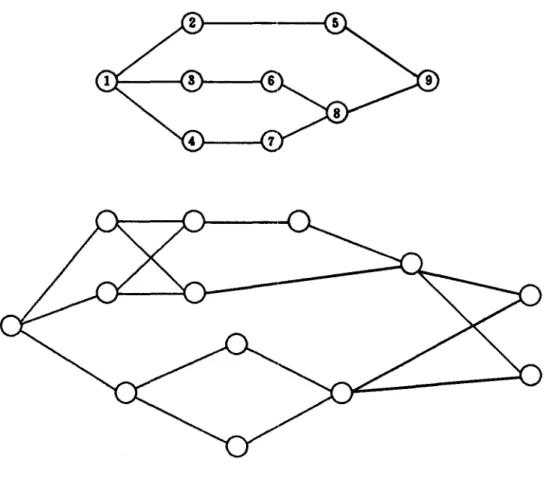
A series-parallel network is one that can be reduced into a chain by replac-ing repeatedly a parallel chain subnetwork with a chain. Fig. 5.2 illus-trates examples. Readers who are interested in a constructive definition of a series-parallel network may refer to Lawler [9]. The chains J
3+ J6 and
J
4+ J7 in the upper network in Fig. 5.2 constitute a parallel chain
subnet-work. The chains J 2+ J 5' J 3+ J 6 and J 4-+ J 7 are parallel to each other, but they do not constitute a parallel chain subnetwork, since the set of suc-cessors for J
5 is not equal to that for J6 and J7•
Sidney [19] has shown the next theorem based only on the following three properties:
(I) An optimal schedule is a permutation.
(11) An optimal schedule under arbitrary initial conditions can be obtained for a problem with a parallel chain precedence relation by the parallel chain algorithm.
(1lI) Let al' O
2' 03 be an optimal schedule to an original problem. Suppose that
0z
is an optimal schedule of a problem obtained by restricting the origi-nal problem to composite jobs in O2, Then, al'
oZ'
03 is also an optimal schedule of the original problem.Theorem 11.
Consider a problem finding an optimal schedule under a pre-cedence relation R. Suppose that R includes a parallel chain subnetwork. Let a be an optimal schedule of a problem obtained by restricting the origi-nal problem to composite jobs in the subnetwork, which is given by the paral-lel chain algorithm. Then, there is an optimal schedule of the original problem which includes a as a (not necessarily consecutive) subschedu1e.Our problem evidently satisfies (1) and (ll). (1lI) must also be satis-fied, since the completion times of 0
3 are nondecreasing functions of its starting times. Thus, theorem 11 can be applied also for our problem. By this theorem, a parallel chain subnetwork in R can be replaced with a chain corresponding to o.
series-Parallel Algorithm
(1) Replace a parallel chain subnetwork of R with a chain corresponding to an optimal schedule obtained by the parallel chain algorithm applied for the subnetwork.
(2) Repeat operation (1) as long as parallel chain subnetworks exist.
Theorem 12.
The series-parallel algorithm gives a schedule minimizing the maximum completion times on both machines for arbitrary initial condi-tions under a series-parallel precedence relation.This theorem can easily be proved by using theorem 11 and the definition of a series-parallel network.
Example 3.
(A series-parallel precedence relation is imposed.)Consider the problem in example 1 and suppose that a precedence relation among job groups is described by the series-parallel network in Fig. 5.3 (a). Calculation by the series-parallel algorithm may proceed as follows.
There are two parallel chain subnetworks in Fig. 5.3 (a), i.e. one is a chain J
2+ J5, and the other is a subnetwork composed of J3 and J4• For the chain J
2+ J5, it is verified that J5+ J2• Thus, according to the first step of the parallel-chain algorithm, this chain is replaced with a composite job
J
25: (a25, S25) defined as
~25= 17+ max {- 2- 7, O}= 17 and
8
Optimal Schedule in a GT- Type Flow-8hop
The constant of this composite job is 6
25
=
18. Since the chain is reduced to a node, the second step is skipped. Next, the parallel chain algorithm may be applied for the parallel chain subnetwork composed of J3 and J4• Then, the first step is skipped, and by the second step this subnetwork is replaced with a chain
J
4+J
3 corresponding to the schedule
J
4·J
3 determined 247by the generalized Johnson's rule. The reduced network is shown in Fig. 5.3 (b). The remaining parallel chain is composed of J
ZS and a chain J4+ J3+ J6, and all arcs are consistent with dominance relations. Thus J
4• JZS· J3• J6 is obtained by the generalized Johnson's. rule, and the final reduced network is shown in Fig. 5.3 (c). The optimal i.nter-group schedule is J
l· J4· JZ· JS• J 3• J6• J7• (a) (b) (c)
Fig. 5.3
Example 3.
6. Summary and Remarks
We proposed an algorithm which gives inter- and intra-group schedules minimizing the maximum completion times in a two-machine GT flow-shop. The series-parallel algorithm has been shown to require computation of order 0
(g
logg), g;
the number of nodes in R, if R is expressed in an adequateinter-nal form
(13J.
Intra-group scheduling by the Johnson's rule needs computation of order 0(n
logn)
wheren
is the job number in the group concerned. The proposed algorithm can be implemented by computation of order not greater than 0(n
logn)
wheren
is the total number of jobs.The main body of our discussion is composed of
(1) an optimal intra-group schedule of a job group is an optimal schedule of a problem restricted to the jobs in the group, whatever an inter-group schedule is (theorem 2),
(2) an optimal inter-group schedule under no precedence relation can be obtained by applying the generalized Johnson's rule for composite jobs corresponding to job groups (theorem 6),
(3) a composite job can be recognized as a natural generalization of an ordinary job (with a time lag) in a flow-shop, and
(4) a composite job scheduling problem conserves properties of a scheduling problem on ordinary jobs (sections 4 and 5).
(2) - (4) implies that inter-group and intra-group scheduling problems are essentially indifferent.
This fact suggests that a intra-group scheduling problem with type-AB jobs only (notice that all composite jobs in this paper are of type-AB) can be solved by replacing each job with a respective composite job and by using the series-parallel algorithm, even if
(1) each job has its setup times not included in the processing times, (2) a series-parallel precedence relation is imposed among jobs.
Remember that Jackson (3] expanded the Johnson's result into a case where jobs of type-A, type-B, type-AB and type-BA are mixed. A similar
exten-tion is possible for the generalized Johnson's rule. See Sekiguchi [18] for details. Thus, our problem inthe GT flow-shop can be solved as follows even when four types of job groups are mixed but there is no precedence relation among job groups of different types. First, find an optimal schedule of job groups of the same type under a precedence constraint among them. Then, com-bine them by Jackson's method. In the preceding paragraph, we considered only type-AB jobs, in introducing precedence relations among jobs in groups. But, it is now easy to see that an intra-group scheduling problem with
type-Optimal Schedule in (l GT-Type Flow-Shop 249
A, type-B type-AB and type-BA jobs (i.e. the type of the job group is not any-one of the standard four types) under a precedence constraint can also be solved as long as there is no precedence relation among jobs of different types. But, notice that a composite is not definable unless a job group is of type-AB or type-BA.
In this paper, we assumed that the buffer capacity between machines is infinite. Actually, the buffer capacity between machines may be finite so as to satisfy the assumption, if the capacity is large enough to keep jobs which machine B processes during transportation of overflowing jobs to/from a nearby warehouse. But, if such a warehouse is not available, we need to solve a two-machine flow shop problem under a finit,~ buffer capacity, which is NP-comp1ete with the exception of a case of capacity zero [15].
Consider that rescheduling jobs is necessary because of changes such as cancellation or addition of orders on the way of an implementation of a sched-ule. There is no difficulty to resolve the situation since the proposed algorithm solves efficiently the probl~ns under arbitrary initial conditions. Determine the initial condition for remaining jobs (and job groups), and reschedule them by the proposed algorithm.
Thus, we see that our algorithm solves a variety of the two-machine mini-mum makespan flow shop problems. However, the algorithm does not resolve situations in which some jobs or some job groups must be started at some spec-ified times or must be prohibited from being scheduled as the first (last) one.
Some cases of a three-machine flow--shop problem can be reduced into ones in a two-machine flow-shop (see [2], and also [13]). This has been shown principally based on the fact that the rnaximum completion time on the last machine of a permutation schedule of the three-machine flow-shop problem is equal to that of the same schedule of the respective two-machine flow-shop problem. It is easy to see that similar cases of a three-machine problem obtained by extending naturally our -machine problem can be reduced to two-machine problems, if two-machine B is recessive. However, it is not clear that under what conditions this is true if machine B may be a bottleneck.
For a general case of the three-maehine problems and for the problems with more than three machines, a branch--and-bound method has been effectively used. Likewise, for the GT flow shop problems with three or more machines, with the exception of some special cases of three maehines, a branch-and-bound-like method will be the only one ~Ihich can be used in practice. The proposed algorithm can be applied for lower bound calculations, and improves the efficiency of a branch-and-bound method [14].
makespan problem in the ordinary two-machine flow shop, the set of permutation schedules can happen not to include an optimal solution only when the follow-ing relation holds for some
i
and j [5].D.-
min(A., B.» D.+
max(A., B.)-
min(A., B.)= D.+ IA.- B.I.
" " " J J J J J J J J
Therefore, there is an optimal schedule among permutation schedules for the intra-group scheduling problem only if there is no pair i and j satisfying the relation. When composite jobs are introduced, the effect of 1ag times appears intensively in~. Determine a composite job corresponding to a job with parameters A~,
B.
and D. then ~.=min(A., B.)-
D. holds. The relation~"
"
"
" " "
above is equivalent to
- ~.>
D.+ IA.- B
.1.
" J J JAn unsolved problem is to specify for general composite jobs the value of ~ which makes all permutation schedules nonoptima1.
Reference
[1] Be11man, R.: Mathematical Aspects of Scheduling Theory.
RAND Report
p-651, RAND Corporation, Santa Monica, April 11, 1955.
[2] Burns, F. and Rooker, J.: Three Stage Flow-Shops with Recessive Second Stage.
Operations Research,
Vo1.26 (1978), 207-208.[3] Jackson, J. R.: An Extension of Johnson's Results on Job Lot Scheduling.
NavaZ Research Logistics QuarterZy,
Vo1.3 (1956), 201-203.[4] Johnson, S. M.: Optimal Two-and Three-Stage Production Schedules with Setup Times Included.
NavaZ Research Logistics QuarterZy,
Vo1.1 (1954), 61-68.[5] Johnson, S. M.: Discussion: Sequencing n Jobs on Two Machines with Arbitrary Time Lags.
Management Science,
Vo1.5 (1959), 299-303.[6] Kurisu, T.: Two-Machine Scheduling under Required Precedence among Jobs.
JournaZ of the Operations Research Society of Japan,
Vo1.19 (1976),1-13.
[7] Kurisu, T.: Two-Machine Scheduling under Arbitrary Precedence Con-straints.
JournaZ of the Operations Research Society of Japan,
Vo1.20 (1977), 113-131.[8] Lageweg, B. J., Lenstra, J. K. and Rinnooy Kan, A. H. G.: A General Bounding Scheme for the Permutation Flow-Shop Problem.
Operations
Optimal Schedule in tI GT-Type Flow-Shop
[9] Lawler, E. L.: Sequencing Jobs to Minimize Total Weighted Completion Time Subject to Precedence Constralnts.
Annals of Discrete Mathematics,
Vol.2 (1978), 75-90.
[10] Maggu, P. L., Das, G. and Kumar, B .• : On Equivalent Job for Job-Block in 2 x n Sequencing Problem with Transportation-Times.
Journal of the
Operations Research Society of Japan,
Vol. 24 (1981), 136-146.[11] Mitten, L. G.: Sequencing n Jobs on Two Machines with Arbitrary Time Lags.
Management Science,
Vo1.5 (1959), 293-298.[12] Mitten, L. G.: A Scheduling Problem.
The Journal of Industrial
Engi-neering,
Vol.10 (1959), 131-135.[13] Monma, C. L.: The Two-Machine Maximum Flow Time Problem with Series-Parallel Precedence Constraints:
A.n
Algorithm and Extensions.Opera-tions Reserach,
Vol.27 (1979), 792-798.[14] Nakanishi, Y.: On the Efficiency of Revised Lower Bound in a Group Scheduling Problem (in Japanese). Manuscript (1983, 2).
[15] Papadimitriou, C. H. and Kanellakis, P. C.: Flowshop Scheduling with Limited Temporary Storage.
JournaZ of the Association for Computing
Machinery,
Vol.27 (1980), 533-549.[16] Sekiguchi, Y., Koyama, S. and Miura, R.: Flow Shop and Analysis of the Schedules.
Transaction of the Society of Instrument and Control
Engi-neers,
Vol.8 (1972), 40-48.[17] Sekiguchi, Y.: On Lower Bounds for Flow-Shop Scheduling Problems.
Hokudai Keizaigaku Kenkyu,
Vol.29 (1979), 139-161.[18] Sekiguchi, Y.: Inter- and Intra-Group-of-Jobs Schedule for Minimizing Makespan in a 2-Machine GT Shop.
The 8th IFAC International Congress
Preprints,
Vol.XIV (1981), XIV 164-169.251
[19] Sidney, J. B.: The Two-Machine Maximum Flow Time Problem with Series-Parallel Precedence Relations.
Operations Research,
Vol.27 (1979), 782-791.Yasuki SEKIGUCHI: Faculty of Economics, Hokkaido University, Kita-Ku Kita 9 Nishi 7