Towards a Functional Reactive Programming Model for
Developing WSANs
Takuo Watanabe
1,a)Kazuhiro Shibanai
1,2Abstract: Functional reactive programming (FRP) is a programming paradigm where a system is described using declarative abstractions of the change propagation of discrete events and continuous signals. This paper presents a purely functional reactive programming model that facilitates a uniform description of distributed coordination and per-node computation. A case study of a wireless sensor-actor network (WSAN) shows that both inter-node coor-dination and intra-node computation can uniformly be written as reactive behaviors. The paper also describes an implementation method of the model using Distributed XFRP, a pure FRP language for distributed systems.
Keywords: functional reactive programming, embedded systems, coordination, wireless sensor-actor networks
1.
Introduction
Functional Reactive Programming (FRP) is a programming paradigm to support the development of reactive systems such as embedded systems and GUIs. In FRP, reactive behaviors are described as change propagation among time-varying values (aka signals) that represent continuously changing values or discrete events [3]. Originally, FRP is introduced to describe interactive animations in the purely functional language Haskell [6]. Un-til now, the paradigm and its non-functional variants have gained popularity in various fields such as Web programming, mobile application development, mobile IoT networks, and embedded systems.
The change propagation among time-varying values can be viewed as dataflow computation. From this viewpoint, FRP pro-vides a high-level and declarative abstraction for describing con-current systems. Thus, integrating FRP with existing concon-current computation models is interesting in both theoretical and prac-tical aspects. We proposed an actor-based execution model of an FRP language for embedded systems, which can reduce the execution cost of a program written in the language by utilizing asynchronous messages in the change propagation [18]. Van den Vonder et al. introduced another direction of integration named Actor-Reactor model that can widen the expressiveness of a re-active programming language by using actors to describe long-lasting or stateful behaviors [16].
To develop distributed applications, we designed and imple-mented Distributed XFRP, a statically-typed, purely functional reactive programming language [15]. The runtime system of the language is based on the Actor model [1] and change propagation among time-varying values is implemented as asynchronous mes-sage passing. In our previous paper [15], we proposed a new al-gorithm for change-propagation via asynchronous messages and
1 Tokyo Institute of Technology, Meguro, Tokyo 152–8552, Japan 2 Currently with BrainPad Inc.
showed that such a distributed runtime system can be used to im-plement pure FRP without suffering from the phenomenon called glitches(temporal inconsistencies in the change propagation).
The compiler*1 of the language translates a source program into an Erlang program. In contrast to our previous work [18] that introduced an actor-based execution model of an FRP language as a concurrent runtime system for resource-constrained unipro-cessor systems, Distributed XFRP actually supports distributed execution of pure FRP programs.
The main contribution of this paper is to show that FRP is suit-able for describing distributed coordination via a case study on a wireless sensor-actor network (WSAN) that controls the air-environment of a long corridor. Since the program of the WSAN is written in Distributed XFRP, inter-node communication re-quired to achieve the coordination is realized in a straightforward manner by time-varying values that support single-source glitch freedom. Moreover, the incremental development of such appli-cations is discussed.
The rest of the paper is organized as follows. The next section introduces the non-distributed subset of our language to explain some basic notions of FRP. In Section 3, the execution model of Distributed XFRP is described briefly. Section 4 presents a WSAN case study to emphasize that Distributed XFRP is benefi-cial for describing coordination. Section 5 surveys related work and Section 6 concludes the paper.
2.
XFRP
XFRP is a general-purpose functional reactive programming language developed as a successor of Emfrp [14], which is de-signed for small-scale embedded systems. Before presenting how a WSAN example is developed using Distributed XFRP [15] in Section 4, this section briefly describes a non-distributed subset of the language.
1 module FanController % module name 2 in tmp : Float, % temperature sensor 3 hmd : Float % humidity sensor
4 out fan : Bool % fan switch
5
6 % discomfort (temperature-humidity) index
7 node di = 0.81 * tmp + 0.01 * hmd * (0.99 * tmp - 14.3) + 46.3 8
9 % fan status
10 node init[False] fan = di >= th 11
12 % threshold
13 node th = 75.0 + if fan@last then -0.5 else 0.5
Fig. 1 Fan Controller in XFRP
tmp
hmd
fan
di
T H temperature sensor humidity sensor fanth
FanController node dependencyexternal device reference past dependency
Fig. 2 Graph Representation of FanController
2.1 Basics
In XFRP, a system (module) is composed of the definitions of time-varying values and other components. Time-varying val-ues are called nodes in the language. Nodes are classified in the following categories: source (input), sink (output), and internal. Source nodes (hereinafter referred to as sources) emit externally given values such as keyboard inputs, network packets from an-other computer, and measurements from a sensor device. Sink nodes (hereinafter referred to as sinks) are the destinations of propagation. They receive results and normally affect the outer world by, for example, displaying characters, changing the volt-age output, etc. Internal nodes lie between sources and sinks and update their values by evaluating associated expressions every time sources change. The definition of an expression is given in a functional style, which means it has no side effects or muta-ble states. In summary, changes of sources propagate throughout internal nodes and finally reach sinks.
Fig. 1 shows a simple fan controller example from our pre-vious paper [17]. The program has two sources tmp and hmd respectively representing the current temperature [◦C] and rela-tive humidity [%] measured by external sensors. The node di expresses the current discomfort index (the degree of discomfort experienced by human). The value of di immediately reflects any changes in the sensor readings (tmp or hmd).
The operator @last allows access to the previous value (the value at the previous moment) of an arbitrary node. Using this operator, we can define history sensitive (or stateful) behaviors. In Fig. 1, @last is used to realize a simple hysteresis control that
protects the fan motor from frequent switching. The definition of th(line 13 in Fig. 1) contains the subexpression fan@last that refers to the value of fan at the previous moment. This means that if fan is already true, th becomes 74.5 (otherwise 75.5). With such shifts of the threshold, we can avoid frequent changes of fanwhen di drifts around the threshold (75.0).
2.2 Execution Model
An XFRP program can be represented as a directed graph whose nodes and edges correspond to nodes (time-varying val-ues) and their dependencies respectively. Fig. 2 shows the graph representation of Fig. 1, which consists of five nodes and five edges. The edges (dependencies) are categorized into two kinds: pastand present. A past edge from node m to n means that n has m@lastin its definition. A present edge from node m to n, in contrast, means that n directly refers to m. In Fig. 2, the dotted arrow line from fan to th is the only past edge. All other edges are present.
By removing the past edges from the graph representation of the program, we should obtain a directed-acyclic graph (DAG) (i.e., no cycles consisting of present edges are allowed.). The topological sorting on the DAG gives a sequence of the nodes. For Fig. 2, a possible sequence is: tmp, hmd, di, th, fan.
The runtime system of the language updates the values of the nodes by repeatedly evaluating the elements of the sequence. A single evaluation cycle is called an iteration. The order of up-dates (scheduling) in an iteration is compatible with the partial order determined by the above mentioned DAG.
The expression n@last is implemented to denote the value of nin the last iteration. At the first iteration, where no nodes have their previous values, n@last refers to the initial value c specified with init[c] in the definition of n. In Fig. 2, the initial value of fanis specified as False (line 10).
3.
Distributed XFRP
Distributed XFRP [15] is a distributed dialect of XFRP. This section briefly introduces some important concepts of the lan-guage.
3.1 Glitches
Glitchesare temporal inconsistencies in the value propagation of FRP systems. Consider the program fragment below.
node x = a + a node y = a * 2 node z = x == y
A glitch-free system guarantees that the values of the all occur-rences of the same node (time-varying value) are the same at every moment. Thus, in a glitch-free system, the value of z is always true. In contrast, in a system with glitches, this property does not hold due to the possible differences in the time of change propagation. In such a system, the value of z may have chances to be false.
Margara and Salvaneschi classified glitch-freedom into two types: single-source and complete [9]. The former guarantees that the changes in a single source (node) are propagated to its
dependent nodes without glitches but other sources are not con-sidered. The latter takes the causal relation of all the sources into account in addition to the requirement of the former. Distributed XFRP supports the single-source glitch freedom.
3.2 Execution Model
This subsection briefly explains the execution model of Dis-tributed XFRP, The detailed description can be found in our pre-vious paper [15].
The runtime system of XFRP is based on the Actor model [1]. Each source, sink, or internal node is implemented as a single ac-tor. Change propagation of time-varying values is realized using asynchronous messages. When the value of a source changes, the source sends its updated value to other nodes that depend on it. Similarly, when a node receives a message that conveys the up-dated value, it updates its value and sends the result to nodes that depend on it.
As described in Section 2.2, the dependency between nodes is represented as a directed graph. In the actor-based implementa-tion, vertices are node actors and edges are reference relationship between them (for example, if node a has a reference to b, there is an edge from b to a). As in XFRP, cycles consisting of present edges are not permitted. A root of a node is a source that has at least one present edge path to the node.
Each source has a counter that increments when it sends a new value. The pair of the ID of the source and the value of its counter is associated with the propagation messages to keep track of the happened-before relation between changes. The associated infor-mation is called version. The relation from version to the value of a node is surjective. If the value of a node n results in the value v by receiving a message with version (s, i), the value of n is said to be v at version (s, i). The use of the IDs of the sources in versions enables the single-source glitch-freedom in our language [15].
Each actor implementing a node has special internal values Buffer, Last, and Deferred to represent its computational states. Buffer holds the received values before they are processed. It is a map whose keys are versions and values are also maps which map the depending nodes to their value at the version. Last is a set of latest received input values used to complement values for di ffer-ent versions. Deferred is a list of versions which are received but their processing is postponed because the node lacks the inputs to calculate the expression.
The update algorithm is divided into two phases. One is the matching phase, where an actor collects inputs for calculating the expression from its Buffer. Every versions in the Buffer is scanned to find an entry that is sufficient to evaluate. The entry consists of input values that have the same source, therefore, at evaluation, the values are merged with inputs using other sources using Last and Deferred. For example, consider a node x has an expression r+ s + t, where r and s have the same source and t has another source, and the Buffer in the node has an entry with the value of r and s in any version. Then x can be evaluated with the value of t in the Last field in x. Second phase is the receiving phase, where the actor waits for a new message from dependent nodes. An arriving message is stored in the Buffer by its attached version. In this time, the value referenced with @last is placed at
a next Version in the Buffer, which means version (s, i + 1) if the Version of the value is (s, i).
4.
Case Study
This section presents a wireless sensor-actor network (WSAN) described in XFRP. The purpose of this case study is to demon-strate that the language is suitable for describing coordination.
Wireless sensor-actor networks (WSANs) [2], [7] are a variant of wireless sensor networks (WSNs) that contain actor nodes in addition to sensor nodes. The responsibilities of actor nodes in-clude controlling actuators, making local decisions, and perform-ing coordination tasks. Note that the term “actor” here is different from the one in the Actor-model.
4.1 WSAN Example
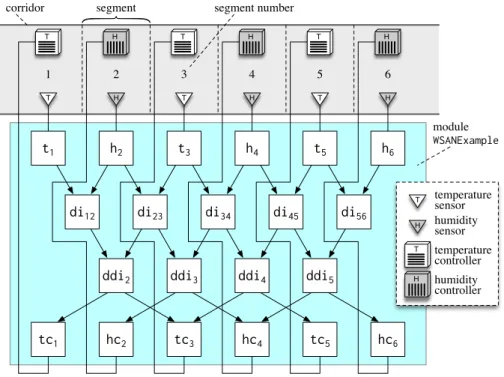
Fig. 3 shows a wireless sensor-actor network (WSAN) that monitors and controls the temperature and humidity of the air in a long corridor. The corridor is divided into several seg-ments that are numbered sequentially. Each odd-numbered (even-numbered) segment is equipped with a temperature (humidity) sensor and a temperature (humidity) controller. A tempera-ture (humidity) controller here indicates a special kind of air-conditioner that controls air temperature (humidity). The purpose of this WSAN is to regulate the air environment of the corridor by lowering the difference in discomfort index among the corri-dor segments.
The behavior of the WSAN is described as follows: Let i ( j) be a positive odd (even) integer, and k be a positive integer. The node*2named ti(hj) is the source node that is connected to the temperature (humidity) sensor located at the i-th ( j-th) segment. Similarly, the node named tci(hcj) is the sink node that is con-nected to the temperature (humidity) controller located in the i-th ( j-th) segment. Note that there is another source node named th — not shown in Fig. 3 for simplicity — that represents the thresh-old for determining which output nodes should be activated. The node named dik(k+1) represents the discomfort index of the in-between area of the k-th and (k + 1)-th segments. The node named ddikcalculates di(k−1)k− dik(k+1), which indicates the de-gree of imbalance in the data measured by the sensors located in the (k −1)-th and (k+1)-th segments. Thus, if it is larger (smaller) than th (−th), the controller with index k − 1 (k+ 1) is activated to lower the difference.
4.2 WSAN Example in XFRP
Fig. 4 shows the XFRP code for the example. The code is a straightforward implementation*3of Fig. 3. For simplicity rea-son, the host specifiers in the code is omitted. To deploy the nodes (time-varying values) to appropriate physical sensor/actor nodes (computers) in the WSAN, we can freely put host specifiers at the source node declarations (lines 3 and 5 in Fig. 4) or at the node definitions (lines 18–22, 25–28 and 31–36). The single-source
*2 The term “node” is used to indicate a time-varying value in XFRP rather
than a physical sensor/actor node (computer) in the WSAN.
*3 The current version of the language does not allow indices in node
names. So we should write, for example, di23 for di23and hence repeat
similar definitions. It may not be difficult to add appropriate syntactic support in the future version.
2
1 3 4 5 6
t
1h
2t
3h
4t
5h
6di
12di
23di
34di
45di
56ddi
2ddi
3ddi
4ddi
5hc
2tc
3hc
4tc
5tc
1hc
6T H
corridor segment segment number
T H T H T H T H T H module WSANExample temperature controller humidity controller temperature sensor humidity sensor T H H T
Fig. 3 WSAN for Regulating the Air-Environment of a Corridor
1 module WSANExample 2 in % temperature sensors
3 t1 : Float, t3 : Float, t5 : Float,
4 % humidity sensors
5 h2 : Float, h4 : Float, h6 : Float, 6 % threshold
7 th : Float
8 out % temperature controllers
9 tc1 : Bool, tc3 : Bool, tc5 : Bool,
10 % humidity controllers
11 hc2 : Bool, hc4 : Bool, hc6 : Bool 12
13 % discomfort index 14 fun di(t, h) = 0.81 * t
15 + 0.01 * h * (0.99 * t - 14.3) + 46.3
16
17 % discomfort index nodes 18 node di12 = di(t1, h2) 19 node di23 = di(t3, h2) 20 node di34 = di(t3, h4)
21 node di45 = di(t5, h4) 22 node di56 = di(t5, h6) 23
24 % di-difference nodes 25 node ddi2 = di12 - di23 26 node ddi3 = di23 - di34
27 node ddi4 = di34 - di45 28 node ddi5 = di45 - di56 29
30 % controller nodes 31 node tc1 = ddi2 > th
32 node hc2 = ddi3 > th
33 node tc3 = ddi2 < -th || ddi4 > th 34 node hc4 = ddi3 < -th || ddi5 > th 35 node tc5 = ddi4 < -th
36 node hc6 = ddi5 < -th
Fig. 4 XFRP Code for Fig. 3
glitch-free property of the language guarantees that no temporal inconsistencies can be observed in any deployment configuration. Using a simple example scenario, the rest of this subsection demonstrates the effectiveness of the single-source glitch-free
property in the WSAN. In the following, the value of th is fixed to 2.0 and assume that ddi5 ≤ th. Suppose that h2= 70.0, t3 = 24.0, and h4 = 75.0. From the node definitions in Fig. 4, we have di23= 72.36, di34 = 72.84, and ddi3 = -0.48. Thus, nei-ther hc2 nor hc4 is activated because th ≥ ddi3 ≥ −th and ddi5 ≤ th. Now suppose that t3 changes to 25.0 but h2 and h4remain the same in the next moment. At that moment, thanks to the single-source glitch-free property, both di23 and di34 are guaranteed to observe that t3= 25.0. Thus di23 = 73.87 and di34= 74.39 holds, and both hc2 and hc4 are still inactive be-cause ddi3= −0.52 ≥ −th. However, without the single-source glitch-free property, it may be possible that di23 sees t3= 24.0 and di34 sees t3= 25.0 at the same time, and hence di23 = 72.36 and di34= 74.39 may hold. In such case, hc4 is incorrectly acti-vated because ddi3= −2.03 < −th hold.
4.3 Discussion
As the example shows, XFRP provides a declarative way to express inter-node (inter-computer) behaviors of WSNs and WSANs. In other words, the language can be used as a macro-programming language [12]. Especially, the single-source glitch-freedom enables a convenient way to program WSANs. Because, when merging data from two or more actor nodes that directly or indirectly receive data from the same sensor node, we don’t need to be bothered with the synchronization among the actor nodes. Moreover, the single-source glitch freedom is more e ffi-cient than complete glitch-freedom such as [8]. If we need the glitch-freedom with regard to multiple sensor nodes, we can use source unification feature provided by the language.
In addition, since the design of the language is based on Em-frp [14], we can also write the internal behaviors of physical sensor/actor nodes in XFRP. Thus, the language enables a uni-form way to express whole (inter- and intra-node) behaviors of
WSANs. This sort of uniformity is important because it eases the development process of WSANs as follows. First, we can con-struct a prototype of a WSAN as a single module that defines the entire (inter- and intra node) behaviors of the WSAN. The mod-ule has no host specifiers initially and the source and sink nodes are connected to some debug/test stubs written in Erlang. After the local testing, we can gradually deploy nodes (time-varying values) to actual physical sensor/actor nodes by incrementally adding host specifiers and source unifiers to the module defini-tion.
5.
Related Work
DREAM [8], [9] is a distributed reactive middleware that sup-ports multiple consistency models: FIFO, causal, single-source glitch freedom, and complete glitch-freedom, but they assume that all messages are delivered in a FIFO order.
REScala [13] is a functional reactive library implemented in Scala. SID-UP (Source IDentifier Update Propagation) [4], [5] is an efficient propagation algorithm for distributed reactive pro-grams realized in REScala and it supports complete glitch-freedom while the execution model is iterative.
Recently, a new propagation method for REScala is pro-posed [10]. The method provides fault tolerance for distributed reactive programming with reasonable performance. Besides, Myter et al. proposed another method for handling partial fail-ures in distributed reactive systems [11]. However, these methods focus on node crashes rather than on network inconsistencies.
Regiment [12] is a functional macroprogramming language for wireless sensor networks (WSNs). The language enables us to write a WSN as a whole via functional reactive program-ming. However, it does not provide mechanisms that support ac-tor nodes.
6.
Concluding Remarks
This paper emphasizes that, via a case study on a wireless sensor-actor network (WSAN) written in Distributed XFRP, pure functional reactive programming (FRP) with distribution support is suitable for developing coordinating distributed applications. Since each computational node in a coordinating distributed sys-tem can be seen as a reactive component, FRP is well suited for describing the intra-node computation. Besides, Distributed XFRP supports inter-node communication via time-varying val-ues. This language feature enables us to write a distributed appli-cation as if it were a non-distributed program. Problems regard-ing synchronization are partially resolved thanks to the sregard-ingle- single-source glitch freedom realized by the language’s runtime system. Also, an incremental development method for distributed appli-cations is discussed.
Evaluation through the development of actual distributed ap-plications remains for future work. One of the challenges is in-vestigating the possibility of distributed FRP in coordinating dis-tributed applications other than WSAN.
Acknowledgments This work is supported in part by JSPS KAKENHI Grant No. 18K11236.
References
[1] Agha, G.: Actors: A Model of Concurrent Computation in Distributed Systems, MIT Press (1986).
[2] Akyildiz, I. F. and Kasimoglu, I. H.: Wireless sensor and actor net-works: research challenges, Ad-hoc Networks, Vol. 2, No. 4, pp. 351– 367 (online), DOI: 10.1016/j.adhoc.2004.04.003 (2004).
[3] Bainomugisha, E., Carreton, A. L., Van Cutsem, T., Mostinckx, S. and De Meuter, W.: A Survey on Reactive Programming, ACM Computing Surveys, Vol. 45, No. 4, pp. 52:1–52:34 (online), DOI: 10.1145/2501654.2501666 (2013).
[4] Drechsler, J. and Salvaneschi, G.: Optimizing Distributed REScala, Workshop on Reactive and Event-based Languages and Systems (RE-BLS ’14)(2014).
[5] Drechsler, J., Salvaneschi, G., Mogk, R. and Mezini, M.: Distributed REScala: An Update Algorithm for Distributed Reactive ming, ACM International Conference on Object Oriented Program-ming Systems Languages and Applications (OOPSLA 2014), ACM, ACM, pp. 361–376 (online), DOI: 10.1145/2660193.2660240 (2014). [6] Elliott, C. and Hudak, P.: Functional Reactive Animation, 2nd ACM SIGPLAN International Conference on Functional Pro-gramming (ICFP 1997), ACM, pp. 263–273 (online), DOI: 10.1145/258949.258973 (1997).
[7] Kamali, M., Laibinis, L., Petre, L. and Sere, K.: Formal development of wireless sensor–actor networks, Science of Computer Program-ming, Vol. 80, pp. 25—49 (online), DOI: 10.1016/j.scico.2012.03.002 (2014).
[8] Margara, A. and Salvaneschi, G.: We Have a DREAM: Distributed Reactive Programming with Consistency Guarantees, 8th ACM In-ternational Conference on Distributed Event-Based Systems (DEBS 2014), ACM, pp. 142–153 (online), DOI: 10.1145/2611286.2611290 (2014).
[9] Margara, A. and Salvaneschi, G.: On the Semantics of Distributed Reactive Programming: The Cost of Consistency, IEEE Transactions on Software Engineering, Vol. 44, No. 7, pp. 689–711 (online), DOI: 10.1109/TSE.2018.2833109 (2018).
[10] Mogk, R., Baumg¨artner, L., Salvaneschi, G., Freisleben, B. and Mezini, M.: Fault-tolerant Distributed Reactive Programming, 32nd European Conference on Object-Oriented Programming (ECOOP 2018), LIPIcs, Vol. 109, Schloss Dagstuhl, pp. 1:1–1:26 (online), DOI: 10.4230/LIPIcs.ECOOP.2018.1 (2018).
[11] Myter, F., Scholliers, C. and De Meuter, W.: Handling Par-tial Failures in Distributed Reactive Programming, 4th ACM SIG-PLAN International Workshop on Reactive and Event-Based Lan-guages and Systems (REBLS 2017), ACM, pp. 1–7 (online), DOI: 10.1145/3141858.3141859 (2017).
[12] Newton, R., Morrisett, G. and Welsh, M.: The Regiment Macropro-gramming System, 6th International Conference on Information Pro-cessing in Sensor Networks (IPSN ’07), ACM, pp. 489–498 (online), DOI: 10.1145/1236360.1236422 (2007).
[13] Salvaneschi, G., Hintz, G. and Mezini, M.: REScala: Bridging Between Object-oriented and Functional Style in Reactive Appli-cations, 13th International Conference on Modularity (Modularity 2014), ACM, pp. 25–36 (online), DOI: 10.1145/2577080.2577083 (2014).
[14] Sawada, K. and Watanabe, T.: Emfrp: A Functional Reactive Pro-gramming Language for Small-Scale Embedded Systems, MODU-LARITY Companion 2016: Companion Proceedings of the 15th Inter-national Conference on Modularity, ACM, pp. 36–44 (online), DOI: 10.1145/2892664.2892670 (2016).
[15] Shibanai, K. and Watanabe, T.: Distributed Functional Reactive Pro-gramming on Actor-Based Runtime, 8th ACM SIGPLAN Interna-tional Workshop on Programming Based on Actors, Agents, and De-centralized Control (AGERE 2018), ACM, pp. 13–22 (online), DOI: 10.1145/3281366.3281370 (2018).
[16] Van den Vonder, S., De Koster, J., Myter, F. and De Meuter, W.: Tackling the Awkward Squad for Reactive Programming: The Actor-Reactor Model, 4th ACM SIGPLAN International Workshop on Reac-tive and Event-Based Languages and Systems (REBLS 2017), ACM, pp. 27–33 (online), DOI: 10.1145/3141858.3141863 (2017). [17] Watanabe, T.: A Simple Context-Oriented Programming Extension
to an FRP Language for Small-Scale Embedded Systems, 10th Inter-national Workshop on Context-Oriented Programming (COP 2018), ACM, pp. 23–30 (online), DOI: 10.1145/3242921.3242925 (2018). [18] Watanabe, T. and Sawada, K.: Towards an Integration of the Actor
Model in an FRP Language for Small-Scale Embedded Systems, 6th International Workshop on Programming based on Actors, Agents, and Decentralized Control (AGERE!@SPLASH 2016)(2016).
![Fig. 1 shows a simple fan controller example from our pre- pre-vious paper [17]. The program has two sources tmp and hmd respectively representing the current temperature [ ◦ C] and rela-tive humidity [%] measured by external sensors](https://thumb-ap.123doks.com/thumbv2/123deta/7997111.1737196/2.892.121.367.225.585/controller-example-respectively-representing-temperature-humidity-measured-external.webp)