( 1 )
Accepted : February 8, 2020 Published online : March 31, 2020 doi:10.24659/gsr.7.1_22
Glycative Stress Research 2020; 7 (1): 22-28 本論文を引用する際はこちらを引用してください。
(c) Society for Glycative Stress Research
Original article
Kaori Ishizaki, Masayuki Yagi, Chieko Sakiyama, Yoshikazu Yonei
Anti-Aging Medical Research Center and Glycative Stress Research Center,Graduate School of Life and Medical Sciences, Doshisha University, Kyoto, Japan
Glycative Stress Research 2020; 7 (1): 22-28 (c) Society for Glycative Stress Research
Influence on the oxidized protein hydrolase (OPH) activity of
herbal tea extract
(原著論文:日本語翻訳版)
ハーブティー抽出物の酸化蛋白分解酵素(OPH)活性に対する影響
石崎 香、八木雅之、﨑山智恵子、米井嘉一
同志社大学大学院生命医科学研究科アンチエイジングリサーチセンター/糖化ストレス研究センター 連絡先: 教授 八木雅之 同志社大学大学院生命医科学研究科アンチエイジングリサーチセンター/ 糖化ストレス研究センター 〒610-0394 京都府京田辺市多々羅都谷 1- 3 TEL&FAX:0774-65-6394 e-mail:[email protected] 共著者:石崎 香 [email protected] ; 﨑山智恵子 [email protected] ; 米井嘉一 [email protected]抄録
糖化最終生成物(
advanced glycation end products; AGEs
)の生成や蓄積よる生体ストレスを総合的にとら
えた概念は糖化ストレス(
glycative stress
)と呼ばれる。糖化ストレスの増大は、老化や糖尿病合併症、アル
ツハイマー病、動脈硬化などの疾患の発症進展リスクになる。糖化ストレス対策は抗糖化と呼ばれ、食後高
血糖の抑制、 糖化反応の抑制、
AGEs
の分解排泄、食事由来の
AGEs
の低減などがある。 酸化蛋白分解酵素
(
oxidized protein hydrolase: OPH
)は老化蛋白や
AGEs
の分解作用を有するプロテアーゼの一種で、生体組
織中に広く分布する。本研究では糖化ストレスの低減に寄与する成分の探索を目的に、ハーブティー抽出物の
OPH
活性に対する影響を検証した。
58
品(
38
種類)のハーブティー熱水抽出液の
OPH
活性に関する影響を
検証した結果、
OPH
活性増強作用は
47
品(
81%
)に認められた。ハーブティーの種類別では
34
種類(
89%
)
に
OPH
活性増強作用が認められた。一方、
12
品の試料抽出液は
OPH
活性を抑制した。チャノキ(
Camellia
sinensis
)由来の茶は緑茶(不発酵茶)と紅茶(発酵茶)で阻害作用を示したが、ほうじ茶(焙煎茶)、プーア
ル茶(後発酵茶)で活性増強した。
OPH
活性増強作用が認められたハーブティーの利用部位を比較すると種子
が葉と比べて有意に強かった。
OPH
活性を増強する作用成分は多くの植物に含まれている可能性がある。茶
葉の焙煎や発酵処理などの加工は
OPH
活性に影響した。ハーブティーは
OPH
活性を増強することで老化蛋
( 2 )
Glycative Stress Research
はじめに
グルコースなどの還元糖と蛋白との非酵素的反応は糖
化(
glycation
)と呼ばれる。糖化は生体内でも起こり、糖
化により組織中に糖化最終生成物(
advanced glycation
end products: AGEs
)が蓄積する。
AGEs
の生成や蓄積は
蛋白の褐色化、架橋形成による組織の硬化による機能性
低下の要因となる。
AGEs
は生体内で特異的受容体
RAGE
(
receptor for AGEs
)と結合し、様々な組織に炎症性変化
を惹起する。このため
AGEs
の生成や蓄積よる生体スト
レスを総合的にとらえた概念は糖化ストレス(
glycative
stress
)呼ばれる
1, 2)。糖化ストレスの増大は、老化や糖尿
病合併症、アルツハイマー病、動脈硬化などの疾患の発症
進展リスクになる。糖化ストレス対策は抗糖化と呼ばれ、
食後高血糖の抑制、糖化反応の抑制(
AGEs
生成抑制)、
AGEs
分解排泄促進などがある
3)。
生体内で酸化または糖化した蛋白は老化蛋白と呼ばれ
る。酸化蛋白分解酵素(
oxidized protein hydrolase: OPH
)
はセリンプロテアーゼの一種で老化蛋白の
N
末端アシ
ル化アミノ酸を遊離する酵素でアシルアミノ酸遊離酵素
(
acylamino-acid releasing enzyme: AARE
)
4, 5)、あるいは
アシルアミノペプチドヒド ラーゼ(
acylaminoacyl-peptide
hydrolase: APEH
)
6)とも呼ばれる。
OPH
は肝臓
7, 8)、脳
9)、
血液
10)、赤血球膜
11, 12)、胎盤
13)など生体組織中に広く分布
する。
糖尿病ラットにおいて血清中
OPH
活性は顕著に上昇し、
血中カルボニル修飾蛋白量が低下する
14)。
OPH
はプロテア
ソームと協働で老化蛋白の分解排泄に作用する
15)。
OPH
は
蛍光性
AGEs
、
CML
など
AGEs
の分解作用を有しする
16)。
また
OPH
は角層中にも存在し、加齢と弱い負の相関性が
みられている。しかし
OPH
の活性に影響する成分は知ら
れていない。
本研究では糖化ストレスの低減に寄与する成分の探索を
目的に、ハーブティー抽出物の
OPH
活性に対する影響を
検証した。
材料と方法
1)試薬
OPH
は
acylamino-acid releasing enzyme
(
AARE
)をタカ
ラバイオ(滋賀県草津市)から購入した。
OPH
は
AARE
を 50 mmol/L
リン酸緩衝液(
pH 7.2
)にて
0.025 U/mL
に
調整して使用した。
OPH
の酵素基質には
L-acetyl-L-alanine
p-nitroanilide
(
AAPA
)を
Bachem
(
Bubendorf, Switzerland
)
から購入して使用した。
AAPA
は
50%
エタノール水溶液
で
25 mmol/L
に調製して使用した。その他の試薬は特級
グレードのものを富士フィルム和光純薬工業(大阪府大阪
市)またはナカライテスク(京都府京都市)から購入して
使用した。
2)ハーブティー
ハーブティーは市販の乾燥物
58
品(
38
種類)を株式会
社ひかわ(島根県出雲市)から提供を受けて使用した。
3)試料抽出液の調製
試料抽出液は
40 mL
の精製水にハーブティー粉末
2 g
を
混合し、
80℃
に設定したウォーターバス中で
60
分間イン
キュベートして得た。得られた抽出液は、室温まで冷却後、
濾過して試料溶液とした。試料溶液の固形分濃度は、抽出
液
5 mL
を入れたアルミトレイを
120℃
に
2
時間おいて水
分を乾燥蒸発させ、蒸発残分を秤量して算出した。試料抽
出液の濃度は固形分量と希釈率から算出し、反応終濃度と
して示した。
4)OPH 活性の測定とOPH 活性化率の算出
OPH
活 性 の 測 定 の 試 料 抽 出 液 を
1/25
量 添 加 し た
反 応 液 を 以 下 の 構 成 で 作 成 し た:
0.1 mol/L Tris
(
tris
(hydroxymethyl) aminomethane)–
塩酸緩衝液(
pH 7.4
)、
2 mmol/L AAPA
、
1 mU/mL OPH
、 試 料 抽 出 液。 反 応
液
250 μL
を、
37℃
で
60
分間インキュベートし、
OPH
が
AAPA
を分解して遊離する
p-nitroanilide(pNA)
量を
405 nm
で吸光度測定した(
S
)。
OPH
活性測定のリファレ
ンスには、前記混合液中に添加する試料溶液の代わりに蒸
留水を添加して測定した(
R
)。
OPH
活性化率(
%
)はリファ
レンス反応で反応開始直後(
0
分)からの
60
分間に遊離生
成された
pNA
量を
100%
として、以下の式で算出した。
OPH
活性化率
(%)
= { (S
60– S
0) / (R
60– R
00)} x 100
S ;
試料溶液添加反応液の
pNA
濃度
,
R ;
リファレンス反応液の
pNA
濃度
,
60 ; 60
分後
,
0 ;
反応直後(
0
分)
OPH
活性の測定は試料抽出液をそのまま、あるいは試
料抽出液を蒸留水で
3
~
100
倍希釈液した
3
濃度を検証し
た。
OPH
活性化率は検証した
3
濃度のうち、最高値を代
表値とした。
KEY WORDS:
酸化蛋白分解酵素(
oxidized protein hydrolase : OPH)、ハーブティー抽出液、
( 3 )
統計解析
OPH
活性化率は平均値 ± 標準偏差で示した。解析結
果の検定は統計解析ソフト
BellCurve for Excel
(社会情報
サービス、東京都新宿区)を使用し、群間の比較にテュー
キーの多重比較検定(
Tukey’s test
)を実施した。統計解析
結果は危険率
5%
未満を有意とした。
結果
58
品のハーブティー熱水抽出液の
OPH
活性に関する
影響を検証した結果、
OPH
活性増強作用は
46
品(
81%
)
に認められた(
Table 1
)。
OPH
活性増強作用が認められ
た
46
品の
OPH
活性化率は、
24
品が
50%
以上(
66.5 ±
12.9 %
)、
22
品が
0%
以上
50%
未満 (
35.5 ± 13.4%
)で
あった(
Table 2
)。一方、
12
品の試料抽出液は
OPH
活性を
抑制し、
8
品が
0%
以上
50%
未満の抑制(
–23.7 ± 10.8%
)、
4
品が
50%
以上の抑制 (
–58.7 ± 4.4%
)であった。
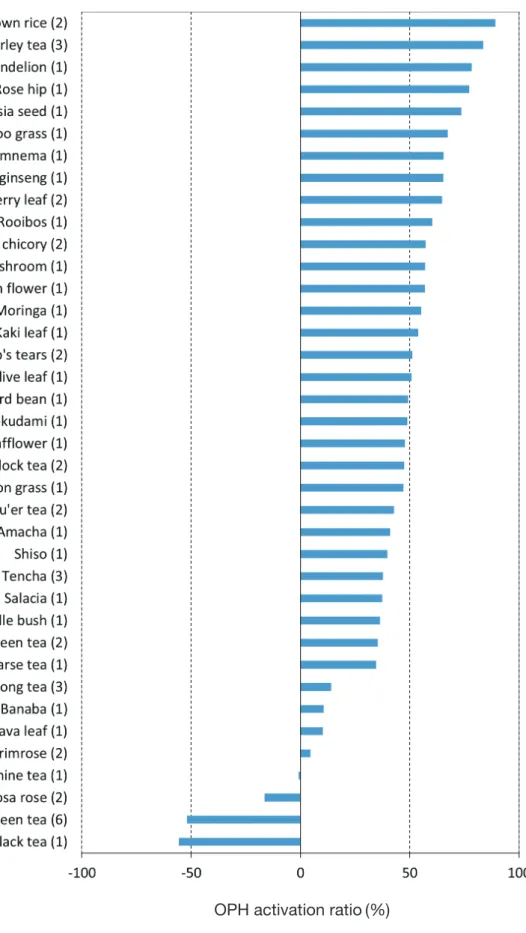
ハーブティーの種類別では
38
種類のうち
34
種類(
89%
)
に
OPH
活性増強作用が認められた。
OPH
活性化率は玄米
(
89.2%
:平均値 ,
n = 2
)、大麦(
83.6
± 2.7%, n = 3
)、タ
ンポポ(
78.3%
)、ローズヒップ(
77.2%
)が
70 %
以上の
高値を示した(
Fig. 1
)。一方、
4
種類は
OPH
活性を阻害し
た。紅茶(
–55.7%
)は
OPH
活性化率が最も大きなマイナ
スの値となり強い阻害作用を示した。次いで阻害作用を示
したハーブティーは緑茶(
– 52.1 ± 9.3%, n = 3
)、メイグ
イ(
–16.5%
:平均値
, n = 2
)、ジャスミン茶(
– 0.8%
)で
あった。
チャノキ(
Camellia sinensis
)由来の茶が
OPH
活性に
与える影響は緑茶(無発酵茶)と紅茶(発酵茶)で
–40%
以上の阻害作用を示したが、ほうじ茶(焙煎茶)、プーア
ル茶(後発酵茶)は活性を増強した。ウーロン茶(半発酵茶)
の作用は使用した
3
品に活性増強作用と阻害作用の両方を
示した。
OPH
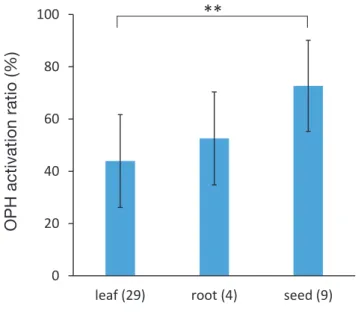
活性増強作用が認められたハーブティーの利用部
位を比較すると、活性化率は種子(
72.7 ± 17.4%, n = 9
)、
根(
52.6 ± 17.8%, n = 4
)、葉(
43.9 ± 17.8%、n = 29
)順
に大きく、種子が葉と比べて有意に大きかった(
p < 0.01,
Fig. 2
)。
考察
OPH
活性に影響を及ぼすハーブティー中の成分
OPH
活性はハーブティー抽出液の影響を与え、検証し
た
58
品(
38
種類)の試料中
46
品(
81%
)、
34
種類(
89%
)
に活性増強作用が認められた。この結果は
OPH
活性を増
強する作用成分が多くの植物に含まれている可能性を示し
ている。既に植物には化学分類学的な知見からさまざまな
属や科レベルの特徴成分が報告されている
17, 18)。
OPH
活
性化率は葉よりも種子を利用しているハーブティーで高値
であったが、活性の強弱に植物分類学的な関連性を認めら
れなかった。
OPH
活性を阻害する作用は緑茶(無発酵茶)に認められた
が、茶葉の焙煎、発酵処理によって阻害作用が軽減した。緑
茶にはカフェイン(
caffeine
)、テオフィリン(
theophylline
)、
タンニン (
tannin
)類などが含まれている
19)。また茶葉は酸化
発酵によりカテキン(
catechins
)がテアフラビン(
theaflavin
)
などに変化することが知られている
20-22)。茶葉の焙煎や発
酵処理などの加工は茶葉成分の変化に起因する
OPH
活性
阻害作用の変化に関連する可能性がある。
糖化ストレス抑制の観点からみた
OPH
活性増強作用
OPH
は生体組織中に広く分布している
7-13)。
OPH
には
AGEs
量 お よ び
N
ε-(carboxymethyl) lysine
(
CML
)量 を
減少させる作用が認められているため
16)、ハーブティーの
摂取は生体内の
OPH
活性の増強に繋がり、体内で
AGEs
化した老化蛋白の分解排泄促進する可能性がある。また
皮膚角層中にも
OPH
様活性が認められ、角層中
CML
の
分解に関与している可能性が示されている。しかし角層
OPH
活性は加齢と弱い負の相関性、角層
CML
量、皮膚中
AGEs
蓄積量(
skin autofluorescence: SAF
)の増加が観
察されている
16)。皮膚中
AGEs
の増加は皮膚のキメ喪失
23)、
黄色化、バリア機能の低下
24)に関与し、皮膚老化の進展に
影響する。ハーブティー成分のスキンケア剤としての利用
は
OPH
活性の低下を抑え、
SAF
抑制に寄与する可能性が
ある。ハーブティーを食品やスキンケア剤として利用する
ことは、
OPH
活性を増強することで
AGEs
の蓄積を防ぎ、
糖化ストレスによる老化抑制の一助となる可能性がある。
結語
ハーブティーの熱水抽出物には
OPH
活性に影響を与える
作用が認められた。
OPH
活性増強作用は評価した
58
品の試
料中、
46
品(
81%
)に認められ、
OPH
活性を増強する作用
成分が多くの植物に含まれている可能性があった。
OPH
活
性に対する影響はハーブの種類、焙煎や発酵処理などの加工、
利用部位によって異なった。ハーブティーの
OPH
活性増強
作用は、老化蛋白や
AGEs
の蓄積を予防する効果が期待され、
糖化ストレスによる老化抑制の一助となる可能性がある。
利益相反申告
本研究の実施にあたりクラージュ株式会社より研究費の支
援を受けた。
謝辞
本研究の一部は文部科学省研究助成(
#26350917
)によっ
て実施された。
( 4 )
Glycative Stress Research
Sample ID 41 1 4 22 26 21 55 56 8 46 38 49 13 15 36 40 43 16 20 25 54 28 44 58 59 45 42 6 52 37 47 33 34 32 31 27 35 19 3 29 5 12 14 17 24 7 11 9 48 39 2 51 30 53 18 23 50 10 Ref Dokudami
Job's tears (non-caramel) Job's tears
Brown rice (crushed) Brown rice (crushed) Barley tea
Nijo Barley tea Rokujo Barley tea Lemon grass Kuma bamboo grass Amacha Salacia Five-leaf ginseng Cassia seed Candle bush Sword bean Rooibos Mulberry leaf
Mulberry leaf (Shimane Pref.) Rugosa rose Rugosa rose Rose hip Tencha Tencha Tencha (fermented) Banaba Guava leaf Evening primrose Evening primrose Moringa Kaki leaf
Green tea (benifuki) Green tea (saemidori) Green tea (Kagosima Pref.) Green tea (autum-winter harvest) Green tea (2nd harvest) Green tea (3rd harvest) Coarse tea (roasted ) Roasted green tea Roasted green tea Jasmine tea Black tea Oolong tea (leaf) Oolong tea (tea bag) Oolong tea (Taiwan) Pu'er tea (tea bag) Pu'er tea (leaf) Gymnema Shiso Olive leaf chicory (raw) chicory Burdock tea Burdock tea Safflower Dandelion Chrysanthemum flower Lingzhi mushroom 24.8 0.9 387.7 224.0 163.8 93.1 116.6 95.1 384.1 165.3 63.7 74.7 214.2 97.2 273.1 114.9 99.6 50.3 34.6 22.3 2.1 77.0 31.7 59.9 53.0 20.5 8.9 2.5 1.6 61.0 208.0 18.9 41.9 25.1 56.6 45.8 63.5 43.3 6.1 51.9 6.2 62.7 51.7 38.4 43.9 37.0 4.0 6.7 29.1 51.3 50.3 384.0 1448.2 714.7 88.2 936.0 35.7 109.5 -Dokudami-cha Hatomugi-cha Genmai mugi-cha Lemon grass Kumazasa-cha Amacha Salacia-cha Amachazuru-cha Habu-cha Candle bush Natamame-cha Rooibos-cha Kuwa-no-ha-cha Meigui Rose hip Ten-cha Banaba-cha Guava leaf-cha Tsukimiso-cha Moringa Kaki-no-ha-cha Ryoku-cha Ban-cha Hoji-cha Jasmine-cha Koh-cha Oolong-cha Pu'er-cha Gymnema-cha Shiso-cha Olive-ha-cha Chicory Gobo-cha Benibana-cha Tanpopo-ne-cha Kikuka-cha Lingzhi Sample name Japanese general tea category
leaf seed seed seed leaf leaf leaf root leaf seed leaf seed leaf leaf flower fruit leaf leaf leaf leaf leaf leaf leaf leaf leaf leaf leaf root flower root flower mushroom Use for tea Saururaceae Poaceae Saxifragaceae Celastraceae Cucurbitaceae Fabaceae Moraceae Rosaceae Lythraceae Myrtaceae Onagraceae Moringaceae Ebenaceae Theaceae Apocynaceae Lamiaceae Oleaceae Asteraceae Ganodermataceae Family name Houttuynia cordata
Coix lacryma-jobi var. ma-yuen Oryza sativa
Hordeum vulgare Cymbopogon citratus Sasa veitchii
Hydrangea macrophylla var. thunbergii Salacia sp. Gynostemma pentaphyllum Senna obtusifolia Cassia alata Canavalia gladiata Aspalathus linearis Morus sp. Rosa rugosa spp. Rosa canina Rubus suavissimus Lagerstroemia speciosa Psidium guajava Oenothera sp. Moringa oleifera Diospyros kaki Camellia sinensis Gymnema sylvestre Perilla frutescens var. crispa Olea europaea Cichorium intybus Arctium lappa Carthamus tinctorius Taraxacum sp. Chrysanthemum morifolium Ganoderma lucidum
Scientific name Sampleconc.
(μg/mL) 0.120 0.123 0.120 0.149 0.155 0.150 0.147 0.146 0.118 0.134 0.113 0.109 0.133 0.140 0.110 0.120 0.129 0.125 0.140 0.058 0.076 0.142 0.123 0.100 0.108 0.089 0.089 0.088 0.080 0.125 0.124 0.034 0.035 0.046 0.047 0.041 0.028 0.108 0.093 0.125 0.080 0.036 0.063 0.104 0.108 0.115 0.114 0.133 0.082 0.121 0.124 0.128 0.117 0.119 0.119 0.143 0.126 0.126 0.080 pNA conc. (mmol/L) 48.9 53.5 48.8 85.8 92.7 86.5 83.0 81.2 47.0 67.4 41.0 37.4 65.3 73.6 36.3 49.2 60.3 55.7 74.0 -27.4 -5.5 77.2 53.4 24.9 34.9 10.5 10.2 9.6 -0.5 55.2 53.8 -57.7 -56.2 -42.9 -41.2 -49.3 -65.1 34.5 15.4 55.2 -0.8 -55.7 -21.9 29.2 34.9 43.4 42.2 65.5 39.8 50.7 54.7 59.7 46.2 48.4 47.7 78.3 56.9 57.0 0.0 Activation ratio (%)
Table 1. Influence on the OPH activity of 58 sample (38 category) herbal tea extract
(oolong tea scented with the aroma of jasmine blossoms)
Sample conc, final sample concentration in reaction reagent; pNA conc, concentration of pNA separated in reaction liquid in 60 minutes; Activation ratio, activation ratio of OPH to reference; OPH, oxidized protein hydrolase; pNA, p-nitroanilide.
( 5 )
ハーブティーの
OPH
活性に対する影響
Green tea Coarse tea Roasted green tea Black tea Oolong tea Pu'er tea
Table 2. OPH activity by processing of green tea
Tea category Processingunfermented roasted fermented n 3 1 2 2 3 2 Activation ratio (%) -52.1 ± 9.3 34.5 35.3 -55.7 14.1 ± 31.3 42.8
Results are expressed as mean ± SD or average values. Green tea, tea of Camellia sinensis source; activation ratio, activation ratio of OPH to reference; OPH, oxidized protein hydrolase; SD, standard deviation.
Sample ID 41 1 4 22 26 21 55 56 8 46 38 49 13 15 36 40 43 16 20 25 54 28 44 58 59 45 42 6 52 37 47 33 34 32 31 27 35 19 3 29 5 12 14 17 24 7 11 9 48 39 2 51 30 53 18 23 50 10 Ref Dokudami
Job's tears (non-caramel) Job's tears
Brown rice (crushed) Brown rice (crushed) Barley tea
Nijo Barley tea Rokujo Barley tea Lemon grass Kuma bamboo grass Amacha Salacia Five-leaf ginseng Cassia seed Candle bush Sword bean Rooibos Mulberry leaf
Mulberry leaf (Shimane Pref.) Rugosa rose Rugosa rose Rose hip Tencha Tencha Tencha (fermented) Banaba Guava leaf Evening primrose Evening primrose Moringa Kaki leaf
Green tea (benifuki) Green tea (saemidori) Green tea (Kagosima Pref.) Green tea (autum-winter harvest) Green tea (2nd harvest) Green tea (3rd harvest) Coarse tea (roasted ) Roasted green tea Roasted green tea Jasmine tea Black tea Oolong tea (leaf) Oolong tea (tea bag) Oolong tea (Taiwan) Pu'er tea (tea bag) Pu'er tea (leaf) Gymnema Shiso Olive leaf chicory (raw) chicory Burdock tea Burdock tea Safflower Dandelion Chrysanthemum flower Lingzhi mushroom 24.8 0.9 387.7 224.0 163.8 93.1 116.6 95.1 384.1 165.3 63.7 74.7 214.2 97.2 273.1 114.9 99.6 50.3 34.6 22.3 2.1 77.0 31.7 59.9 53.0 20.5 8.9 2.5 1.6 61.0 208.0 18.9 41.9 25.1 56.6 45.8 63.5 43.3 6.1 51.9 6.2 62.7 51.7 38.4 43.9 37.0 4.0 6.7 29.1 51.3 50.3 384.0 1448.2 714.7 88.2 936.0 35.7 109.5 -Dokudami-cha Hatomugi-cha Genmai mugi-cha Lemon grass Kumazasa-cha Amacha Salacia-cha Amachazuru-cha Habu-cha Candle bush Natamame-cha Rooibos-cha Kuwa-no-ha-cha Meigui Rose hip Ten-cha Banaba-cha Guava leaf-cha Tsukimiso-cha Moringa Kaki-no-ha-cha Ryoku-cha Ban-cha Hoji-cha Jasmine-cha Koh-cha Oolong-cha Pu'er-cha Gymnema-cha Shiso-cha Olive-ha-cha Chicory Gobo-cha Benibana-cha Tanpopo-ne-cha Kikuka-cha Lingzhi Sample name Japanese general tea category
leaf seed seed seed leaf leaf leaf root leaf seed leaf seed leaf leaf flower fruit leaf leaf leaf leaf leaf leaf leaf leaf leaf leaf leaf root flower root flower mushroom Use for tea Saururaceae Poaceae Saxifragaceae Celastraceae Cucurbitaceae Fabaceae Moraceae Rosaceae Lythraceae Myrtaceae Onagraceae Moringaceae Ebenaceae Theaceae Apocynaceae Lamiaceae Oleaceae Asteraceae Ganodermataceae Family name Houttuynia cordata
Coix lacryma-jobi var. ma-yuen Oryza sativa
Hordeum vulgare Cymbopogon citratus Sasa veitchii
Hydrangea macrophylla var. thunbergii Salacia sp. Gynostemma pentaphyllum Senna obtusifolia Cassia alata Canavalia gladiata Aspalathus linearis Morus sp. Rosa rugosa spp. Rosa canina Rubus suavissimus Lagerstroemia speciosa Psidium guajava Oenothera sp. Moringa oleifera Diospyros kaki Camellia sinensis Gymnema sylvestre Perilla frutescens var. crispa Olea europaea Cichorium intybus Arctium lappa Carthamus tinctorius Taraxacum sp. Chrysanthemum morifolium Ganoderma lucidum
Scientific name Sampleconc.
(μg/mL) 0.120 0.123 0.120 0.149 0.155 0.150 0.147 0.146 0.118 0.134 0.113 0.109 0.133 0.140 0.110 0.120 0.129 0.125 0.140 0.058 0.076 0.142 0.123 0.100 0.108 0.089 0.089 0.088 0.080 0.125 0.124 0.034 0.035 0.046 0.047 0.041 0.028 0.108 0.093 0.125 0.080 0.036 0.063 0.104 0.108 0.115 0.114 0.133 0.082 0.121 0.124 0.128 0.117 0.119 0.119 0.143 0.126 0.126 0.080 pNA conc. (mmol/L) 48.9 53.5 48.8 85.8 92.7 86.5 83.0 81.2 47.0 67.4 41.0 37.4 65.3 73.6 36.3 49.2 60.3 55.7 74.0 -27.4 -5.5 77.2 53.4 24.9 34.9 10.5 10.2 9.6 -0.5 55.2 53.8 -57.7 -56.2 -42.9 -41.2 -49.3 -65.1 34.5 15.4 55.2 -0.8 -55.7 -21.9 29.2 34.9 43.4 42.2 65.5 39.8 50.7 54.7 59.7 46.2 48.4 47.7 78.3 56.9 57.0 0.0 Activation ratio (%)
Table 1. Influence on the OPH activity of 58 sample (38 category) herbal tea extract
(oolong tea scented with the aroma of jasmine blossoms)
Sample conc, final sample concentration in reaction reagent; pNA conc, concentration of pNA separated in reaction liquid in 60 minutes; Activation ratio, activation ratio of OPH to reference; OPH, oxidized protein hydrolase; pNA, p-nitroanilide.
41 1 4 22 26 21 55 56 8 46 38 49 13 15 36 40 43 16 20 25 54 28 44 58 59 45 42 6 52 37 47 33 34 32 31 27 35 19 3 29 5 12 14 17 24 7 11 9 48 39 2 51 30 53 18 23 50 10 Ref Dokudami
Job's tears (non-caramel) Job's tears
Brown rice (crushed) Brown rice (crushed) Barley tea
Nijo Barley tea Rokujo Barley tea Lemon grass Kuma bamboo grass Amacha Salacia Five-leaf ginseng Cassia seed Candle bush Sword bean Rooibos Mulberry leaf
Mulberry leaf (Shimane Pref.) Rugosa rose Rugosa rose Rose hip Tencha Tencha Tencha (fermented) Banaba Guava leaf Evening primrose Evening primrose Moringa Kaki leaf
Green tea (benifuki) Green tea (saemidori) Green tea (Kagosima Pref.) Green tea (autum-winter harvest) Green tea (2nd harvest) Green tea (3rd harvest) Coarse tea (roasted ) Roasted green tea Roasted green tea Jasmine tea Black tea Oolong tea (leaf) Oolong tea (tea bag) Oolong tea (Taiwan) Pu'er tea (tea bag) Pu'er tea (leaf) Gymnema Shiso Olive leaf chicory (raw) chicory Burdock tea Burdock tea Safflower Dandelion Chrysanthemum flower Lingzhi mushroom 24.8 0.9 387.7 224.0 163.8 93.1 116.6 95.1 384.1 165.3 63.7 74.7 214.2 97.2 273.1 114.9 99.6 50.3 34.6 22.3 2.1 77.0 31.7 59.9 53.0 20.5 8.9 2.5 1.6 61.0 208.0 18.9 41.9 25.1 56.6 45.8 63.5 43.3 6.1 51.9 6.2 62.7 51.7 38.4 43.9 37.0 4.0 6.7 29.1 51.3 50.3 384.0 1448.2 714.7 88.2 936.0 35.7 109.5 -Dokudami-cha Hatomugi-cha Genmai mugi-cha Lemon grass Kumazasa-cha Amacha Salacia-cha Amachazuru-cha Habu-cha Candle bush Natamame-cha Rooibos-cha Kuwa-no-ha-cha Meigui Rose hip Ten-cha Banaba-cha Guava leaf-cha Tsukimiso-cha Moringa Kaki-no-ha-cha Ryoku-cha Ban-cha Hoji-cha Jasmine-cha Koh-cha Oolong-cha Pu'er-cha Gymnema-cha Shiso-cha Olive-ha-cha Chicory Gobo-cha Benibana-cha Tanpopo-ne-cha Kikuka-cha Lingzhi leaf seed seed seed leaf leaf leaf root leaf seed leaf seed leaf leaf flower fruit leaf leaf leaf leaf leaf leaf leaf leaf leaf leaf leaf root flower root flower mushroom Saururaceae Poaceae Saxifragaceae Celastraceae Cucurbitaceae Fabaceae Moraceae Rosaceae Lythraceae Myrtaceae Onagraceae Moringaceae Ebenaceae Theaceae Apocynaceae Lamiaceae Oleaceae Asteraceae Ganodermataceae Houttuynia cordata
Coix lacryma-jobi var. ma-yuen Oryza sativa
Hordeum vulgare Cymbopogon citratus Sasa veitchii
Hydrangea macrophylla var. thunbergii Salacia sp. Gynostemma pentaphyllum Senna obtusifolia Cassia alata Canavalia gladiata Aspalathus linearis Morus sp. Rosa rugosa spp. Rosa canina Rubus suavissimus Lagerstroemia speciosa Psidium guajava Oenothera sp. Moringa oleifera Diospyros kaki Camellia sinensis Gymnema sylvestre Perilla frutescens var. crispa Olea europaea Cichorium intybus Arctium lappa Carthamus tinctorius Taraxacum sp. Chrysanthemum morifolium Ganoderma lucidum 0.120 0.123 0.120 0.149 0.155 0.150 0.147 0.146 0.118 0.134 0.113 0.109 0.133 0.140 0.110 0.120 0.129 0.125 0.140 0.058 0.076 0.142 0.123 0.100 0.108 0.089 0.089 0.088 0.080 0.125 0.124 0.034 0.035 0.046 0.047 0.041 0.028 0.108 0.093 0.125 0.080 0.036 0.063 0.104 0.108 0.115 0.114 0.133 0.082 0.121 0.124 0.128 0.117 0.119 0.119 0.143 0.126 0.126 0.080 48.9 53.5 48.8 85.8 92.7 86.5 83.0 81.2 47.0 67.4 41.0 37.4 65.3 73.6 36.3 49.2 60.3 55.7 74.0 -27.4 -5.5 77.2 53.4 24.9 34.9 10.5 10.2 9.6 -0.5 55.2 53.8 -57.7 -56.2 -42.9 -41.2 -49.3 -65.1 34.5 15.4 55.2 -0.8 -55.7 -21.9 29.2 34.9 43.4 42.2 65.5 39.8 50.7 54.7 59.7 46.2 48.4 47.7 78.3 56.9 57.0 0.0 (oolong tea scented
with the aroma of jasmine blossoms)
Sample conc, final sample concentration in reaction reagent; pNA conc, concentration of pNA separated in reaction liquid in 60 minutes; Activation ratio, activation ratio of OPH to reference; OPH, oxidized protein hydrolase; pNA, p-nitroanilide.
( 6 )
Glycative Stress Research
Fig. 1.
Influence on the OPH activity of 38 category herbal tea extract.
OPH activation ratio, activation ratio of OPH to reference; Extract condition, dry herb powder 2g + 40 mL hot water (80℃), incubated for 60 min; OPH, oxidized protein hydrolase.
OPH activation ratio (%)
C
at
eg
or
y
o
f
he
rb
al
t
ea
(
nu
m
b
er
o
f
sa
m
p
le
)
OPH activation ratio (%)
Ca
te
go
ry
o
f h
er
bal
te
a
(n
um
be
r o
f s
am
ple
)
Fig. 1
( 7 )
参考文献
1)
Ichihasi M, Yagi M, Nomoto K, et al. Glycation stress and
photo-aging in skin. Ant-Aging Med. 2011; 8: 23-29.
2)
Yagi M, Yonei Y. Glycative stress and anti-aging: 1. What
is glycative stress? Glycative Stress Res. 2016; 3: 152-155.
3)
Yagi M, Yonei Y. Glycative stress and anti-aging: 13.
Regulation of glycative stress. 1. Postprandial blood
glucose regulation. Glycative Stress Res. 2019; 6: 175-180.
4)
Miyagi M, Sakiyama F, Kato I, et al. Complete covalent
structure of porcine liver acylamino acid-releasing enzyme
and identification of its active site serine residue. J Biochem.
1995; 118: 771-779.
5)
Tsunasawa S, Imanaka T, Nakazawa T. Apparent
dipeptidyl peptidase activities of acylamino acid-releasing
enzymes. J Biochem. 1983; 93: 1217-1220.
6)
Kobayashi K, Smith JA. Acyl-peptide hydrolase from rat
liver. Characterization of enzyme reaction. J Biol Chem.
1987; 262: 11435-11445.
7)
Gade W, Brown JL. Purification and partial characterization
of alpha-N-acylpeptide hydrolase from bovine liver. J
Biol Chem. 1978; 253: 5012-5018.
8)
Mitta M, Miyagi M, Kato I, et al. Identification of the
catalytic triad residues of porcine liver acylamino
acid-releasing enzyme. J Biochem. 1998; 123: 924-931.
9)
Yamin R, Zhao C, O'Connor PB, et al. Acyl peptide
hydrolase degrades monomeric and oligomeric
amyloid-beta peptide. Mol Neurodegener. 2009; 4: 33.
10)
Quistad GB, Klintenberg R, Casida JE. Blood acylpeptide
hydrolase activity is a sensitive marker for exposure to some
organophosphate toxicants. Toxicol Sci. 2005; 86: 291-299.
11)
Beppu M, Inoue M, Ishikawa T, et al. Presence of
membranebound proteinases that preferentially degrade
oxidatively damaged erythrocyte membrane proteins as
secondary antioxidant defense. Biochim Biophys Acta.
1994; 1196: 81-87.
12)
Fujino T, Watanabe K, Beppu M, et al. Identification
of oxidized protein hydrolase of human erythrocytes as
acylpeptide hydrolase. Biochim Biophys Acta. 2000;
1478: 102-112.
13)
Unger T, Nagelschmidt M, Struck H.
N-Acetylaminoacyl-p-nitranilidase from human placenta. Purification and
some properties. Eur J Biochem. 1979; 97: 205-211.
14)
Shimizu K, Ikegami-Kawai M, Takahashi T. Increased
oxidized protein hydrolase activity in serum and urine of
diabetic rat models. Biol Pharm Bull. 2009; 32: 1632-1635.
15)
Shimizu K, Kiuchi Y, Ando K, et al. Coordination of
oxidized protein hydrolase and the proteasome in the
clearance of cytotoxic denatured proteins. Biochem
Biophys Res Commun. 2004; 324: 140-146.
16)
Yagi M, Ishigami M, Mori R, et al. Reduction effect of
oxidized protein hydrolase (OPH) on advanced glycation
end products and OPH-like activity in human stratum
corneum. Glycative Stress Res. 2017; 4: 184-191.
17)
Singh R. Chemotaxonomy: A tool for plant classification.
J Medicinal Plants, Studies. 2016; 4: 90-93.
18)
Liu K, Abdullah AA, Huang M, et al. Novel approach
to classify plants based on metabolite-content similarity.
Biomed Res Int. 2017; 5296729.
19)
Tang GY, Meng X, Gan R-Y, et al. Health functions and
related molecular mechanisms of tea components: An
update review. In J Mol Sci. 2019; 20: 6196.
20)
Tanaka T, Miyata Y, Tamaya K, et al. Increase of theaflavin
gallates and thearubigins by acceleration of catechin
oxidation in a new fermented tea product obtained by the
tea-rolling processing of loquat (Eriobotrya japonica) and
green tea leaves. J Agric Food Chem. 2009; 57: 5816-5822.
21)
Jiang HY, Shii T, Matsuo Y, et al. A new catechin oxidation
product and polymeric polyphenols of post-fermented tea.
Food Chem. 2011; 129: 830-836.
22)
Zhang M, Otake K, Miyauchi Y, et al. Comprehensive
NMR analysis of two kinds of post-fermented tea and
their anti-glycation activities in vitro. Food Chem. 2019;
277: 735-743.
23)五味貴優
.
角層のAGEs
評価法とその応用. Bio Industry.
2011; 28: 20-26.
24)
Yokota M. Tokudome Y. The effect of glycation on
epidermal lipid content, its metabolism and change in
barrier function. Skin Pharmacol Physiol. 2016; 29:
231-242.
Fig. 2.
Influence on the OPH activity use for tea.
Results are expressed as mean ± SD. Parenthesis shows number of samples. **: p < 0.01, Tukey's multiple comparison test. OPH activation ratio, activation ratio of OPH to reference; Extract condition, dry herb powder 2 g + 40 mL hot water (80℃), incubated for 60min; OPH, oxidized protein hydrolase; SD, standard deviation.