Somatic mutation of immunoglobulin heavy chain
variable region genes in gastric low-grade
MALT type lymphoma
著者
HOJO Hiroshi, KUZE Tetuo, NAKAMURA Naoya,
HASHIMOTO Yuko, ABE Masafumi
journal or
publication title
鹿児島大学医学雑誌=Medical journal of
Kagoshima University
volume
51
number
Suppl.
page range
48-50
URL
http://hdl.handle.net/10232/18358
Med. J. Kagoshima Univ., Vol. 51. Suppl. 48-50, July, 1999
Somatic mutation of immunoglobulin heavy chain variable region genes
in gastric low-grade MALT type lymphoma
Hiroshi Hojo, Tetuo Kuze, Naoya Nakamura, Yuko Hashimoto, and Masafumi Abe
First Department of Pathology, Fukushima Medical University, School of Medicine
Malignant lymphoma arising from mucosa-associ ated lymphoidtissue (MALT)occurs in various extranodal organs including the gastrointestinal (GI) tract, lungs, sali vary gland and thyroid. Since Isaacson and Wright first described a new concept of MALT lymphoma in 1983, its essential and distinctive difference from nodal lymphoma has been characterized and generally accepted. Low-grade
MALT type (L-MALT) lymphoma is morphologically
characterized by a proliferation of centrocyte-like cells, lymphoepithelial lesions, plasmocytic differentiation and follicular colonization. The immunophenotype was con sidered to show a similar phenotype to nodal marginal zone B-cell lymphoma or splenic marginal cell lymphoma: sIgM+, slgD-, clg-/+, pan B+, CD5-, CD10-, CD23-, and
CD43-/+.
In response to antigen stimulation, somatic hypermutation of VH (immunoglobulin heavy chain vari
able region) genes is generally believed to occur in germi nal center B-cells, which results in the generation of memory B-cells, producing antibodies with a high specific ity and affinity. These mutations are distributed in both complementary determining regions (CDR) and the frame work regions (FR) with a high ratio of replacement (R) to silent (S) mutations in the CDR indicating antigen selec tion. Ongoing mutation indicates the intraclonal variation of VH genes and suggests the genetic evidence that antigen stimulation plays an important role in clonal expansion in follicular lymphoma. Sequence analysis of rearranged VH genes has been used to determine where B-cell lymphoma
derives from pre-germinal center or post-germinal center B-cells. In order to clarify the cell characteristics and ori gin of L-MALT lymphoma, and to asses the difference of somatic mutation between L-MALT lymphoma and gastric diffuse large B-cell lymphoma (DLBL), we analyzed the
VH genes from eight cases of L-MALT lymphomas and two
cases of gastric DLBL. To further elucidate the role of an tigen selection in L-MALT lymphoma, we analyzed intraclonal variations of VH genes.
Materials and Methods
Fifty-seven gastric lymphomas obtained from the files of the First Department of Pathology, Fukushima Medical University, School of Medicine, collected be tween 1983 and 1998, were reviewed. Fifty-seven lymphomas were subclassified as L-MALT lymphoma (24 cases), mantle cell lymphoma (MCL) (1), L-MALT lymphoma with diffuse large B cell lymphoma (DLBL) (9), and DLBL (23). Clinical and follow-up data were also obtained from referring clinicians. Paraffin and frozen im munohistochemistry were performed using the following antibodies: CD3, CD5, CD10, CD20 (FBI), CD21, CD23, CD30, CD43, CD45RO, CD74, CDw75, immunoglobu lins, bcl2, bcl6, Pax5, cyclinDl, p53, pl6, p27, MDM2, MIB1, LMP1, EBNA2 and keratin. Immunophenotypic study using the ABC method was helpful for confirming the diagnosis reached by morphologic examination of the
H.E. stained sections.
Table 1. Distribution of Mutations of VH genes in L-MALT lymphoma
Case No. Germline Region Replacement Silent Total
1 V3-23 CDRH 7 (13.7) 3 (3.9) 10 (19.6) FRm 5 (5.2) 5 (5.2) 10 (10.4) 2 DP-51 CDRn 7 (13.7) 1 (2.0) 8 (15.7) FRffl 2 (2.1) 3 (3.1) 5 (4.2) 3 B42 CDRII 2 (3.9) 3 (5.9) 5 (9.8) FRffl 2 (2.1) 2 (2.1) 4 (4.2) 4 VH311 CDRH 6 (11.8) 0 6 (11.8) FRffl 6 (6.3) 2 (2.1) 8 (8.3) 5 VH311 CDRII 1 (2.0) 2 (3.9) 3 (5.9) FRffl 7 (7.3) 7 (7.3) 14 (14.6) 6 DP-49 CDRII 4 (7.8) 1 (2.0) 5 (9.8) FRIII 6 (6.3) 1 (1.0) 7 (7.3) 7 VH311 CDRII 4 (7.8) 0 4 (7.8) FRIII 8 (8.3) 4 (4.2) 12 (12.5) 8 DP53 CDRII 7 (13.7) 3 (3.9) 10 (19.6) FRffl 9 (9.4) 8 (8.3) 17 (17.7)
Using BLATIN and the GenBank Database.
CDR: Complementary determining region.
Parentheses indicate percentage.
Somatic mutation of immunoglobulin heavy chain variable region genes [49]
Sequences of the CDRII and FRIII region of VH
genes were analyzed in twelve cases of L-MALT lymphomaandtwo casesof DLBL using semi-nested PCR. DNA preparation was performed from a whole section of either frozen or paraffin-embedded tissue. The two-step semi-nested PCR reaction was performed in either a GeneAmp 9700 System (Perkin Elmer Applied Systems, Chiba, Japan) or a DNA Thermal Cycler (Perkin Elmer), as described previously. In brief, in the first round PCR amplification was carried out using consensus primers of
the second framework portion of the VH region (FR2A) and
the JH region (UH) from genomic DNA. In the second round of PCR, the PCR products of the first round were amplified using primer FR2A and another JH primer (VUH). The primer sequences were follows: 5TGG (A/ G)TC CG(CA) CAG (G/QC(T/C) (T/QC(A/G/T/C) GG3' (termed FR2A), 5TGA GGA GAC GGT GAC C3' (termed UH), 5'GTG ACC AGG GT(A/G/C/T) CCT TGG CCC CAG3'5 (termed VUH). PCR products were electro-phoresed on 2% agarose gel and visualized by ethidium bromide staining. Appropriately sized PCR products were isolated. PCR products were cloned in the pCR II vector using the TA cloning system according to the manufacturer's protocol (Invitrogen, San Diego, CA, USA). Sequencing was performed with an SQ5500 auto mated sequencer (Hitachi, Tokyo, Japan) by the dideoxy chain termination method with fluorescent dyes using a Thermo Sequenase Core Sequencing Kit (Amersham Inter national pic, Little Chalfont, UK). DNA sequences were analyzed using BLATIN and the GenBank Database. Mu
tations in the VH were identified by comparing the consen
sus sequence of each case with the corresponding germline
to estimate somatic mutations.
Results
Twenty-four gastric L-MALT lymphomas were ex amined in the present study. The mean age of the patients in the 24 L-MALT lymphomas was 56 years (20 to 80 years) with a M/F ratio of 1:2. Twenty-two cases (92%) of L-MALT lymphoma were restricted to the submucosa, and two cases showed an infiltration of propria muscle. The morphologic characteristics of L-MALT lymphomas were commonly found in all our cases. L-MALT lymphoma showed a preferential involvement of epithelial structures. Follicular colonization was found in 18 cases of L-MALT lymphoma (75%) with an irregularly expanded and
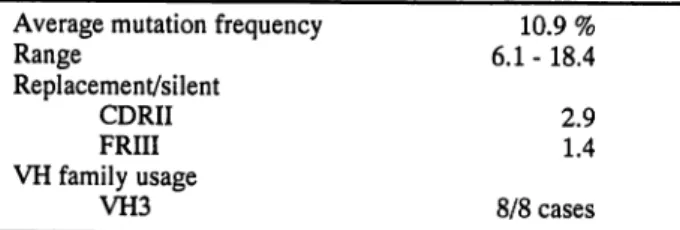
seg-Table 2. Somatic Mutation Analysis of DNA in L-MALT Lymphoma
Average mutation frequency 10.9 %
Range 6.1 -18.4 Replacement/silent CDRII 2.9 FRIII 1.4 VH family usage VH3 8/8 cases
Average mutation frequency: total number of somatic mutations
/ total number of bases.
mented FDCnetwork pattern. The neoplastic cells usually were centrocyte-like cells and/ormonocytoid B-cells, anda small number of transformedblasts and plasmocytic differ entiation was also found. The neoplastic cells expressed CD20 but lacked T-cell-associated antigens. Immunohis tochemistry revealed that L-MALT lymphoma was nega tive for CD5, CD34, CD43, and slgD. The bcl2 protein was identified in 18 cases of MALT lymphoma (75%). p53 protein reacted with L-MALT lymphomas showing intranuclear staining, and positive cells were less than 10% of the neoplastic cells except one case.
All twelve cases of L-MALT lymphoma examined in the present study showed IgH gene rearrangement and eight cases of them showed frequent somatic mutation of
the rearranged VH genes, with a much higher R/S mutation
ratio in the CDRII than FRIII. (Tables 1, 2). The average mutation frequency was 10.9% (range: 6.1-18.4%), and the averages of R/S ratio of the CDR II and FRIII were 2.9 and
1.8, respectively. The VH family used was found to be VH3
in all eight cases. The mutation frequency of two cases in DLBL was 6.25% and 13.61%, respectively. The ongoing mutation (intraclonal variation) was observed in all three cases of L-MALT lymphomas (Table 3).
Discussion
Sequence analysis of rearranged VH genes has been
used to determine whether B-cell lymphomas derive from pre-germinal center B-cells, germinal center B-cells or post-germinal center B-cells, and to asses the role of anti gen stimulation in lymphomagenesis. Pre-germinal center
B-cells usually exhibit unmutated VH genes with a
germline sequence. Antigen-activated proliferating germi
nal center B-cells show mutated VH genes and intraclonal
variations by ongoing mutations. Post-germinal center
memory B-cells show mutated VH genes with a higher ratio
of R/S mutation in the CDRs in comparison with FRs, but lack ongoing mutations. Ongoing mutation occurs in ger minal centers but not in marginal zones. From the date of somatic mutation analysis of B-cell lymphomas, L-MALT lymphoma is considered to originate from post-germinal center B-cells (memory B-cells) that have undergone anti gen selections. However, recent several reports have showed that ongoing mutations as indicated by intraclonal
variations of VH gene sequences are found in L-MALT
lymphoma. Ongoing mutations are known to exist in folli cularlymphoma and provide the genetic evidence that anti gen stimulation playsan important role in clonalexpansion of this lymphoma. In the present study, L-MALT
lymphomas showed mutated VH gene with a high ratio of
R/S mutations and ongoing mutations. These data includ ing ours suggest that antigen-driven-high-affinity somatic mutations may play an important role in the clonal expan sion of MALT lymphomas. The ongoing mutation of L-MALT lymphoma may reflect reentry in to a germinal cen ter pathway, and may occur in follicular colonization in which lymphoma cells infiltrate to reactive follicles.
[50] Hiroshi HOJO et al.
Table 3. VH Sequences of L-MALT Lymphoma Clones
Case No. Germline Clone
VH Sequence
V3-23 GCT ATT AGT GGT AGT - C - A - - C
-CDR II
GGT GGT AGC ACA TAC - - a -CA -Tt
-TAC GCA GAC TTC GTG AAG GGC 1-1* 1-2 1-3 1-4 1-5 T -T - c T - c T T -- C -- A -- C -- A - - C -- C -- A - - C --a - - A --a CCA --a -CA -- -- t - - t - T t - T t V3-23 1-1* 1-2 1-3 1-4 1-5 V3-23 1-1* 1-2 1-3 1-4 1-5
CGG TTC ACC ATC TCC AGA GAC FR III AAT - - A G-A G-A - - A - - A TCC G G -G G G
-AAG AAC ACG CTG TAT CTG - - t - - a G -A a a G A a a G - - t - - a G -1 - - a G -CAA G — G— G — G — G — C
-ATG AAC AGC CTG AGA GCC GAG GAC ACG GCC GTA TAT TAC TGT GCG AAA
c — c — c — c C C -- G -- — c — c
VH3-11AAC ATA AAG CAA - - C G -- -- C G -C G -C G -C G -C G
-GAT GGA AGT C C -C C C C -CDRII
GAG AAA TAC G G G -G G G -TAT GTG A -- -- A -- -- A A -- -- A -- -- A -GAC TCT GTG AAG GGC - - G - - G - - G - - G - - G - - G FRIII
VH3-11CGA TTC ACC ATC TCC AGA GAC AAC GCC AAG AAC TCA CTG TAT CTG CAA
4.!* _T_ __c 4-2 - T - - - c 4-3 - T - - - c 4-4 - - a - T - - - c 4-5 - T - - - c 4-6 - T - - - c
VH3-11 ATG AAC AGC CTG AGA GCC GAG GAC ACG GCT GTG TAT TAC TGT GCG AGA
4-5 - A - A - - - G - G - - T - - - - c T
-4-6 - - c - A - A - - G T - - - - c T
-CDRII
VH3-11AAC ATA AAG CAA GAT GGA AGT GAG AAA TAC TAT GTG GAC TCT GTG AAG GGC
7.!* c A_t _G_ 7.2 g__ C__ _T_ _G_ 7.3 G__ c__ _T_ _G_ 7-4 C - - A-t -G-7.5 G c__ _Q_ _T_ _G_ 7.8 G__ c__ _T_ _G_ FRIII
VH3-11CGA TTC ACC ATC TCC AGA GAC AAC GCC AAG AAC TCA CTG TAT CTG CAA
7.!* a 7.2 a 7.3 a 7-4 - - t a 7.5 a 7.6 a 7.7 a 7-8 - - a
H3-11 ATG AAC AGC CTG AGA GCC GAG GAC ACG GCT GTG TAT TAC TGT GCG AGA
7-1* T - - c A-a - T - TTc GCT 7-2 T - - - - c A-a -TG -Tt GCT 7-3 T - - - - c A-a -T- TTc GCT 7.4 T - - - - c A-a - T - TTc GCT 7-5 T - - - - c A-a - T - TTc GCT 7-6 T - - - - c A-a -TG -Tt GCT 7-7 T - - -C- - - c A-a - T - TTc GCT 7-8 T-A - - c A-a -TG -Tt GCT