Journal of Fluid Science and Technology
Laminarization of inhomogeneous turbulent channel flow
under stable density stratification
1. Introduction
Density stratification has pivotal effects on turbulence in geophysical and engineering flows, and hence, many research studies have been investigated on stratified homogeneous turbulence. One of the typical flow configurations studying the effects of stable density stratification is a turbulent channel flow driven by a constant mean pressure gradient. In this flow configuration, our previous DNSs(Iida, Kasagi, and Nagano, 2002) show the occurrence of internal gravity waves in the channel center and relaminarization at the strong density stratification as observed in the minimal channel flow; flow is turbulent on one side of a channel, while it is laminar on the other side.
Recent DNSs (Brethouwer, Duguet, and Schlatter, 2012) with the large computational region, however, show that when turbulent flow, bounded by the walls, becomes sufficiently suppressed not only by decreasing the Reynolds number, but also by imposing the body forces such as buoyancy, Coriolis, and MHD forces, a flow becomes spatially intermittent, and turbulent and quasi-laminar regions simultaneously appear in the same flow domain.
Especially, previous studies of a stably stratified channel flow, which has the same flow configuration as our previous study (Iida, Kasagi, and Nagano, 2002), show that a flow is spatially intermittent instead of one-sided turbulence when the computational region is sufficiently large (Garcia-Villalba and del Alamo, 2011; Fukudome and Ogami,2017). Here, intermittent turbulence is defined as partial laminarization or turbulence collapse in Flores and Riley, 2011, which shows that the turbulence collapse is related to a decrease in the Monin-Obukov length nondimensionalized by the viscous wall unit. This spatial intermittency can be coined as the inhomogeneity in this study.
An inhomogeneous turbulent structure is dependent on the dynamical parameters; when a flow is partially relaminarized by the viscosity due to the low-Reynolds number, the local turbulent regions in the upper and lower walls appear simultaneously, and a flow is almost homogeneous over the wall-normal direction (Tuckerman et. al., 2014;
Oaki IIDA* and Yoshito NAGASE*
* Department of Mechanical Engineering Nagoya Institute of Technology Gokiso-cho, Showa-ku, Nagoya 466-8555, Japan
E-mail: [email protected]
Received: 21 October 2020; Revised: 28 December 2020; Accepted: 16 March 2021 Abstract
Effects of buoyancy force stabilizing the disturbances are investigated on a turbulent channel flow bounded by two walls of different temperatures. With a constant mean pressure gradient imposed, the buoyancy force related to the Grashof number (Gr) is systematically increased by increasing the temperature difference between upper and lower walls, which are perpendicular to the gravitational direction. As a result, the mean flow rate increases with an increase in the Gr, and turbulent structures become intermittent and inhomogeneous; turbulent and quasi-laminar regions simultaneously appear in the same computational region. Detailed visualization for instantaneous turbulent structure shows that in the upper and lower sides of a channel, the turbulent regions appear alternatively, and local one-sided turbulence is observed. Finally, with a further increase in the Gr, the stratified channel flow becomes complete one-sided turbulence where a flow becomes turbulent on one side of a channel, while it becomes laminarized on the other side.
Iida and Nagase, Journal of Fluid Science and Technology, Vol.16, No.2 (2021)
Fukudome and Iida, 2012), which is different from the relaminarization for stable density stratification, where turbulent structures are inhomogeneous even in the wall-normal direction (Deusebio, Caulfield, and Taylor, 2015).
In previous studies (Iida, Kasagi, and Nagano, 2002; Fukudome and Ogami,2017), performed at the relatively small computational region, one-sided turbulence is observed, indicating that relaminarized flow is strongly inhomogeneous in the wall-normal direction; in Iida, Kasagi, and Nagano, sides of the computational region are set to be 5 x2 x2 in the streamwise, wall-normal, and spanwise directions, respectively. However, it is still unclear how a flow is relaminarized under strong density stratification, when the computational region is reasonably large enough that a flow could become spatially intermittent and inhomogeneous; the final structure of turbulence in a stratified channel is not well discussed in the previous DNS study (Garcia-Villalba and del Alamo, 2011), except their comments that at the critical Richardson number, the small patch of the turbulent region remains.
So, the objective of this study is to investigate the relaminarization of a turbulent channel flow under stable density stratification, especially when the computational region is large enough that turbulent and quasi-laminar regions appear simultaneously. Especially, our focus is on how the stable density stratification affects the wall-normal asymmetry of flow structure at the relaminarization; in the previous studies, wall-normal inhomogeneity of turbulence is reported under strong density stratification in both Couette flow (Deusebio, Caulfield, and Taylor, 2015) and open channel flow (Brethouwer, Duguet, and Schlatter, 2012), but not in the Poiseuille flow as investigated in this study.
In the study of Deusebio, Caulfield, and Taylor, 2015, sides of the computational region are set to be 4 x2 x2 in the streamwise, wall-normal, and spanwise directions, respectively, and a band of the turbulent region is observed in the entire computational box as shown in Fig. 7 of their paper. In contrast, in the study of Brethouwer, Duguet, and Schlatter, 2012, sides of the computational region are set to be 100 (32 ) x1( x50(16 in the streamwise, wall-normal, and spanwise directions, respectively, as shown in Fig. 13(c) of their paper, where two lumps of the turbulent region are observed. In both studies, however, turbulent regions are twisted in the horizontal directions, and hence they become inhomogeneous in the wall-normal direction.
As discussed in the next section, in this study, the computational region is set to be sufficiently large to include the turbulent and laminar regions, considering the results of the previous studies; in one case of this study, i.e., case A, the spanwise side of the computational region is almost equivalent to the computational region of Brethouwer, Duguet, and Schlatter, 2012, while in the other case, i.e., case B, its streamwise side is set to be almost equivalent to theirs; two different computational regions may be useful to show which computational side affects more seriously on the one-sided turbulence. Although our resolution of numerical simulations is mostly performed at relatively coarse grid resolution, similar calculations are performed at the same coarse grid resolution in our previous study (Iida, Kasagi, and Nagano, 2002), where qualitative comparisons are made with results of fine-grid resolution to the validity of the numerical results, and experimental results (Fukui, Nakajima, and Ueda, 1983), to show the validity of our numerical results.
2. Flow configuration and numerical conditions
In this study, direct numerical simulations of an incompressible turbulent channel flow are performed with a spectral method. No-slip conditions are assumed on both upper and lower walls. A flow is driven by a constant mean pressure gradient, and a constant temperature difference T is imposed on two walls; the temperature of the upper wall is larger than that of the lower wall. By assuming the gravity g in the wall-normal direction, the buoyancy force may contribute to stabilizing the disturbances, and hence the flow is dynamically under stable density stratification.
A flow is driven in the x direction by an imposed mean pressure gradient. The wall-normal (gravitational) and spanwise directions are assumed to be the y and z directions, respectively.
where x, y, and z are assumed to be x1, x2, and x3, respectively. As in our previous study (Iida, Kasagi, and Nagano,
2002), Re (=u ) and Pr are set to be 150 and 0.71, respectively; u and are the friction velocity, channel half
width, and kinematic viscosity, respectively. Gr(= g ), defined by the channel width 2 is changed from
10x106 to 300x106; is the volume expansion rate of the fluid. In some studies, Richardson number
Ri =Gr/(8Re is used for representing the buoyancy forces.
Computations are performed at the different computation boxes as shown in Fig. 1. In case A, the computational box of 5 16 is resolved by the 64, 65, 512 grids point in the x, y, and z directions, respectively while in case B, the computational box of 40 , 2 2 is resolved by the 512, 65, 64 grid points in the x, y, and z directions, respectively. In the realistic experimental configuration, channel half width as well as a mean pressure gradient are assumed to be identical in both cases to make the Re identical, while a temperature difference between two walls is assumed to be systematically changed. Moreover, as discussed in the next section, when Gr increases, turbulence becomes inhomogeneous in horizontal directions, which causes a serious discrepancy between the different computational regions; especially, an increase in the streamwise side of the computational region increases the resistance against the one-sided turbulence rather than an increase in its spanwise side.
In cases Afx, Afy, and Afz, grid points are set to be double in the x, y, and z directions, respectively. Spatially, a pseudo spectral method is used, and an aliasing error is removed by the padding method;in the horizontal and vertical directions, Fourier and Chebyshev polynomials are used, respectively. For the integration of the time, the second-order Adams-Bashforth method is used for no-linear and buoyancy terms, while the Crank-Nicolson method is used for viscous and conductive terms. All statistics hereafter are nondimensionalized by the mean pressure gradient, , and without any indication. The time interval dt for the integration is decreased from 0.0008 to 0.0002 with an increase in the bulk mean velocity. In the following, turbulent statistics are averaged over horizontal directions as well as over time;the statistics are calculated every 100 dt at least over the time period of 100 u . In contrast, in the cases where the statistics are asymmetric between the different sides of the wall, they are averaged only over the horizontal directions, because one-sided turbulence may be considered to be a transient process over the long period of time.
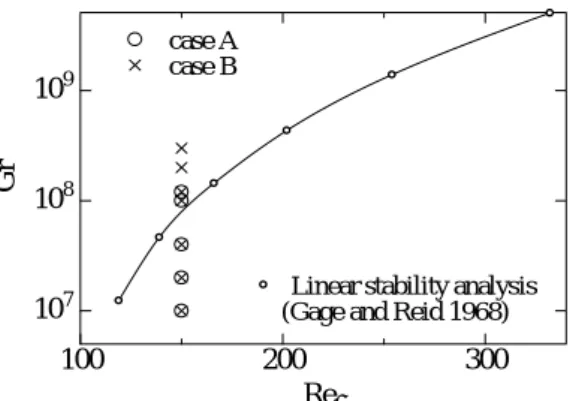
Figure 2 shows the range of Gr in cases A and B; in case A, Gr is set to be 10x106, 20x106, 100x106, 120x106, while
in case B, it is set to be 10x106, 20x106, 100x106,120x106,240x106 and 300x106. In linear stability analysis, the flow 2 2 2 1 1 8 i i i j i j i j j u u p u Gr u t x x Re x x Re 0 i i u x 2 1 j j j j u t x Re Pr x x
Fig. 2 Distribution of Re and Gr used in the calculation. For comparison, the curve of the linear stability analysis is included. In the region above the curve, the disturbances may be stabilized.
Numerically, the governing equations are incompressible Navier-stokes equations, and a buoyancy force is approximated by the linear Boussinesq equation. The dynamical parameters, when nondimensionalized by the channel half width , mean pressure gradient, temperature difference between two walls, are the friction Reynolds number (Re ) the Prandtl number (Pr), and Grashof number (Gr), due to the Boussinesq approximation.
100 200 300 107 108 109 Re Gr case A case B
Linear stability analysis (Gage and Reid 1968)
Iida and Nagase, Journal of Fluid Science and Technology, Vol.16, No.2 (2021)
may be relaminarized at Gr=8x10⁷ at Re . As discussed in the next section, case A becomes one-sided channel
flow at Gr=120x106, and hence, the numerical simulation at larger Gr than 120x106 is not performed in case A, because
the objective of this study is to show the emergence of one-sided turbulence as the interim state for the relaminarization. In contrast, in case B, as discussed in the next section, one-sided turbulence over the entire channel is not observed at Gr=120x106. Hence, Gr is further increased in case B, until the flow becomes one-sided turbulence in the entire channel. 3. Results and discussions
(a) (b)
Fig. 3 (a) Mean velocity profiles of different computational regions and Grashof numbers. The velocity profiles of Gr=120x106 in case A and Gr=300x106 in case B are instantaneous snapshots. To clarify the asymmetry at Gr=300x106 in case B, the profile turned around with respect y/ =0 is included as “-y”. (b) Mean velocity profiles in cases A, Afx, Afy, and Afz of Gr=120x10,which are obtained at end of time development of Cf shown in Figs. 5(c), i.e., t =60.
Figure 3 shows the mean velocity profiles in different computational boxes. It is clearly seen that in both cases, the mean velocity increases with an increase in the Grashof number. At Gr=10x106, a difference in mean velocity profiles
in the different computational regions is negligible. As is discussed later, a flow of Gr=10x106 is almost homogeneous
over the entire channel region. At Gr=100x106, however, the difference is slightly marked between cases A and B.
Especially in case A, at Gr=120x106, the velocity profile becomes asymmetric between upper and lower walls, though in
case B, it is still symmetric, indicating that the streamwise side of the computational region more affects the asymmetry of the mean velocity profile. In case B, definite asymmetry is observed at Gr=300x106. Finally, as shown in Fig. 3(b),
asymmetric velocity profiles are confirmed even in cases of different grid resolutions at Gr=120x106.
Figure 4 shows the r.m.s. of the velocity fluctuations in cases A and B. As shown in Fig. (a), at Gr=10x106, a
difference in the r.m.s. velocity fluctuations is mostly negligible in all components between cases A and B, indicating that turbulence is still homogeneous, and hence independent of the computational region. However, as shown in Fig. (b), the differences between cases A and B are observed in urms at Gr= 20x106 and40x106. Moreover, as shown in Fig.
(c), the r.m.s. of the velocity fluctuations in case A becomes asymmetric between upper and lower sides at Gr=120x106 ,
which is not observed at Gr=10x106 where a mean velocity profile is also symmetric with respect to a channel center.
At Gr=120x106of case A, the lower side of a channel becomes relaminarized, though the flow is still turbulent on the
upper side. This complete one-sided turbulence was reported at Gr=20x106 (Ri is approximately 110) when the
computational region is small in our previous study (Iida, Kasagi, and Nagano, 2002). Hence, Gr, at which a flow becomes complete one-sided turbulence, is dependent on the size of the computational region as indicated in the previous study of the large computational region (Garcia-Villalba and del Alamo, 2011). Besides, it should be noted in Fig. 4(d) that in cases Afx, Afy, and Afz, the state of one-sided turbulence is observed as in case A, despite the difference in the grid resolutions.
It is also interesting to see that Gr of one-sided turbulence is larger than the critical value, i.e., Gr =80x106, Ri =440,
predicted by the linear stability analysis (Gage and Reid,1968). This may be because stability analysis may not consider the effect that a flow becomes intermittent and inhomogeneous at the sufficiently large stratification. A more interesting issue is that the statistics on the turbulent side at Gr=120x106 are almost identical to those at Gr=10x106, indicating that
there is no tendency for laminarization, at least in the r.m.s. velocity fluctuations of the turbulent side.
-1 0 1 0 20 40 60 Gr=10x10 6 100x106 120x106 y/ U Gr=10x106 100x106 120x106 300x106 -y Symbols; case A Lines; case B -1 0 1 0 10 20 30 40 50 60 y/ U case A(Gr=120×106) case Afx case Afy case Afz
(a) (b)
.
(c) (d)
Fig. 4 Distributions of r.m.s. of velocity fluctuations, (a) Gr=10x106 of cases A and B, (b) Gr=20x106 and 40x106 of case A and B, (c) Gr=10x106 and 120x106 of case A, (d) Gr=120x106 in cases A, Afx, Afy, and Afz; the results of Fig. 4(d) are at the end of the time development in Figs. 5(c), and not averaged over time.
(a) (b)
(c)
The starting times for each case are arbitrary.
Figure 5 shows the time development of the skin friction coefficient Cf in both walls of case A and B. First, as shown in Fig. (a), at Gr=10x106, the amplitude of the oscillation of Cf is small on both walls. With an increase in Gr,
an increase in the oscillation is observed. In case A, at Gr=120x106, a flow becomes relaminarized on the lower-wall
side. This laminarization is not a temporary phenomenon, but it continues over t=200, which period is much larger than
0 100 200 300 400 0.002 0.004 0.006 0.008 Cf t Upper wall Lower wall Gr=10x106 Gr=120x106 Gr=100x106 0.000 0.002 0.004 0.006 -1 0 1 0 1 2 3 y/ urm s ,vrm s , wrm s urms vrms wrms Symbols; cases A, Lines cases B Gr=10x106 -1 0 1 0 1 2 3 y/ urms ,vrm s , wrm s urms vrms wrms Thin lines; Gr=10x106 Thick lines; Gr=120x106 case A 3000 400 500 0.002 0.004 0.006 0.008 Cf t Gr=300x106 Gr=10x106 Gr=120x106 Gr=240x106 -1 0 1 0 1 2 3 4 5 y/ urm s case A Afx Afy Afz -1 0 1 0 1 2 3 y/ urm s Gr=20x106 Gr=40x106 Symbols; cases A, Lines cases B
Iida and Nagase, Journal of Fluid Science and Technology, Vol.16, No.2 (2021)
that of a short oscillation of Cf related to the turbulent activity observed on the upper-wall side. As shown in Fig. 5(b), this is also true in case B, where flows on both walls are turbulent at Gr=10x106 and 120x106. At Gr=240x106, however,
a definite asymmetry is observed between two different walls. Moreover, at Gr=300 x106, the complete one-sided
turbulence is observed; a flow becomes laminar at the upper side of the channel, while the flow is still turbulent on the other side of a channel. Finally,as shown in Fig.5(c), one-sided turbulence is still observed in cases of different grid resolutions, in which calculations are started from the same initial conditions of one-sided turbulence. A close look shows that when the grid resolution is finer in the streamwise direction, Cf tends to be small because of an increase in the bulk flow rate as observed in our previous study. It is also noted in case Afx that despite an abrupt decrease in Cf on the turbulent side, it later bounces back, indicating the strong resilience of one-sided turbulence.
(a) (b)
Fig. 6 Instantaneous distributions of the second invariant of the deformation tensor at (a) Gr=10x106 and (b) 20x106 in the entire computational region of case A. The value of ui xj uj xi is set to be 0.01 in all cases. Hereafter, a large arrow represents the
direction of the mean flow.
Figures 6 and 7 show the instantaneous distributions of the second invariant of the deformation tensor II, which is defined as ui xj uj xi, and its positive value is known to be representing vortical structures; Figures 6(a) and (b) are snapshots at Gr=10x106 and 20x106 in case A, respectively. First, it is noted that at Gr=10x106, isosurfaces of II are
almost uniformly distributed over the entire channel except in the channel center, and hence, turbulence is horizontally homogeneous over the entire channel. In contrast, at Gr=20x106, quasi-laminar regions, where isosurfaces of II are
rarely distributed, appear between the turbulent regions.
Fig. 7 Instantaneous distributions of II =0.01 at (a) Gr=100x106 and (c) 120x106 in the entire region of case A. (b) r.m.s. of vertical velocity fluctuation v at the different z locations in case A of Gr=100x106; v2 are averaged over x direction at each different z location, and then normalized after square root by each local friction velocity ulocal tau of each z location and each wall side.
With a further increase in the Gr, as shown in Fig. 7(a), the quasi-laminar regions are enlarged at Gr=100x106 in
comparison to the cases of lower Gr, and hence the distances between different turbulent regions increase. Moreover, it is noted that the flow conditions between upper and lower walls are uncorrelated; when a flow is turbulent on the upper or lower side, it tends to become relaminarized on the opposite side. This asymmetry is more clearly observed by the local distributions of vrms as shown in Fig. 7(b), where v2 is averaged at the typical z over the x direction. It is noted in
Fig. 7(b) that when the flow becomes turbulent on one side of a channel, on its other side, the flow tends to become laminar, indicating the local one-sided turbulence.
Then, as shown in Fig. 7(c), entire one-sided turbulence appears at Gr=120x106; on the upper-wall side, several
turbulent regions are observed, while on the lower-wall side, quasi-laminar regions cover the entire side of a channel.
Fig. 8 Instantaneous distributions of II =0.01at (a) Gr=120x106 and (b) 300x106 in the entire region of case B; in (a), blue and red isosurfaces are those in upper and lower sides of a channel, respectively.
Fig. 9 Instantaneous distributions of Relocal at lower and upper walls of different Gr in different cases. Friction velocity of Relocal is the square root of the instantaneous shear stress at the wall divided by the density.
0 100 200 300 400 10-5 10-4 10-3 10-2 10-1 100 Gr=0 10x106 20x106 120x106 300x106 P .d. f. case B
Relocal at upper wall
0 100 200 300 400 10-5 10-4 10-3 10-2 10-1 100 Gr=0 Gr=10x106 Gr=20x106 Gr=120x106 Gr=300x106 P .d. f.
Relocal at lower wall case B 0 100 200 300 400 10-5 10-4 10-3 10-2 10-1 100 Gr=0 10x106 20x106 100x106 120x106 P .d.f .
Relocal at upper wall case A 0 100 200 300 400 10-5 10-4 10-3 10-2 10-1 100 Gr=0 10x106 20x106 100x106 120x106 P .d. f.
Relocal at lower wall case A
Iida and Nagase, Journal of Fluid Science and Technology, Vol.16, No.2 (2021)
Figures 8(a) and (b) are the snapshots at Gr=120x106 and 300x106 in case B. In case B, similar results to case A are
observed. At Gr=120x106, the flow becomes not only horizontally, but also vertically inhomogeneous, although flows
of both sides are statistically turbulent. At Gr=300x106, a turbulent region appears on one side of a channel, though Gr
at which a flow becomes complete one-sided turbulence, is dependent on the computational region.
Figure 9 shows the PDFs of Relocal i.e., local friction Reynolds number defined by the instantaneous friction velocity
at each wall and channel half width. First, it is noted that the peak of PDF is almost at Relocal=150, because its average
over the entire channel should be 150. Second, with an increase in Gr, the deviation of Relocal from 150 increases, and
the peaks of PDFs are shifted from 150 to lower values, which simultaneously tends to increase the maximum value of Relocal. Hence, turbulence could locally survive, and intermittent turbulence appears even when Re =150 is smaller than
critical Reynolds number Rec at the given Gr. 5. Conclusions
This study performed DNSs of a turbulent channel flow of Re =150 under stable density stratification in two different computation regions. In case A, the sides of the computational box are set to be 5 16 in the x, y, and z directions, respectively while in case B, they are 40 , 2 2 in the x, y, and z directions, respectively. At Gr=10x106 (Ri is
approximately 55), a flow is mostly homogeneous over an entire channel, and mean velocity profiles and the r.m.s velocity fluctuations of both cases are in good agreement with each other. With an increase in the stratification, in both cases, the turbulent and quasi-laminar regions simultaneously appear in the same computational domain, and a flow
becomes inhomogeneous as shown in the previous study of Garcia-Villalba and del Alamo, 2011. Due to this
inhomogeneity, a difference is observed in urms and mean velocity between the different computational regions.
Especially, the difference is observed in urms at Gr=20x106 (Ri is approximately 110) at which our previous study
observed complete one-sided turbulence (Iida, Kasagi, and Nagano, 2002).
With a further increase in Gr, at Gr=100x106 in case A, the turbulent and quasi-laminar regions appear staggered
between different sides of a channel, though statistics are almost symmetric; when the flow becomes locally laminar at one side of a channel, the flow on the opposite side is still turbulent. This local asymmetry and local one-sided turbulence are also observed at Gr=120x106 in case B. Hence, it is suggested that the turbulent channel flow, under
strong density stratification, becomes locally one-sided turbulence, even though statistics averaged over the entire horizontal region are still turbulent on both sides, which is not observed in laminarization by a decrease in the Reynolds number without density stratification (Tuckerman et al., 2014; Fukudome and Iida, 2012).
Finally, in case A, at Gr=120x106, the channel flow becomes complete one-sided turbulence, where the flow becomes
laminar over the entire region on one side of a channel, while it still becomes turbulent on the other side. In case B, complete one-sided turbulence is observed at Gr=300x106. Sufficient scientific evidences are not provided at present
to determine whether complete one-sided turbulence is physically realistic or unrealistic, though complete one-sided turbulence seems to be on the extension line of local one-sided turbulence. Hence, in any way, this study shows that turbulence in the Poiseuille flow also becomes inhomogeneous in the wall-normal direction under strong density stratification as observed in both Couette flow (Deusebio, Caulfield, and Taylor, 2015) and open channel flow (Brethouwer, Duguet, and Schlatter, 2012).
As far as the turbulent region is concerned, no tendency for laminarization is observed in the r.m.s. of velocity fluctuations, as long as a flow is turbulent. This is because the local friction Reynolds number is more shifted to the higher Reynolds number in the turbulent region with an increase in the amount of laminar region where the local friction Reynolds number becomes lower than the average value.
Although it is shown in this study that laminarization under density stratification is different from that of low Reynolds number, its detailed mechanism is still unknown. Especially, previous studies (Zonta, Onorato, and Soldati, 2012; Zonta and Soldati, 2018) indicate the effects of internal gravity waves in the channel center on the laminarization of near-wall turbulence, which must differentiate the effects of strong stable stratification from those of low Reynolds number.
Acknowledgment
Professor S. Tamano, Nagoya Institute of Technology, and Dr. K. Fukudome, Tokyo University of Science. References
Brethouwer, G., Duguet, Y., and Schlatter, P., Turbulent-laminar coexistence in wall flows with Coriolis, buoyancy or Lorentz forces, J. Fluid Mech., Vol. 704, pp. 137-172, (2012).
Deusebio, E., Caulfield, C. P., and Taylor, J. R., The intermittency boundary in stratified plane Couette flow, J. Fluid Mech., Vol. 781, pp. 298-329, (2015).
Flores, O. and Riley, J. J., Analysis of turbulence collapse in the stably stratified surface layer using direct numerical simulation, Boundary-Layer Meteorol., Vol. 139, pp. 241-259, (2011).
Fukui, K., Nakajima, M., and Ueda, H., A laboratory experiment on momentum and heat transfer in the stratified surface layer, Quart. J. Roy. Meteorol. Soc., Vol. 109, pp. 661-676 (1983).
Fukudome, K. and Iida, O., Large-scale flow structure in turbulent Poiseuille flows at low-Reynolds numbers, J. Fluid Science and Technology, Vol. 7, pp. 181-195, (2012).
Fukudome, K. and Ogami, Y., Large-scale intermittency in turbulent Poiseuille flows at low Reynolds number under stable density stratification, In proceedings of 10th International Symposium of Turbulence and Shear Flow
Phenomena (TSFP10), Chicago, USA, (2017), Paper No. P-20.
Gage, S. K. and Reid, W. H., The stability of thermally stratified plane Poiseuille flow, J. Fluid Mech., Vol. 33, pp. 21-32, (1968).
Garcia-Villalba, M. and del Alamo, J. C., Turbulence modification by stable stratification in channel flow, Physics of Fluids, Vol. 23, 045104, (2011).
Iida, O., Kasagi, N., and Nagano, Y., Direct numerical simulations of turbulent channel flow under stable density stratification, Int. J. Heat Mass Transfer, Vol. 45, pp. 1693-1703, (2002).
Tuckerman, L. S., Kreilos, T., Schrobsdorff, H., Schneider, T. M., and Gibson, J. F., Turbulent-laminar patterns in plane Poiseuille flow, Physics of Fluids, Vol. 26, 114103 (2014).
Zonta, F., Onorato, M., and Soldati, A., Turbulence and internal waves in stably-stratified channel flow with temperature-dependent fluid properties, J. Fluid. Mech., Vol. 697, pp. 175-203, (2012).
Zonta, F. and Soldati, A., Stably stratified wall-bounded turbulence, Applied Mechanics Reviews, Vol. 70, 040801, (2018).