Abstract
This paper provides a cognitive historical analysis of expressions using the preposition at, or at-constructions, in English. In this paper, it is proposed that at-constructions have a general construction schema indicating backgrounding of the end portion of a whole movement or action. This schema is motivated by the bodily experience of directing attention to something and cognitive prominence among focused entities. Because at has been used frequently to describe these fundamental cognitive processes, it is argued that, due to the conserving effect (Bybee (2006)), the constructional meaning of at-constructions has been observed throughout the history of English, in contrast with the relevant descriptions in the Oxford English Dictionary and the Middle English Dictionary.
1. Introduction
To date, various attempts have been made to characterize the properties of the so-called conative construction in English. Among them, Levin (1993: 42) observes that the conative construction expresses “an attempted action without specifying whether the action was actually carried out.” This observation is basically correct, but she does not discuss cognitive motivations behind the conative construction in detail. Besides, the meaning Levin characterizes has expressions with at in common. Therefore, as Broccias (2001: 69) notes, the label ‘at-constructions’ is more appropriate for all expressions using at.1 In the present
paper, from a cognitive linguistic perspective, it is proposed that the constructional meaning of at-constructions is that the end portion of a motion or action with
Historical Perspective
*respect to some entity related to the referent of the prepositional object is backgrounded. From a cognitive historical perspective, it is also claimed that, due to the conserving effect (Bybee (2006)), this meaning has been observed in at-constructions even during the Old English (OE) period and earlier than the end of Middle English (ME) period, where the Oxford English Dictionary (OED) and the Middle English Dictionary (MED) attribute the first citations.
The organization of this paper is as follows. Section 2 examines previous analyses of at-constructions, paying attention to the semantic properties of the conative construction. Section 3 characterizes the constructional meaning of at-constructions in cognitive terms and discusses cognitive motivations behind the constructional meaning. Section 4 examines the historical development of at-constructions. Section 5 is the conclusion.
2. At-Constructions in English
Levin (1993) argues that the conative construction does not specify whether the action was actually carried out. However, this meaning is not a characteristic of the conative construction. Consider the following sentence, where at occurs with the stative verb be.
(1) Lucy is at the supermarket. (Herskovits (1986: 15)) As Herskovits observes, (1) is ambiguous as to whether Lucy is inside or outside of the supermarket. Exactly the same interpretation can be made for motion expressions with at.
(2) a. They ran at the house.
b. Sam threw a handful of mud at Sandy. (van der Leek (1996: 368)) Aside from the differences in transitivity, both of these sentences may or may not mean that the movable entities have actually reached the prepositions’ object referent or, in cognitive linguistic terms, the landmark (LM). From a semantic point of view, (2a, b) contrast with the corresponding expressions with a to-phrase, as in (3a, b), which indicate that the movable entities actually reached the LM.
(3) a. They ran to the house. (cf. (2a))
b. Sam threw a handful of mud to Sandy. (cf. (2b))
Let us examine in some detail the semantic properties of the conative construction. Levin (1993: 42) says that the conative construction is used with
verbs whose meaning includes notions of both contact and motion. Thus, verbs such as move and touch, which lack the notion of either contact or motion, do not occur in the construction.
(4) a. *Monica moved at the cat.
b. *Terry touched at the cat. (Levin (1993: 42))
The verbs break and carve, which signal a change of state, do not occur in the construction.
(5) a. *Janet broke at the bread. (Levin (1993: 41))
b. *Carol carved at the stone. (Levin (1993: 158))
As far as the verb carve is concerned, Jackendoff (1997), comparing (6a) with (6b), points out that carve can be used in the construction if it occurs with the aspectual particle away.2
(6) a. Simmy was carving away at the roast.
b. *Simmy was carving at the roast. (Jackendoff (1997: 540))
In (6a), away facilitates an iterative interpretation. Attributing the repetitive action to a part of constructional meaning is also pointed out by van der Leek (1996) and Broccias (2001). In (7), the ingestion (i.e., sipping) takes place in a bit-by-bit fashion, and the whole substance evoked by the referent of the prepositional object is not necessarily consumed.
(7) He sipped at a tumbler of water. (Broccias (2001: 69)) Taking these facts into consideration, Broccias (2001) classifies constructions with at into three types of schema (which he calls scenarios): allative, ablative, and allative/ablative schemas. Of these schemas, the third (allative/ablative schema) contains the former two schemas, and it seems sufficient to see here the allative and ablative schemas.3 The allative schema is one in which the action denoted
by the verb is attempted but does not necessarily take place. In this schema, the transmission of an emitted entity or energy moves from the agent towards the LM. The relevant examples are given in (8).
(8) a. Sally kicked at the wall. [emitted entity: Sally’s leg] b. Sally threw the stone at Sam. [emitted entity: stone]
(Broccias (2001: 73)) In each of these examples, emission of a sort of entity is involved but the entity does not necessarily reach the goal specified by the LM. The ablative schema, in contrast, is one in which the action denoted by the verb is either repeated or
prolonged. It contains an ablative component at the end of the whole event schema.
(9) a. The horse pulled at the cart. (Broccias (2001: 75)) b. Sam chipped at the rock. (Broccias (2001: 76)) In (9a), the LM (the cart) moves towards the agent (the horse), which is opposite direction of the allative schemas illustrated in (8). (9b) evokes a bit-by-bit process of removal of an entity, where some pieces are removed from the rock while the agent (Sam) repeatedly chips. Interestingly, the something removed is not always the entity specified by the LM of at. In (10, 11), the removed entities are a sensation and attention, respectively.
(10) ...his fingers stroking at the base of her neck, sending delightful shivers, signals of desire, up and down her spine.
(BNC: HGT 4112/Broccias (2001: 77)) (11) I also remember how the knocker-up went around the streets banging
at bedroom windows with a long stick to wake the occupants in time to get to work.
(BNC: B22 1673/Broccias (2001: 78 (underlined original)) In (10), delightful shivers, a sort of sensation felt by the entity referred to by her, are released from the LM (the base of her neck). In (11), attention to wake the occupants is released from the LM (bedroom window). Both sensation and attention refer to entities that occur in the interaction among focused entities, as will be explored in the next section.
3. Cognitive Motivations for Backgrounding
Although there is a difference in which direction a movable entity may move in relation to the LM, at-constructions have a common meaning that the interaction between a kind of emitted entity and the LM is not mentioned explicitly. In other words, in at-constructions, the end portion of a movement or an action is inevitably backgrounded. Therefore, the (b)-variants in (12, 13), which contain the particles focusing on the endpoint of action, become odd, regardless of which direction an emitted entity moves or whether the action described successfully reached the LM.
(12) a. The visitors beat the door down.
b. *The visitors beat at the door down. (Lee (2003: 173))
(13) a. She pulled the tablecloth off.
b. *She pulled at the tablecloth off. (Lee (2003: 175))
One question now arises: what makes the interaction between the emitted entity and the LM backgrounded in at-constructions? To answer this question, let us begin by discussing the preposition at. From a body of previous study of the preposition, Ishizaki (2002a, b) propose a cognitive characterization of at, according to which the preposition has two senses (not distinct, but cognitively related), as in (14).
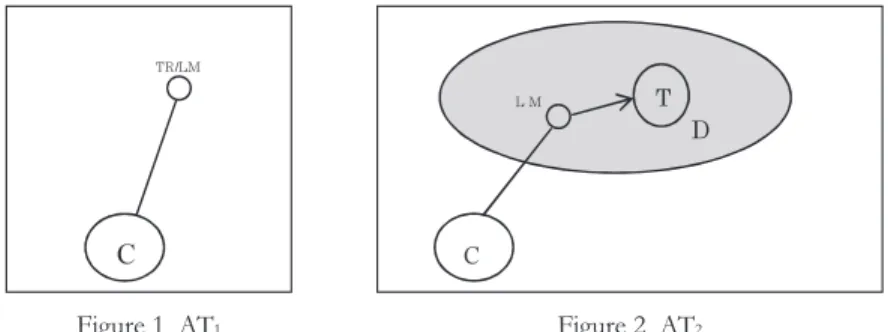
(14) AT1: A point in space where the trajector and the landmark is located.
AT2: A space adjacent to the landmark in which the trajector is located.
(Ishizaki (2002b: 112)) AT1, which is similar to what Herskovits (1986: 128) calls the “ideal meaning” of at, profiles a relation in which the trajector (TR) is placed at the point expressed by the LM. This topological sense of at is schematically represented as Figure 1, where C refers to the conceptualizer. The relevant example is provided in (15), where, regardless of the fact that Heathrow Airport is a three-dimensional entity, the speaker construes it as a point where the TR (the group of students) arrived.
(15) The group of students arrived at Heathrow Airport early this morning. AT2 is seen as an extension from the sense of AT1 via metonymy, an extension
from a point to its vicinity.4 This kind of extension is motivated in cognitive
linguistics as an instance of the reference point (RP) construction, defined as “the ability to invoke the conception of one entity for purposes of establishing mental contact with one another” (Langacker (1993: 5)). According to Langacker, the conceptualizer directs his or her attention to a RP and then makes mental contact with a target (T) within the dominion (D) evoked by the reference point. AT2
can be represented as Figure 2, where the RP is the LM (which is topologically coincident with the TR in the same way as in AT1).5 The T may be the TR as a
physical entity (as in the motion construction of (2)), an entity emitted towards the LM (as in the allative schema of (8)), or some entity removed from the LM (as in the ablative schema of (9)). In the latter two cases the TR is coincident with the LM in Figure 2.
mental contact with the T. In cognitive linguistics, the TR is defined as the most prominent entity in a focal scene, whereas the LMs are less prominent than the TR in such a scene. Langacker (1999: 54, 59) further claims that the profile of the search domain (SD), defined by Hawkins (1984) as the space to which the TR is confined, is less prominent than the TR and LMs are. This is because although TR and LM are delineated entities, the SD is neither bounded nor explicitly mentioned. D from the RP construction is similar to the SD in that both of them are not delineated entities within which something is searched for. To summarize, prominent entities among the profiled elements are placed in the following order of relevance.
(16) Trajector (TR) > Landmark (LM) > Dominion (D)/Search Domain (SD) (Adapted from Ishizaki (2002b: 117)) With these theoretical discussions in mind, let us make a cognitive characterization of at-constructions. A common experience is that the more we direct our attention to or concentrate on something―the LM in at-constructions― the more our eyesight narrows until it finally becomes conceptualized as a point. There are three things worth discussing in this conceptualization. First, in the course of this conceptualization, we do not come to care what the LM’s internal structure is like. To put it another way, whenever we use the preposition at, we try to conceptualize both the TR and the LM as one and the same point in space (the conceptualization of AT1). While conceivable conceptually in the numerical
scale (e.g. at 3,300 feet, at 10: 00 p.m.), it is hardly possible in the physical world to confine physical entities to one and the same point. As a result, we are obliged to put the emitted entity within the D of the point at which the LM is located
(the conceptualization of AT2). The cognitive implication is that at-constructions
express a movement into/interact with the D, which is cognitively less prominent than the TR and the LM.
Second, the notion of direction observed in at-constructions derives from our bodily experience and therefore it is not inherent to the lexical meaning of the preposition per se. Among the English prepositions at, from, and to, whose LMs are conceptualized as points in space and time, at is different from the other two prepositions in that the notion of direction does not come from the preposition itself but from the whole process of directing attention to something. A few words are in order regarding the notion of ‘direction.’ Broccias (2001) uses it to refer to the direction of an entity’s physical or abstract movement, but we are using it here to refer to the conceptualizer’s mental access towards the LM. Thus, regardless of whether the direction of an entity is allative or ablative, a directional meaning is always involved in at-constructions because the conceptualizer tries to make an emitted entity interact with the LM or its D. As to the notion of direction, van der Leek (1996) argues that the conative construction is not always “conative” because the action it describes does not always undergo the intended result in the reading, as in (17).
(17) a. Deep in thought, Sam was aimlessly cutting away at the bread b. Sam kicked at the dog, though he didn’t really intend to hit it.
(van der Leek (1996: 367)) However, aimlessly and intend to in these examples refer to Sam’s motivation in such actions. What is crucial for the present analysis is the fact that Sam directs his attention to the LMs or their D, rather than the purpose of taking these actions. Finally, regardless of whether it is done physically or psychologically, directing our attention to or concentrating on something can hardly be accomplished instantaneously, and it often requires a certain amount of time and/or several attempts to explore the T. Therefore, while the end portion of the movement/ action remains backgrounded consistently, iterative and continuative readings, as observed in (6a) and (9b), are often (but not always) involved in the conceptualization of at-constructions.
Let us consider the following example to make our discussion clear.
(18) Maggie is at her desk. (Herskovits (1986: 16)) According to Herskovits (1986: 16, 17), (18) can have two readings, made explicit
in (19).
(19) a. Maggie is very close to her desk. b. Maggie is using her desk.
The speaker of (19) directs his or her attention to Maggie’s desk to interact with Maggie. However, Maggie is a three-dimensional thing in the physical world, and it is not probable for her to locate at her desk, which is conceptualized as a point. Thus, (18) may undergo the interpretation that Maggie is physically located within the D of the LM (her desk), as in (19a) indicates. (19b) undergoes similar cognitive processes as (19a), except that the conceptualizer interacts with a functional aspect of the desk that is accessible within the D: the conceptualizer psychologically locates Maggie in relation to the desk, whose purpose is to support work and study. Since working and studying are homogeneous atelic processes, continuative meaning is easily evoked in (19b) while the conceptualizer directs his or her attention to the functional aspect of the desk to interact with the TR (Maggie). To summarize, we have shown that at-constructions have the general construction meaning that the end portion of the whole movement/action is backgrounded. This constructional meaning is formed because the conceptualizer, whether physically or psychologically, directs his or her attention to the D (ominion) of the LM, which is a region cognitively less prominent than the LM(s). Then, the notion of direction comes from the whole process of focusing on the LM. In addition, in the course of directing our attention to or concentrating on something, it may take a certain amount of physical or psychological time, which sometimes leads us to interpret the described event in a continuous or repetitive way.
4. Historical Development of At-Constructions
4.1. Descriptions of the So-called Conative Construction in the OED and the MED
It is well-known that the preposition at has been frequently used throughout the history of English. Given that at-constructions are based on our fundamental bodily experience of directing our attention to something, it is expected that the notion of direction towards the LM (or its D) is intrinsic to the meaning of at-constructions. Also expected is that, because of its high frequency, the meaning is
subject to ‘the conserving effect,’ which indicates that expressions with high token frequency are stored independently in our brain as conventional units so as allow processing them easily and resist further analogical changes (Bybee (2006: 10, 11, 271, 272)). However, contrary to our expectations, the OED and the MED give definitions of at as (20a, b) for the so-called conative construction, citing (21) from the late ME texts, not from OE texts.
(20) a. Of motion directed towards: In the direction of, towards, so as to get at; often with hostile intent, ‘against’; in to run, rush, go, have, throw, shoot, let drive, aim, etc. (OED s.v. at. 13.) b. Of the goal or aim of an activity: in the direction of (sth.); (thow,
strike, thrust, aim) at; ... (MED s.v. at. 3b.) (21) a. His swerde drawes he, Strykes at Percevelle his sword draw-PAST
he strike-PAST at Percevelle ‘He drew his sword (and) stroke at
Percevelle’ (a1400 Sir Perc. 1702/OED)
b. He koude hunte at wilde deer. he can-PAST hunt at wild deer ‘He could hunt at wild deer.’ (c1390 Canterbury Tales, TH. B. 1926/MED) If the present analysis is correct, one may wonder why the first citations of the so-called conative construction were so late. In this section, it is shown that the constructional meaning of at-constructions can be traced to earlier in the history of English.
4.2. A Cognitive Approach to Prepositional Phrases in Earlier English
In this section, we provide theoretical and empirical outlines of an earlier time in English through comparison with present-day German. In the following subsections, we examine observations by Smith (1993) about present-day German and discuss how these can explain the nature of prepositional phrases in earlier English. Then, for our purposes, we confine our attention to the distribution of nouns between dative (DAT) and accusative (ACC) cases.
4.2.1. Distribution of DAT and ACC in Present-day German
There is a long-standing view that morphological case marking of nouns is a syntactic operation and that cases themselves have no inherent semantic content. However, Smith (1993) contends that case marking depends on how the speaker construes the referents of nouns in the described situation. Smith (1993: 533)
uses a cognitive characterization of ACC, suggesting that the prototypical use of German ACC is the physical movement of a TR along a path that makes contact with the LM. In contrast, DAT signifies a conceptually significant “departure” from the ACC prototype (Smith (1993: 547)). Providing evidence for the distributions of present-day German cases for nouns followed by the prepositions, Smith classified German prepositions into two types: “1―way” and “2―way.”
(22) a. 1―way Prepositions with DAT Nouns in German aus ‘out of,’ bei ‘near,’ nach ‘to,’ von ‘from,’zu ‘at, to’ b. 1―way Prepositions with ACC Nouns in German durch ‘through,’ um ‘around’
In the 1―way prepositions, the contact image plays a crucial role in the choice of ACC. Smith (1993: 547) argues that DAT, however, is absent from this image, hence it is not implied that a directed path followed by the TR of the preposition makes contact with the prepositional LM.
(23) 2―way Prepositions with DAT and ACC Nouns in German an ‘on,’ auf ‘on,’ hinter ‘behind,’ in ‘in,’ neben ‘next to,’ über ‘over,’ unter ‘under,’ vor ‘in front of,’ zwischen ‘between’
(Adapted from Zwarts (2006: 94)) In the German 2―way prepositions, Smith (1993: 534) defines DAT and ACC as (24a, b), respectively, from a cognitive grammatical perspective.
(24) a. DAT designates the confinement of the TR of the preposition to a set of points satisfying the locative specifications of the preposition. This set of points is called the search domain (SD) of the preposition. b. ACC designates the fact that the TR of the preposition is not always
confined to the SD of the preposition, but enters the SD at some point along a path.
The difference in the conceptualization between DAT and ACC becomes apparent in the following examples.
(25) a. Wir wanderten in den Bergen. we wandered in the-DAT mountains ‘We wandered (around) in the mountains.’ b. Wir wanderten in die Berge. we wandered in die-ACC Berge.
In (25a), where the DAT noun den Bergen is preceded by in (‘in’), the subject referent Wir (‘we’) wandered within the SD evoked by the LM den Bergen (‘the mountain’). In contrast, in (25b), where the ACC noun is preceded by the preposition, Wir wandered into the SD.
4.2.2. Distribution of DAT and ACC in OE
OE also had 1―way and 2―way prepositions in the same way as present-day German. Though not an exhaustive list, some types of preposition are shown in (26, 27).
(26) a. 1 way Prepositions with DAT nouns in OE
æfter ‘after, along, according to,’ æt ‘at,’ fræm ‘from,’ of ‘of,’ to ‘to’ b. 1 way Prepositions with ACC nouns in OE
þurh ‘through,’ ymb(e)‘after, about, around’ (27) 2―way Prepositions with DAT and ACC nouns in
OE beofan ‘before,’ behindan ‘behind,’ binnan ‘within,’ bufan ‘above,’ gemang ‘among,’ in ‘in, into,’ on ‘on, onto,’ under ‘under,’ ofer ‘over’
(Adapted from Mitchell (1985: 497―499)) The following are examples with the 2―way preposition ofer (‘over’) in OE. In (28a) ofer is followed by a DAT noun to express a static location, whereas in (28b) it is followed by an ACC noun to express a departure over the sea. These interpretations are in accordance with those in German, as Smith observes in (25).
(28) a. ofer þæm hongiað hrinde bearwas over it-DAT hang frosty groves
‘frosty groves hang over it (=lake)’ (Beowulf 1363/Lass (1994: 230)) b. Gewát þá ofer wægholm
depart then over sea-ACC
‘then he departed over the sea’ (Beowulf 217/Lass (1994: 230)) Findings from comparative linguistics (see, for example, Lass (1994: Section 9.4)) suggest that the classifications of the 1―way and 2―way prepositions in present-day German are available to those of OE. A noteworthy point along these lines is that although the directions of movement/action are conceptualized through our bodily experience, as discussed in Section 3, the end portions of motion/ action have been coded in English as entire prepositional phrases, rather than as the prepositions themselves. This is accommodated within cognitive linguistic
assumptions on prepositions, since, as the cognitive grammatical definitions of preposition and noun in (29a, b) suggest, prepositional phrases involve the conceptualizations of both a thing and a relation in a focal scene.
(29) a. PREPOSITION: A symbolic expression categorized semantically as the atemporal relation, whose landmark is commonly elaborated by an overt nominal that directly follows it. (Langacker (1987: 243)) b. NOUN: A Symbolic structure whose semantic pole profiles a thing. (Langacker (1987: 491)) By the end of ME period, the morphological case distinction between DAT and ACC had been lost. To compensate for the loss, some 2―way prepositions were required to express the meaning ‘a movement to a SD’ in a different way. A specific treatment for this was the introduction of the preposition to. According to Mustanoja (1960: 390, 415), into became frequent in the ME period, whereas unto (with the meaning ‘onto’ in PDE) became common from the late ME period. Thus, even if the morphological case distinction between DAT and ACC is lost, some types of movement in English, specifically ‘a movement TO/IN/INTO the (SD of) LM’ can be expressed linguistically by English prepositional phrases.
4.3. The Development
4.3.1. At-Constructions in the OE and ME Periods
The OE æt (‘at’) was a native word in English; it profiled a spatial relation between entities from earlier English. As we saw in (26a), æt in the OE and (Early) ME periods was a 1―way preposition followed by a DAT noun quite regularly. According to Lass (1994: 229), DAT in OE contained heterogeneous categories because it took over the dative, locative, ablative, and instrumental cases from Proto-Indo-European languages. In addition, DAT in OE was used adverbially, as in hwíl-um ‘at times’ and stycce-mæl-um (‘piecemeal, little by little’). Given these historical facts, it is reasonable that various types of interaction between an emitted entity and the LM (e.g., allative vs. ablative, ballistic movement vs. bit-by-bit action) might have been expressed in at-constructions. For example, in (30) below (edited by Mitchell and Robinson (1992)), there are two DATs and the DAT him (‘him’) and fōtum (‘foot’) are instances of ‘dative of possession’ use and locative use, respectively.
(30) þæt him æt f o
―
tum fo―
ll fæ―
ge cempa; that him-DAT at foot-DAT fell fated warrior-NOM‘(the) fated warrior fell at his foot.’ (The Battle of Maldon, 119―120) It is worth mentioning about the locative use of DAT that the metonymical extension from AT1 to AT2 is clearly observed in the OE period; in (30), the
warrior fell down to a place in the vicinity of his foot, that is, the D of the LM. This extension is cognitively plausible if we assume that, in at-constructions, the conceptualizer makes contact with something within the D of the LM, which is a less prominent region than the LM.
Let us now compare (31a) and (31b), whose prepositional phrases have the [at NPDAT] and the [on NPACC] structures, respectively.
(31) a. He cnucode æt ðære dura. he knock-PAST at the door-DAT ‘He knocked on the door.’
(Homl. Th. ii. 382, 1.17,22/Sosa-Acevedo (2009: 77)) b. Heó on þære cýtan duru cnocode.
She on the hut door-ACC knock-PAST ‘She knocked at the door of the hut.’
(Homl. A. 196, 26/Sosa-Acevedo (2009: 77)) Following Goldberg (1995), who defines the meaning of the conative construction as ‘X DIRECTS ACTION AT Y,’ Sosa-Acevedo (2009) maintains that, unlike (31b), (31a) is not a conative construction because it describes a situation in which the emitted entity (here, the effector’s hand) actually contacts with the door. As to (31b), Sosa-Acevedo’s observation is in line with the observation by Smith (1993) for present-day German because the emitted entity (i.e., her hand) moved into the SD (i.e., somewhere on the surface) of the door. However, contrary to Sosa-Acevedo’s analysis, it seems difficult to determine that (31a) was NOT the conative construction. As in Section 4.2.1., DAT in present-day German is absent from the contact image. If Smith’s analysis for present-day German is available to OE too, it is plausible that (31a), where æt with the DAT noun was employed, was used to direct the conceptualizer’s attention to the door (perhaps) with several knocks, rather than whether the effector’s hand actually had contact with it. Therefore, while it is true that (31a) is not the conative construction under the definition given by Goldberg (1995), it can still be an instance of at-constructions
in that the conceptualizer directs his or her attention to something with knocking and the contact image of the whole process is backgrounded.
Recall now that the OED and the MED give the first citations of the so-called conative construction from the late ME texts. As is clear from the discussion about (31a), the first citations by the OED and the MED seem rather late, and they should perhaps date back to the OE period. However, similarly important is the fact that the notion of direction was not a new invention occurring later in the history, which strongly supports our view that whenever at has been used, the bodily experience of directing the conceptualizer’s attention towards something is involved and, because of the conserving effect resulting from its higher frequency of occurrence, it has been intrinsic to at-constructions in the history of English. 4.3.2. At-Constructions in the ModE Period
Let us conclude with a brief look at the development of at-constructions in ModE. Many dictionaries and grammar books published in the ModE period suggest that at in those days had the sense of AT2 as well as AT1. For example, in
his English dictionary published in 1761, Fenning points out that at can mean near, and in, as follows:
(32) ...before a place, it signifies sometimes, close to; and at other times, in it. (The Royal English Dictionary or, A TREASURY of the English Language, s.v. at) A quick search of Early English Books Online (EEBO)6 restricted to between
1600 and 1699 yields 14,068 instances of the collocation type [aim at]. This suggests that visual perception, as in aim at, was a fairly established collocation type in those days as well. Although small in number,7 there are also examples of
the conative construction, as in:
(33) He made a blow at me, but instead of striking me, I expected when his fist would have flown from his body into my face: he kickt at me, but that leg being up, the other was incapable of supporting his body, and so he fell down.
(1668, The English Rogue Described, in the Life of Meriton Latroon, a Witty Extravagant/EEBO)
(34) The rest of his companions mocking him, some threw things at him; others would haue pulled him downe: but he spurned and kicked at them with his feet, and in the end they began to play the cats, and to
scratch and fight one with the other:
(1608, A General Historie of the Netherlands/EEBO) In (33) he (‘a fellow (at a drinking place)’) tried to contact with the LM (me) by kicking, but contact was not actually carried out. In (34), we cannot tell from the context whether his (‘pulpit’) feet actually made contact with the LM them (‘a youth’s companions’) by kicking, but it seems rather clear that the focus in the example is more on directing attention to the LM (them) with kicking (for several times) than on whether kicking has actually been done to each of them. It is concluded that in the same way as in PDE, at-constructions in ModE have had a schematic meaning that the end portion of the whole movement/action is backgrounded, regardless of whether the arrival or the action described was successful.
5. Conclusion
In this paper, we have examined at-constructions from the viewpoint of cognitive historical linguistics. First, we proposed that at-constructions in PDE have a schematic meaning that the end portion of the described movement or action is backgrounded. The meaning is well-motivated in terms of cognitive prominence because an emitted entity moves into the dominion evoked by the LM, less prominent region than the TR and LM. Second, it was argued that, throughout the history of English, at-constructions have involved the notion of directing attention to something. Our observation suggests that the first citation of the so-called conative construction should be traced back to the OE period, because of the conserving effect resulting from the high frequency.
NOTES
* This study is supported in part by Grant-in-Aid for Scientific Research (C) from Japan
Society for the Promotion of Science (JSPS): Grant No. 24520057.
1 It is also true that the label conative construction is quite pervasive in contemporary
linguistic theories. Therefore, the term conative construction may also be used elsewhere in this paper as a major semantic group of the at-constructions exhibiting (in)transitivity.
2 A similar contrast has already been discussed by Pinker (1989: 108―109) with the verb
cut. According to Pinker, in (i) the bread is not properly cut, and such an implication is
(i) John was cutting at the bread.
(ii) John was cutting away at the bread. (Pinker (1989: 108))
3 The allative/ablative schema, not discussed further here, is one that shares both the allative
schema (i.e., it involves transitional allative motion) and the ablative schema (i.e., it contains an ablative component), as in (i).
(i) Sam sprayed at the trees with some insecticide. (Broccias (2001: 78))
4 A similar observation is provided in Navarro (2002: 217), where he suggests its use to
distinguish at from other semantically analogous prepositions, such as on (contact image) and by (absence of contact image).
5 Note that Figures 1 and 2 employed here are different from those in Ishizaki (2002b) in
that the former two figures are based on RP construction, rather than on Search Domain (SD), a type of RP point construction.
6 EEBO contains over 125 thousand British, British Colonial, and general English-language
items printed between 1473 and 1701. In both of the searches, the constituents’ variants are taken into account.
7 With the quick search performed under the same conditions as searching [aim at], the
collocation type of [hit at] has only 84 instances.
REFERENCES
Broccias, Cristiano (2001) “Allative and Ablative at-constructions,” CLS 37 (Main Session), 67― 81.
Bybee, Joan (2006) Frequency of Use and the Organization of Language, Oxford University Press, Oxford.
Fenning, Daniel (1761) The Royal English Dictionary or, a Treasury of the English Language To
Which is Prefixed, a Comprehensive Grammar of the English Tongue, London.
Goldberg, Adele E. (1995) Constructions: A Construction Grammar Approach to Argument Structure, University of Chicago Press, Chicago.
Hawkins, Bruce W. (1984) The Semantics of English Spatial Prepositions, Doctoral dissertation, University of California, San Diego.
Herskovits, Annette (1986) Language and Spatial Cognition: An Interdisciplinary Study of Prepositions
in English, Cambridge University Press, Cambridge.
Ishizaki, Yasuaki (2002a) “Dounou Koubun no Imikouzo to Rekishitekihattatu ni Tsuite (On the Semantic Structure of Conative Construction and Its Historical Development,” JELS 19, 196―205.
Ishizaki, Yasuaki (2002b) “The Preposition At and the English Conative Construction,”
Chubu Eibungaku 21 (Central Japan English Studies 21), 107―122.
Kurath, Hand ed. (1957) Middle English Dictionary, University of Michigan Press, Ann Arbor. Langacker, Ronald W. (1987) Foundations of Cognitive Grammar vol. 1.: Theoretical Prerequisites,
Stanford University Press, Stanford.
Langacker, Ronald W. (1993) “Reference-point Constructions,” Cognitive Linguistics 4, 1―38. Langacker, Ronald W. (1999) Grammar and Conceptualization, Mouton de Gruyter, Berlin and
New York.
Lass, Roger (1994) Old English: A Historical Linguistic Companion, Cambridge University Press, Cambridge.
Lee, Keedong (2003) “The Conative Construction in English,” Discourse and Cognition 10―3. Levin, Beth (1993) English Verb Classes and Alternations, The University of Chicago Press,
Chicago.
Mitchell, Bruce (1985) Old English Syntax, vol. 1, Clarendon Press, Oxford.
Mitchell, Bruce and Fred C. Robinson (1992) A Guide to Old English (5th edition), Blackwell, Oxford.
Mustanoja, Tauno F. (1960) Middle English Syntax, Part I: Parts of Speech, Akateeminen Kirjakauppa, Keskuskatu 2, Helsinki.
Navarro, Ferrando I. (2002) “Towards a Description of the Meaning of At,” Perspectives on
Prepositions eds. by Cuyckens Hubert and Radden Günter, Tübingen: Niemeyer, 211―230.
Pinker, Steven (1989) Learnability and Cognition: The Acquisition of Argument Structure, The MIT Press, Cambridge, MA.
Simpson, John A. and Edmund S. C. Weiner eds. (1989) The Oxford Dictionary, (2nd. edition), Oxford University Press, Oxford.
Smith, Michael B. (1993) “Cases as Conceptual Categories: Evidence from German,”
Conceptualizations and Mental Processing in Language, eds. by Geiger, Richard A. and Brygida
Rudzka-Ostyn, Mouton de Gruyter, Berlin and New York.
Sosa-Acevedo, Eulalia (2009) “Lexical Classes and the Conative Construction in Old English,”
Studia Anglica Posnaniensia 45―1, 69―90.
van der Leek, Frederike (1996) “The English Conative Construction: A Compositional Account,” CLS 32 (Main Session), 363―378.
Zwarts, Joost (2006) “Case Marking Direction: The Accusative in German PPs,” CLS 42, 93― 107.
Corpus