The Influence of Circulation Efficiency on the
Longevity of a Community Currency Organization:
A Dual Case Study
Jeremy
S
EPTEMBER※Abstract
Within the last 20 years, the number and complexity of community currencies (CCs) around the world has steadily grown. The literature reveals that these varied CC organizations have shown effectiveness in developing social capital but it also shows that little research has been done on the operational aspects of CCs. This paper examines whether the efficiency of a CC s circulation system affects its operational longevity. A comparative dual case study was employed, which examined the circulation mechanisms of 2 contrasting CCs that have both operated for over a decade. The two CC organizations contrast strongly in their currency issuing mechanisms (digital currency vs. paper currency), their access to resources, organizational size and ultimate longevity. The methodology was divided into two phases. In the first phase the circulation systems of both CCs were examined to determine how efficiently they flowed. The second phase involved establishing whether the efficiency of each CC s circulation system had an effect on the operational longevity of the organization. The findings suggest that with CCs that are exchangeable for the national currency, the circulation efficiency can have an effect on the organization s longevity. These kinds of CCs have the capacity to earn income through a positive exchange differential caused by inefficient or incomplete circulation. In other words circulation efficiency, which affects social impact, can be negatively correlated with income, which affects longevity. On the other hand, with CCs that are not exchangeable for the national currency, there appears to be no direct link between circulation efficiency and organizational longevity.
Key Words: Community currencies, Operational longevity, Circulation
※ Ph.D. Student, Tohoku University, Graduate School of Economics and Management
© The Policy Science Association of Ritsumeikan University: Journal of Policy Science, 2019. ISSN 1881-6703. vol. 13., pp.49-68
1. INTRODUCTION
1.1 Definition and Purpose of Community Currencies
Community Currencies (CCs) have been in existence since the beginning of the modern economy and are known by various names such as local currencies, alternative currencies and complementary currencies. They are not legal tender and circulate alongside national currencies to accomplish their goals. According to Lietaer (2004, p.3) a CC is an agreement within a community to accept something other than legal tender as a means of payment. Therefore, any medium of exchange for goods and services outside of the legal tender system and within a limited community can be described as a CC. CCs can generally be divided into those that promote local social development and those that promote local economic development. These two types are not mutually exclusive and many CCs bridge the divide between social and economic development.
The literature reveals a connection between CCs and the provision of social support and social capital1 development. In an international study of CCs it was
found that 50.2% out of 3418 CC projects worldwide (a large number of them being timebanks) aimed to build social capital and inclusion by rewarding social care and community-based activities (Longhurst & Seyfang, 2012, p.11). Furthermore, the findings from Richey, 2007; Wheatley, Younie, Alajlan, McFarlane, 2011; Izumi and Nakazato, 2013; Nakazato and Hiramoto, 2012 all point to the role that CCs play in building social capital.
1.2 Growing Numbers and Sophistication
Since the mid 1980s the numbers of CCs worldwide have been growing steadily. According to Lietaer (2001. p.339), in 1995 there were around 1000 CC systems worldwide. Current estimates of CC systems indicate steady growth. Studer (2016) and Longhurst & Seyfang (2012, p.11) put the current number at around 3500 systems worldwide while Lietaer & Dunne (2013, p.73) estimate there are around 4000 systems worldwide. This growth in numbers has also been accompanied by an increase in sophistication with some CCs issuing electronic currency and even making use of blockchain technology.
2. RESEARCH PURPOSE AND THE DOUBLE TRIANGLE SYSTEM
2.1 Research Purpose
As seen above CCs have a association with social capital development and the number of CC organizations has grown steadily over the last two decades. However, despite the benefits of CCs and their growth in numbers, little research has been done on their managerial and operational aspects. (Calvo & Morales, 2014, p.14) Consequently, from a managerial point of view there is a lack of clarity regarding the differences between organizations that succeed in the long run and those that fail. This paper focuses on the sustainable management aspect of CCs. Specifically; it questions whether the efficiency of a CC s circulation system has an effect on its operational longevity.
2.2 Double Triangle System
As seen above roughly half of CCs worldwide focus on social development and tend to circulate mainly between individuals with non-commercial interests. For example CCs often facilitate transactions that encourage community-building activities such as care for the elderly, help with housework, babysitting and other social forms of mutual support. However, in recent years CCs have emerged that facilitate transactions between commercial and non-commercial interests, thus connecting with the local business community to increase the spread and potential impact of the currency. Nishibe (Kichiji & Nishibe, 2008) has dubbed these kinds of circulation systems as double triangle systems (DTS). The development of DTS are discussed below.
The circulation systems of Japanese CCs have essentially undergone two phases of evolution. The first phase, which can be described as a single triangle system, involved the above-mentioned exchanges of mutual support between individual participants. Two of the most wide spread CC systems in Japan at the start of the 2000s were the Fureai Kippu system, which was a generic name for a loose collection of timebanks spread across Japan (Hayashi, 2012, p.36) and Eco-money, which was a non-profit organization that provided local regions with the support needed to introduce local and regional currencies (Lietaer, 2004, p.6). Both of these systems focused on mutual assistance between individuals and excluded commercial and business interests. Writing about the Eco-Money system in 2008 Kichiji and Nishibe state the following:
Eco-money tends to accumulate in the hands of participants (in particular younger generations) who have made significant contributions such as providing a snow shovel or personal shopping to other participants (especially elderly people) because they cannot locate the desired services. As a result, Eco-money does not enjoy smooth circulation among participants (Kichiji and Nishibe, 2008, p.269).
The Fureai Kippu system had similar problems regarding the accumulation of Fureai Kippu credits in the accounts of more active users (Hayashi, 2012, p.38). Thus, the problem with this first phase system or single triangle system was that more active users tended to amass the currency and could not find services to spend it on.
The second phase or evolution of CC circulation in Japan has been labeled the DTS. Kichiji and Nishibe write that in order to overcome the shortcomings of a single triangle system,
it is necessary to introduce the major cycle (a large triangle) as a driving force where CC mediates commercial transactions of goods and services offered by businesses and industries, the municipality, civil groups, and NPOs …to forge a complementary relationship between commercial and non-commercial transactions in an integrated cycle of CC (Kichiji and Nishibe, 2008, p.269).
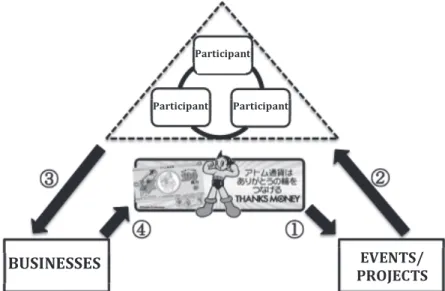
Therefore, the main strength of a DTS circulation system is that, in addition to exchanges between individual participants, there are commercial areas to spend the currency. The more places there are to spend the currency, the less it accumulates in one place. Thus, an indication of a well functioning DTS system is less accumulation in users hands, which results in smoother circulation. Fig.1 is a simplified representation of a DTS circulation system.
Certain CCs in Japan including the Toda Oar in Saitama prefecture (Kurita, Yoshida &Miyazaki, 2015, p.56) and Genki Tsuuka in Neyagawa City (Izumi & Nakazato, 2017, p.52) have moved from a single triangle system to a double triangle system in order to improve circulation of their respective currencies.
The CC organizations examined in this paper follow different circulation paths but both contain the same elements seen in the diagram. As such they meet the requirements of a DTS and consequently their circulation will be analyzed within this framework. The author has chosen to focus on this kind of circulation system because of its adoption by some modern CCs and its potential to increase the impact of a CC organization that adopts it.
3. METHODOLOGY
3.1 Dual Case study
In order to investigate whether the efficiency of a CC s DTS circulation system has an effect on the organization s longevity, a comparative design strategy in the form of a dual case study was employed. According to Bryman (2012, p.73), social phenomena are better understood when compared in relation to two or more meaningfully contrasting cases. For this reason two contrasting CC organizations, Earthday Money (EM) and Atom Currency (AC), were selected for examination. EM and AC contrast in their currency issuing mechanisms despite both organizations making use of a DTS circulation template. EM has a digital currency that is not exchangeable for Japanese yen and AC has a paper currency that is exchangeable for Japanese yen. Furthermore, the two organizations contrast in their access to resources and organizational sizes. A final important contrast is that after about 12 years of circulating, EM steadily declined and no longer circulates whereas AC still circulates and has expanded to six branches
Fig.1: Abridged version of a DTS circulation network.
nationally on the strength of their model. Within the last 8 years in Japan about half of newly created CCs have stopped operating after 3-4 years (Izumi & Nakazato, 2017, p.43). Both EM and AC have operated for more than 10 years, making them appropriate cases for the study of sustainable management in the field of CCs.
3.2 Methodology
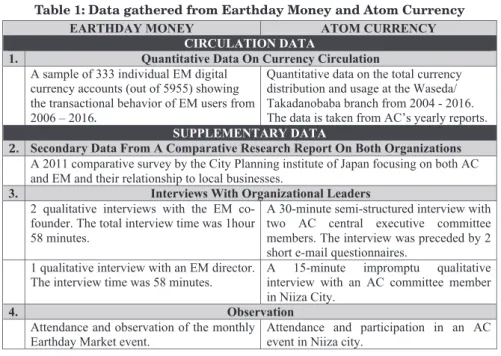
A lack of currency hoarding is a hallmark of a well functioning DTS system and indicates smooth circulation. With this is mind the methodology was divided into two phases. Firstly, the circulation performances of both CCs were examined to establish how smoothly they flowed. This was determined by the level of currency hoarding or accumulation visible in either of these two CC networks. In practical terms this meant determining what percentage of the currency earned by participants was actually spent and completed its circulation path. Quantitative circulation data gathered from both organizations was used to establish this. In the case of EM, this quantitative data was further supplemented by data gathered through interviews with organizational leaders and secondary data from a 2011 survey comparing the 2 organizations.
Once the efficiency of each organization s circulation was determined, the second phase involved establishing whether this efficiency had an effect on the overall longevity of each organization. The data gathered from each organization can be seen below in table 1.
4. RESEARCH SITES
The two organizations being studied are Earthday Money (EM), which is a CC that circulated in Shibuya in Tokyo, and Atom Currency (AC), which is a local currency that has 6 branches throughout Japan. A short summary of each organization is discussed below.
4.1 Earthday Money
Earthday Money was founded on October 23, 2001, as a specified nonprofit corporation to promote volunteering in Shibuya. Individuals who wished to take part in the EM system could sign up to volunteer for one of over 20 NPO projects listed on their website. Upon completing their participation, they received the currency, which could then be spent at one of around 150 participating businesses in Shibuya. The currency was equivalent to the Japanese yen in value (¥500 = 500r) but not exchangeable for Japanese yen. It was effectively used as a coupon or voucher. From December 2006 EM was mainly issued as a digital currency that could be transacted via cellular phones. EM s cofounder states that the currency is not active now due to problems with the digital currency s technological platform (EM co-founder, personal communication, March 26, 2016).
Table 1: Data gathered from Earthday Money and Atom Currency
EARTHDAY MONEY ATOM CURRENCY
CIRCULATION DATA
1. Quantitative Data On Currency Circulation
A sample of 333 individual EM digital currency accounts (out of 5955) showing the transactional behavior of EM users from 2006 – 2016
Quantitative data on the total currency distribution and usage at the Waseda/ Takadanobaba branch from 2004 - 2016. The data is taken from AC’s yearly reports.
SUPPLEMENTARY DATA
Secondary Data From A Comparative Research Report On Both Organizations
A 2011 comparative survey by the City Planning institute of Japan focusing on both AC and EM and their relationship to local businesses.
3. Interviews With Organizational Leaders
2 qualitative interviews with the EM co-founder. The total interview time was 1hour 58 minutes.
A 30-minute semi-structured interview with two AC central executive committee members. The interview was preceded by 2 short e-mail questionnaires.
1 qualitative interview with an EM director.
The interview time was 58 minutes. A interview with an AC committee member 15-minute impromptu qualitative in Niiza City.
4. Observation
Attendance and observation of the monthly Earthday Market event.
Attendance and participation in an AC event in Niiza city.
4.2 Atom Currency
AC was launched on 7th April 2004 in the districts of Waseda and Takadanobaba
in Tokyo. It is also a nonprofit organization founded with the purpose of engaging in activities that contribute to society (AC executive committee members, personal communication, May 22, 2017). It is run by a central executive committee, which serves as a central administration point for its 6 branches. The currency is denominated as Bariki (馬力 ) and is equivalent to Japanese yen in value (500 馬 力 = ¥500). Until 2008, AC only circulated in their Waseda/ Takadanobaba branch. In 2009 AC expanded nationally and according to it s website it currently has 6 branches around Japan. Atom Currency has two primary goals:
I. To promote volunteer and charity activities within the area. II. To base this community revitalization around local businesses
The focus of this paper is on sustainable management. For this reason the bulk of the analysis on AC will focus on the original branch in Waseda/Takadanobaba as it has been in operation since 2004.
5. CIRCULATION ANALYSIS
5.1 Earthday Money’s Circulation System 5.1.1 Earthday Money Circulation Summary
EM s DTS circulation pattern is depicted in Fig.2 and explained in the steps below. Earthday Money circulation followed the following pattern:
1. Participating NPOs request currency from the EM association to
distribute it to volunteers taking part in their projects. Until 2006 this was only done using paper currency. After 2006 paper currency issuance was largely discontinued in favor of digital currency.
2. Participants receive the currency for volunteering or taking part in an
activity. With the currency in their possession, they can now freely exchange it with other participants within the single triangle system.
3. EM participants use the currency as a coupon at local businesses.
Typically the usage limit is between 200r and 500r. A few stores accept up to 2000r.
4. Businesses can exchange the currency amongst themselves, use it at the
monthly Earthday Market or donate it to one of the participating NPOs to begin the cycle again.
5.1.2 Earthday Money Digital Account Data
Before analyzing the data from the 333 individual EM digital accounts, there are two factors that need to be considered.
The first factor is selection bias. The total population of 59552 accounts was
inaccessible. Consequently the accounts were randomly selected (every second account was chosen) from the comments section3 of the EM website. When an EM
participant transacts with the digital currency they can make a comment on the website. This comment provides a link to their account information, which can be downloaded. This means that high frequency users appear more often in the comments section and have a higher probability of being selected. This selection bias is taken into consideration when analyzing the account data.
The second factor is the division between paper and digital currency circulation. According to EM s cofounder, when EM introduced the digital currency in 2006, the paper currency was discontinued and only used at the monthly Earthday Market (EM co-founder, personal communication, January 24, 2017). EM s
Fig.2: Earthday Money’s DTS circulation system.
director also states that the paper currency was discontinued but adds that earlier issues of the paper currency continued circulating for several years (EM director, personal communication, June 9th, 2017). An observation visit to the monthly Earthday Market confirmed that a very small but unknown amount of the paper currency was still in circulation. The digital account data will only provide insight into the digital currency circulation, as there is no data available on the remaining paper currency circulating. However, the digital account data will be supplemented by data from the City Planning Institute of Japan and interview data with EM s cofounder. Together these three points of data will be used to examine the smoothness of EM s overall currency flow.
5.1.3 Analysis of EM Digital Account data
Each individual digital account shows how much currency a participant earned, how much they spent, how often they volunteered and how often they spent the currency. Consequently, Marimo-san s account pictured below in Fig. 3 shows the following four data points and their respective values
Fig.34: Example of an EM digital account
Source: Earthday Money homepage
● CURRENCY EARNED = 11,300r (equivalent to ¥11,300) ● CURRENCY SPENT = 2,000r (equivalent to ¥2000)
● NUMBER OF TIMES VOLUNTEERED = 23
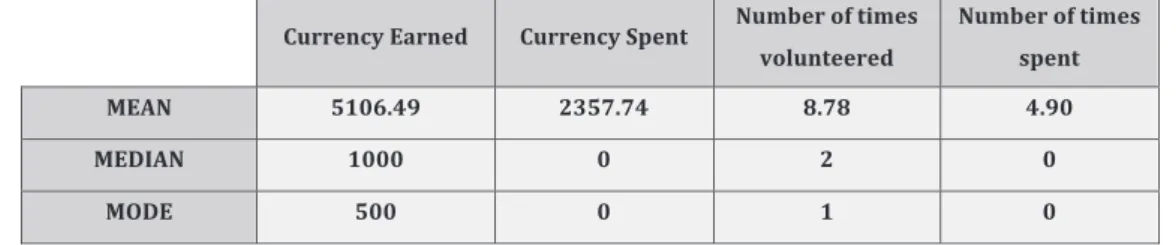
These four data points will be used to investigate the flow of EM s digital currency. Table 2 reveals the sample population s mean, median and mode values for these four data points. This table reveals that on average less than 50% of the digital currency earned by sample population users was spent. The median value shows an even greater difference between the currency earned and used. The median and mode values for the currency spent also indicate that a large number of users who earned the digital currency never spent it. In fact, 56% of the sample population (185 users) never used the currency that they earned. This suggests that a lot of digital currency accumulated unused in users accounts and that the digital currency circulation was not smooth.
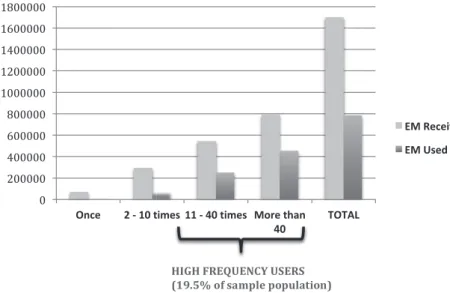
When users are divided by frequency of volunteering a clearer picture of transactional behavior emerges. The four frequency groups can be seen in table 3 below. The ratios between currency earned and currency spent for each of these frequency groups is shown in the graph (fig.4) below. The total currency earned in the sample population is 1,700,460r while the total currency spent is 785,126r. Thus, only 46% of the currency earned was spent.
From fig.4 we can surmise that high frequency volunteers (those volunteering more than 11 times), were more likely to use the digital currency. These high frequency volunteers were responsible for 78.5% (1,335,384r) of the currency earned and 90% (706,096r) of the currency spent. They represent 19.5% of the sample population and are most likely overrepresented here due to the previously mentioned selection bias. Therefore, it is highly probable that these frequent volunteers are far less than 19.5% of the total population of 5955. Because of this selection bias it is expected that far less than 46% of digital currency earned in the total population was actually spent and that the majority of the currency was left unused in user s accounts. Overall the account data suggests that EM s digital
Table 25: Average, Median and Mode values of the 333 accounts
currency system did not circulate smoothly
Table 3: Volunteer frequency table.
Source: Created by author from digital account sample data
Fig. 4: Ratio between EM digital currency earned and spent.
5.1.4 Interview and Survey Data
In addition to the digital account data, interview and survey data also point to currency accumulation in EM S circulation. The occurrence of currency hoarding at participating business was revealed in an interview with EM s cofounder. When asked about accumulation of the currency at participating businesses he responded that some storeowners informed him that they had accumulated too much currency (EM co-founder, personal communication, January 24, 2017). EM s co-founder also adds that this did not cause undue problems for the businesses but it does establish that currency hoarding was occurring at participating businesses.
A 2011 survey by the City Planning Institute of Japan also suggests that EM s currency was underspent at participating stores. In the survey 10 EM participating stores and 13 AC stores were questioned on how frequently the currencies were used in their stores. All 10 EM stores selected the lowest frequency of usage. This is a small sample of stores but again it implies that the currency was underspent. Thus, the digital account data, the interview data as well as the survey data all indicate that EM s circulation was not smooth due to accumulation in users accounts and at participating stores.
5.2 Atomu Currency’s Circulation 5.2.1 AC Circulation Summary
AC s DTS circulation pattern is depicted in Fig 6 below. If the currency completes
Fig 5: City Planning Institute of Japan’s survey question 5.
circulation it starts and ends to the local branch office, where it is exchanged for Japanese yen by storeowners. The circulation steps are described below.
1. After the AC central executive committee approves an event or project, the
currency is issued to event promoters or organizers by the branch committee. The event organizers bear the cost for the issued currency, which is paid to the local branch office. For example if an event requires 100,000 馬力 (Bariki) for distribution, the organizers pay ¥100,000 to the local executive office. Therefore, this step involves purchasing the currency with Japanese yen. The cost for the actual printing of the currency is borne by the Branch committee.
2. The event takes place and the currency is distributed to the participants
who can now freely exchange it amongst themselves.
3. Participants spend the currency at participating stores. There is no limit
on the amount of currency that can be spent at a participating store.
4. Storeowners can then exchange the currency they received for Japanese
Yen at the local executive office. This returns the currency to its place of origin and completes the circulation path. According to AC s 2016 report, on average 66% of distributed currency was spent at stores and returned to local executive offices across all branches (Atom Tsuuka Executive Committee, 2017).
Fig 6: AC circulation system - Adapted from AC’s published book
5.2.2 Income Factor Of AC’s Circulation
AC earns income from the exchange differential with Japanese yen. For this reason perfectly smooth circulation is generally not ideal for an AC branch. For example: If 100,000馬力 is issued to event organizers, they have to pay ¥100,000 to the branch office for the currency. The currency then circulates within the community and if only 50,000馬力 is returned to the branch office via store owners, the office only pays out ¥50,000 of the original ¥100,000 to the store owners. In this example the 50% redemption rate provides the AC branch a profit of ¥50, 000. This profit is necessary to cover branch expenses. According to a member of the Niiza City branch committee, the biggest expense that branches struggle to meet is the ¥200,000 - ¥300,000 licensing fee for the use of the Testuwan Atomu (Astroboy) character (AC Niiza Branch committee member, personal communication, November 13, 2016).
Finding the optimal redemption rate is a balancing act for an AC branch. According to AC s central executive committee vice chairman, the optimal redemption rate depends on how much currency is issued. He stated that for an issuance of 1,000,000 Bariki, a redemption rate of 70% is optimal (¥300,000 income). While for an issuance of 5,000,000馬力, a 90% redemption rate is even more optimal (¥500,000 income) (AC executive committee members, personal communication, March 22, 2017). This important balance between currency issuance and redemption percentage will be borne in mind during the analysis. Because the emphasis of this paper is on sustainable management, the circulation analysis will focus on AC s oldest branch (Waseda/Takadanobaba) which has been circulating since 2004.
5.2.3 AC Waseda/Takadanobaba Branch Circulation Analysis
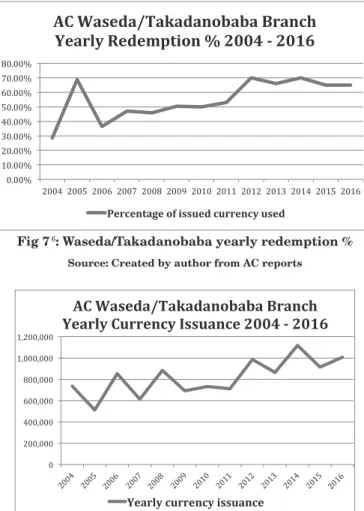
AC s circulation system is well organized with yearly internal audits and reports. Because of this annual reporting, there is complete data stretching back to the Waseda/Takadanobaba branch s first year of operation. As mentioned above, a good sign of a well functioning DTS system is less accumulation and smooth circulation. Due to AC s well-documented system there is a simple way to evaluate the smoothness of their circulation. Aside from the income differential, the higher the redemption percentage is, the smoother the circulation is. The redemption percentage is the exact percentage of currency that has moved through the whole system and included all possible stakeholders.
The two graphs below (Fig.7 & 8) show the Waseda/Takadanobaba branch s yearly currency issuance and redemption figures from 2004 to 2016. With the exception of a temporary spurt in in 2004, the redemption percentage shows a gradual sustained increase. The amount of currency issued follows a zigzag pattern but also shows a gradual sustained increase. These graphs demonstrate that the Waseda/Takadanobaba branch has thus far successfully balanced their income needs with their currency issuance. The gradual increase in both these variables is ideal for long run sustainability because as the currency issuance increases, the branch will be able to comfortably adjust to a higher redemption percentage without reducing their income. Taking into consideration the income needs of the branch, it can be said that it enjoys smooth circulation.
Fig 76: Waseda/Takadanobaba yearly redemption %
Source: Created by author from AC reports
Fig 87: Waseda/Takadanobaba yearly currency issuance
5.3 Circulation Efficiency And Longevity
As seen above EM s circulation appeared to be inefficient with accumulation of the currency in users accounts and participating business. In contrast AC s circulation was more efficient with less accumulation. The question now is in what way did the relative efficiencies of these currencies affect their longevity?
5.3.1 Earthday Money
It appears that EM s circulation had no direct effect on EM s longevity as the efficiency of the circulation made no difference to the procurement of resources that could contribute to the maintenance of the organization. Furthermore, both EM s cofounder and director were of the opinion that the failure of the digital currency platform was the chief reason for EM ceasing operations8. This failure
was directly related to a lack of the funding and resources necessary to overhaul the system and was in no way connected to the efficiency of EM s circulation. Thus EM s inefficient circulation most likely affected the impact of its currency but not its continuity.
5.3.2 Atom Currency
As seen above AC is exchangeable for Japanese yen, which allows an AC branch to receive income through the exchange differential. Because of the ability to gain monetary resources through circulation, the circulation efficiency of an AC branch is directly related to its income and consequently its longevity. Less efficient circulation means more income for the branch at the expense of excluding stakeholders from the circulation path and reducing the currency s social impact. By contrast, the more efficiently AC circulates, the less income the branch earns. Thus in AC s case, circulation efficiency, which affects social impact, can be negatively correlated with income, which affects longevity. A branch whose circulation is too smooth runs the risk of failing to cover its expenses and having to cease operations.
This failure to cover expenses occurred in 2016 at AC s Wako City branch. In 2016 the branch issued 1,475,610 Bariki (馬力 ) and had a 95% redemption rate. The previous year s redemption rate had been 90%. In the 2016 report the Wako City branch committee states that the high usage of the currency and the high redemption rate made it difficult to continue operating the branch (Atom Tsuuka Executive Committee 2017, p.17). The branch subsequently closed. Ultimately
this means that AC branches have to balance the need to cover branch expenses against the need to include and encourage the active participation of participating stores. The Takadanobaba/Waseda branch has navigated this balance successfully by slowly increasing the currency issued each year as the usage increases.
6. Conclusion
6.1 Implications of this research
The findings from AC s circulation analysis suggest that CCs that are exchangeable for the national currency have the capacity to earn income through a positive exchange differential. However, if the main source of income is the exchange differential it potentially places the income of the CC organization in conflict with spreading the circulation and impact of the currency. In this case it is therefore recommended that the CC organization in question should aim to procure a means of primary funding aside from the exchange differential. In this way efficient circulation, which should be a positive outcome, will not negatively impact the longevity of the organization as it did with the AC Wako City branch. On the other hand CCs that are not exchangeable for the national currency, while perhaps lacking a potential stream of income, will never face the dilemma of placing potential income at odds with potential social impact.
6.2 This Study’s Limitations
6.2.1 Incomplete Earthday Money Data
Unlike AC, EM does not have a published book or yearly reports and by the time this study took place it had been in decline for a number of years. For this reason there is no data on EM s paper currency circulation, which was the only means of currency issuance prior to 2006. Therefore it appears that any interpretations regarding the circulation of EM are only valid after 2006 and any overall conclusions on EM s paper and digital circulation will be imperfect.
6.2.2 Limitations Of Case Study Research
The chief limitation of any case study research is the inability to generalize the results. This paper is no exception. It is therefore recommended that a broader comparative study involving a larger set of CC organizations take place, in order to further clarify the relationship between currency circulation and the longevity of CC organizations
Notes
1 Social relationships such as trust, norms and networks that facilitate cooperation among
members of a community. (Nishide, 2009, p.1)
2 http://earthdaymoney.org/ - Earthday Money Homepage.
3 http://earthdaymoney.heteml.jp/earthdaymoney.org/people/ - Earthday Money comments
section.
4 http://www.earthdaymoney.org/people/details.php?id=00016561 5 http://www.earthdaymoney.org/people/index.php
6 http://atom-community.jp/about/byelaw-report.html - Atomu Tsuuka yearly reports. 7 http://atom-community.jp/about/byelaw-report.html - Atomu Tsuuka yearly reports. 8 EM co-founder, personal communication, January 24, 2017
EM director, personal communication, June 9th, 2017
References
Atom Currency Executive Committee. (2015). Community Design using Atomu Currency: A future where people are connected to their town. Shinjuku: Shinhyoron (Japanese)
Atom Tsuuka Executive Committee. (2017). Atom Tsuuka Business Report for 2016 (13th term). Retrieved from Http: //atom-community.jp/about/byelaw-report.html (Japanese)
Bryman, A. (2012). Social research methods. New York: Oxford University Press.
Calvo, S., & Morales, A. (2014). Exploring complementary currencies in Europe: a comparative study of local initiatives in Spain and the United Kingdom. Retrieved from Living in Minca http://www.livingin minca.org/wpcontent/ uploads/ 2015/03/Complementary_Currencies.Pdf Hayashi, M. (2012). Japan s Fureai Kippu Time-banking in Elderly Care: Origins, Development,
Challenges and Impact International Journal of Community Currency Research 16 (A) 30-44 Retrieved from https://ijccr.net/?s=fureai
Izumi, R., Nakazato, H. (2013). The Reach and Impact of People's Network by Community Currency Experiment : A Case Study of the Peanuts in Chiba Senshuu University Economic bulletin 47, No. 3, 1- 16 Retrieved from https://ci.nii.ac.jp/naid/40019750236/ (Japanese) Izumi, R., Nakazoto, H. (2017). The Current State of Japanese Community Currency Activities
Based on the 2016 Survey. Senshuu University Economic bulletin, 52(2), 39-53.(Japanese) Kichiji, N., & Nishibe, M. (2008). Network Analyses of the Circulation Flow of Community
Currency. Evolutionary and Institutional Economics Review, 4(2), 267-300. doi:10.14441/ eier.4.267
Kobayashi, S., Miyazaki, Y., & Yoshida, M. (2017, 10-14 May). Historical transition of community currencies in Japan. Paper presented at the IV International Conference on Social and Complementary Currencies, Barcelona, Spain, 2017. Retrieved from https://www. researchgate.net/publication/316882220_Historical_transition_of_community_currencies_ in_Japan
Kudo, A., & Murota, M. (2011). A study on actual conditions and future issues about utilization of community currencies and retail shops. Reports of the City Planning Institute of Japan, 9, 127-130. Retrieved from http://www.cpij.or.jp/com/ac/reports/9-4_127.pdf (Japanese)
Kurita, K., Miyazaki, Y. and Nishibe, M. (2012) CC Coupon Circulation and Shopkeepers Behaviour: A Case Study of the City of Musashino, Tokyo, Japan. International Journal of Community Currency Research 16 (D) 136-145. Retrieved from https://ijccr.net/2012/07/08/ cc-coupon-circulation-and-shopkeepers-behaviour-a-case-study-of-the-city-of-musashino-tokyo-japan/
by community currency? Influence of perceptions of reward on motivation. International Journal of Community Currency Research 19 (D) 53-61. Retrieved from https://ijccr. net/2015/03/08/what-kinds-of-volunteers-become-more-motivated-by-community-currency-%E2%80%A8influence-of-perceptions-of-reward-on-motivation-2/
Lietaer, B. (2001) The Future of Money: Creating new wealth, work and a wiser world. London: The Random House Group Limited
Lietaer, B. (2004) Complementary Currencies in Japan Today: History, Originality and Relevance International Journal of Community Currency Research. Vol.8, pp.1-23. Retrieved from https://www.natcapsolutions.org/LASER/LASER_Japanese-Complementary-Currencies.pdf
Lietaer, B. A., & Dunne, J. (2013). Rethinking money: how new currencies turn scarcity into prosperity. Oakland CA: Berrett-Koehler
Longhurst, N. Seyfang, G. (2012). Money, Money, Money? A Scoping Study of Grassroots Complementary Currencies for Sustainability. 3S Working Paper 2012-02. Retrieved from Norwich: Science, Society and Sustainability Research Group. https://grassrootsinnovations. files.wordpress.com/2012/05/seyfang-and-longhurst-2012-money-money-money.pdf
Nakazato, H. and Hiramoto, T. (2012). An Empirical Study of the Social Effects of Community Currencies International Journal of Community Currency Research.16 (D) 124-135. Retrieved from https://ijccr.net/2012/07/08/an-empirical-study-of-the-social-effects-of-community-currencies/
Nishide, Y. (2009). Social Capital and Civil Society in Japan. Sendai: Tohoku University Press Richey, S. (2007). Manufacturing Trust: Community Currencies and the creation of Social
Capital Political Behavior. Vol.29, Issue 1, pp.69-88. Retrieved from https://www. researchgate.net/publication /225681378_Manufacturing_Trust_Community_Currencies_ and_the_Creation_of_Social_Capital
Studer, M. (2016, January 05). Bringing People Together Through Money? Community Currency and Local Exchanges. Retrieved from http://www.huffingtonpost.com/ pro-journo/bringing-people-together_b_8916374.html
Wheatley, G., Younie, C., Alajlan, H. and McFarlane, E. (2011) Calgary Dollars: Economic and Social Capital Benefits International Journal of Community Currency Research 15 (A) 84-89. Retrieved from https: //ijccr.net/2012/05/29/calgary-dollars-economic-and-social-capital-benefits/
Personal Interviews
AC executive committee members. (2017, March 22) Personal interview EM co-founder. (2016, March 26) Personal interview
EM co-founder. (2017, January 24) Personal interview
AC Niiza Branch committee member. (2016, November 13) Personal interview EM director, (2017, June 8). Personal interview. Conducted via Skype